
Trailer tracking benefits for logistics fleets in 2026
Trailer tracking is defined as the use of GPS, sensor technology, and telematics hardware to monitor the real-time location, condition, and utilisation of trailers across a logistics fleet. The trailer tracking benefits for logistics are measurable and well-documented: 80% of fleets now use GPS tracking, with 44% reporting improved productivity and 53% improved equipment utilisation. That adoption rate reflects a clear industry consensus. For UK logistics managers and fleet operators, the case is no longer whether to track trailers, but how to extract the full value from doing so.
1. Trailer tracking benefits for logistics: operational efficiency gains
Real-time trailer location data directly reduces detention time, the single largest hidden cost in logistics operations. Visibility initiatives eliminate 35 to 45% of detention time and deliver labour productivity gains of 20 to 25% by automating arrival and unloading insights. That is not a marginal improvement. For a fleet running 50 or more trailers, it represents tens of thousands of pounds recovered annually from time previously lost at loading docks.

The efficiency gains extend beyond detention. When dispatch teams have live trailer locations, they can reassign assets mid-route, consolidate partial loads, and reduce deadhead mileage. Idle trailers sitting in a yard or at a customer site become visible and actionable rather than invisible and forgotten.
Key operational improvements delivered by trailer tracking:
- Reduced detention time through automated dwell-time alerts sent directly to dispatch
- Improved trailer utilisation by identifying idle assets and reallocating them faster
- Optimised routing using live location data to adjust collections and deliveries in real time
- Faster load consolidation by matching available trailers to nearby freight opportunities
- Reduced deadhead mileage through better visibility of empty trailer positions across the network
Pro Tip: Integrate trailer location data directly into your transport management system rather than monitoring it on a separate screen. When location feeds into dispatch and billing automatically, your team acts on data rather than chasing it.
2. How trailer tracking enhances fleet security and cargo theft prevention
Trailer tracking is one of the most effective tools available for cargo theft prevention, and the data is unambiguous. Tracked assets cut theft losses by 76% and reduce insurance premiums by 31%, according to a Samsara survey. Those figures reflect a fundamental shift in how fleets treat trailers: not as passive assets, but as active participants in their own security.
The technology behind this protection is layered. Modern systems combine GPS location with door-open sensors, driver validation, geofencing alerts, and in some cases, cab-facing cameras. Each layer adds a detection point that makes unauthorised access harder to conceal and easier to respond to.
The first 15 minutes after a theft incident are the most critical window for cargo recovery. Rapid incident alerting within this window significantly increases recovery chances and reduces total losses. A system that notifies your operations centre the moment a trailer door opens outside a geofenced zone is not a luxury. It is a recovery mechanism.
Security features that deliver the greatest protection include:
- GPS geofencing that triggers alerts when a trailer moves outside an authorised area
- Door-open sensors that detect unauthorised access in real time
- Driver validation to confirm the correct operator is coupling the trailer
- Tamper alerts for power disconnection or GPS jamming attempts
- Insurance documentation supported by timestamped location and event logs
Pro Tip: Choose an integrated trailer security system rather than a standalone GPS tracker. A tracker tells you where the trailer is. An integrated system tells you what is happening to it, and when.
3. What cost savings and ROI can logistics operators expect?
The financial case for trailer tracking is built on reductions across multiple cost categories simultaneously. Asset tracking delivers average decreases of 12% in fuel and labour costs, 15% in maintenance costs, and 19% in accident costs. These are not projections. They are averages drawn from fleets that have already deployed the technology.
A phased rollout on 300 trailers, documented by Phillips Connect, reduced fuel consumption by 11%, temperature-related claims by 37%, and detention hours by 24% within six months. That timeline matters. Many fleet operators expect technology investments to take years to pay back. Trailer tracking consistently delivers ROI within one year of adoption for the majority of adopters.
| Cost category | Typical saving |
|---|---|
| Fuel and labour costs | Up to 12% reduction |
| Maintenance costs | Around 15% reduction |
| Accident-related costs | Up to 19% reduction |
| Insurance premiums | Up to 31% reduction |
| Temperature-related cargo claims | Up to 37% reduction |
Pro Tip: When building your business case internally, calculate detention costs first. Detention is the easiest saving to quantify because it maps directly to driver hours and customer penalty clauses. Use that figure as your anchor number.
4. Which sensor technologies deliver the greatest advantages?
Modern trailer tracking goes well beyond a GPS unit bolted to a chassis. Sensor suites now include GPS, door sensors, temperature and humidity probes, tyre pressure monitors, and load sensors, all feeding data into cloud analytics platforms for real-time decision-making. Each sensor type addresses a specific operational or financial risk.
Temperature and humidity probes are particularly valuable for refrigerated and pharmaceutical logistics, where a single out-of-range event can invalidate an entire load. Door sensors protect against both theft and accidental transit damage. Tyre pressure monitoring reduces blowout risk and extends tyre life, which is a meaningful maintenance saving across a large trailer fleet.
The connectivity layer matters as much as the sensors themselves. Cellular connectivity works well for UK and European road networks, while satellite connectivity provides coverage for remote or cross-border routes where mobile signal is unreliable. Cloud and edge computing then process the incoming data, enabling automated alerts and workflow triggers without requiring manual monitoring.
| Sensor type | Primary benefit |
|---|---|
| GPS with geofencing | Real-time location and detention management |
| Door-open sensors | Theft detection and cargo security |
| Temperature and humidity probes | Cold chain compliance and claims reduction |
| Tyre pressure monitors | Predictive maintenance and blowout prevention |
| Load sensors | Utilisation tracking and overload prevention |
A phased rollout approach starting with GPS and door sensors, then adding condition monitoring in a second phase, allows fleets to prove ROI quickly before committing to full sensor integration across every asset.
5. How trailer tracking improves OTIF delivery performance
On-time, in-full delivery rates are a direct measure of logistics reliability, and trailer tracking has a quantifiable impact on them. Predictive ETAs and integrated dock scheduling can reduce detention by 55 to 70% and improve OTIF rates from 85 to 90% up to 95 to 98%. For logistics operators managing contracts with major retailers or manufacturers, that improvement is the difference between retaining a contract and losing it.
The mechanism is straightforward. When a trailer’s location and estimated arrival time feed automatically into a customer’s dock scheduling system, loading bays are ready when the vehicle arrives. Delays caused by dock unavailability, which are a significant proportion of total detention time, are eliminated. The trailer moves through the site faster, and the driver returns to the network sooner.
Real-time tracking for logistics also improves exception management. When a trailer is delayed due to traffic, a breakdown, or a border crossing, the operations team knows immediately and can communicate proactively with the customer. That transparency builds confidence and reduces the administrative burden of reactive customer service calls.
6. Enhancing fleet visibility through depot and yard management
Trailer tracking does not stop at the road network. Container and trailer fleet visibility across depots is one of the most underdeveloped areas of logistics management, and it is where significant utilisation gains remain uncaptured. Trailers sitting in a yard for days without movement are a direct cost: they occupy space, they are unavailable for revenue-generating work, and they often go unnoticed until a driver needs one and cannot find it.
Yard management integration allows fleet operators to see every trailer’s status, location within the depot, and last movement timestamp from a single dashboard. This visibility supports faster trailer turnaround, more accurate maintenance scheduling, and better planning for peak demand periods. Digitising depot yard management reduces the time spent physically searching for assets and eliminates the manual yard checks that consume driver and shunter time.
For UK operators managing multiple depots, centralised visibility across sites is particularly valuable. A trailer that is idle at one depot may be urgently needed at another. Without real-time data, that mismatch is invisible. With it, reallocation takes minutes rather than hours.
7. Integrating trailer tracking data into existing workflows
Trailer telematics fail without integration into operational workflows, according to OpenTrack’s analysis of scaling challenges. This is the most common reason fleets underperform against their expected ROI. The data exists, but it sits in a separate system that dispatch teams do not consult during their working day.
Effective integration means trailer location and status data flows directly into your transport management system, your billing platform, and your customer communication tools. Arrival timestamps trigger invoice generation automatically. Dwell-time alerts go to the dispatcher responsible for that lane, not to a generic inbox. Maintenance alerts create work orders in your workshop management system without manual input.
The KPIs worth tracking once integration is in place include:
- Detention hours per lane to identify chronic delay points with specific customers or routes
- Trailer utilisation rate measured as the percentage of trailers in active use versus sitting idle
- Fuel consumption per tonne-kilometre to track efficiency improvements over time
- Maintenance event frequency to validate the impact of predictive alerts on unplanned downtime
- OTIF delivery rate as the headline commercial performance metric
Pro Tip: Before selecting a trailer tracking platform, confirm that it offers an open API or pre-built connectors for your existing TMS. A system that cannot share data with your operational tools will always be a reporting tool rather than a management tool.
Key takeaways
Trailer tracking delivers measurable gains in efficiency, security, and cost control when the data is integrated directly into operational workflows rather than monitored in isolation.
| Point | Details |
|---|---|
| Efficiency gains are immediate | Visibility initiatives eliminate 35 to 45% of detention time within months of deployment. |
| Security impact is substantial | Tracked assets reduce theft losses by 76% and cut insurance premiums by 31%. |
| ROI arrives within the year | Most fleets recover their investment within 12 months through fuel, maintenance, and accident cost reductions. |
| Sensor variety drives deeper value | GPS alone is a starting point; door, temperature, and tyre sensors unlock condition monitoring and compliance benefits. |
| Integration determines success | Trailer data fed into TMS and dispatch workflows converts visibility into operational decisions. |
The real barrier to trailer tracking value is not the technology
I have spoken with enough UK fleet operators to know that the technology itself is rarely the obstacle. The GPS units work. The sensors are reliable. The data arrives in real time. What consistently holds fleets back is the gap between data collection and operational action.
The most common pattern I see is a fleet that installs trailer trackers, generates a dashboard full of location pins and dwell-time figures, and then continues to run dispatch the same way it always has. The data exists in one window. The dispatcher works in another. Nothing changes, and six months later someone asks why the ROI has not materialised.
The fleets that extract genuine value from trailer tracking are the ones that treat it as an operational change programme, not a technology purchase. They map their existing workflows first, identify where location and status data would change a decision, and then configure the system to deliver that data at the right moment to the right person. That is a harder conversation to have internally than signing a hardware contract, but it is the one that determines whether the investment pays back.
My practical advice: start with one lane or one customer relationship where detention is a known problem. Measure the baseline. Deploy tracking. Measure again after 90 days. That single data point, presented to your operations director with a pound figure attached, will do more to drive wider adoption than any vendor presentation.
— Vytautas
How Fleetalyse supports trailer tracking for UK logistics operators
Fleetalyse provides UK logistics operators with trailer GPS trackers designed for straightforward deployment across HGV fleets, mixed assets, and standalone trailers. The platform combines real-time location data with driver behaviour monitoring, tachograph compliance, and maintenance scheduling in a single telematics environment built specifically for UK transport regulations.
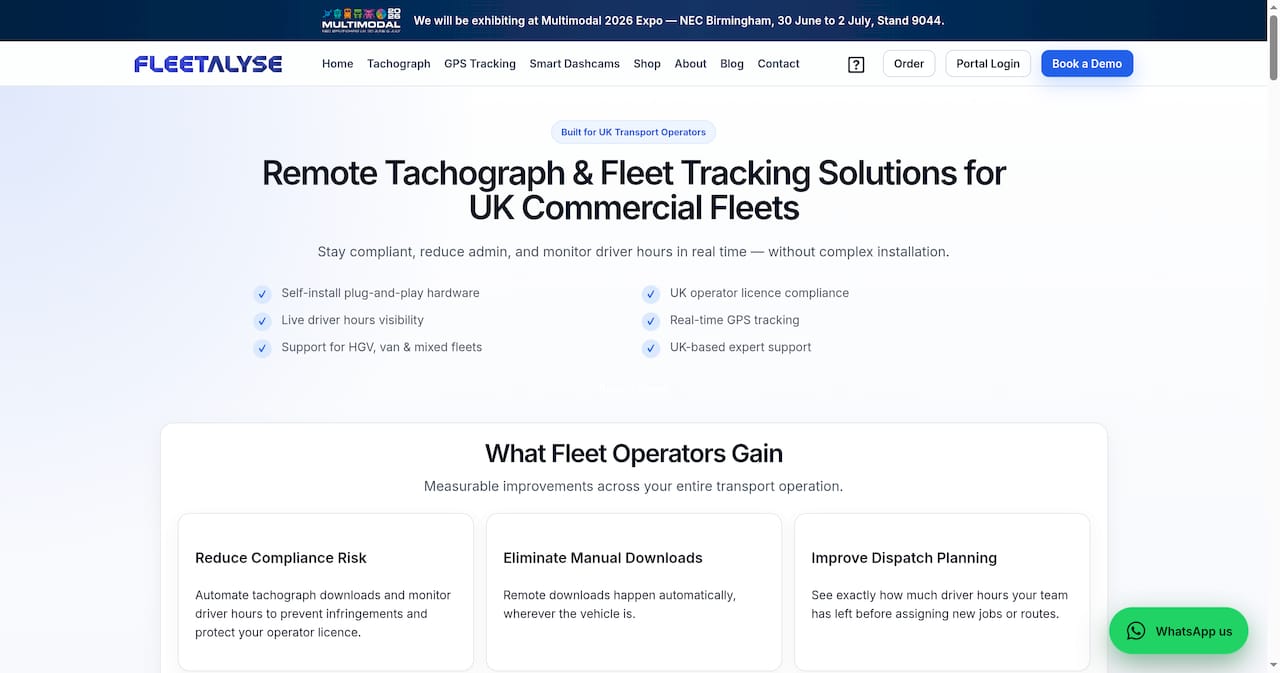
If you are evaluating logistics tracking solutions and want to see how Fleetalyse integrates trailer visibility with DVSA compliance and fleet data analysis, the Fleetalyse solutions page covers the full platform in detail. UK-based support is available for setup, configuration, and troubleshooting, so you are not left managing implementation alone.
FAQ
What are the main trailer tracking benefits for logistics fleets?
Trailer tracking delivers real-time location visibility, reduced detention time, improved asset utilisation, cargo theft prevention, and lower fuel and maintenance costs. Most fleets see measurable ROI within 12 months of deployment.
How much can trailer tracking reduce cargo theft losses?
Tracked assets cut theft losses by 76% and reduce insurance premiums by 31%, with the first 15 minutes after an incident being the critical window for recovery.
Does trailer tracking integrate with transport management systems?
Yes, and integration is critical to unlocking full value. Trailer location and status data should feed directly into your TMS, dispatch, and billing workflows to convert visibility into operational decisions rather than passive reporting.
How quickly does trailer tracking pay for itself?
The majority of fleet operators recover their investment within one year. A phased rollout on 300 trailers demonstrated reductions of 11% in fuel consumption and 24% in detention hours within six months.
Which trailer sensors deliver the greatest operational benefit?
GPS with geofencing provides the foundation. Door-open sensors add security, temperature probes protect cold chain cargo, and tyre pressure monitors reduce unplanned maintenance. Deploying them in phases allows fleets to prove ROI at each stage before expanding.