

Before You Switch On GPS: UK Fleet Checklist for Vehicle Tracking Laws

Vehicle tracking is legal for UK employers, but only when it’s transparent, proportionate, and properly documented. Before switching anything on, you need to tell drivers in writing, choose and record a lawful basis (usually a Legitimate Interest Assessment), and run a Data Protection Impact Assessment if the monitoring is high risk. Skip these steps and the Information Commissioner’s Office has the power to fine your business and force you to unwind the whole system.
TL;DR:
- Employers must clearly notify drivers in writing about the data collected, purpose, retention, and access before starting vehicle tracking.
- A Legitimate Interest Assessment is the preferred lawful basis, especially when employment relationships create a power imbalance that compromises consent.
- A Data Protection Impact Assessment is required for systematic, high-risk, or continuous audio/video monitoring, and should be periodically revisited with system changes.
- Tracking data, including location and driver behaviour, is personal data and should be retained for 12-24 months depending on its use, with proper deletion schedules.
- Covert tracking is subject to strict legal standards, requiring genuine necessity and often RIPA approval for public authorities, with overt methods preferred to minimize legal risk.
Table of Contents
- Vehicle tracking laws UK employers need to know
- Choosing a lawful basis and telling drivers what’s happening
- When you need a DPIA and how to manage the risk
- What counts as personal data, and how long you should keep it
- Separating work time from personal time
- Covert tracking and the higher bar for public bodies
- Building a vehicle tracking policy that holds up
- What happens if you get it wrong
- Where Fleetalyse’s features fit into the compliance picture
- Legal cases shaping how tracking is judged today
- Using tracking data in disciplinary or legal proceedings
- An editor’s take on getting this right
- Getting compliant tracking up and running
- Where to check the details yourself
- Sources
Vehicle tracking laws UK employers need to know
UK GDPR and the Data Protection Act 2018 sit at the centre of every vehicle tracking decision, because location data tied to a named driver or a recognisable vehicle counts as personal data. That means the standard data protection principles apply in full: you need a lawful basis, a clear purpose, and proportionate handling from the moment the tracker starts logging.
The Human Rights Act 1998 matters too, specifically Article 8’s right to private life, which is why courts and the ICO both expect employers to justify monitoring rather than assume it’s automatically fine. For most private businesses, that justification comes through a Legitimate Interest Assessment rather than covert surveillance law. The Regulation of Investigatory Powers Act 2000 (RIPA) only becomes relevant when a public authority, such as a council or police force, wants to conduct covert surveillance, or when a private investigator is instructed to track a vehicle without the driver’s knowledge.
For the exact wording of these obligations, go to the primary sources rather than secondary summaries. The core GDPR text on legislation.gov.uk sets out the underlying principles, and the ICO publishes detailed operational guidance for organisations running any form of vehicle or in‑cab surveillance.
Choosing a lawful basis and telling drivers what’s happening
Most employers rely on legitimate interest as their lawful basis for fleet tracking, rather than consent. That distinction matters because employment relationships carry an inherent power imbalance: a driver who feels pressured to “consent” to tracking to keep their job hasn’t given free consent at all, which makes legitimate interest, backed by a documented LIA, the more defensible route.
Whichever basis you choose, drivers need clear written notice before tracking starts, not a verbal mention in a team meeting. Your notification should cover:
- What data is collected (location, speed, journey times, idling, harsh braking)
- Why you’re collecting it (safety, routing, compliance, insurance)
- How long you’ll keep it and who can access it
- Whether private-time tracking is switched off, and how
- How drivers can exercise their data protection rights
Document the decision itself, not just the policy. Consulting staff or union representatives before rollout, even informally, strengthens your position if a driver later challenges the monitoring.
When you need a DPIA and how to manage the risk
A DPIA becomes mandatory when tracking is systematic, covers a large number of drivers, or includes higher-risk elements like continuous in-cab audio or video, which the ICO’s guidance on vehicle surveillance treats with particular caution.
A workable DPIA checklist covers:
- Scope: which vehicles, drivers, and data types are involved
- Necessity: why less intrusive options won’t achieve the same purpose
- Risk identification: what could go wrong for drivers if data is misused
- Mitigations: access controls, encryption, retention limits, and privacy modes
Pro Tip: Treat the DPIA as a living document, not a one-off form. Revisit it whenever you add dashcams, extend tracking to new vehicle types, or change your retention period.
What counts as personal data, and how long you should keep it
Location, speed, journey times, idling duration, and driving events (harsh braking, sharp cornering) all count as personal data once linked to an identifiable driver. Continuous audio recording and always-on in-cab video carry noticeably higher risk, because they capture far more than an employer needs for safety or routing.
Retention should match purpose, not convenience:
- Routine journey logs: commonly retained for 12 to 24 months before deletion
- Incident-related footage or data: kept longer, but only with a documented reason (insurance claim, legal proceedings, disciplinary case)
- Everything else: deleted on a fixed schedule, not left indefinitely “just in case”
Drivers have the right to request their own tracking data through a subject access request, and you must respond within the standard statutory timeframe, treating the request the same way you’d treat any other personal data request.
Separating work time from personal time
Tracking a driver around the clock, including evenings, weekends, and personal errands in a company vehicle, is one of the fastest ways to turn a defensible monitoring policy into an indefensible one. If the vehicle is ever used privately, drivers need a genuine way to switch tracking off or reduce it during that time.
Three practical approaches work well together:
- Schedule-based tracking that automatically pauses outside rostered hours
- A manual switch or app toggle drivers control for private journeys
- Geofencing that suppresses detailed location logging around a driver’s home address
Whichever method you choose, write it into policy and train drivers on exactly how to use it, so nobody is left guessing whether they’re being watched on a Sunday afternoon.
Covert tracking and the higher bar for public bodies
Covert tracking, monitoring a vehicle without the driver’s knowledge, faces a far stricter test than routine fleet tracking. It has to be genuinely necessary and proportionate to a specific, serious concern (suspected fraud or theft, for instance), not a convenient way to avoid an awkward conversation.
Public authorities face an extra layer of constraint: councils, NHS trusts, and police forces conducting covert surveillance generally need RIPA authorisation before they act. Private investigators instructed to track a vehicle covertly face similarly elevated scrutiny and need a clear, documented lawful basis for every case they take on, a point the SIASS legal overview sets out in detail.
If you’re tempted by covert tracking, get legal advice first. In almost every case, an overt system with clear notification achieves the same operational goal without the legal exposure.
Building a vehicle tracking policy that holds up
A written policy is what turns good intentions into something you can defend if the ICO or an employment tribunal ever asks questions. It should set out:
- The purpose of tracking and the lawful basis you’ve chosen
- A summary of your DPIA findings, where one applies
- Exactly what data you collect and for how long
- Who can access the data, and under what circumstances
- How privacy mode works and when it applies
- Your process for handling subject access requests
- What happens if there’s a data breach
Rolling it out properly means:
- Consulting staff before launch and gathering signed acknowledgement of the policy
- Training drivers on the technology and their rights
- Reviewing processor agreements with any third-party tracking provider
Name a data controller internally, and set a review cycle, annually at minimum, so the policy doesn’t quietly go stale while your fleet and technology change around it.
What happens if you get it wrong
Serious breaches under UK GDPR can result in fines of up to £17.5 million or 4% of global annual turnover, whichever is higher, and separate penalties apply if you fail to report a qualifying breach within 72 hours.
Beyond the fine itself, the ICO’s usual response pattern involves investigation, remedial notices requiring specific changes, and public enforcement action that damages reputation with clients and drivers alike.
If a breach happens, move fast:
- Contain the exposure and assess what data was affected
- Notify the ICO within 72 hours if the breach meets the reporting threshold
- Tell affected drivers if the breach poses a real risk to them
- Record what happened and what you changed afterwards
Where Fleetalyse’s features fit into the compliance picture
Several practical features reduce the day-to-day burden of staying compliant, without replacing the legal groundwork above.
- Remote tachograph downloads cut the manual admin around driver-hours evidence, which strengthens your legitimate-interest case for fleets already subject to Operator Licence and DVSA rules
- Automated driver-hours monitoring creates a consistent audit trail, useful if a DPIA or an ICO enquiry ever asks how decisions were made
- Role-based access controls limit who inside your business can see raw tracking data, supporting the access-control commitments you’ll have written into policy
- Scheduled data deletion helps enforce the retention windows you’ve set, rather than relying on someone remembering to clear old logs
None of this replaces the notification, LIA, or DPIA work covered earlier. It simply makes the ongoing obligations easier to keep up with once the policy is in place. For a walkthrough of the regulatory side specifically, Fleetalyse’s guide to GPS tracking on vehicles covers proportionality and notification requirements in more depth.
Legal cases shaping how tracking is judged today
UK case law on vehicle tracking specifically is thin, which is precisely why employers lean so heavily on ICO guidance and broader data protection and employment tribunal precedent. Tribunals assessing whether monitoring was fair have consistently asked the same underlying questions: was the employee told, was the monitoring proportionate to the stated purpose, and was less intrusive tracking available?
Cases involving covert workplace surveillance more broadly, including camera and computer monitoring, have shaped the reasoning the ICO and tribunals now apply to vehicle tracking by extension. The consistent theme is that covert methods face far heavier scrutiny than open, notified tracking, and employers who can show a documented decision-making process (an LIA, a DPIA, a written policy) tend to fare considerably better than those relying on informal justifications after the fact.
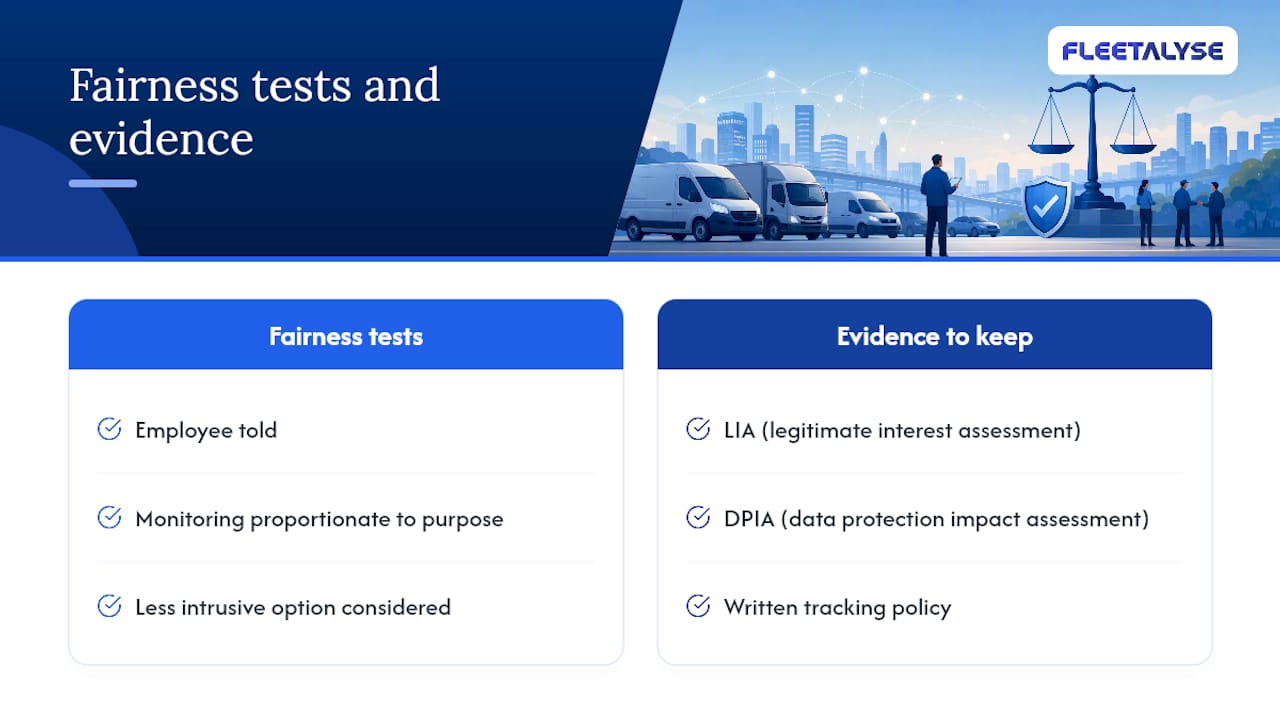
The direction of travel in enforcement has also hardened. Regulators increasingly expect organisations to demonstrate the necessity and proportionality tests were actively applied, not just assumed. That’s a meaningful shift from treating data protection as a paperwork exercise to treating it as a live decision that needs revisiting whenever tracking scope changes, whether that’s adding dashcams, extending coverage to personal-use vehicles, or introducing new behavioural scoring features.
For employers, the practical lesson is straightforward: keep the evidence of your reasoning, not just the policy document itself.
Using tracking data in disciplinary or legal proceedings
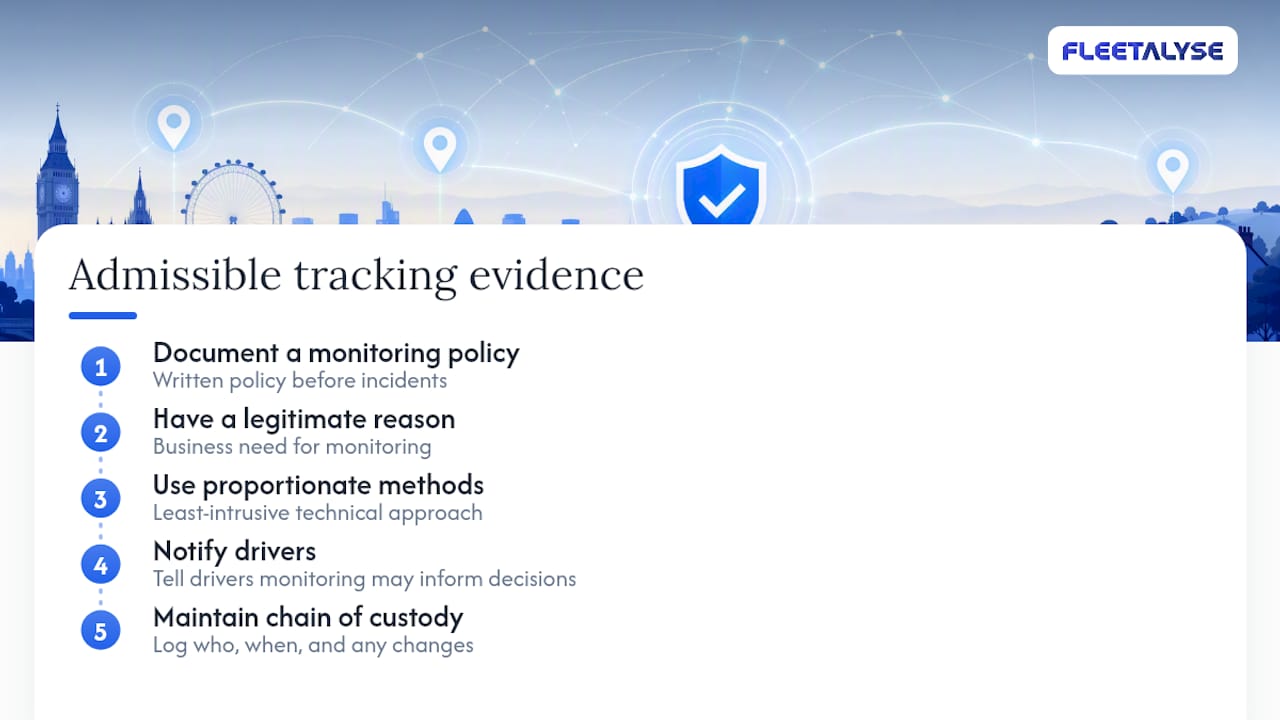
Tracking data can be used in disciplinary proceedings, but only if it was collected lawfully in the first place and the driver was told monitoring might inform performance or conduct decisions. Data gathered covertly, or without proper notification, is far more likely to be challenged successfully by the employee, even if it clearly shows a genuine problem.
Employment tribunals generally weigh three things when tracking data is presented as evidence: whether the employer had a legitimate reason to monitor, whether the method used was proportionate to that reason, and whether the employee had been told monitoring could happen. Data used to support a dismissal for speeding, route deviation, or unauthorised vehicle use tends to hold up far better when it sits inside a documented, notified monitoring policy than when it’s introduced as an afterthought.
The same principle applies to civil claims, insurance disputes, and criminal investigations involving company vehicles. Courts and insurers are generally willing to accept tracking evidence, but the chain of custody matters: who accessed the data, when, and whether it was altered. That’s another reason access controls and audit logging aren’t just internal best practice, they’re what makes the evidence usable if you ever need it.
If you’re planning to rely on tracking data for a disciplinary case, get the policy and notification right before you need the evidence, not after.
An editor’s take on getting this right
The businesses that struggle here aren’t the ones ignoring the law. They’re the ones treating notification as a formality rather than the actual foundation of lawful tracking. Get transparency right, run a DPIA where the risk warrants it, and give drivers a genuine privacy option, and most of the legal exposure disappears. The driver acceptance guide is worth reading before rollout, not after complaints start.
— Vytautas
Getting compliant tracking up and running
Fleetalyse gives you a way to run driver behaviour monitoring and GPS tracking with the audit trail already built in, rather than bolting compliance documentation on afterwards. Automated driver-hours reporting, role-based access, and scheduled data deletion mean the technical safeguards your DPIA calls for are already part of the system, not a separate project.
The driver behaviour monitoring product page covers exactly what data gets captured and how access is controlled, which is worth reviewing alongside your own policy draft. If you’re setting up hardware from scratch, the unlocked GPS trackers are UK-available Teltonika devices with no SIM lock-in. UK-based support is available if you want help getting the setup right the first time, book a demo to see how it fits your fleet before you commit to anything.
Where to check the details yourself
For the exact legal wording, go directly to the core GDPR provisions on legislation.gov.uk and the ICO’s surveillance in vehicles guidance, which covers DPIA expectations in full. For covert surveillance and RIPA specifics, the SIASS legal overview is a clear independent reference, and the RAC’s practical fleet guidance covers day-to-day implementation questions well.
Sources
- Surveillance in vehicles — ICO
- Vehicle tracking and covert surveillance – UK legal overview (2026 edition) — SIASS