

Fleet leasing vs buying: the UK operator’s guide

Around 80% of mid-to-large fleets lease their vehicles rather than own them outright. This single figure tells you something important about where the industry has landed on the question of fleet leasing vs buying. Leasing converts a capital purchase into predictable monthly operating expenditure, preserving your borrowing capacity and keeping vehicles newer. Buying keeps the asset on your balance sheet, gives you full control over upfits and usage, and eliminates ongoing payments once the vehicle is paid off. Neither is universally correct.
Quick orientation by operator profile:
- Growth fleets scaling past 25 vehicles typically favour leasing: it centralises financing, maintenance and lifecycle management without tying up capital.
- Specialist-vehicle operators (refrigerated units, bespoke workshop vans) often buy or use hire purchase to retain full control over upfitting and warranty.
- High-mileage HGV fleets need to model residual risk carefully before committing to an open-end lease.
- Small owner-operators (1–10 vehicles) may find outright purchase or hire purchase simpler, provided they can absorb maintenance costs.
The DVSA compliance obligation sits across both models. Whichever route you choose, your tachograph, driver hours and vehicle roadworthiness requirements do not change. That makes telematics integration a contractual consideration, not an afterthought.
Table of Contents
- How does commercial fleet leasing work in the UK?
- What does buying and owning fleet vehicles actually involve?
- What are the real financial trade-offs between leasing and buying?
- How do leasing and buying affect day-to-day operations?
- UK tax and accounting: what to check with your accountant
- How does telematics change the leasing vs buying decision?
- What should you ask before signing a lease or buying?
- Which acquisition route fits your fleet situation?
- Verdict and next steps for UK fleet operators
- Key takeaways
- The case for treating telematics as the deciding factor
- Fleetalyse reduces TCO risk whether you lease or buy
- Useful sources and further reading
How does commercial fleet leasing work in the UK?
UK fleet leasing comes in several distinct structures, each with different risk profiles and payment obligations.
Contract hire (operating lease) is the most common arrangement for commercial fleets. You pay a fixed monthly rental over an agreed term, typically 24–48 months, and return the vehicle at the end. The lessor retains the asset and carries the residual value risk. Maintenance packages, tyre management and accident management can be bundled in, which is why full-service managed programmes can reduce total cost of ownership by an estimated 10–15%.
Finance lease keeps the vehicle off your ownership register but places residual value risk with you. At the end of the term you either sell the vehicle and retain most of the proceeds, or extend the lease. It suits operators who want the tax treatment of a lease without giving up disposal control.
Hire purchase (HP) is technically a purchase route: you pay a deposit, make fixed monthly instalments, and own the vehicle outright at the end. No mileage restrictions, full upfitting freedom, but the asset sits on your balance sheet from day one.
Key points to understand before signing any lease:
- Open-end leases place residual risk on the operator; closed-end leases transfer it to the lessor.
- Mileage caps are standard in contract hire. Exceeding them triggers per-mile penalties, so accurate mileage forecasting matters.
- Early termination fees can be substantial. Returning a vehicle two years into a four-year contract rarely saves money.
- Upfitting under a lease requires lessor approval. Some will accept bespoke builds; many will not without a premium.
- Typical contract lengths run 24–60 months. Shorter terms give more flexibility; longer terms lower monthly payments.
What does buying and owning fleet vehicles actually involve?
Outright purchase means paying the full vehicle cost upfront, either from reserves or through asset finance. You own the vehicle immediately, carry all maintenance and disposal responsibility, and can modify it without restriction. For specialist builds, that freedom is often decisive.

Asset finance (a secured loan against the vehicle) spreads the purchase cost over 3–7 years. Monthly payments are higher than an equivalent lease because you are repaying the full purchase price plus interest, but you build equity throughout. Once paid off, the vehicle is yours to run cost-free or sell.
Hire purchase sits between the two: structured like a loan, treated like a lease until the final payment. It is popular for HGVs where operators want ownership but need to spread capital outlay.
Ownership responsibilities to plan for:
- Scheduled and unscheduled maintenance falls entirely to you once the manufacturer warranty expires.
- Disposal and remarketing costs are your problem. Residual values for commercial vehicles fluctuate with age, mileage and market conditions.
- Capital is tied up in depreciating assets, which reduces borrowing headroom for other investments.
- Fleet refresh cycles are driven by your own budget, not a contract end date, which can lead to vehicles staying in service longer than is economical.
For operators running specialist upfits, buying gives you the clearest path to a bespoke build with no lessor approval required and no end-of-contract reinstatement cost.
What are the real financial trade-offs between leasing and buying?
Total cost of ownership is the only honest basis for comparison. Sticker price and monthly payment comparisons mislead because they ignore depreciation, maintenance, downtime and residual value.
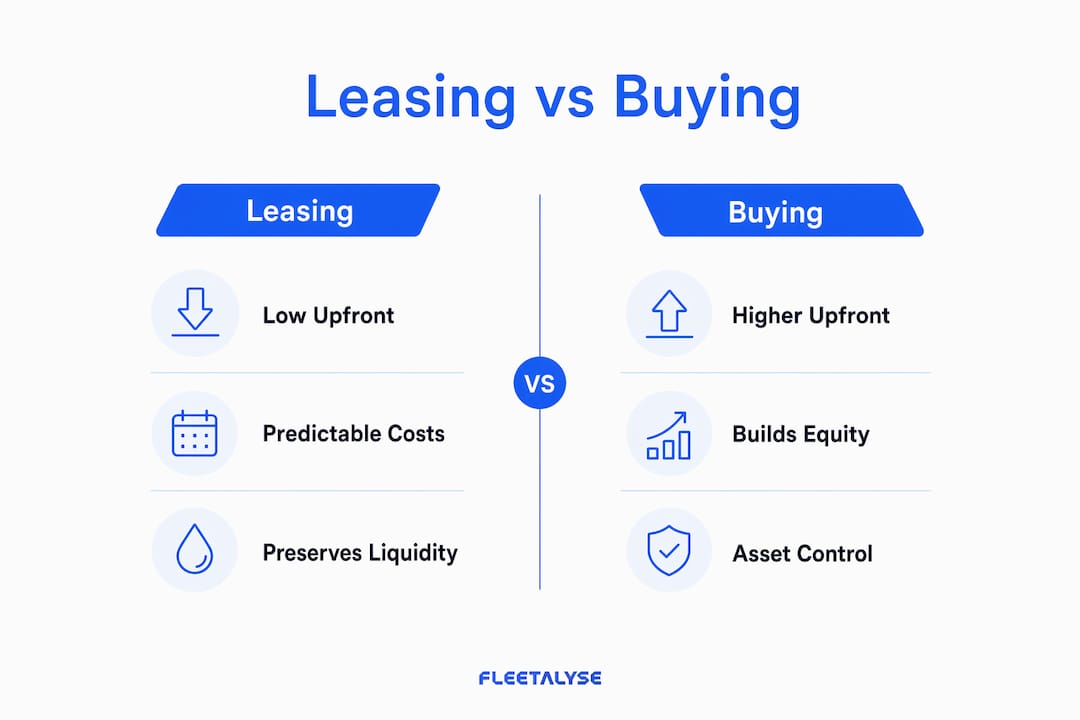
| Dimension | Leasing (contract hire) | Buying (outright / HP) |
|---|---|---|
| Upfront cost | Low (deposit or first rental) | High (full price or large deposit) |
| Monthly cost | Fixed OpEx, predictable | Higher loan repayment; zero once paid off |
| Balance sheet | Off-balance-sheet (operating lease) | Asset + liability recorded |
| Residual value risk | Lessor (closed-end) | Operator |
| Maintenance | Often bundled | Operator’s responsibility |
| Flexibility | Limited by contract term | Full control |
| Scalability | Easier to add vehicles | Capital-constrained |
| Access to newer tech | Built into refresh cycle | Depends on replacement budget |
Leasing shifts CapEx to predictable OpEx, which preserves borrowing capacity and smooths cashflow. Buying builds equity but ties up capital in assets that depreciate fastest in their first three years.
Pro Tip: When modelling the two options, include a realistic maintenance cliff trigger: the point at which an ageing owned vehicle’s repair costs spike sharply. This single input often flips the net present value calculation in favour of leasing for fleets running vehicles beyond five years.
Also consider sale-leaseback if you already own vehicles and need to free up working capital. You sell the vehicles to a lessor and lease them back, converting a balance-sheet asset into monthly OpEx without interrupting operations. See the Fleetalyse fleet total cost of ownership guide for UK-specific TCO modelling inputs.
How do leasing and buying affect day-to-day operations?
Vehicle age is the most direct operational lever. Leased fleets average 3.2 years old versus 5.34 years for owned fleets, and that gap translates into measurable fuel economy differences and fewer unscheduled breakdowns. Younger vehicles spend less time off-road.
Maintenance responsibility under a managed lease is outsourced to the lessor’s network. That removes the administrative burden of sourcing workshops, negotiating labour rates and managing parts. For operators without an in-house workshop, this is a genuine operational advantage. Unscheduled breakdowns carry an average cost of around £1,324 and roughly 20 lost operational hours per incident, so reducing their frequency has a direct P&L impact.
Owned fleets have more flexibility on preventive maintenance scheduling because you are not bound by a lessor’s approved repairer network. That matters for specialist vehicles where bespoke parts or workshop expertise are required. Watch for these contract red flags in leased arrangements:
- Narrow maintenance windows that conflict with your operational hours.
- Restrictions on which workshops can carry out repairs.
- Penalties for modifications that affect residual value.
- Long lead times for approved spare parts on specialist upfits.
For warranty considerations on fleet maintenance, particularly when mixing leased and owned assets, understanding what is covered and for how long affects your maintenance budget significantly.
UK tax and accounting: what to check with your accountant
This section is a prompt for professional advice, not a substitute for it. Tax treatment depends on your company structure, accounting method and the specific lease or finance product you use.
- Operating leases (contract hire): rental payments are typically treated as an operating expense, deductible against trading profit. The asset does not appear on your balance sheet under older accounting standards, though IFRS 16 and FRS 102 changes have altered this for larger entities.
- Finance leases and HP: the asset is capitalised, and you claim capital allowances. The interest element of payments is deductible; the capital element is not.
- VAT: 50% of the VAT on lease rentals for cars is typically irrecoverable where there is any private use. For commercial vehicles (vans, HGVs), full VAT recovery is generally available, subject to conditions.
- Replacement cycles: 12–36 month cycles suit fleets prioritising technology access and fuel efficiency; 48–60 month cycles reduce monthly cost but increase residual and maintenance risk.
Consult your accountant before committing to a lease or purchase structure. UK tax rules on capital allowances, IFRS 16 balance sheet treatment and VAT recovery differ by vehicle type, entity structure and accounting period. Getting this wrong affects your P&L, debt ratios and tax liability.
How does telematics change the leasing vs buying decision?
Integrated telematics shifts the decision from a financial question to an operational one. Real-time diagnostics and predictive maintenance triggers let you identify the maintenance cliff before it becomes an emergency repair, whether you lease or own. For owned fleets, this extends economic vehicle life. For leased fleets, it prevents end-of-contract condition penalties.
Telematics capabilities to require in any fleet contract or RFP:
- Real-time GPS tracking and geofencing.
- Driver behaviour monitoring (harsh braking, speeding, idling).
- Automated tachograph downloads and driver hours alerts.
- Preventive maintenance scheduling triggered by mileage or engine diagnostics.
- Fuel consumption reporting by vehicle and driver.
- DVSA-ready compliance reporting and Operator Licence support.
Contractual checklist for telematics and data access:
- Who owns the telematics data: you or the lessor?
- Can you export raw driver and tachograph data to your own compliance system?
- Is telematics hardware supplied by the lessor, or must you fit your own?
- Does lessor-supplied hardware integrate with your existing fleet management platform?
- What happens to data access if you terminate the lease early?
Fleetalyse’s fleet analysis platform covers GPS tracking, remote tachograph downloads, driver behaviour monitoring and automated compliance reporting, and works across HGVs, vans and trailers regardless of whether they are leased or owned. For mixed HGV and van fleets, plug-and-play hardware means you are not dependent on a lessor to supply or configure the telematics unit. The broader telematics efficiency case is well established: the data you collect directly informs whether your next contract should be a lease or a purchase.
What should you ask before signing a lease or buying?
Work through these questions with your finance lead and any prospective lessor before committing.
- What is the assumed residual value, and how was it calculated?
- Is maintenance included, and what does it cover (scheduled, unscheduled, tyres, accident)?
- What are the early-termination penalties, and under what conditions can they be waived?
- How are upfits treated at end of contract: reinstatement cost or agreed residual adjustment?
- Who owns the telematics and compliance data generated during the contract?
- What is the mileage cap, and what is the per-mile excess charge?
- Can you add vehicles mid-contract, and on what terms?
- What is the lead time for replacement vehicles if one is written off?
Data to collect for side-by-side TCO modelling:
- Annual mileage per vehicle and expected contract term.
- Current cost-per-hour of unscheduled downtime.
- Fuel cost assumptions and expected efficiency difference between new and current vehicles.
- Upfitting cost and whether it is amortised over the contract.
- Your current borrowing rate and headroom.
Quick decision triggers:
- Fleet over 25 vehicles and growing: leasing typically wins on scalability and admin burden.
- Specialist upfits required: buying or HP gives cleaner control.
- Cashflow constrained: leasing preserves capital; sale-leaseback unlocks it from existing assets.
- DVSA compliance pressure: either model works, but telematics access must be contractually guaranteed.
Which acquisition route fits your fleet situation?
Small van fleet (1–10 vehicles). Outright purchase or HP is often simpler at this scale. Lease admin and minimum-term obligations can outweigh the cashflow benefit. Recommendation: buy or HP unless cashflow is tight.
Growing fleet (scaling from 10 to 50 vehicles). Leasing preserves the liquidity you need to hire drivers and invest in operations. Contract hire with a maintenance bundle removes the workshop management burden as headcount grows. Recommendation: contract hire with a managed maintenance package.
Specialist-fit vehicles (refrigerated, bespoke workshop vans). Lessors often decline bespoke upfits or charge reinstatement costs that erode the cashflow advantage. Buying gives you full control over the build and no end-of-contract penalty. Recommendation: outright purchase or asset finance.
High-mileage HGV fleet. Open-end leases expose you to residual risk on vehicles that depreciate faster under heavy use. Closed-end leases may include mileage caps that generate significant penalties. Ownership with a strong telematics-driven maintenance programme can be more predictable. Recommendation: model both options with realistic mileage and maintenance cliff inputs before deciding.
Verdict and next steps for UK fleet operators
Most UK commercial fleets above 25 vehicles lease because the operational and cashflow advantages outweigh the long-term equity argument at scale. Smaller fleets and specialist operators often find ownership gives them more control at lower total cost, particularly once vehicles are paid off. The honest answer is that neither model wins without modelling your specific mileage, downtime cost and maintenance profile.
Two immediate actions:
- Gather your fleet’s actual cost-per-hour downtime figure and current average vehicle age. These two inputs change the TCO calculation more than any other variable.
- Request three comparative quotes: one contract hire with a full maintenance bundle, one hire purchase or asset finance package, and one sale-leaseback proposal if you already own vehicles. Compare them on total five-year cost, not monthly payment.
Include telematics data access as a contractual requirement in every RFP you issue, and confirm the treatment with your accountant before signing.
Key takeaways
Leasing suits most mid-to-large UK commercial fleets because it converts capital expenditure into predictable operating costs, keeps vehicles newer, and reduces maintenance administration.
| Point | Details |
|---|---|
| Industry prevalence | Around 80% of mid-to-large fleets lease, reflecting the cashflow and operational advantages at scale. |
| CapEx vs OpEx | Leasing shifts vehicle cost to monthly OpEx; buying capitalises the asset and builds equity over time. |
| Operational uptime | Leased fleets average 3.2 years old vs 5.34 years for owned fleets, with measurable fuel economy and downtime benefits. |
| Tax treatment | Operating leases, finance leases and HP are treated differently for VAT, capital allowances and P&L. Confirm with your accountant. |
| Fleetalyse | Works across leased and owned fleets, providing GPS tracking, remote tachograph downloads and driver behaviour monitoring regardless of acquisition model. |
The case for treating telematics as the deciding factor
The conventional framing of leasing vs buying as a pure finance question misses the most important variable for a commercial fleet operator: operational risk. Whether you lease or buy, the cost that will surprise you is not the monthly payment. It is the unscheduled breakdown at 2 AM on the M6, the DVSA prohibition notice because driver hours data was not downloaded in time, or the end-of-contract condition penalty on a vehicle that was never properly maintained.
Telematics does not resolve the lease-or-buy question, but it changes the inputs. A fleet with real-time diagnostics, automated tachograph compliance and driver behaviour data can model its maintenance cliff accurately, negotiate lease terms from a position of knowledge, and demonstrate compliance to the DVSA without a paper chase. That data advantage is available regardless of acquisition model, but it has to be contractually protected. Operators who sign leases without securing data ownership and export rights are handing their compliance evidence to a third party.
The operators who get this right treat telematics access as a non-negotiable contract term, not a nice-to-have add-on. That single requirement, built into every RFP and every lease negotiation, changes the risk profile of either acquisition route.
Fleetalyse reduces TCO risk whether you lease or buy
Knowing your acquisition model is only half the picture. The other half is what happens to your vehicles, drivers and compliance data once they are on the road.
Fleetalyse gives UK fleet operators GPS vehicle tracking, driver behaviour monitoring, remote tachograph downloads and automated DVSA compliance reporting across HGVs, vans and trailers. Plug-and-play hardware means you are not dependent on a lessor to supply or configure your telematics unit, and your compliance data stays yours. Whether your fleet is fully leased, fully owned, or a mix of both, Fleetalyse fits without disrupting existing contracts. For operators who need unlocked GPS trackers that work independently of any lease arrangement, the Fleetalyse shop has plug-and-play Teltonika devices ready to deploy. Request a demo to see how Fleetalyse integrates with your current fleet structure.
Useful sources and further reading
- Leasing vs. Buying: Which is Best for Your Fleet Goals? — Element Fleet — industry prevalence data, managed programme TCO savings and sale-leaseback overview.
- Fleet Leasing vs. Buying Analysis — Alliance Fleet Solutions — CapEx vs OpEx framing, telematics and maintenance cliff modelling.
- The Benefits of Leasing Trucks — Penske Truck Leasing — vehicle age benchmarks, fuel economy data and breakdown cost figures.
- Fleet Vehicles: Lease vs Buy — Merchants Fleet — open-end vs closed-end lease residual risk comparison.
- Should You Lease or Buy Fleet Vehicles? — National Fleet Services — operational flexibility and mileage restriction analysis.
- Fleet Total Cost of Ownership: the 2026 UK Guide — Fleetalyse — UK-specific TCO modelling inputs and acquisition model comparison.
- Fleet Analysis Software — Fleetalyse — product overview covering GPS tracking, tachograph downloads and driver behaviour monitoring.
Save the decision checklist in Section 8 and share the TCO modelling inputs with your finance lead before your next lease renewal or vehicle purchase decision.