

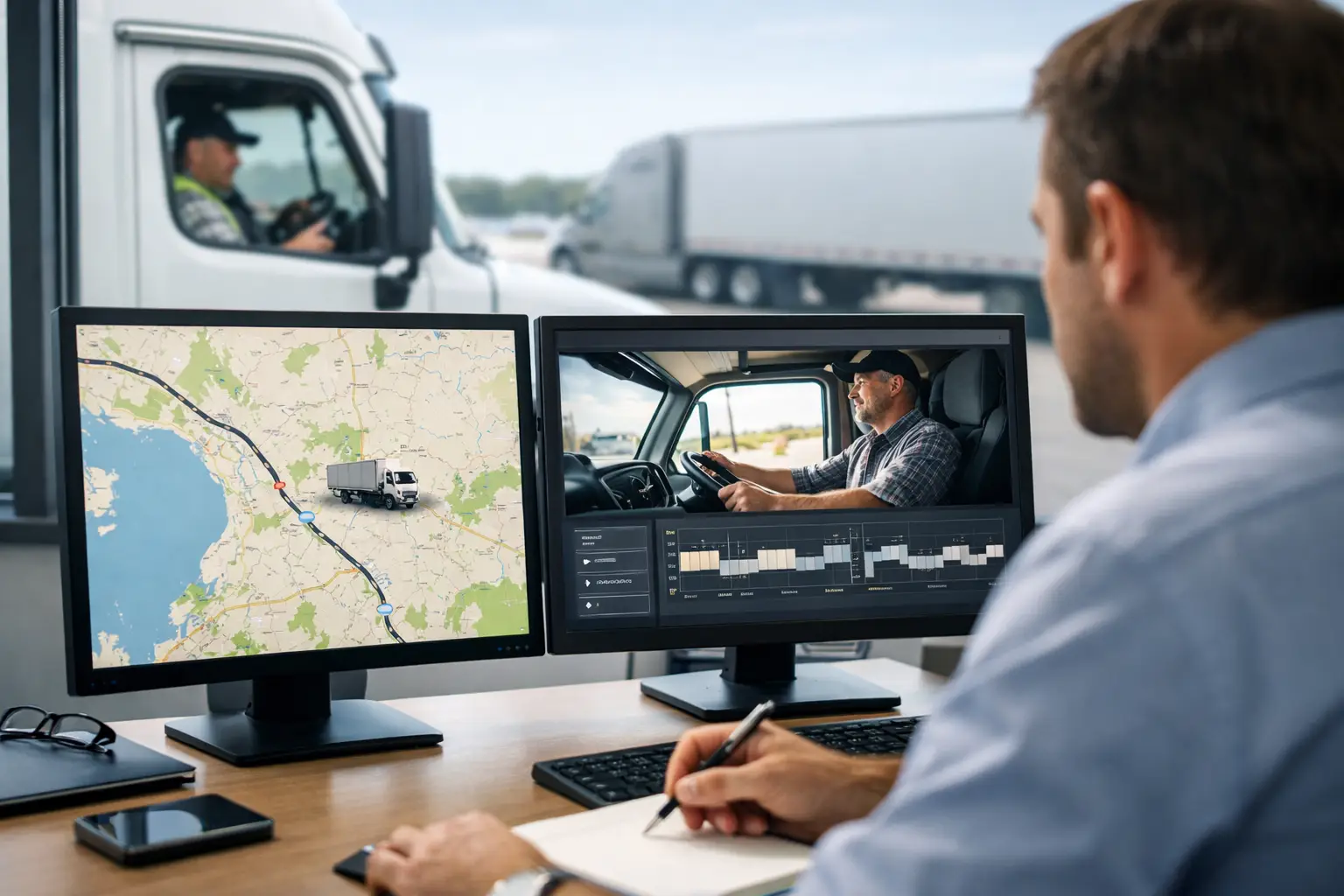

A planner gives a driver one more job because the board looks clear. Halfway through the shift, it becomes obvious there is not enough legal time left to finish it. Now the depot is rearranging loads, the driver is under pressure, and the compliance team is left checking whether an infringement could have been avoided. That is exactly where live driver hours monitoring earns its place.
For UK fleet operators, live driver hours monitoring is not just a useful dashboard feature. It is a practical way to reduce guesswork around available driving time, support better dispatch decisions, and stay ahead of driver hours issues before they become a problem. When the same platform also handles tachograph compliance, vehicle visibility and reporting, the value is even clearer because teams stop working across separate systems and delayed data.
Why live driver hours monitoring matters day to day
Most transport businesses do not run into trouble because nobody understands the rules. The real problem is timing. Driver hours data often sits in the wrong place, arrives too late, or has to be pieced together manually. By the time someone notices a risk, the vehicle is already on the road and the day has moved on.
Live visibility changes that. Instead of relying on old downloads, driver calls, paper notes or rough assumptions, transport teams can see remaining drive time, working time and break status while operations are still moving. That means planners can allocate work based on what is legally possible rather than what looks possible on paper.
This matters for more than compliance. It affects customer service, route planning, depot workload and driver morale. If drivers are regularly given work that pushes legal limits, the business ends up with more last-minute changes, more avoidable phone calls and more pressure on the people trying to keep the operation compliant.
What good live driver hours monitoring should actually do
Not every system gives enough detail to be useful in a busy transport office. A basic view of where the vehicle is may help with ETA updates, but it does not tell you whether the driver can legally complete the next leg. The useful standard is higher than that.
A proper live driver hours monitoring system should show current activity, available driving time, remaining working time, break requirements and upcoming rest constraints in a format that can be understood quickly. It should also update reliably enough to support live planning, not simply provide a historical record after the fact.
For many operators, the real advantage comes when this data sits alongside vehicle tracking, remote tachograph downloads and compliance reporting. Then the transport office is no longer switching between one system for visibility, another for hours, and a spreadsheet for follow-up. That joined-up view cuts admin, but more importantly it reduces the chance of a bad operational decision caused by incomplete information.
Better planning starts with knowing who is actually available
Dispatch planning is where live hours data proves itself fastest. A planner looking at ten vehicles may have several drivers near the end of available drive time, one approaching a required break and another with enough time left for an extra collection. Without live data, those differences are easy to miss.
When availability is clear, jobs can be assigned with more confidence. The office can choose the driver with legal capacity to complete the work rather than the one who simply happens to be closest. That reduces mid-route reshuffling and helps protect service levels.
It also improves communication with customers. If there is not enough legal time left for a same-day delivery, the business knows early and can set expectations properly. That is far better than promising a job and then spending the afternoon explaining why it cannot be finished.
There is a trade-off, of course. Live data improves planning, but it does not remove the need for judgement. Traffic, loading delays, ferry schedules and driver availability still affect what is realistic. The point is not that software makes every decision. The point is that planners can make better decisions with less guesswork.
Compliance becomes easier when risk is visible earlier
Most compliance issues build quietly. A missed break, a day extended too far, or a pattern of rushed scheduling can sit unnoticed until reports are reviewed later. At that stage, the business is dealing with evidence rather than prevention.
Live driver hours monitoring moves attention forward. Compliance teams and transport managers can spot drivers who are approaching limits and intervene before the infringement happens. That may mean changing the job sequence, reallocating a collection, or making a simple call to confirm the next break.
This is especially valuable for operators with mixed workloads where plans change during the day. Multi-drop work, last-minute customer requests and return loads can all stretch a schedule. If the office cannot see legal capacity in real time, each change carries more risk than it should.
For UK operators, that matters because driver hours management is not an isolated admin task. It feeds directly into operator licence protection, audit readiness and the overall standard expected from the transport operation. A cleaner process makes life easier when the business needs to demonstrate control.
Why disconnected systems create avoidable pressure
Many fleets still manage hours, tracking and compliance through a mixture of portals, manual downloads and internal spreadsheets. It works up to a point, but it creates friction everywhere. The planner checks one screen for location, another for driver status and then asks the compliance team to confirm whether the hours are current. That is slow, and slow decisions usually become expensive decisions.
A single platform approach is more than convenience. It reduces duplication, shortens response time and gives each team access to the same operational picture. The depot can see what is happening now. Compliance can see what needs attention. Management can review trends without asking staff to compile reports by hand.
That is why integrated platforms tend to deliver stronger results than standalone tools. The gains are not only technical. They show up in reduced admin time, fewer avoidable infringements and less day-to-day chasing between teams.
What to look for if you are reviewing systems
If you are considering live driver hours monitoring, look beyond the headline claim. The first question is whether the data is timely enough to support live planning rather than retrospective analysis. The second is whether the information is presented clearly enough for dispatch and depot teams to act on quickly.
After that, integration matters. If the system also supports remote tachograph downloads, vehicle and trailer tracking, driver behaviour insights and maintenance visibility, the operational benefit is much greater. That is because transport teams rarely solve one problem at a time. They are balancing compliance, utilisation, customer delivery windows and asset control together.
Implementation should also be realistic. Complex hardware installs and unclear pricing often slow adoption before the system has delivered any value. Operators tend to get better results from straightforward setup, transparent monthly costs and a platform that fits into the way a UK fleet actually runs. That practical approach is one reason businesses look at providers such as Fleetalyse when they want stronger control without adding admin.
The result is calmer operations, not just better data
The best outcome from live driver hours monitoring is not a more detailed dashboard. It is a transport office that spends less time reacting. Jobs are assigned with a clearer view of legal availability. Compliance teams spend less time chasing missing information. Drivers deal with fewer unrealistic instructions and fewer last-minute changes.
That does not mean every day runs perfectly. Road transport never works like that. Delays happen, customers change plans and depots get busy. But when the business can see driver hours as operations unfold, it has more room to respond properly and less need to recover from avoidable mistakes.
For operators under pressure to protect compliance, improve planning and cut manual workload, that is the real value. Good systems do not add noise. They give the right people enough clarity to act earlier and with more confidence.
If your team is still making driver hours decisions from delayed downloads, driver calls and spreadsheet updates, the issue is not just inefficiency. It is lost control at the point where control matters most.