

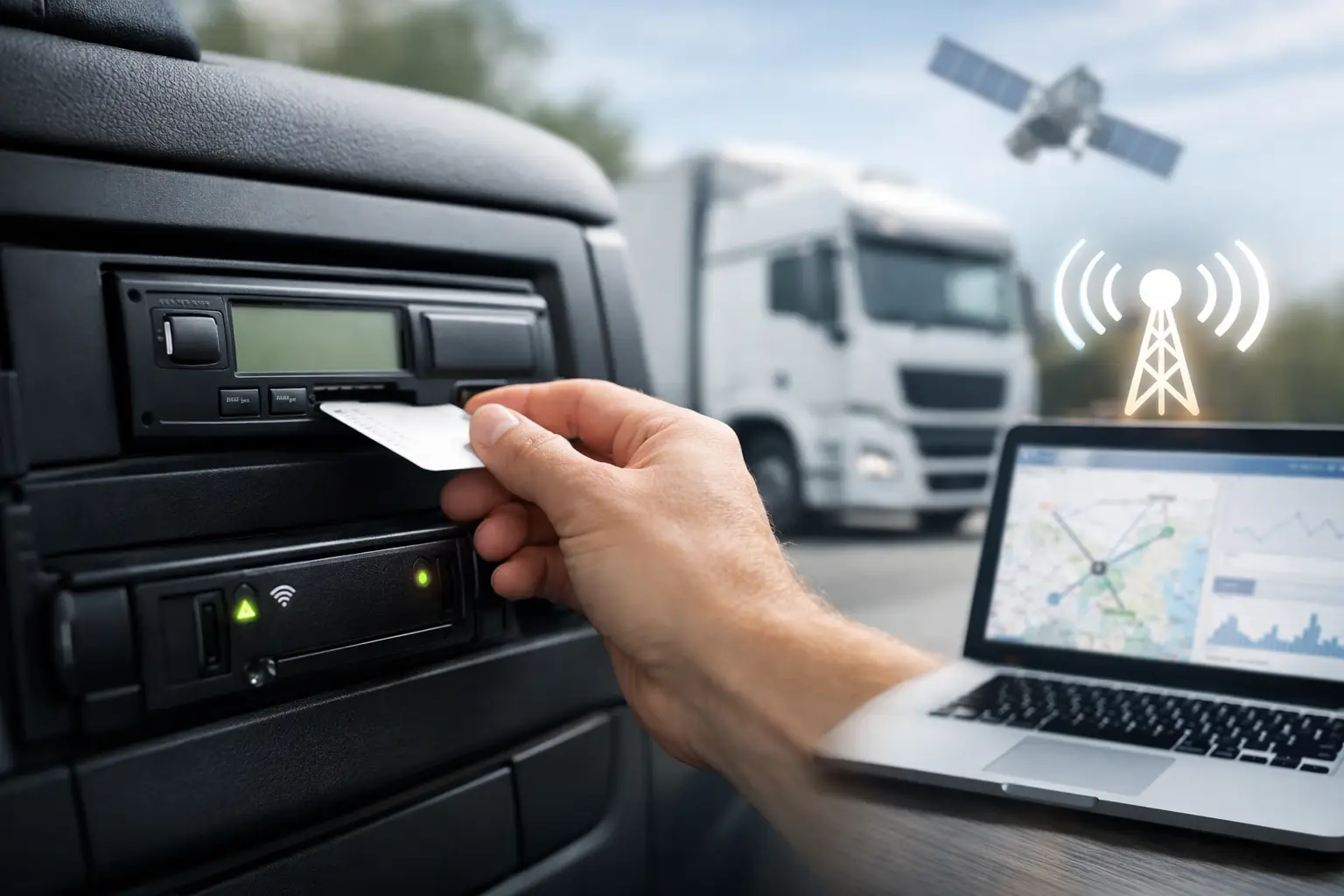

If your team is still chasing vehicles for card reads and unit downloads, compliance is taking more time than it should. A remote tachograph download system changes that by collecting driver card and vehicle unit data without pulling vehicles back to base, giving transport teams more control with less manual work.
For many UK operators, that shift is not just about convenience. It affects how quickly infringements are spotted, how much admin sits with depot staff, and how confidently a transport manager can demonstrate control if the business is ever asked questions about compliance. Manual processes can work for a small fleet with predictable routes. Once vehicles are moving across depots, working nights, or spending long periods away from site, they usually start to break down.
What a remote tachograph download system actually does
At its core, a remote tachograph download system automates the collection of tachograph data from both the driver card and the vehicle unit. Instead of relying on someone to physically connect a download tool, the system transfers the required files remotely and stores them for analysis and record keeping.
That sounds straightforward, but the operational value is in what happens around the download. Good systems do not just pull files. They help teams stay within download deadlines, reduce the risk of missed records, and make data available quickly enough to act on it. If a driver has repeated working time issues or a vehicle is approaching a compliance threshold, the point is to know early, not weeks later when the paperwork catches up.
For UK operators, that matters because tachograph compliance is not separate from day-to-day fleet control. Driver hours affect planning, resourcing, shift allocation and service levels. A remote system works best when it supports those wider decisions rather than sitting as a standalone compliance tool.
Why manual downloads create avoidable risk
Most transport managers know the weak points already. A driver forgets to hand in a card. A vehicle misses its scheduled download because it is on long-distance work. Someone assumes the data has been collected, but it has not. Then the office is left patching together records and checking calendars instead of managing the fleet.
The issue is not that manual downloading is impossible. The issue is that it depends on people remembering the same repetitive task every time, even when operations are stretched. That creates gaps, and gaps are exactly what auditors and enforcement officers pay attention to.
There is also the admin burden. When download activity is managed through spreadsheets, wall charts or separate software, compliance becomes slower and harder to verify. You can still get the job done, but it takes more effort to prove that it is under control.
A remote tachograph download system removes much of that friction. Scheduled downloads happen automatically, records are centralised, and transport teams spend less time chasing data. That does not replace compliance management, but it gives it a stronger foundation.
The real business case is time and control
Operators often look at remote downloading as a compliance purchase. In practice, the strongest case is usually operational. Time spent arranging downloads, checking who is overdue, and moving files between systems has a direct cost. So does the delay between an issue happening and the office seeing it.
When downloads are automated, admin teams can focus on exceptions instead of routine collection. Transport managers can review driver activity sooner. Depot teams can spend less time coordinating vehicle returns just to meet download requirements. Across a busy fleet, that time adds up quickly.
Control is the other part of the equation. If your tachograph data sits in one place and your vehicle visibility sits somewhere else, decisions get fragmented. The same driver hours issue might affect route planning, overtime, customer delivery windows and next-day allocations. A disconnected setup means more checking across multiple systems and more room for mistakes.
That is why many operators now want remote downloading built into a wider fleet platform rather than added as another standalone tool.
What to look for in a remote tachograph download system
Not every system delivers the same operational benefit. The basics are remote collection, secure storage and scheduled downloads. Beyond that, the difference is in how usable the platform is for a busy transport office.
A strong setup should make it clear which drivers and vehicles are compliant, which downloads are due, and where attention is needed. If you need to click through multiple screens to work out what is missing, the system is adding work rather than removing it.
Live driver hours visibility is particularly valuable. Remote downloads tell you what has happened. Live hours help you manage what happens next. If dispatch planners can see available driving time before assigning work, they are less likely to create problems that the compliance team only discovers later.
Implementation also matters. Some operators have been put off telematics and compliance platforms because they expect a complex rollout, hidden hardware costs or long installation delays. In reality, the right system should be practical to deploy and straightforward to understand. If the technology is meant to simplify operations, the setup should reflect that.
Where remote downloads fit into daily transport operations
This is where the value becomes obvious. A remote tachograph download system is useful on its own, but it becomes far more powerful when it sits alongside vehicle tracking, driver management and reporting.
Take a typical mixed fleet running across multiple sites. Vehicles are not always returning to the same depot, and drivers may swap units across the week. Without remote access to tachograph data, the office is always playing catch-up. With remote downloads in place, data collection becomes routine, not an event.
That changes how people work. Compliance managers can review exceptions rather than chase files. Dispatch teams can make better allocation decisions using current driver hours information. Business owners get clearer oversight without asking staff to build reports manually.
For operator licence protection, that matters. A business that can demonstrate regular downloads, structured oversight and prompt follow-up is in a much stronger position than one relying on good intentions and spreadsheets.
It depends on fleet type and working pattern
There is no single best setup for every operator. A small fleet working locally may feel less pressure to automate because vehicles return to base regularly. Even then, remote downloads can still reduce admin and create a cleaner audit trail.
For fleets with tramping drivers, multi-depot operations, agency drivers or frequent vehicle swaps, the case is much stronger. The more movement there is across people, sites and assets, the harder manual processes become to maintain.
The same applies to growth. A process that works with ten vehicles often struggles at thirty. By the time compliance admin starts pulling people away from planning and service delivery, the business is already paying the price.
So the question is not simply whether remote downloading is useful. It is whether your current process still gives you reliable control as the operation becomes more complex.
Why one platform usually works better than separate systems
Many operators already have tracking in one platform and tachograph compliance in another. That can be made to work, but it often creates duplicated admin and partial visibility. One team checks vehicle locations, another checks downloads, and nobody sees the full picture quickly enough.
Bringing compliance and telematics together tends to be more practical. You can view driver activity, vehicle movement, utilisation and exceptions from one system. Reporting becomes easier, and there is less time lost switching between platforms or exporting data.
That joined-up view is where a provider such as Fleetalyse has an advantage for UK operators. The focus is not generic tracking with compliance added on the side. It is operational control built around the real demands of transport teams - downloads completed on time, driver hours visible, vehicles tracked, and fewer disconnected tools to manage.
Choosing a system that reduces work, not adds to it
The best remote tachograph download system is not the one with the longest feature list. It is the one your team will actually use every day because it makes the job easier. That means clear compliance status, reliable automation, practical reporting and no unnecessary complexity.
Price matters too, but so does transparency. A low headline figure can quickly lose its appeal if hardware, setup or support costs are unclear. For most operators, predictability is more valuable than a cheap-looking quote that expands once the rollout begins.
If you are assessing options, look past the sales language and ask a simple question: will this reduce admin next month, improve oversight next quarter, and make compliance easier to evidence if we are ever challenged? If the answer is uncertain, keep looking.
A remote tachograph download system should give your transport office more breathing space, not another dashboard to babysit. When it is properly integrated into daily operations, compliance becomes less about chasing data and more about acting on it before it becomes a problem.