


A single roadside inspection can trigger a chain reaction that puts your entire haulage operation at risk. With the DVSA issuing over 20,000 fixed penalty notices for tachograph offences annually, understanding common tachograph infringements and penalties is no longer optional. It's a fundamental requirement for survival. You likely feel the constant pressure of complex drivers' hours regulations and the heavy administrative burden of ensuring manual data downloads are completed on time. It's an exhausting process that leaves no room for error when your Operator Licence is on the line.
We agree that the current regulatory landscape often feels like a minefield designed to catch out even the most diligent operators. This guide provides the clarity you need to master DVSA tachograph regulations for 2026 and protect your business from debilitating fines. We'll break down the most frequent compliance pitfalls and show you exactly how to pass Traffic Commissioner audits with flying colours while reducing your daily administrative overheads. It's time to move beyond simple tracking and start managing real transport operations with total confidence.
Key Takeaways
- Learn to distinguish between accidental administrative errors and intentional falsification to safeguard your fleet’s compliance record.
- Identify common tachograph infringements and penalties, such as exceeding driving limits or missing rest periods, to avoid immediate DVSA intervention.
- Navigate the DVSA’s graduated fixed penalty system and understand how offences are categorised into £100, £200, and £300 fine bands.
- Protect your Operator Licence and 'Good Repute' by understanding why a £300 fine is often the least of a fleet manager’s concerns during a Traffic Commissioner audit.
- Eliminate compliance bottlenecks and see infringements before they occur by moving from reactive manual downloads to proactive live data management.
Understanding Tachograph Infringements in the UK Transport Sector
A tachograph infringement occurs whenever a driver or operator breaches the UK’s strict drivers’ hours or recording regulations. These rules exist to ensure road safety and maintain fair competition across the haulage industry. To grasp the technical side of how these devices capture data, What is a Tachograph? provides an essential overview of the hardware involved. For the DVSA, any missing data is a red flag. They view gaps in records as a sign of deeper operational issues or hidden non-compliance. This is why understanding common tachograph infringements and penalties is the first step toward building a resilient transport business.
The DVSA operates on a philosophy of total transparency. They expect to see a continuous, unbroken record of a driver's day, including work, rest, and periods of availability. When data is missing, the burden of proof shifts to the operator to explain the void. This level of scrutiny is why Fleetalyse is built for real transport operations, not just tracking. We focus on providing the visibility you need to stay ahead of the regulator. Minor errors amongst a large fleet can quickly escalate into serious legal trouble. What looks like a small mistake in isolation can lead to a "systemic failure" finding if it happens across multiple vehicles over a set period.
Intentional vs Unintentional Violations
Drivers often claim they simply forgot to insert their card, but auditors rarely accept this as a valid excuse during a formal inspection. The law makes a clear distinction between negligence and intentional falsification. Negligence involves administrative errors, whilst falsification is the deliberate manipulation of records to hide actual driving hours. Systemic failure is the repeated occurrence of minor errors across a fleet. Falsification is a criminal offence that often leads to immediate prosecution and the potential loss of an Operator’s Licence. Negligence is still serious, as it shows a lack of management control.
The Legal Framework: From EU Rules to UK Assimilated Law
The 2026 legislative landscape for UK operators is governed by assimilated law, which keeps the core of the previous EU regulations. You must manage a mix of domestic GB rules for local work and AETR rules for cross-border haulage into Europe. The DVSA acts as the primary enforcement body, using roadside stops and remote audits to check for common tachograph infringements and penalties. Staying compliant requires a proactive approach to data management. Compliance isn't optional. Using the tools at Fleetalyse ensures your fleet stays on the right side of the law by turning complex data into actionable insights.
The Most Common Tachograph Violations: From Hours to Data Gaps
DVSA roadside inspections and remote audits consistently highlight a recurring set of failures. These common tachograph infringements and penalties are often the result of simple oversight rather than intentional law-breaking. However, the consequences for your operator licence remain severe. Compliance requires a 24-hour accounting of a driver's activity, leaving no room for "missing data" or forgotten manual entries. Real transport operations demand precision, and even small gaps in records can trigger a full fleet audit.
Drivers’ Hours and Rest Period Breaches
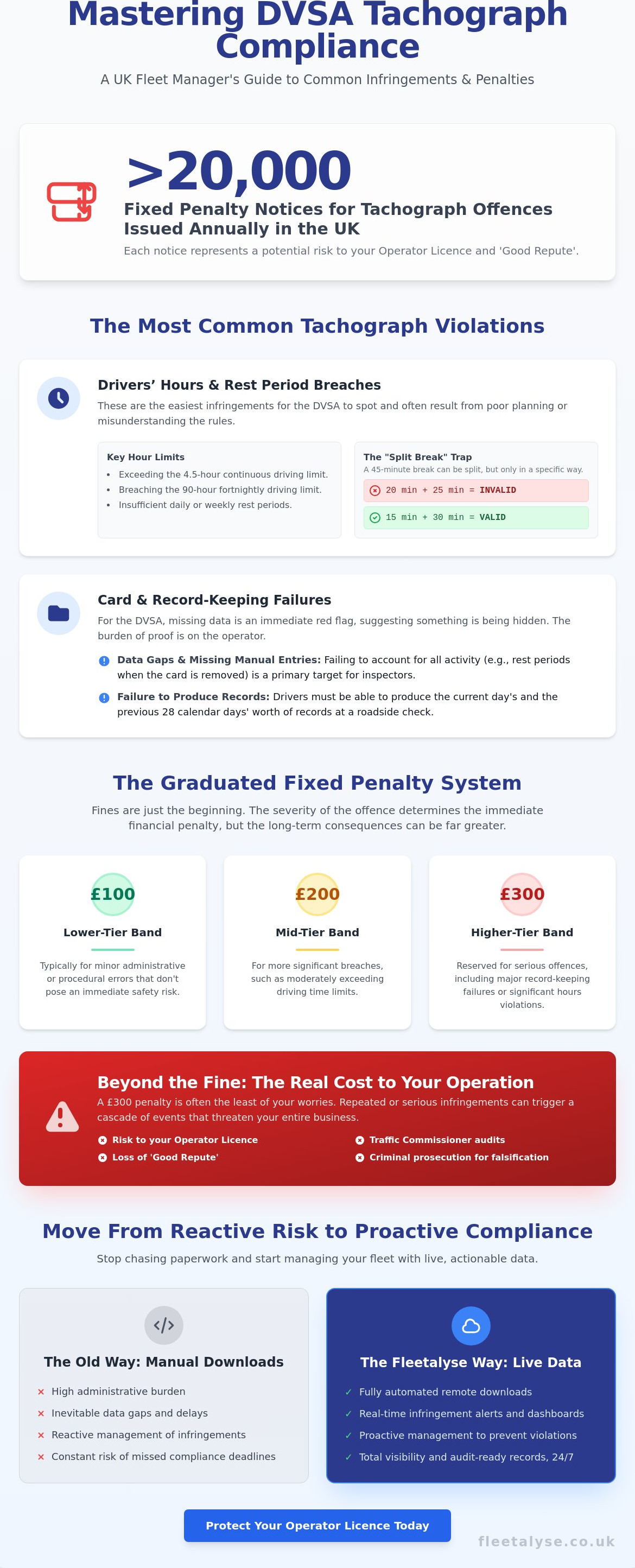
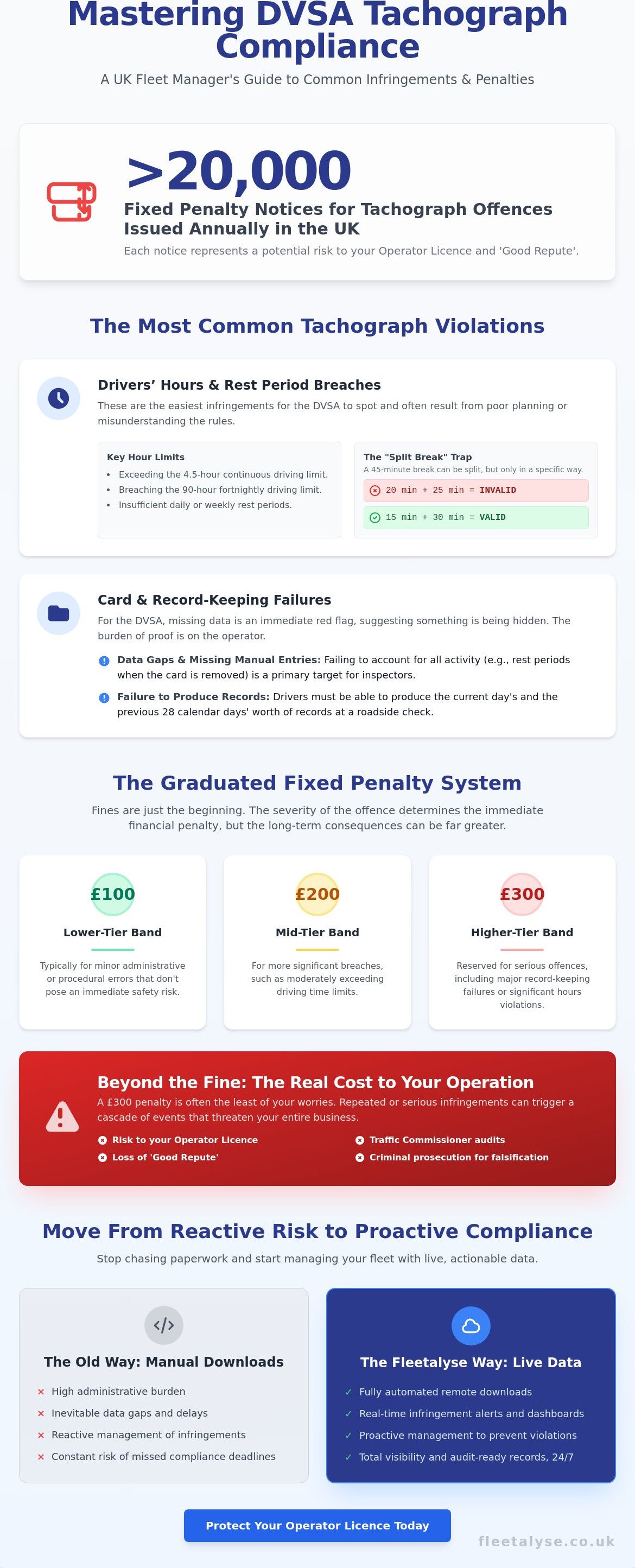
The 4.5-hour driving limit is a hard ceiling. Drivers must take a 45-minute break after this period, or a qualifying split break. A frequent error occurs when drivers take a 20-minute break followed by a 25-minute break. This is invalid. To qualify as a split break, the first segment must be at least 15 minutes and the second at least 30 minutes. During peak periods, the 90-hour fortnightly limit is often breached because of poor forward planning. These rules exist because EU tachograph regulations prioritise road safety by strictly managing driver fatigue.
Card and Record-Keeping Failures
Data gaps are a primary target for enforcement officers. Drivers must account for every minute of their day. If a driver leaves their card out overnight, they must use the manual entry function to record that period as rest. Failure to produce 28 days of records at the roadside is an immediate red flag. Technical infringements also catch operators out. You must download driver card data every 28 days and vehicle unit (VU) data every 90 days. Missing these deadlines suggests a lack of oversight. Using an expired card or driving without one is a critical failure that often leads to heavy fines and vehicle prohibitions.
Equipment and Calibration Issues
Your hardware must be legal and functional. Every tachograph unit requires a calibration check every two years and a full inspection every six years. Driving with an uncalibrated unit is a serious offence. Tampering, such as using magnets to "stop the clock" or software overrides, is treated as a criminal matter rather than a simple administrative error. It leads to immediate vehicle prohibition and potential prison sentences. Mode switch errors are more common; drivers often forget to set the tachograph to "Other Work" whilst loading. This misrepresents their actual duty time. To avoid these pitfalls, UK operators need visibility over their real-time data to catch errors before they become fines.
- Failing to use the "Other Work" mode during loading and unloading.
- Miscalculating the 11-hour daily rest requirement or the reduced 9-hour rest.
- Neglecting to record non-driving work performed away from the vehicle via manual entries.
Total Transparency. Real Transport Operations. That is how Fleetalyse helps you maintain a clean compliance record.
Decoding the Penalties: Fixed Penalties, Fines, and Prosecution
The DVSA manages UK road safety through a strict Graduated Fixed Penalty system. This framework ensures that common tachograph infringements and penalties are proportionate to the severity of the breach. Instead of a one-size-fits-all approach, officers issue on-the-spot fines based on the specific risk posed to the public. If a driver cannot pay the fine immediately, the vehicle is often immobilised until the debt is settled.
Financial penalties fall into three distinct bands. These thresholds reflect the level of non-compliance found during an inspection:
- £100 Penalty: Issued for minor infringements, such as small timing discrepancies or failing to record a vehicle registration number correctly.
- £200 Penalty: Applied to more significant breaches, including exceeding the daily driving limit by less than one hour.
- £300 Penalty: Reserved for the most serious roadside offences. This includes exceeding the daily driving limit by more than two hours or failing to take a required break after 4.5 hours of driving.
Whilst these fines are immediate, they are only the beginning of the potential fallout. Repeated offences or evidence of systemic neglect will trigger a follow-up investigation into the entire fleet operation.
Roadside Sanctions and Prohibitions
A DVSA roadside stop involves a thorough inspection of both the driver's digital card and the vehicle's technical integrity. If an officer identifies a safety risk, they issue a "prohibition" notice. This stops the vehicle from being driven until the issue is resolved. An "S" marked prohibition is particularly damaging for UK operators. It suggests a significant failure in your management systems. These marks stay on your record and negatively impact your Operator Compliance Risk Score (OCRS), making your fleet a frequent target for future stops. In extreme cases, the DVSA will use physical wheel clamps to immobilise the vehicle, ensuring it stays off the road until the driver completes a mandatory rest period.
Criminal Prosecution and Prison Sentences
Fixed penalties are not always sufficient. For "serious" offences involving intent or fraud, the DVSA will escalate the case to the Magistrates’ Court or Crown Court. Falsifying records or interfering with recording equipment is a criminal act. This carries a maximum 2-year prison sentence for the individuals involved. Court-imposed fines often reach £5,000 per offence, which can quickly bankrupt a small haulage business. Liability also extends to the boardroom. Directors are held personally responsible for driver infringements if the prosecution proves the company lacked proper oversight. Protecting your operator's licence requires more than just reactive fixes; it demands total visibility of your fleet's data.
Beyond the Fine: The Impact on Your Operator Licence and Traffic Commissioner Audits
A £300 roadside fine is often the smallest problem a fleet manager faces. While fixed penalties sting, the real threat lies in the damage to your Operator Licence (O-Licence). The Traffic Commissioner (TC) views common tachograph infringements and penalties as evidence of a wider management failure. If your drivers consistently break hours rules, you're failing the "Good Repute" requirement that's central to your right to operate.
The DVSA monitors every stop through the Operator Compliance Risk Score (OCRS). This system uses a red, amber, and green traffic light system to categorise fleets. A "Red" score makes your vehicles a magnet for roadside checks. In 2023, the DVSA increased its focus on targeted enforcement, meaning high-risk operators face constant disruption and delayed deliveries. This data is shared across agencies, ensuring that poor compliance doesn't stay hidden.
The Public Inquiry Process
A Public Inquiry (PI) is a formal hearing before the Traffic Commissioner. It usually starts with a "call-up" letter detailing your compliance failures. You must explain why you shouldn't lose your licence in a setting that feels much like a court of law. Outcomes range from formal warnings to curtailment, which forces you to reduce your fleet size immediately. In severe cases, the TC will revoke the licence entirely. The Transport Manager's professional competence is also at stake. Losing this status can end a career instantly, as the TC can declare an individual unfit to manage transport operations across the UK.
The Long-Term Cost of a Tarnished Reputation
A poor compliance record creates financial leaks beyond government fines. Insurance providers now use OCRS data and PI history to set premiums. High-risk operators often see costs rise by 20% or more compared to compliant fleets. Additionally, major tier-1 logistics firms and local authorities now demand a "Green" OCRS status for all subcontractors. Losing a major contract because of common tachograph infringements and penalties can be fatal for a small or medium-sized haulier. Regaining "Good Repute" once it's lost is a multi-year process that many businesses don't survive. It's far cheaper to invest in compliance now than to try and rebuild a broken reputation later.
Proactive Compliance: How Remote Data Management Eliminates Infringement Risk
Manual downloads are a massive compliance bottleneck in 2026. Relying on a driver to remember a 28-day deadline is a gamble with your O-licence. If a vehicle is stuck on a long-haul job or a driver is on leave, the deadline passes. You're left with a gap in your records. This reactive approach is why many fleets still struggle with common tachograph infringements and penalties. Real-time data management changes the dynamic from "what went wrong?" to "how do we prevent it?". It's about moving away from guesswork and into a space of total operational certainty.
The Benefits of Remote Tachograph Download
Remote downloads eliminate the need for vehicles to return to the depot specifically for data collection. This saves fuel, time, and driver hours. Dispatchers gain live visibility into remaining driving time through a simple dashboard. They can see exactly how many minutes a driver has left before a mandatory break is required. This prevents over-hours violations before the wheels even stop turning. Learn more about our Remote Tachograph Download solutions to see how live data keeps your fleet moving without interruptions.
Integrated Analysis and Reporting
Automation ensures you never miss the 28-day driver card or 90-day vehicle unit download cycles again. The software handles the schedule in the background, downloading data while the vehicle is on the road. When data flows into an integrated analysis platform, it identifies patterns in driver behaviour that might otherwise go unnoticed. Automated infringement letters make the debrief process professional and consistent. By automating these tasks, transport managers reduce administrative burdens by roughly 12 to 15 hours per week. This allows the team to focus on Real Transport Operations rather than chasing drivers for cards.
Building a "Compliance First" Culture
Using data to educate drivers is more effective than simple punishment. When a driver sees their own live hours, they take ownership of their compliance. This Total Transparency is vital during DVSA audits. It proves you have robust systems in place to monitor and correct common tachograph infringements and penalties. A clean audit trail protects your business reputation and your bottom line. Our solutions are built for the rigours of UK haulage, providing the clarity needed to pass any inspection with confidence.
Protect Your Operator Licence Through Proactive Data Control
Managing a haulage operation in 2026 requires more than just keeping vehicles on the road. It demands a rigorous approach to data. The DVSA currently issues fixed penalties of up to £300 for individual offences, but the real danger lies in Public Inquiries. A single audit by the Traffic Commissioner can result in the suspension or loss of your Operator Licence. Understanding common tachograph infringements and penalties is only the first step. You need a system that eliminates manual errors and closes data gaps before they become legal liabilities.
Fleetalyse is built for real transport operations, not just tracking. We don't believe in hidden costs or complex contracts. Our model includes a fee-free hardware lease and total transparency pricing, so you know exactly what you're paying from day one. Remote downloads ensure you never miss a deadline, keeping your drivers focused on the road and your business safe from prosecution. It's time to move from reactive fixes to proactive protection.
Secure your fleet compliance with Fleetalyse Remote Tachograph Downloads
Your compliance shouldn't be a source of stress; let's make it your competitive advantage.
Frequently Asked Questions
How much are the fines for tachograph infringements in the UK?
Fixed penalty notices for common tachograph infringements and penalties typically range from £50 to £300 depending on the severity. The DVSA issues these roadside for five main categories of offences. If a case reaches a magistrate’s court, fines can become unlimited. For example, failing to keep records or data manipulation often results in the highest tier of graduated fixed penalties to deter dangerous driving habits.
How long do tachograph infringements stay on a driver’s record?
Infringements stay on a driver’s record for four years for the purposes of DVSA monitoring. While the physical data on a driver card only needs to be carried for 28 days, the historical record impacts your Operator Compliance Risk Score (OCRS). The Traffic Commissioner reviews this four-year history during audits or if you're called to a Public Inquiry, so long-term compliance is vital for your professional repute.
Can a driver be fined for an infringement committed 28 days ago?
Yes, DVSA officers can fine you for any infringement discovered within your records from the last 28 days. Under the updated Mobility Package regulations, this roadside check period extends to 56 days for international journeys. Drivers must carry all manual entries and printouts for this entire period. Failing to produce these records results in immediate fixed penalties, even if the driving occurred weeks ago in a different vehicle.
What happens if a tachograph malfunctions whilst a driver is on the road?
You must have the unit repaired by an approved fitment centre within seven days of the fault occurring. If the vehicle cannot return to your base within this one-week window, you're required to get it fixed at a workshop along your route. Whilst the tachograph is broken, you must record your activities manually on the back of tachograph printout rolls to prove you're still following the legal rest requirements.
Is the operator or the driver responsible for tachograph fines?
Both the driver and the operator share legal responsibility, though the driver usually receives the initial roadside fine. However, the operator faces separate prosecution if they fail to schedule work properly or ignore repeated common tachograph infringements and penalties. The DVSA expects companies to download data regularly, identify errors, and provide documented training. If you don't manage your drivers' hours properly, the Traffic Commissioner can revoke your entire licence.
How often must I download my driver card and vehicle unit data?
You must download driver card data at least every 28 days and vehicle unit (VU) data every 90 days. These are the maximum legal intervals, but many UK operators choose to download data daily using remote telematics to avoid missing deadlines. Failing to meet these 28 and 90-day targets is a serious breach of your operator licence conditions and will lead to an unsatisfactory OCRS rating during DVSA inspections.
What is a "Public Inquiry" in the context of tachograph compliance?
A Public Inquiry is a formal legal hearing called by the Traffic Commissioner to review the suitability of an operator licence. This usually happens after the DVSA identifies serious or repeated compliance failures during a roadside stop or a fleet audit. The Commissioner has the power to suspend, curtail, or revoke your licence entirely. It's a high-stakes environment where you must prove your organisation is capable of running a safe, legal transport operation.
Can I go to prison for a tachograph offence?
Yes, you can go to prison for up to two years for the most serious tachograph offences. This maximum sentence generally applies to cases of deliberate fraud, such as using magnets to manipulate data or falsifying records to hide excessive driving. The courts treat the intentional endangerment of road safety through driver fatigue as a criminal matter. Beyond jail time, a criminal record for fraud will permanently end your career in the haulage industry.
Frequently asked questions
Intentional vs Unintentional Violations
Drivers often claim they simply forgot to insert their card, but auditors rarely accept this as a valid excuse during a formal inspection. The law makes a clear distinction between negligence and intentional falsification. Negligence involves administrative errors, whilst falsification is the deliberate manipulation of records to hide actual driving hours. Systemic failure is the repeated occurrence of minor errors across a fleet. Falsification is a criminal offence that often leads to immediate prosecution and the potential loss of an Operator’s Licence. Negligence is still serious, as it shows a lack of management control.
The Legal Framework: From EU Rules to UK Assimilated Law
The 2026 legislative landscape for UK operators is governed by assimilated law, which keeps the core of the previous EU regulations. You must manage a mix of domestic GB rules for local work and AETR rules for cross-border haulage into Europe. The DVSA acts as the primary enforcement body, using roadside stops and remote audits to check for common tachograph infringements and penalties. Staying compliant requires a proactive approach to data management. Compliance isn't optional. Using the tools at Fleetalyse ensures your fleet stays on the right side of the law by turning complex data into actionable insights. DVSA roadside inspections and remote audits consistently highlight a recurring set of failures. These common tachograph infringements and penalties are often the result of simple oversight rather than intentional law-breaking. However, the consequences for your operator licence remain severe. Compliance requires a 24-hour accounting of a driver's activity, leaving no room for "missing data" or forgotten manual entries. Real transport operations demand precision, and even small gaps in records can trigger a full fleet audit.
Drivers’ Hours and Rest Period Breaches
The 4.5-hour driving limit is a hard ceiling. Drivers must take a 45-minute break after this period, or a qualifying split break. A frequent error occurs when drivers take a 20-minute break followed by a 25-minute break. This is invalid. To qualify as a split break, the first segment must be at least 15 minutes and the second at least 30 minutes. During peak periods, the 90-hour fortnightly limit is often breached because of poor forward planning. These rules exist because EU tachograph regulations prioritise road safety by strictly managing driver fatigue.
Card and Record-Keeping Failures
Data gaps are a primary target for enforcement officers. Drivers must account for every minute of their day. If a driver leaves their card out overnight, they must use the manual entry function to record that period as rest. Failure to produce 28 days of records at the roadside is an immediate red flag. Technical infringements also catch operators out. You must download driver card data every 28 days and vehicle unit (VU) data every 90 days. Missing these deadlines suggests a lack of oversight. Using an expired card or driving without one is a critical failure that often leads to heavy fines and vehicle prohibitions.
Equipment and Calibration Issues
Your hardware must be legal and functional. Every tachograph unit requires a calibration check every two years and a full inspection every six years. Driving with an uncalibrated unit is a serious offence. Tampering, such as using magnets to "stop the clock" or software overrides, is treated as a criminal matter rather than a simple administrative error. It leads to immediate vehicle prohibition and potential prison sentences. Mode switch errors are more common; drivers often forget to set the tachograph to "Other Work" whilst loading. This misrepresents their actual duty time. To avoid these pitfalls, UK operators need visibility over their real-time data to catch errors before they become fines. Total Transparency. Real Transport Operations. That is how Fleetalyse helps you maintain a clean compliance record. The DVSA manages UK road safety through a strict Graduated Fixed Penalty system. This framework ensures that common tachograph infringements and penalties are proportionate to the severity of the breach. Instead of a one-size-fits-all approach, officers issue on-the-spot fines based on the specific risk posed to the public. If a driver cannot pay the fine immediately, the vehicle is often immobilised until the debt is settled. Financial penalties fall into three distinct bands. These thresholds reflect the level of non-compliance found during an inspection: Whilst these fines are immediate, they are only the beginning of the potential fallout. Repeated offences or evidence of systemic neglect will trigger a follow-up investigation into the entire fleet operation.
Roadside Sanctions and Prohibitions
A DVSA roadside stop involves a thorough inspection of both the driver's digital card and the vehicle's technical integrity. If an officer identifies a safety risk, they issue a "prohibition" notice. This stops the vehicle from being driven until the issue is resolved. An "S" marked prohibition is particularly damaging for UK operators. It suggests a significant failure in your management systems. These marks stay on your record and negatively impact your Operator Compliance Risk Score (OCRS), making your fleet a frequent target for future stops. In extreme cases, the DVSA will use physical wheel clamps to immobilise the vehicle, ensuring it stays off the road until the driver completes a mandatory rest period.
Criminal Prosecution and Prison Sentences
Fixed penalties are not always sufficient. For "serious" offences involving intent or fraud, the DVSA will escalate the case to the Magistrates’ Court or Crown Court. Falsifying records or interfering with recording equipment is a criminal act. This carries a maximum 2-year prison sentence for the individuals involved. Court-imposed fines often reach £5,000 per offence, which can quickly bankrupt a small haulage business. Liability also extends to the boardroom. Directors are held personally responsible for driver infringements if the prosecution proves the company lacked proper oversight. Protecting your operator's licence requires more than just reactive fixes; it demands total visibility of your fleet's data. A £300 roadside fine is often the smallest problem a fleet manager faces. While fixed penalties sting, the real threat lies in the damage to your Operator Licence (O-Licence). The Traffic Commissioner (TC) views common tachograph infringements and penalties as evidence of a wider management failure. If your drivers consistently break hours rules, you're failing the "Good Repute" requirement that's central to your right to operate. The DVSA monitors every stop through the Operator Compliance Risk Score (OCRS). This system uses a red, amber, and green traffic light system to categorise fleets. A "Red" score makes your vehicles a magnet for roadside checks. In 2023, the DVSA increased its focus on targeted enforcement, meaning high-risk operators face constant disruption and delayed deliveries. This data is shared across agencies, ensuring that poor compliance doesn't stay hidden.
The Public Inquiry Process
A Public Inquiry (PI) is a formal hearing before the Traffic Commissioner. It usually starts with a "call-up" letter detailing your compliance failures. You must explain why you shouldn't lose your licence in a setting that feels much like a court of law. Outcomes range from formal warnings to curtailment, which forces you to reduce your fleet size immediately. In severe cases, the TC will revoke the licence entirely. The Transport Manager's professional competence is also at stake. Losing this status can end a career instantly, as the TC can declare an individual unfit to manage transport operations across the UK.
The Long-Term Cost of a Tarnished Reputation
A poor compliance record creates financial leaks beyond government fines. Insurance providers now use OCRS data and PI history to set premiums. High-risk operators often see costs rise by 20% or more compared to compliant fleets. Additionally, major tier-1 logistics firms and local authorities now demand a "Green" OCRS status for all subcontractors. Losing a major contract because of common tachograph infringements and penalties can be fatal for a small or medium-sized haulier. Regaining "Good Repute" once it's lost is a multi-year process that many businesses don't survive. It's far cheaper to invest in compliance now than to try and rebuild a broken reputation later. Manual downloads are a massive compliance bottleneck in 2026. Relying on a driver to remember a 28-day deadline is a gamble with your O-licence. If a vehicle is stuck on a long-haul job or a driver is on leave, the deadline passes. You're left with a gap in your records. This reactive approach is why many fleets still struggle with common tachograph infringements and penalties. Real-time data management changes the dynamic from "what went wrong?" to "how do we prevent it?". It's about moving away from guesswork and into a space of total operational certainty.
The Benefits of Remote Tachograph Download
Remote downloads eliminate the need for vehicles to return to the depot specifically for data collection. This saves fuel, time, and driver hours. Dispatchers gain live visibility into remaining driving time through a simple dashboard. They can see exactly how many minutes a driver has left before a mandatory break is required. This prevents over-hours violations before the wheels even stop turning. Learn more about our Remote Tachograph Download solutions to see how live data keeps your fleet moving without interruptions.
Integrated Analysis and Reporting
Automation ensures you never miss the 28-day driver card or 90-day vehicle unit download cycles again. The software handles the schedule in the background, downloading data while the vehicle is on the road. When data flows into an integrated analysis platform, it identifies patterns in driver behaviour that might otherwise go unnoticed. Automated infringement letters make the debrief process professional and consistent. By automating these tasks, transport managers reduce administrative burdens by roughly 12 to 15 hours per week. This allows the team to focus on Real Transport Operations rather than chasing drivers for cards.
Building a "Compliance First" Culture
Using data to educate drivers is more effective than simple punishment. When a driver sees their own live hours, they take ownership of their compliance. This Total Transparency is vital during DVSA audits. It proves you have robust systems in place to monitor and correct common tachograph infringements and penalties. A clean audit trail protects your business reputation and your bottom line. Our solutions are built for the rigours of UK haulage, providing the clarity needed to pass any inspection with confidence. Get a transparent quote for your fleet compliance today. Managing a haulage operation in 2026 requires more than just keeping vehicles on the road. It demands a rigorous approach to data. The DVSA currently issues fixed penalties of up to £300 for individual offences, but the real danger lies in Public Inquiries. A single audit by the Traffic Commissioner can result in the suspension or loss of your Operator Licence. Understanding common tachograph infringements and penalties is only the first step. You need a system that eliminates manual errors and closes data gaps before they become legal liabilities. Fleetalyse is built for real transport operations, not just tracking. We don't believe in hidden costs or complex contracts. Our model includes a fee-free hardware lease and total transparency pricing, so you know exactly what you're paying from day one. Remote downloads ensure you never miss a deadline, keeping your drivers focused on the road and your business safe from prosecution. It's time to move from reactive fixes to proactive protection. Secure your fleet compliance with Fleetalyse Remote Tachograph Downloads Your compliance shouldn't be a source of stress; let's make it your competitive advantage.
How much are the fines for tachograph infringements in the UK?
Fixed penalty notices for common tachograph infringements and penalties typically range from £50 to £300 depending on the severity. The DVSA issues these roadside for five main categories of offences. If a case reaches a magistrate’s court, fines can become unlimited. For example, failing to keep records or data manipulation often results in the highest tier of graduated fixed penalties to deter dangerous driving habits.
How long do tachograph infringements stay on a driver’s record?
Infringements stay on a driver’s record for four years for the purposes of DVSA monitoring. While the physical data on a driver card only needs to be carried for 28 days, the historical record impacts your Operator Compliance Risk Score (OCRS). The Traffic Commissioner reviews this four-year history during audits or if you're called to a Public Inquiry, so long-term compliance is vital for your professional repute.
Can a driver be fined for an infringement committed 28 days ago?
Yes, DVSA officers can fine you for any infringement discovered within your records from the last 28 days. Under the updated Mobility Package regulations, this roadside check period extends to 56 days for international journeys. Drivers must carry all manual entries and printouts for this entire period. Failing to produce these records results in immediate fixed penalties, even if the driving occurred weeks ago in a different vehicle.
What happens if a tachograph malfunctions whilst a driver is on the road?
You must have the unit repaired by an approved fitment centre within seven days of the fault occurring. If the vehicle cannot return to your base within this one-week window, you're required to get it fixed at a workshop along your route. Whilst the tachograph is broken, you must record your activities manually on the back of tachograph printout rolls to prove you're still following the legal rest requirements.
Is the operator or the driver responsible for tachograph fines?
Both the driver and the operator share legal responsibility, though the driver usually receives the initial roadside fine. However, the operator faces separate prosecution if they fail to schedule work properly or ignore repeated common tachograph infringements and penalties. The DVSA expects companies to download data regularly, identify errors, and provide documented training. If you don't manage your drivers' hours properly, the Traffic Commissioner can revoke your entire licence.
How often must I download my driver card and vehicle unit data?
You must download driver card data at least every 28 days and vehicle unit (VU) data every 90 days. These are the maximum legal intervals, but many UK operators choose to download data daily using remote telematics to avoid missing deadlines. Failing to meet these 28 and 90-day targets is a serious breach of your operator licence conditions and will lead to an unsatisfactory OCRS rating during DVSA inspections.
What is a "Public Inquiry" in the context of tachograph compliance?
A Public Inquiry is a formal legal hearing called by the Traffic Commissioner to review the suitability of an operator licence. This usually happens after the DVSA identifies serious or repeated compliance failures during a roadside stop or a fleet audit. The Commissioner has the power to suspend, curtail, or revoke your licence entirely. It's a high-stakes environment where you must prove your organisation is capable of running a safe, legal transport operation.
Can I go to prison for a tachograph offence?
Yes, you can go to prison for up to two years for the most serious tachograph offences. This maximum sentence generally applies to cases of deliberate fraud, such as using magnets to manipulate data or falsifying records to hide excessive driving. The courts treat the intentional endangerment of road safety through driver fatigue as a criminal matter. Beyond jail time, a criminal record for fraud will permanently end your career in the haulage industry.