


Fleet telematics contract negotiation guide for UK fleets

Signing a telematics contract without proper preparation is one of the most expensive mistakes a UK fleet manager can make. This fleet telematics contract negotiation guide exists because too many operators discover, months into a contract, that they are locked into unfavourable pricing, unclear data ownership terms, and service level agreements that offer no real accountability. Whether you manage a mixed fleet of HGVs and vans or a specialist tachograph-equipped operation, the contract you sign today shapes your compliance posture and operational costs for years. Here is how to get it right from the start.
Table of Contents
- Understanding key contract components and legal requirements
- Preparing to negotiate effectively: research and strategy
- Executing the negotiation: securing favourable terms and service level agreements
- Verifying compliance and managing contract performance
- Expert perspectives: nuanced insights for smarter negotiation
- How Fleetalyse supports your telematics contracting success
- Frequently asked questions
Key Takeaways
| Point | Details |
|---|---|
| Contract basics | Understand typical contract lengths, fleet minimums, and penalties to negotiate effectively. |
| Preparation is vital | Thorough cost analysis and competitive benchmarking build the leverage needed in negotiations. |
| Focus on SLAs | Clear, measurable service level agreements with credit-back clauses protect operational performance. |
| Legal compliance matters | UK GDPR requires Data Protection Impact Assessments and clear occupant notification for telematics data. |
| Guard against lock-in | Secure data export rights post-contract to avoid expensive vendor lock-in risks. |
Understanding key contract components and legal requirements
Every effective fleet telematics contract negotiation guide starts with the fundamentals. Before you sit across from a vendor, you need to understand what is actually inside these agreements and where the financial and legal risks hide.
Contract duration and minimum commitments are the first pressure points. Enterprise telematics contracts typically run 24 to 36 months with minimum fleet commitments of 50 or more vehicles, and early termination penalties reaching 50 to 75% of the remaining contract value. For a 100-vehicle fleet on a three-year agreement, that exposure is significant. Many operators only discover this clause when they need to switch providers or downsize following a contract loss.
UK data protection law adds another layer of complexity. ICO 2025 guidance requires a Data Protection Impact Assessment (DPIA) before deploying any telematics system that processes location data. Dashcam footage, for instance, must not be retained longer than necessary, with the ICO citing one week as a reasonable limit absent an incident. Failing to meet these obligations puts your Operator Licence at risk, not just your data compliance record.
Key contract terms every fleet manager should scrutinise:
- Auto-renewal clauses that extend your commitment without active consent
- Data ownership provisions specifying who holds your fleet and driver data
- Hardware ownership at contract end, including whether units are leased or purchased
- Interoperability terms governing whether your data can be exported to third-party systems
- Force majeure and liability caps that limit vendor accountability during service failures
| Contract element | What to look for | Risk if ignored |
|---|---|---|
| Term length | 24 to 36 months typical | Locked in during fleet restructure |
| Minimum vehicles | 50+ for enterprise pricing | Penalties if fleet shrinks |
| Early termination | 50 to 75% of remaining value | Major unplanned cost |
| Data retention | Must align with ICO guidance | GDPR non-compliance |
| Auto-renewal notice | Should be 60 days or fewer | Missed exit window |
Pro Tip: Ask your vendor to define “fleet size” precisely in the contract. Some agreements count every asset including trailers, which can push you above minimum thresholds and increase your termination exposure unexpectedly.
Pairing good contract terms with the right hardware matters too. Understanding your fleet tracking and dashcam requirements before negotiations means you can specify exactly what you need, rather than accepting whatever the vendor bundles in.
With a clear grasp of contract basics and UK compliance rules, we now focus on how to thoroughly prepare before entering negotiations.
Preparing to negotiate effectively: research and strategy
Preparation is where most fleet managers underinvest, and where the most leverage is actually built. Walking into a negotiation without data is like driving without a tachograph: you have no record of where you have been and no defence if something goes wrong.

Effective negotiation begins 90 to 120 days before your current contract expires. That timeline gives you room to gather data, approach alternative vendors, and negotiate without the pressure of an imminent renewal deadline. Annual reviews during the contract period keep you informed, and competitive benchmarking every two to three years ensures you are not drifting above market rates.
Here is a structured preparation process:
- Extract 12 to 18 months of cost data. Pull every invoice from your current provider, including hardware fees, subscription costs, installation charges, and any ad hoc support fees.
- Categorise your expenditure. Separate hardware from software, one-off from recurring, and contracted from discretionary spend.
- Benchmark against the market. Compare hardware versus software costs and calculate total cost of ownership over three to five years, not just the headline monthly rate.
- Identify your non-negotiables. For most UK fleet operators, these include DVSA-compliant remote tachograph downloads, real-time GPS tracking, and driver behaviour reporting.
- Set your walk-away position. Decide in advance the price point, contract length, or SLA standard below which you will not sign.
- Approach at least two alternative vendors. A genuine competing offer is your strongest negotiating tool.
Key questions to ask during vendor benchmarking:
- What is the total cost per vehicle per month, including all hardware and support?
- What are the penalties for reducing fleet size by 20% or more mid-contract?
- How is data exported if you terminate the contract?
- What uptime guarantees are written into the service level agreement?
| Preparation tactic | Negotiation impact | Time required |
|---|---|---|
| 18-month cost analysis | Identifies overspend and leverage points | 2 to 3 days |
| Competitive benchmarking | Validates pricing and creates alternatives | 1 to 2 weeks |
| Walk-away threshold setting | Prevents unfavourable concessions | Half a day |
| Non-negotiable list | Focuses negotiation on what matters most | Half a day |
Pro Tip: When reviewing service level agreements and KPIs, ask vendors to show you real performance data from comparable fleets, not just their standard SLA document. Actual uptime figures tell a very different story than contractual promises.
After thorough preparation, we move onto practical negotiation tactics to secure favourable contract terms.
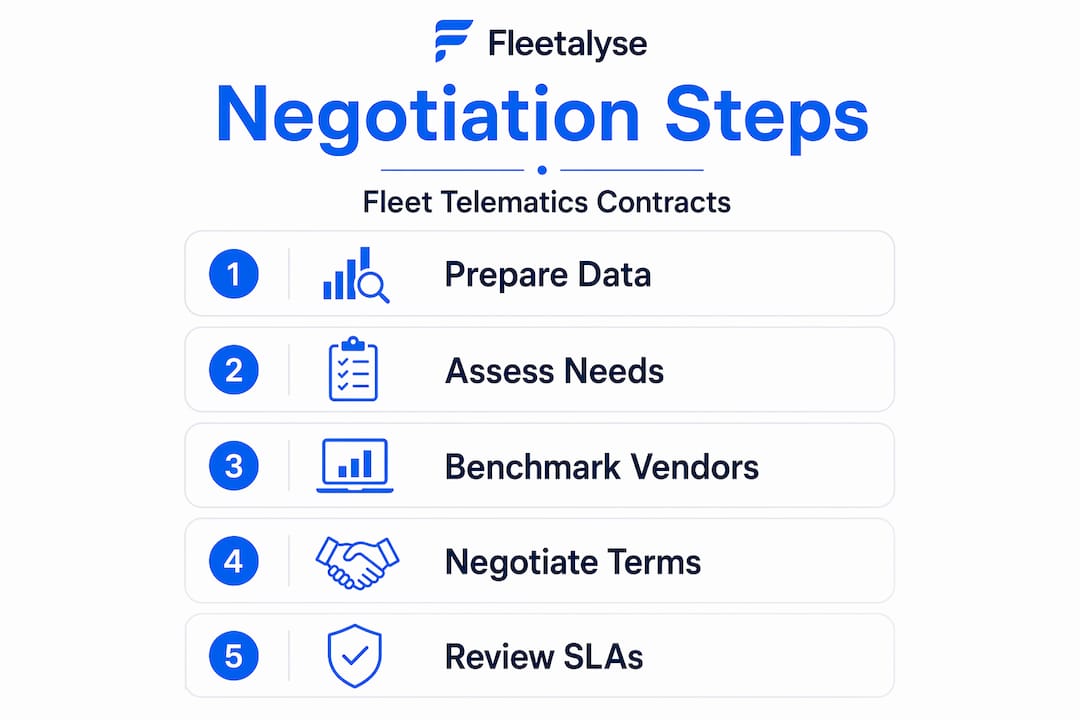
Executing the negotiation: securing favourable terms and service level agreements
This is where preparation pays off. Negotiating fleet management agreements is not about being adversarial; it is about being specific. Vague requests get vague responses. Precise, data-backed asks get results.
Follow this sequence when entering active negotiations:
- Lead with your data. Present your cost analysis and benchmarking findings. This signals you are informed and removes the vendor’s ability to anchor pricing unrealistically.
- Negotiate pricing structure before headline rate. Tiered pricing, where the per-unit cost decreases as fleet size grows, is far more valuable than a small discount on a flat rate.
- Push for a technology refresh clause. This guarantees hardware upgrades at defined intervals without additional cost, protecting you from running outdated units mid-contract.
- Insist on a pilot programme. Pilot deployments covering 25 to 50 vehicles with agreed success metrics and locked pricing before full rollout reduce your risk substantially.
- Define SLA credit provisions explicitly. Service credits typically range from 5% for standard SLA misses to 25% for severe failures, with formal reviews every 24 to 36 months or when fleet size changes by more than 25%.
Critical SLA categories to negotiate:
- System uptime: Target 99.5% or above, with clearly defined measurement windows
- Data delivery latency: How quickly does GPS and driver data reach your platform?
- Support response times: Distinguish between critical failures and standard queries
- Reporting accuracy: What percentage of trips must be correctly logged?
- Claims processing: For dashcam footage requests, define the turnaround time in hours, not days
“Define walk-away positions pre-negotiation and build performance accountability into SLAs.” This is not a negotiating tactic; it is the foundation of a contract that actually protects your operation.
Common pitfalls to avoid:
- Accepting verbal commitments that are not reflected in the written contract
- Agreeing to SLAs without defined credit-back mechanisms
- Overlooking what happens to your data if the vendor is acquired or goes insolvent
- Signing before your legal or compliance team has reviewed data processing terms
Pro Tip: Review the service level agreement essentials carefully before signing. A credit provision that only applies after three consecutive failures is effectively no protection at all.
With contracts negotiated, focus shifts to ensuring ongoing compliance and effective monitoring of telematics service performance.
Verifying compliance and managing contract performance
A signed contract is not the finish line. The real work is making sure your vendor delivers what was agreed, and that your operation stays on the right side of UK data protection law throughout the contract term.
Build a structured review calendar from day one:
- Monthly: Review system uptime reports and flag any SLA deviations in writing.
- Quarterly: Audit driver data access logs to confirm only authorised personnel are viewing personal data.
- Annually: Conduct a formal SLA performance review, with renegotiations triggered every 24 to 36 months or when fleet size shifts by more than 25%.
- At renewal: Repeat the full benchmarking process rather than accepting a rollover.
On data protection, the obligations do not end at deployment. ICO guidance requires clear signage in all vehicles notifying occupants that surveillance recording is active, with audio recording disabled by default. Your contract should specify that the vendor’s system configuration supports these requirements out of the box.
Key compliance checkpoints:
- DPIA completed and documented before system goes live
- Data retention schedules written into the contract, not just the vendor’s privacy policy
- Deletion confirmation process agreed for when data exceeds retention limits
- Driver notification process documented and auditable
| Compliance checkpoint | Responsible party | Review frequency |
|---|---|---|
| DPIA completion | Fleet operator | Before deployment |
| Vehicle signage | Fleet operator | At each new vehicle addition |
| Data retention audit | Shared with vendor | Quarterly |
| SLA performance review | Both parties | Annually |
| Contract renegotiation | Both parties | Every 24 to 36 months |
If your vendor misses SLA targets repeatedly, your contract should include a formal escalation path and, ultimately, the right to terminate without penalty after a defined number of failures. Ensure this is written in, not assumed.
Pro Tip: Store all vendor performance reports and SLA deviation notices in a dedicated compliance folder. If you ever need to invoke termination rights or defend a DVSA inspection, having a clear paper trail is invaluable. Reviewing your dashcam policies and legal guidance as part of this process keeps your hardware configuration aligned with your contractual and legal obligations.
Beyond basic compliance, unique insights from industry experts reveal deeper negotiation strategies and lessons learned.
Expert perspectives: nuanced insights for smarter negotiation
Here is something most fleet telematics contract negotiation guides will not tell you: the clauses that cost operators the most money are rarely the ones they negotiated badly. They are the ones nobody thought to negotiate at all.
Data portability is the most overlooked issue in telematics service contracts. When you switch providers or terminate a contract, your historical fleet data, driver behaviour records, and compliance logs should come with you. Yet many contracts are silent on this point, leaving you dependent on the vendor’s goodwill. Negotiate post-cancellation data export in standard formats, free of charge, with at least 30 days of access. Without this, years of operational data become inaccessible the moment the contract ends.
Auto-renewal clauses are another area where operators routinely lose leverage. A 90-day notice window sounds reasonable until you realise that your benchmarking and alternative vendor conversations take at least that long. Reject auto-renewal notice periods over 60 days and insist that early termination fees are defined as a flat figure, not a percentage of remaining contract value. The latter can be unpredictable and disproportionate, particularly if your fleet size has changed.
Graduated pricing clauses are underused but genuinely powerful. Rather than locking in a fixed per-unit rate, negotiate a pricing schedule that adjusts automatically as your fleet grows or contracts. This removes the need to renegotiate every time your vehicle count changes and protects you from paying enterprise rates on a reduced fleet.
The same logic applies to technology refresh provisions. Telematics hardware evolves quickly, and a unit that was current in 2023 may lack the CAN-bus integration or remote tachograph download capability you need by 2026. A refresh clause, written into the original contract, means you are not funding hardware upgrades out of your operational budget mid-term.
Finally, define your non-negotiables before the first meeting and share them with your internal stakeholders. Negotiations that drift because the fleet manager and compliance officer have different priorities give vendors room to manoeuvre. Alignment internally is as important as leverage externally. Staying informed through fleet management insights helps you and your team stay aligned on what the market actually offers.
How Fleetalyse supports your telematics contracting success
Knowing what to negotiate is only half the challenge. The other half is choosing a telematics partner whose platform is built to deliver on the terms you have worked hard to secure.
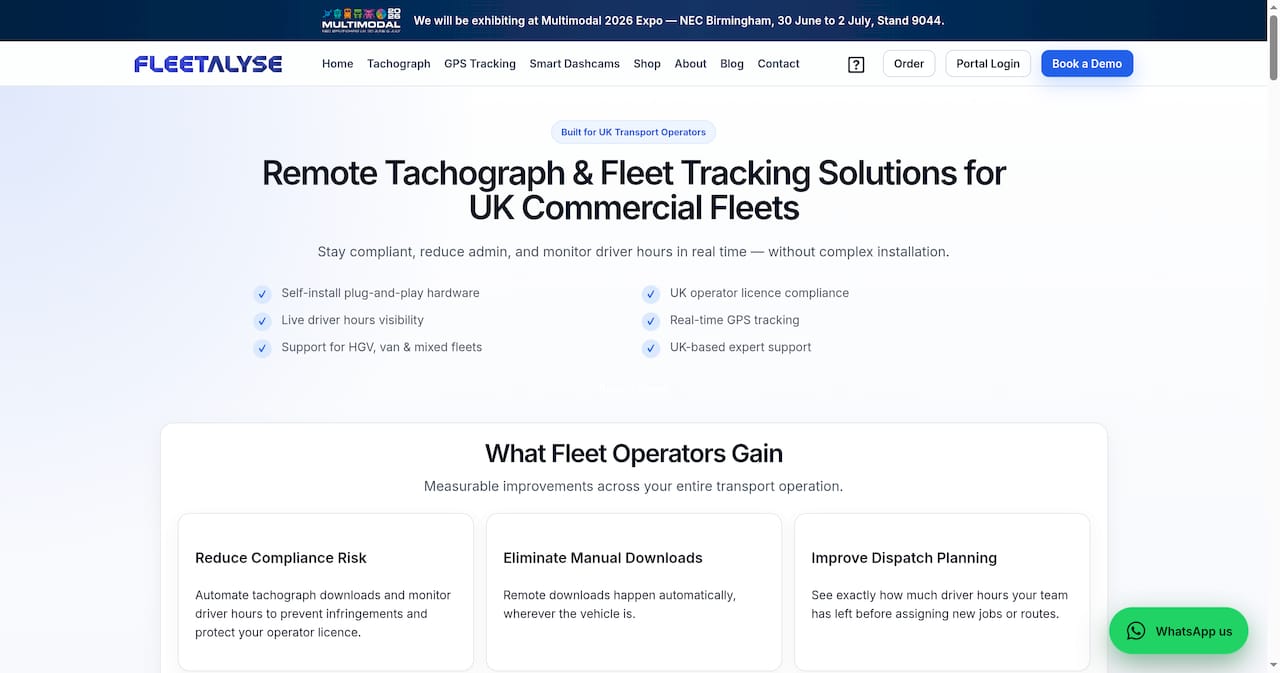
Fleetalyse is a UK-based telematics and compliance platform designed specifically for commercial fleet operators. From remote tachograph downloads and GPS vehicle tracking to driver behaviour monitoring and automated driver hours reporting, every feature is built around the compliance and operational demands of UK transport law. The platform supports HGVs, vans, trailers, and mixed fleets, with plug-and-play hardware that does not require professional installation. Whether you are entering a new contract negotiation or reviewing an existing agreement, the Fleetalyse compliance platform gives you the data visibility and audit trail you need to hold vendors accountable. Explore the full range of GPS trackers, smart dashcams, and telematics accessories at the telematics hardware shop to find solutions that fit your fleet’s exact requirements.
Frequently asked questions
What is a reasonable minimum fleet size commitment in telematics contracts?
Most UK enterprise telematics contracts require minimum commitments of 50+ vehicles to access preferred pricing and service levels. Smaller fleets should negotiate lower thresholds or flexible volume terms from the outset.
How can I ensure compliance with UK data protection laws when using telematics?
You must complete a DPIA before deployment, limit data retention to necessary periods, and display clear signage in all vehicles. ICO 2025 guidance also requires audio recording to be disabled by default in vehicle surveillance systems.
When should fleet telematics contract negotiations begin?
Negotiations should start 90 to 120 days before your current contract expires, with annual reviews during the term and competitive benchmarking every two to three years to maintain market awareness.
What credit-back provisions are typical in UK fleet telematics SLAs?
Service credits typically range from 5% for standard SLA misses to 25% for severe service failures. Ensure these thresholds and the credit calculation method are explicitly defined in your contract.
How can I prevent vendor lock-in in telematics contracts?
Negotiate post-cancellation data export in standard formats, free of charge, with at least 30 days of access after termination. This ensures your historical fleet data remains yours regardless of which provider you use next.