


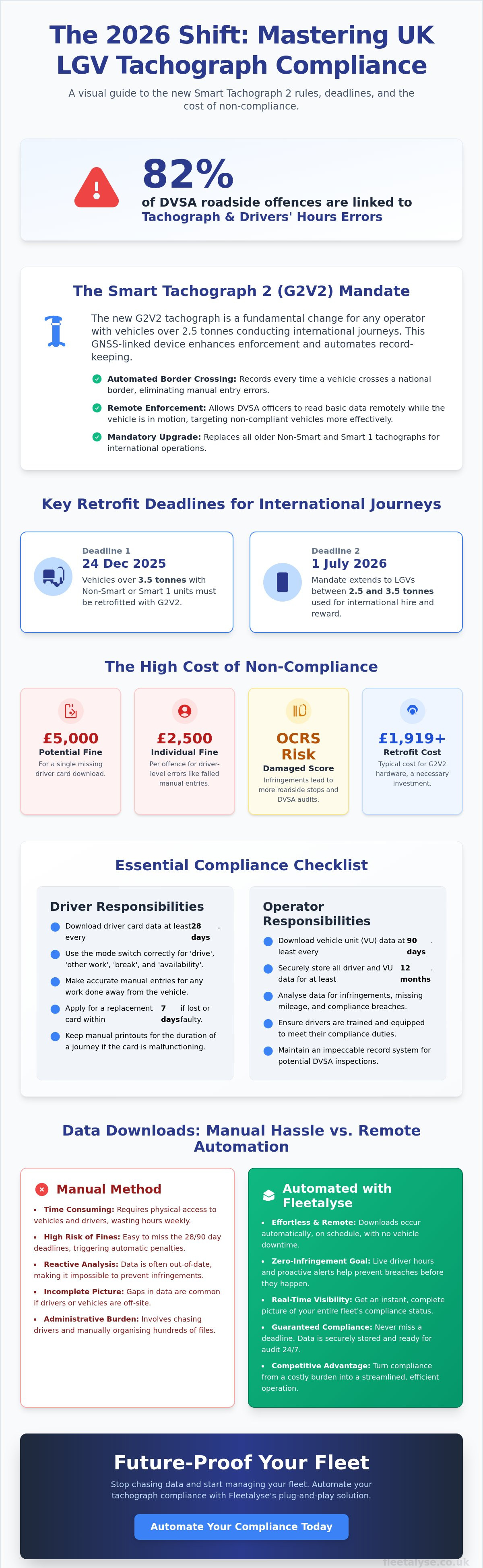
Did you know that 82% of DVSA roadside offences are now linked to tachograph and drivers' hours errors? It's a sobering figure that proves compliance is no longer just a paperwork exercise. It's a real-time data strategy. If you're managing international operations, the July 1, 2026 deadline for Smart Tachograph 2 (G2V2) means the rules for LGV tachograph compliance UK have fundamentally changed for vehicles over 2.5 tonnes.
You're likely tired of manual downloads taking up hours of your week and the constant worry that a missing driver card download could trigger a £5,000 fine. We understand that real transport operations are about moving goods, not chasing data. This guide provides a clear roadmap to automate your compliance, ensuring total visibility of driver hours and a zero-infringement OCRS score. We'll examine the £1,919.00 cost of G2V2 retrofitting, the strict 28-day card download rules, and the digital tools that turn compliance from a burden into a competitive advantage.
Key Takeaways
- Identify the mandatory requirements for Smart Tachograph 2 (G2V2) to ensure your international journeys remain legal under the latest UK and AETR rules.
- Master the essential checklist for LGV tachograph compliance UK, including driver manual entries and the critical 28-day card download schedule.
- Understand the impact of the Graduated Fixed Penalty system and how infringements directly damage your Operator Compliance Risk Score (OCRS).
- Compare the hidden costs of manual data collection against the efficiency of remote tachograph downloads for real-time fleet visibility.
- Future-proof your fleet with integrated analysis tools that provide live driver hours and plug-and-play compliance management.
Understanding the 2026 UK LGV Tachograph Regulations
Achieving LGV tachograph compliance UK requires a strict adherence to both domestic law and the international AETR agreement. For decades, vehicles under 3.5 tonnes operated in a regulatory grey area. That era ends in 2026. The Driver and Vehicle Standards Agency (DVSA) has shifted its focus. They now prioritise digital data integrity over easily manipulated manual logs. Understanding the hardware is the first step. If you're wondering what is a Tachograph? in its modern form, it's a sophisticated GNSS-linked device that tracks every border crossing and rest period with satellite precision.
Smart 1 units, introduced in 2019, provided basic GPS location. Smart Tachograph 2 (G2V2) goes much further. It automatically records when a vehicle crosses a national border. It also allows enforcement officers to read data remotely whilst the vehicle is in motion. For UK domestic operators who never leave the country, Smart 1 units remain legal for now. However, any vehicle crossing into the EU must upgrade to G2V2 hardware. This technology is the backbone of the UK-EU Trade and Cooperation Agreement. You can find more about integrating these units with your fleet at Fleetalyse.
Key Deadlines and Smart 2 Transitions
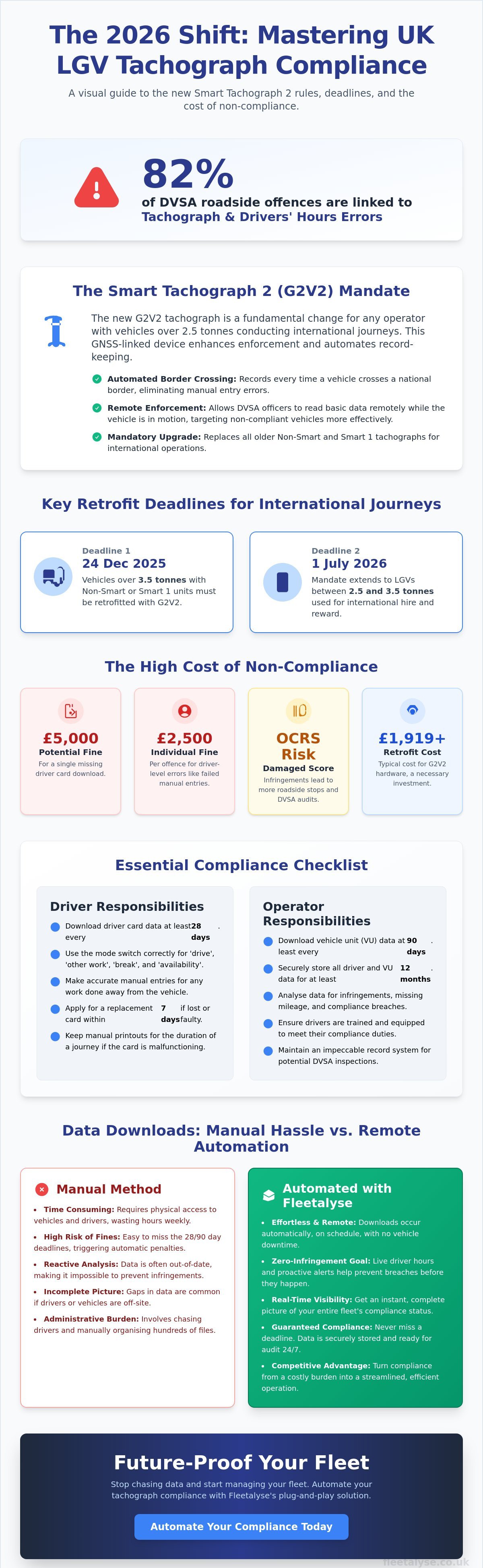
The timeline is tight. By 24 December 2025, all vehicles over 3.5 tonnes engaged in international transport must have G2V2 units fitted if they currently use non-smart or Smart 1 tachographs. From 1 July 2026, the mandate extends to LGVs between 2.5 and 3.5 tonnes used for international hire and reward. Only vehicles used exclusively for domestic transport or those falling under specific short distance exemptions are currently carved out from these upgrades. The transitional Smart 2 units used in early 2024 are fully compliant, but older hardware is now a liability for international hauliers.
Assimilated Rules and the UK Operator Licence
Your Operator Licence (O Licence) depends on your ability to prove your drivers are well-rested and legal. The DVSA views tachograph data as the primary evidence of your professional competence. Road safety standards in the UK are tied directly to these records. If your data shows frequent missing entries or rest period infringements, your Operator Compliance Risk Score (OCRS) will suffer. A poor score leads to more roadside stops and potential Public Inquiries. LGV tachograph compliance UK is the only way to protect your business's reputation and operational freedom. The 2026 Smart 2 mandate now serves as the definitive baseline for compliance across all international transport operations.
Essential Compliance Checklist for Drivers and Operators
Maintaining LGV tachograph compliance UK isn't a one-sided task. It's a shared burden between the person behind the wheel and the transport office. The law is clear on the minimums. You must download driver card data at least every 28 days and vehicle unit (VU) data every 90 days. However, relying on these 28 and 90-day limits is risky. Real transport operations benefit from weekly or even daily downloads to catch errors before they escalate into DVSA fines. Organising digital files into a clear, chronological structure ensures you're ready for an unannounced inspection at any moment.
Drivers carry the weight of daily accuracy. This includes the precise use of the mode switch and making manual entries for any work done away from the cab. Under the 2022 Tachograph Amendment Regulations, the requirement for detailed records has only become stricter for those operating internationally. If a driver card is lost or faulty, the driver must apply for a replacement within seven days and keep manual printouts in the meantime. Failure to manage these basic steps can lead to individual fines of up to £2,500 per offence.
Daily Driver Requirements
Correct mode switch usage is vital. Drivers must switch to 'other work' for loading or vehicle checks and 'break/rest' for their legal intervals. Manual entries are often where compliance fails. If a driver starts their shift at the depot before reaching the vehicle, that time must be manually added to the digital record. Without these entries, you have unexplained gaps that look like hidden driving time to a DVSA officer. It's about total transparency from start to finish.
Operator Data Management Standards
Operators must secure and store all data for at least 12 months. It's not enough to just 'have' the files. You must analyse them. Missing mileage reports are a critical tool here. They highlight periods where a vehicle moved without a card inserted, which is a major red flag for enforcement. Training your team to spot these patterns early prevents long-term damage to your OCRS. If you're looking to simplify this process, you can get started with automated analysis tools that flag infringements instantly.
Beyond storage, operators need a robust system for infringement reporting. When an error occurs, it's your job to issue a written warning or provide corrective training. Showing a "paper trail" of internal discipline and education proves to the DVSA that you're a proactive, responsible operator. This proactive approach is what separates high-performing fleets from those constantly under the microscope; for those interested in how transport planning and safety principles are managed by specialists elsewhere, you can learn more about ML Traffic Engineers Australia.
The High Cost of Non-Compliance: Fines and DVSA Audits
Ignoring LGV tachograph compliance UK isn't just a regulatory risk. It's a direct threat to your cash flow. The DVSA uses a Graduated Fixed Penalty system (GFPS) to punish infringements on the spot. For minor driving time overruns, you'll face fines of £100 to £300 per offence. However, serious breaches carry far heavier weight. Failure to observe rest periods or keep proper records can result in court-imposed fines of up to £2,500. If you've failed to install a tachograph entirely, that figure jumps to £5,000. These aren't theoretical numbers. They're daily realities for 82% of operators caught in roadside checks with record-keeping errors.
The financial pain doesn't end with a fixed penalty notice. Modern enforcement has gone digital. The Smart Tachograph 2 (G2V2) units use Dedicated Short Range Communication (DSRC). This technology allows DVSA officers to "ping" your vehicle as it passes a remote sensing point. They can instantly see 19 different parameters, including whether a driver card is inserted or if the tachograph has been tampered with. They don't need to stop you to know you're in breach. They simply pull over the high-risk vehicles and let the compliant ones pass, saving their resources for the "red" rated fleets.
Understanding OCRS and Audit Triggers
The DVSA doesn't pick vehicles at random. They use the Operator Compliance Risk Score (OCRS). Every roadside infringement or MOT failure feeds into this "traffic light" system. A "Red" score makes your fleet a permanent target for roadside stops. If your score stays low, you'll likely trigger a desk-based assessment or a full site visit. During these audits, any systemic failure to analyse tachograph data can lead to a Public Inquiry. The Traffic Commissioner has the power to suspend or revoke your Operator Licence entirely. Without that licence, your business stops moving.
Common Pitfalls in LGV Record Keeping
Complexity often leads to error. Many operators struggle with mixed fleets, where some drivers move between 3.5t vans and 7.5t LGVs. From 1 July 2026, this distinction vanishes for international work, bringing more vehicles into the penalty zone. Other common traps include:
- Missing "Other Work": Drivers often forget to record time spent loading, cleaning, or doing admin as "Other Work" via manual entries.
- Unattended Assets: Moving trailers or assets without tracking their location often leads to "missing mileage" on the vehicle unit.
- Mode Switch Errors: Failing to switch to "Rest" during a break is the most frequent cause of avoidable infringements.
Protecting your reputation requires more than just avoiding fines. It requires a system that tracks assets and driver hours in real time. Built for Real Transport Operations, our solutions ensure your OCRS remains green by catching these pitfalls before a DVSA officer does. You can see how Fleetalyse integrates these data streams to keep your fleet invisible to enforcement for all the right reasons.
Streamlining Data: Remote Tachograph Downloads vs Manual Methods
Manual data collection is a hidden drain on your bottom line. Every time a driver has to return to the depot specifically to download a card, you're paying for fuel, driver time, and administrative labour. For many UK fleets, this process takes upwards of 30 minutes per vehicle, per month. Remote tachograph download technology replaces this friction with a plug-and-play hardware solution. It's built for real transport operations, allowing data to flow directly from the vehicle to your analysis software without the driver ever leaving the cab. This transition is essential for maintaining consistent LGV tachograph compliance UK standards without sacrificing operational efficiency.
Cloud-based storage offers a level of security that physical office backups simply cannot match. If your office suffers a fire or a server failure, your compliance history could vanish, leaving you defenceless during a DVSA audit. Remote systems encrypt data and store it in redundant cloud centres, ensuring your 12-month legal history is always accessible. It eliminates the "human factor" entirely. You no longer have to worry about a driver forgetting to hand over their card or a transport manager missing a 90-day vehicle unit deadline. The system handles the heavy lifting, ensuring your LGV tachograph compliance UK remains bulletproof regardless of where your vehicles are located.
The ROI of Automated Compliance
Switching to remote downloading saves an average of 12 hours of administrative work per month for a 10-vehicle fleet. That's time your team could spend on route optimisation or customer service. Automated scheduling ensures you never miss the 28-day driver card deadline, even when vehicles are out on long-distance international routes. You can learn more about our remote tachograph download solutions to save time and protect your OCRS score from avoidable administrative errors.
Live Driver Hours: Real-Time Visibility
The real power of digital integration is moving from reactive analysis to proactive management. Traditional manual methods tell you about an infringement three weeks after it happened. Live driver hours provide real-time visibility. You can see exactly how much driving time is left on a card before a violation occurs. Integrating this data with GPS fleet tracking gives you a complete operational overview. You can take control of your compliance today and prevent accidental hours-exceeding before the vehicle even stops.
Future-Proofing Your Fleet with Fleetalyse Compliance Solutions
Achieving LGV tachograph compliance UK shouldn't feel like a constant battle against deadlines and hardware failures. Fleetalyse is built for real transport operations, not just tracking. We understand that UK hauliers need more than a dot on a map. You need a system that ensures every vehicle is legal and every driver is protected from accidental infringements. Our approach is grounded in industry expertise and a refusal to use marketing hyperbole. We provide the tools you need to manage the rigours of modern logistics with quiet confidence.
Total transparency is the foundation of our service. Unlike many providers in the sector, we offer clear pricing and no-nonsense contracts. Our fee-free lease model for hardware acts as a tangible manifestation of our commitment to your bottom line. It removes the upfront capital burden that often stalls fleet upgrades, allowing you to install the latest G2V2-compatible units without a massive initial investment. This model ensures you have high-spec hardware that integrates amongst your existing systems with a simple plug-and-play connection.
The real difference lies in our focus on live driver hours. Most compliance software is reactive, telling you what went wrong days or weeks after the event. We close that gap. By providing a proactive compliance tool, we allow transport managers to see exactly how much driving time remains on a card in real time. This visibility is what separates efficient, low-risk fleets from those constantly facing DVSA scrutiny. It turns compliance from a defensive necessity into a strategic advantage.
Beyond Tracking: A Complete Compliance Ecosystem
Our platform is a single point of truth for your entire operation. We combine van tracking, trailer tracking, and remote tacho downloads into one unified interface. This eliminates the need for multiple subscriptions and fragmented data. Our UK-based support team acts as the expert partner your fleet needs, providing localised knowledge that global software giants cannot match. Fleetalyse turns raw fleet data into actionable business decisions by providing a clear overview of both vehicle location and driver legality at all times.
Ready to Take Control of Your Compliance?
Getting started with remote downloads is a straightforward process. Our hardware is designed for rapid deployment, ensuring zero downtime for your LGVs during installation. Once connected, the system automatically handles your 28-day and 90-day download obligations, sending the data directly to your analysis programme. You can stop chasing driver cards and start focusing on your core transport operations. Secure your fleet compliance and start your remote download journey here to ensure your business is fully prepared for the July 2026 mandate.
Secure Your Fleet for the 2026 Mandate
The 1 July 2026 deadline represents a firm boundary for international LGV operations. Transitioning to Smart Tachograph 2 hardware isn't just a technical upgrade. It's a necessary step to protect your Operator Licence from the DVSA's remote sensing capabilities and the £5,000 fines associated with failing to install proper equipment. By automating your data collection, you move from reactive damage control to proactive management, ensuring your OCRS remains green and your vehicles stay on the road.
We've built our solutions for real transport operations, prioritising functional utility and total transparency. You won't find hidden costs or complex contracts here. Just clear pricing and a fee-free lease model designed by UK-based industry experts. It's time to stop chasing driver cards and start focusing on your core logistics. LGV tachograph compliance UK is simpler when you have a no-nonsense partner by your side. Start your journey to total fleet compliance with Fleetalyse and gain the visibility your business deserves. Your fleet is ready for the future.
Frequently Asked Questions
Do I need a tachograph for an LGV under 3.5 tonnes?
Yes, if you operate a vehicle between 2.5 and 3.5 tonnes for international hire and reward. From 1 July 2026, these vehicles must be fitted with a Smart Tachograph 2 under the UK-EU Trade and Cooperation Agreement. Purely domestic UK operations under 3.5 tonnes remain exempt unless the vehicle is towing a trailer that brings the total combination weight above 3.5 tonnes.
How often must I download data from a digital tachograph in the UK?
You must download driver card data at least every 28 days and vehicle unit data every 90 days. These are the legal maximum intervals permitted by the DVSA. Many professional operators download data weekly to maintain LGV tachograph compliance UK and identify driver infringements before they become systemic issues.
What is a Smart Tachograph 2 and is it mandatory for domestic UK work in 2026?
Smart Tachograph 2 (G2V2) is the latest hardware featuring automated border recording and remote sensing capabilities. It is mandatory for all international journeys from 1 July 2026. It is not currently mandatory for vehicles used exclusively for domestic UK work, where older digital or Smart 1 units remain legally acceptable for vehicles over 3.5 tonnes.
Can I be fined if my driver forgets to make a manual entry?
Yes, you can face an on-the-spot fine of up to £300 for missing manual entries. The DVSA views unexplained gaps in a driver's record as a serious breach of the Graduated Fixed Penalty system. If a case involving systemic record-keeping failures reaches court, fines can escalate to £2,500 per offence.
What happens if a driver card is lost or stolen whilst on a journey?
You must produce a printout from the vehicle unit at the start and end of every journey. Write your name, driver licence number, and signature on the back of each printout to stay legal. You must apply for a replacement card within 7 days and can continue to drive for a maximum of 15 calendar days whilst awaiting the new card.
Is remote tachograph downloading legal and DVSA-approved?
Remote tachograph downloading is fully legal and recognised by the DVSA as an effective way to manage data. It uses the same secure protocols as manual cable downloads but transmits the data wirelessly. This method helps ensure LGV tachograph compliance UK by removing the human error associated with manual 28-day deadlines.
How long do I need to keep tachograph records for my UK fleet?
You must keep all tachograph records for at least 12 months from the date of the recording. This requirement applies to digital files, manual printouts, and analogue charts. These records must be stored in their raw format and be readily available for inspection by the DVSA or the Traffic Commissioner at any time.
What is the maximum fine for a tachograph infringement in 2026?
The maximum fine for serious offences, such as failing to install a tachograph or tampering with records, is £5,000. For most drivers' hours offences, the fine is capped at £2,500. Beyond financial penalties, persistent infringements put your Operator Licence at risk, which can lead to the total suspension of your transport business.
Frequently asked questions
Key Deadlines and Smart 2 Transitions
The timeline is tight. By 24 December 2025, all vehicles over 3.5 tonnes engaged in international transport must have G2V2 units fitted if they currently use non-smart or Smart 1 tachographs. From 1 July 2026, the mandate extends to LGVs between 2.5 and 3.5 tonnes used for international hire and reward. Only vehicles used exclusively for domestic transport or those falling under specific short distance exemptions are currently carved out from these upgrades. The transitional Smart 2 units used in early 2024 are fully compliant, but older hardware is now a liability for international hauliers.
Assimilated Rules and the UK Operator Licence
Your Operator Licence (O Licence) depends on your ability to prove your drivers are well-rested and legal. The DVSA views tachograph data as the primary evidence of your professional competence. Road safety standards in the UK are tied directly to these records. If your data shows frequent missing entries or rest period infringements, your Operator Compliance Risk Score (OCRS) will suffer. A poor score leads to more roadside stops and potential Public Inquiries. LGV tachograph compliance UK is the only way to protect your business's reputation and operational freedom. The 2026 Smart 2 mandate now serves as the definitive baseline for compliance across all international transport operations. Maintaining LGV tachograph compliance UK isn't a one-sided task. It's a shared burden between the person behind the wheel and the transport office. The law is clear on the minimums. You must download driver card data at least every 28 days and vehicle unit (VU) data every 90 days. However, relying on these 28 and 90-day limits is risky. Real transport operations benefit from weekly or even daily downloads to catch errors before they escalate into DVSA fines. Organising digital files into a clear, chronological structure ensures you're ready for an unannounced inspection at any moment. Drivers carry the weight of daily accuracy. This includes the precise use of the mode switch and making manual entries for any work done away from the cab. Under the 2022 Tachograph Amendment Regulations, the requirement for detailed records has only become stricter for those operating internationally. If a driver card is lost or faulty, the driver must apply for a replacement within seven days and keep manual printouts in the meantime. Failure to manage these basic steps can lead to individual fines of up to £2,500 per offence.
Daily Driver Requirements
Correct mode switch usage is vital. Drivers must switch to 'other work' for loading or vehicle checks and 'break/rest' for their legal intervals. Manual entries are often where compliance fails. If a driver starts their shift at the depot before reaching the vehicle, that time must be manually added to the digital record. Without these entries, you have unexplained gaps that look like hidden driving time to a DVSA officer. It's about total transparency from start to finish.
Operator Data Management Standards
Operators must secure and store all data for at least 12 months. It's not enough to just 'have' the files. You must analyse them. Missing mileage reports are a critical tool here. They highlight periods where a vehicle moved without a card inserted, which is a major red flag for enforcement. Training your team to spot these patterns early prevents long-term damage to your OCRS. If you're looking to simplify this process, you can get started with automated analysis tools that flag infringements instantly. Beyond storage, operators need a robust system for infringement reporting. When an error occurs, it's your job to issue a written warning or provide corrective training. Showing a "paper trail" of internal discipline and education proves to the DVSA that you're a proactive, responsible operator. This proactive approach is what separates high-performing fleets from those constantly under the microscope. Ignoring LGV tachograph compliance UK isn't just a regulatory risk. It's a direct threat to your cash flow. The DVSA uses a Graduated Fixed Penalty system (GFPS) to punish infringements on the spot. For minor driving time overruns, you'll face fines of £100 to £300 per offence. However, serious breaches carry far heavier weight. Failure to observe rest periods or keep proper records can result in court-imposed fines of up to £2,500. If you've failed to install a tachograph entirely, that figure jumps to £5,000. These aren't theoretical numbers. They're daily realities for 82% of operators caught in roadside checks with record-keeping errors. The financial pain doesn't end with a fixed penalty notice. Modern enforcement has gone digital. The Smart Tachograph 2 (G2V2) units use Dedicated Short Range Communication (DSRC). This technology allows DVSA officers to "ping" your vehicle as it passes a remote sensing point. They can instantly see 19 different parameters, including whether a driver card is inserted or if the tachograph has been tampered with. They don't need to stop you to know you're in breach. They simply pull over the high-risk vehicles and let the compliant ones pass, saving their resources for the "red" rated fleets.
Understanding OCRS and Audit Triggers
The DVSA doesn't pick vehicles at random. They use the Operator Compliance Risk Score (OCRS). Every roadside infringement or MOT failure feeds into this "traffic light" system. A "Red" score makes your fleet a permanent target for roadside stops. If your score stays low, you'll likely trigger a desk-based assessment or a full site visit. During these audits, any systemic failure to analyse tachograph data can lead to a Public Inquiry. The Traffic Commissioner has the power to suspend or revoke your Operator Licence entirely. Without that licence, your business stops moving.
Common Pitfalls in LGV Record Keeping
Complexity often leads to error. Many operators struggle with mixed fleets, where some drivers move between 3.5t vans and 7.5t LGVs. From 1 July 2026, this distinction vanishes for international work, bringing more vehicles into the penalty zone. Other common traps include: Protecting your reputation requires more than just avoiding fines. It requires a system that tracks assets and driver hours in real time. Built for Real Transport Operations, our solutions ensure your OCRS remains green by catching these pitfalls before a DVSA officer does. You can see how Fleetalyse integrates these data streams to keep your fleet invisible to enforcement for all the right reasons. Manual data collection is a hidden drain on your bottom line. Every time a driver has to return to the depot specifically to download a card, you're paying for fuel, driver time, and administrative labour. For many UK fleets, this process takes upwards of 30 minutes per vehicle, per month. Remote tachograph download technology replaces this friction with a plug-and-play hardware solution. It's built for real transport operations, allowing data to flow directly from the vehicle to your analysis software without the driver ever leaving the cab. This transition is essential for maintaining consistent LGV tachograph compliance UK standards without sacrificing operational efficiency. Cloud-based storage offers a level of security that physical office backups simply cannot match. If your office suffers a fire or a server failure, your compliance history could vanish, leaving you defenceless during a DVSA audit. Remote systems encrypt data and store it in redundant cloud centres, ensuring your 12-month legal history is always accessible. It eliminates the "human factor" entirely. You no longer have to worry about a driver forgetting to hand over their card or a transport manager missing a 90-day vehicle unit deadline. The system handles the heavy lifting, ensuring your LGV tachograph compliance UK remains bulletproof regardless of where your vehicles are located.
The ROI of Automated Compliance
Switching to remote downloading saves an average of 12 hours of administrative work per month for a 10-vehicle fleet. That's time your team could spend on route optimisation or customer service. Automated scheduling ensures you never miss the 28-day driver card deadline, even when vehicles are out on long-distance international routes. You can learn more about our remote tachograph download solutions to save time and protect your OCRS score from avoidable administrative errors.
Live Driver Hours: Real-Time Visibility
The real power of digital integration is moving from reactive analysis to proactive management. Traditional manual methods tell you about an infringement three weeks after it happened. Live driver hours provide real-time visibility. You can see exactly how much driving time is left on a card before a violation occurs. Integrating this data with GPS fleet tracking gives you a complete operational overview. You can take control of your compliance today and prevent accidental hours-exceeding before the vehicle even stops. Achieving LGV tachograph compliance UK shouldn't feel like a constant battle against deadlines and hardware failures. Fleetalyse is built for real transport operations, not just tracking. We understand that UK hauliers need more than a dot on a map. You need a system that ensures every vehicle is legal and every driver is protected from accidental infringements. Our approach is grounded in industry expertise and a refusal to use marketing hyperbole. We provide the tools you need to manage the rigours of modern logistics with quiet confidence. Total transparency is the foundation of our service. Unlike many providers in the sector, we offer clear pricing and no-nonsense contracts. Our fee-free lease model for hardware acts as a tangible manifestation of our commitment to your bottom line. It removes the upfront capital burden that often stalls fleet upgrades, allowing you to install the latest G2V2-compatible units without a massive initial investment. This model ensures you have high-spec hardware that integrates amongst your existing systems with a simple plug-and-play connection. The real difference lies in our focus on live driver hours. Most compliance software is reactive, telling you what went wrong days or weeks after the event. We close that gap. By providing a proactive compliance tool, we allow transport managers to see exactly how much driving time remains on a card in real time. This visibility is what separates efficient, low-risk fleets from those constantly facing DVSA scrutiny. It turns compliance from a defensive necessity into a strategic advantage.
Beyond Tracking: A Complete Compliance Ecosystem
Our platform is a single point of truth for your entire operation. We combine van tracking, trailer tracking, and remote tacho downloads into one unified interface. This eliminates the need for multiple subscriptions and fragmented data. Our UK-based support team acts as the expert partner your fleet needs, providing localised knowledge that global software giants cannot match. Fleetalyse turns raw fleet data into actionable business decisions by providing a clear overview of both vehicle location and driver legality at all times.
Ready to Take Control of Your Compliance?
Getting started with remote downloads is a straightforward process. Our hardware is designed for rapid deployment, ensuring zero downtime for your LGVs during installation. Once connected, the system automatically handles your 28-day and 90-day download obligations, sending the data directly to your analysis programme. You can stop chasing driver cards and start focusing on your core transport operations. Secure your fleet compliance and start your remote download journey here to ensure your business is fully prepared for the July 2026 mandate. The 1 July 2026 deadline represents a firm boundary for international LGV operations. Transitioning to Smart Tachograph 2 hardware isn't just a technical upgrade. It's a necessary step to protect your Operator Licence from the DVSA's remote sensing capabilities and the £5,000 fines associated with failing to install proper equipment. By automating your data collection, you move from reactive damage control to proactive management, ensuring your OCRS remains green and your vehicles stay on the road. We've built our solutions for real transport operations, prioritising functional utility and total transparency. You won't find hidden costs or complex contracts here. Just clear pricing and a fee-free lease model designed by UK-based industry experts. It's time to stop chasing driver cards and start focusing on your core logistics. LGV tachograph compliance UK is simpler when you have a no-nonsense partner by your side. Start your journey to total fleet compliance with Fleetalyse and gain the visibility your business deserves. Your fleet is ready for the future.
Do I need a tachograph for an LGV under 3.5 tonnes?
Yes, if you operate a vehicle between 2.5 and 3.5 tonnes for international hire and reward. From 1 July 2026, these vehicles must be fitted with a Smart Tachograph 2 under the UK-EU Trade and Cooperation Agreement. Purely domestic UK operations under 3.5 tonnes remain exempt unless the vehicle is towing a trailer that brings the total combination weight above 3.5 tonnes.
How often must I download data from a digital tachograph in the UK?
You must download driver card data at least every 28 days and vehicle unit data every 90 days. These are the legal maximum intervals permitted by the DVSA. Many professional operators download data weekly to maintain LGV tachograph compliance UK and identify driver infringements before they become systemic issues.
What is a Smart Tachograph 2 and is it mandatory for domestic UK work in 2026?
Smart Tachograph 2 (G2V2) is the latest hardware featuring automated border recording and remote sensing capabilities. It is mandatory for all international journeys from 1 July 2026. It is not currently mandatory for vehicles used exclusively for domestic UK work, where older digital or Smart 1 units remain legally acceptable for vehicles over 3.5 tonnes.
Can I be fined if my driver forgets to make a manual entry?
Yes, you can face an on-the-spot fine of up to £300 for missing manual entries. The DVSA views unexplained gaps in a driver's record as a serious breach of the Graduated Fixed Penalty system. If a case involving systemic record-keeping failures reaches court, fines can escalate to £2,500 per offence.
What happens if a driver card is lost or stolen whilst on a journey?
You must produce a printout from the vehicle unit at the start and end of every journey. Write your name, driver licence number, and signature on the back of each printout to stay legal. You must apply for a replacement card within 7 days and can continue to drive for a maximum of 15 calendar days whilst awaiting the new card.
Is remote tachograph downloading legal and DVSA-approved?
Remote tachograph downloading is fully legal and recognised by the DVSA as an effective way to manage data. It uses the same secure protocols as manual cable downloads but transmits the data wirelessly. This method helps ensure LGV tachograph compliance UK by removing the human error associated with manual 28-day deadlines.
How long do I need to keep tachograph records for my UK fleet?
You must keep all tachograph records for at least 12 months from the date of the recording. This requirement applies to digital files, manual printouts, and analogue charts. These records must be stored in their raw format and be readily available for inspection by the DVSA or the Traffic Commissioner at any time.
What is the maximum fine for a tachograph infringement in 2026?
The maximum fine for serious offences, such as failing to install a tachograph or tampering with records, is £5,000. For most drivers' hours offences, the fine is capped at £2,500. Beyond financial penalties, persistent infringements put your Operator Licence at risk, which can lead to the total suspension of your transport business.