
If 25% of fatal road crashes in Great Britain are linked to driver fatigue, why are so many haulage firms still relying on manual tachograph analysis that only identifies risks weeks after the vehicle has returned to base? You already understand that keeping your fleet safe is about more than just avoiding a £552.00 average fine for hours offences. It's about protecting your drivers and securing your operator licence against the scrutiny of a DVSA audit. Managing driver fatigue regulations UK effectively requires a shift from reactive paperwork to real-time operational oversight.
We agree that manual compliance is too slow to prevent accidents or infringements in a modern transport environment. This guide promises to show you how to move beyond basic legal requirements by using live data to build a proactive fatigue management plan. We'll examine the latest 2026 regulatory frameworks, the danger of silent fatigue indicators, and how total transparency over driver hours can transform your fleet's safety record and operational efficiency.
Key Takeaways
- Implement a proactive Fatigue Risk Management System (FRMS). Address cognitive impairment risks like night work and long-haul fatigue before they become incidents.
- Simplify managing driver fatigue regulations UK. Master the 9-hour driving limit and mandatory split break rules with total transparency.
- Replace slow, manual tachograph analysis. Use live visibility to intervene before drivers exceed their legal working time or rest requirements.
- Protect your operator licence. Use automated remote tachograph downloads to ensure a constant, clean compliance record for DVSA audits.
- Identify "silent" fatigue indicators. Use real-time telematics to move your safety strategy from reactive paperwork to proactive operational decisions.
Understanding Driver Fatigue Regulations in the UK
The Driver and Vehicle Standards Agency (DVSA) defines fatigue as a significant cognitive impairment. It isn't just a case of feeling a bit tired after a long shift. Fatigue reduces reaction times, degrades spatial awareness, and compromises a driver's ability to process complex information. Managing driver fatigue regulations UK is a critical operational priority because the legal framework treats the vehicle as a workplace. Whether your fleet operates under EU Drivers’ Hours rules or GB Domestic rules, the standard for safety remains the same. You must ensure your drivers are fit for duty.
The Traffic Commissioner holds transport operators to a high standard. They expect robust systems that go beyond simple tachograph record-keeping. If your drivers are consistently pushing the 4.5-hour driving limit, you aren't just flirting with a fine; you're operating at the edge of safety. The 4.5-hour limit is a legal maximum, not a target. Treating it as a goal increases the risk of cognitive decline whilst on the road. Total transparency over these hours is the only way to protect your operator licence from suspension or revocation.
The Legal Duty of UK Transport Operators
Your Operator Licence is a contract with the Traffic Commissioner. It mandates that you keep vehicles safe and drivers healthy. Under the Health and Safety at Work etc. Act 1974, you have a legal duty to manage the risks of fatigue. Compliance isn't just about avoiding a £552.00 average fine for hours offences. It's about preventing "Lack of Oversight" charges during a DVSA office audit. If you can't prove you're actively monitoring driver welfare, you're liable for their actions on the road. Real transport operations require real-time visibility to meet these obligations.
Why 4.5 Hours Is Not Always "Safe"
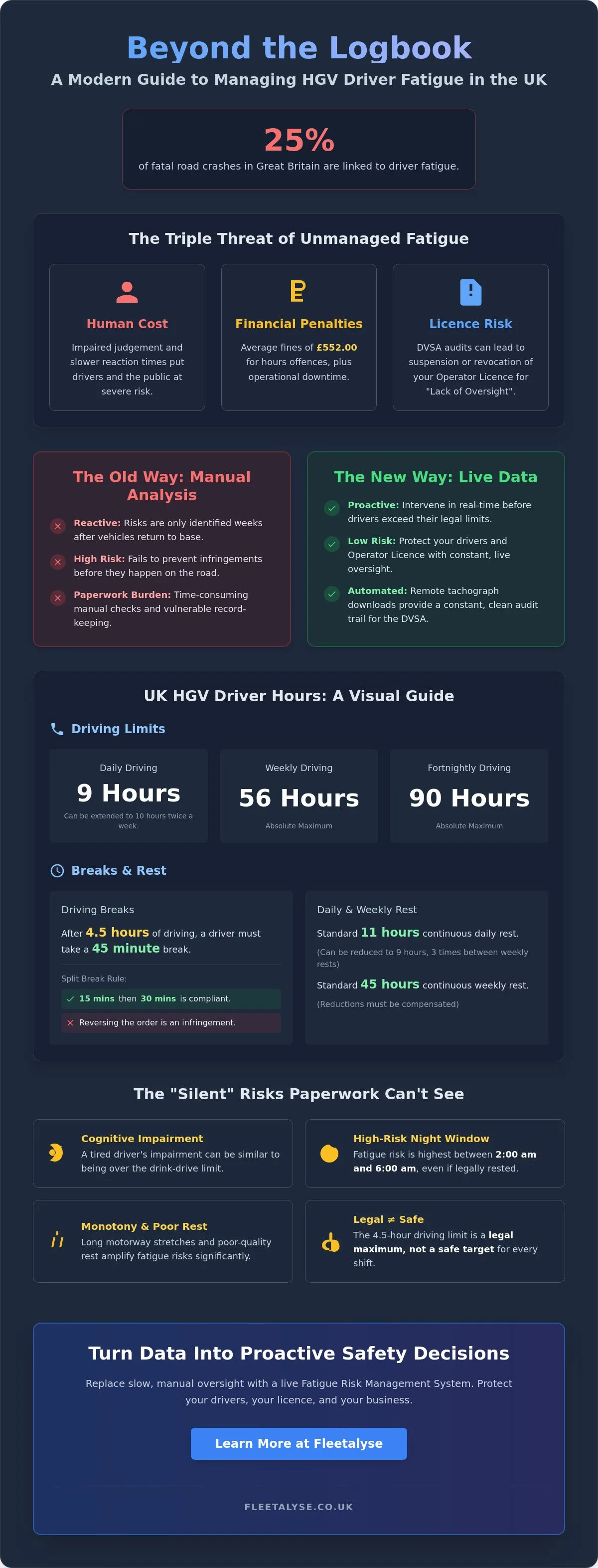
Fatigue is a silent killer because it impacts decision-making before physical sleepiness sets in. Research into the Effects of fatigue on safety shows that a tired driver's impairment can be similar to being over the drink-drive limit. Monotonous motorways, night shifts between 2:00 am and 6:00 am, and poor rest quality exacerbate this risk. A driver might be "legal" according to their tachograph but still be completely unfit to drive. You need to distinguish between technical compliance and actual safety. If a tired driver causes a fatal accident, they can face up to 14 years in prison. As an operator, your systems must be strong enough to prevent that journey from ever starting. You can find more about integrating these safety checks at fleetalyse.co.uk.
Core HGV Driver Rest Rules and Tachograph Compliance
The standard daily driving limit is 9 hours. You can extend this to 10 hours twice a week, but the weekly limit of 56 hours and the fortnightly limit of 90 hours remain absolute. These figures aren't just administrative hurdles. They're the baseline for safe operation. Department for Transport research confirms that structured rest is the most effective way to combat cognitive decline behind the wheel. Your digital tachograph is the primary tool for managing driver fatigue regulations UK. It must accurately distinguish between "Other Work" and "Rest" to provide a true picture of driver exhaustion levels.
Daily rest usually requires 11 continuous hours. You can reduce this to 9 hours three times between any two weekly rest periods. However, relying on reduced rest as a standard practice is a shortcut to operational risk. Weekly rest is equally rigid. A regular 45-hour rest is required, though it can be reduced to 24 hours every other week. Any reduction must be compensated by an equivalent period of rest taken en bloc before the end of the third week following the week in question. Managing these rolling deadlines requires total transparency over your fleet's data.
Managing Split Breaks and Daily Rest
Split breaks are a common source of unintended infringements. You can split the mandatory 45-minute break into two periods, but the order is fixed. It must be a 15-minute break followed by a 30-minute break. Reversing this order or taking two 22.5-minute breaks results in a "Failure to Take Breaks" violation. In multi-manning scenarios, the second driver can take a break whilst the vehicle is moving, provided they aren't assisting the person driving. Organising shift patterns to prioritise these rest windows prevents the "silent" fatigue that builds up over a long week.
Tachograph Misuse and Record-Keeping
The DVSA identifies "Failure to Take Breaks" as the most frequent compliance failure amongst UK haulage firms. Manual record-keeping is too slow for real transport operations. It leads to errors that only surface weeks after the event. The DVSA increasingly uses sophisticated tools to spot tachograph manipulation during a remote tachograph download. They look for "missing kilometres" and unexplained "other work" entries. If you're ready to move beyond manual analysis and take control of your compliance, you can explore our integrated tracking solutions. Visibility is the only way to ensure your drivers are actually resting when the tachograph says they are.

Manual Oversight vs Live Driver Hours Tracking
Manual tachograph downloads are a relic of a slower era. If you only see your driver data 28 days after the event, you aren't managing safety; you're managing history. Reactive compliance means you're identifying risks that have already passed, which does nothing to prevent an accident on today's shift. Managing driver fatigue regulations UK effectively requires a move away from the filing cabinet and towards real-time operational oversight. The administrative burden of manual collection is also a hidden drain on your profits. A typical fleet of 20 vehicles can consume up to 15 hours of office time every month just for data retrieval and basic analysis. Automated systems eliminate this waste.
Live tracking also changes the psychological dynamic within the cab. When drivers know their hours are visible in real-time, it builds a culture of shared responsibility. It's no longer just the driver's job to watch the clock. The transport office becomes a partner in safety. This visibility ensures that the 4.5-hour driving limit is respected, not because of a fear of fines, but because the system makes it impossible to ignore. It's about moving from a "catch them out" mentality to a "keep them safe" strategy.
The Problem with Reactive Compliance
Finding an infringement weeks later is a dangerous "audit trail" trap. If a DVSA investigator spots a pattern of fatigue-related errors during an office audit, "I didn't know" is not a valid defence. Reactive systems hide systemic issues, like poorly planned routes that consistently force drivers to skip breaks. This lack of oversight puts your Operator Licence at immediate risk. You can't fix a fatigue issue that occurred three weeks ago, but the Traffic Commissioner can certainly punish you for it today. It's a gamble that real transport operations can't afford to take.
The Benefits of Live Visibility
Live visibility allows for immediate intervention. Transport managers can receive automated alerts when a driver is 15 minutes away from their mandatory break. Using live driver hours enables you to optimise route planning on the fly. If a driver is delayed in traffic, you can see exactly how much driving time they have left before they must stop. This prevents the stress of "racing the clock," which is a primary cause of driver fatigue. It creates total transparency, ensuring that safety and productivity work together rather than against each other.
Implementing a Fatigue Risk Management System (FRMS)
An FRMS is a data-driven system that manages safety risks more effectively than basic hours monitoring. It bridges the gap between following the law and actually managing safety. Managing driver fatigue regulations UK requires more than just ticking boxes on a compliance sheet. You need a continuous cycle of improvement. This involves four distinct steps: profiling your specific risks, designing safer work patterns, fostering a reporting culture, and using data to act on trends. It's a proactive approach that treats fatigue as a manageable hazard rather than an unavoidable accident.
- Step 1: Profile Risks. Identify high-risk shifts, such as night work between 2:00 am and 6:00 am, or monotonous long-haul motorway routes.
- Step 2: Design Patterns. Organise rotas to favour natural circadian rhythms. Avoid "backward-rotating" shifts where start times get earlier each day.
- Step 3: Just Culture. Create an environment where drivers feel safe to report they are too tired to drive. Safety must come before the schedule.
- Step 4: Check and Act. Use telematics to close the loop. If the data shows a spike in infringements on a specific route, change the route.
Risk Assessment for Road Transport
Your risk assessment must look beyond the driver's seat. Safety-critical roles include transport managers and dispatchers who set the pace of the operation. Monotonous motorway driving is a well-known trigger, but complex urban delivery routes present different fatigue triggers due to constant stop-start stress. Don't overlook the "commute gap." If a driver has a 60-minute commute to the depot before a 10-hour shift, their total wakefulness period is already dangerously extended. Effective managing driver fatigue regulations UK means accounting for these hidden hours in your risk profile.
Training and Behavioural Monitoring
Toolbox talks shouldn't be boring lectures. Use them to share real data on fleet fatigue trends and explain the biological signs of exhaustion. Modern telematics provide secondary indicators that a driver is struggling. Harsh braking, erratic steering, or sudden lane departures often signal a drop in concentration before a sleep event occurs. By using tachograph analysis integration, you can identify repeat offenders who consistently push their legal limits. This allows you to provide targeted training and support. If you want to move from reactive paperwork to real-time safety decisions, Ready to Take Control.
Fleetalyse: Turning Fleet Data into Safety Decisions
Fleetalyse is built for Real Transport Operations. We aren't just another tracking company. We understand that managing driver fatigue regulations UK is about more than just dots on a map. It's about protecting your drivers and your operator licence with precise, actionable data. Our system provides automated remote tachograph downloads that ensure your compliance records are always up to date. You don't have to chase drivers for cards or manually upload files. The data flows directly from the vehicle to our platform, allowing you to focus on running your business. We provide the visibility you need to make informed safety decisions in real-time.
We believe in total transparency. That's why we offer clear pricing and a fee-free lease model for our hardware. There are no hidden costs or complex contracts that tie you down. This straightforward approach supports UK hauliers of all sizes, from single-vehicle owner-operators to large commercial fleets. By removing the financial and administrative barriers to high-quality data, we act as a no-nonsense expert partner in your safety strategy. Our goal is to make professional compliance accessible to every operator on British roads.
Plug & Play Compliance Solutions
Our hardware is designed for quick, seamless integration. It plugs directly into existing HGV and van systems without requiring extensive downtime. Once connected, you get live driver hours data alongside GPS asset location. This combination is powerful. You can see exactly where your vehicles are and, more importantly, how much driving time each operator has left. It reduces administrative overhead whilst significantly improving your readiness for a DVSA audit. You move from guessing to knowing. It's a plug and play connection to a safer, more efficient fleet.
Ready to Take Control?
The transition from paper-heavy manual systems to data-led management is the biggest step you can take for fleet safety. It replaces the stress of potential infringements with the peace of mind that comes from total transparency. You've seen how fatigue impacts road safety and how the legal framework demands active oversight. Managing driver fatigue regulations UK effectively means implementing the tools that make that oversight possible without the manual grind. Stop managing history and start managing your real-time operation. Enquire about our Remote Tachograph Download solutions today and see the difference that professional visibility makes to your bottom line.
Take Control of Your Fleet’s Safety Today
Effective managing driver fatigue regulations UK requires a shift from recording history to managing real-time risks. You've seen how identifying fatigue before it results in a £756.26 average fine for tachograph offences protects both your drivers and your operator licence. By moving away from manual oversight and adopting a proactive Fatigue Risk Management System, you eliminate the "audit trail" trap that leaves 25% of fatal crashes linked to driver exhaustion. Reactive paperwork is no longer enough for modern logistics.
Fleetalyse is built for Real Transport Operations, providing the visibility needed to turn fleet data into safety decisions. We support your business with a fee-free hardware lease model and specialist UK-based compliance support. This ensures you have the professional tools required to maintain a clean record whilst protecting your bottom line. Total transparency isn't just a goal; it's an operational necessity on British roads.
Secure your fleet with real-time compliance tracking from Fleetalyse. Taking this step today ensures your transport operation remains resilient, compliant, and ready for the road ahead.
Frequently Asked Questions
What are the main UK regulations for managing driver fatigue?
The primary frameworks are the EU Drivers’ Hours rules and the GB Domestic rules. These are supported by the Health and Safety at Work etc. Act 1974, which requires employers to manage workplace risks. Highway Code Rule 91 also places a legal duty on drivers to ensure they are fit for duty. Simply following hours limits isn't enough; you must actively prevent exhaustion across your fleet.
How often should I download tachograph data to stay compliant?
Legally, you must download driver card data every 28 days and vehicle unit data every 90 days. However, waiting for these deadlines makes managing driver fatigue regulations UK a reactive process. Most professional operators now use remote downloads to access data daily. This ensures you identify potential infringements or fatigue patterns immediately rather than weeks after the risk has passed.
Can a transport manager be held personally liable for driver fatigue accidents?
Yes, transport managers face significant personal risk. If a fatigue-related fatal accident occurs, you can be prosecuted for corporate manslaughter or gross negligence if a "Lack of Oversight" is proven. The Traffic Commissioner can also permanently revoke your professional competence. With fatigue causing up to 20% of all road crashes, the legal system demands robust, documented management systems.
What is the "4.5-hour rule" in HGV driving?
This rule mandates a 45-minute break after 4.5 hours of continuous driving. You can split this into a 15-minute break followed by a 30-minute break, but the order cannot be reversed. It's a hard limit designed to combat cognitive decline. Treating this limit as a target is dangerous; safety often requires breaks much earlier depending on the driver's condition.
How does remote tachograph download help with fatigue management?
Remote downloads provide live visibility into a driver's current shift status. Instead of relying on manual checks, transport managers receive real-time data on driving time, breaks, and rest periods. This total transparency allows for immediate intervention if a driver is approaching their limit. It turns fleet data into proactive safety decisions that prevent accidents before they happen.
What should a driver do if they feel fatigued but haven’t reached their legal limit?
The driver must stop in a safe place immediately. Legal limits are the absolute maximum, but they don't account for individual health or sleep quality. Under the Health and Safety at Work Act, a driver is responsible for their fitness to drive. Continuing whilst tired can lead to a charge of causing death by dangerous driving, which carries a 14-year prison sentence.
Is live driver hours tracking legal under UK privacy laws?
Yes, it's legal provided you have a legitimate business interest and inform your staff. Managing road safety and ensuring regulatory compliance are valid reasons for data collection under UK GDPR. You must be transparent about what data is tracked and how it's used. Most drivers appreciate the system when it's framed as a tool for their own safety and protection.
What are the penalties for breaching drivers’ hours regulations in the UK?
The DVSA issues on-the-spot fixed penalties, with average fines for hours offences reaching £552.00 in early 2026. Serious or repeated breaches can lead to court-imposed fines of up to £5,000 per violation. Beyond the financial cost, your operator licence is at risk. The Traffic Commissioner has the power to suspend your entire operation if they find systemic failures in your fatigue management.
Frequently asked questions
The Legal Duty of UK Transport Operators
Your Operator Licence is a contract with the Traffic Commissioner. It mandates that you keep vehicles safe and drivers healthy. Under the Health and Safety at Work etc. Act 1974, you have a legal duty to manage the risks of fatigue. Compliance isn't just about avoiding a £552.00 average fine for hours offences. It's about preventing "Lack of Oversight" charges during a DVSA office audit. If you can't prove you're actively monitoring driver welfare, you're liable for their actions on the road. Real transport operations require real-time visibility to meet these obligations.
Why 4.5 Hours Is Not Always "Safe"
Fatigue is a silent killer because it impacts decision-making before physical sleepiness sets in. Research into the Effects of fatigue on safety shows that a tired driver's impairment can be similar to being over the drink-drive limit. Monotonous motorways, night shifts between 2:00 am and 6:00 am, and poor rest quality exacerbate this risk. A driver might be "legal" according to their tachograph but still be completely unfit to drive. You need to distinguish between technical compliance and actual safety. If a tired driver causes a fatal accident, they can face up to 14 years in prison. As an operator, your systems must be strong enough to prevent that journey from ever starting. You can find more about integrating these safety checks at fleetalyse.co.uk. The standard daily driving limit is 9 hours. You can extend this to 10 hours twice a week, but the weekly limit of 56 hours and the fortnightly limit of 90 hours remain absolute. These figures aren't just administrative hurdles. They're the baseline for safe operation. Department for Transport research confirms that structured rest is the most effective way to combat cognitive decline behind the wheel. Your digital tachograph is the primary tool for managing driver fatigue regulations UK. It must accurately distinguish between "Other Work" and "Rest" to provide a true picture of driver exhaustion levels. Daily rest usually requires 11 continuous hours. You can reduce this to 9 hours three times between any two weekly rest periods. However, relying on reduced rest as a standard practice is a shortcut to operational risk. Weekly rest is equally rigid. A regular 45-hour rest is required, though it can be reduced to 24 hours every other week. Any reduction must be compensated by an equivalent period of rest taken en bloc before the end of the third week following the week in question. Managing these rolling deadlines requires total transparency over your fleet's data.
Managing Split Breaks and Daily Rest
Split breaks are a common source of unintended infringements. You can split the mandatory 45-minute break into two periods, but the order is fixed. It must be a 15-minute break followed by a 30-minute break. Reversing this order or taking two 22.5-minute breaks results in a "Failure to Take Breaks" violation. In multi-manning scenarios, the second driver can take a break whilst the vehicle is moving, provided they aren't assisting the person driving. Organising shift patterns to prioritise these rest windows prevents the "silent" fatigue that builds up over a long week.
Tachograph Misuse and Record-Keeping
The DVSA identifies "Failure to Take Breaks" as the most frequent compliance failure amongst UK haulage firms. Manual record-keeping is too slow for real transport operations. It leads to errors that only surface weeks after the event. The DVSA increasingly uses sophisticated tools to spot tachograph manipulation during a remote tachograph download. They look for "missing kilometres" and unexplained "other work" entries. If you're ready to move beyond manual analysis and take control of your compliance, you can explore our integrated tracking solutions. Visibility is the only way to ensure your drivers are actually resting when the tachograph says they are. Manual tachograph downloads are a relic of a slower era. If you only see your driver data 28 days after the event, you aren't managing safety; you're managing history. Reactive compliance means you're identifying risks that have already passed, which does nothing to prevent an accident on today's shift. Managing driver fatigue regulations UK effectively requires a move away from the filing cabinet and towards real-time operational oversight. The administrative burden of manual collection is also a hidden drain on your profits. A typical fleet of 20 vehicles can consume up to 15 hours of office time every month just for data retrieval and basic analysis. Automated systems eliminate this waste. Live tracking also changes the psychological dynamic within the cab. When drivers know their hours are visible in real-time, it builds a culture of shared responsibility. It's no longer just the driver's job to watch the clock. The transport office becomes a partner in safety. This visibility ensures that the 4.5-hour driving limit is respected, not because of a fear of fines, but because the system makes it impossible to ignore. It's about moving from a "catch them out" mentality to a "keep them safe" strategy.
The Problem with Reactive Compliance
Finding an infringement weeks later is a dangerous "audit trail" trap. If a DVSA investigator spots a pattern of fatigue-related errors during an office audit, "I didn't know" is not a valid defence. Reactive systems hide systemic issues, like poorly planned routes that consistently force drivers to skip breaks. This lack of oversight puts your Operator Licence at immediate risk. You can't fix a fatigue issue that occurred three weeks ago, but the Traffic Commissioner can certainly punish you for it today. It's a gamble that real transport operations can't afford to take.
The Benefits of Live Visibility
Live visibility allows for immediate intervention. Transport managers can receive automated alerts when a driver is 15 minutes away from their mandatory break. Using live driver hours enables you to optimise route planning on the fly. If a driver is delayed in traffic, you can see exactly how much driving time they have left before they must stop. This prevents the stress of "racing the clock," which is a primary cause of driver fatigue. It creates total transparency, ensuring that safety and productivity work together rather than against each other. An FRMS is a data-driven system that manages safety risks more effectively than basic hours monitoring. It bridges the gap between following the law and actually managing safety. Managing driver fatigue regulations UK requires more than just ticking boxes on a compliance sheet. You need a continuous cycle of improvement. This involves four distinct steps: profiling your specific risks, designing safer work patterns, fostering a reporting culture, and using data to act on trends. It's a proactive approach that treats fatigue as a manageable hazard rather than an unavoidable accident.
Risk Assessment for Road Transport
Your risk assessment must look beyond the driver's seat. Safety-critical roles include transport managers and dispatchers who set the pace of the operation. Monotonous motorway driving is a well-known trigger, but complex urban delivery routes present different fatigue triggers due to constant stop-start stress. Don't overlook the "commute gap." If a driver has a 60-minute commute to the depot before a 10-hour shift, their total wakefulness period is already dangerously extended. Effective managing driver fatigue regulations UK means accounting for these hidden hours in your risk profile.
Training and Behavioural Monitoring
Toolbox talks shouldn't be boring lectures. Use them to share real data on fleet fatigue trends and explain the biological signs of exhaustion. Modern telematics provide secondary indicators that a driver is struggling. Harsh braking, erratic steering, or sudden lane departures often signal a drop in concentration before a sleep event occurs. By using tachograph analysis integration, you can identify repeat offenders who consistently push their legal limits. This allows you to provide targeted training and support. If you want to move from reactive paperwork to real-time safety decisions, Ready to Take Control. Fleetalyse is built for Real Transport Operations. We aren't just another tracking company. We understand that managing driver fatigue regulations UK is about more than just dots on a map. It's about protecting your drivers and your operator licence with precise, actionable data. Our system provides automated remote tachograph downloads that ensure your compliance records are always up to date. You don't have to chase drivers for cards or manually upload files. The data flows directly from the vehicle to our platform, allowing you to focus on running your business. We provide the visibility you need to make informed safety decisions in real-time. We believe in total transparency. That's why we offer clear pricing and a fee-free lease model for our hardware. There are no hidden costs or complex contracts that tie you down. This straightforward approach supports UK hauliers of all sizes, from single-vehicle owner-operators to large commercial fleets. By removing the financial and administrative barriers to high-quality data, we act as a no-nonsense expert partner in your safety strategy. Our goal is to make professional compliance accessible to every operator on British roads.
Plug & Play Compliance Solutions
Our hardware is designed for quick, seamless integration. It plugs directly into existing HGV and van systems without requiring extensive downtime. Once connected, you get live driver hours data alongside GPS asset location. This combination is powerful. You can see exactly where your vehicles are and, more importantly, how much driving time each operator has left. It reduces administrative overhead whilst significantly improving your readiness for a DVSA audit. You move from guessing to knowing. It's a plug and play connection to a safer, more efficient fleet.
Ready to Take Control?
The transition from paper-heavy manual systems to data-led management is the biggest step you can take for fleet safety. It replaces the stress of potential infringements with the peace of mind that comes from total transparency. You've seen how fatigue impacts road safety and how the legal framework demands active oversight. Managing driver fatigue regulations UK effectively means implementing the tools that make that oversight possible without the manual grind. Stop managing history and start managing your real-time operation. Enquire about our Remote Tachograph Download solutions today and see the difference that professional visibility makes to your bottom line. Effective managing driver fatigue regulations UK requires a shift from recording history to managing real-time risks. You've seen how identifying fatigue before it results in a £756.26 average fine for tachograph offences protects both your drivers and your operator licence. By moving away from manual oversight and adopting a proactive Fatigue Risk Management System, you eliminate the "audit trail" trap that leaves 25% of fatal crashes linked to driver exhaustion. Reactive paperwork is no longer enough for modern logistics. Fleetalyse is built for Real Transport Operations, providing the visibility needed to turn fleet data into safety decisions. We support your business with a fee-free hardware lease model and specialist UK-based compliance support. This ensures you have the professional tools required to maintain a clean record whilst protecting your bottom line. Total transparency isn't just a goal; it's an operational necessity on British roads. Secure your fleet with real-time compliance tracking from Fleetalyse. Taking this step today ensures your transport operation remains resilient, compliant, and ready for the road ahead.
What are the main UK regulations for managing driver fatigue?
The primary frameworks are the EU Drivers’ Hours rules and the GB Domestic rules. These are supported by the Health and Safety at Work etc. Act 1974, which requires employers to manage workplace risks. Highway Code Rule 91 also places a legal duty on drivers to ensure they are fit for duty. Simply following hours limits isn't enough; you must actively prevent exhaustion across your fleet.
How often should I download tachograph data to stay compliant?
Legally, you must download driver card data every 28 days and vehicle unit data every 90 days. However, waiting for these deadlines makes managing driver fatigue regulations UK a reactive process. Most professional operators now use remote downloads to access data daily. This ensures you identify potential infringements or fatigue patterns immediately rather than weeks after the risk has passed.
Can a transport manager be held personally liable for driver fatigue accidents?
Yes, transport managers face significant personal risk. If a fatigue-related fatal accident occurs, you can be prosecuted for corporate manslaughter or gross negligence if a "Lack of Oversight" is proven. The Traffic Commissioner can also permanently revoke your professional competence. With fatigue causing up to 20% of all road crashes, the legal system demands robust, documented management systems.
What is the "4.5-hour rule" in HGV driving?
This rule mandates a 45-minute break after 4.5 hours of continuous driving. You can split this into a 15-minute break followed by a 30-minute break, but the order cannot be reversed. It's a hard limit designed to combat cognitive decline. Treating this limit as a target is dangerous; safety often requires breaks much earlier depending on the driver's condition.
How does remote tachograph download help with fatigue management?
Remote downloads provide live visibility into a driver's current shift status. Instead of relying on manual checks, transport managers receive real-time data on driving time, breaks, and rest periods. This total transparency allows for immediate intervention if a driver is approaching their limit. It turns fleet data into proactive safety decisions that prevent accidents before they happen.
What should a driver do if they feel fatigued but haven’t reached their legal limit?
The driver must stop in a safe place immediately. Legal limits are the absolute maximum, but they don't account for individual health or sleep quality. Under the Health and Safety at Work Act, a driver is responsible for their fitness to drive. Continuing whilst tired can lead to a charge of causing death by dangerous driving, which carries a 14-year prison sentence.
Is live driver hours tracking legal under UK privacy laws?
Yes, it's legal provided you have a legitimate business interest and inform your staff. Managing road safety and ensuring regulatory compliance are valid reasons for data collection under UK GDPR. You must be transparent about what data is tracked and how it's used. Most drivers appreciate the system when it's framed as a tool for their own safety and protection.
What are the penalties for breaching drivers’ hours regulations in the UK?
The DVSA issues on-the-spot fixed penalties, with average fines for hours offences reaching £552.00 in early 2026. Serious or repeated breaches can lead to court-imposed fines of up to £5,000 per violation. Beyond the financial cost, your operator licence is at risk. The Traffic Commissioner has the power to suspend your entire operation if they find systemic failures in your fatigue management.