

Could your UK Operator’s Licence survive a surprise DVSA inspection tomorrow morning? You're likely already feeling the pressure of the August 2025 deadline for Smart 2 retrofitting. Manual tachograph downloads are slow and frustrating. Missing a single deadline can trigger an audit that puts your entire fleet at risk. It's a constant battle to stay ahead of drivers’ hours infringements whilst keeping your vehicles on the road.
We understand the daily struggle of fleet management. This guide is built for real transport operations. It provides everything you need to secure your business by moving from manual guesswork to automated, 100% compliant data management. We'll explore the 2026 regulatory requirements, the shift to remote data collection, and how to gain clear visibility of driver availability. You'll learn how to keep your records audit-ready without the administrative headache.
Key Takeaways
- Audit your fleet hardware now to prepare for the 2026 Smart 2 mandate and ensure your vehicles remain compliant.
- Master UK driver hours regulations to protect your Operator’s Licence and avoid costly DVSA infringements.
- Automate data collection with remote tachograph downloads to eliminate manual errors and keep your drivers on the road.
- Implement a robust analysis strategy to turn raw compliance data into actionable insights for your transport operation.
Understanding the Tachograph: More Than Just a "Black Box"
The tachograph is the legal heartbeat of UK road transport compliance. It's far more than a simple recording device; it serves as the primary tool for ensuring road safety and fair competition across the haulage industry. What is a tachograph in a practical sense? It is a device that monitors vehicle speed, distance travelled, and specific driver activities to ensure compliance with rest requirements. Real transport operations rely on this data to stay on the right side of the law. Most heavy goods vehicles (HGVs) over 3.5 tonnes must carry one. The same applies to most passenger-carrying vehicles with more than nine seats. The industry has evolved rapidly, moving from old-fashioned analogue paper charts to digital systems and the latest Gen2 smart devices.
The Legal Requirement for UK Operators
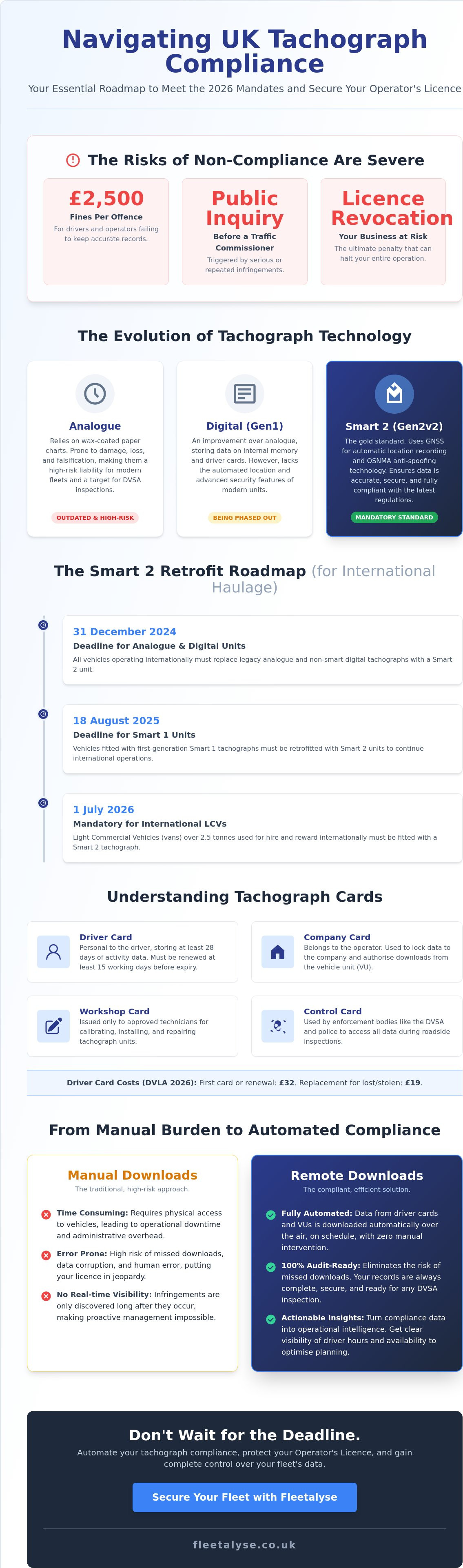
Your UK Operator’s Licence relies entirely on your ability to produce accurate tachograph records. It's the foundation of your professional standing. Failure to keep these records leads to severe consequences. Drivers and operators face fines of up to £2,500 for record-keeping offences. Serious or repeated breaches often lead to a Public Inquiry, where a Traffic Commissioner can suspend or revoke your licence entirely. The Retained EU Law (Revocation and Reform) Act 2023 ensures that previous EU transport regulations continue to govern UK roads as assimilated rules. Clear compliance. Total visibility. These aren't optional extras; they're operational necessities.
Maintaining this level of legal clarity is equally important when managing your physical assets. For transport operators looking to verify the status of their depots or future operating centres, Mynlis allows you to explore Regulated Personal Local Authority Search to ensure full property compliance and due diligence.
Tachograph Cards: Who Needs What?
Managing the different types of smart cards is a vital part of fleet administration. There are four distinct cards used in the UK system:
- Driver Cards: These are personal to the driver and store at least 28 days of activity data.
- Company Cards: These belong to the operator and are used to lock data and download information from the vehicle unit.
- Workshop Cards: Only issued to approved technicians for the purpose of calibrating and repairing units.
- Control Cards: Used by the DVSA and police to carry out roadside inspections.
Proactive management is key. You should apply for a card renewal at least 15 working days before the current one expires. If a card is lost, damaged, or stolen, the driver must notify the DVLA immediately and apply for a replacement within seven days. According to current DVLA standards for 2026, a first GB driver card or a renewal costs £32. If you need to replace a lost or stolen card, the fee is £19. Keeping these cards current ensures your fleet stays moving without legal interruptions.
Navigating UK Tachograph Regulations: From Analogue to Smart 2
Compliance isn't a static target. It's a moving parts operation. Fleet managers must know exactly what's under the dashboard to avoid heavy fines and PG9 prohibition notices. The transition from paper to satellite tracking represents the biggest shift in haulage since the 2006 digital mandate. Understanding the hardware evolution is the first step in future-proofing your business.
Analogue vs. Digital vs. Smart Tachographs
Analogue units rely on wax charts. They're a liability for modern operators. Physical charts are easily damaged, lost, or falsified, making them a primary target for DVSA inspections. Digital units improved this by storing data on internal memory and driver cards. However, the current gold standard is the Smart 2 tachograph.
Smart 2 hardware uses Global Navigation Satellite System (GNSS) technology to record locations automatically at the start and end of shifts, plus every three hours of driving. These units include sophisticated security features designed to prevent tampering. This includes OSNMA (Open Service Navigation Message Authentication) to stop GNSS spoofing. It's built for real transport operations, ensuring your data is accurate and resistant to external interference.
The 2026 Compliance Roadmap
The UK government has set firm deadlines for vehicles crossing international borders. If your fleet operates in the EU, you must follow the Smart tachograph 2 regulations. The rollout follows a strict schedule based on the age and type of your current equipment:
- 31 December 2024: Replace all non-smart digital and analogue units in vehicles used for international transport.
- 18 August 2025: Replace Smart 1 units in vehicles used for international transport.
- 1 July 2026: Mandatory fitment for LCVs (vans) over 2.5 tonnes used for hire and reward in international transport.
Managers should audit their current hardware immediately. Check the tachograph head for a Bluetooth icon or the "G2V2" marking to identify Smart 2 units. If you're running older kit, the retrofitting window is closing. Transitional Smart 2 units are currently available to bridge the gap before full satellite authentication features are fully active across the network.
Managing this transition requires clear visibility across your entire asset list. You can audit your current compliance status to see which vehicles need immediate upgrades. Don't wait for the 2025 rush. Hardware shortages are common during mandate shifts, and being proactive is the only way to maintain total transparency in your fleet operations.
Managing Driver Hours and Operator Licence Compliance
The tachograph exists to enforce the GB domestic and EU drivers' hours rules. These regulations ensure road safety by preventing driver fatigue. Compliance isn't optional; it's a core requirement of your Operator Licence. UK haulage operates under strict limits that every fleet manager must track with precision. Failure to monitor these leads to heavy fines and potential public inquiries.
- Daily Driving: Maximum 9 hours, extendable to 10 hours twice per week.
- Weekly Driving: Maximum 56 hours.
- Fortnightly Driving: Maximum 90 hours over any two consecutive weeks.
- Breaks: A 45-minute break is mandatory after 4.5 hours of driving. This can be split into a 15-minute break followed by a 30-minute break.
Rest periods are equally vital. Drivers need 11 hours of daily rest, though this can be reduced to 9 hours three times between weekly rests. Regular weekly rest must be 45 hours, but a reduced rest of 24 hours is permitted if the difference is compensated within three weeks. Analysis software highlights infringements such as "insufficient daily rest" or "exceeded daily driving" clearly on reports. Missing mileage is another common red flag. This suggests a vehicle moved without a card inserted, which is a major compliance risk.
The Role of the Transport Manager
Transport managers hold the legal responsibility for data integrity. You must download driver card data every 28 days and vehicle unit (VU) data every 90 days. It's a non-negotiable deadline. Beyond drivers' hours, you must also track the Working Time Directive (WTD). Unlike driving limits, WTD includes all "other work" like loading, cleaning, and administration. Total weekly working time can't exceed an average of 48 hours over a reference period, usually 17 or 26 weeks.
Preparing for a DVSA Audit
A DVSA officer can request your records at the roadside or during a site visit. They look for missing data gaps and patterns of repeated infringements. If you've joined the Earned Recognition scheme, you share performance data with the DVSA in exchange for fewer roadside stops. This requires 100% digital accuracy. When drivers perform work away from the vehicle, they must use manual entries on the tachograph. A "letter of attestation" is rarely used now; manual entries are the standard for recording sick leave or holidays. Keep your records clean. Good data management protects your O-Licence.
Manual vs. Remote Tachograph Downloads: Efficiency Gains
Traditional compliance management used to mean waiting for a driver to return to the office. This "driver-in-the-office" model is a bottleneck for modern logistics. Manual tachograph downloads require physical access to the vehicle, which pulls assets off the road and disrupts schedules. Remote technology removes this friction. By connecting hardware directly to the vehicle's CAN bus, data flows automatically from the cab to your desk without the vehicle ever needing to visit the depot.
Remote downloads are entirely unattended. The system collects data whilst the vehicle is working, whether it's on a delivery anywhere in the country or parked up at a motorway service station. This constant stream of information eliminates the administrative labour involved in chasing cards. It also removes the risk of missing data gaps that often occur when manual download schedules slip because of operational pressure.
The True Cost of Manual Data Collection
Manual data collection carries hidden costs that drain a fleet's profitability. You aren't just paying for the download. You're paying for vehicle downtime and driver wages. Admin staff often spend hours every week managing schedules and physically retrieving files. A fleet of 20 vehicles can lose 40 hours of productivity every month just to basic compliance tasks. This creates a cycle of "compliance chasing" at the end of every month that adds unnecessary stress to transport managers.
- Missing miles: Delayed downloads lead to data gaps that trigger DVSA red flags during audits.
- Compliance chasing: Transport managers spend roughly 15% of their working week chasing drivers for card downloads.
- Operational lag: Decisions are made on old data, not what's happening on the road right now.
Why Remote Download is Built for Real Transport Operations
Real-world haulage moves too fast for manual processes. Modern remote hardware uses a simple Plug & Play connection to integrate with the tachograph unit. Once installed, data is encrypted and sent via the GSM network directly to your analysis platform. It's secure, fast, and reliable. This is technology built for real transport operations, not just basic tracking.
The biggest operational gain is visibility through Live Driver Hours. You can see exactly how much drive time a driver has left in real-time. This isn't just a compliance tool; it's a planning asset. You can assign loads based on actual availability rather than guesswork. It's a system designed for the rigours of the UK road network, ensuring you stay compliant without slowing down your business.
Ready to automate your compliance? Discover how our remote download solutions save UK fleets time and money.
Implementing a Robust Tachograph Strategy for 2026
The 2026 deadline for Smart Tachograph Version 2 (G2V2) retrofitting is a critical milestone for UK operators. If your vehicles cross international borders, the clock is already ticking. Start with a comprehensive fleet audit. Identify which hardware versions are currently installed and schedule retrofits well ahead of the August 2025 and July 2026 cut-offs. Waiting until the final month leads to garage backlogs and unnecessary downtime.
Operational compliance requires more than just functional hardware. Drivers must be proficient in manual entries and mode selections. Errors here are the most common cause of avoidable fines. Implement a "No-Nonsense" debrief process. Address every infringement within 48 hours of the data download. This immediate feedback loop changes driver behaviour faster than a monthly report ever will. It's about creating a culture of accountability on the road.
Selecting the Right Analysis Partner
Choose a partner that prioritises ease of use and deep reporting. You need a platform that offers UK-based support from people who actually understand DVSA enforcement. Total transparency is vital. Avoid long-term contracts that lock you in for 60 months. Look for clear pricing models that don't hide "activation fees" or "extra module costs." Fleetalyse integrates with leading analysis software seamlessly. This connection ensures your tachograph data flows from the vehicle to the analyst without manual intervention, saving hours of administrative work every week.
The Synergy of Tacho and Telematics
Combining tachograph data with GPS tracking transforms how you manage a fleet. It's no longer enough to know where a truck is located. You need to know exactly how many minutes of drive time that specific driver has left before their next legal break. This real-time visibility prevents dispatchers from assigning jobs that would force a driver into an infringement. It's about proactive management, not reactive firefighting.
Integrating these data streams also provides insights into fuel efficiency and idle times. When you see how driving style impacts both compliance and costs, you can make informed decisions. High-performing fleets use this data to reward efficient drivers and target training where it's actually needed. Turn your raw data into a competitive advantage for your haulage business. Take control of your compliance with Fleetalyse.
Future-Proof Your Compliance Strategy
The road to 2026 requires more than reactive fixes. Transitioning to Smart 2 hardware and adopting remote tachograph downloads are essential steps to protect your Operator Licence. Manual data collection costs the average UK fleet significant time and increases the risk of human error. By automating these processes, you secure your data integrity whilst freeing up your team for more productive tasks. Compliance shouldn't be a burden; it's the foundation of a profitable haulage business.
Fleetalyse provides a no-nonsense approach to fleet management. Our systems are built for real transport operations, prioritising functional utility over flashy, unnecessary features. You'll benefit from total transparency with clear pricing and no hidden costs. We even offer fee-free hardware lease models to help you upgrade without heavy upfront capital expenditure. It's time to stop chasing data and start using it to drive your business forward.
Get a Transparent Quote for Remote Tachograph Downloads
Take the stress out of your 2026 planning and build a more resilient, compliant fleet today.
Frequently Asked Questions
How often must I download tachograph data for UK compliance?
You must download driver card data at least every 28 days and vehicle unit data every 90 days. These are the maximum legal intervals set by the DVSA. Many professional operators choose to download their tachograph data weekly to spot infringements before they become serious. Missing these strict deadlines leads to immediate compliance risks for your operator licence and potential regulatory action.
What is a Smart 2 tachograph and do I need one in 2026?
A Smart 2 tachograph is the latest hardware version featuring mandatory G2V2 technology for automated cross-border tracking. If you operate vehicles over 2.5 tonnes on international journeys, you'll need one fitted by July 2026. This deadline follows the August 2025 requirement for heavier HGVs. The technology ensures automatic recording of border crossings and loading activities to improve international transport transparency.
Can I drive an HGV without a driver card?
You cannot legally drive an HGV without a driver card unless your card is lost, stolen, or damaged. In these specific cases, you're permitted to drive for up to 15 calendar days whilst waiting for a replacement. You must produce daily printouts from the vehicle unit and sign them manually. Driving without a card for any other reason is a serious offence that triggers heavy penalties.
What are the fines for tachograph infringements in the UK?
Fixed penalties for tachograph infringements typically range from £100 to £300 per offence depending on the severity. However, serious cases involving record falsification can lead to unlimited fines or up to two years in prison. The DVSA issued over 20,000 fixed penalties during the 2022/23 period. These fines affect both the individual driver and the operator's standing with the Traffic Commissioner.
How does remote tachograph download actually work?
Remote download works by connecting a small telematics device to the vehicle's digital tachograph. This unit automatically pulls data from the driver card and vehicle head, sending it to your office via a secure mobile network. It removes the need for manual downloads or vehicle downtime. You get real-time compliance visibility without the vehicle ever needing to return to the depot for data collection.
What should I do if my tachograph driver card is lost or stolen?
You must notify the DVLA within seven days if your card is lost, stolen, or malfunctioning. Apply for a replacement immediately, which currently costs £19 for UK drivers. Whilst waiting for the new card, you're required to produce daily printouts from the tachograph at the start and end of every shift. Keep these signed records for 28 days to show to enforcement officers during roadside checks.
Is a tachograph required for vans under 3.5 tonnes?
Most vans under 3.5 tonnes don't need a tachograph for domestic UK work. However, if you're towing a trailer that brings the total outfit weight over 3.5 tonnes, a unit is usually required. From July 2026, vans between 2.5 and 3.5 tonnes used for hire or reward on international journeys must also be fitted with a Smart 2 device to meet new EU regulations.
How long must I keep tachograph records for the DVSA?
You must keep tachograph records for at least 12 months from the date they were recorded. The DVSA requires these for inspection to ensure you're following drivers' hours rules. Many UK fleets choose to keep them for 24 months to satisfy Working Time Directive audits and legal requirements. Digital backups should be stored securely and be easily accessible for unannounced inspections at your operating centre.
Frequently asked questions
The Legal Requirement for UK Operators
Your UK Operator’s Licence relies entirely on your ability to produce accurate tachograph records. It's the foundation of your professional standing. Failure to keep these records leads to severe consequences. Drivers and operators face fines of up to £2,500 for record-keeping offences. Serious or repeated breaches often lead to a Public Inquiry, where a Traffic Commissioner can suspend or revoke your licence entirely. The Retained EU Law (Revocation and Reform) Act 2023 ensures that previous EU transport regulations continue to govern UK roads as assimilated rules. Clear compliance. Total visibility. These aren't optional extras; they're operational necessities.
Tachograph Cards: Who Needs What?
Managing the different types of smart cards is a vital part of fleet administration. There are four distinct cards used in the UK system: Proactive management is key. You should apply for a card renewal at least 15 working days before the current one expires. If a card is lost, damaged, or stolen, the driver must notify the DVLA immediately and apply for a replacement within seven days. According to current DVLA standards for 2026, a first GB driver card or a renewal costs £32. If you need to replace a lost or stolen card, the fee is £19. Keeping these cards current ensures your fleet stays moving without legal interruptions. Compliance isn't a static target. It's a moving parts operation. Fleet managers must know exactly what's under the dashboard to avoid heavy fines and PG9 prohibition notices. The transition from paper to satellite tracking represents the biggest shift in haulage since the 2006 digital mandate. Understanding the hardware evolution is the first step in future-proofing your business.
Analogue vs. Digital vs. Smart Tachographs
Analogue units rely on wax charts. They're a liability for modern operators. Physical charts are easily damaged, lost, or falsified, making them a primary target for DVSA inspections. Digital units improved this by storing data on internal memory and driver cards. However, the current gold standard is the Smart 2 tachograph. Smart 2 hardware uses Global Navigation Satellite System (GNSS) technology to record locations automatically at the start and end of shifts, plus every three hours of driving. These units include sophisticated security features designed to prevent tampering. This includes OSNMA (Open Service Navigation Message Authentication) to stop GNSS spoofing. It's built for real transport operations, ensuring your data is accurate and resistant to external interference.
The 2026 Compliance Roadmap
The UK government has set firm deadlines for vehicles crossing international borders. If your fleet operates in the EU, you must follow the Smart tachograph 2 regulations. The rollout follows a strict schedule based on the age and type of your current equipment: Managers should audit their current hardware immediately. Check the tachograph head for a Bluetooth icon or the "G2V2" marking to identify Smart 2 units. If you're running older kit, the retrofitting window is closing. Transitional Smart 2 units are currently available to bridge the gap before full satellite authentication features are fully active across the network. Managing this transition requires clear visibility across your entire asset list. You can audit your current compliance status to see which vehicles need immediate upgrades. Don't wait for the 2025 rush. Hardware shortages are common during mandate shifts, and being proactive is the only way to maintain total transparency in your fleet operations. The tachograph exists to enforce the GB domestic and EU drivers' hours rules. These regulations ensure road safety by preventing driver fatigue. Compliance isn't optional; it's a core requirement of your Operator Licence. UK haulage operates under strict limits that every fleet manager must track with precision. Failure to monitor these leads to heavy fines and potential public inquiries. Rest periods are equally vital. Drivers need 11 hours of daily rest, though this can be reduced to 9 hours three times between weekly rests. Regular weekly rest must be 45 hours, but a reduced rest of 24 hours is permitted if the difference is compensated within three weeks. Analysis software highlights infringements such as "insufficient daily rest" or "exceeded daily driving" clearly on reports. Missing mileage is another common red flag. This suggests a vehicle moved without a card inserted, which is a major compliance risk.
The Role of the Transport Manager
Transport managers hold the legal responsibility for data integrity. You must download driver card data every 28 days and vehicle unit (VU) data every 90 days. It's a non-negotiable deadline. Beyond drivers' hours, you must also track the Working Time Directive (WTD). Unlike driving limits, WTD includes all "other work" like loading, cleaning, and administration. Total weekly working time can't exceed an average of 48 hours over a reference period, usually 17 or 26 weeks.
Preparing for a DVSA Audit
A DVSA officer can request your records at the roadside or during a site visit. They look for missing data gaps and patterns of repeated infringements. If you've joined the Earned Recognition scheme, you share performance data with the DVSA in exchange for fewer roadside stops. This requires 100% digital accuracy. When drivers perform work away from the vehicle, they must use manual entries on the tachograph. A "letter of attestation" is rarely used now; manual entries are the standard for recording sick leave or holidays. Keep your records clean. Good data management protects your O-Licence. Traditional compliance management used to mean waiting for a driver to return to the office. This "driver-in-the-office" model is a bottleneck for modern logistics. Manual tachograph downloads require physical access to the vehicle, which pulls assets off the road and disrupts schedules. Remote technology removes this friction. By connecting hardware directly to the vehicle's CAN bus, data flows automatically from the cab to your desk without the vehicle ever needing to visit the depot. Remote downloads are entirely unattended. The system collects data whilst the vehicle is working, whether it's on a delivery in Birmingham or parked up at a motorway service station. This constant stream of information eliminates the administrative labour involved in chasing cards. It also removes the risk of missing data gaps that often occur when manual download schedules slip because of operational pressure.
The True Cost of Manual Data Collection
Manual data collection carries hidden costs that drain a fleet's profitability. You aren't just paying for the download. You're paying for vehicle downtime and driver wages. Admin staff often spend hours every week managing schedules and physically retrieving files. A fleet of 20 vehicles can lose 40 hours of productivity every month just to basic compliance tasks. This creates a cycle of "compliance chasing" at the end of every month that adds unnecessary stress to transport managers.
Why Remote Download is Built for Real Transport Operations
Real-world haulage moves too fast for manual processes. Modern remote hardware uses a simple Plug & Play connection to integrate with the tachograph unit. Once installed, data is encrypted and sent via the GSM network directly to your analysis platform. It's secure, fast, and reliable. This is technology built for real transport operations, not just basic tracking. The biggest operational gain is visibility through Live Driver Hours. You can see exactly how much drive time a driver has left in real-time. This isn't just a compliance tool; it's a planning asset. You can assign loads based on actual availability rather than guesswork. It's a system designed for the rigours of the UK road network, ensuring you stay compliant without slowing down your business. Ready to automate your compliance? Discover how our remote download solutions save UK fleets time and money. The 2026 deadline for Smart Tachograph Version 2 (G2V2) retrofitting is a critical milestone for UK operators. If your vehicles cross international borders, the clock is already ticking. Start with a comprehensive fleet audit. Identify which hardware versions are currently installed and schedule retrofits well ahead of the August 2025 and July 2026 cut-offs. Waiting until the final month leads to garage backlogs and unnecessary downtime. Operational compliance requires more than just functional hardware. Drivers must be proficient in manual entries and mode selections. Errors here are the most common cause of avoidable fines. Implement a "No-Nonsense" debrief process. Address every infringement within 48 hours of the data download. This immediate feedback loop changes driver behaviour faster than a monthly report ever will. It's about creating a culture of accountability on the road.
Selecting the Right Analysis Partner
Choose a partner that prioritises ease of use and deep reporting. You need a platform that offers UK-based support from people who actually understand DVSA enforcement. Total transparency is vital. Avoid long-term contracts that lock you in for 60 months. Look for clear pricing models that don't hide "activation fees" or "extra module costs." Fleetalyse integrates with leading analysis software seamlessly. This connection ensures your tachograph data flows from the vehicle to the analyst without manual intervention, saving hours of administrative work every week.
The Synergy of Tacho and Telematics
Combining tachograph data with GPS tracking transforms how you manage a fleet. It's no longer enough to know where a truck is located. You need to know exactly how many minutes of drive time that specific driver has left before their next legal break. This real-time visibility prevents dispatchers from assigning jobs that would force a driver into an infringement. It's about proactive management, not reactive firefighting. Integrating these data streams also provides insights into fuel efficiency and idle times. When you see how driving style impacts both compliance and costs, you can make informed decisions. High-performing fleets use this data to reward efficient drivers and target training where it's actually needed. Turn your raw data into a competitive advantage for your haulage business. Take control of your compliance with Fleetalyse. The road to 2026 requires more than reactive fixes. Transitioning to Smart 2 hardware and adopting remote tachograph downloads are essential steps to protect your Operator Licence. Manual data collection costs the average UK fleet significant time and increases the risk of human error. By automating these processes, you secure your data integrity whilst freeing up your team for more productive tasks. Compliance shouldn't be a burden; it's the foundation of a profitable haulage business. Fleetalyse provides a no-nonsense approach to fleet management. Our systems are built for real transport operations, prioritising functional utility over flashy, unnecessary features. You'll benefit from total transparency with clear pricing and no hidden costs. We even offer fee-free hardware lease models to help you upgrade without heavy upfront capital expenditure. It's time to stop chasing data and start using it to drive your business forward. Get a Transparent Quote for Remote Tachograph Downloads Take the stress out of your 2026 planning and build a more resilient, compliant fleet today.
How often must I download tachograph data for UK compliance?
You must download driver card data at least every 28 days and vehicle unit data every 90 days. These are the maximum legal intervals set by the DVSA. Many professional operators choose to download their tachograph data weekly to spot infringements before they become serious. Missing these strict deadlines leads to immediate compliance risks for your operator licence and potential regulatory action.
What is a Smart 2 tachograph and do I need one in 2026?
A Smart 2 tachograph is the latest hardware version featuring mandatory G2V2 technology for automated cross-border tracking. If you operate vehicles over 2.5 tonnes on international journeys, you'll need one fitted by July 2026. This deadline follows the August 2025 requirement for heavier HGVs. The technology ensures automatic recording of border crossings and loading activities to improve international transport transparency.
Can I drive an HGV without a driver card?
You cannot legally drive an HGV without a driver card unless your card is lost, stolen, or damaged. In these specific cases, you're permitted to drive for up to 15 calendar days whilst waiting for a replacement. You must produce daily printouts from the vehicle unit and sign them manually. Driving without a card for any other reason is a serious offence that triggers heavy penalties.
What are the fines for tachograph infringements in the UK?
Fixed penalties for tachograph infringements typically range from £100 to £300 per offence depending on the severity. However, serious cases involving record falsification can lead to unlimited fines or up to two years in prison. The DVSA issued over 20,000 fixed penalties during the 2022/23 period. These fines affect both the individual driver and the operator's standing with the Traffic Commissioner.
How does remote tachograph download actually work?
Remote download works by connecting a small telematics device to the vehicle's digital tachograph. This unit automatically pulls data from the driver card and vehicle head, sending it to your office via a secure mobile network. It removes the need for manual downloads or vehicle downtime. You get real-time compliance visibility without the vehicle ever needing to return to the depot for data collection.
What should I do if my tachograph driver card is lost or stolen?
You must notify the DVLA within seven days if your card is lost, stolen, or malfunctioning. Apply for a replacement immediately, which currently costs £19 for UK drivers. Whilst waiting for the new card, you're required to produce daily printouts from the tachograph at the start and end of every shift. Keep these signed records for 28 days to show to enforcement officers during roadside checks.
Is a tachograph required for vans under 3.5 tonnes?
Most vans under 3.5 tonnes don't need a tachograph for domestic UK work. However, if you're towing a trailer that brings the total outfit weight over 3.5 tonnes, a unit is usually required. From July 2026, vans between 2.5 and 3.5 tonnes used for hire or reward on international journeys must also be fitted with a Smart 2 device to meet new EU regulations.
How long must I keep tachograph records for the DVSA?
You must keep tachograph records for at least 12 months from the date they were recorded. The DVSA requires these for inspection to ensure you're following drivers' hours rules. Many UK fleets choose to keep them for 24 months to satisfy Working Time Directive audits and legal requirements. Digital backups should be stored securely and be easily accessible for unannounced inspections at your operating centre.