


Telematics unit data explained: the UK fleet manager’s guide

Most UK fleet operators have telematics devices fitted to their vehicles. Far fewer are actually using the data those devices generate beyond watching dots move on a map. The result is predictable: missed fault warnings, unexpected breakdowns, driver hours infringements, and DVSA penalties that could have been avoided entirely. This guide covers telematics unit data explained in full, walking you through the six core data categories, tachograph compliance obligations, UK GDPR requirements, and how to turn raw telematics data insights into real operational improvements. If you manage vehicles for a living, this is worth reading carefully.
Table of Contents
- Understanding telematics unit data categories
- Key telematics data for driver hours and tachograph compliance
- Navigating UK vehicle tracking data privacy and GDPR compliance
- Using telematics data to improve safety and predictive maintenance
- A fresh look at telematics data: beyond raw numbers to actionable insight
- Optimise your fleet with Fleetalyse telematics and compliance solutions
- Frequently asked questions
Key Takeaways
| Point | Details |
|---|---|
| Six telematics data categories | Telematics units collect diagnostic, engine, fuel, transmission, electrical, and driver behaviour data crucial for fleet maintenance. |
| Tachograph compliance critical | Remote tachograph data downloads automate monitoring of driver hours and rest breaks, helping avoid costly fines. |
| Strict UK data privacy | Fleets must follow GDPR rules including consent, transparency, and limited data retention for telematics information. |
| Safety and maintenance gains | Data-driven coaching and predictive maintenance reduce accidents by 22% and lower unplanned downtime. |
| Automate telematics action | Integrating telematics data with your maintenance system dramatically speeds response to vehicle faults and improves fleet uptime. |
Understanding telematics unit data categories
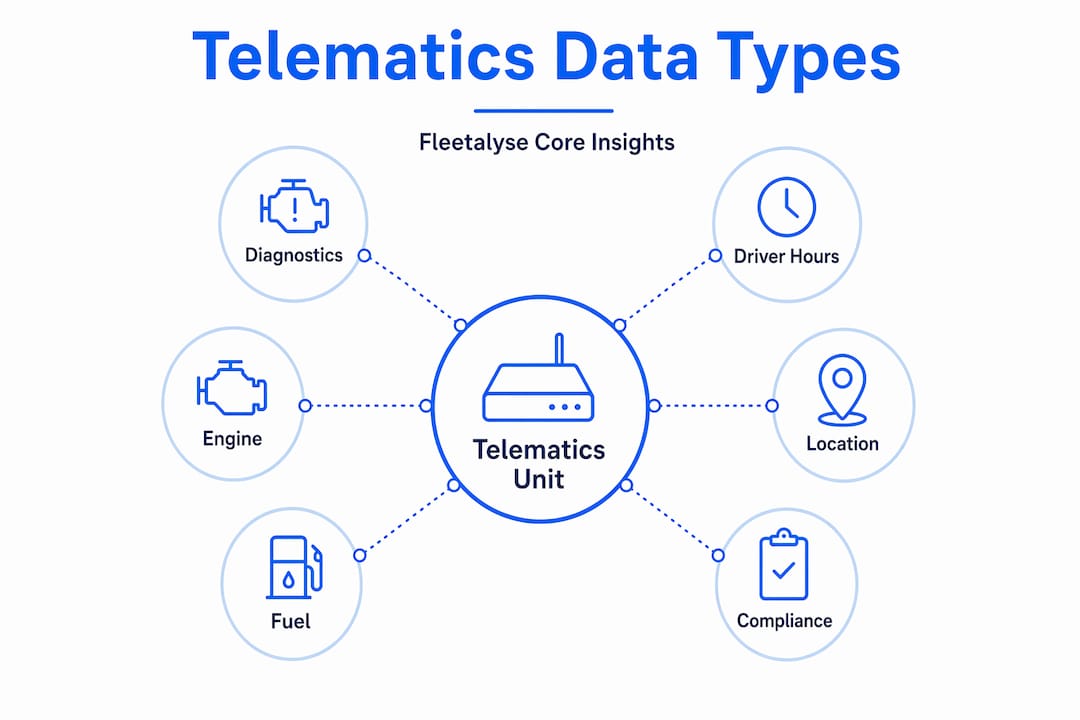
To fully grasp telematics data, it helps to understand the foundational data categories collected continuously by units installed in your vehicles. Most modern telematics units connect via OBD-II (for lighter vehicles) or J1939 (for HGVs and commercial vehicles), and the breadth of data they capture goes well beyond speed and location.
OBD-II and J1939 telematics data covers six distinct categories, each with specific maintenance and compliance implications:
- Diagnostic trouble codes (DTCs): These are fault codes generated when a vehicle’s onboard computer detects a problem. They fall into four types: P (powertrain), B (body), C (chassis), and U (network/communication). A P0300 code, for example, signals a random engine misfire, which left unaddressed can cause catalytic converter damage and MOT failure.
- Engine parameters: Coolant temperature, oil pressure, intake air temperature, and RPM data all have operational thresholds. Coolant temperature consistently above 105°C, for instance, is a reliable early indicator of a failing thermostat or head gasket issue.
- Fuel trims: Short-term and long-term fuel trim values reveal the health of injectors and the air-fuel mixture system. Persistent positive long-term fuel trims above +10% often indicate a vacuum leak or weak fuel injectors, signalling service is needed regardless of mileage.
- Transmission data: Automatic transmission fluid (ATF) temperature and gear shift quality metrics allow early detection of clutch pack wear or solenoid faults before they become costly failures.
- Electrical system data: Voltage irregularities and charging system faults frequently forewarn battery or alternator failures, which are among the most common causes of roadside breakdowns in commercial fleets.
- Driver behaviour wear indicators: Hard braking, aggressive acceleration, and high-speed cornering do not just affect safety scores. They accelerate brake pad wear, tyre degradation, and suspension stress, all of which telematics can quantify.
| Data category | What it monitors | Maintenance trigger |
|---|---|---|
| Diagnostic trouble codes | Fault codes across powertrain, body, chassis | Immediate or scheduled repair by code type |
| Engine parameters | Coolant temp, oil pressure, RPM | Threshold breach triggers service alert |
| Fuel trims | Air-fuel ratio, injector performance | Persistent deviation signals system service |
| Transmission data | ATF temp, shift quality | Early fault detection before failure |
| Electrical system | Voltage, charging system | Pre-emptive battery or alternator check |
| Driver behaviour | Braking, acceleration, cornering | Adjusted maintenance intervals per driver |
Understanding telematics units at this level changes how you approach vehicle maintenance. You move from fixed mileage-based schedules to condition-based servicing, which is both more accurate and more cost-effective.
Pro Tip: Configure your telematics platform to alert you when engine coolant temperature or oil pressure readings breach their normal operating range, not just when a DTC is generated. This gives you an earlier warning window before a fault code is even logged.
Key telematics data for driver hours and tachograph compliance
Beyond vehicle health, telematics also plays a critical role in recording driver hours and meeting UK regulatory standards. For any fleet operating HGVs or relevant LCVs, this is not optional territory.
Here is how telematics integrates with tachograph compliance in practice:
- Automated remote downloads: Telematics systems can pull tachograph data remotely, removing the need for drivers to physically hand in cards. This reduces the risk of missed downloads and keeps your compliance records current without manual chasing.
- Real-time hours monitoring: Your platform can flag when a driver is approaching their 4 hours 30 minutes continuous driving limit, prompting a break before an infringement occurs. The legal requirement is a minimum 45-minute break, which can be split into a 15-minute segment followed by a 30-minute segment.
- Mode selection accuracy: Telematics records whether drivers are correctly logging rest, availability, and work modes on the tachograph head unit. Incorrect mode entries are one of the most common causes of DVSA prohibition notices.
- Ferry and vehicle swap entries: Manual entries remain legally required when a driver boards a ferry or switches vehicles. Telematics can flag gaps in the record that may indicate a missed manual entry, helping you catch errors before an inspection.
- Smart tachograph obligations: As of mid-2026, smart tachographs are mandatory for HGVs in international operations and now extend to LCVs over 2.5 tonnes in international service. If your fleet crosses borders, this is a compliance requirement you cannot afford to overlook.
Pro Tip: Set your telematics compliance features to send automated alerts to both the driver and fleet manager when a driver is within 30 minutes of their maximum continuous driving time. This gives enough time to find a safe stopping point without breaching the limit.
The administrative burden of manual tachograph management is significant. Automating downloads and hours monitoring through telematics is one of the clearest efficiency gains available to UK fleet operators today.

Navigating UK vehicle tracking data privacy and GDPR compliance
Aside from data content, how you handle telematics data is equally important. UK law sets strict privacy and consent standards every fleet must follow, and the consequences of getting this wrong extend beyond fines to genuine damage to driver trust and retention.
Under UK GDPR, location and behavioural data collected by telematics units count as personal data. That means you need a lawful basis for collecting it, and “we fitted a tracker” is not sufficient on its own. Here is what compliance actually requires:
- Transparency: Drivers must be told what data is being collected, why it is being collected, who can access it, and how long it will be retained. This should be documented in a written privacy notice, not just mentioned verbally.
- Lawful basis: Most fleets rely on legitimate interests as their lawful basis, but this requires a Legitimate Interests Assessment (LIA) to be completed and documented. For more sensitive monitoring, written consent may be more appropriate.
- Data Protection Impact Assessment (DPIA): Where telematics monitoring is likely to result in high risk to individuals, a DPIA is legally required before you begin. This is particularly relevant for continuous location tracking.
- Retention limits: UK GDPR retention rules require routine GPS data to be held for no longer than 30 to 90 days, while tachograph records and delivery documentation may be retained for 12 to 24 months depending on their purpose. Holding data longer than necessary is a compliance breach.
- Privacy mode: Telematics systems should include a privacy mode or physical switch that disables tracking during a driver’s personal time. This is not just good practice; it aligns with obligations under the Human Rights Act regarding the right to a private life.
- Breach notification: If a data breach occurs, you have 72 hours to notify the ICO. Ensure your telematics provider has clear incident response procedures in place.
Pro Tip: Review your data privacy compliance documentation annually, not just at initial setup. Regulation evolves, and a DPIA completed three years ago may no longer reflect your current tracking practices or the data your system now captures.
Getting privacy right is not just about avoiding fines. Drivers who understand and trust how their data is used are more likely to engage positively with safety coaching and performance feedback.
Using telematics data to improve safety and predictive maintenance
With compliance and privacy established, leveraging telematics data for safety and maintenance unlocks tangible operational benefits. This is where the investment in telematics hardware genuinely pays back.
Driver safety scoring works by pulling event data from your telematics API, including harsh braking, rapid acceleration, speeding, and sharp cornering. Crucially, well-configured systems normalise these scores against route difficulty. A driver navigating a busy urban delivery route will naturally record more braking events than one on a motorway run. Scoring without this adjustment is unfair and leads to driver disengagement.
“Fleets applying data-driven safety coaching have seen a 22% reduction in reportable accidents, with route-adjusted scoring ensuring feedback is fair and actionable rather than punitive.”
That reduction translates directly into lower insurance premiums, fewer vehicle off-road days, and reduced exposure to civil liability. For a fleet of 50 vehicles, the financial impact is substantial.
Predictive maintenance is where vehicle telematics explained properly starts to look genuinely transformative. Rather than servicing vehicles on a fixed mileage or time schedule, you use engine parameters, DTC patterns, and driver behaviour data to adjust intervals per vehicle and per driver. A vehicle driven hard on urban routes needs more frequent brake inspections than one covering motorway miles. Telematics tells you which is which.
| Maintenance approach | Trigger | Typical outcome |
|---|---|---|
| Reactive | Vehicle breaks down | High repair cost, unplanned downtime |
| Scheduled (mileage-based) | Fixed interval regardless of condition | Over-servicing or under-servicing |
| Predictive (telematics-driven) | Data threshold or fault pattern | Planned service, lower cost, less downtime |
Automated CMMS (Computerised Maintenance Management System) integration takes this further. When a DTC is detected, the system can automatically raise a work order, notify the workshop, and check parts availability, all without manual intervention. Connecting your telematics safety tools to your maintenance workflow closes the gap between data and action.
Pro Tip: Set DTC severity thresholds in your telematics platform so that critical fault codes trigger an immediate alert and work order, while advisory codes are batched into the next scheduled service. This prevents alert fatigue while ensuring nothing urgent is missed.
A fresh look at telematics data: beyond raw numbers to actionable insight
Here is an uncomfortable truth that most telematics vendors will not tell you directly. The majority of fleets that invest in telematics hardware are not getting close to the value the technology can deliver. Not because the hardware is inadequate, but because the data sits in a dashboard that nobody has time to analyse properly.
Fault codes wait days before triggering a work order. Delayed DTC responses are one of the most common causes of avoidable breakdowns in commercial fleets, and the root cause is almost always the same: no automated pathway from data to action. A fleet manager sees a fault code notification, adds it to a mental list, and by the time it reaches the workshop, the vehicle has done another 800 miles on a failing component.
The fix is not more dashboards. It is integration. When your telematics platform connects directly to your CMMS, your procurement system, and your driver communication tools, data stops being something you look at and becomes something that acts on your behalf. A coolant temperature alert raises a work order. A fuel trim deviation orders a diagnostic appointment. A driver behaviour score triggers a coaching message. None of this requires a human to notice it first.
This is also where the importance of telematics data configuration becomes clear. Generic out-of-the-box alert thresholds are almost always wrong for your specific vehicles and duty cycles. An HGV running a quarry route has a very different normal operating range for engine temperature than a refrigerated van doing overnight supermarket deliveries. Tailoring your alert configuration to vehicle type and duty cycle is not a nice-to-have. It is the difference between telematics that genuinely protects your fleet and telematics that generates noise you learn to ignore.
Integrating telematics with procurement also closes a loop that most fleets leave open. When a fault code triggers a work order and that work order automatically checks parts stock and raises a purchase order if needed, your average repair turnaround time drops significantly. That is vehicle availability back in your hands.
The fleets getting the most from advanced telematics integration are not necessarily the largest or the most technically sophisticated. They are the ones that have moved beyond viewing data to building workflows around it. That shift in mindset is worth more than any hardware upgrade.
Optimise your fleet with Fleetalyse telematics and compliance solutions
Having explored how telematics data can transform fleet management, Fleetalyse offers practical tools to put these insights into daily practice. The platform brings together GPS tracking, driver behaviour monitoring, and smart dashcam footage in a single, unified interface, so you are not piecing together data from multiple disconnected systems.
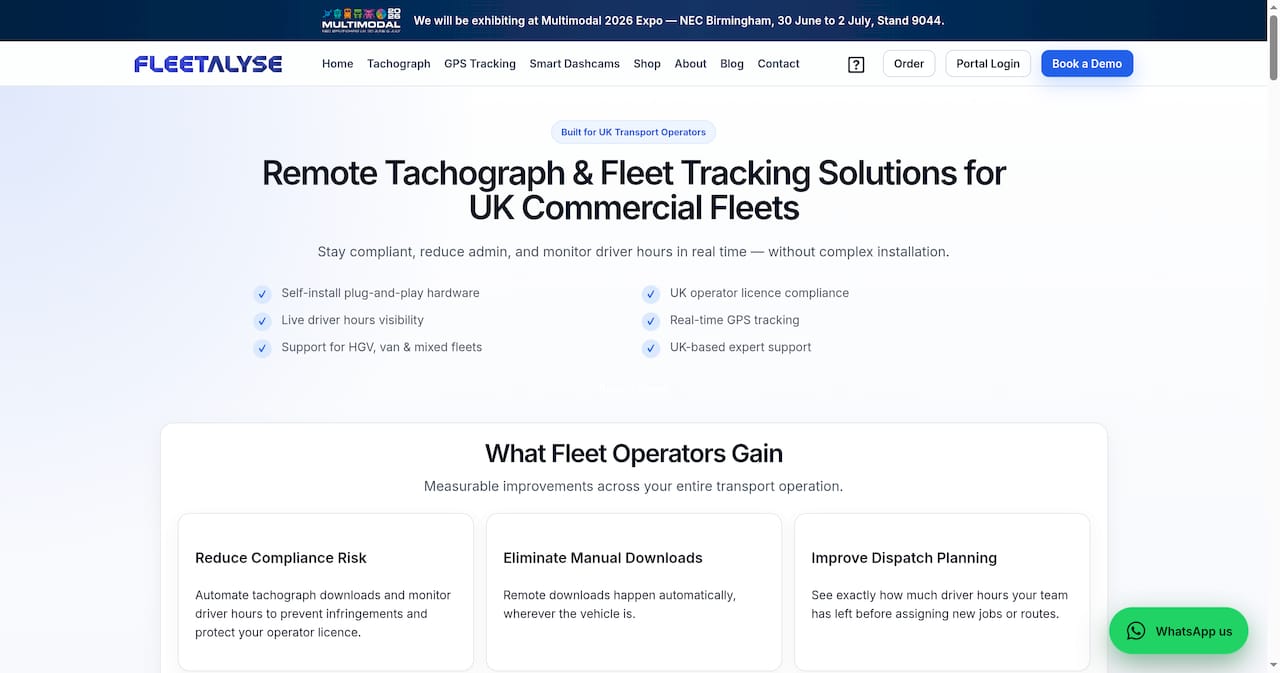
Automated alerts and CMMS integration mean that when a fault code appears or a driver behaviour threshold is breached, your team receives an actionable notification rather than a raw data point. Remote tachograph downloads and digital compliance management reduce the administrative burden on your compliance officers, helping your fleet meet UK and EU driver hours regulations without the paperwork mountain. Fleetalyse also includes privacy mode settings designed to comply with UK GDPR, ensuring driver data is handled lawfully without compromising operational visibility. Explore the full range of Fleetalyse GPS trackers and dashcams or visit the Fleetalyse telematics platform to see how it fits your fleet’s specific compliance and safety requirements.
Frequently asked questions
What types of data do telematics units collect beyond GPS location?
Telematics units collect diagnostic fault codes, engine parameters, fuel system data, transmission status, electrical system health, and driver behaviour metrics in addition to GPS location data. Each category serves a distinct purpose in vehicle maintenance and fleet compliance management.
How do smart tachographs improve driver hours compliance?
Smart tachographs automate the recording of driving and rest periods, significantly reducing manual entry errors and enabling remote data downloads for efficient compliance management. As of mid-2026, smart tachographs are mandatory for UK HGVs and for LCVs over 2.5 tonnes operating internationally.
What privacy rules must UK fleets follow when using telematics?
UK fleets must obtain a lawful basis for tracking, be fully transparent with drivers about data use, limit retention periods, and conduct Data Protection Impact Assessments where required. UK GDPR rules also require breach notification to the ICO within 72 hours and retention of routine GPS data for no longer than 30 to 90 days.
How can telematics data help reduce fleet accidents?
Telematics data monitors harsh braking, acceleration, and speeding events, enabling targeted driver coaching that has been shown to reduce reportable accidents by 22% when scoring is adjusted fairly for route difficulty. Consistent coaching based on real driving data builds safer habits over time.
What is predictive maintenance in the context of telematics?
Predictive maintenance uses telematics fault codes and engine parameter data to forecast when a component is likely to fail, allowing you to schedule servicing before a breakdown occurs rather than reacting after the fact. This approach reduces both repair costs and unplanned vehicle downtime.