


Would you risk a £5,000 fine because your 3.5-tonne van crossed the border without a specific piece of hardware? For many operators, the van tachograph uk rules feel like a moving target that threatens to turn a profitable international delivery into a legal nightmare. You likely chose a van fleet to avoid the heavy administrative burden of HGVs. Now, new regulations are closing that gap and adding layers of complexity to your daily operations.
It's a frustrating shift, but staying compliant doesn't have to be a manual chore. This guide helps you master the complex world of UK van tachograph regulations, from current weight limits to the critical July 1, 2026 international mandates. We will clarify which vehicles require a Smart Tachograph 2 and how to calculate weight for van and trailer combinations. You will learn how to automate data downloads and maintain audit-ready records, ensuring your fleet stays on the road and out of the DVSA's spotlight.
Key Takeaways
- Identify if your international operations fall under the July 2026 mandate for vans over 2.5 tonnes to avoid £5,000 fines.
- Learn how the "van plus trailer" rule can trigger van tachograph uk compliance requirements even for smaller light commercial vehicles.
- Navigate the technical process of retrofitting Smart Tachograph 2 hardware and the necessity of using an Approved Tachograph Centre (ATC).
- Establish a reliable data download schedule to meet strict 28-day and 90-day legal deadlines without administrative stress.
- Discover how remote download technology automates compliance and provides real-time visibility into live driver hours.
Understanding Van Tachograph Rules in the UK: Current Mandates
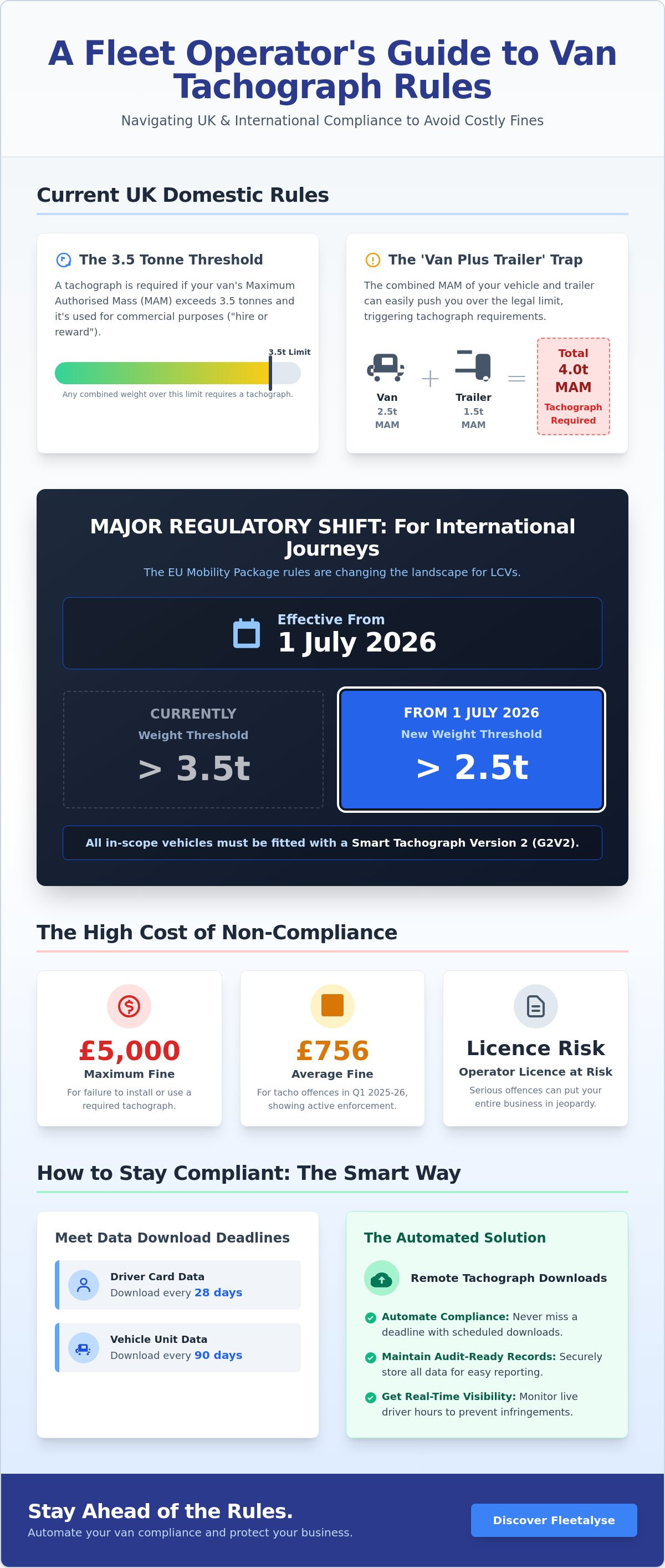
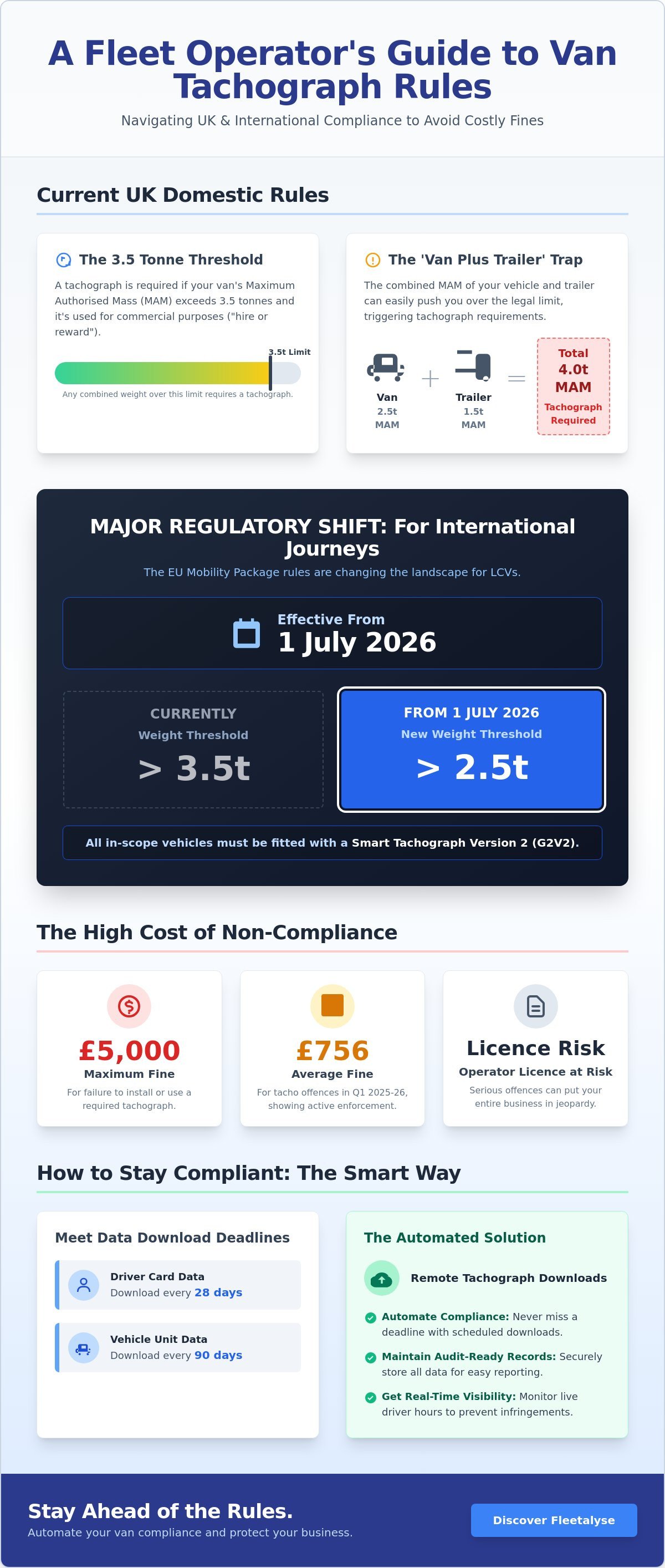
Compliance begins with a clear understanding of Maximum Authorised Mass (MAM). This figure represents the absolute limit a vehicle can weigh when fully loaded, including fuel, passengers, and cargo. For the vast majority of van tachograph uk operations, the magic number is 3,500kg (3.5 tonnes). If your vehicle's MAM exceeds this threshold and you're using it for commercial purposes, you're typically bound by the same drivers' hours regulations as heavy goods vehicles.
The most common trap for UK operators is the "Van plus Trailer" rule. You might drive a van with a 2,500kg MAM, which feels comfortably exempt. However, if you hitch a trailer with a 1,500kg MAM to that same van, your combined MAM is now 4,000kg. Because this total exceeds the 3.5-tonne limit, you must use a tachograph for any commercial journey. Many landscapers, builders, and recovery drivers learn this the hard way during a roadside stop. To understand the basics of the hardware itself, you can read more about What is a Tachograph? and its role in road safety.
The DVSA (Driver and Vehicle Standards Agency) is the primary enforcer on British roads. Their officers don't just look for HGVs; they're increasingly focused on light commercial vehicles (LCVs) that appear to be overweight or operating without required records. They have the power to stop any vehicle and check for compliance with both domestic UK rules and, where applicable, international EU driving hours. For fleets looking to simplify these requirements, Fleetalyse provides the tools needed to manage data without the manual headache.
When is a Tachograph Legally Required for a Van?
You need a tachograph if your van, or van and trailer combination, has a MAM of over 3.5 tonnes and is used for "hire or reward" or in connection with a trade or business. Private use is generally exempt. For example, using a large van to move your own furniture to a new house doesn't require a tacho. However, using that same van to deliver goods for a client certainly does. The grey area often involves "dual-purpose" vehicles like 4x4 pickups. If these are used to tow plant machinery to a site, they almost always trigger the requirement.
The Consequences of Non-Compliance
The financial and operational risks are significant. Failure to install or use a tachograph when required can result in a fine of up to £5,000. Data from the first quarter of the 2025-2026 financial year shows that the average fine for tachograph record offences was £756.26. Beyond the immediate fine, the DVSA can issue on-the-spot fixed penalties of up to £1,500. Most critically, serious or repeated offences can lead to a public inquiry before a Traffic Commissioner, putting your Operator Licence and your entire business at risk.
The 2026 EU Mobility Package: New Van Tachograph Requirements
July 1, 2026, marks the most significant regulatory shift for light commercial vehicle operators in a generation. From this date, the EU Mobility Package rules mandate that vans with a Maximum Authorised Mass (MAM) between 2.5 and 3.5 tonnes must be fitted with a tachograph for international transport. This isn't just an EU directive; the UK government has aligned with these standards to allow British hauliers to continue operating cross-border. It means the van tachograph uk landscape is expanding to include thousands of vehicles previously considered exempt.
Hire and reward is the key phrase for this transition. If you operate a standard long-wheelbase Ford Transit or a Mercedes Sprinter for courier deliveries to Paris or Dublin, you are now in scope. The rules specifically target international freight and cabotage. Cabotage refers to transport between two places in the same country by a vehicle registered in another country. Most popular LCV models, including the Volkswagen Crafter and Peugeot Boxer, will fall under this mandate when crossing borders for commercial work.
The 2.5-Tonne Threshold Explained
Why is the weight limit dropping? The threshold is falling from 3.5 tonnes to 2.5 tonnes to standardise safety and fair competition across the logistics sector. For many couriers and express delivery services, this change is a major administrative hurdle. If your van has a MAM of 2,300kg but you tow a small 500kg trailer, your 2,800kg total puts you firmly in scope for these international rules. You must identify your vehicle's plate weight now to avoid being caught out at the border.
Smart Tachograph Version 2 (G2V2) Requirements
The hardware requirement for this new era is the Smart Tachograph Version 2 (G2V2). This isn't just a basic recording device. It features automatic border-crossing registration and enhanced GPS location tracking. The device automatically logs the vehicle's position at the start and end of the working day, and every three hours of accumulated driving. These features allow enforcement agencies to monitor cabotage and driver rest periods more effectively than ever before.
Existing fleets must plan for retrofitting well before the July 2026 cut-off to ensure van tachograph uk compliance. Retrofitting a Smart Tachograph 2 is estimated to cost between £1,000 and £2,200 per vehicle, including installation and calibration. Waiting until the last minute will likely lead to supply chain delays and higher installation fees. You can prepare your fleet for 2026 today by integrating smart data management into your current operations.
Fitting a Tachograph to Your Van: Hardware and Exemptions
Most light commercial vehicles (LCVs) leave the factory without the standard DIN slots found in HGVs. This makes a van tachograph uk installation a physical challenge. Technicians often have to fit bespoke housing or modify the dashboard trim to accommodate the unit. It isn't just about finding space; the device must be securely connected to the vehicle's gearbox to record speed and distance accurately. This technical hurdle is why retrofitting a Smart Tachograph 2 is a specialised job that requires precision and the right hardware.
Calibration isn't a DIY task. You must use an Approved Tachograph Centre (ATC) to ensure the unit is legal and sealed. These centres are the only facilities authorised to calibrate the hardware and apply the official seals that prevent tampering. If a DVSA officer finds a broken seal or an expired calibration certificate during a roadside check, they will treat the vehicle as non-compliant. This applies even if the driver has followed their hours perfectly. For fleets looking to simplify the data side of this process, Fleetalyse offers "Plug & Play" connections for remote data management once the core hardware is in place.
Not every van requires a tachograph. The most common exemption is the 100km radius rule for specific trades. If you are carrying "tools of the trade" (like a plumber carrying pipes and wrenches) and driving isn't your main activity, you may be exempt within a 100km radius of your base. However, this exemption is narrow. If you deliver goods for someone else, or if the weight of your van and trailer exceeds 3.5 tonnes for commercial work, the exemption usually vanishes.
Common Van Tachograph Exemptions
Tradespeople often fall under the "carrying materials or equipment" exemption if the driving is secondary to their main job. Non-commercial carriage of goods is another key area. If you're using a large van for a private house move, you don't need a tacho. Emergency and rescue vehicles, such as those used by the NHS or police, also maintain exempt status in the UK. Always check your specific MAM before assuming you're exempt.
Calibration and Maintenance Standards
Digital and smart tachographs require a mandatory calibration check every two years. During a DVSA inspection, officers will scrutinise these records and the physical seals on the unit. If you're managing a larger fleet, it's vital to organise a rolling retrofitting and calibration programme. This prevents your entire fleet from being grounded at once. Retrofitting costs typically range from £1,000 to £2,200 per vehicle, so planning your budget well in advance of the 2026 deadline is a smart business move.
Best Practices for Van Tachograph Data Management
Compliance is a baseline. Efficiency is the goal. For any operator managing a van tachograph uk requirement, the law is clear: you must download driver card data at least every 28 days and vehicle unit (VU) data every 90 days. These are the absolute legal limits, but waiting until the final day is a high-risk strategy. Leading UK fleets aim for weekly card downloads and monthly VU captures to ensure no data is lost to hardware failure or driver error. You must also retain these records for at least 12 months to satisfy a DVSA inspection.
The "Missing Data" trap is a common pitfall for van drivers who frequently switch between tacho-regulated work and domestic tasks. When a driver enters the cab after a period of "Out of Scope" work or annual leave, they must make a manual entry on the tachograph. Failure to account for every minute of the working day creates gaps in the record. These gaps are often the first thing an auditor looks for during a fleet check. Training your team to handle manual entries correctly is as vital as the hardware itself.
Manual vs. Remote Data Collection
Manual downloads are a drain on resources. It typically takes 15 to 20 minutes per vehicle to physically connect a download tool and transfer the files. For a fleet of ten vans, that's over three hours of labour every month, excluding the fuel costs of returning vehicles to a central depot. Manual handling also increases the risk of data corruption or lost files. Remote download technology has become the industry standard because it removes the human element entirely. Data is encrypted and sent to your office whilst the van is still on the move, ensuring you never miss a 28-day deadline. Secure your remote download solution to eliminate these administrative burdens.
Analysing Driver Hours for Van Fleets
Collecting data is only half the battle; you must analyse it to protect your Operator Licence. Analysis software identifies infringements such as insufficient daily rest, speeding, or working time directive violations. Use these insights as a coaching tool rather than a disciplinary hammer. If the data shows a driver consistently misses their breaks, it might indicate that your delivery routes are too ambitious. Integrating tachograph data with your GPS fleet tracking provides a complete picture of "Real Transport Operations," allowing you to balance compliance with commercial reality.
Streamlining Van Compliance with Remote Tachograph Downloads
Remote tachograph download technology transforms a reactive compliance process into a proactive business strategy. For any operator managing a van tachograph uk fleet, the ability to pull data whilst the vehicle is out on a delivery or a job across the country is a game changer. The system uses a secure GPRS connection to transmit encrypted files directly from the vehicle unit and the driver card to your office. It eliminates the need for vans to return to a central depot just to plug in a download key. This keeps your drivers on the road and your business moving.
Real-time visibility is the primary advantage of this automation. Instead of waiting for a manual download to discover an infringement that happened three weeks ago, you can monitor live driver hours as they occur. You will know exactly how much driving time is left before a mandatory break is required. This level of insight is why Fleetalyse is built for real transport operations; not just simple tracking. It provides the granular data needed to make informed dispatch decisions without risking your Operator Licence.
The ROI of Automated Compliance
The return on investment for remote downloads is immediate and measurable. Manual downloads typically consume 20 minutes of staff time per vehicle. For a fleet of 15 vans, that is five hours of labour every month just to stay legal. When you factor in the fuel costs and vehicle downtime associated with returning to base, the "hidden" cost of manual compliance is significant. Automated systems reduce the likelihood of DVSA fines by ensuring you never miss a 28-day or 90-day deadline. Fleetalyse provides total transparency with clear pricing, ensuring you know exactly what your compliance costs are without hidden fees or complex contracts.
Implementing a "Plug & Play" Solution
Modern hardware makes the transition to remote downloads simple. Most units offer a "Plug & Play" connection that integrates with your existing van fleet with minimal disruption. These systems are designed for seamless integration with your favourite tachograph analysis software, allowing data to flow directly into your existing reporting tools. There is no need for complex IT overhauls. You get a reliable, expert partner that understands the specific pressures of the UK haulage and LCV sectors. Ready to take control of your van compliance? Start your journey today and ensure your fleet is prepared for the 2026 mandates.
Future-Proof Your Van Fleet Today
The regulatory landscape for UK operators is shifting rapidly. With the July 1, 2026 deadline approaching for international transport, your current exempt status might soon vanish. Whether you're navigating the "van plus trailer" calculation for domestic work or preparing for the new 2.5-tonne threshold, staying ahead of the DVSA is essential. Manual data collection is a drain on your time and a constant risk to your Operator Licence. It's time to move beyond spreadsheets and manual download keys.
Transitioning to automated systems protects your business from £5,000 fines and keeps your drivers focused on the road. We built our service for real transport operations; not just simple tracking. You get total transparency with clear pricing and no hidden costs. By automating your data management, you ensure every file is downloaded on time and every record is audit-ready. Take control of your van tachograph uk requirements now to focus on growing your business with total peace of mind.
Secure your fleet compliance with our remote tachograph solutions.
Frequently Asked Questions
Do I need a tachograph in my van if I am only driving within the UK?
Vans operating solely within the UK are not required to be fitted with a tachograph if they weigh between 2.5 and 3.5 tonnes. This exemption remains in place even after the July 2026 international deadline. However, if your van or van-and-trailer combination exceeds a Maximum Authorised Mass (MAM) of 3.5 tonnes for commercial work, you must use a tachograph regardless of your route.
What is the "Van and Trailer" rule for tachographs?
The "Van and Trailer" rule requires you to add the MAM of your van to the MAM of your trailer to find your total gross weight. If this combined figure exceeds 3,500kg (3.5 tonnes) and you're using the vehicle for business, you'll need a van tachograph uk compliant setup. This often catches out tradespeople using small vans to tow plant equipment or heavy materials.
Will my electric van need a tachograph under the 2026 rules?
The UK government is currently considering exemptions for zero-emission vans. This potentially allows electric vans weighing between 3.5 and 4.25 tonnes to remain exempt from tachograph and drivers' hours rules. This policy accounts for the additional weight of batteries. It aims to encourage the adoption of electric vehicles without adding the administrative burden of HGV-style compliance.
How much does it cost to fit a tachograph to a van in the UK?
The cost of retrofitting a Smart Tachograph 2 (G2V2) typically ranges between £1,000 and £2,200. This price includes the hardware, professional installation, and the mandatory calibration at an Approved Tachograph Centre (ATC). Because light commercial vehicles aren't designed with standard slots for these units, the labour costs reflect the technical difficulty of the custom dashboard installation.
Do van drivers need a Driver CPC if they use a tachograph?
Yes, in most cases where a tachograph is legally required for commercial work, the driver must also hold a valid Driver Certificate of Professional Competence (CPC). You'll need to complete 35 hours of periodic training every five years to maintain this. Specific exemptions exist for drivers carrying their own tools or equipment within a 100km radius of their base, provided driving isn't their main activity.
What is the penalty for driving a van without a required tachograph?
Failure to install or use a tachograph when required can result in a fine of up to £5,000. Additionally, the DVSA can issue on-the-spot fixed penalties of up to £1,500 for multiple offences during a single roadside check. Serious breaches often lead to vehicle impoundment and a public inquiry before the Traffic Commissioner, which puts your entire Operator Licence and business at risk.
How often must I download the data from my van tachograph?
You must legally download data from the driver card at least every 28 days. The vehicle unit (VU) data must be downloaded at least every 90 days. Whilst these are the maximum limits, many operators use remote technology to capture van tachograph uk data weekly. This ensures you have a reliable backup and can spot driver infringements before they become significant legal issues.
Can I use a portable tachograph for my van?
No, portable or "plug-in" tachographs are not legal for compliance in the UK. Every tachograph must be a fixed, type-approved device that is professionally installed and sealed by an Approved Tachograph Centre. The device must be hard-wired to the vehicle's gearbox to ensure accurate recording of speed and distance. Any unit that isn't permanently fitted and calibrated will be rejected by the DVSA.
Frequently asked questions
When is a Tachograph Legally Required for a Van?
You need a tachograph if your van, or van and trailer combination, has a MAM of over 3.5 tonnes and is used for "hire or reward" or in connection with a trade or business. Private use is generally exempt. For example, using a large van to move your own furniture to a new house doesn't require a tacho. However, using that same van to deliver goods for a client certainly does. The grey area often involves "dual-purpose" vehicles like 4x4 pickups. If these are used to tow plant machinery to a site, they almost always trigger the requirement.
The Consequences of Non-Compliance
The financial and operational risks are significant. Failure to install or use a tachograph when required can result in a fine of up to £5,000. Data from the first quarter of the 2025-2026 financial year shows that the average fine for tachograph record offences was £756.26. Beyond the immediate fine, the DVSA can issue on-the-spot fixed penalties of up to £1,500. Most critically, serious or repeated offences can lead to a public inquiry before a Traffic Commissioner, putting your Operator Licence and your entire business at risk. July 1, 2026, marks the most significant regulatory shift for light commercial vehicle operators in a generation. From this date, the EU Mobility Package rules mandate that vans with a Maximum Authorised Mass (MAM) between 2.5 and 3.5 tonnes must be fitted with a tachograph for international transport. This isn't just an EU directive; the UK government has aligned with these standards to allow British hauliers to continue operating cross-border. It means the van tachograph uk landscape is expanding to include thousands of vehicles previously considered exempt. Hire and reward is the key phrase for this transition. If you operate a standard long-wheelbase Ford Transit or a Mercedes Sprinter for courier deliveries to Paris or Dublin, you are now in scope. The rules specifically target international freight and cabotage. Cabotage refers to transport between two places in the same country by a vehicle registered in another country. Most popular LCV models, including the Volkswagen Crafter and Peugeot Boxer, will fall under this mandate when crossing borders for commercial work.
The 2.5-Tonne Threshold Explained
Why is the weight limit dropping? The threshold is falling from 3.5 tonnes to 2.5 tonnes to standardise safety and fair competition across the logistics sector. For many couriers and express delivery services, this change is a major administrative hurdle. If your van has a MAM of 2,300kg but you tow a small 500kg trailer, your 2,800kg total puts you firmly in scope for these international rules. You must identify your vehicle's plate weight now to avoid being caught out at the border.
Smart Tachograph Version 2 (G2V2) Requirements
The hardware requirement for this new era is the Smart Tachograph Version 2 (G2V2). This isn't just a basic recording device. It features automatic border-crossing registration and enhanced GPS location tracking. The device automatically logs the vehicle's position at the start and end of the working day, and every three hours of accumulated driving. These features allow enforcement agencies to monitor cabotage and driver rest periods more effectively than ever before. Existing fleets must plan for retrofitting well before the July 2026 cut-off to ensure van tachograph uk compliance. Retrofitting a Smart Tachograph 2 is estimated to cost between £1,000 and £2,200 per vehicle, including installation and calibration. Waiting until the last minute will likely lead to supply chain delays and higher installation fees. You can prepare your fleet for 2026 today by integrating smart data management into your current operations. Most light commercial vehicles (LCVs) leave the factory without the standard DIN slots found in HGVs. This makes a van tachograph uk installation a physical challenge. Technicians often have to fit bespoke housing or modify the dashboard trim to accommodate the unit. It isn't just about finding space; the device must be securely connected to the vehicle's gearbox to record speed and distance accurately. This technical hurdle is why retrofitting a Smart Tachograph 2 is a specialised job that requires precision and the right hardware. Calibration isn't a DIY task. You must use an Approved Tachograph Centre (ATC) to ensure the unit is legal and sealed. These centres are the only facilities authorised to calibrate the hardware and apply the official seals that prevent tampering. If a DVSA officer finds a broken seal or an expired calibration certificate during a roadside check, they will treat the vehicle as non-compliant. This applies even if the driver has followed their hours perfectly. For fleets looking to simplify the data side of this process, Fleetalyse offers "Plug & Play" connections for remote data management once the core hardware is in place. Not every van requires a tachograph. The most common exemption is the 100km radius rule for specific trades. If you are carrying "tools of the trade" (like a plumber carrying pipes and wrenches) and driving isn't your main activity, you may be exempt within a 100km radius of your base. However, this exemption is narrow. If you deliver goods for someone else, or if the weight of your van and trailer exceeds 3.5 tonnes for commercial work, the exemption usually vanishes.
Common Van Tachograph Exemptions
Tradespeople often fall under the "carrying materials or equipment" exemption if the driving is secondary to their main job. Non-commercial carriage of goods is another key area. If you're using a large van for a private house move, you don't need a tacho. Emergency and rescue vehicles, such as those used by the NHS or police, also maintain exempt status in the UK. Always check your specific MAM before assuming you're exempt.
Calibration and Maintenance Standards
Digital and smart tachographs require a mandatory calibration check every two years. During a DVSA inspection, officers will scrutinise these records and the physical seals on the unit. If you're managing a larger fleet, it's vital to organise a rolling retrofitting and calibration programme. This prevents your entire fleet from being grounded at once. Retrofitting costs typically range from £1,000 to £2,200 per vehicle, so planning your budget well in advance of the 2026 deadline is a smart business move. Compliance is a baseline. Efficiency is the goal. For any operator managing a van tachograph uk requirement, the law is clear: you must download driver card data at least every 28 days and vehicle unit (VU) data every 90 days. These are the absolute legal limits, but waiting until the final day is a high-risk strategy. Leading UK fleets aim for weekly card downloads and monthly VU captures to ensure no data is lost to hardware failure or driver error. You must also retain these records for at least 12 months to satisfy a DVSA inspection. The "Missing Data" trap is a common pitfall for van drivers who frequently switch between tacho-regulated work and domestic tasks. When a driver enters the cab after a period of "Out of Scope" work or annual leave, they must make a manual entry on the tachograph. Failure to account for every minute of the working day creates gaps in the record. These gaps are often the first thing an auditor looks for during a fleet check. Training your team to handle manual entries correctly is as vital as the hardware itself.
Manual vs. Remote Data Collection
Manual downloads are a drain on resources. It typically takes 15 to 20 minutes per vehicle to physically connect a download tool and transfer the files. For a fleet of ten vans, that's over three hours of labour every month, excluding the fuel costs of returning vehicles to a central depot. Manual handling also increases the risk of data corruption or lost files. Remote download technology has become the industry standard because it removes the human element entirely. Data is encrypted and sent to your office whilst the van is still on the move, ensuring you never miss a 28-day deadline. Secure your remote download solution to eliminate these administrative burdens.
Analysing Driver Hours for Van Fleets
Collecting data is only half the battle; you must analyse it to protect your Operator Licence. Analysis software identifies infringements such as insufficient daily rest, speeding, or working time directive violations. Use these insights as a coaching tool rather than a disciplinary hammer. If the data shows a driver consistently misses their breaks, it might indicate that your delivery routes are too ambitious. Integrating tachograph data with your GPS fleet tracking provides a complete picture of "Real Transport Operations," allowing you to balance compliance with commercial reality. Remote tachograph download technology transforms a reactive compliance process into a proactive business strategy. For any operator managing a van tachograph uk fleet, the ability to pull data whilst the vehicle is on a delivery in Manchester or a job in London is a game changer. The system uses a secure GPRS connection to transmit encrypted files directly from the vehicle unit and the driver card to your office. It eliminates the need for vans to return to a central depot just to plug in a download key. This keeps your drivers on the road and your business moving. Real-time visibility is the primary advantage of this automation. Instead of waiting for a manual download to discover an infringement that happened three weeks ago, you can monitor live driver hours as they occur. You will know exactly how much driving time is left before a mandatory break is required. This level of insight is why Fleetalyse is built for real transport operations; not just simple tracking. It provides the granular data needed to make informed dispatch decisions without risking your Operator Licence.
The ROI of Automated Compliance
The return on investment for remote downloads is immediate and measurable. Manual downloads typically consume 20 minutes of staff time per vehicle. For a fleet of 15 vans, that is five hours of labour every month just to stay legal. When you factor in the fuel costs and vehicle downtime associated with returning to base, the "hidden" cost of manual compliance is significant. Automated systems reduce the likelihood of DVSA fines by ensuring you never miss a 28-day or 90-day deadline. Fleetalyse provides total transparency with clear pricing, ensuring you know exactly what your compliance costs are without hidden fees or complex contracts.
Implementing a "Plug & Play" Solution
Modern hardware makes the transition to remote downloads simple. Most units offer a "Plug & Play" connection that integrates with your existing van fleet with minimal disruption. These systems are designed for seamless integration with your favourite tachograph analysis software, allowing data to flow directly into your existing reporting tools. There is no need for complex IT overhauls. You get a reliable, expert partner that understands the specific pressures of the UK haulage and LCV sectors. Ready to take control of your van compliance? Start your journey today and ensure your fleet is prepared for the 2026 mandates. The regulatory landscape for UK operators is shifting rapidly. With the July 1, 2026 deadline approaching for international transport, your current exempt status might soon vanish. Whether you're navigating the "van plus trailer" calculation for domestic work or preparing for the new 2.5-tonne threshold, staying ahead of the DVSA is essential. Manual data collection is a drain on your time and a constant risk to your Operator Licence. It's time to move beyond spreadsheets and manual download keys. Transitioning to automated systems protects your business from £5,000 fines and keeps your drivers focused on the road. We built our service for real transport operations; not just simple tracking. You get total transparency with clear pricing and no hidden costs. By automating your data management, you ensure every file is downloaded on time and every record is audit-ready. Take control of your van tachograph uk requirements now to focus on growing your business with total peace of mind. Secure your fleet compliance with our remote tachograph solutions.
Do I need a tachograph in my van if I am only driving within the UK?
Vans operating solely within the UK are not required to be fitted with a tachograph if they weigh between 2.5 and 3.5 tonnes. This exemption remains in place even after the July 2026 international deadline. However, if your van or van-and-trailer combination exceeds a Maximum Authorised Mass (MAM) of 3.5 tonnes for commercial work, you must use a tachograph regardless of your route.
What is the "Van and Trailer" rule for tachographs?
The "Van and Trailer" rule requires you to add the MAM of your van to the MAM of your trailer to find your total gross weight. If this combined figure exceeds 3,500kg (3.5 tonnes) and you're using the vehicle for business, you'll need a van tachograph uk compliant setup. This often catches out tradespeople using small vans to tow plant equipment or heavy materials.
Will my electric van need a tachograph under the 2026 rules?
The UK government is currently considering exemptions for zero-emission vans. This potentially allows electric vans weighing between 3.5 and 4.25 tonnes to remain exempt from tachograph and drivers' hours rules. This policy accounts for the additional weight of batteries. It aims to encourage the adoption of electric vehicles without adding the administrative burden of HGV-style compliance.
How much does it cost to fit a tachograph to a van in the UK?
The cost of retrofitting a Smart Tachograph 2 (G2V2) typically ranges between £1,000 and £2,200. This price includes the hardware, professional installation, and the mandatory calibration at an Approved Tachograph Centre (ATC). Because light commercial vehicles aren't designed with standard slots for these units, the labour costs reflect the technical difficulty of the custom dashboard installation.
Do van drivers need a Driver CPC if they use a tachograph?
Yes, in most cases where a tachograph is legally required for commercial work, the driver must also hold a valid Driver Certificate of Professional Competence (CPC). You'll need to complete 35 hours of periodic training every five years to maintain this. Specific exemptions exist for drivers carrying their own tools or equipment within a 100km radius of their base, provided driving isn't their main activity.
What is the penalty for driving a van without a required tachograph?
Failure to install or use a tachograph when required can result in a fine of up to £5,000. Additionally, the DVSA can issue on-the-spot fixed penalties of up to £1,500 for multiple offences during a single roadside check. Serious breaches often lead to vehicle impoundment and a public inquiry before the Traffic Commissioner, which puts your entire Operator Licence and business at risk.
How often must I download the data from my van tachograph?
You must legally download data from the driver card at least every 28 days. The vehicle unit (VU) data must be downloaded at least every 90 days. Whilst these are the maximum limits, many operators use remote technology to capture van tachograph uk data weekly. This ensures you have a reliable backup and can spot driver infringements before they become significant legal issues.
Can I use a portable tachograph for my van?
No, portable or "plug-in" tachographs are not legal for compliance in the UK. Every tachograph must be a fixed, type-approved device that is professionally installed and sealed by an Approved Tachograph Centre. The device must be hard-wired to the vehicle's gearbox to ensure accurate recording of speed and distance. Any unit that isn't permanently fitted and calibrated will be rejected by the DVSA.