
Avoid impoundment: UK cabotage rules and digital evidence for hauliers
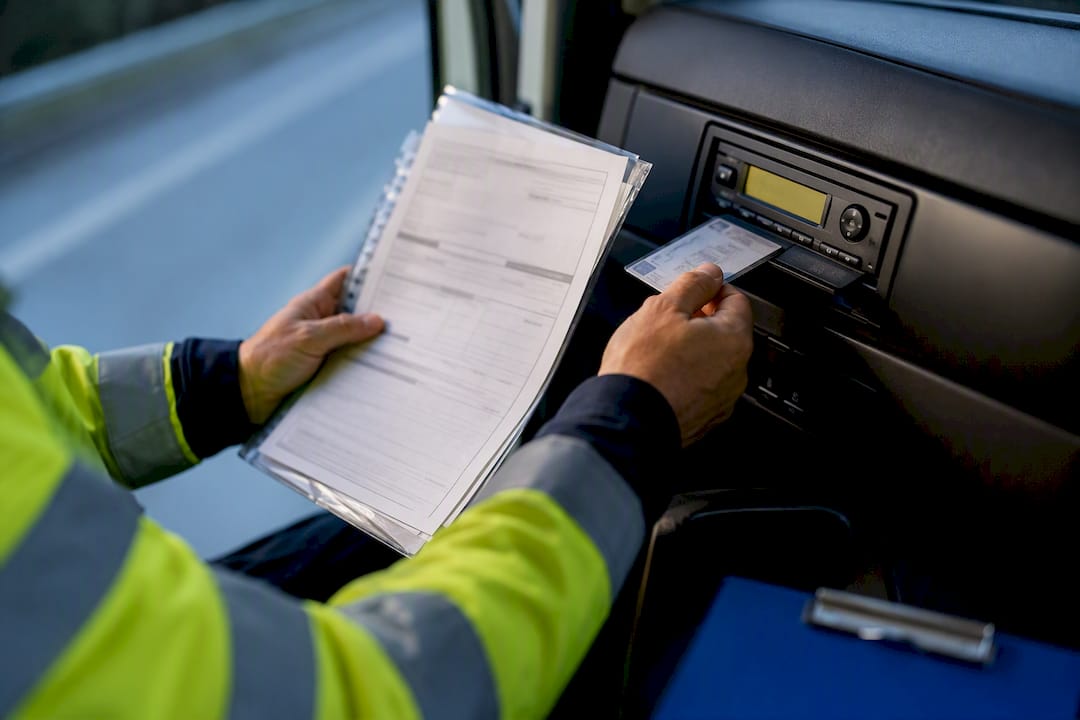
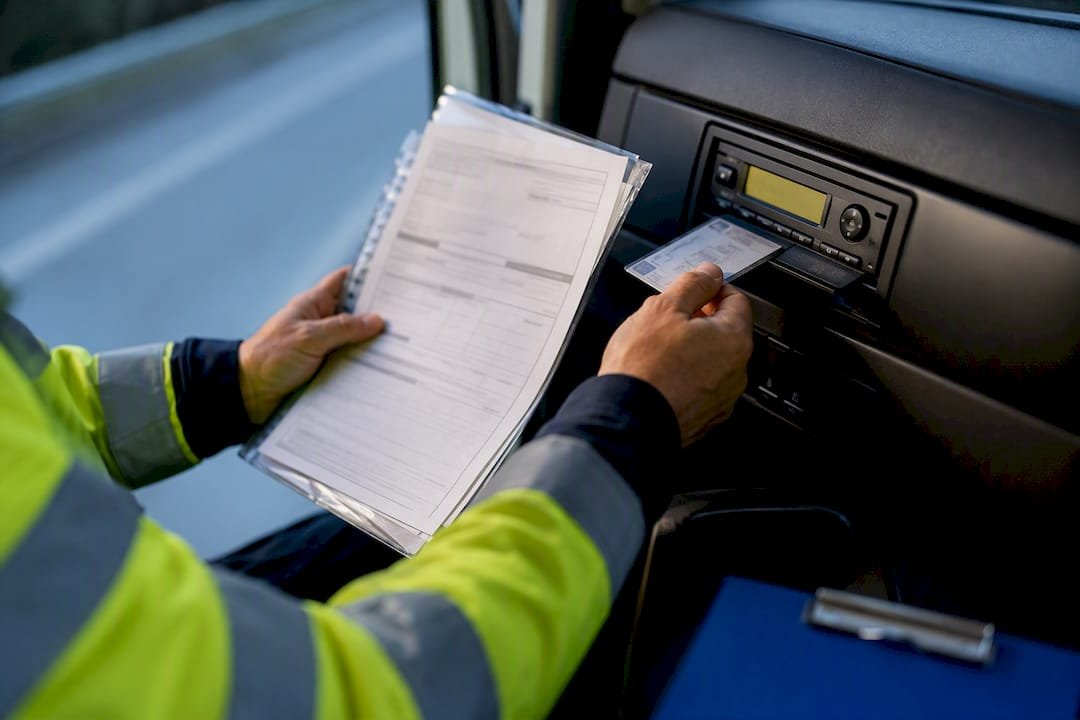
EU operators can perform a maximum of two cabotage movements in the UK within seven days of unloading an inbound laden international journey. Entry into the UK must be laden. Turn up empty and you lose cabotage rights entirely, permitted only a single bilateral movement to collect an export load. DVSA officers can and do impound vehicles when drivers can’t prove the inbound journey on the spot.
TL;DR:
- Operators must perform no more than two cabotage moves in the UK within seven days of unloading an inbound laden international journey; turning up empty limits cabotage rights to a single bilateral load collection.
- The seven-day window begins at the final unloading time, not border crossing, and is unaffected by weekends or holidays, requiring the same vehicle to complete all permitted moves.
- Proof of a legal cabotage includes signed consignment notes, Community Licence, EU posting declarations, tachograph records, and GPS data, all ideally digitized and synchronized.
- DVSA enforcement involves roadside checks for complete documentation, with vehicle impoundment and seizure likely if proof is insufficient, and operators must build automatic evidence trails proactively.
- The temporary cabotage extension from late 2021 has expired, meaning unlimited cabotage is no longer available, and unladen entries are limited to a single bilateral export movement only.
Table of Contents
- What does UK law actually say about cabotage?
- Which operators can exercise cabotage rights in the UK?
- What documents prove a legal cabotage movement?
- How does DVSA enforce cabotage breaches?
- Operational compliance checklist for fleet managers
- Did the temporary cabotage extension survive Brexit disruption?
- Do car transporters or bilateral permits change the rules?
- What should fleet managers prioritise first?
- How Fleetalyse keeps your evidence trail audit-ready
- Where to check the official cabotage rules
- Sources
What does UK law actually say about cabotage?
The legal foundation for cabotage in the UK sits in Article 8 of Regulation (EC) 1072/2009, retained in UK law after Brexit and enforced exactly as it reads for goods vehicles operating between Great Britain and the EU. Article 8 permits an EU-registered haulier to carry out cabotage operations following an international journey into the host state, but the UK’s own guidance for non-UK operators limits these to a small number of operations within a seven-day window, and it’s this UK-specific restriction that governs every movement on British roads.
The seven-day clock starts ticking the moment the inbound international load is fully unloaded, not when the vehicle crosses the border, and not when the driver logs off duty. That distinction catches out plenty of experienced operators. A trailer unloaded in Dover on a Monday morning has until the following Monday to complete both permitted cabotage movements, and the countdown doesn’t pause for weekends, bank holidays, or waiting time at a depot.

There’s also a “same vehicle” requirement running through the regulation. The cabotage operations must be carried out using the same vehicle, or the same vehicle and trailer combination, that made the inbound international journey. Swap the tractor unit partway through and you’ve broken the chain of evidence that legitimises the whole sequence, even if the swap was for entirely legitimate maintenance reasons.
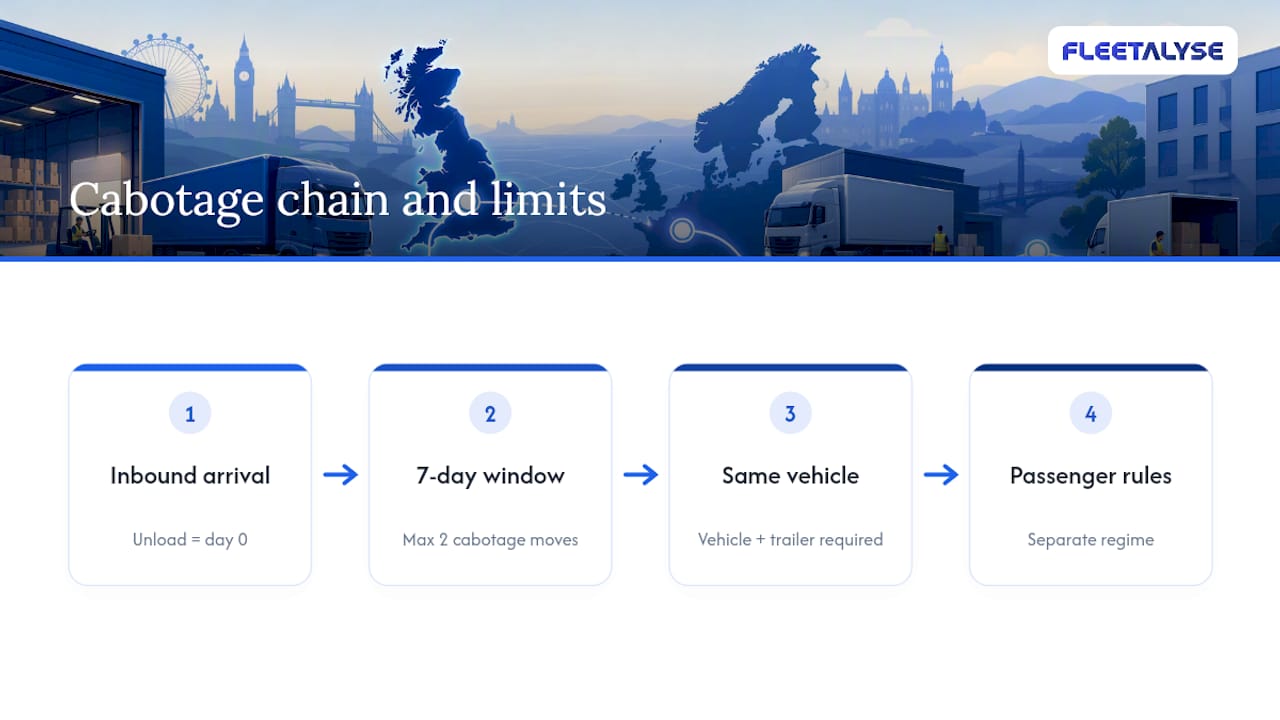
Passenger transport operates under a separate framework. Coach and bus cabotage falls under different retained EU rules with their own thresholds and reporting duties, so don’t assume the 2-in-7 goods vehicle rule transfers across to passenger services. If your fleet runs mixed operations, treat the two rule sets as distinct compliance regimes rather than variations on a theme.
Which operators can exercise cabotage rights in the UK?
EU-based hauliers operating under the UK-EU Trade and Cooperation Agreement retain the cabotage access described above, provided they hold a valid Community Licence and meet the laden-entry condition. Operators from ECMT permit countries or those working under bilateral road haulage agreements face a different, generally tighter, set of conditions, and many bilateral arrangements don’t grant cabotage rights at all, only transit and bilateral carriage permissions.
Non-EU operators without a relevant bilateral or multilateral agreement have no automatic cabotage rights in the UK whatsoever. Attempting a domestic move without the correct permit basis isn’t a grey area. It’s a straightforward breach, regardless of how the paperwork for the inbound journey looks.
Northern Ireland adds a further layer of nuance. Arrangements with the Republic of Ireland allow for some practical flexibility given the shared land border and integrated supply chains, and enforcement sits with the Transport Regulation Unit rather than the DVSA. Divergence between Great Britain and Northern Ireland rules has widened since Brexit, and operators running cross-border NI routes should treat GB guidance as a starting point, not a substitute for checking NI-specific instruments directly.
For a broader view of how operator licensing and cross-border duties interact, our UK fleet compliance guide for operators covers the wider regulatory picture beyond cabotage alone.
What documents prove a legal cabotage movement?
Roadside enforcement comes down to one question: can the driver prove, immediately, that the vehicle entered the UK laden and that the current movement falls within the permitted 2-in-7 window? The paperwork that answers that question needs to be in the cab, not filed back at the depot.
- A signed CMR or consignment note showing the inbound international laden journey, including load, discharge point, and dates.
- Community Licence documentation confirming the operator’s authorisation to carry out international and cabotage operations.
- Evidence of the posting declaration filed on the EU posting declaration portal, which EU drivers must register before carrying out cabotage in the UK, mirroring the posting rules UK hauliers follow when operating in the EU.
- Tachograph records that corroborate the vehicle’s movement timestamps against the claimed inbound journey.
- GPS trail data showing load and discharge locations matching the times stated on the consignment note.
Digital records carry real weight here. Timestamped tachograph data and GPS logs give an officer independent corroboration that doesn’t depend on a driver’s memory or a scrap of paper that’s gone missing from the door pocket. DVSA enforcement notices make clear that an inability to produce clear documentation is sufficient grounds for action on its own, irrespective of whether the underlying journey was actually legitimate.
Pro Tip: Keep a digital copy of every CMR and posting declaration synced to a back-office system the moment the load is confirmed, not after the driver reports it. A roadside stop is the wrong moment to discover the paperwork never made it off the depot printer.
How does DVSA enforce cabotage breaches?
The DVSA enforces cabotage rules in Great Britain, while the Transport Regulation Unit covers Northern Ireland. Roadside checks typically involve an officer requesting the CMR for the inbound journey, checking tachograph data against the claimed timeline, and cross-referencing dates against the seven-day window.
Consequences for a confirmed breach escalate quickly. Fixed penalty notices are the mildest outcome. Impounding the vehicle is common where the driver can’t produce satisfactory evidence on the spot, and DVSA has publicly confirmed cases where vehicles were seized and, following repeated or serious breaches, disposed of after the statutory retention period expired without a successful claim for return.
If a vehicle is stopped, the immediate priority is producing every piece of documentary and digital evidence available, calmly and completely. Partial paperwork invites further scrutiny rather than resolving it. Where a vehicle has already been impounded, operators can apply to the Traffic Commissioner for the vehicle’s return, but that process depends entirely on demonstrating the operation was lawful, which is far harder to prove after the fact than at the roadside. Our DVSA roadside check checklist for HGVs sets out what officers look for across a wider inspection, not just cabotage evidence.
Operational compliance checklist for fleet managers
Getting cabotage right isn’t about memorising the regulation. It’s about building a process that makes compliance the default rather than something a driver has to remember under pressure at a roadside stop. Here’s the sequence Fleetalyse recommends building into your standard operating procedure.
- Verify laden status before departure. Confirm the inbound journey was genuinely laden, and capture the consignment note digitally before the vehicle leaves the discharge point, not after.
- Timestamp everything automatically. Automated tachograph downloads remove the gap between what a driver remembers and what actually happened, giving you a corroborating record without relying on manual logs.
- Match GPS traces to load events. A GPS track that shows the vehicle arriving at the discharge point at the exact time the CMR states is far more persuasive to an inspecting officer than a date scrawled on a form.
- Brief drivers on the seven-day clock. Make sure every driver understands the window runs from final unloading, not from border crossing, and knows exactly which documents to hand over first at a stop.
- Set a retention policy for proofs. Keep CMRs, posting declarations, and tachograph exports for a defined period after each cabotage sequence, long enough to cover any Traffic Commissioner enquiry.
- Plan return loads properly. Arrange genuine return freight or lawful subcontracting arrangements well in advance, rather than accepting an ad hoc domestic pickup that falls outside the permitted operations.
The evidence chain matters more than any single document. A signed CMR on its own is useful; a CMR corroborated by tachograph timestamps and a matching GPS trail is close to unanswerable. Remote tachograph downloads make that second layer far easier to maintain, since drivers stop being the bottleneck for getting records off the vehicle and into a system an office team can check before a dispute even arises. Our guide to remote tachograph download explains how that data flow works in practice.
Pro Tip: Build a one-page “cabotage evidence pack” template for drivers to fill at the point of unloading, not the point of the stop. It takes two minutes and removes the panic of reconstructing a timeline in front of an officer.
Avoid the temptation to treat an empty return leg as an opportunity for “just one quick domestic job.” An unladen entry into the UK forfeits cabotage rights outright, and no amount of good intent changes that once an officer checks the paperwork trail.
Did the temporary cabotage extension survive Brexit disruption?
No, it didn’t, and this is where a surprising number of operators get caught relying on outdated advice. Following the supply chain disruption of late 2021, the Department for Transport ran a consultation that introduced a temporary relaxation, allowing unlimited cabotage movements for a limited period after a laden arrival.
That extension was explicitly time-limited and has since expired. Since then, the standard cabotage restriction has applied without exception. Trade press coverage from that period still circulates online, and articles written during the relaxation window sometimes get shared or reprinted without the expiry date attached, giving the false impression that unlimited cabotage remains available.
Policy teams involved in that consultation have been consistent in warning operators to check GOV.UK directly for the current instrument rather than trusting a summary written eighteen months, or several years, out of date. Before relying on any article discussing UK transport regulations and cabotage flexibility, check the publication date and cross-reference it against the current guidance page. If a source doesn’t state clearly that the 14-day extension ended in April 2022, treat it as unreliable.
Do car transporters or bilateral permits change the rules?
Car transporters get a narrow seasonal relaxation, but it’s easy to misread the scope. The exception applies only to vehicles carrying complete cars and vans, and only within specific date windows, typically stretches in February to March and August to September, tied to new vehicle registration peaks. Outside those windows, the standard 2-in-7 rule applies to car transporters exactly as it does to any other HGV.
Combined and triangular traffic, where a vehicle picks up and delivers across multiple countries in a single trip, faces tighter constraints under the retained regulation because each leg risks blurring into unauthorised cabotage if the sequencing isn’t carefully documented. ECMT permits can offer a route through some of these scenarios for operators without full EU/TCA access, but they carry their own quota limits and don’t automatically confer UK cabotage rights.
The unladen entry rule deserves one final clarification, because it’s misunderstood constantly. A vehicle entering the UK empty is permitted exactly one bilateral movement, a single trip to collect a genuine export load bound back out of the country. That’s not a cabotage operation and doesn’t count towards the 2-in-7 allowance, but it also can’t be stretched into a domestic delivery run before heading to the export pickup. Cross-trade, moving goods between two countries neither of which is the haulier’s home state, is a separate concept again and shouldn’t be confused with either cabotage or the single bilateral collection allowance.
What should fleet managers prioritise first?
If you take one thing from all of this, make it proof capture. The regulation itself is fairly simple: two moves, seven days, laden entry. What trips operators up is never the rule. It’s the gap between what actually happened on the road and what the paperwork in the cab can demonstrate three days later at a checkpoint.
Coach your drivers on posting declarations before they cross the Channel, not after DVSA asks for one. Build automated evidence trails so nobody’s compliance depends on a driver’s memory or a note that might not survive a wet Tuesday in the cab door pocket. And keep a genuinely close watch on DfT publications, because Northern Ireland’s divergence from Great Britain shows no sign of narrowing, and the next tweak to the framework is more likely to come from a quiet statutory instrument than a headline announcement.
— Vytautas
How Fleetalyse keeps your evidence trail audit-ready
Certain fleet management platforms provide proof that survives a roadside stop without a driver having to reconstruct anything from memory. Where a manual paper trail leaves gaps between unloading, the next pickup, and whatever the tachograph says happened in between, Fleetalyse closes them automatically.
Remote tachograph downloads can pull driver activity data straight into a back office without waiting for a physical card swap, so timestamps supporting an inbound laden journey are already logged before an officer even asks. Pair that with connected GPS tracking hardware and you get a location trail that matches load and discharge times to the minute, exactly the corroboration DVSA officers look for. Driver behaviour monitoring then gives fleet managers visibility into how consistently drivers are following posting declaration and documentation SOPs, before a breach becomes an impounding notice. Operators interested in automated evidence capture solutions can contact providers for a demonstration.
Where to check the official cabotage rules
For the current position, bookmark these directly rather than relying on summaries:
- Gov
- Article 8, Regulation 1072/2009 (retained)
- Temporary extension consultation and expiry
- Our own fleet compliance essentials guide
Sources
- Transporting goods into the UK as a non-UK operator
- EU Regulation 1072/2009 — Article 8 (as retained)
- Temporary extension to road haulage cabotage