
Relying on manual driver card downloads is no longer just an administrative burden; it's a calculated risk to your HGV operator licence. You're likely tired of chasing drivers across the yard or worrying about the 28-day legal deadline while your vehicles are away from the depot. Staying ahead of the remote tacho download legal requirements UK operators must follow is becoming more critical as the July 2026 Smart Tacho V2 deadlines approach. Missing a single file shouldn't be the reason you face heavy fines or DVSA points.
We understand that regulatory adherence shouldn't feel like a full-time job. This guide will help you master the legal framework and technical standards needed to maintain a 100% compliant, audit-ready fleet using remote tachograph technology. We'll examine the specific requirements for vehicle units and driver cards, explore the 2026 LCV mandates for international haulage, and demonstrate how total automation can eliminate administrative labour. By the end, you'll have a clear roadmap to secure, hands-off compliance and total peace of mind during inspections.
Key Takeaways
- Understand the non-negotiable 28-day driver card and 90-day vehicle unit download deadlines to protect your HGV operator licence.
- Learn how to meet all remote tacho download legal requirements UK standards by transitioning from manual retrieval to automated, "over-the-air" data collection.
- Prepare your fleet for the July 2026 Smart Tacho V2 retrofitting deadlines to ensure uninterrupted compliance for international commercial transport.
- Establish an audit-ready compliance record by maintaining at least 12 months of secure data storage and integrating it with professional analysis software.
- Discover how combining remote downloads with live driver hours and GPS tracking reduces administrative labour and provides peace of mind during DVSA inspections.
Understanding the UK Legal Framework for Tachograph Data Downloads
Every commercial transport operator in the UK must adhere to strict rules regarding driver activity records. The law requires that all data from digital tachographs be retrieved, analysed, and stored to ensure road safety and fair competition. This Digital Tachograph Explained resource provides a technical foundation for how these devices record information. Staying compliant with remote tacho download legal requirements UK standards starts with a clear grasp of the DVSA's strict timelines. These rules apply to most HGVs over 3.5 tonnes, buses with more than nine seats, and, as of July 2026, light commercial vehicles (LCVs) between 2.5 and 3.5 tonnes used for international hire and reward.
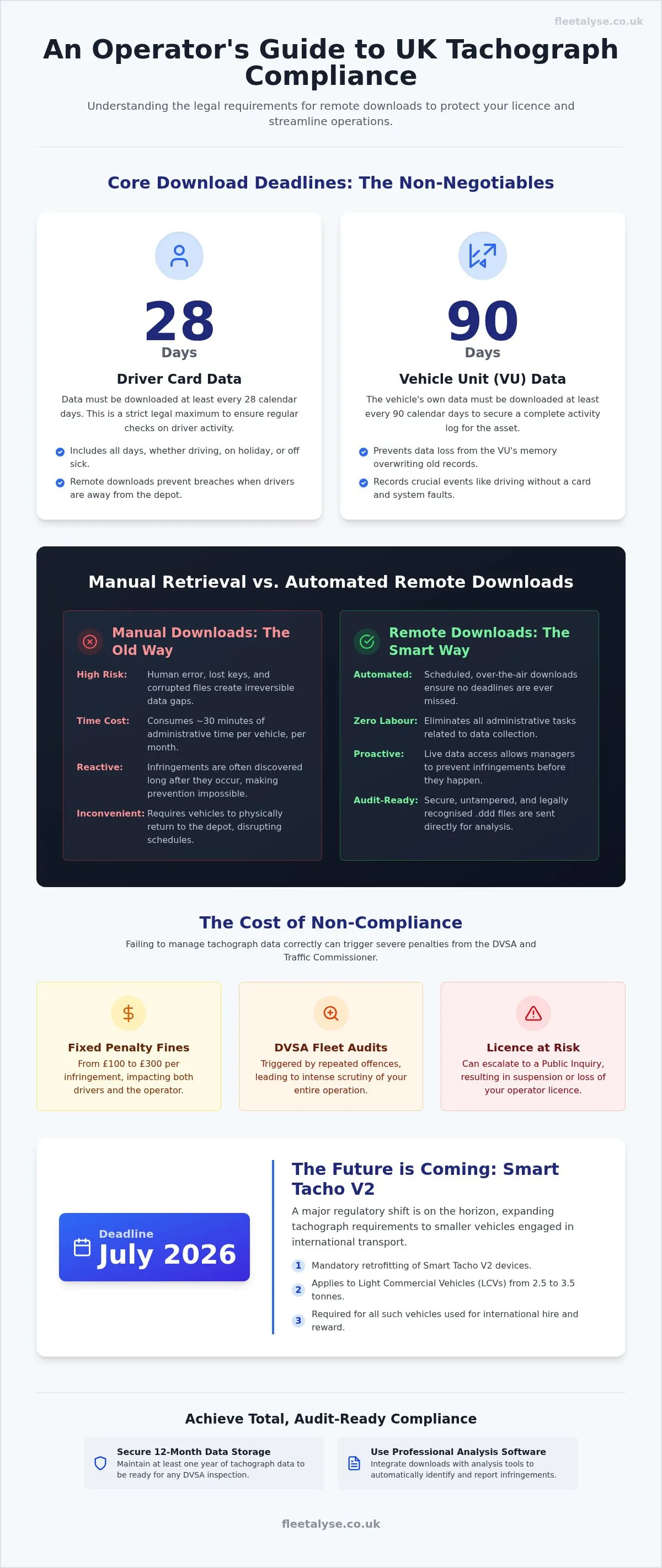
The legal consequences for failing to manage this data are severe. Drivers and operators can face fixed penalty notices ranging from £100 to £300 per infringement. Repeated offences or serious data gaps often trigger a DVSA fleet audit. This can lead to a Public Inquiry before a Traffic Commissioner, potentially resulting in the suspension or total loss of your operator licence. Compliance isn't optional; it's the backbone of your business's legal right to operate on UK roads.
The 28-Day Driver Card Rule
UK law mandates that data from a driver's smart card must be downloaded at least every 28 days. It's vital to remember that this refers to 28 calendar days, not just the days the driver was behind the wheel. If a driver is on holiday or sick, those days still count towards the deadline. Drivers must also use manual entries to account for any rest periods or work away from the vehicle. Chasing drivers for manual downloads whilst they're on long-distance routes is a common headache. If a vehicle doesn't return to the depot within that 28-day window, the risk of a breach increases significantly, making remote solutions a pragmatic necessity for modern fleets.
The 90-Day Vehicle Unit (VU) Requirement
The Vehicle Unit (VU) acts as the primary record for the asset itself. It stores technical data including vehicle speed, system faults, and sensor calibrations. Under UK law, this data must be downloaded at least every 90 days. The VU is critical during an audit because it shows when a vehicle was moved without a card inserted, highlighting potential "ghost driving" or unauthorised use. A major risk with the VU is data "wrap-around." Once the internal memory is full, the oldest records are overwritten. If you wait too long to download, you lose the primary evidence needed to prove your fleet's compliance history. Automated systems at Fleetalyse help prevent this by scheduling downloads well before these limits are reached.
Remote Download vs Manual Retrieval: Ensuring Legal Data Integrity
Manual data retrieval is a relic of the past that introduces unnecessary risk to your operations. When you rely on drivers to manually download their cards, you invite human error into your compliance chain. Lost download keys, corrupted files, or simple forgetfulness can leave gaps in your records that are impossible to fill retrospectively. In contrast, remote downloading ensures the integrity of .ddd files. These are the only legally recognised format for tachograph data in UK courts. These encrypted files are transmitted directly from the vehicle to your analysis platform, ensuring they remain untampered and accurate.
Following the UK Government Tachograph Rules is significantly easier when you move away from reactive manual checks. Remote systems provide real-time visibility into driver hours. This allows transport managers to spot potential infringements before they occur. This proactive approach is the most effective way to meet the remote tacho download legal requirements UK operators face. Research indicates that manual tachograph data downloads can take approximately 30 minutes per month, per vehicle. Automation removes this administrative burden entirely.
The Role of the Hosted Company Card
To legally retrieve data remotely, a Company Card must be present to authenticate the request. Traditionally, this meant keeping a physical card in a local card reader, which is prone to hardware failure or being accidentally disconnected. We use a hosted card rack system to solve this. This infrastructure keeps your Company Card secure in a controlled, data-centre environment. It allows the card to "talk" to your vehicles over the air via a secure authentication handshake. This process ensures that every download is legally valid and cryptographically secure without any manual intervention from your staff.
Eliminating Downtime and Operational Costs
The financial argument for automation is as strong as the legal one. Returning a vehicle to the depot solely for a manual download wastes fuel and valuable driver hours. For long-haul operators, this unnecessary downtime can cost hundreds of pounds in lost productivity per vehicle each month. Remote Tachograph Download is the automated retrieval of encrypted data via telematics hardware. It allows your fleet to stay on the road whilst remaining fully compliant. By removing the need for physical access to the vehicle, you can automate your entire download schedule and focus on core operations. This efficiency ensures your compliance records are always complete and ready for a DVSA inspection.
Navigating Smart Tachograph Regulations and the 2026 Shift
The transition from standard digital units to smart tachographs represents a significant leap in regulatory technology. Whilst the first generation of smart tachographs (V1) introduced GNSS positioning, the latest Smart Tachograph Version 2 (G2V2) adds even more granular data tracking. These updates are designed to enforce the EU Mobility Package and the UK-EU Trade and Cooperation Agreement. Understanding the remote tacho download legal requirements UK fleets must meet is no longer just about meeting deadlines; it's about managing hardware that is increasingly capable of self-reporting infringements. These units use Global Navigation Satellite System (GNSS) technology to record vehicle positions at the start and end of shifts, as well as every three hours of accumulated driving.
The most critical date on the horizon is 1 July 2026. From this point, light commercial vehicles (LCVs) with a Maximum Authorised Mass (MAM) between 2.5 and 3.5 tonnes must be fitted with G2V2 units if they are used for international hire and reward transport. This includes any trailer weight being towed. The 2022 Amendment Regulations provide the legal basis for these changes in the UK. Operators who fail to retrofit their international fleets by the relevant deadlines will find their vehicles legally grounded at the border. This shift brings vans into the same regulatory orbit as HGVs, requiring a level of data management that many LCV operators haven't previously needed.
Smart Tachograph Version 2 (G2V2) Requirements
G2V2 units introduce automated recording of border crossings, removing the need for drivers to stop and manually enter country codes. They also record "loading and unloading" events, providing a more detailed picture of a driver's duty cycle. For operators, this means the volume of data stored on the vehicle unit is larger and more complex. As these cross-border rules evolve, many international hauliers also rely on CiDATax SRL for specialist tax and regulatory guidance to ensure their operations remain compliant across the UK and EU. You must ensure your telematics hardware is compatible with these newer units; if your current system can't handle the encrypted G2V2 file structure, you won't be able to retrieve this essential data remotely, leaving you at risk of non-compliance during a DVSA audit.
Modern enforcement relies on Dedicated Short-Range Communication (DSRC). This technology allows DVSA officers to pre-screen vehicles whilst they are moving at motorway speeds. The tachograph broadcasts a subset of data to roadside receivers, alerting officers to potential manipulation, driver card issues, or calibration errors. If your data isn't "clean" or your downloads are overdue, your vehicle is far more likely to be pulled over for a physical inspection. Implementing a remote tachograph download solution ensures that your records are always up to date and your drivers stay on the move. It's the only pragmatic way to maintain a low-risk profile in an era of automated enforcement.

Best Practices for Maintaining an Audit-Ready Compliance Record
Under UK law, tachograph data must be securely stored for a minimum of 12 months. However, simply having the files saved on a hard drive isn't enough to pass a DVSA inspection. You must demonstrate that you are actively using that data to manage your fleet's safety and conduct. Integrating your downloads with professional analysis software is a prerequisite for modern compliance. This setup allows you to monitor live driver hours and intervene before a minor oversight becomes a legal breach. By staying on top of the remote tacho download legal requirements UK fleets are bound by, you protect your HGV operator licence from unnecessary scrutiny.
Step-by-Step Audit Preparation Framework
To ensure you are ready for a DVSA inspection at any time, follow this structured approach:
- First, verify that all vehicle and driver downloads are within the legal 28/90 day window without exception.
- Second, ensure all raw data files are backed up in a secure, off-site cloud environment to prevent data loss.
- Third, generate weekly infringement reports and document the specific corrective actions or debriefs taken with drivers.
A DVSA auditor expects to see a clear trail of infringement management, not just raw data. It's about "closing the loop" on every incident. If a driver exceeds their hours, you must show evidence of a debrief and any subsequent training. This proves that you have a robust system in place to prevent recurrence. You can start automating your compliance reports today to ensure this trail is always visible and up to date.
Managing Missing Mileage and Unaccounted Driving
Accounting for every kilometre the vehicle travels is a strict legal requirement. Discrepancies between vehicle movements and driver records, often called "missing mileage," are a major red flag for auditors. Remote VU downloads are essential for identifying these gaps. They allow you to cross-reference the odometer readings from the vehicle unit against the driver card data automatically. This helps you quickly identify "driving without a card" incidents, whether they are genuine errors or unauthorised use. Reconciling these movements immediately ensures your records remain accurate and defensible. Pragmatic operators use these digital insights to maintain a 100% compliant, audit-ready status without the stress of manual cross-referencing.
Streamlining Your Operator Licence Compliance with Fleetalyse
Fleetalyse acts as a pragmatic expert partner for UK transport operators. We don't just provide data; we provide the tools to maintain a 100% compliant fleet with minimal effort. By combining remote tachograph downloads with GPS fleet tracking, we give you a unified view of your assets. This integration allows you to see where your vehicles are and exactly how many hours your drivers have left in real-time. Meeting the remote tacho download legal requirements UK authorities demand shouldn't require a dedicated administrative team. Our platform is built for transparency, offering clear costs and direct data access without the hidden complexities often found in global software suites.
Our "Live Driver Hours" feature is a critical tool for real-time compliance management. It moves your operation from reactive to proactive. Instead of discovering an infringement weeks after it happened, you can see the remaining drive time for every driver on your screen right now. This visibility is essential for planning routes that don't push your staff toward legal breaches. It's a straightforward solution built for the rigours of real-world applications.
Why a Local Specialist Matters for UK Operators
The UK HGV industry has unique rigours and specific DVSA standards that generic, international providers often overlook. We focus on the domestic market, ensuring our services align perfectly with your Operator Licence safety requirements. Our tachograph analysis integration simplifies your reporting process by feeding raw data directly into the analysis tools you already trust. This localised expertise means we understand the daily struggles of regional hauliers. We prioritise functional utility over flashy, unnecessary features, ensuring you have the exact data needed for an audit.
Next Steps: Securing Your Fleet Compliance
The July 2026 deadlines are approaching quickly. Sticking with manual retrieval methods is a risk your business doesn't need to take. Moving to an automated system now provides immediate peace of mind and long-term security. It eliminates the "human error" factor and ensures you never miss a legal deadline. Take control of your compliance record before the new regulations for LCVs and Smart Tacho V2 take full effect.
You can book a compliance health check to see how our automated tools can transform your operations. Automated compliance is the only reliable way to protect your business's future on the road. Don't wait for a DVSA inspection to find the gaps in your records. Focus on your core business and let us handle the technical burden of regulatory adherence.
Secure Your Fleet’s Future Beyond 2026
The regulatory landscape for UK transport is shifting rapidly. With the July 2026 Smart Tacho V2 deadlines approaching, manual data retrieval is becoming a significant operational risk. Mastering the remote tacho download legal requirements UK operators face means moving away from reactive habits. You need a system that ensures 100% DVSA audit-ready data without the need for physical vehicle access. Automation isn't just about saving time; it's about protecting your operator licence from the consequences of missing the 28-day and 90-day download windows.
By partnering with a specialist UK-based compliance provider, you gain more than just software. You get real-time visibility through live driver hours monitoring and a platform built specifically for the rigours of the domestic industry. This pragmatic approach removes the administrative labour that often leads to human error. You can automate your fleet compliance with Fleetalyse remote tacho downloads today to ensure your records are always complete and secure. Take the stress out of your next inspection and keep your focus on the road ahead.
Frequently Asked Questions
How often is it legally required to download driver card data in the UK?
Driver card data must be downloaded at least every 28 days. This is a strict legal limit based on calendar days, not just the days the driver was working. Additionally, the vehicle unit (VU) data must be retrieved every 90 days. Failing to meet these deadlines leaves your operation vulnerable to DVSA scrutiny. Automated systems help you stay ahead of these windows by scheduling downloads well before the data reaches the legal limit.
Is remote tachograph downloading fully compliant with DVSA regulations?
Yes, remote downloading is fully recognised by the DVSA as a legitimate method for data retrieval. The system must produce authentic, encrypted .ddd files that are identical to those retrieved via manual methods. As long as the data remains untampered and is authenticated using a valid Company Card, it meets all remote tacho download legal requirements UK standards. This technology is often preferred by operators as it significantly reduces the risk of human error.
What are the penalties for failing to download tachograph data on time?
Failing to download data on time can lead to fixed penalty notices ranging from £100 to £300 per infringement. However, the greater risk is to your HGV operator licence. Systematic failures to manage data can result in a DVSA fleet audit or a Public Inquiry before a Traffic Commissioner. Penalties at this level include licence suspension or revocation, which can effectively shut down your commercial operations and damage your business's reputation for years.
Do I still need a physical Company Card if I use remote downloading?
Yes, you still need a physical Company Card to authenticate every remote download request. The card acts as a secure digital key that allows the server to communicate with the vehicle unit. Instead of carrying it to every vehicle, you can place the card in a hosted card rack. This allows for centralised, over-the-air authentication, ensuring your downloads are legally valid while the physical card remains in a secure, static location at all times.
What happens if a vehicle is out of the country when a download is due?
If a vehicle is out of the country, manual retrieval is impossible, which often leads to missed deadlines. Remote downloading solves this by using the vehicle's telematics hardware to transmit data over cellular networks. As long as the vehicle has a signal, the download can be completed anywhere in Europe. This ensures you remain compliant with UK laws even when your fleet is operating on international routes for weeks or months at a time.
How long must a transport operator keep tachograph records for legal purposes?
Transport operators are legally required to store tachograph records for at least 12 months from the date of the recording. These records must be kept in their original, raw format and be made available to DVSA officers or the police upon request. It's best practice to back up these files in a secure cloud environment. This ensures that you can always produce a complete, 100% compliant audit trail during a roadside check or a full depot inspection.
Can remote download hardware be fitted to any digital tachograph unit?
Most digital tachograph units manufactured after 2009 support remote downloading. This includes VDO Continental units from version 1.3 onwards and Stoneridge units from version 7.1 onwards. Earlier models may lack the necessary front-port communication capabilities or internal hardware to facilitate over-the-air transfers. If you operate an older fleet, you should check the compatibility of your vehicle units before attempting to integrate an automated remote download solution to ensure it will function correctly.
What is the July 2026 deadline for Smart Tachograph Version 2?
By 1 July 2026, all light commercial vehicles (LCVs) between 2.5 and 3.5 tonnes used for international hire and reward must be fitted with a Smart Tachograph Version 2. This regulation also applies to HGVs that haven't yet been retrofitted for international journeys. This change is part of the UK-EU Trade and Cooperation Agreement. It aims to improve driver welfare and ensure fair competition across borders by bringing smaller vans under the same regulatory framework as heavy goods vehicles.
Frequently asked questions
How often is it legally required to download driver card data in the UK?
Driver card data must be downloaded at least every 28 days. This is a strict legal limit based on calendar days, not just the days the driver was working. Additionally, the vehicle unit (VU) data must be retrieved every 90 days. Failing to meet these deadlines leaves your operation vulnerable to DVSA scrutiny. Automated systems help you stay ahead of these windows by scheduling downloads well before the data reaches the legal limit.
Is remote tachograph downloading fully compliant with DVSA regulations?
Yes, remote downloading is fully recognised by the DVSA as a legitimate method for data retrieval. The system must produce authentic, encrypted .ddd files that are identical to those retrieved via manual methods. As long as the data remains untampered and is authenticated using a valid Company Card, it meets all remote tacho download legal requirements UK standards. This technology is often preferred by operators as it significantly reduces the risk of human error.
What are the penalties for failing to download tachograph data on time?
Failing to download data on time can lead to fixed penalty notices ranging from £100 to £300 per infringement. However, the greater risk is to your HGV operator licence. Systematic failures to manage data can result in a DVSA fleet audit or a Public Inquiry before a Traffic Commissioner. Penalties at this level include licence suspension or revocation, which can effectively shut down your commercial operations and damage your business's reputation for years.
Do I still need a physical Company Card if I use remote downloading?
Yes, you still need a physical Company Card to authenticate every remote download request. The card acts as a secure digital key that allows the server to communicate with the vehicle unit. Instead of carrying it to every vehicle, you can place the card in a hosted card rack. This allows for centralised, over-the-air authentication, ensuring your downloads are legally valid while the physical card remains in a secure, static location at all times.
What happens if a vehicle is out of the country when a download is due?
If a vehicle is out of the country, manual retrieval is impossible, which often leads to missed deadlines. Remote downloading solves this by using the vehicle's telematics hardware to transmit data over cellular networks. As long as the vehicle has a signal, the download can be completed anywhere in Europe. This ensures you remain compliant with UK laws even when your fleet is operating on international routes for weeks or months at a time.
How long must a transport operator keep tachograph records for legal purposes?
Transport operators are legally required to store tachograph records for at least 12 months from the date of the recording. These records must be kept in their original, raw format and be made available to DVSA officers or the police upon request. It's best practice to back up these files in a secure cloud environment. This ensures that you can always produce a complete, 100% compliant audit trail during a roadside check or a full depot inspection.
Can remote download hardware be fitted to any digital tachograph unit?
Most digital tachograph units manufactured after 2009 support remote downloading. This includes VDO Continental units from version 1.3 onwards and Stoneridge units from version 7.1 onwards. Earlier models may lack the necessary front-port communication capabilities or internal hardware to facilitate over-the-air transfers. If you operate an older fleet, you should check the compatibility of your vehicle units before attempting to integrate an automated remote download solution to ensure it will function correctly.
What is the July 2026 deadline for Smart Tachograph Version 2?
By 1 July 2026, all light commercial vehicles (LCVs) between 2.5 and 3.5 tonnes used for international hire and reward must be fitted with a Smart Tachograph Version 2. This regulation also applies to HGVs that haven't yet been retrofitted for international journeys. This change is part of the UK-EU Trade and Cooperation Agreement. It aims to improve driver welfare and ensure fair competition across borders by bringing smaller vans under the same regulatory framework as heavy goods vehicles.