
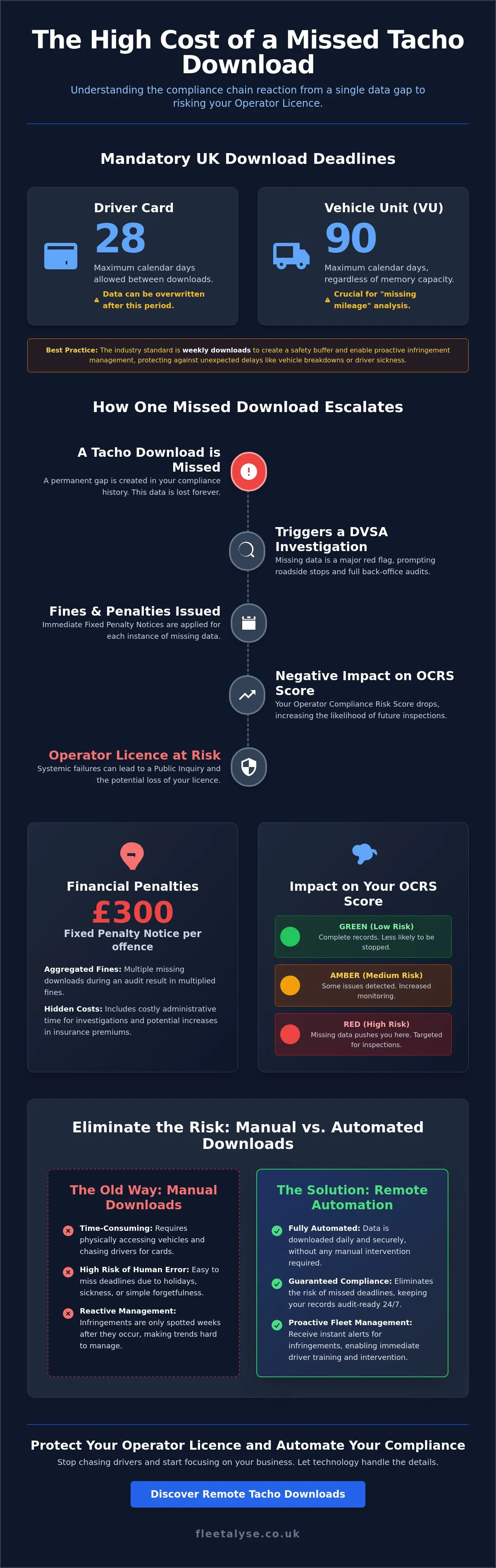
A missing tachograph download is a permanent gap in your compliance history that no amount of retrospective paperwork can fix. When the 28-day driver card or 90-day vehicle unit deadlines pass without a successful data transfer, you haven't just missed a date; you've lost the primary evidence required to prove your fleet is operating safely. The consequences of missing a tacho download extend far beyond a simple administrative oversight. These gaps often act as a direct trigger for a full DVSA investigation into your entire transport operation.
You likely already feel the constant pressure of chasing drivers for cards or manually visiting vehicles with a download tool before the clock runs out. It's a stressful, time-consuming cycle that pulls focus from your core business. This guide explains how these data holes impact your OCRS score and the specific legal risks to your Operator Licence. We'll examine the financial penalties involved and detail how to automate your compliance. You'll learn how to keep your records 'Green' and ensure your fleet stays audit-ready without the manual burden.
Key Takeaways
- Master the mandatory 28-day and 90-day download cycles to ensure your fleet remains fully compliant with UK law.
- Identify the specific financial and legal consequences of missing a tacho download, ranging from immediate Fixed Penalty Notices to potential court summons.
- Understand how missing data points negatively impact your OCRS score and increase the likelihood of disruptive DVSA roadside inspections.
- Prevent permanent data loss caused by tachograph memory overwriting, ensuring your business maintains a complete and irretrievable audit trail.
- Learn how transitioning to remote download technology can automate your compliance and remove the administrative burden of manual data retrieval.
Understanding Tachograph Download Deadlines and Legal Requirements
The DVSA maintains a strict stance on data retrieval. Compliance hinges on two specific windows: 28 days for driver cards and 90 days for vehicle units. These are not suggestions. They are the maximum legal thresholds. In 2026, the DVSA continues to use these metrics as a primary indicator of an operator's fitness to hold a licence. The consequences of missing a tacho download often start with a simple administrative error but can quickly escalate into a formal inquiry into your entire operation.
It is vital to understand that these limits refer to calendar days, not working days. If a driver takes a 14 day holiday, those days still count towards the 28 day limit. Many operators fall into this trap, assuming the clock pauses when the ignition is off. It doesn't. Missing these deadlines creates a permanent hole in your records that cannot be legally filled after the fact.
Driver Card vs Vehicle Unit: Key Differences
A driver card typically stores around 28 days of average driving activity before it begins to overwrite the oldest data. In contrast, the Vehicle Unit (VU) has a much larger internal memory, often capable of holding 365 days of data. However, the law mandates a VU download every 90 days regardless of capacity. To understand the technical origins of these devices, you can read more about What is a Tachograph? and its role in European transport history.
Operators hold the legal liability for both data sets. A common pitfall is the missing mileage trap. By comparing VU data with driver card records, auditors can see exactly when a vehicle was moved without a card inserted. If you only download cards and ignore the VU, you leave a massive gap in your compliance shield. This oversight is a major red flag during any DVSA inspection.
Best Practice: Why Weekly Downloads are the Industry Standard
Relying on the maximum legal limit is a high risk strategy. Smart UK hauliers aim for weekly downloads to create a safety buffer. This protects the business against vehicle breakdowns, driver sickness, or card malfunctions that could otherwise push you past the deadline. Tachograph download deadlines are the absolute legal limit for data retrieval to avoid prosecution.
Frequent downloads allow for early detection. You can spot infringements like insufficient daily rest or speeding immediately. Waiting 28 days to find a mistake means the driver might have repeated that same error 20 times before you noticed. Moving to a remote system via Fleetalyse ensures this data flows daily, removing the risk of the consequences of missing a tacho download entirely. It turns reactive firefighting into proactive management.
DVSA Compliance Fines and Legal Penalties for Missing Data
The DVSA treats missing tachograph data as a serious breach of trust. When an officer requests records and you fail to provide them, they don't see a simple mistake; they see a void where safety evidence should be. This lack of transparency triggers a chain reaction of enforcement actions. The consequences of missing a tacho download begin with immediate financial hits but can escalate to criminal prosecution if the gaps appear intentional or systemic.
Enforcement officers use historical data to look for patterns. A single missing file might lead to a warning; however, a consistent failure to download data from specific vehicles suggests a deeper failure in your internal controls. In 2026, the DVSA prioritises "targeted enforcement," meaning once you are on their radar for data gaps, your fleet will face more frequent stops and inspections. They use these gaps to prove a "systemic failure," arguing that your management structure is fundamentally incapable of ensuring road safety.
Fixed Penalties and Graduated Fines
Most record-keeping offences are handled via Fixed Penalty Notices (FPNs). If you fail to produce a driver card or vehicle unit download during a roadside check, the standard fine is currently £300 per offence. If an audit of your premises reveals multiple missing downloads, these fines are often aggregated. The financial burden isn't just the penalty itself. It includes the administrative cost of responding to a DVSA investigation and the potential increase in insurance premiums that follows a recorded offence.
For many operators, the true cost lies in the mandatory back-office audits. If the DVSA suspects your records are incomplete, they may demand a full inspection of the last 12 months of your operation. This process is intrusive and expensive. You can avoid these manual audit risks by ensuring your data is always current through automated remote download solutions.
The Ultimate Sanction: Public Inquiries
The Traffic Commissioner holds the power to end a transport business. If missing downloads are deemed a sign of "loss of professional competence," you will be called to a Public Inquiry. This is a formal legal proceeding where your Operator Licence is at stake. The Commissioner can decide to suspend your operations, reduce the number of vehicles you are allowed to run, or revoke your licence entirely. For a Transport Manager, a "finding of unfitness" can lead to a personal disqualification from the industry. Missing data is rarely just about the paperwork; it's about whether you can be trusted to run a safe fleet.

The Impact on Your OCRS Score and Operator Licence
The DVSA uses the Operator Compliance Risk Score (OCRS) as a primary filter to identify which vehicles to target for roadside inspections. This system calculates a score over a rolling three-year period based on data from annual tests, roadside inspections, and remote audits. When your records show gaps, your status shifts from Green to Amber or Red. The consequences of missing a tacho download are immediately visible to enforcement officers via ANPR technology. They don't pull over every vehicle they see. They target the operators whose data suggests a lack of management control.
Commercial viability depends on this score. Many Tier 1 contractors and blue-chip logistics partners now mandate a 'Green' OCRS status in their service level agreements. If your score slips due to administrative errors or missing files, you may find your business excluded from high-value tenders. This is a commercial reality in 2026. It isn't just about avoiding a fine; it's about protecting your company's ability to trade and grow.
The Roadside Domino Effect
A poor OCRS score triggers a cycle of operational disruption. Red-rated fleets are statistically more likely to be stopped and subjected to an "S" marked prohibition or an extended inspection. A standard check can quickly turn into a two-hour delay if an officer identifies historical data gaps. This downtime carries a heavy price. It causes missed delivery slots, increases driver fatigue, and damages your relationship with your customers. One oversight on a single driver card can flag your entire fleet for years. You can't afford to have your vehicles sitting in a layby because of a paperwork error.
Maintaining Your 'Green' Status
Protecting your licence requires a shift from reactive to proactive management. You must ensure that 100% of your data is retrieved and checked for infringements well before the legal limits. High-quality records are your strongest shield during a DVSA desk-based assessment or a full premises audit. When your data is complete, it proves you have 'effective and continuous' control over your transport activities. Learn how live driver hours tracking keeps you in the green and ensures your compliance remains bulletproof. It takes the pressure off your transport office and puts you back in control.
Operational Risks: When Data Gaps Become Irretrievable
Digital tachographs operate on a "First In, First Out" principle known as a circular buffer. This means the device has a fixed amount of internal memory. Once that memory is full, the system automatically overwrites the oldest data with new activity. There is no warning. There is no "undo" button. The consequences of missing a tacho download are final because once that data is overwritten, the original digital evidence is gone forever. This creates a permanent "Missing Data" flag on your compliance reports that cannot be cleared.
Tacho analysis software is designed to spot these gaps instantly. A report filled with "Unknown Activity" or missing mileage is a major red flag for auditors. They often assume that missing data is a deliberate attempt to hide serious infringements, such as exceeded driving limits or insufficient weekly rest. By failing to retrieve the data before the buffer clears, you effectively lose your ability to prove you were operating legally. This often leads to double penalties: one for the missing record and another for the suspected infringement the data would have covered.
Technical Limits of Digital Tachographs
Storage capacity varies between generations of hardware. Gen 1 units, standard in vehicles registered before June 2019, typically store around 365 days of VU data. However, the driver cards themselves are much more limited, often holding only 28 to 30 days of average activity. The introduction of Gen 2 "Smart" tachographs brought better security and GPS logging, but the physical storage constraints remain a bottleneck. If a driver card is not downloaded within its window, the cryptographic digital signature attached to those records is lost. You cannot reconstruct a digitally signed file after the event. Any manual record you create to fill the gap will lack the legal weight of the original encrypted data.
The Administrative Nightmare of Manual Records
Trying to fix a data gap manually is an expensive, time-consuming process that rarely satisfies a DVSA inspector. Transport managers often spend hours chasing drivers across multiple depots to find missing cards or verify "unknown" vehicle movements. This administrative burden pulls your team away from productive work and into a cycle of reactive damage control. Relying on manual entries is risky; the DVSA view these as secondary evidence at best. Once tacho data is overwritten in the VU, it is technically impossible to recover the original digital evidence. You can eliminate this technical risk and the associated stress by choosing to secure your fleet data with remote downloads. This ensures your records are backed up daily, long before the circular buffer becomes a problem.
Eliminating the Risk: Moving to Remote Tachograph Downloads
Manual downloading is a logistical bottleneck. It forces your vehicles to return to a central depot just to move data from a card to a computer. This wasted mileage costs money and creates unnecessary wear on your fleet. By moving to remote technology, you remove the human element from the compliance chain. You no longer need to worry about the consequences of missing a tacho download because the system handles the retrieval for you. It's about moving from reactive panic to "Total Transparency."
Remote systems provide a level of oversight that manual methods cannot match. Instead of waiting 28 days to see if a driver has stayed within legal limits, you get a clear view of your data every single day. This real-time visibility allows you to spot potential infringements before they escalate into a DVSA investigation. It's a proactive shield for your Operator Licence. This approach is built for real transport operations, not just basic tracking.
How Remote Tacho Download Works
The hardware is a "Plug & Play" connection. It fits directly into the back of the tachograph unit. There's no complex wiring. There's no lengthy vehicle downtime. Once the unit is active, you can set an automatic schedule. Downloads happen whilst the vehicle is on the road, amongst its usual routes. This data flows seamlessly into your favourite tacho analysis software without any manual intervention. It's a quiet, efficient process that works in the background of your daily haulage tasks.
The ROI of Automated Compliance
A single DVSA fine for a record-keeping offence is a significant hit to your margins. In 2026, these penalties start at £300 per instance. If an audit reveals a systemic failure across ten vehicles, the financial damage is immediate and severe. In contrast, an automated subscription is a predictable operational cost. It's an investment in your company's survival. You stay audit-ready 24/7. You don't have to lift a finger to stay compliant.
Fleetalyse offers a fee-free lease model for hardware to ensure total transparency. There are no hidden costs. You get the tools you need to protect your "Green" OCRS status without a massive upfront capital outlay. This level of automation frees up your transport managers. They can focus on routing and revenue instead of chasing driver cards. Discover how Fleetalyse automates your remote tacho downloads and take the stress out of your compliance cycle today.
Take Control of Your Fleet Compliance
Compliance is the foundation of a profitable haulage business. The consequences of missing a tacho download reach far beyond a £300 fine. They threaten your Operator Licence, damage your OCRS score, and lead to the permanent loss of vital evidence. You cannot recover data once the circular buffer overwrites it. Manual download schedules remain a high-stakes gamble with your company's future in 2026. One missed 28-day deadline can trigger a full DVSA audit.
Switching to a remote system removes this uncertainty. You gain total visibility with daily data retrievals and an audit-ready archive. Our solution is Built for Real Transport Operations. It provides a practical tool for UK-based compliance specialists who value efficiency over paperwork. We believe in Total Transparency and Clear Pricing. This ensures you have the hardware needed to succeed without hidden fees. Stop chasing driver cards and start focusing on your core logistics. Secure your fleet's compliance with Remote Tacho Downloads from Fleetalyse. Your fleet deserves the protection of automated, reliable data management.
Frequently Asked Questions
What is the maximum fine for missing a tachograph download?
Fixed Penalty Notices for failing to produce or keep records are currently £300 per offence at the roadside. If the case reaches a magistrates' court, fines are technically unlimited, though they often reach £5,000 per missing record. For systemic failures, the Traffic Commissioner can also impose separate financial penalties on your Operator Licence during a Public Inquiry.
Can the DVSA prosecute me for data missing from three years ago?
Yes, the DVSA can use historical data to prove a long-term pattern of non-compliance. While roadside checks focus on the current 28-day period, office audits typically examine the previous 12 months. However, the Operator Compliance Risk Score (OCRS) tracks your performance over a rolling 3-year window. Any serious data gaps found during this time can be used as evidence to revoke your licence.
What happens if a driver card is full before the 28-day download limit?
The card will automatically overwrite the oldest data, causing a permanent loss of digital evidence. Most driver cards hold approximately 28 days of activity, but high-intensity work or double-shifting can fill them much sooner. You must download the card as soon as it reaches capacity. Ignoring this is one of the most common consequences of missing a tacho download for high-utilisation fleets.
Is the company or the driver responsible for missing tacho data?
Both parties share the legal burden, but the operator holds the ultimate responsibility for data retrieval. A driver can be fined £300 for failing to produce a card. However, the operator must have robust systems to monitor and collect that data. If those systems fail, the Transport Manager and the company are liable for failing to supervise driver hours and rest periods.
How do missing downloads affect my OCRS score?
Missing data points act as a negative multiplier that pushes your fleet status from Green to Amber or Red. Every recorded failure to produce a download or a missing mileage report adds points to your risk profile. Once your fleet is Red-rated, your vehicles are statistically 4 times more likely to be stopped for time-consuming roadside inspections by DVSA officers using ANPR technology.
What should I do if I realise I have missed a 90-day vehicle download?
Download the data immediately and document the reason for the delay in your compliance records. You must show the "corrective action" taken to prevent the error from happening again. Simply leaving the gap is a red flag for auditors. By being transparent and fixing the process, you reduce the risk of facing the harshest consequences of missing a tacho download during a formal audit.
Can remote tachograph downloads prevent missing data gaps?
Yes, remote technology removes the risk of human error by automating the retrieval process daily. The system pulls data wirelessly whilst the vehicle is on the road, ensuring your files are backed up long before the card or vehicle unit reaches capacity. This creates a 100% complete data set and ensures you are audit-ready 24/7 without needing the vehicle to return to the depot.
Does the DVSA accept manual records if tacho data is missing?
Manual records are treated as secondary evidence and are rarely accepted as a substitute for digital data. You should only use manual entries for genuine emergencies, such as a card theft or equipment malfunction. If the DVSA suspects you are using manual records to hide a failure to download, they will treat it as a serious compliance breach rather than a valid record-keeping attempt.
Frequently asked questions
Driver Card vs Vehicle Unit: Key Differences
A driver card typically stores around 28 days of average driving activity before it begins to overwrite the oldest data. In contrast, the Vehicle Unit (VU) has a much larger internal memory, often capable of holding 365 days of data. However, the law mandates a VU download every 90 days regardless of capacity. To understand the technical origins of these devices, you can read more about What is a Tachograph? and its role in European transport history. Operators hold the legal liability for both data sets. A common pitfall is the missing mileage trap. By comparing VU data with driver card records, auditors can see exactly when a vehicle was moved without a card inserted. If you only download cards and ignore the VU, you leave a massive gap in your compliance shield. This oversight is a major red flag during any DVSA inspection.
Best Practice: Why Weekly Downloads are the Industry Standard
Relying on the maximum legal limit is a high risk strategy. Smart UK hauliers aim for weekly downloads to create a safety buffer. This protects the business against vehicle breakdowns, driver sickness, or card malfunctions that could otherwise push you past the deadline. Tachograph download deadlines are the absolute legal limit for data retrieval to avoid prosecution. Frequent downloads allow for early detection. You can spot infringements like insufficient daily rest or speeding immediately. Waiting 28 days to find a mistake means the driver might have repeated that same error 20 times before you noticed. Moving to a remote system via Fleetalyse ensures this data flows daily, removing the risk of the consequences of missing a tacho download entirely. It turns reactive firefighting into proactive management. The DVSA treats missing tachograph data as a serious breach of trust. When an officer requests records and you fail to provide them, they don't see a simple mistake; they see a void where safety evidence should be. This lack of transparency triggers a chain reaction of enforcement actions. The consequences of missing a tacho download begin with immediate financial hits but can escalate to criminal prosecution if the gaps appear intentional or systemic. Enforcement officers use historical data to look for patterns. A single missing file might lead to a warning; however, a consistent failure to download data from specific vehicles suggests a deeper failure in your internal controls. In 2026, the DVSA prioritises "targeted enforcement," meaning once you are on their radar for data gaps, your fleet will face more frequent stops and inspections. They use these gaps to prove a "systemic failure," arguing that your management structure is fundamentally incapable of ensuring road safety.
Fixed Penalties and Graduated Fines
Most record-keeping offences are handled via Fixed Penalty Notices (FPNs). If you fail to produce a driver card or vehicle unit download during a roadside check, the standard fine is currently £300 per offence. If an audit of your premises reveals multiple missing downloads, these fines are often aggregated. The financial burden isn't just the penalty itself. It includes the administrative cost of responding to a DVSA investigation and the potential increase in insurance premiums that follows a recorded offence. For many operators, the true cost lies in the mandatory back-office audits. If the DVSA suspects your records are incomplete, they may demand a full inspection of the last 12 months of your operation. This process is intrusive and expensive. You can avoid these manual audit risks by ensuring your data is always current through automated remote download solutions.
The Ultimate Sanction: Public Inquiries
The Traffic Commissioner holds the power to end a transport business. If missing downloads are deemed a sign of "loss of professional competence," you will be called to a Public Inquiry. This is a formal legal proceeding where your Operator Licence is at stake. The Commissioner can decide to suspend your operations, reduce the number of vehicles you are allowed to run, or revoke your licence entirely. For a Transport Manager, a "finding of unfitness" can lead to a personal disqualification from the industry. Missing data is rarely just about the paperwork; it's about whether you can be trusted to run a safe fleet. The DVSA uses the Operator Compliance Risk Score (OCRS) as a primary filter to identify which vehicles to target for roadside inspections. This system calculates a score over a rolling three-year period based on data from annual tests, roadside inspections, and remote audits. When your records show gaps, your status shifts from Green to Amber or Red. The consequences of missing a tacho download are immediately visible to enforcement officers via ANPR technology. They don't pull over every vehicle they see. They target the operators whose data suggests a lack of management control. Commercial viability depends on this score. Many Tier 1 contractors and blue-chip logistics partners now mandate a 'Green' OCRS status in their service level agreements. If your score slips due to administrative errors or missing files, you may find your business excluded from high-value tenders. This is a commercial reality in 2026. It isn't just about avoiding a fine; it's about protecting your company's ability to trade and grow.
The Roadside Domino Effect
A poor OCRS score triggers a cycle of operational disruption. Red-rated fleets are statistically more likely to be stopped and subjected to an "S" marked prohibition or an extended inspection. A standard check can quickly turn into a two-hour delay if an officer identifies historical data gaps. This downtime carries a heavy price. It causes missed delivery slots, increases driver fatigue, and damages your relationship with your customers. One oversight on a single driver card can flag your entire fleet for years. You can't afford to have your vehicles sitting in a layby because of a paperwork error.
Maintaining Your 'Green' Status
Protecting your licence requires a shift from reactive to proactive management. You must ensure that 100% of your data is retrieved and checked for infringements well before the legal limits. High-quality records are your strongest shield during a DVSA desk-based assessment or a full premises audit. When your data is complete, it proves you have 'effective and continuous' control over your transport activities. Learn how live driver hours tracking keeps you in the green and ensures your compliance remains bulletproof. It takes the pressure off your transport office and puts you back in control. Digital tachographs operate on a "First In, First Out" principle known as a circular buffer. This means the device has a fixed amount of internal memory. Once that memory is full, the system automatically overwrites the oldest data with new activity. There is no warning. There is no "undo" button. The consequences of missing a tacho download are final because once that data is overwritten, the original digital evidence is gone forever. This creates a permanent "Missing Data" flag on your compliance reports that cannot be cleared. Tacho analysis software is designed to spot these gaps instantly. A report filled with "Unknown Activity" or missing mileage is a major red flag for auditors. They often assume that missing data is a deliberate attempt to hide serious infringements, such as exceeded driving limits or insufficient weekly rest. By failing to retrieve the data before the buffer clears, you effectively lose your ability to prove you were operating legally. This often leads to double penalties: one for the missing record and another for the suspected infringement the data would have covered.
Technical Limits of Digital Tachographs
Storage capacity varies between generations of hardware. Gen 1 units, standard in vehicles registered before June 2019, typically store around 365 days of VU data. However, the driver cards themselves are much more limited, often holding only 28 to 30 days of average activity. The introduction of Gen 2 "Smart" tachographs brought better security and GPS logging, but the physical storage constraints remain a bottleneck. If a driver card is not downloaded within its window, the cryptographic digital signature attached to those records is lost. You cannot reconstruct a digitally signed file after the event. Any manual record you create to fill the gap will lack the legal weight of the original encrypted data.
The Administrative Nightmare of Manual Records
Trying to fix a data gap manually is an expensive, time-consuming process that rarely satisfies a DVSA inspector. Transport managers often spend hours chasing drivers across multiple depots to find missing cards or verify "unknown" vehicle movements. This administrative burden pulls your team away from productive work and into a cycle of reactive damage control. Relying on manual entries is risky; the DVSA view these as secondary evidence at best. Once tacho data is overwritten in the VU, it is technically impossible to recover the original digital evidence. You can eliminate this technical risk and the associated stress by choosing to secure your fleet data with remote downloads. This ensures your records are backed up daily, long before the circular buffer becomes a problem. Manual downloading is a logistical bottleneck. It forces your vehicles to return to a central depot just to move data from a card to a computer. This wasted mileage costs money and creates unnecessary wear on your fleet. By moving to remote technology, you remove the human element from the compliance chain. You no longer need to worry about the consequences of missing a tacho download because the system handles the retrieval for you. It's about moving from reactive panic to "Total Transparency." Remote systems provide a level of oversight that manual methods cannot match. Instead of waiting 28 days to see if a driver has stayed within legal limits, you get a clear view of your data every single day. This real-time visibility allows you to spot potential infringements before they escalate into a DVSA investigation. It's a proactive shield for your Operator Licence. This approach is built for real transport operations, not just basic tracking.
How Remote Tacho Download Works
The hardware is a "Plug & Play" connection. It fits directly into the back of the tachograph unit. There's no complex wiring. There's no lengthy vehicle downtime. Once the unit is active, you can set an automatic schedule. Downloads happen whilst the vehicle is on the road, amongst its usual routes. This data flows seamlessly into your favourite tacho analysis software without any manual intervention. It's a quiet, efficient process that works in the background of your daily haulage tasks.
The ROI of Automated Compliance
A single DVSA fine for a record-keeping offence is a significant hit to your margins. In 2026, these penalties start at £300 per instance. If an audit reveals a systemic failure across ten vehicles, the financial damage is immediate and severe. In contrast, an automated subscription is a predictable operational cost. It's an investment in your company's survival. You stay audit-ready 24/7. You don't have to lift a finger to stay compliant. Fleetalyse offers a fee-free lease model for hardware to ensure total transparency. There are no hidden costs. You get the tools you need to protect your "Green" OCRS status without a massive upfront capital outlay. This level of automation frees up your transport managers. They can focus on routing and revenue instead of chasing driver cards. Discover how Fleetalyse automates your remote tacho downloads and take the stress out of your compliance cycle today. Compliance is the foundation of a profitable haulage business. The consequences of missing a tacho download reach far beyond a £300 fine. They threaten your Operator Licence, damage your OCRS score, and lead to the permanent loss of vital evidence. You cannot recover data once the circular buffer overwrites it. Manual download schedules remain a high-stakes gamble with your company's future in 2026. One missed 28-day deadline can trigger a full DVSA audit. Switching to a remote system removes this uncertainty. You gain total visibility with daily data retrievals and an audit-ready archive. Our solution is Built for Real Transport Operations. It provides a practical tool for UK-based compliance specialists who value efficiency over paperwork. We believe in Total Transparency and Clear Pricing. This ensures you have the hardware needed to succeed without hidden fees. Stop chasing driver cards and start focusing on your core logistics. Secure your fleet's compliance with Remote Tacho Downloads from Fleetalyse. Your fleet deserves the protection of automated, reliable data management.
What is the maximum fine for missing a tachograph download?
Fixed Penalty Notices for failing to produce or keep records are currently £300 per offence at the roadside. If the case reaches a magistrates' court, fines are technically unlimited, though they often reach £5,000 per missing record. For systemic failures, the Traffic Commissioner can also impose separate financial penalties on your Operator Licence during a Public Inquiry.
Can the DVSA prosecute me for data missing from three years ago?
Yes, the DVSA can use historical data to prove a long-term pattern of non-compliance. While roadside checks focus on the current 28-day period, office audits typically examine the previous 12 months. However, the Operator Compliance Risk Score (OCRS) tracks your performance over a rolling 3-year window. Any serious data gaps found during this time can be used as evidence to revoke your licence.
What happens if a driver card is full before the 28-day download limit?
The card will automatically overwrite the oldest data, causing a permanent loss of digital evidence. Most driver cards hold approximately 28 days of activity, but high-intensity work or double-shifting can fill them much sooner. You must download the card as soon as it reaches capacity. Ignoring this is one of the most common consequences of missing a tacho download for high-utilisation fleets.
Is the company or the driver responsible for missing tacho data?
Both parties share the legal burden, but the operator holds the ultimate responsibility for data retrieval. A driver can be fined £300 for failing to produce a card. However, the operator must have robust systems to monitor and collect that data. If those systems fail, the Transport Manager and the company are liable for failing to supervise driver hours and rest periods.
How do missing downloads affect my OCRS score?
Missing data points act as a negative multiplier that pushes your fleet status from Green to Amber or Red. Every recorded failure to produce a download or a missing mileage report adds points to your risk profile. Once your fleet is Red-rated, your vehicles are statistically 4 times more likely to be stopped for time-consuming roadside inspections by DVSA officers using ANPR technology.
What should I do if I realise I have missed a 90-day vehicle download?
Download the data immediately and document the reason for the delay in your compliance records. You must show the "corrective action" taken to prevent the error from happening again. Simply leaving the gap is a red flag for auditors. By being transparent and fixing the process, you reduce the risk of facing the harshest consequences of missing a tacho download during a formal audit.
Can remote tachograph downloads prevent missing data gaps?
Yes, remote technology removes the risk of human error by automating the retrieval process daily. The system pulls data wirelessly whilst the vehicle is on the road, ensuring your files are backed up long before the card or vehicle unit reaches capacity. This creates a 100% complete data set and ensures you are audit-ready 24/7 without needing the vehicle to return to the depot.
Does the DVSA accept manual records if tacho data is missing?
Manual records are treated as secondary evidence and are rarely accepted as a substitute for digital data. You should only use manual entries for genuine emergencies, such as a card theft or equipment malfunction. If the DVSA suspects you are using manual records to hide a failure to download, they will treat it as a serious compliance breach rather than a valid record-keeping attempt.