
UK fleet compliance breach consequences: what operators must know
Breaching UK fleet compliance regulations can trigger vehicle prohibition on the spot, fixed penalty notices, criminal prosecution, and Traffic Commissioner action that ends with your operator licence revoked and directors disqualified. The compliance breach consequences UK fleet operators face span three escalating tiers: immediate DVSA enforcement on the road, criminal proceedings in the magistrates’ or Crown Court, and regulatory action before a Traffic Commissioner at a Public Inquiry. If you are reading this because something has already gone wrong, your first three steps are: secure all tachograph downloads and vehicle-unit data immediately, stop any vehicle with an unresolved safety prohibition, and contact a specialist transport solicitor before making any statement under caution.
Pro Tip: Download and preserve raw digital tachograph files and driver card data the moment you become aware of an investigation. Overwritten or missing data is treated as concealment, not accident.
Key takeaways
Compliance breach consequences in UK fleet operations escalate quickly from fixed penalties to licence revocation when systems and records fail to demonstrate operator control.
| Point | Details |
|---|---|
| Preserve evidence immediately | Secure tachograph files and DDRs before anything else; overwritten data implies concealment. |
| S-marked prohibitions are serious | Each one feeds into OCRS and features prominently at any Public Inquiry. |
| Falsification carries criminal risk | Deliberate tachograph fraud can result in an unlimited fine and up to two years’ imprisonment on indictment. |
| Cooperation limits escalation | Full cooperation with DVSA, combined with specialist legal advice, materially reduces the risk of disqualification. |
| Fleetalyse automates the audit trail | Automated downloads, anomaly alerts, and structured reports give operators the documentary evidence needed to demonstrate compliant systems. |
Table of Contents
- What are the compliance breach consequences UK operators face from DVSA on the day?
- How does a case escalate to the Traffic Commissioner?
- What criminal and financial penalties can operators and drivers face?
- What triggers deeper investigation and worsens your outcome?
- How does an enforcement case typically unfold?
- What should you do right now if DVSA visits or you find a breach?
- How do you prevent breaches and reduce enforcement risk?
- How Fleetalyse reduces the risk of enforcement consequences
- Why transparent systems are the strongest defence
- Fleetalyse keeps your compliance records prosecution-ready
- Sources
What are the compliance breach consequences UK operators face from DVSA on the day?
The Driver and Vehicle Standards Agency (DVSA) holds significant on-the-spot powers when officers stop a vehicle at the roadside or conduct a site visit. Understanding those powers is the first step to managing the operational fallout.
According to DVSA enforcement guidance, officers can issue:
- Prohibition notices (specified or unspecified period): the vehicle cannot move until rectification is complete and a removal notice issued. An “S” mark on a prohibition denotes a serious safety defect.
- Fixed penalty notices (FPNs): issued for drivers’ hours and tachograph offences, with amounts varying by offence category.
- Vehicle immobilisation: used where a driver or operator is considered a flight risk or the offence is serious enough to warrant it.
- Verbal warnings and advisory letters: reserved for minor, isolated errors with no pattern of operator culpability.
The DVSA enforcement sanctions policy sets out how examiners categorise infringements and when they escalate beyond the roadside. A Most Serious Infringement (MSI) or Very Serious Infringement (VSI) pattern triggers a report to the Traffic Commissioner rather than a simple fixed penalty.
| DVSA tool | Operational impact | Typical follow-up |
|---|---|---|
| Prohibition notice (non-S) | Vehicle off road until repaired | Operator Rectification Notice (ORN) |
| Prohibition notice (S-marked) | Immediate stop; serious safety finding | MIVR report; likely TC referral |
| Fixed penalty notice | Financial penalty; driver/operator record | Historical offence check; possible prosecution |
| Immobilisation | Vehicle detained at roadside | Prosecution or TC referral |
How does a case escalate to the Traffic Commissioner?
A single fixed penalty rarely ends at the Traffic Commissioner’s door. Referral happens when DVSA examiners identify patterns, deliberate conduct, or systemic failures in operator management.
Common referral triggers include:
- Multiple MSIs across a fleet or within a short period
- Evidence of tachograph tampering or deliberate use of another driver’s card
- Serious maintenance failures, including repeated S-marked prohibitions
- Missing or inadequate Defect and Defect Repair (DDR) records or Preventive Maintenance Inspections (PMIs)
- Failure to honour licence undertakings
Under the Goods Vehicles (Licensing of Operators) Act 1995, Traffic Commissioners hold statutory powers to revoke, suspend, or curtail an operator licence and to disqualify named individuals, including directors and transport managers. The operator licensing guide confirms that losing good repute is sufficient grounds for revocation, and that commissioners assess both the operator entity and the individuals responsible for compliance.
Possible outcomes at a Public Inquiry range from a formal warning through to curtailment (reducing authorised vehicles), suspension, full revocation, and personal disqualification. Disqualification can prevent an individual from holding or being named on any operator licence for a specified period.
In the A Johnstone Ltd decision (OM2052623), deliberate use of another driver’s tachograph card and concealment of drivers’ hours offences led directly to licence revocation and disqualification. The Traffic Commissioner found that the conduct destroyed the trust necessary for continued operation.
Public Inquiries centre on what practitioners call the “Priority Freight” question: can this operator be trusted to comply in the future? A negative answer, regardless of how long the business has traded, typically results in revocation.
What criminal and financial penalties can operators and drivers face?
Criminal exposure for tachograph and drivers’ hours offences is broader than many operators realise. Penalties for compliance breaches range from fixed penalties to unlimited fines and imprisonment.
Key penalty bands under the Transport Act 1968 and related legislation:
- Drivers’ hours offences: typically Level 4 fines on summary conviction (currently up to £2,500 per offence).
- Tachograph record offences: Level 5 fines on summary conviction (currently up to £5,000).
- Deliberate falsification of tachograph records: tried on indictment, carrying an unlimited fine and up to two years’ imprisonment.
Fixed penalties differ from prosecution: they are issued at the roadside and accepted without a court appearance, but they remain on record and feed into DVSA’s Operator Compliance Risk Score (OCRS). A deteriorating OCRS increases the frequency of targeted roadside stops and the likelihood of a formal investigation. Beyond fines, operators absorb vehicle downtime costs, legal fees, and the reputational damage of a public inquiry decision published on GOV.UK.
The DVSA enforcement sanctions policy also establishes that historical offences identified within 28 days at the roadside attract fixed penalties, while offences older than 28 days are progressed to prosecution.
What triggers deeper investigation and worsens your outcome?
Enforcement teams look for specific patterns. Understanding what draws scrutiny helps you prioritise the right controls.
The most common triggers for escalated regulatory action include:
- Misuse of driver cards: using another driver’s card is treated as deliberate falsification, not a procedural error.
- Tachograph tampering: any evidence of device interference is treated as a severe aggravating factor.
- Missing or inadequate DDRs: failure to produce defect records for the required 15-month period is a recurring aggravating factor in Public Inquiry decisions.
- Missed PMIs: gaps in the preventive maintenance schedule signal systemic failure rather than isolated oversight.
- Repeated S-marked prohibitions: a pattern of serious safety defects suggests the maintenance regime is not functioning.
- Failure to act on data: where operators had access to tachograph data showing infringements but took no action, culpability increases significantly.
The Just Haulage Limited decision (OD2076359) illustrates this clearly: missing PMIs, inadequate DDRs, and S-marked prohibitions were treated collectively as evidence of systemic failure, leading to revocation and transport manager disqualification.
How does an enforcement case typically unfold?
Knowing the sequence helps you make the right operational decisions at each stage.
- Roadside stop: DVSA officer checks tachograph data, driver card, vehicle condition, and licence documents.
- TEVR/MIVR report: a formal vehicle examination report is completed; S-marked prohibitions trigger a more serious report to the Traffic Commissioner.
- Fixed penalty or ORN: minor offences result in fixed penalties or an operator rectification notice; serious offences proceed to desk-based assessment.
- Desk-based assessment: DVSA analysts review operator systems, download records, and maintenance files. This stage often reveals failures not visible at the roadside.
- Prosecution or TC referral: depending on severity and operator history, the matter goes to the magistrates’ court or is reported to the Traffic Commissioner.
- Public Inquiry: the Traffic Commissioner schedules a hearing, typically within weeks to a few months of referral. Decisions are published publicly.
The 28-day rule is operationally significant: historical tachograph offences identified within 28 days of the roadside stop attract fixed penalties; those beyond 28 days are referred for prosecution under the DVSA enforcement sanctions policy.
Pro Tip: Automated tachograph downloads on a rolling schedule mean your records are never more than a few days old. That gap matters when the 28-day clock starts.
What should you do right now if DVSA visits or you find a breach?
Act in this order within the first 72 hours:
- Secure all raw tachograph vehicle-unit files and driver card downloads immediately. Do not allow data to be overwritten.
- Preserve all DDRs, PMI records, and maintenance files. Establish a clear chain of custody.
- Suspend any driver where a safety risk exists pending investigation.
- Stop any vehicle subject to an unresolved prohibition notice.
- Appoint a single named point of contact for all DVSA communications.
- Contact a specialist transport solicitor before making any statement under caution. Specialist solicitor guidance confirms that early legal support materially affects outcomes.
- Do not destroy, alter, or withhold records. Concealment is consistently treated as a severe aggravating factor and can convert a manageable situation into disqualification.
Cooperation with DVSA is expected and noted positively. Obstruction is not. The distinction between cooperating fully and making admissions without legal advice is where specialist solicitors earn their value.
Pro Tip: An automated audit trail showing regular downloads, timestamped alerts, and driver-level reporting demonstrates that your systems were functioning. That evidence is your first line of defence at a Public Inquiry.
How do you prevent breaches and reduce enforcement risk?
Prevention is built on consistent systems, not one-off checks. Use this as your recurring control framework:
- Daily walkaround checks and DDR process: drivers complete and sign defect reports every day; transport managers review and act on defects before vehicles depart.
- Automated tachograph and card downloads: schedule downloads at least every 28 days for vehicle units and every 28 days for driver cards. Automate where possible to remove human error.
- Six-week PMI compliance: maintain a rolling preventive maintenance schedule and keep records for at least 15 months.
- OLAT training: directors and transport managers should complete Operator Licence Awareness Training and refresh it regularly.
- Timely notifications: report convictions, changes to transport managers, and changes to operating centres to the Traffic Commissioner promptly.
Ownership matters as much as process. Drivers own daily checks; the transport manager owns download schedules and PMI records; the safety lead owns defect resolution; a senior director owns notification obligations and OLAT currency.
- Keep a compliance file with evidence of each control operating: download logs, signed DDRs, PMI certificates, training records.
- Review your fleet compliance checklist at least quarterly.
- Use driver management best practices to structure oversight of driver behaviour alongside tachograph compliance.
Pro Tip: The strongest mitigation at a Public Inquiry is documentary evidence that you identified a problem, acted on it promptly, and changed your systems. A folder of timestamped automated reports is far more persuasive than verbal assurances.
How Fleetalyse reduces the risk of enforcement consequences
Fleetalyse addresses the specific gaps that most commonly trigger DVSA escalation and Traffic Commissioner referral.
- Automated remote tachograph downloads: vehicle units and driver cards are downloaded on a scheduled basis without manual intervention, eliminating the most common record-keeping gap.
- Tamper and anomaly alerts: the platform flags unusual patterns in tachograph data, giving transport managers early warning before an examiner identifies the same issue.
- Driver behaviour monitoring: continuous monitoring of speed, hours, and driving patterns supports proactive intervention rather than reactive enforcement.
- Maintenance scheduling and DDR capture: automated reminders and digital record capture keep PMI and defect records current and retrievable.
- Audit-ready reporting: structured reports are formatted to support Public Inquiry submissions and DVSA desk-based assessments.
Explore how automated compliance data supports audit readiness, and see how compliance tools for UK fleets compare across the key risk areas.
Why transparent systems are the strongest defence
The operators who face the most severe outcomes at Public Inquiries are rarely those who made a single mistake. They are the ones whose records could not demonstrate that any meaningful system existed. That pattern is consistent across Traffic Commissioner decisions, and it shapes how Fleetalyse approaches compliance support.

Automated tachograph downloads and structured audit reporting are not administrative luxuries. They are the documentary foundation that allows an operator to say, credibly and with evidence, “our systems were working, we identified the issue, and we acted.” That answer is the difference between a warning and a revocation. Regulators extend trust to operators who can prove transparency; they withdraw it from those who cannot.
Fleetalyse keeps your compliance records prosecution-ready
Operators who automate their tachograph downloads and maintenance records spend less time reconstructing evidence under pressure and more time running their fleet. Fleetalyse delivers that automation without complex installation: plug-and-play hardware, remote downloads, and structured reporting that is ready the moment DVSA or a Traffic Commissioner asks for it.
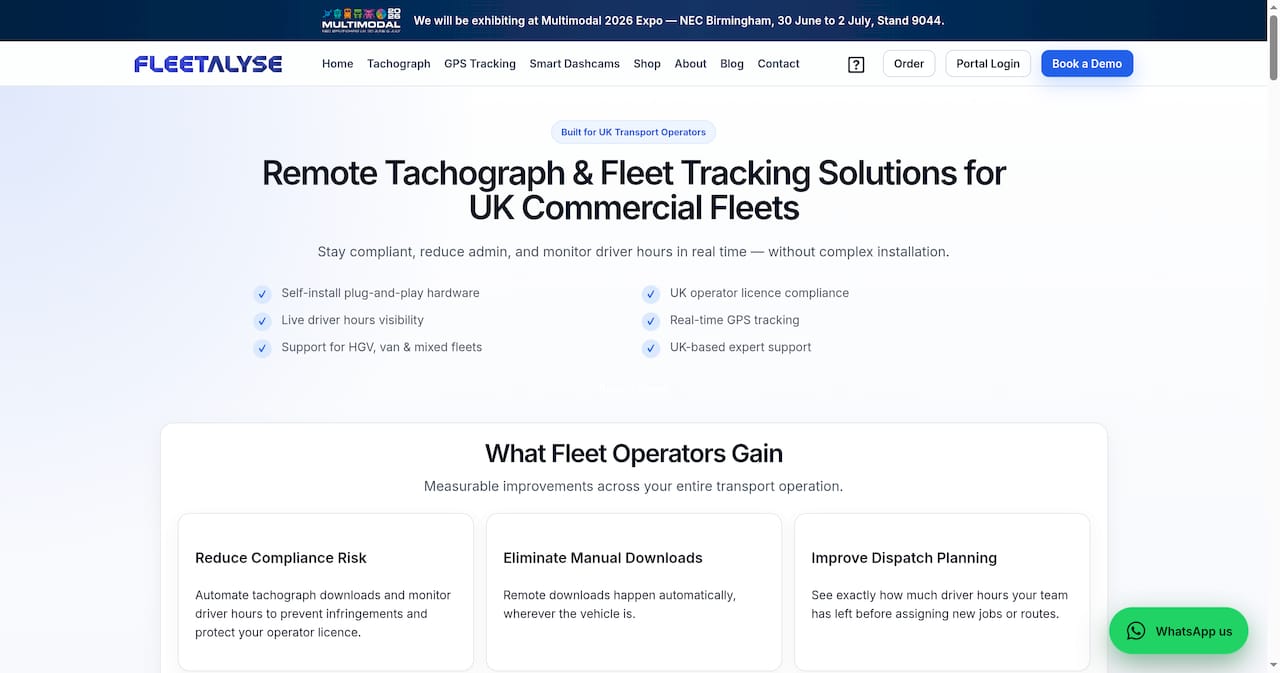
Three capabilities that directly address the enforcement risks covered above:
- Automated remote tachograph and card downloads: scheduled, timestamped, and stored without manual intervention.
- Audit-ready compliance reports: formatted for DVSA desk-based assessments and Public Inquiry submissions.
- Driver behaviour monitoring: continuous oversight of hours, speed, and driving patterns with alerts before issues escalate.
Book a demonstration with the Fleetalyse team to see how the platform closes the compliance gaps that most commonly lead to Traffic Commissioner referral.