

UK operator licence explained: a guide for operators

An operator’s licence (commonly called an O licence) is the legal authorisation issued by the Traffic Commissioners for Great Britain that permits a business or individual to use goods vehicles over 3.5 tonnes Maximum Authorised Mass (MAM) on public roads, or to operate passenger-carrying vehicles for hire or reward. The Driver and Vehicle Standards Agency (DVSA) administers the scheme on the Traffic Commissioners’ behalf. If you are unsure whether you need one, take three steps now: check whether your vehicles meet the weight or passenger threshold; identify which traffic area your operating centre falls within; and begin gathering your financial standing evidence, maintenance documentation, and transport manager details.
Operating without a valid licence is a criminal offence. The Traffic Commissioners can also grant an interim licence to allow you to trade while your full application is processed, which is worth requesting if your start date is imminent.
Key takeaways
An operator’s licence is a legal requirement for any UK business using goods vehicles over 3.5 tonnes MAM or operating passenger vehicles for hire or reward, and Traffic Commissioners can curtail, suspend, or revoke it at any point if standards slip.
| Point | Details |
|---|---|
| Confirm whether you need a licence | Check vehicle MAM against the 3.5-tonne threshold or passenger capacity against the nine-seat PSV threshold before operating. |
| Choose the correct licence type | Restricted covers own-goods only; standard national adds hire-or-reward; standard international extends rights to EU routes. |
| Apply at least nine weeks ahead | GOV.UK guidance recommends a nine-week lead time; missing documents are the most common cause of delays beyond 7–9 weeks. |
| Advert timing is non-negotiable | The newspaper advert and application submission must fall within a 21-day window; missing it forces a re-advert and significant delay. |
| Fleetalyse automates your compliance evidence | Remote tachograph downloads, maintenance scheduling, and driver hours alerts create the audit-ready records Traffic Commissioners expect. |
Table of Contents
- What is an operator licence in the UK and why does it exist?
- Who must hold a goods or PSV operator licence?
- What are the different types of operator licence?
- What do you need to prove to get a licence?
- How to apply for an operator licence in the UK
- What fees should you expect and how long does it take?
- What are your ongoing duties once you hold a licence?
- Which traffic area covers you and who should you contact?
- How do you check whether a company holds a valid licence?
- How telematics helps you meet your operator licence duties
- The mistakes that actually cost operators their licences
- Fleetalyse keeps your compliance evidence ready before you need it
- Sources
What is an operator licence in the UK and why does it exist?
The operator licensing regime exists for three clear public-policy reasons: road safety, fair competition, and the protection of communities around operating centres. Without it, there would be no consistent mechanism to ensure that heavy goods vehicles are properly maintained, that drivers comply with hours rules, or that operators have the financial resources to run a safe fleet.
The Goods Vehicles (Licensing of Operators) Act 1995 is the primary legislation that establishes the obligation to hold a licence and defines the distinction between restricted and standard licences. Equivalent passenger vehicle rules sit within separate PSV legislation.
Two bodies share responsibility for the scheme:
- Traffic Commissioners make all regulatory decisions: granting, varying, suspending, curtailing, and revoking licences. Each of the eight traffic areas in Great Britain has its own Traffic Commissioner.
- DVSA handles day-to-day administration, processes applications, and conducts roadside and operator inspections.
The Vehicle Operator Licensing (VOL) self-service system is the online portal through which operators submit applications, notify changes, and manage their licence. Most interactions with the scheme now happen through VOL rather than by post.
Note for Northern Ireland operators: the rules and processes differ from those in Great Britain. Separate guidance is available via nidirect and you should consult that before applying.
The principal legal instruments and official guidance you should read are:
- Goods Vehicles (Licensing of Operators) Act 1995
- The Goods Vehicles (Licensing of Operators) Regulations 1995
- GOV.UK: Goods vehicle operator licensing guide
- GOV.UK: A guide to public service vehicle operator licensing
- GOV.UK: Vehicle operator licence applications guidance
Who must hold a goods or PSV operator licence?
Goods vehicle operators
A goods vehicle operator’s licence is required for any person or business using a goods vehicle with a MAM exceeding 3.5 tonnes on a public road in connection with any trade or business. Where a vehicle has no plated weight, the threshold falls to 1,525 kg unladen. This applies whether you own the vehicle, lease it, or hire it short-term.
That last point is critical and frequently misunderstood:
The ‘operator’ is the person who uses the vehicle for business purposes, not necessarily the person who owns it. If you hire a 7.5-tonne vehicle for a week to move stock, you are the operator and you need the licence. The hire company’s own licence does not cover your use of the vehicle.
This matters enormously for businesses that use subcontractors or short-term rental vehicles. If those arrangements are not backed by the correct licence, the legal liability sits with you.
PSV operators
A PSV operator’s licence is required for vehicles designed or adapted to carry nine or more passengers for hire or reward. Vehicles carrying fewer than nine passengers for hire or reward generally fall under local taxi or private hire vehicle (PHV) licensing rather than the PSV regime.
London has additional complexity: Transport for London (TfL) administers taxi and PHV licensing in the capital, and certain London bus services require a London Service Permit rather than a standard PSV licence.
Common exemptions and borderline cases
Not every heavy vehicle operation requires an O licence. Typical exemptions include:
- Vehicles used solely by the armed forces
- Agricultural vehicles used for agricultural purposes
- Vehicles operated by the police or fire service
- Certain vehicles used for non-commercial purposes (e.g., a charity moving its own goods with no commercial element)
If you are unsure whether your operation is exempt, the safest approach is to contact the DVSA or your local Traffic Commissioner’s office before operating. Assuming an exemption applies and being wrong carries serious criminal and regulatory consequences.
What are the different types of operator licence?
Goods vehicle licence types
The three goods vehicle licence categories each carry different permissions and obligations:
- Restricted licence: covers carriage of your own goods only, in connection with your own trade or business. You cannot carry goods for hire or reward. No transport manager CPC is required. Suitable for businesses that move their own products (e.g., a builder carrying tools and materials).
- Standard national licence: permits carriage of goods for hire or reward within Great Britain. Requires a nominated transport manager holding a Transport Manager CPC. This is the most common licence type for hauliers operating domestically.
- Standard international licence: extends standard national permissions to include hire-or-reward operations in or through EU countries and other international routes. Also requires a transport manager CPC. Operators moving goods across borders need this category.
PSV licence types
PSV operators have four licence categories:
- Restricted PSV licence: for operators running no more than two vehicles not for hire or reward (e.g., a community group).
- Standard national PSV licence: for hire-or-reward passenger operations within Great Britain.
- Standard international PSV licence: for hire-or-reward operations crossing international borders.
- Special restricted PSV licence: for operators running a single vehicle with no more than eight passenger seats, typically used for hotel shuttles or similar niche operations.
When you need more than one licence
If your operating centres span more than one traffic area, you need a separate licence for each area. A haulier with depots in Yorkshire and the West Midlands, for example, holds two licences, one from each relevant Traffic Commissioner.
What do you need to prove to get a licence?
The application process is not simply a form-filling exercise. Traffic Commissioners assess five substantive criteria, and a weakness in any one of them can delay or sink an application.
| Requirement | What you must demonstrate |
|---|---|
| Establishment | A fixed operating centre in Great Britain with the right to use it for parking authorised vehicles |
| Financial standing | Sufficient capital and liquidity to operate safely; commonly evidenced by bank statements, asset valuations, or an accountant’s letter |
| Professional competence | For standard licences: a nominated transport manager holding a valid Transport Manager CPC |
| Maintenance arrangements | Either an in-house maintenance programme with qualified staff, or a written contract with a nominated garage; maintenance records must be kept |
| Good repute | Disclosure of all relevant convictions and cautions for the applicant and any nominated transport manager |
Financial standing is the requirement that catches most applicants off guard. The DVSA looks for capital and liquidity sufficient to sustain operations until the business is cash-positive, so a single month’s bank statement is rarely enough. Detailed bank records, asset documentation, and in some cases an accountant’s letter are advisable.
Professional competence for standard licences means nominating a transport manager who holds a Transport Manager CPC. That person must be genuinely and continuously responsible for transport operations, not a name on a form. Traffic Commissioners scrutinise this closely, and a transport manager who cannot demonstrate real involvement is a red flag at public inquiry.
Publication requirement: you must place a notice in a local newspaper circulating in the area of your proposed operating centre. The Vehicle operator licence applications guidance provides the mandatory template wording. You cannot write your own version.
Pro Tip: Request a copy of the full newspaper page, not just a clipping. You must upload the entire page when submitting your application, and a clipping alone will cause your application to be returned.
How to apply for an operator licence in the UK
The application process follows a clear sequence. Rushing any step, particularly the newspaper advert, is the most common cause of avoidable delay.
- Confirm which licence type and traffic area you need. Use your operating centre’s location to identify the correct traffic area and decide between restricted, standard national, or standard international based on your planned operations.
- Place the local newspaper advert. Use the mandatory template from the Vehicle operator licence applications guidance. The advert must appear in a newspaper circulating in the area of your proposed operating centre.
- Observe the 21-day timing rule. The date the advert is published and the date the DVSA receives your application must fall within a 21-day window. Missing this window means starting the advert process again. This is the single most common administrative failure in the entire process.
- Register on the VOL self-service system. Create or log into your account at the Vehicle Operator Licensing portal. Most of the application is completed online.
- Complete the application form. Declare all relevant convictions and cautions, enter your operating centre details, and specify the number of vehicles and trailers you wish to authorise.
- Nominate your transport manager (standard licences). Enter the transport manager’s details and CPC qualification reference. They will receive a separate notification and must confirm their nomination.
- Upload supporting documents. These include the full newspaper page, financial standing evidence, and your maintenance contract or in-house maintenance programme details.
- Submit and pay the application fee. Fees are paid online at the point of submission.
- Request an interim licence if needed. If you need to operate before the full licence is granted, you can request an interim licence at the point of application. Goods vehicle interim licences can last for several months.
- Await the decision. Decisions typically take 7–9 weeks in straightforward cases. Missing documents are the most common cause of delays beyond that window.
Pro Tip: Apply at least nine weeks before you need to operate. GOV.UK guidance explicitly recommends this lead time, and it gives you room to resolve any queries from the DVSA without missing your start date.
What fees should you expect and how long does it take?
Fee levels for operator licences are set by the government and are subject to periodic review. The main fee categories you will encounter are:
| Fee type | When it applies |
|---|---|
| Application fee | Paid when you submit your initial application |
| Issue fee | Paid when the licence is granted |
| Continuation fee | Paid periodically to keep the licence in force |
| Interim licence fee | Paid if you request an interim licence while your application is processed |
| Major change fee | Paid when you apply to vary the licence (e.g., adding vehicles or a new operating centre) |
Current fee amounts are published on GOV.UK and updated periodically. Always check the Apply for a vehicle operator licence page for the figures that apply at the time you submit, rather than relying on third-party sources that may be out of date.
The standard decision timeline is 7–9 weeks for a complete, well-documented application. Applications that arrive with missing financial evidence, an incorrectly timed advert, or incomplete conviction declarations routinely take longer. In some cases, the Traffic Commissioner may call the applicant to a public hearing before making a decision, which extends the timeline further.
If your application is straightforward and your documents are in order, nine weeks is a realistic planning assumption. Build that buffer into your business plan.
What are your ongoing duties once you hold a licence?
Receiving your licence is the beginning of your obligations, not the end. Traffic Commissioners treat the licence as an ongoing commitment and will act when standards slip. The operator licensing guide makes clear that curtailment, suspension, and revocation are live tools, not last resorts.
Your core ongoing duties include:
- Driver hours and tachograph compliance: drivers of vehicles in scope must use a tachograph, and records must be kept for a minimum of 12 months. Remote tachograph downloads are now standard practice for efficient record management.
- Vehicle maintenance records: every vehicle must have a documented safety inspection schedule. Inspections must be carried out at appropriate intervals and records retained.
- MOT compliance: all authorised vehicles must hold a valid MOT. Allowing an MOT to lapse on an authorised vehicle is a straightforward route to regulatory action.
- Operating centre conditions: any conditions attached to your operating centre (e.g., restrictions on vehicle movements at certain times) must be observed.
- Notifying changes: you must notify the DVSA promptly of changes to your business, including changes to your transport manager, operating centre, or the number of authorised vehicles.
- Disclosure of convictions: new convictions or cautions for the operator or transport manager must be declared.
Compliance failures most commonly arise from three sources: poor or infrequent maintenance inspections, a transport manager who is nominally in post but not genuinely overseeing operations, and subcontractor arrangements where the operator assumes the subcontractor’s compliance is their own problem. It is not.
For practical guidance on building controls that hold up under scrutiny, the operator licence compliance guide covers the most common risk points in detail.
Which traffic area covers you and who should you contact?
Great Britain is divided into eight traffic areas, each overseen by a Traffic Commissioner. Your operating centre’s location determines which area you fall within and which Traffic Commissioner has jurisdiction over your licence.
The eight traffic areas are:
- North East of England
- North West of England
- West Midlands
- East Midlands
- East of England
- South East and Metropolitan (London)
- South Wales
- Western Traffic Area
Scotland is covered by the Traffic Commissioner for Scotland, who also handles cases from the North East of England area in some circumstances. If your operating centres span more than one area, you will deal with more than one Traffic Commissioner.
Key contact points for operators:
- VOL self-service system: for applications, notifications, and licence management online
- DVSA: for administrative queries, document submissions, and inspection-related matters
- Traffic Commissioner’s office: for regulatory queries, public inquiry information, and appeals
- Upper Tribunal (Administrative Appeals Chamber): for formal appeals against Traffic Commissioner decisions
The Vehicle operator licence applications guidance lists each traffic area and its associated counties, which is the most reliable way to confirm which area applies to your operating centre.
How do you check whether a company holds a valid licence?
The public operator licence register is searchable online through the VOL system. Before hiring a haulier or subcontracting work to a passenger operator, you can verify:
- Whether the operator holds a current licence
- The licence type (restricted, standard national, or standard international)
- The number of vehicles and trailers authorised
- The name of the nominated transport manager
- Any conditions or restrictions attached to the licence
This matters practically. If you subcontract work to an unlicensed operator and goods are carried illegally, your own business may face scrutiny from the Traffic Commissioner. Procurement teams and transport managers should treat a licence check as a standard pre-engagement step, not an optional extra.
Before placing work with a subcontractor, request and verify the following:
- A copy of their operator’s licence disc (displayed in the vehicle)
- Confirmation of their transport manager’s name and CPC status
- Evidence of their current maintenance contract or in-house maintenance programme
- Confirmation that their continuation fees are up to date
A subcontractor who is reluctant to provide any of these documents is a subcontractor worth avoiding.
How telematics helps you meet your operator licence duties
Holding a licence is one thing. Demonstrating compliance to a Traffic Commissioner under scrutiny is another. Telematics and fleet management tools create the audit trail that makes the difference when a DVSA inspector arrives or a public inquiry is called.
Fleetalyse is built specifically for this environment. Its features map directly to the ongoing duties that Traffic Commissioners assess:
- Remote tachograph downloads: automated retrieval of driver data eliminates the risk of missed downloads and ensures records are always current and accessible. This directly satisfies the tachograph record-keeping obligation.
- Driver hours monitoring: real-time alerts flag potential hours violations before they become infringements, giving your transport manager the visibility they need to intervene early.
- Maintenance scheduling: automated reminders for safety inspections, MOTs, and service intervals mean no vehicle slips through the gap between manual diary entries.
- Audit-ready records: all data is stored and exportable, so when a Traffic Commissioner or DVSA inspector asks for evidence of your maintenance programme or driver hours compliance, you can produce it immediately rather than scrambling through paper files.
These features support your transport manager’s statutory duties rather than replacing them. A transport manager who can point to a complete, timestamped digital record of inspections, downloads, and driver hours alerts is in a fundamentally stronger position at a public inquiry than one relying on manual logs.
Pro Tip: Set up scheduled weekly reports in your telematics platform covering driver hours, tachograph download status, and upcoming maintenance due dates. Sending these automatically to your transport manager creates a documented oversight trail that demonstrates genuine, continuous management of transport operations.
For a practical walkthrough of how telematics maps to specific licence requirements, the operator licence compliance guide for 2026 covers the full picture.
The mistakes that actually cost operators their licences
Most application refusals and licence revocations are not caused by deliberate wrongdoing. They come from predictable, avoidable failures that operators repeat because nobody told them clearly what the Traffic Commissioner is actually looking for.
The newspaper advert timing rule is the most common administrative trap. Operators place the advert, wait a few weeks, then submit the application, not realising the required timing window has already closed. The application is returned, the advert must run again, and significant delay results. The fix is simple: place the advert and submit the application within the same week.
Financial evidence is the second consistent failure point. A single bank statement covering one month tells the Traffic Commissioner almost nothing about whether you can sustain a safe operation. Bring three to six months of statements, an asset schedule, and if your finances are complex, an accountant’s letter that speaks directly to your ability to meet the financial standing thresholds.
The transport manager problem is subtler but more damaging. Nominating a transport manager who exists on paper but has no real involvement in daily operations is not just a compliance risk; it is the kind of thing that emerges under cross-examination at a public inquiry and destroys credibility. The transport manager must be genuinely in control of transport operations, with documented evidence of that involvement.
For operators preparing applications, the practical do/don’t list is short:
- Do place the advert and submit the application within the same 21-day window
- Do provide at least three months of financial evidence, not one
- Do ensure your transport manager is genuinely active and can evidence their role
- Don’t assume a subcontractor’s licence covers your use of their vehicles
- Don’t let MOTs or maintenance inspection intervals lapse after the licence is granted
- Don’t wait for a DVSA inspection to discover a gap in your tachograph records
The transport manager compliance tools guide goes deeper on the practical steps that protect both the licence and the transport manager’s own good repute.
Fleetalyse keeps your compliance evidence ready before you need it
Staying compliant with your operator licence obligations generates a significant administrative workload: tachograph downloads, maintenance logs, driver hours reports, MOT tracking, and the ongoing documentation your transport manager needs to demonstrate genuine oversight. Fleetalyse handles that workload automatically, so your team spends less time on paperwork and more time running the operation.
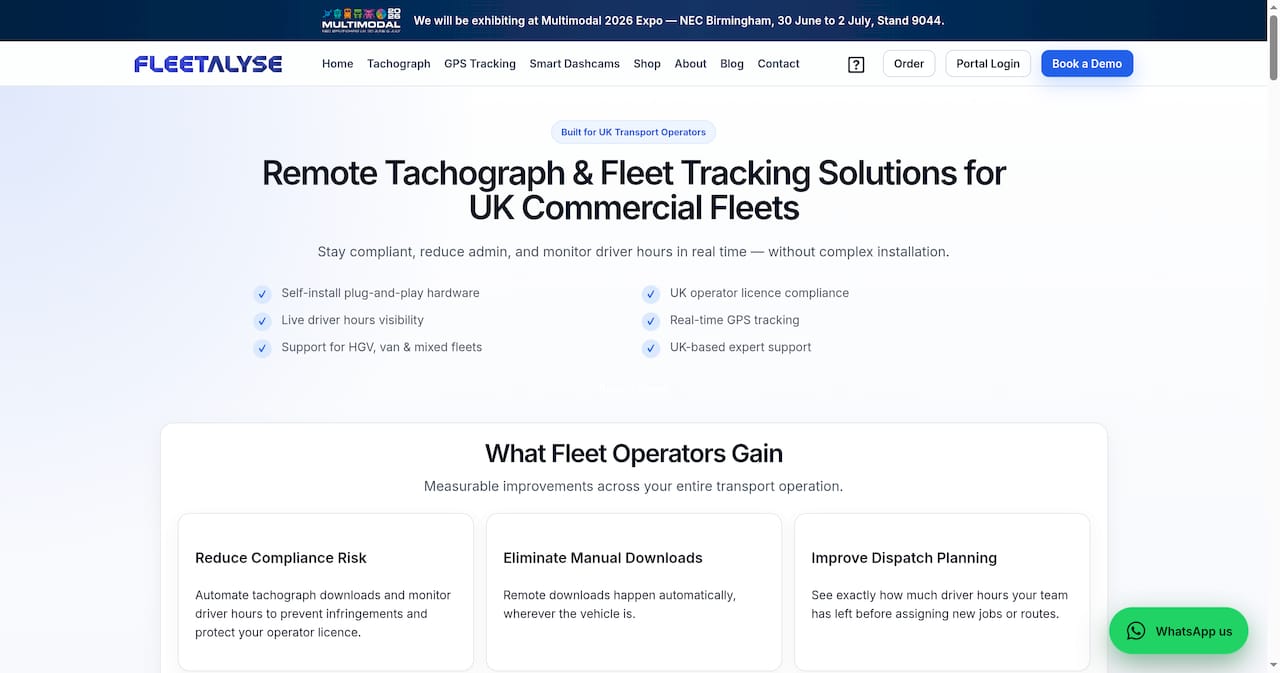
Remote tachograph downloads run on a schedule, driver hours alerts fire before an infringement occurs, and maintenance reminders are tied to each vehicle’s inspection interval. Every record is stored, timestamped, and exportable, giving you audit-ready evidence at any point. This does not replace your legal obligation to hold a valid operator’s licence or to meet the statutory requirements set by the Traffic Commissioners. It does mean that when scrutiny arrives, your documentation is already in order.
To see how Fleetalyse supports your transport manager’s duties and reduces the day-to-day compliance burden, explore driver behaviour monitoring or get in touch with the UK-based support team to discuss your fleet’s specific requirements.
Sources
The following official sources were used to build this guide. Each is worth bookmarking for reference throughout your application and beyond.
- Goods vehicle operator licensing guide
- Apply for a vehicle operator licence: Apply for a licence
- Vehicle operator licence applications: guidance
- Legislation
This article is general information, not a substitute for advice from a qualified lawyer. Consult a qualified legal professional about your own circumstances before acting on anything here.