

Fleet driver licence checking explained for UK fleets
Editorial correction: 28 September 2026. Updated the digital licence information and removed unsupported fixed checking and retention claims. The original publication date is retained.

Fleet driver licence checking means checking a driver's current entitlement before allocating a vehicle, then keeping that information under review. HSE guidance on driving for work covers company vehicles and privately owned vehicles used for business. The DVLA provides a share-code checking service and a separate Access to Driver Data API for authorised users. GOV.UK Wallet is not currently a substitute for those checks.
What are the legal obligations for fleet driver licence checks?
Employers must manage work-related road risks. HSE explains the relationship between road traffic and health and safety law, including responsibilities for driver fitness and competence. Specific HGV or public-service-vehicle requirements may also apply. Licence checking supports these responsibilities; a completed check alone does not establish that every legal duty has been met.
For operator licence holders, the checking process should form part of the wider transport-management arrangements. Check the conditions of your licence and current regulator guidance when setting policy. Do not treat a generic checking timetable or software report as a guarantee of compliance.

Include agency and contractor arrangements in your review. HSE's driver-safety guidance includes current licences, insurance and MOTs. Its vehicle-safety guidance also covers privately owned vehicles used for work.
Key legal obligations at a glance:
- Verify licence validity and correct vehicle entitlement before a driver operates any fleet vehicle.
- Check for endorsements, penalty points, and disqualifications that affect driving eligibility.
- Confirm medical fitness, particularly for HGV and PCV vocational licence holders.
- Apply the same checks to grey fleet and agency drivers as to directly employed drivers.
- Retain documented evidence of every check, including consent, method, date, and result.
Pro Tip: If your organisation uses agency drivers regularly, build licence verification into your agency contract terms. Require the agency to confirm checks have been completed and to provide evidence on request. This helps clarify responsibilities without removing your own duties.
How to perform effective driver licence checks
The standard process for fleet driver licence verification in the UK uses the DVLA Share Driving Licence service. The steps are straightforward, but the administrative discipline required to manage them across a large fleet is where most operators struggle.
- Request driver consent. The driver must actively agree to share their licence data with you. Consent must be recorded and retained.
- Driver generates a share code. The driver logs into GOV.UK and generates a one-time check code. This code is valid for 21 days only.
- Employer redeems the code. You enter the code alongside the last eight characters of the driver’s licence number on the GOV.UK portal. The check reveals entitlements, endorsements, and any disqualifications.
- Record the result. Log the date, method, result, and the name of the person who conducted the check. Store this securely.
- Act on findings. If the check reveals issues, take documented action immediately. Do not allow a driver to continue operating until the issue is resolved.
A check code can be used only once and must be used within 21 days. If a code expires before use, request a new one and review whether a check is overdue under your policy. Code expiry alone does not show that the driver has lost their entitlement.
The DVLA's Access to Driver Data API lets authorised users retrieve licence information. Access, permission and record-keeping arrangements must be checked with the DVLA or your service provider; the API listing does not promise cryptographic audit logs or automatic ongoing consent. Separately, GOV.UK Wallet guidance updated on 1 September 2026 says a digital driving licence will follow the Veteran Card. Do not rely on Wallet for current fleet licence checks.
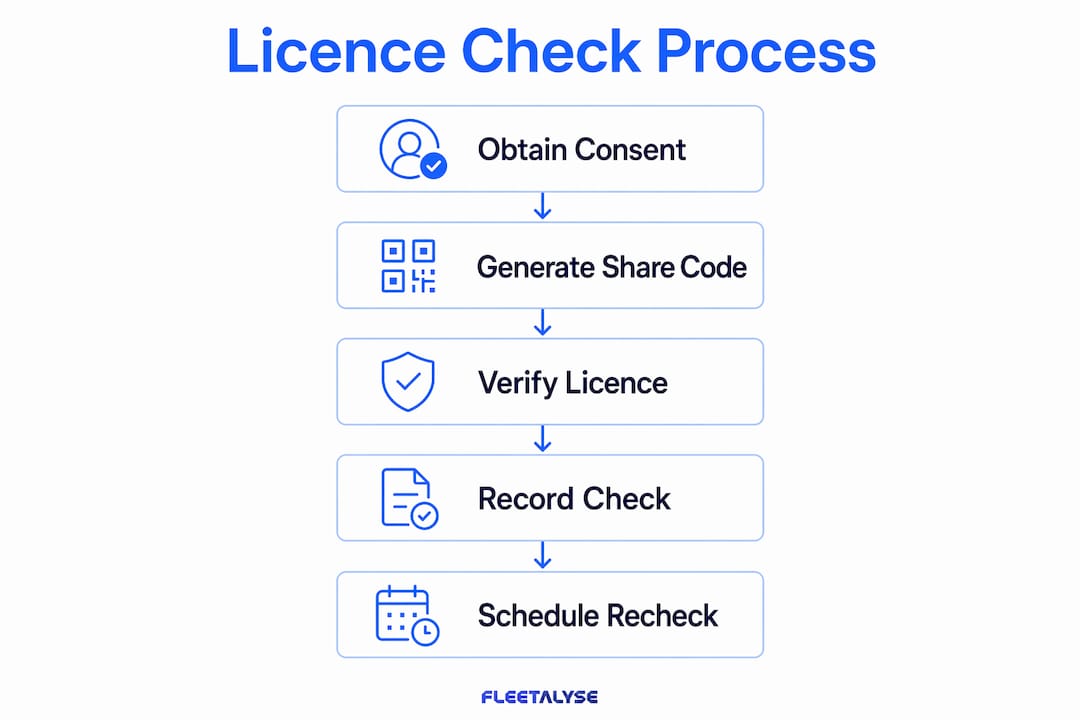
Practical tip: Assign a person to review upcoming checks and expired codes. If you consider an API-based service, ask how it obtains permission, handles failed checks and lets your team review and export records. Compare its actual process with your existing one before committing.
What is the recommended frequency for fleet driver licence checking?
Set a documented checking schedule appropriate to the driving work, driver history and any applicable operator or insurer requirements. The HSE guidance cited above does not prescribe the fixed annual, six-monthly and quarterly bands previously shown here. Those bands should not be presented as a universal legal or industry requirement.
| Situation | What to review |
|---|---|
| New driver or changed vehicle category | Confirm the required entitlement before assigning the vehicle. |
| Routine ongoing work | Record the next review date and the reasons for the interval in your policy. |
| Reported endorsement, restriction or relevant change | Assess the change promptly instead of waiting for the next routine review. |
Beyond scheduled checks, certain events should trigger an immediate ad-hoc verification:
- A driver receives a new endorsement or fixed penalty notice.
- A driver reports a medical condition that may affect their fitness to drive.
- A driver changes vehicle category or takes on a new role requiring different entitlements.
- Your insurer requests confirmation of licence status following an incident.
- A driver returns from an extended absence such as long-term sick leave.
Grey fleet drivers present a particular scheduling challenge. They are often invisible to fleet management systems because they do not appear in vehicle tracking data. Building grey fleet drivers into your licence checking schedule requires a separate register and a clear process for obtaining consent and share codes before business journeys.
How to handle issues discovered during licence checks
Common issues found during checks include wrong vehicle entitlement, accumulated penalty points, active disqualifications, and medical restrictions or vocational-licence renewal issues. Each requires a different response, but all require documented action.
Where entitlement or insurance cover is uncertain, verify the position before allocating driving work. Insurance outcomes depend on the policy and circumstances; do not assume either that a licence issue automatically voids all cover or that cover remains unaffected.
The correct responses by issue type:
- Disqualification. Ground the driver immediately. Do not allow them to operate any fleet vehicle until the disqualification is resolved. Document the date you discovered the issue and the action taken.
- High penalty points. Reassign the driver to lower-risk duties if possible. Review the checking interval under your risk policy. Notify your insurer if required under your policy terms.
- Wrong entitlement. Remove the driver from vehicles they are not licensed to operate. Arrange retraining or reclassification before returning them to those duties.
- Medical or entitlement concern. Check the current licence restrictions and relevant DVLA requirements before assigning vocational driving work. Resolve uncertainty with the driver and the appropriate qualified adviser.
- Expired document or renewal in progress. Check current entitlement and the relevant DVLA renewal rules before assigning work. Do not assume that an expired document or a pending application settles whether the person may drive.
Pro Tip: Create a simple issue log that records the driver name, issue type, date discovered, action taken, and date resolved. Keep the log alongside the underlying check results so a reviewer can follow each decision.
How to maintain proper records and audit trails
A useful operational record identifies the check date, method, result, reviewer and any follow-up action. Keeping these fields together makes your process easier to review. They are a practical record structure, not a claim that a regulator accepts every record containing these fields.
The DVLA checking service requires the driver's permission. Record how permission was obtained and follow the requirements of the service you use. Permission to access a driving record does not by itself settle all your data-protection responsibilities.
A structured approach to record keeping:
- Maintain a central driver register listing every driver, their licence number, vehicle entitlements, and check history.
- Store check results with the date, method, and responsible person clearly recorded against each entry.
- Set and document a justified retention period. The ICO says there is no single fixed retention limit; consider your purpose and any applicable legal requirements, then securely dispose of records when no longer needed.
- Log all actions taken in response to issues, including the date the issue was resolved.
- Integrate licence check records with your wider fleet compliance platform so that auditors can access a single, coherent compliance picture.
A missed review is a process gap. For example, a check completed 14 months ago is overdue under a policy requiring annual checks, even if the driver's licence remains valid. Scheduling and reminders can help, but someone still needs to review missed or failed checks.
Key takeaways
Keep licence verification within a documented driving-for-work process, with permission, scheduled reviews and action on problems. Include the people who drive their own vehicles for business as well as those using company vehicles.
| Point | Details |
|---|---|
| Manage driving-for-work risks | Use current HSE and regulator guidance when setting your driving-for-work policy. |
| Risk-based frequency matters | Set and document intervals suited to the work and any specific requirements; reassess when circumstances change. |
| Grey fleet is in scope | Grey fleet drivers require the same licence, MOT, and insurance verification as company vehicle drivers. |
| Digital tools reduce gaps | The authorised DVLA API and the share-code service are separate routes. GOV.UK Wallet driving licences are still described as a future feature in the cited guidance. |
| Audit trails are non-negotiable | Keep check dates, results, reviewers and follow-up actions together so your process can be reviewed. |
Make licence checking an ongoing process
Give each check a clear owner and next review date. Use a separate queue for unresolved results so that a reminder marked complete does not hide an outstanding issue. Include temporary and grey-fleet drivers in the same review process.
When comparing digital services, ask to see the failed-check workflow as well as the successful one. A useful demonstration should show who reviews an exception, how the driver is contacted and what evidence can be exported. A tool can support your process; it cannot make the operational decision for you.
Fleetalyse: compliance and tracking working together
Driver licence verification is one part of a wider compliance picture. Knowing a driver holds the right licence is valuable. Knowing how they are actually driving, where their vehicle is, and whether their hours are within legal limits gives you the complete picture.
Fleetalyse integrates GPS vehicle tracking, driver behaviour monitoring, and tachograph compliance into a single platform built for UK commercial fleets. The Teltonika FMC650 HGV GPS tracker pairs directly with the Fleetalyse platform to give you real-time visibility across your HGV fleet, supporting both DVSA compliance and operator licence requirements. For fleets managing vans and mixed assets, the full range of vehicle GPS trackers provides the same level of oversight. Licence checking tells you who should be driving. Fleetalyse tells you what is actually happening on the road.
FAQ
What is fleet driver licence checking?
It is the process of reviewing a driver's licence status and vehicle entitlement as part of managing driving for work.
How often should fleet driver licences be checked?
Use a documented interval based on the work, driver circumstances and any specific operator or insurer requirements. Review relevant changes promptly. The fixed bands previously shown in this article were not supported as a universal requirement.
Do grey fleet drivers need licence checks?
Include people using their own vehicles for work in your driving-for-work checks. Ensure the licence entitlement, insurance and MOT where required are appropriate and current, with review dates and change reporting set out in your policy.
What happens if a DVLA share code expires before it is redeemed?
Request a new code from the driver. DVLA codes expire after 21 days and can be used only once. An expired code does not by itself show that the driver's licence is invalid.
What records do I need to keep for licence checks?
A practical record includes the check date, method, result, permission, reviewer and follow-up action. Protect it and keep it under your justified retention policy. Confirm any additional requirements that apply to your operation.