

Avoid DVSA Fines: WTD Breaks for Drivers, Telematics for UK Fleets

No mobile worker can drive or work for more than six hours without a break, and under the Road Transport (Working Time) Regulations 2005 that break grows to 30 minutes once working time passes six hours and 45 minutes past nine. Every segment must be at least 15 minutes, taken before the threshold hits, not after. If driving alone reaches 4.5 hours first, Gov confirms the drivers’ hours break takes precedence, a distinction that some compliance tools are built to flag automatically.
TL;DR:
- Breaks of at least 15 minutes must be taken before the six and nine-hour working time thresholds; stacking breaks at the shift’s end is non-compliant.
- The 4.5-hour driving limit often triggers breaks first for long-haul drivers, while mixed duties may reach the six-hour work threshold earlier, requiring flexible planning.
- Recording and monitoring actual hours over a 17 or 26-week period is essential, as a single busy week can push a driver over the weekly 60-hour limit if not carefully tracked.
- Fleets should design shifts around break thresholds, use live telematics for real-time alerts, and avoid treating periods of availability as qualifying breaks.
- Non-compliance risks include fines, license bans, increased inspection scrutiny, and potential liability in collisions caused by fatigue.
Table of Contents
- What are the WTD rules for HGV drivers?
- The 6‑hour and 9‑hour break rules, explained in minutes
- How WTD interacts with drivers’ hours and the 4.5-hour rule
- Practical compliance steps for drivers and fleet managers
- How telematics closes the gap between policy and reality
- What happens when WTD break rules are breached
- Do the same WTD break rules apply to every driver?
- Why WTD breaks exist: the health and safety case
- A typical shift: where WTD and drivers’ hours diverge in practice
- Author perspective: common enforcement pitfalls and pragmatic priorities
- Get automated WTD compliance without the manual chasing
- Primary sources and further reading
- Sources
- FAQ
What are the WTD rules for HGV drivers?
The Working Time Directive, transposed into UK law through the Road Transport (Working Time) Regulations 2005, exists to stop fatigue building up across a working week, not just a single shift. It applies to “mobile workers”, meaning anyone whose main job is driving a goods or passenger vehicle covered by EU or GB drivers’ hours rules, and it sits alongside, not instead of, the separate drivers’ hours regulations.
The weekly ceiling matters as much as the daily break rules. Mobile workers can average 48 hours a week, calculated over a reference period of 17 or 26 weeks, and can work up to 60 hours in any single week provided that average holds. Mobile workers cannot opt out of these limits, unlike some other UK employees under the wider Working Time Regulations.
Employers carry the legal weight of proving compliance. That means:
- Recording actual hours worked, not scheduled hours, for every mobile worker
- Monitoring the rolling average against the 17 or 26 week reference period
- Keeping evidence available for DVSA checks, not just internal review
Get the weekly maths wrong and a single busy week can quietly push a driver’s average over the line months later, long after the shift itself is forgotten.
The 6‑hour and 9‑hour break rules, explained in minutes
Forget percentages and formulas. The break rules for WTD breaks for drivers boil down to three numbers you can memorise in the cab: six, 30, and 45.
- Work up to six hours: no break is legally required yet, though good rostering rarely lets a shift run this long without one anyway.
- Work between six and nine hours: you need breaks totalling at least 30 minutes, and each segment must be a minimum of 15 minutes.
- Work beyond nine hours: the total rises to 45 minutes, still built from segments of 15 minutes or more.
Splitting is allowed, and in practice it’s how most shifts actually run. A driver might take 15 minutes mid‑morning and 15 minutes before lunch to satisfy the 30‑minute rule, or 15 plus 30 to reach 45. What is not allowed is stacking the whole break at the end of the shift. The Road Transport (Working Time) Regulations require breaks to fall before working time crosses six or nine hours, and a break taken after the threshold has already been breached does not undo the infringement. Practitioner guidance echoes this: a late break is a broken rule, not a fixed one.
How WTD interacts with drivers’ hours and the 4.5-hour rule
Two separate rulebooks apply to the same shift, and drivers rarely hit their thresholds at the same moment. WTD governs total working time; drivers’ hours rules govern driving time specifically, and the tighter limit wins whenever the two diverge.
Under drivers’ hours rules, a 45 minute break is required after 4.5 hours of continuous driving, which can be split into 15 minutes followed by 30, according to the European Commission’s guidance on driving time and rest periods. When a driver spends the whole shift behind the wheel, the 4.5‑hour driving limit typically bites before the six‑hour WTD threshold does, so the drivers’ hours break takes precedence.
- A driver doing pure long‑haul driving will usually hit the 4.5‑hour rule first, well ahead of the six‑hour WTD mark.
- A driver splitting time between driving and loading, paperwork, or yard work may reach six hours of combined working time before ever driving for 4.5 hours straight.
- Where duties mix driving and other work in the same period, working time accumulates across both, so breaks need planning against whichever threshold arrives first, a point GOV.UK’s simplified guidance sets out clearly.
Pro Tip: Don’t plan breaks around only one rulebook. Build rosters that assume both the 4.5‑hour driving limit and the six‑hour working time limit could apply on any given day, then let whichever arrives first dictate the break. Our guide to drivers’ hours and the Working Time Directive breaks down more scenarios like this.
Practical compliance steps for drivers and fleet managers
Getting WTD breaks right is a design problem before it’s a monitoring problem. Rosters built without break windows baked in will generate infringements no matter how careful the driver is.
- Design shifts around the thresholds, not around them. Build in break windows before the six‑hour and nine‑hour marks are reached, not scheduled around convenient stopping points that happen to fall after.
- Keep the right records for two years. Tachograph data and written statements should be retained to support enforcement checks, in line with Gov for goods vehicles.
- Separate breaks from periods of availability. POA pauses the working time clock but is not a qualifying break, and treating the two as interchangeable is one of the most common enforcement pitfalls fleets fall into.
- Brief drivers before the shift, not after an infringement. Make clear what counts as a break, what counts as POA, and what the driver’s own responsibility is for taking breaks on time.
- Use live monitoring to catch drift early. Automated alerts on approaching thresholds give drivers and controllers a chance to react before a break becomes overdue.
Pro Tip: Reasonable steps matter in enforcement. Documented rostering, training records, and monitoring logs are what regulators look for when assessing whether an operator did enough to prevent an infringement, according to Gov. Our piece on reducing driver infringements covers the training side of this in more depth.
How telematics closes the gap between policy and reality
A written policy on WTD breaks for drivers only works if someone is actually watching the clock in real time, and most fleets don’t have the admin capacity to do that shift by shift, driver by driver. This is the operational gap telematics is built to close.
Fleetalyse’s approach matches specific tools to specific compliance tasks:
- Remote tachograph downloads remove the manual chase for data, so working time and driving time are captured without a depot visit.
- Live driver‑hours visibility shows controllers where a driver sits against both the 4.5‑hour driving limit and the six or nine‑hour WTD thresholds, in the same view.
- Automated alerts flag an approaching threshold before it’s breached, giving dispatch time to adjust a route or confirm a break.
When trialling any system, check how it distinguishes POA from qualifying breaks. That distinction, not the raw hours total, is where most infringements actually originate.
What happens when WTD break rules are breached
Non-compliance with WTD break regulations carries real enforcement teeth, not just a paperwork slap on the wrist. The DVSA can issue fixed penalty notices at the roadside for driving or working time infringements, and repeat or serious breaches escalate to the Traffic Commissioner, who has the power to curtail, suspend, or revoke an operator’s licence.
For the driver personally, a pattern of infringements can affect their vocational licence and their standing with any employer checking their driver conduct history. For the operator, the consequences run wider still. A poor compliance record shows up in the Operator Compliance Risk Score, which increases the likelihood of roadside stops and depot audits, creating a cycle where one breach invites closer scrutiny that uncovers more.
Civil liability sits alongside the regulatory risk. If a fatigued driver is involved in a collision and an investigation finds WTD breaks were routinely skipped or logged incorrectly, that record becomes evidence in any subsequent claim or prosecution. Insurers take a dim view of fleets that can’t demonstrate they took reasonable steps to prevent fatigue related incidents, and premiums tend to reflect that.
The practical lesson for fleet managers is that a break taken five minutes late isn’t a technicality. It’s a documented infringement the moment the DVSA pulls tachograph data, and the paper trail from that single missed break can outlast the shift by years if it ends up in a licence review.
Do the same WTD break rules apply to every driver?
Not every driver on the road answers to the same rulebook, and confusing the categories is a common source of accidental non-compliance. Professional HGV and PCV drivers whose main occupation is driving fall squarely under the mobile worker definition in the Road Transport (Working Time) Regulations, meaning the six‑hour, nine‑hour, and weekly average rules apply in full, alongside the separate drivers’ hours limits.
Occasional or mixed‑duty drivers sit in murkier territory. Someone who drives only occasionally as part of a broader job, say a tradesperson who drives a van between sites but spends most of the day on tools, may not meet the “mobile worker” threshold at all, depending on how much of their working time is actually spent driving. Getting this classification wrong in either direction creates risk: treating a genuine mobile worker as exempt invites enforcement action, while over applying WTD rules to staff who don’t need them adds unnecessary rostering friction.
Passenger transport carries its own nuances too. Coach drivers on long tours often combine driving with passenger assistance duties, and both count toward the same working time total under WTD, even though only the driving portion counts toward the 4.5‑hour drivers’ hours limit. Our breakdown of EU driving hours rules for UK fleets covers how these categories interact in more detail.
The safest operational default for fleet managers is to assume WTD applies to anyone whose role involves regular driving as a core function, and to check the exemptions rather than assume them.

Why WTD breaks exist: the health and safety case
WTD break rules aren’t bureaucratic box ticking. They exist because fatigue behind the wheel of a multi tonne vehicle behaves differently to fatigue at a desk, and the consequences of getting it wrong are measured in lives, not missed deadlines.
Continuous driving or working without a break degrades reaction time and judgement well before a driver feels genuinely tired. The 15 minute minimum segment isn’t arbitrary either. A break shorter than that doesn’t give the body enough time to properly disengage from the task, which is why the regulations set a floor rather than leaving break length to discretion.
The weekly limits matter just as much as the daily ones for driver health. A driver who stays within daily break rules but consistently works close to 60 hours a week, week after week, is carrying a cumulative fatigue debt that daily breaks alone don’t clear. That’s precisely why the 48‑hour average, calculated over 17 or 26 weeks, exists as a backstop against the single‑week 60‑hour maximum being used as a routine ceiling rather than an occasional exception.
For fleet managers, the health and safety case doubles as the commercial case. Fatigued drivers are more likely to be involved in incidents, more likely to make costly errors, and more likely to leave the industry burnt out. Treating WTD breaks for drivers as a genuine wellbeing measure, rather than a compliance hurdle to route around, tends to show up in lower incident rates and better driver retention over time.
A typical shift: where WTD and drivers’ hours diverge in practice
Consider a driver starting at 6:00am on a long-haul trunking run. They drive continuously and reach 4.5 hours of driving at 10:30am, well before six hours of total working time have accumulated. The 45 minute drivers’ hours break takes precedence here, and the driver must stop, whether or not WTD’s six-hour threshold has been reached.
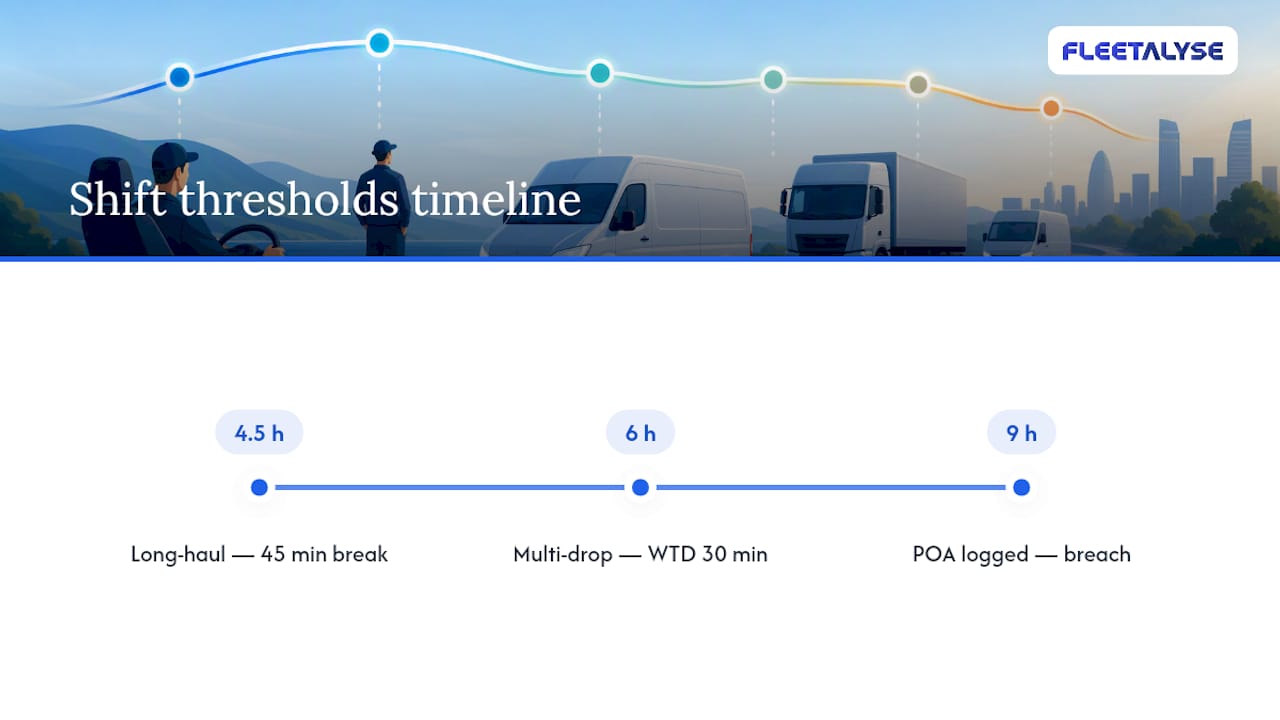
Now compare that with a driver on a multi-drop delivery round who spends the morning alternating between driving, loading, and paperwork at each stop. Because driving time is broken up by other duties, they might not hit 4.5 hours of continuous driving until well into the afternoon, but their combined working time could pass six hours by late morning. In this case, the WTD 30-minute break requirement bites first, even though the driver hasn’t come close to the drivers’ hours driving limit.
A third scenario catches out fleets more often than either of the above: a driver who takes a genuine 20-minute rest stop but logs it as “available” rather than a qualifying break, because they kept their phone on for incoming job instructions. That period doesn’t count as a break under WTD rules, since POA time doesn’t stop the working time clock in the way a proper break does. The shift then runs past the nine-hour threshold with only 30 minutes of qualifying break logged instead of 45, and the infringement only surfaces when someone checks the tachograph data against the written duty log. Our page on live driver hours monitoring walks through how this kind of gap gets caught before it becomes a fine.
Author perspective: common enforcement pitfalls and pragmatic priorities
The two mistakes I see repeated across fleets are treating POA as a break, and letting drivers take their break after a threshold has already passed rather than before it. Both feel harmless in the moment and both are documented infringements the instant a tachograph gets checked. Fix rostering first, monitoring second, and driver training third, in that order, and most of this risk disappears before it starts.
— Vytautas
Get automated WTD compliance without the manual chasing
Some telematics platforms give you a live view of driving time and working time in the same dashboard, so you see a threshold approaching instead of finding out about it after a DVSA check. Where a spreadsheet or a paper log only tells you what already happened, remote tachograph downloads and automated alerts tell you what’s about to happen, while there’s still time to act on it.
If you manage HGVs, vans, or a mixed fleet, start by looking at what driver behaviour monitoring actually flags in practice, or explore the unlocked GPS trackers built for plug-and-play installs without a workshop visit. Book a demo to see how live hours visibility and automated threshold alerts would look against your own rosters before your next audit lands.
Primary sources and further reading
For enforcement detail, check GOV.UK’s working time rules and the 2005 Regulations directly.
Sources
- Working time rules: lorry, bus and coach drivers and crew
- The Road Transport (Working Time) Regulations 2005
- Driving time and rest periods — European Commission
- EU rules on drivers’ hours and working time: simplified guidance (GOV.UK)
FAQ
How long is the WTD break for a driver?
Working time between six and nine hours requires breaks totalling at least 30 minutes; beyond nine hours, that rises to 45 minutes, with each segment at least 15 minutes long.
Can an HGV driver split their break into smaller chunks, like 15 minutes at a time?
Yes, breaks can be split into segments as long as each one is at least 15 minutes and the total meets the 30 or 45 minute requirement for the hours worked.
What are the WTD rules for HGV drivers?
HGV drivers count as mobile workers under the Road Transport (Working Time) Regulations 2005, meaning they must take breaks before six and nine hour thresholds and cannot average more than 48 hours a week.
What is the 9-hour rule for the Working Time Directive?
Once working time exceeds nine hours in a shift, breaks totalling at least 45 minutes are required, built from segments of 15 minutes or more, taken before the nine-hour mark is reached.
Does a period of availability count as a WTD break?
No. Periods of availability pause the working time clock but don’t count as a qualifying break, a distinction that catches out many fleets during DVSA checks.