
In the 2023/24 reporting period, the DVSA issued thousands of fixed penalties for drivers’ hours offences, with individual fines reaching up to £300 per instance. For many haulage firms, these costs are just the tip of the iceberg. Learning how to avoid driver hour fines UK is no longer just about protecting your cash flow. It's about defending your OCRS score and your very right to operate. You likely find it difficult to track hours across a distributed fleet whilst vehicles are on the road. It's a constant worry that a single roadside check could trigger a Public Inquiry.
This 2026 guide provides the strategies and automated tools you need to eliminate tachograph infringements and ensure your operator licence remains secure. We'll show you how to move from reactive stress to total compliance. You'll learn about the latest DVSA enforcement standards, the shift toward remote data collection, and the practical steps to achieve a zero-infringement fleet.
Key Takeaways
- Understand the full financial impact of DVSA infringements beyond standard fines, including the hidden costs of vehicle prohibitions and delayed deliveries.
- Identify the most frequent tachograph errors, such as exceeding driving limits and insufficient rest, to proactively protect your UK operator licence.
- Learn how to avoid driver hour fines UK fleets encounter by shifting from high-risk manual downloads to automated, real-time compliance monitoring.
- Implement a robust 5-step compliance strategy featuring "No-Card, No-Key" policies and regular driver toolbox talks to eliminate unknown driving events.
- Discover how remote tachograph technology provides total transparency, turning complex fleet data into clear, actionable insights for real transport operations.
The True Cost of Driver Hour Fines for UK Operators
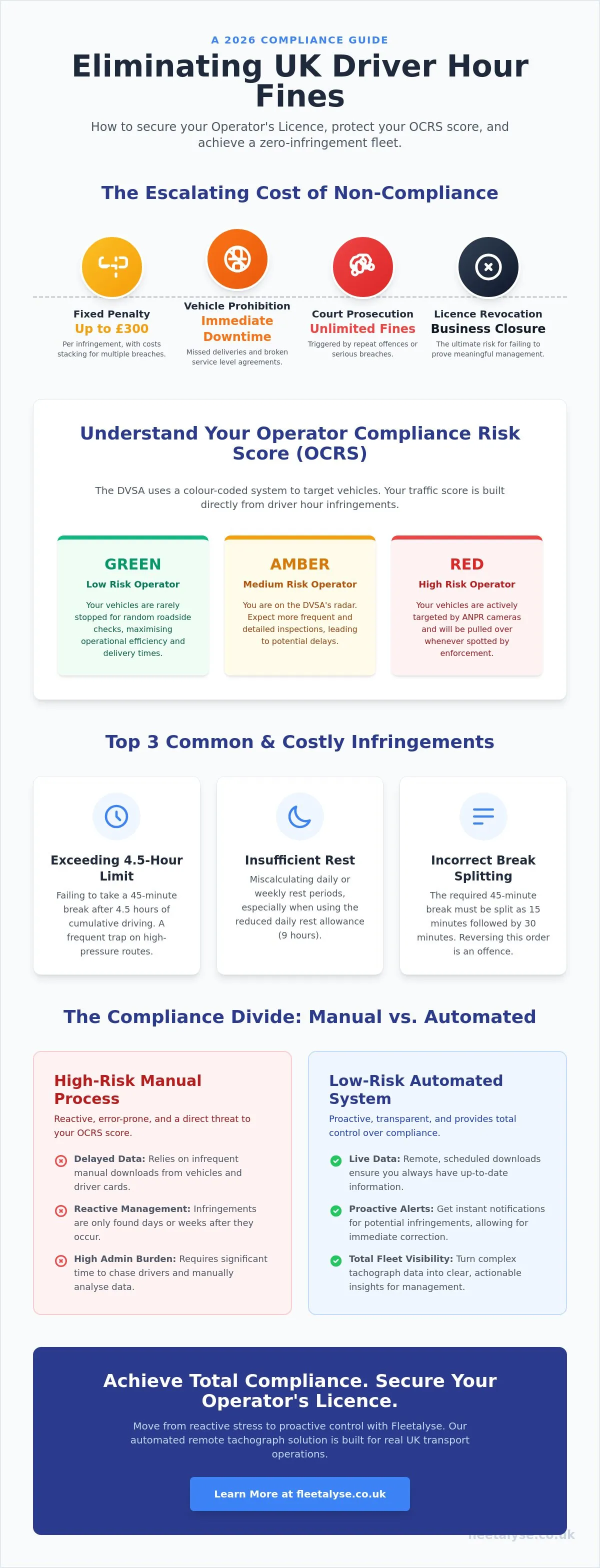
DVSA enforcement is more precise than ever. In 2026, a standard roadside check isn't just a brief delay; it's a forensic audit of your digital records. Most operators think of fines as a simple business expense. They aren't. A single fixed penalty for a rest period infringement usually costs between £100 and £300. However, if an officer finds multiple breaches, those costs stack. If a driver exceeds five infringements in a single check, the DVSA often moves toward prosecution. In court, fines are unlimited.
The financial impact stretches far beyond the initial ticket. When an officer issues a prohibition notice, your vehicle is off the road immediately. This leads to missed delivery slots and broken service level agreements. For a small fleet, one "S" marked prohibition can wipe out the profit from an entire month of haulage. Understanding how to avoid driver hour fines UK is a requirement for survival, not just a matter of preference. You must manage UK driver hour regulations with absolute precision to keep your assets moving.
Persistent offenders eventually face the Traffic Commissioner. This is the ultimate risk for any UK operator. The Commissioner has the power to suspend or revoke your Operator's Licence entirely. They look for evidence of "meaningful management." If you can't show you've identified and corrected driver errors, your professional competence is questioned. At this stage, the cost isn't a fine; it's the total closure of your business.
Financial Penalties vs. Operational Reputation
Fixed penalty notices are the visible part of the problem. The real damage happens to your reputation. Large scale contractors now demand 12 to 24 months of clean compliance data before they'll even invite you to tender. A history of hours infringements suggests a lack of control. It signals to potential clients that your fleet is a liability. Using a platform like Fleetalyse provides the transparency needed to prove your reliability to stakeholders. Don't let a £200 fine cost you a £200,000 contract.
Understanding the OCRS and Graduated Fixed Penalties
The Operator Compliance Risk Score (OCRS) is a rolling three year data set used by the DVSA to target their resources. It uses a colour coded system:
- Green: Low risk. These operators are rarely stopped for random checks.
- Amber: Medium risk. You're on the radar for more frequent inspections.
- Red: High risk. Your vehicles will be pulled over whenever they're spotted by ANPR cameras.
Your "Traffic" score is built directly from your driver hour records. If your drivers consistently miss breaks or over-run their shift, your score drops. Green operators spend less time at the side of the road and more time making deliveries. High quality data keeps you moving. Clear data leads to total compliance.
The Most Common Infringements and How to Spot Them
Fines for tachograph infringements aren't just an annoying cost of doing business. They represent a systemic risk to your operator licence. Understanding how to avoid driver hour fines UK starts with identifying exactly where drivers slip up during a typical shift. Statistics from the DVSA show that nearly 25% of all roadside prohibitions involve hours-related offences. These aren't always deliberate acts of non-compliance. Most stem from a simple lack of technical knowledge or poor habits during high-pressure multi-drop routes.
The most frequent issues involve exceeding the 4.5-hour driving limit and failing to manage rest periods. Insufficient daily and weekly rest is a major trigger for penalties. Drivers often push the 11-hour daily rest rule to its limit, especially when trying to finish a run. While reducing this to 9 hours is allowed three times between weekly rests, miscounting these instances is a common mistake. If your drivers don't track these reductions accurately, your business faces significant financial exposure during a fleet audit.
The 4.5-Hour Rule and Break Splitting
The 4.5-hour rule is a frequent trap for UK hauliers. A driver must take a 45-minute break after 4.5 hours of driving. You can split this break, but the sequence is non-negotiable. It must be a 15-minute break followed by a 30-minute break. Reverse this order, and the first 30-minute block won't count toward the required total. Many drivers in multi-drop operations fail to switch their tachograph to "Rest" while waiting at a delivery bay. If the unit stays on "Other Work," that time doesn't count as a break, leading to an immediate driving over-run.
"Unknown Driving" is another compliance killer often found in the yard. This occurs when a vehicle is moved without a driver card inserted. Even a short 30-metre shuffle to clear a loading bay creates a gap in the digital record. The DVSA views these gaps with extreme suspicion. Preventing this requires strict yard protocols and regular downloads to identify and explain every metre the vehicle travels.
Manual Entries: The #1 Source of Avoidable Fines
Manual entries are the primary target for DVSA inspectors because they reveal the gaps in a driver's day. When a driver is away from the vehicle, perhaps for a safety briefing or office work, the tachograph cannot record their activity. Upon returning to the cab, the driver must manually record that time as "Other Work" or "Rest." Failing to do this creates a "missing data" alert that is impossible to hide during an inspection. You can find the specific requirements for these records in the official UK government guidance.
Drivers must be trained to use the digital tachograph's manual entry prompt every time they insert their card. This includes accounting for time spent on training, vehicle checks, or even travel time to a remote site. If you want to improve your compliance oversight, you need a system that highlights these manual entry failures before the DVSA finds them. Accurate record-keeping is the only way to prove your fleet operates within the law.

Manual vs. Automated Compliance: Which Prevents More Fines?
Manual tachograph management is a high-risk strategy for 2026. Relying on drivers to manually download their cards every 28 days creates unnecessary friction. It leads to administrative bottlenecks where transport managers spend 15% of their week chasing staff instead of optimising routes. When a card isn't read on time, the data gap becomes a liability. Automated systems remove this human error entirely. They provide total transparency and ensure your records are always complete.
The financial argument for automation is clear. A single DVSA fixed penalty for a driver hours infringement typically costs £300. More serious breaches referred to court can result in fines reaching £2,500 per offence. Investing in a solution like Fleetalyse costs a fraction of one HGV fine. It moves your business from a reactive state to a proactive one. This is the most reliable method for how to avoid driver hour fines UK in a climate of increasing enforcement.
- Eliminate missing data gaps that trigger DVSA audits.
- Reduce administrative overhead by 80% through automated scheduling.
- Protect your O-Licence with 100% download consistency.
- Identify fatigue patterns before they result in accidents or fines.
The Problem with Retrospective Analysis
Analysing data 28 days after the event is too late. If a driver exceeded their limit on day one, they've likely repeated the error multiple times before you spot it. This creates a compliance blind spot. You cannot manage live driver fatigue with a retrospective view. The full text of the legislation details the strict requirements operators must meet to remain legal. Missing these details because of slow data processing puts your entire operation at risk. Real transport operations require real-time visibility to stay safe.
Benefits of Remote Tachograph Downloads
Remote technology ensures your data is always ready for a DVSA inspection. There is no need for trucks to return to the depot specifically for a card read. This keeps your fleet on the road and earning. The system pulls data automatically. It integrates directly with analysis software for instant reporting. It is a plug and play solution that provides a clear audit trail. This technology is the most effective way to understand how to avoid driver hour fines UK while maintaining a lean, efficient administrative team. You get total control without the paperwork.
A 5-Step Strategy to Organise Your Compliance Programme
Compliance isn't a one-off task. It's a daily operational requirement. To master how to avoid driver hour fines UK, operators need a structured framework that moves beyond reactive fixes. The DVSA's 2024 enforcement data shows that tachograph and hours violations remain a primary reason for roadside prohibitions. A proactive strategy reduces this risk immediately.
- Conduct monthly toolbox talks: Keep drivers updated on the nuances between EU and GB domestic rules. 15-minute targeted sessions are more effective than annual marathons.
- Implement a No-Card, No-Key policy: Drivers shouldn't be able to start the engine without a valid driver card. This eliminates unknown driving events, which accounted for 23% of tachograph-related fines in recent industry reports.
- Schedule automated remote downloads: Don't rely on manual card reads. Configure your hardware to pull driver and vehicle data every 24 hours. This ensures 100% data continuity.
- Use live monitoring: Intervene before a breach occurs by viewing real-time drive time remaining on your dashboard.
- Perform monthly audits: Identify your top 5% high-risk drivers based on infringement frequency. Prioritise these individuals for immediate retraining.
Driver Training and Behaviour Management
Infringement reports shouldn't be used as a disciplinary stick. Use them as a positive training tool. If a driver consistently misses a 45-minute break by three minutes, it's often a planning issue rather than a behavioural one. Clear communication regarding rest requirements is vital. Drivers must feel safe to report potential breaches caused by loading delays or traffic. When you create a culture of transparency, drivers are more likely to flag issues before they become legal liabilities. This shifts the focus from punishment to operational safety.
Setting Up Real-Time Alerts
Modern fleet software provides live visibility into the cab. Configure your system to flag upcoming break requirements 15 minutes before they're due. This allows transport managers to support drivers stuck in busy loading bays or heavy traffic. Instead of the driver feeling pressured to push through, the manager can reschedule the next drop-off. Live visibility in daily dispatch planning means you're making decisions based on real transport operations. It's the most effective way to stop a breach before the clock runs out.
Ready to automate your tachograph downloads and eliminate manual errors? Secure your compliance hardware today.
Proactive Compliance with Fleetalyse: Built for Real Operations
Fleetalyse provides the tools you need to master how to avoid driver hour fines UK regulations impose on modern fleets. We don't just offer basic tracking. Our platform is built for real transport operations. This means we focus on the specific pressures of the UK haulage industry. Through Remote Tachograph Download and Live Driver Hours, we deliver total transparency for commercial fleets. You gain a clear view of your entire operation from a single, intuitive dashboard.
Rapid deployment is essential for busy operators. Our "Plug & Play" hardware connects directly to the vehicle tachograph. You can start collecting data immediately without expensive installations or specialist engineers. This approach removes the barriers to compliance. It ensures your fleet stays on the road whilst remaining fully legal. We prioritise functional utility and ease of use over flashy, unnecessary features.
Live Driver Hours: Stop Infringements Before They Happen
The live countdown feature is a game-changer for transport managers. It provides a real-time view of driving, break, and rest periods. You can see exactly when a driver is approaching a legal limit. This proactive visibility helps you intervene before an infringement occurs. One of our partners achieved a 90% reduction in driver hour violations within the first 90 days of use. Remote data ensures you are audit-ready at all times. It protects your O-Licence from the risk of DVSA scrutiny.
Seamless Tachograph Analysis Integration
Fleetalyse integrates amongst your existing analysis software. You keep the tools you like whilst gaining the benefits of our live data stream. We believe in honesty and fairness. That's why we use a fee-free lease model with clear pricing. There are no hidden costs or complex contracts that trap you into long-term commitments. You get the hardware and the software in one transparent package that scales with your business needs.
Managing a fleet is difficult enough without worrying about technical failures. Our system is designed to be reliable and straightforward. It turns raw fleet data into actionable decisions for your transport office. Ready to secure your fleet's future? Take control of your compliance data today. Book a demo of our compliance solutions to see how we simplify how to avoid driver hour fines UK hauliers encounter.
Future-Proof Your Fleet Compliance
Operating a haulage business in 2026 requires more than just keeping trucks on the road. With DVSA roadside fines reaching up to £300 per infringement, the financial stakes are higher than ever. You've seen that manual data collection is the primary cause of missed deadlines and that a structured 5-step strategy is essential for protecting your O-Licence. Understanding how to avoid driver hour fines UK wide starts with replacing reactive habits with automated precision. It's about moving away from the stress of manual tachograph downloads and embracing systems that work whilst your drivers are on the move.
Fleetalyse provides a solution Built for Real Transport Operations. We offer a fee-free hardware lease model and Total Transparency pricing, so you always know your exact costs. Stop chasing drivers for cards and start focusing on your growth. Protect your fleet and avoid fines with Fleetalyse Remote Downloads. It's time to put your compliance on autopilot and drive your business forward with confidence.
Frequently Asked Questions
What is the maximum fine for a driver hours infringement in the UK?
Fixed penalty notices for driver hours offences typically cost £300 per infringement. However, the DVSA can take serious or repeated cases to court where fines reach £2,500 per offence or even become unlimited for certain graduated fixed penalties. In extreme scenarios involving falsified records, drivers face two years in prison. Keeping records accurate is the only way to avoid driver hour fines UK operators face during roadside inspections.
How often must I download my driver card and vehicle unit data?
You must download driver card data at least every 28 days and vehicle unit (VU) data every 90 days. These are the legal minimums under UK law. Many efficient fleets download data daily or weekly to catch infringements early. Missing these deadlines is a common compliance failure that triggers immediate fines during a DVSA audit. It's best to automate this process to ensure you never miss a deadline.
Can a driver be fined for an infringement that happened 28 days ago?
Yes, and that window is now wider. DVSA officers can inspect records for the current day and the previous 56 calendar days. If an officer finds an offence committed three weeks ago during a roadside check, they'll issue a fine. Drivers must carry their tachograph card and any manual records for this entire 56 day period to remain compliant. Failure to produce these records results in immediate penalties.
What is the difference between EU rules and GB domestic driver hours?
EU rules apply to most vehicles over 3.5 tonnes, focusing on a 9 hour daily driving limit and 45 minute breaks. GB domestic rules govern vehicles exempt from EU regulations, such as certain vans or local authority vehicles. Domestic rules are less restrictive, allowing up to 10 hours of daily driving. Knowing which set applies to your specific vehicle is vital for knowing how to avoid driver hour fines UK regulations enforce.
How does the DVSA OCRS score affect my business?
The Operator Compliance Risk Score (OCRS) acts as a performance rating for your fleet. A Red high risk score makes your vehicles 4 times more likely to be pulled over for roadside inspections compared to Green operators. High scores lead to frequent delays and increased scrutiny of your records. Maintaining a low risk score keeps your trucks on the road and reduces the chance of operational disruption or targeted audits.
Is remote tachograph downloading legal and DVSA-approved?
Remote tachograph downloading is fully legal and encouraged by the DVSA as a method for maintaining compliance. It uses encrypted GPRS connections to pull data from the vehicle unit without the truck returning to the depot. This technology ensures you never miss a 28 day or 90 day deadline. It removes the human error associated with manual downloads and provides a clear, digital audit trail for investigators.
What happens if a driver exceeds their hours due to an emergency?
Drivers can deviate from the rules under Article 12 of Regulation (EC) 561/2006 to reach a suitable stopping place for safety. The driver must make a manual printout from the tachograph at the end of the shift and write the specific reason for the extension on the back. Heavy traffic is rarely accepted; it must be an unforeseen event like a major accident or emergency road closure.
How can I track live driver hours without calling the driver?
Real-time telematics systems connect directly to the vehicle's tachograph to show live drive times and rest periods. This gives transport managers a live dashboard of remaining hours for every driver in the fleet. You can see exactly who has 15 minutes of drive time left and who's currently on a break. This visibility prevents accidental overruns and eliminates the need for distracting phone calls to the cab.
Frequently asked questions
Financial Penalties vs. Operational Reputation
Fixed penalty notices are the visible part of the problem. The real damage happens to your reputation. Large scale contractors now demand 12 to 24 months of clean compliance data before they'll even invite you to tender. A history of hours infringements suggests a lack of control. It signals to potential clients that your fleet is a liability. Using a platform like Fleetalyse provides the transparency needed to prove your reliability to stakeholders. Don't let a £200 fine cost you a £200,000 contract.
Understanding the OCRS and Graduated Fixed Penalties
The Operator Compliance Risk Score (OCRS) is a rolling three year data set used by the DVSA to target their resources. It uses a colour coded system: Your "Traffic" score is built directly from your driver hour records. If your drivers consistently miss breaks or over-run their shift, your score drops. Green operators spend less time at the side of the road and more time making deliveries. High quality data keeps you moving. Clear data leads to total compliance. Fines for tachograph infringements aren't just an annoying cost of doing business. They represent a systemic risk to your operator licence. Understanding how to avoid driver hour fines UK starts with identifying exactly where drivers slip up during a typical shift. Statistics from the DVSA show that nearly 25% of all roadside prohibitions involve hours-related offences. These aren't always deliberate acts of non-compliance. Most stem from a simple lack of technical knowledge or poor habits during high-pressure multi-drop routes. The most frequent issues involve exceeding the 4.5-hour driving limit and failing to manage rest periods. Insufficient daily and weekly rest is a major trigger for penalties. Drivers often push the 11-hour daily rest rule to its limit, especially when trying to finish a run. While reducing this to 9 hours is allowed three times between weekly rests, miscounting these instances is a common mistake. If your drivers don't track these reductions accurately, your business faces significant financial exposure during a fleet audit.
The 4.5-Hour Rule and Break Splitting
The 4.5-hour rule is a frequent trap for UK hauliers. A driver must take a 45-minute break after 4.5 hours of driving. You can split this break, but the sequence is non-negotiable. It must be a 15-minute break followed by a 30-minute break. Reverse this order, and the first 30-minute block won't count toward the required total. Many drivers in multi-drop operations fail to switch their tachograph to "Rest" while waiting at a delivery bay. If the unit stays on "Other Work," that time doesn't count as a break, leading to an immediate driving over-run. "Unknown Driving" is another compliance killer often found in the yard. This occurs when a vehicle is moved without a driver card inserted. Even a short 30-metre shuffle to clear a loading bay creates a gap in the digital record. The DVSA views these gaps with extreme suspicion. Preventing this requires strict yard protocols and regular downloads to identify and explain every metre the vehicle travels.
Manual Entries: The #1 Source of Avoidable Fines
Manual entries are the primary target for DVSA inspectors because they reveal the gaps in a driver's day. When a driver is away from the vehicle, perhaps for a safety briefing or office work, the tachograph cannot record their activity. Upon returning to the cab, the driver must manually record that time as "Other Work" or "Rest." Failing to do this creates a "missing data" alert that is impossible to hide during an inspection. You can find the specific requirements for these records in the official UK government guidance. Drivers must be trained to use the digital tachograph's manual entry prompt every time they insert their card. This includes accounting for time spent on training, vehicle checks, or even travel time to a remote site. If you want to improve your compliance oversight, you need a system that highlights these manual entry failures before the DVSA finds them. Accurate record-keeping is the only way to prove your fleet operates within the law. Manual tachograph management is a high-risk strategy for 2026. Relying on drivers to manually download their cards every 28 days creates unnecessary friction. It leads to administrative bottlenecks where transport managers spend 15% of their week chasing staff instead of optimising routes. When a card isn't read on time, the data gap becomes a liability. Automated systems remove this human error entirely. They provide total transparency and ensure your records are always complete. The financial argument for automation is clear. A single DVSA fixed penalty for a driver hours infringement typically costs £300. More serious breaches referred to court can result in fines reaching £2,500 per offence. Investing in a solution like Fleetalyse costs a fraction of one HGV fine. It moves your business from a reactive state to a proactive one. This is the most reliable method for how to avoid driver hour fines UK in a climate of increasing enforcement.
The Problem with Retrospective Analysis
Analysing data 28 days after the event is too late. If a driver exceeded their limit on day one, they've likely repeated the error multiple times before you spot it. This creates a compliance blind spot. You cannot manage live driver fatigue with a retrospective view. The full text of the legislation details the strict requirements operators must meet to remain legal. Missing these details because of slow data processing puts your entire operation at risk. Real transport operations require real-time visibility to stay safe.
Benefits of Remote Tachograph Downloads
Remote technology ensures your data is always ready for a DVSA inspection. There is no need for trucks to return to the depot specifically for a card read. This keeps your fleet on the road and earning. The system pulls data automatically. It integrates directly with analysis software for instant reporting. It is a plug and play solution that provides a clear audit trail. This technology is the most effective way to understand how to avoid driver hour fines UK while maintaining a lean, efficient administrative team. You get total control without the paperwork. Compliance isn't a one-off task. It's a daily operational requirement. To master how to avoid driver hour fines UK, operators need a structured framework that moves beyond reactive fixes. The DVSA's 2024 enforcement data shows that tachograph and hours violations remain a primary reason for roadside prohibitions. A proactive strategy reduces this risk immediately.
Driver Training and Behaviour Management
Infringement reports shouldn't be used as a disciplinary stick. Use them as a positive training tool. If a driver consistently misses a 45-minute break by three minutes, it's often a planning issue rather than a behavioural one. Clear communication regarding rest requirements is vital. Drivers must feel safe to report potential breaches caused by loading delays or traffic. When you create a culture of transparency, drivers are more likely to flag issues before they become legal liabilities. This shifts the focus from punishment to operational safety.
Setting Up Real-Time Alerts
Modern fleet software provides live visibility into the cab. Configure your system to flag upcoming break requirements 15 minutes before they're due. This allows transport managers to support drivers stuck in busy loading bays or heavy traffic. Instead of the driver feeling pressured to push through, the manager can reschedule the next drop-off. Live visibility in daily dispatch planning means you're making decisions based on real transport operations. It's the most effective way to stop a breach before the clock runs out. Ready to automate your tachograph downloads and eliminate manual errors? Secure your compliance hardware today. Fleetalyse provides the tools you need to master how to avoid driver hour fines UK regulations impose on modern fleets. We don't just offer basic tracking. Our platform is built for real transport operations. This means we focus on the specific pressures of the UK haulage industry. Through Remote Tachograph Download and Live Driver Hours, we deliver total transparency for commercial fleets. You gain a clear view of your entire operation from a single, intuitive dashboard. Rapid deployment is essential for busy operators. Our "Plug & Play" hardware connects directly to the vehicle tachograph. You can start collecting data immediately without expensive installations or specialist engineers. This approach removes the barriers to compliance. It ensures your fleet stays on the road whilst remaining fully legal. We prioritise functional utility and ease of use over flashy, unnecessary features.
Live Driver Hours: Stop Infringements Before They Happen
The live countdown feature is a game-changer for transport managers. It provides a real-time view of driving, break, and rest periods. You can see exactly when a driver is approaching a legal limit. This proactive visibility helps you intervene before an infringement occurs. One of our partners achieved a 90% reduction in driver hour violations within the first 90 days of use. Remote data ensures you are audit-ready at all times. It protects your O-Licence from the risk of DVSA scrutiny.
Seamless Tachograph Analysis Integration
Fleetalyse integrates amongst your existing analysis software. You keep the tools you like whilst gaining the benefits of our live data stream. We believe in honesty and fairness. That's why we use a fee-free lease model with clear pricing. There are no hidden costs or complex contracts that trap you into long-term commitments. You get the hardware and the software in one transparent package that scales with your business needs. Managing a fleet is difficult enough without worrying about technical failures. Our system is designed to be reliable and straightforward. It turns raw fleet data into actionable decisions for your transport office. Ready to secure your fleet's future? Take control of your compliance data today. Book a demo of our compliance solutions to see how we simplify how to avoid driver hour fines UK hauliers encounter. Operating a haulage business in 2026 requires more than just keeping trucks on the road. With DVSA roadside fines reaching up to £300 per infringement, the financial stakes are higher than ever. You've seen that manual data collection is the primary cause of missed deadlines and that a structured 5-step strategy is essential for protecting your O-Licence. Understanding how to avoid driver hour fines UK wide starts with replacing reactive habits with automated precision. It's about moving away from the stress of manual tachograph downloads and embracing systems that work whilst your drivers are on the move. Fleetalyse provides a solution Built for Real Transport Operations. We offer a fee-free hardware lease model and Total Transparency pricing, so you always know your exact costs. Stop chasing drivers for cards and start focusing on your growth. Protect your fleet and avoid fines with Fleetalyse Remote Downloads. It's time to put your compliance on autopilot and drive your business forward with confidence.
What is the maximum fine for a driver hours infringement in the UK?
Fixed penalty notices for driver hours offences typically cost £300 per infringement. However, the DVSA can take serious or repeated cases to court where fines reach £2,500 per offence or even become unlimited for certain graduated fixed penalties. In extreme scenarios involving falsified records, drivers face two years in prison. Keeping records accurate is the only way to avoid driver hour fines UK operators face during roadside inspections.
How often must I download my driver card and vehicle unit data?
You must download driver card data at least every 28 days and vehicle unit (VU) data every 90 days. These are the legal minimums under UK law. Many efficient fleets download data daily or weekly to catch infringements early. Missing these deadlines is a common compliance failure that triggers immediate fines during a DVSA audit. It's best to automate this process to ensure you never miss a deadline.
Can a driver be fined for an infringement that happened 28 days ago?
Yes, and that window is now wider. DVSA officers can inspect records for the current day and the previous 56 calendar days. If an officer finds an offence committed three weeks ago during a roadside check, they'll issue a fine. Drivers must carry their tachograph card and any manual records for this entire 56 day period to remain compliant. Failure to produce these records results in immediate penalties.
What is the difference between EU rules and GB domestic driver hours?
EU rules apply to most vehicles over 3.5 tonnes, focusing on a 9 hour daily driving limit and 45 minute breaks. GB domestic rules govern vehicles exempt from EU regulations, such as certain vans or local authority vehicles. Domestic rules are less restrictive, allowing up to 10 hours of daily driving. Knowing which set applies to your specific vehicle is vital for knowing how to avoid driver hour fines UK regulations enforce.
How does the DVSA OCRS score affect my business?
The Operator Compliance Risk Score (OCRS) acts as a performance rating for your fleet. A Red high risk score makes your vehicles 4 times more likely to be pulled over for roadside inspections compared to Green operators. High scores lead to frequent delays and increased scrutiny of your records. Maintaining a low risk score keeps your trucks on the road and reduces the chance of operational disruption or targeted audits.
Is remote tachograph downloading legal and DVSA-approved?
Remote tachograph downloading is fully legal and encouraged by the DVSA as a method for maintaining compliance. It uses encrypted GPRS connections to pull data from the vehicle unit without the truck returning to the depot. This technology ensures you never miss a 28 day or 90 day deadline. It removes the human error associated with manual downloads and provides a clear, digital audit trail for investigators.
What happens if a driver exceeds their hours due to an emergency?
Drivers can deviate from the rules under Article 12 of Regulation (EC) 561/2006 to reach a suitable stopping place for safety. The driver must make a manual printout from the tachograph at the end of the shift and write the specific reason for the extension on the back. Heavy traffic is rarely accepted; it must be an unforeseen event like a major accident or emergency road closure.
How can I track live driver hours without calling the driver?
Real-time telematics systems connect directly to the vehicle's tachograph to show live drive times and rest periods. This gives transport managers a live dashboard of remaining hours for every driver in the fleet. You can see exactly who has 15 minutes of drive time left and who's currently on a break. This visibility prevents accidental overruns and eliminates the need for distracting phone calls to the cab.