
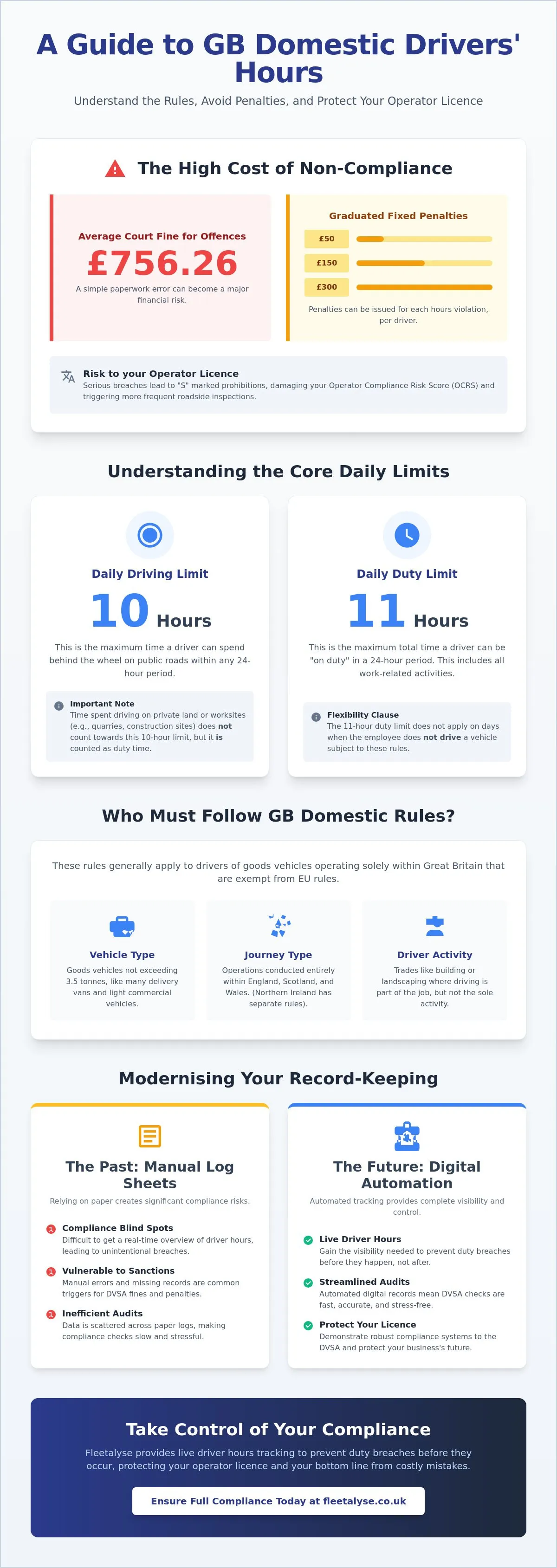
With average court fines for tachograph offences hitting £756.26 in early 2025, a simple paperwork error is now a major financial risk. Relying on manual record sheets often creates a compliance blind spot that leaves your fleet vulnerable to DVSA sanctions. Understanding the GB domestic drivers hours rules tachograph requirements is no longer just about safety. It's about protecting your bottom line from graduated penalties that can reach £300 per offence.
You likely find the distinction between the 10-hour driving limit and the 11-hour duty rule frustrating to track across a busy week. It's difficult to manage driver fatigue when your data is scattered across paper logs or disconnected systems. This guide simplifies the complexities of GB domestic limits and record-keeping to ensure your fleet remains fully compliant with current standards. We'll clarify the specific driving and duty thresholds, explain exactly when a tachograph becomes mandatory, and outline a system to streamline your compliance audits.
Key Takeaways
- Identify whether your vehicles fall under GB domestic or EU rules to ensure you are applying the correct regulatory framework for your specific operations.
- Master the 10-hour daily driving and 11-hour duty limits to maintain road safety and avoid graduated fixed penalties from the DVSA.
- Learn how to manage GB domestic drivers hours rules tachograph requirements by moving from manual logs to automated digital records.
- Understand the "Golden Rule" of mixed driving to stay compliant when your drivers switch between domestic and international tasks in a single week.
- Discover how live driver hours tracking provides the visibility needed to prevent duty breaches before they occur, protecting your operator licence.
What are GB Domestic Drivers’ Hours Rules?
GB domestic rules form the legal backbone for transport operations that fall outside the scope of EU regulations. These rules apply to goods vehicles driven within England, Scotland, and Wales. Northern Ireland operates under its own separate legislative framework. The core objective is simple. It's about preventing driver fatigue. Tired drivers are a danger to themselves and other road users. Maintaining a high standard of road safety is the primary reason the DVSA enforces these limits so strictly. Mastering the GB domestic drivers hours rules tachograph framework is the only way to protect your business from unnecessary scrutiny.
While many operators associate heavy haulage with digital monitoring, the GB domestic drivers hours rules tachograph requirements also impact lighter fleets. Understanding What is a Tachograph? is essential even for those currently using manual records. The transition to digital data is becoming the industry standard. Your Operator Licence depends on your ability to prove compliance. A poor record doesn't just invite fines. It damages your standing with the DVSA. It can lead to a public inquiry that puts your entire business at risk.
Who must follow GB domestic rules?
Most goods vehicles not exceeding 3.5 tonnes, such as delivery vans and light commercials, fall under this category. You are likely "Domestic" if your vehicle is out of scope for EU (Assimilated) rules. This includes certain trades like building, landscaping, or local delivery where driving is not the driver's only activity. Some industries have specific exemptions. For example, emergency services, milk floats, and vehicles used for local authority work often operate under different criteria. Determining your status depends on your vehicle weight and your journey type. If your work is entirely within Great Britain and your vehicle is light, these are the rules you must follow.
The consequences of non-compliance
Ignoring these limits is a costly mistake. The DVSA issues graduated fixed penalties ranging from £50 to £300 for hours violations. More importantly, serious breaches can result in "S" marked prohibitions. These are particularly damaging. They suggest a significant, systemic failure in your management systems. These markers directly lower your Operator Compliance Risk Score (OCRS). A red OCRS score makes your vehicles a target for more frequent roadside inspections. This wastes time and fuel. Business owners and Transport Managers also face personal legal liability. You are responsible for the actions of your drivers. The DVSA expects you to have active oversight of their working patterns at all times.
Daily Driving and Duty Limits Explained
The 10-hour daily driving limit is the cornerstone of the GB domestic drivers hours rules tachograph framework. This limit applies specifically to time spent behind the wheel on public roads. If your drivers operate in sectors like agriculture, quarrying, or construction, off-road driving is handled differently. Time spent driving on private land or worksites does not count towards the 10-hour driving total. Whilst this provides some operational leeway, it still counts as duty time. Mastering the GB domestic drivers hours rules tachograph requirements requires a clear understanding of these dual limits to avoid DVSA scrutiny.
The 11-hour daily duty limit defines the total working day. This includes driving, loading, and administrative tasks. A unique feature of the Official GB Domestic Drivers' Hours Rules is the "no driving" exemption. If a driver does not drive a vehicle subject to these rules on a particular day, the 11-hour duty limit does not apply for that 24-hour period. This flexibility helps regional operators manage staff who split their time between the warehouse and the road.
Defining "Duty Time" for employees vs self-employed
Distinguishing between employee and owner-driver duty time is critical for accurate record-keeping. For an employee, every minute spent working for their employer counts as duty time. This covers everything from vehicle checks to office meetings. Self-employed owner-drivers operate under a narrower definition. Only time spent driving or performing vehicle-related tasks counts as duty. General business administration, such as chasing invoices or marketing, is excluded. This distinction often creates a compliance gap. Many operators over-report or under-report hours because they don't recognise this difference. Using live driver hours tracking helps clarify these boundaries in real-time.
Exemptions to the daily duty limit
Specific professions are exempt from the 11-hour duty limit entirely. This includes doctors, nurses, and vets whilst they are performing their professional duties. Commercial travellers also fall under this exemption. If a driver only uses their vehicle to transport themselves to appointments and carries no goods for hire or reward, the duty limit is waived. Maintenance workers in the gas, water, and electricity sectors follow similar rules. Emergency situations provide a final layer of flexibility. If you must exceed limits to deal with events causing danger to life or significant public disruption, you can do so. You must record the reasons clearly on your logbook or tachograph printout to avoid fines during a DVSA audit.
Record-Keeping: Manual Sheets vs Tachographs
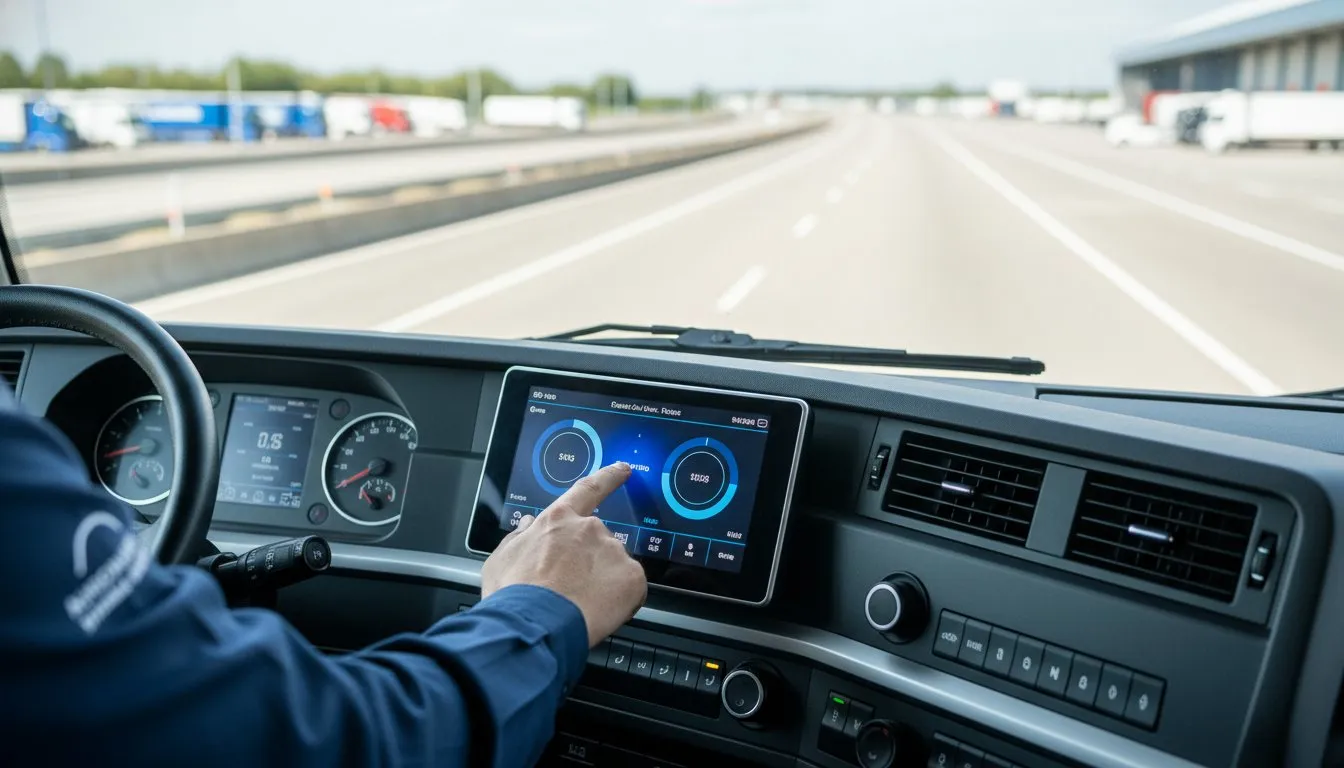
Under the GB domestic drivers hours rules tachograph framework, record-keeping is a mandatory requirement for most commercial operations. You must track daily driving and duty time to prove your fleet stays within legal boundaries. Traditionally, this meant using paper-based weekly record sheets or logbooks. Whilst these satisfy the legal minimum for domestic work, they are increasingly outdated. Modern fleets are shifting towards digital recording to eliminate the "compliance blind spot" inherent in paper systems. This transition aligns with Logistics UK industry standards for professional fleet management. It ensures that every minute of a driver's shift is accounted for without the risk of human error or lost paperwork.
Retention rules are strict. You must keep all driving records for at least 12 months from the date they were created. These documents must be available for inspection by the DVSA at any time. If you cannot produce a logbook for a specific date during an audit, you face the same graduated penalties as a direct hours breach. Many operators find that managing a year's worth of physical paper for every driver is a logistical nightmare. Digital storage simplifies this process. It allows for instant retrieval and ensures your history is protected from physical damage or loss.
The hidden costs of manual record sheets
Paper logs are a significant administrative burden. Collecting, checking, and filing manual sheets takes hours of management time every week. There is also the constant risk of missing or illegible data. A single lost sheet during a DVSA roadside check can trigger an investigation into your entire operation. Manual systems also hide dangerous fatigue patterns. You won't see that a driver is consistently pushing their 11-hour duty limit until long after the shift ends. By then, the risk of an incident has already passed, but the potential for an "S" marked prohibition remains. This reactive approach leaves your OCRS score vulnerable to avoidable hits.
Digital tachographs as a compliance tool
Digital units remove the guesswork from the GB domestic drivers hours rules tachograph requirements. They automatically record every second of driving time with precision that manual logs can't match. This provides transport managers with real-time visibility into their fleet's status. You can see exactly who is close to their limit before they overstep it. Implementing a remote tachograph download system eliminates manual data collection entirely by sending encrypted files directly to your analysis software. This proactive approach turns compliance from a daily chore into a streamlined business process. It keeps your drivers safe and your vehicles on the road without the need for constant manual intervention.
Managing Mixed Driving and Complex Scenarios
Managing mixed driving is often the most complex aspect of the GB domestic drivers hours rules tachograph framework. The "Golden Rule" is absolute. EU rules always take precedence. If a driver performs any amount of EU-regulated work in a single day, EU rules apply to that entire 24-hour period. This includes the stricter break and rest requirements. If they perform EU work at any point during a week, the EU rules for weekly rest must also be satisfied. This creates a significant trap for regional operators who occasionally send a van driver out in an HGV. You cannot pick and choose which rules to follow based on convenience.
Recording "Out of Scope" driving correctly is essential to avoid false infringements. When a driver is using a tachograph-equipped vehicle for work that falls under domestic rules, they should use the "OUT" mode on the digital unit. This tells the system that the driving is not subject to EU regulations. Multi-drop drivers in mixed fleets face the highest risk here. They often fail to log loading and unloading as "other work" on their tachograph card. This results in a "missing data" error during a DVSA inspection. Accurate entries are the only way to prove you haven't exceeded the 10-hour driving limit.
Navigating the Working Time Directive (WTD)
WTD adds another layer of complexity to your operations. Whilst GB domestic rules allow for an 11-hour duty day, you must still adhere to the 48-hour average working week. This average is calculated over a rolling 17 or 26-week reference period. You cannot simply ignore total working hours because a driver is "domestic". Adequate rest periods must be maintained amongst varied shift patterns to prevent cumulative fatigue. This is where many businesses fail their audits. They track driving but forget to monitor total working time. Accurate data is your best defence against claims of driver exhaustion.
Audit-ready documentation for mixed fleets
A unified record is the only way to satisfy a DVSA inspector. If a driver switches between multiple vehicles in one shift, their tachograph card must reflect every activity. This includes "other work" entries for time spent in vehicles without a tachograph. Inspectors look for a continuous, unbroken history of a driver's week. Gaps in data suggest hidden driving or insufficient rest. Secure your tachograph analysis integration to ensure your records are always ready for a surprise visit. This automation removes the manual burden of reconciling mixed driving logs and protects your operator licence.
Modernising Your Compliance with Fleetalyse
Fleetalyse transforms compliance from a manual burden into a streamlined digital process. It serves as a central hub for your entire fleet's data. Managing GB domestic drivers hours rules tachograph requirements shouldn't involve chasing paper logs or waiting for weekly reports. Most generic software only identifies infringements after the fact. Fleetalyse is different. We focus on live driver hours. This provides real-time visibility into every shift as it happens. You can see exactly how much duty time remains before a driver hits the 11-hour limit. This proactive oversight is the most effective way to prevent DVSA penalties.
Shifting to predictive management changes your fleet's culture. You're no longer reacting to mistakes. You're preventing them. Automated monitoring identifies patterns of fatigue or near-misses before they escalate into serious incidents. This keeps your OCRS score healthy and your vehicles on the road. It's a practical, expert-led solution designed for the specific challenges of the UK's regional infrastructure. You get the clarity needed to make informed operational decisions without the traditional administrative headache.
Remote tachograph download and analysis
Maximising vehicle uptime is essential for profitability. You can't afford to have assets sitting in the yard just to satisfy data collection rules. Remote tachograph download eliminates this necessity. The system automatically retrieves data whilst the vehicle is working, regardless of its location. This ensures your GB domestic drivers hours rules tachograph data is captured without fail. This information flows seamlessly into our tachograph analysis integration. It removes the risk of human error and ensures you never miss a legal download deadline again. It's a set-and-forget solution that guarantees your records are always current and audit-ready.
Simplified fleet tracking and asset security
Fleetalyse combines GPS fleet tracking with driver behaviour and hours data in a single interface. This creates a transparent, undeniable record of your operations. Whether you're tracking van movements or monitoring heavy trailer assets, the data is robust and reliable. This level of detail is your best defence during a DVSA visit. It demonstrates a commitment to professional standards that manual systems simply can't match. Learn more about our remote tachograph solutions for UK operators. Modernising your compliance today secures your Operator Licence and ensures your business remains competitive in a tightening regulatory landscape.
Secure Your Operator Licence with Smart Compliance
Managing a modern fleet requires more than just meeting the legal minimum. You must distinguish between the 10-hour driving and 11-hour duty limits whilst navigating the complexities of mixed driving scenarios. Relying on manual record sheets is a gamble that risks your OCRS score and invites avoidable fines. Mastering the GB domestic drivers hours rules tachograph requirements is about moving from reactive logbooks to proactive, digital oversight. It's the only way to ensure your records are always audit-ready.
Automated remote tachograph downloads remove the administrative burden of manual data collection. Live driver hours visibility ensures you catch potential infringements before they occur. Our expert UK-based compliance support provides the localised expertise your business needs to stay operational and efficient. You can't afford to leave your regulatory standing to chance. Streamline your fleet compliance with Fleetalyse today. Taking control of your data now protects your business for the long term.
Frequently Asked Questions
Do I need a tachograph for a 3.5-tonne van under GB domestic rules?
You don't usually need a tachograph for a 3.5-tonne van used solely for domestic operations within Great Britain. However, you must still record your hours using a manual logbook or weekly record sheet. If you occasionally tow a trailer that takes the gross train weight over 3.5 tonnes, or if you engage in international transport, EU rules and tachograph requirements will apply instead.
What is the maximum number of hours I can drive in a day under GB rules?
You are limited to a maximum of 10 hours of driving in any 24-hour period. This driving limit applies specifically to time spent behind the wheel on public roads. Off-road driving in sectors like construction or agriculture doesn't count towards this 10-hour total. It is still recorded as duty time, but it doesn't consume your daily driving allowance.
How much duty time am I allowed in a single working day?
The maximum daily duty limit is 11 hours in any 24-hour period. Duty time includes driving plus any other work performed for your employer, such as loading, vehicle maintenance, or administrative tasks. If you don't drive at all on a specific day, this 11-hour limit doesn't apply to that shift. This provides some flexibility for staff who split their time between warehouse work and driving.
Can I use a manual logbook instead of a tachograph for domestic driving?
Yes, manual logbooks and weekly record sheets are the traditional method for tracking GB domestic drivers hours rules tachograph compliance. Whilst legally acceptable, many fleets now use digital tachographs to eliminate the risk of missing data or manual errors. Digital records provide a more robust defence during a DVSA audit compared to paper logs and simplify the administrative burden for transport managers.
What happens if I drive under both EU and GB domestic rules in the same day?
EU rules take precedence if you perform any amount of EU-regulated driving in a single day. You must follow the stricter EU break and rest requirements for the entire 24-hour period. This "Golden Rule" ensures that drivers aren't switching between sets of regulations to extend their working day beyond safe limits. It is a critical area where many operators fail their compliance checks.
Are there any exemptions to the GB domestic drivers’ hours rules?
Several exemptions exist for specific professions and vehicle types. Doctors, nurses, and vets are exempt whilst performing professional duties. Other exemptions include emergency service vehicles, milk floats, and vehicles used for local authority work. Drivers who don't drive for more than four hours in any day of a week are also exempt from the duty limit for that specific week.
How long must I keep my driving records for the DVSA?
You must retain all driving and duty records for at least 12 months from the date of the entry. These records must be available for inspection at your operating centre at all times. Failure to produce these documents during a DVSA check can lead to graduated fixed penalties. It can also result in more severe sanctions against your operator licence if systemic failures are identified.
Is a 15-minute break enough to reset my driving time under domestic rules?
No, GB domestic rules don't have the same "break and reset" structure as EU regulations. The 10-hour driving and 11-hour duty limits are absolute totals within a 24-hour period. Whilst you must take breaks to manage fatigue, a short break doesn't allow you to exceed the daily driving or duty thresholds. You must always ensure your total work stays within the GB domestic drivers hours rules tachograph limits.
Frequently asked questions
Who must follow GB domestic rules?
Most goods vehicles not exceeding 3.5 tonnes, such as delivery vans and light commercials, fall under this category. You are likely "Domestic" if your vehicle is out of scope for EU (Assimilated) rules. This includes certain trades like building, landscaping, or local delivery where driving is not the driver's only activity. Some industries have specific exemptions. For example, emergency services, milk floats, and vehicles used for local authority work often operate under different criteria. Determining your status depends on your vehicle weight and your journey type. If your work is entirely within Great Britain and your vehicle is light, these are the rules you must follow.
The consequences of non-compliance
Ignoring these limits is a costly mistake. The DVSA issues graduated fixed penalties ranging from £50 to £300 for hours violations. More importantly, serious breaches can result in "S" marked prohibitions. These are particularly damaging. They suggest a significant, systemic failure in your management systems. These markers directly lower your Operator Compliance Risk Score (OCRS). A red OCRS score makes your vehicles a target for more frequent roadside inspections. This wastes time and fuel. Business owners and Transport Managers also face personal legal liability. You are responsible for the actions of your drivers. The DVSA expects you to have active oversight of their working patterns at all times. The 10-hour daily driving limit is the cornerstone of the GB domestic drivers hours rules tachograph framework. This limit applies specifically to time spent behind the wheel on public roads. If your drivers operate in sectors like agriculture, quarrying, or construction, off-road driving is handled differently. Time spent driving on private land or worksites does not count towards the 10-hour driving total. Whilst this provides some operational leeway, it still counts as duty time. Mastering the GB domestic drivers hours rules tachograph requirements requires a clear understanding of these dual limits to avoid DVSA scrutiny. The 11-hour daily duty limit defines the total working day. This includes driving, loading, and administrative tasks. A unique feature of the Official GB Domestic Drivers' Hours Rules is the "no driving" exemption. If a driver does not drive a vehicle subject to these rules on a particular day, the 11-hour duty limit does not apply for that 24-hour period. This flexibility helps regional operators manage staff who split their time between the warehouse and the road.
Defining "Duty Time" for employees vs self-employed
Distinguishing between employee and owner-driver duty time is critical for accurate record-keeping. For an employee, every minute spent working for their employer counts as duty time. This covers everything from vehicle checks to office meetings. Self-employed owner-drivers operate under a narrower definition. Only time spent driving or performing vehicle-related tasks counts as duty. General business administration, such as chasing invoices or marketing, is excluded. This distinction often creates a compliance gap. Many operators over-report or under-report hours because they don't recognise this difference. Using live driver hours tracking helps clarify these boundaries in real-time.
Exemptions to the daily duty limit
Specific professions are exempt from the 11-hour duty limit entirely. This includes doctors, nurses, and vets whilst they are performing their professional duties. Commercial travellers also fall under this exemption. If a driver only uses their vehicle to transport themselves to appointments and carries no goods for hire or reward, the duty limit is waived. Maintenance workers in the gas, water, and electricity sectors follow similar rules. Emergency situations provide a final layer of flexibility. If you must exceed limits to deal with events causing danger to life or significant public disruption, you can do so. You must record the reasons clearly on your logbook or tachograph printout to avoid fines during a DVSA audit. Under the GB domestic drivers hours rules tachograph framework, record-keeping is a mandatory requirement for most commercial operations. You must track daily driving and duty time to prove your fleet stays within legal boundaries. Traditionally, this meant using paper-based weekly record sheets or logbooks. Whilst these satisfy the legal minimum for domestic work, they are increasingly outdated. Modern fleets are shifting towards digital recording to eliminate the "compliance blind spot" inherent in paper systems. This transition aligns with Logistics UK industry standards for professional fleet management. It ensures that every minute of a driver's shift is accounted for without the risk of human error or lost paperwork. Retention rules are strict. You must keep all driving records for at least 12 months from the date they were created. These documents must be available for inspection by the DVSA at any time. If you cannot produce a logbook for a specific date during an audit, you face the same graduated penalties as a direct hours breach. Many operators find that managing a year's worth of physical paper for every driver is a logistical nightmare. Digital storage simplifies this process. It allows for instant retrieval and ensures your history is protected from physical damage or loss.
The hidden costs of manual record sheets
Paper logs are a significant administrative burden. Collecting, checking, and filing manual sheets takes hours of management time every week. There is also the constant risk of missing or illegible data. A single lost sheet during a DVSA roadside check can trigger an investigation into your entire operation. Manual systems also hide dangerous fatigue patterns. You won't see that a driver is consistently pushing their 11-hour duty limit until long after the shift ends. By then, the risk of an incident has already passed, but the potential for an "S" marked prohibition remains. This reactive approach leaves your OCRS score vulnerable to avoidable hits.
Digital tachographs as a compliance tool
Digital units remove the guesswork from the GB domestic drivers hours rules tachograph requirements. They automatically record every second of driving time with precision that manual logs can't match. This provides transport managers with real-time visibility into their fleet's status. You can see exactly who is close to their limit before they overstep it. Implementing a remote tachograph download system eliminates manual data collection entirely by sending encrypted files directly to your analysis software. This proactive approach turns compliance from a daily chore into a streamlined business process. It keeps your drivers safe and your vehicles on the road without the need for constant manual intervention. Managing mixed driving is often the most complex aspect of the GB domestic drivers hours rules tachograph framework. The "Golden Rule" is absolute. EU rules always take precedence. If a driver performs any amount of EU-regulated work in a single day, EU rules apply to that entire 24-hour period. This includes the stricter break and rest requirements. If they perform EU work at any point during a week, the EU rules for weekly rest must also be satisfied. This creates a significant trap for regional operators who occasionally send a van driver out in an HGV. You cannot pick and choose which rules to follow based on convenience. Recording "Out of Scope" driving correctly is essential to avoid false infringements. When a driver is using a tachograph-equipped vehicle for work that falls under domestic rules, they should use the "OUT" mode on the digital unit. This tells the system that the driving is not subject to EU regulations. Multi-drop drivers in mixed fleets face the highest risk here. They often fail to log loading and unloading as "other work" on their tachograph card. This results in a "missing data" error during a DVSA inspection. Accurate entries are the only way to prove you haven't exceeded the 10-hour driving limit.
Navigating the Working Time Directive (WTD)
WTD adds another layer of complexity to your operations. Whilst GB domestic rules allow for an 11-hour duty day, you must still adhere to the 48-hour average working week. This average is calculated over a rolling 17 or 26-week reference period. You cannot simply ignore total working hours because a driver is "domestic". Adequate rest periods must be maintained amongst varied shift patterns to prevent cumulative fatigue. This is where many businesses fail their audits. They track driving but forget to monitor total working time. Accurate data is your best defence against claims of driver exhaustion.
Audit-ready documentation for mixed fleets
A unified record is the only way to satisfy a DVSA inspector. If a driver switches between multiple vehicles in one shift, their tachograph card must reflect every activity. This includes "other work" entries for time spent in vehicles without a tachograph. Inspectors look for a continuous, unbroken history of a driver's week. Gaps in data suggest hidden driving or insufficient rest. Secure your tachograph analysis integration to ensure your records are always ready for a surprise visit. This automation removes the manual burden of reconciling mixed driving logs and protects your operator licence. Fleetalyse transforms compliance from a manual burden into a streamlined digital process. It serves as a central hub for your entire fleet's data. Managing GB domestic drivers hours rules tachograph requirements shouldn't involve chasing paper logs or waiting for weekly reports. Most generic software only identifies infringements after the fact. Fleetalyse is different. We focus on live driver hours. This provides real-time visibility into every shift as it happens. You can see exactly how much duty time remains before a driver hits the 11-hour limit. This proactive oversight is the most effective way to prevent DVSA penalties. Shifting to predictive management changes your fleet's culture. You're no longer reacting to mistakes. You're preventing them. Automated monitoring identifies patterns of fatigue or near-misses before they escalate into serious incidents. This keeps your OCRS score healthy and your vehicles on the road. It's a practical, expert-led solution designed for the specific challenges of the UK's regional infrastructure. You get the clarity needed to make informed operational decisions without the traditional administrative headache.
Remote tachograph download and analysis
Maximising vehicle uptime is essential for profitability. You can't afford to have assets sitting in the yard just to satisfy data collection rules. Remote tachograph download eliminates this necessity. The system automatically retrieves data whilst the vehicle is working, regardless of its location. This ensures your GB domestic drivers hours rules tachograph data is captured without fail. This information flows seamlessly into our tachograph analysis integration. It removes the risk of human error and ensures you never miss a legal download deadline again. It's a set-and-forget solution that guarantees your records are always current and audit-ready.
Simplified fleet tracking and asset security
Fleetalyse combines GPS fleet tracking with driver behaviour and hours data in a single interface. This creates a transparent, undeniable record of your operations. Whether you're tracking van movements or monitoring heavy trailer assets, the data is robust and reliable. This level of detail is your best defence during a DVSA visit. It demonstrates a commitment to professional standards that manual systems simply can't match. Learn more about our remote tachograph solutions for UK operators. Modernising your compliance today secures your Operator Licence and ensures your business remains competitive in a tightening regulatory landscape. Managing a modern fleet requires more than just meeting the legal minimum. You must distinguish between the 10-hour driving and 11-hour duty limits whilst navigating the complexities of mixed driving scenarios. Relying on manual record sheets is a gamble that risks your OCRS score and invites avoidable fines. Mastering the GB domestic drivers hours rules tachograph requirements is about moving from reactive logbooks to proactive, digital oversight. It's the only way to ensure your records are always audit-ready. Automated remote tachograph downloads remove the administrative burden of manual data collection. Live driver hours visibility ensures you catch potential infringements before they occur. Our expert UK-based compliance support provides the localised expertise your business needs to stay operational and efficient. You can't afford to leave your regulatory standing to chance. Streamline your fleet compliance with Fleetalyse today. Taking control of your data now protects your business for the long term.
Do I need a tachograph for a 3.5-tonne van under GB domestic rules?
You don't usually need a tachograph for a 3.5-tonne van used solely for domestic operations within Great Britain. However, you must still record your hours using a manual logbook or weekly record sheet. If you occasionally tow a trailer that takes the gross train weight over 3.5 tonnes, or if you engage in international transport, EU rules and tachograph requirements will apply instead.
What is the maximum number of hours I can drive in a day under GB rules?
You are limited to a maximum of 10 hours of driving in any 24-hour period. This driving limit applies specifically to time spent behind the wheel on public roads. Off-road driving in sectors like construction or agriculture doesn't count towards this 10-hour total. It is still recorded as duty time, but it doesn't consume your daily driving allowance.
How much duty time am I allowed in a single working day?
The maximum daily duty limit is 11 hours in any 24-hour period. Duty time includes driving plus any other work performed for your employer, such as loading, vehicle maintenance, or administrative tasks. If you don't drive at all on a specific day, this 11-hour limit doesn't apply to that shift. This provides some flexibility for staff who split their time between warehouse work and driving.
Can I use a manual logbook instead of a tachograph for domestic driving?
Yes, manual logbooks and weekly record sheets are the traditional method for tracking GB domestic drivers hours rules tachograph compliance. Whilst legally acceptable, many fleets now use digital tachographs to eliminate the risk of missing data or manual errors. Digital records provide a more robust defence during a DVSA audit compared to paper logs and simplify the administrative burden for transport managers.
What happens if I drive under both EU and GB domestic rules in the same day?
EU rules take precedence if you perform any amount of EU-regulated driving in a single day. You must follow the stricter EU break and rest requirements for the entire 24-hour period. This "Golden Rule" ensures that drivers aren't switching between sets of regulations to extend their working day beyond safe limits. It is a critical area where many operators fail their compliance checks.
Are there any exemptions to the GB domestic drivers’ hours rules?
Several exemptions exist for specific professions and vehicle types. Doctors, nurses, and vets are exempt whilst performing professional duties. Other exemptions include emergency service vehicles, milk floats, and vehicles used for local authority work. Drivers who don't drive for more than four hours in any day of a week are also exempt from the duty limit for that specific week.
How long must I keep my driving records for the DVSA?
You must retain all driving and duty records for at least 12 months from the date of the entry. These records must be available for inspection at your operating centre at all times. Failure to produce these documents during a DVSA check can lead to graduated fixed penalties. It can also result in more severe sanctions against your operator licence if systemic failures are identified.
Is a 15-minute break enough to reset my driving time under domestic rules?
No, GB domestic rules don't have the same "break and reset" structure as EU regulations. The 10-hour driving and 11-hour duty limits are absolute totals within a 24-hour period. Whilst you must take breaks to manage fatigue, a short break doesn't allow you to exceed the daily driving or duty thresholds. You must always ensure your total work stays within the GB domestic drivers hours rules tachograph limits.