
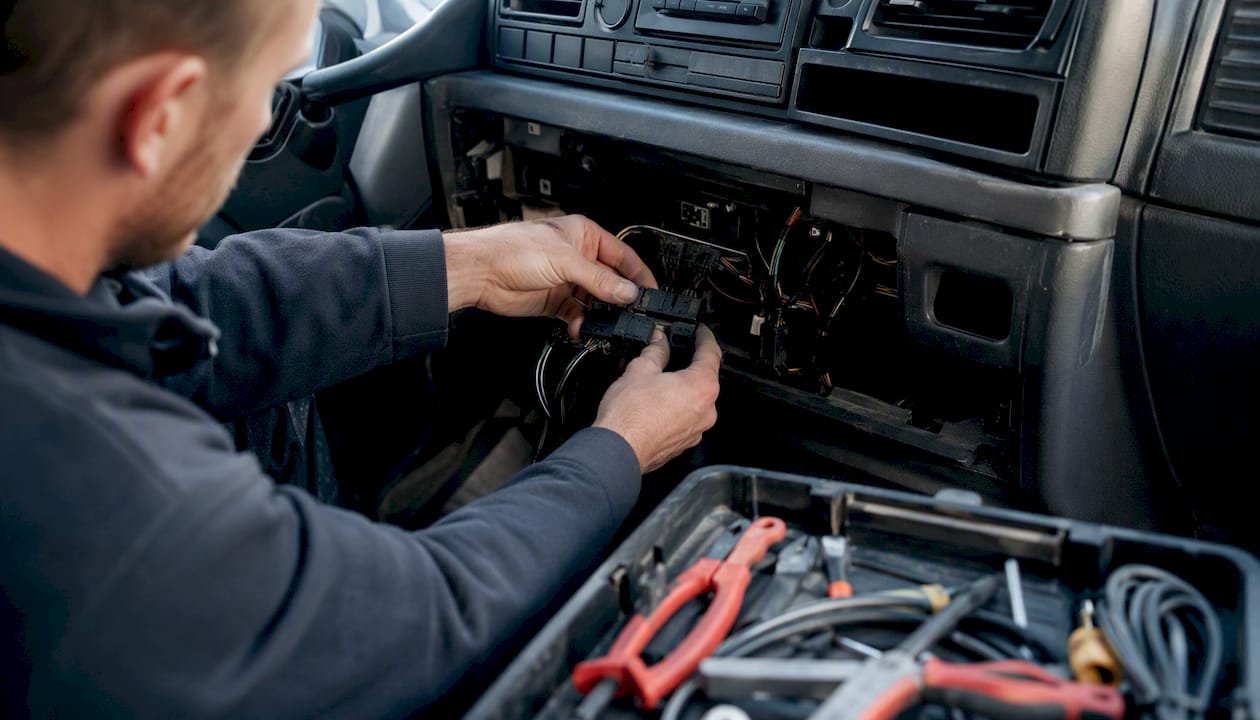
Smart tachograph v2 rules: what UK fleets must know
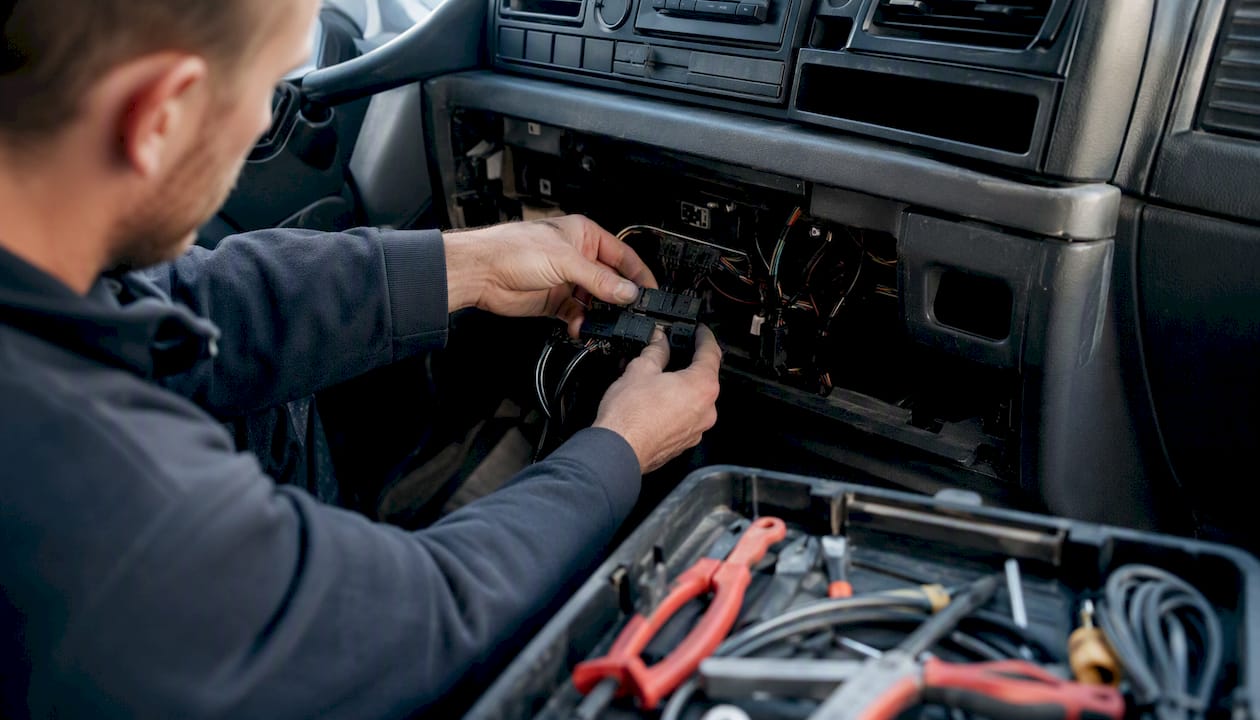
Smart tachograph version 2 (G2V2) is now a live compliance obligation for UK fleets, not a future consideration. Under Gov, the key dates are:
- 21 February 2024 — smart tachograph 2 (transitional or full) required in all newly registered in-scope goods vehicles operating in the UK (six months after the original EU date, reflecting the UK domestic delay confirmed in S.I. 2023/739)
- 24 December 2025 — full smart tachograph 2 units mandatory in all newly registered in-scope goods vehicles; transitional units no longer acceptable for new registrations from this date
- 1 July 2026 — light commercial vehicles (LCVs) over 2.5 t permissible gross vehicle weight used in international operations or cabotage must be fitted with smart tachograph 2
In-scope vehicles are goods vehicles over 3.5 t and certain passenger vehicles used in regulated road transport. LCVs over 2.5 t join that scope from 1 July 2026 for international work. Your immediate next steps: audit which vehicles are affected, book approved-centre fitting slots, and apply for driver cards now — they are not issued instantly.
Key takeaways
Smart tachograph v2 rules are active UK law, with three compliance dates that every transport manager should have fixed in their planning calendar: 21 February 2024, 24 December 2025, and 1 July 2026.
| Point | Details |
|---|---|
| Who is in scope | Goods vehicles over 3.5 t and LCVs over 2.5 t in international operations; LCVs join from 1 July 2026. |
| Critical dates | 21 February 2024 (new registrations); 24 December 2025 (full units only); 1 July 2026 (LCVs). |
| Download intervals | Driver card every 28 days; vehicle unit every 90 days — both statutory, no grace period. |
| No soft enforcement | Enforcement officers treat missing hardware or overdue downloads as immediate non-compliance. |
| Fleetalyse | Automates remote tachograph downloads and driver behaviour monitoring to reduce compliance risk across UK fleets. |
Table of Contents
- What does smart tachograph 2 actually change for UK operators?
- Which vehicles and journeys are in scope under UK rules?
- Key UK compliance dates and retrofit deadlines you must plan for
- Transitional vs full smart tachograph 2: what is the practical difference?
- What are your download and record-keeping obligations?
- Are there exemptions, and how do you prove them at roadside?
- Practical compliance checklist for UK fleets: the next 90 to 180 days
- What happens at a tachograph fitting and calibration appointment?
- Why smart tachograph v2 compliance deserves your attention now
- Fleetalyse keeps your fleet compliant with smart tachograph v2
- Sources
What does smart tachograph 2 actually change for UK operators?
G2V2 is the second generation of the smart (digital) tachograph, formally defined under Commission Implementing Regulation (EU) 2021/1228 and incorporated into UK law through assimilated EU legislation. The headline difference from its predecessor is not just a hardware upgrade — it is a shift in how enforcement agencies can monitor your fleet.
Key features that directly affect your operations:
- Automatic border-crossing recording — the unit logs each time a vehicle crosses an international border without any driver input, creating a tamper-resistant record that enforcement officers can check remotely
- Remote data interrogation — roadside officers and DVSA can query vehicle unit data without stopping the vehicle, meaning non-compliance can be identified before a physical stop occurs
- GNSS position recording with OSNMA — full G2V2 units use Galileo’s Open Service Navigation Message Authentication to verify location data; transitional units record GNSS positions but without that cryptographic verification layer
- Mandatory security software updates — the Joint Research Centre (DTC) maintains approved device lists and mandatory update schedules that operators must track to keep units compliant
- Enhanced anti-tamper protections — physical and software-level sealing requirements, including the EN 16882 seal standard referenced in TRACE II enforcement guidance
Pro Tip: Remote interrogation changes your risk profile in a practical way. Enforcement officers can now flag a vehicle for a targeted stop before it reaches a check point. Keeping your vehicle unit downloads current and your data clean is no longer just a paperwork exercise — it is your first line of defence.
For a broader grounding in how DVSA applies these rules day-to-day, the DVSA tachograph compliance guide covers enforcement priorities and what inspectors look for.
Which vehicles and journeys are in scope under UK rules?
The UK operates under assimilated EU legislation (formerly retained EU law), which means the tachograph rules that applied under EU Regulation (EC) No 165/2014 continue to apply in Great Britain with UK-specific amendments. Northern Ireland follows AETR rules for international journeys and the same assimilated rules for domestic operations.
The practical scope breaks down as follows:
- Goods vehicles over 3.5 t used in regulated road transport — the core in-scope category since the original digital tachograph rules
- Passenger vehicles with more than 9 seats (including the driver) used for hire or reward on journeys over 50 km
- LCVs over 2.5 t permissible gross vehicle weight used in international operations or cabotage — in scope from 1 July 2026
The 2.5 t threshold is assessed on permissible gross vehicle weight, not unladen weight. A van that sits below 2.5 t unladen can be captured if a towed trailer pushes the combined permissible mass above that threshold for an international journey. Van operators running trailer combinations should check their vehicle registration documents carefully before assuming they are out of scope.
For a detailed breakdown of how these rules apply specifically to van fleets, the UK van tachograph rules guide covers the LCV scope in full.
Registration date and permitted tachograph types
| Vehicle registration date | Tachograph type permitted / required |
|---|---|
| Before 1 June 2019 | Analogue or digital (generation 1) acceptable; smart 1 if retrofitted |
| 1 June 2019 – 21 August 2023 | Smart tachograph 1 (generation 1 smart) required for new registrations |
| 21 August 2023 – 21 February 2024 | Smart tachograph 2 transitional or full (EU date; UK domestic-only delay applied) |
| 21 February 2024 – 24 December 2025 | Smart tachograph 2 (transitional or full) required for new UK registrations |
| From 24 December 2025 | Full smart tachograph 2 only for new registrations; transitional units no longer accepted for new fits |
| LCVs over 2.5 t from 1 July 2026 | Smart tachograph 2 required for international operations |
Vehicles already in service before these dates may be subject to retrofit requirements as per regulatory schedules.
Key UK compliance dates and retrofit deadlines you must plan for
The timeline below covers every statutory trigger point that affects your planning. The legal basis for the UK-specific dates sits in S.I. 2023/739 and the GOV.UK tachograph guidance.
- 21 August 2023 — transitional smart tachograph 2 units legally permitted across the UK and EU; the first G2V2 devices enter service
- 21 February 2024 — UK compliance date for newly registered in-scope goods vehicles (six months after the EU date of 21 August 2023, reflecting the domestic-only delay in S.I. 2023/739); smart tachograph 2 mandatory from this point for new registrations
- 31 December 2024 — retrofit deadline for vehicles first registered between 1 June 2019 and 31 December 2024 that were fitted with smart tachograph 1 and used in international operations; these vehicles require a G2V2 retrofit by this date
- 18 August 2025 — retrofit deadline for vehicles first registered before 1 June 2019 (analogue or first-generation digital) used in international operations; smart tachograph 2 required from this date
- 24 December 2025 — full smart tachograph 2 units become mandatory for all newly registered in-scope goods vehicles; transitional units are no longer acceptable for new registrations from this date onwards
- 1 July 2026 — LCVs over 2.5 t permissible gross vehicle weight used in international operations or cabotage must be fitted with smart tachograph 2; this is the date the European Commission confirms completes the phased rollout for lighter vehicles
The six-month UK delay to 21 February 2024 applied specifically to domestic-only new registrations. Vehicles operating internationally were subject to the EU date of 21 August 2023 and should already be compliant. If you are running a mixed fleet with some vehicles on domestic-only work and others crossing into Europe, the date that applies depends on the journeys each vehicle actually makes.
Pro Tip: If your fleet includes vehicles registered between 2019 and 2024 that have been on domestic-only routes, check whether any of those vehicles have since been redeployed to international work. A vehicle that was domestic-only at the retrofit deadline but now crosses borders may be operating with the wrong tachograph type.
Transitional vs full smart tachograph 2: what is the practical difference?
Both unit types are legally G2V2, but they differ in one technically significant way. A transitional unit records GNSS position data but does not apply Galileo OSNMA cryptographic authentication to verify that the location data has not been manipulated. A full unit does. The DTC smart tachograph pages maintain the approved device lists and mandatory security update schedules for both types.
Functional differences that matter operationally:
- Location verification — full units use OSNMA; transitional units record position without that authentication layer, which means location data carries slightly less evidential weight in enforcement proceedings
- Software update dependency — both types require mandatory security updates via approved channels; operators must track DTC update schedules and ensure workshops apply patches during calibration visits
- Anti-tamper and sealing — both types must meet EN 16882 seal requirements; enforcement officers check seal integrity at roadside and during company checks
- Ongoing use — a transitional unit already fitted does not need to be replaced solely because it is transitional; it can remain in service provided it functions correctly and receives required updates
The critical procurement point: from 24 December 2025, only full units are acceptable for new registrations. If you are booking retrofits or new fits now, specify full G2V2 units unless you are fitting a vehicle registered before that date and the transitional unit is already available and approved.
Pro Tip: When sourcing units, ask your supplier to confirm the device’s approval status on the DTC list and its software update pathway. A unit that is approved today but has no clear update route could create compliance problems at the next calibration.
What are your download and record-keeping obligations?
Download intervals are statutory, not advisory. Under GOV.UK tachograph rules:
- Driver card — data must be downloaded at least every 28 days
- Vehicle unit — data must be downloaded at least every 90 days
Missing either deadline is an infringement. There is no grace period. Enforcement officers at roadside checks will verify download dates, and DVSA company checks will audit your download records against the statutory intervals.
Core operator duties:
- Retain downloaded tachograph data for a minimum of 12 months (driver card data) and 12 months (vehicle unit data) — both accessible for inspection on request
- Hold a company card to lock the vehicle unit to your operator record and to access data during company checks
- Ensure calibration is carried out by an approved tachograph centre every two years or after any repair that could affect accuracy
- Keep calibration certificates and workshop cards on file for inspection
Enforcement under G2V2 is more targeted than under previous generations. Remote interrogation means officers can identify vehicles with overdue downloads or anomalous data before a physical stop. Industry reporting consistently flags driver cards as the operational bottleneck: a driver without a valid card cannot legally operate a G2V2-fitted vehicle in scope. Apply for cards well in advance of any compliance date.
Automating your download schedule removes the single biggest source of missed deadlines. The remote tachograph download service from Fleetalyse handles vehicle unit and driver card downloads automatically, with alerts when a download is approaching or overdue. For a detailed look at how automation changes the compliance workload, the automated tachograph compliance guide sets out the practical steps.
Are there exemptions, and how do you prove them at roadside?
Several categories of vehicle and operation are exempt from tachograph requirements, but the burden of proof sits with the operator. GOV.UK guidance makes clear that exemptions require robust documentation to be relied upon during checks.
Common exemptions relevant to UK fleets:
- Own-account transport where driving is not the main activity — for example, a plumber carrying tools to a job; the driver’s primary role must be demonstrably non-driving
- Craft-related goods — vehicles used by craft workers carrying goods made by hand to their place of work
- Vehicles under 7.5 t carrying materials or equipment for the driver’s own use in certain specified circumstances
- Specific passenger exceptions — scheduled services under 50 km, vehicles used for non-commercial passenger transport, and certain community transport operations
- Recovery vehicles operating within a defined radius
- Horse boxes used for non-commercial purposes
Edge cases to watch:
- A van operator running local deliveries may be exempt, but the moment that van crosses into international operations or cabotage, the exemption may no longer apply
- Courier and parcel operators doing cabotage legs are frequently caught by this distinction; the journey type, not the vehicle type, determines scope
- Trailer combinations that push a van’s permissible gross weight above 2.5 t for an international journey bring that vehicle into scope from 1 July 2026, regardless of what the van’s own plate weight says
Pro Tip: Keep a written record for every vehicle you claim is exempt: the statutory basis for the exemption, the nature of the work, and evidence that the driver’s primary activity is not driving. A verbal explanation at a roadside check is not sufficient. DVSA officers expect documentary evidence, and a missing paper trail is treated the same as no exemption at all.
For a full breakdown of infringement categories and what enforcement looks like in practice, the tachograph infringements and penalties guide covers the most common operator mistakes.
Practical compliance checklist for UK fleets: the next 90 to 180 days
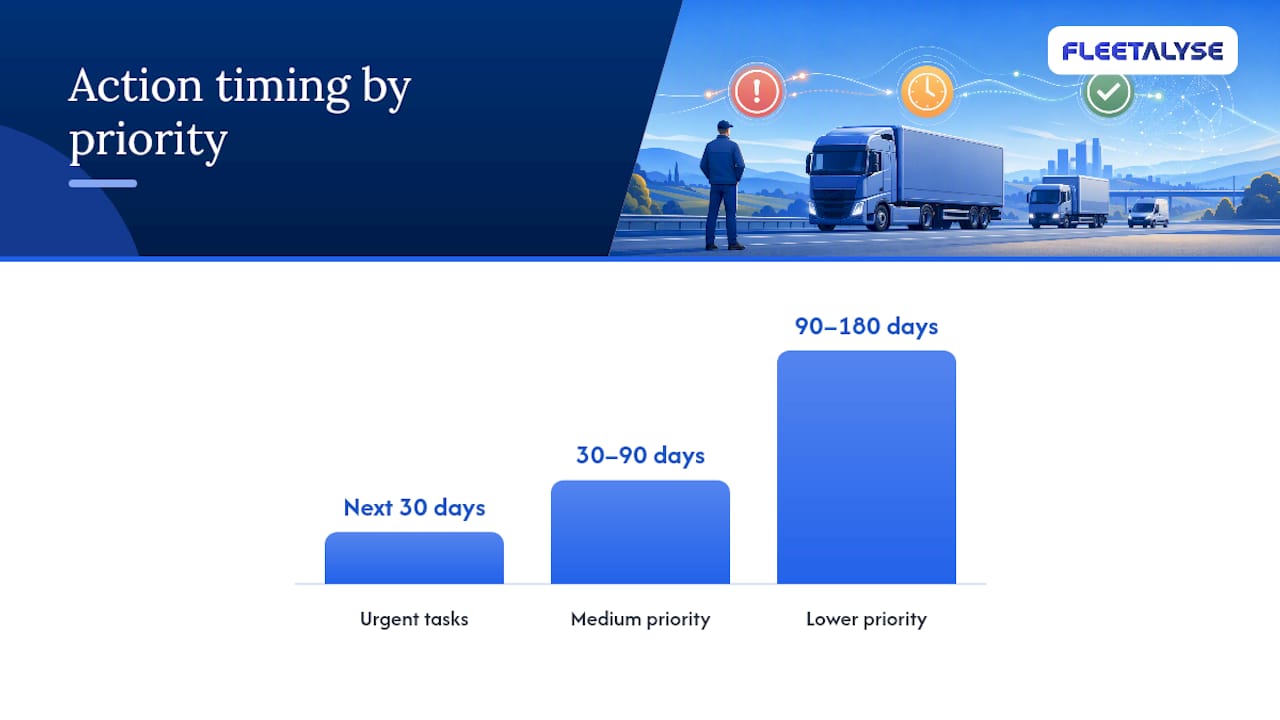
Turn the dates into actions. This is the order that matters.
Urgent (next 30 days):
- Audit your fleet — list every vehicle by registration date, permissible gross weight, and journey type (domestic only vs international); identify which vehicles are already in scope and which will be captured from 1 July 2026
- Apply for driver cards immediately for any driver who does not already hold a valid tachograph driver card; processing takes time and a driver without a card cannot operate a G2V2-fitted vehicle
- Confirm which vehicles already have G2V2 fitted and which still need retrofitting; cross-reference against the retrofit deadlines above
Medium priority (30–90 days):
- Book approved tachograph centre appointments for retrofits and calibrations; workshop slots fill quickly ahead of compliance deadlines, and the tachograph guide for 2026 sets out what to expect at each stage
- Apply for a company card if you do not already hold one; you need it to lock vehicle units to your operator record and to access data during checks
- Set up a download schedule covering both the 28-day driver card interval and the 90-day vehicle unit interval; automate where possible
Lower priority but time-sensitive (90–180 days):
- Train drivers and admin staff on G2V2 operation: how to insert and remove driver cards correctly, what the unit’s display indicators mean, and what to do if a fault is recorded
- Review your data retention process to confirm downloaded files are stored securely and accessible for at least 12 months
- For van operators: confirm by June 2026 that all LCVs over 2.5 t used internationally are fitted, calibrated, and that drivers hold valid cards
Industry guidance for van operators recommends treating 1 July 2026 as a hard deadline with no buffer — fitting and calibration appointments should be booked months in advance to avoid backlogs. Building a compliant compliance workflow into your transport management process now will reduce the administrative pressure as each deadline approaches.
What happens at a tachograph fitting and calibration appointment?
An approved tachograph centre appointment for a G2V2 fit covers several distinct steps, and understanding what you will receive at the end helps you store the right paperwork.
What a fit and calibration appointment covers:
- Physical installation of the vehicle unit and connection to the vehicle’s speed sensor and power supply
- Calibration of the unit to the vehicle’s specific tyre size and axle configuration, recorded on a calibration plaque fixed inside the cab
- Application of the EN 16882 security seals to the unit and its connections
- Company lock: your company card is inserted to register the vehicle unit to your operator record
- Test of driver card insertion and data recording to confirm the unit is functioning correctly
- Issue of a calibration certificate (VU calibration printout) that you must retain for inspection
To verify an approved centre, check the DVSA-approved tachograph centre register. Keep the calibration certificate, the workshop card record, and the installation documentation together in the vehicle file. Enforcement officers can request these at roadside, and DVSA company checks will expect them to be on file.
Pro Tip: Book retrofit appointments now, not in the month before a deadline. Workshop capacity across approved centres tightens significantly as compliance dates approach. Operators who left smart tachograph 1 retrofits to the last few weeks found appointment slots unavailable and faced enforcement risk as a result.
Industry and enforcement insights that often get missed
The shift to G2V2 is not simply a hardware change. The European Commission’s assessment frames it explicitly as a capability upgrade for enforcement agencies: automatic border-crossing records and remote interrogation allow officers to build a picture of a vehicle’s compliance history before it is ever stopped. That changes the risk calculation for operators who have historically relied on the low probability of a physical check.
Practitioners consistently highlight two operational pitfalls:
- Driver cards as the critical path — cards must be applied for in advance; a driver without a valid card cannot legally operate a G2V2-fitted vehicle in scope, and there is no workaround at a roadside check
- No soft-enforcement period — enforcement officers treat missing hardware or overdue downloads as immediate non-compliance; there is no informal grace period attached to any of the UK compliance dates
Pro Tip: Automate driver card and vehicle unit downloads. Operators who rely on manual download routines consistently miss the 28-day and 90-day intervals under operational pressure. Automated alerts and remote download capability remove that risk entirely and create an auditable record that holds up at company checks.
The TRACE II enforcement guidance is worth reading alongside GOV.UK guidance because it explains what enforcement officers are specifically looking for during inspections — including seal integrity, software update status, and the evidential weight of GNSS data. Understanding the inspection framework helps you build compliance processes that hold up under scrutiny.
Why smart tachograph v2 compliance deserves your attention now
From where Fleetalyse sits, working with UK fleet operators every day, the operators who treat G2V2 as a live operational priority rather than a future project are consistently better placed. The compliance dates are not moving. The enforcement capability is already active. And the administrative burden of managing downloads, calibration records, and driver card renewals manually grows with every vehicle added to scope.
Getting compliant early also creates a data advantage. G2V2 generates richer, more granular records than its predecessors. Operators who build the right data workflows now, including driver behaviour monitoring alongside tachograph data, gain visibility into their fleet that goes well beyond meeting a legal minimum. That visibility supports safer operations, better fuel management, and stronger evidence in the event of an incident or investigation.
Fleetalyse keeps your fleet compliant with smart tachograph v2
Staying on top of G2V2 obligations means managing download schedules, calibration records, driver card renewals, and data retention simultaneously. Fleetalyse handles the download side automatically, so your team is not manually tracking 28-day and 90-day intervals across a mixed fleet.
Specific ways Fleetalyse supports tachograph v2 compliance:
- Automated remote tachograph downloads for both vehicle units and driver cards, with alerts when a download is approaching or overdue
- Data retention and audit trails stored securely and accessible for DVSA company checks
- Driver behaviour monitoring that adds context to tachograph records, supporting investigations and operator licence reviews
- Real-time fleet visibility across HGVs, vans, and mixed assets, so you can confirm which vehicles are in scope and track their compliance status
Visit the driver behaviour monitoring page to see how Fleetalyse integrates compliance reporting with operational data, or browse compatible GPS trackers if you are adding hardware to vehicles ahead of the July 2026 LCV deadline. To discuss your fleet’s specific compliance requirements, contact the Fleetalyse team directly at Fleetalyse.
Sources
Verify all compliance obligations against primary sources, and check GOV.UK regularly for live updates as secondary legislation is amended.
- Gov
- The Drivers’ Hours and Tachographs (Amendment) Regulations 2023
- TRACE II tachograph enforcement guidance (TRACE 2)
- DTC smart tachograph information