
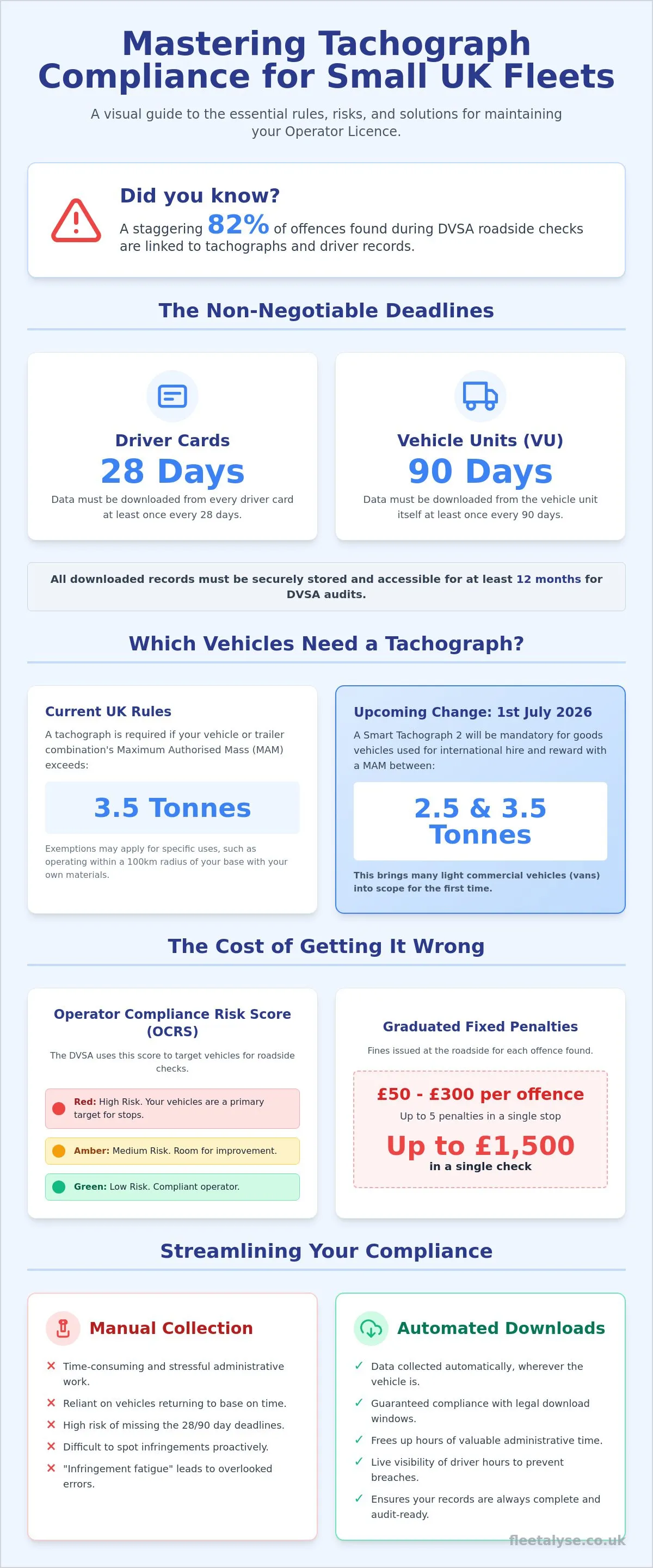
Did you know that 82% of offences found during DVSA roadside checks are linked to tachographs and driver records? It's a staggering figure that highlights just how easy it is to fall foul of complex regulations. For many operators, maintaining tachograph compliance for small fleets uk feels like an endless cycle of manual data downloads and administrative stress. You want to focus on your customers, yet you're often stuck chasing driver cards or worrying that a single oversight could lead to a costly public inquiry.
We understand the pressure of keeping a small team compliant whilst managing daily operations. This guide provides a practical roadmap to master the essentials of UK regulations and protect your Operator Licence from avoidable fines. We'll break down the mandatory 28-day and 90-day download deadlines, explain the July 2026 rule changes for international light commercial vehicles, and show you how to automate your data collection. By the end, you'll have a clear plan to reduce your paperwork and ensure your fleet stays audit-ready at all times.
Key Takeaways
- Master the mandatory 28-day driver card and 90-day vehicle unit download deadlines to keep your records audit-ready.
- Understand why regional operators face the same rigorous DVSA scrutiny as national carriers and how to prepare for roadside checks.
- Streamline tachograph compliance for small fleets uk by replacing time-consuming manual downloads with automated remote technology.
- Identify the common pitfalls, such as infringement fatigue, that can jeopardise your Operator Licence and business survival.
- Learn how live visibility of driver hours allows you to proactively manage rest periods and prevent accidental scheduling breaches.
The Fundamentals of Tachograph Compliance for UK Small Fleets
Tachograph compliance is more than just a box-ticking exercise. It is a legal obligation within the UK's strict transport framework. In simple terms, What is a Tachograph? It is a device that records driving time, speed, and distance, ensuring that drivers stay within safe limits. For small operators, this data is the primary evidence used by the DVSA to verify you are operating safely and fairly. Whether you run two vehicles or twenty, the standards for tachograph compliance for small fleets uk remain exactly the same as those for national haulage firms. There is no "small business" leniency when it comes to road safety.
Most modern fleets now use digital units to track these metrics. However, the industry is currently shifting towards Smart Tachograph 2 (G2V2) technology. This latest hardware version is mandatory for new vehicle registrations and those undertaking international work. These units offer enhanced GPS tracking and dedicated short-range communication, allowing authorities to check certain compliance data remotely without even stopping the vehicle. Your data is the lifeblood of your Operator Licence. If your records are incomplete or show frequent breaches, your licence is at immediate risk.
Which Vehicles Require a Tachograph?
The standard threshold for tachograph usage is 3.5 tonnes. If your vehicle or trailer combination exceeds this Maximum Authorised Mass (MAM), you usually need a tachograph. A significant change arrives on 1 July 2026. Goods vehicles between 2.5 and 3.5 tonnes used for international transport for hire and reward must be fitted with a Smart Tachograph 2. This brings many van operators into the scope of these rules for the first time. Some exemptions exist for small businesses, such as carrying your own materials within a 100km radius of your base. If you operate exclusively within the UK, you may fall under GB Domestic Rules rather than EU regulations. These rules are slightly different but still require meticulous record-keeping to avoid heavy penalties.
The DVSA and Your Compliance Score
The DVSA monitors every operator through the Operator Compliance Risk Score (OCRS). The OCRS is a rolling risk-assessment tool used by the DVSA to rank operators by their likelihood of non-compliance, serving as the primary trigger for 2026 roadside interventions and office audits. A "red" score makes your vehicles a magnet for roadside stops. During these stops, officers can issue graduated fixed penalties. These fines typically range from £50 to £300 per offence, and a single stop can result in up to five separate penalties. For a small business, a £1,500 hit to cash flow from one roadside check is a serious blow. Maintaining tachograph compliance for small fleets uk is the only reliable way to keep your OCRS in the "green" and protect your business from the threat of a Public Inquiry.
Managing Your Data: The 28-Day and 90-Day Rules
The legal backbone of tachograph compliance for small fleets uk rests on two non-negotiable numbers: 28 and 90. You are required by law to download data from every driver card at least every 28 days. The vehicle unit, or VU, must be downloaded every 90 days. These aren't suggestions. They are hard deadlines. Missing them by even twenty-four hours can trigger a red flag in your records. Small fleets often find these dates difficult to manage. Unlike large firms with dedicated compliance teams, you might have vehicles out on long-distance jobs or drivers who don't return to the yard for weeks. This logistical gap is where most infringements happen.
Beyond the downloads, you must store these records for at least 12 months. This allows the DVSA to conduct retrospective audits to ensure your business hasn't been cutting corners. If you find the manual process of chasing cards and plugging in download keys too burdensome, you can automate your data collection to ensure you never miss a legal window. Relying on memory or manual spreadsheets is a high-risk strategy that rarely survives a professional audit.
Driver Obligations vs Operator Responsibilities
Compliance is a shared duty. Drivers are responsible for the accurate use of mode switches. They must correctly toggle between 'Drive', 'Other Work', 'Rest', and 'Out of Scope' to provide a true picture of their day. If a driver spends time away from the vehicle, such as on annual leave or sick days, they must make manual entries upon their return to account for that period. However, the legal burden of monitoring this data falls on the operator. You must analyse every download to spot patterns of fatigue or repeated errors. Ignoring these mistakes is a quick way to jeopardise your licence.
Data Storage and Security Standards
Digital data is fragile. You need a robust backup system to ensure records aren't lost to hardware failure or accidental deletion. DVSA inspectors expect to see high data integrity during an audit. One of the most common issues they look for is "missing mileage". This occurs when the vehicle unit records movement without a driver card inserted. It suggests someone was driving "off the clock". If you cannot explain every single kilometre your vehicles have moved, you'll likely face a graduated fixed penalty or a formal inquiry. A transport manager's primary role is to verify this data, ensuring that every minute and every mile is accounted for.
Common Compliance Pitfalls for Small Fleet Operators
Small operators often fall into the trap of "infringement fatigue." This happens when you see the same minor driver errors week after week. Because these errors haven't resulted in a fine yet, you might stop flagging them during your busy schedule. This is a dangerous path to take. The DVSA views a lack of documented corrective action as a systemic failure in your tachograph compliance for small fleets uk. If you aren't actively managing these errors, you aren't complying. Silence is seen as permission in the eyes of the regulator.
Another frequent issue is the "Unknown Driver" event. This occurs when a vehicle moves without a driver card inserted. Whether it's a mechanic moving a truck in the yard or a driver "shunting" for a few minutes, every movement must be recorded. Inspectors see these gaps as a major red flag. They often assume these events are a deliberate attempt to hide driving time. Similarly, small fleets struggle with data downloads when vehicles are on long-distance jobs. If a vehicle is away for six weeks, you've already missed your 28-day driver card deadline. You cannot wait for the vehicle to return to the yard to remain legal.
Handling Driver Infringements Professionally
When an infringement occurs, you must act immediately. Conduct a formal driver debrief. Sit down with the driver, explain the breach, and record their explanation. This isn't just about discipline; it's about creating a robust paper trail. If the DVSA audits you, they want to see that you've identified the problem and provided training to prevent a repeat. This requirement applies to agency and part-time drivers too. You are legally responsible for their behaviour whilst they are operating your assets. Consistent documentation is your best defence against a poor OCRS score.
The Myth of the "Small Fleet Exemption"
Many operators mistakenly believe the DVSA only targets the "big players" with hundreds of vehicles. This is a costly mistake. Enforcement is increasingly data-driven and automated. If your data shows missed downloads or roadside offences, you will be targeted regardless of your fleet size. The standard of proof for safe operation is universal across the industry. The upcoming 2026 rule changes for vans between 2.5 and 3.5 tonnes on international routes prove that the regulatory net is only getting tighter. Size is no defence in a Public Inquiry; the Traffic Commissioner expects the same level of professional diligence from a one-vehicle owner as they do from a multinational haulier.

Remote Downloads vs Manual Collection: An Efficiency Comparison
Manual data collection is the traditional method for many regional operators. It requires a physical download tool, the company card, and the vehicle to be present at the depot. This process is slow. It creates unnecessary vehicle downtime and administrative friction. For a fleet of five vehicles, you might lose several hours every month just retrieving files. If a vehicle is on a long-distance job, the data remains trapped in the unit. This makes meeting the mandatory deadlines for tachograph compliance for small fleets uk a constant struggle.
Remote tachograph downloads change this dynamic entirely. The system pulls data from the vehicle unit and driver card whilst the asset is still on the road. There is no need for manual intervention or vehicle visits. It turns a reactive chore into a silent, background process. By removing the "hidden costs" of labour and downtime, small teams can redirect their focus toward growth and customer service. You gain real-time visibility into your operations, which is essential for efficient dispatch and route planning.
Eliminating the "Chase" for Driver Cards
Chasing drivers for their cards is a thankless task. Remote systems eliminate this friction by scheduling automatic downloads. This ensures you never miss the 28-day driver card deadline, even if the driver is working remotely or starting from home. Beyond basic compliance, you gain access to live driver hours. This visibility allows you to monitor driving patterns and rest periods as they happen. It's a proactive way to improve driver behaviour and prevent fatigue before an infringement occurs. You no longer have to wait for a driver to return to the yard to know if they are close to their limit.
Integrating Tacho Data with Fleet Analysis
Raw data is only useful if you can understand it. Modern compliance requires moving from simple file storage to actionable reporting. Fleetalyse simplifies this journey by integrating remote downloads with powerful analysis software. Having your GPS tracking and tachograph data in one central hub provides a complete picture of your fleet's health. It makes your business audit-ready and removes the complexity of managing multiple systems. You can see vehicle locations and driver availability in one centre, making your daily planning much more accurate. If you're ready to leave manual paperwork behind, you can set up your automated download system here.
Future-Proofing Your Compliance with Fleetalyse
The regulatory landscape is shifting towards total digitisation. By 2026, the DVSA will rely more heavily on remote data interrogation and automated risk scoring. For regional operators, maintaining tachograph compliance for small fleets uk with manual tools is becoming an operational liability. Fleetalyse provides a straightforward, automated solution that removes the administrative burden from your daily schedule. Our system handles remote tachograph downloads in the background, ensuring your driver card and vehicle unit data is always captured within the legal 28-day and 90-day windows. You no longer need to coordinate vehicle visits or wait for drivers to return to the depot.
Safety is the foundation of a healthy Operator Licence. Our live driver hours tracking gives you a real-time view of your team's remaining driving time and mandatory rest periods. This visibility is crucial for preventing accidental infringements and managing driver fatigue before it becomes a roadside penalty. We integrate seamlessly with major UK tachograph analysis platforms, providing a smooth path from raw data collection to audit-ready reporting. There are no hidden complexities or unnecessary features; just a reliable, transparent service built for the practical needs of UK transport managers.
Why Remote Compliance is Essential in 2026
Roadside enforcement is no longer a game of chance. The DVSA uses data to target their interventions. With the rollout of Smart Tachograph Version 2, authorities can now check compliance data whilst your vehicles are in motion. If your records are incomplete, you're a high-priority target for a stop. Remote compliance ensures your data is always current and accurate. Beyond avoiding fines, live data helps you make better commercial decisions. You can see exactly which drivers have the hours available for a late-notice delivery, allowing you to maximise your assets without risking a breach of the rules.
Getting Started with a Specialist Partner
We don't believe in marketing hyperbole or over-complicated software. The Fleetalyse approach is rooted in industry expertise and pragmatic support for the local operator. We understand the daily struggles of managing a small team and the pressure of keeping your OCRS in the green. A great first step is to organise a fleet audit to identify your current data gaps and hardware requirements. We provide the technical tools and the industry insight needed to keep your business moving safely and legally. Don't wait for a DVSA letter to fix your processes. Protect your fleet with remote tachograph downloads from Fleetalyse and secure the future of your Operator Licence today.
Secure Your Operator Licence for 2026
Maintaining tachograph compliance for small fleets uk is the only reliable way to protect your business from DVSA intervention. We've detailed the non-negotiable 28-day and 90-day download deadlines and the serious risks of ignoring minor driver errors. As the regulatory environment becomes increasingly data-driven, manual collection is no longer a sustainable strategy. It wastes valuable time and leaves your business vulnerable to administrative oversights that could lead to a Public Inquiry.
Moving to an automated system removes the stress from your daily operations. You gain immediate visibility through real-time driver hours monitoring and transparent, benefit-first reporting. Fleetalyse provides the expertise and technical tools needed to keep your records audit-ready without the need for manual vehicle visits. Don't let complex paperwork jeopardise your professional standing or your licence. Streamline your compliance with Fleetalyse remote downloads and take control of your fleet's safety standards today. You've built your business to last; ensure your compliance keeps it that way.
Frequently Asked Questions
Do I need a tachograph if my fleet only operates within the UK?
Yes, most goods vehicles over 3.5 tonnes must be fitted with a tachograph, even if they never leave the country. This is a fundamental requirement for tachograph compliance for small fleets uk. Whilst some specific exemptions exist for tradespeople carrying their own tools within a 100km radius, most commercial haulage and "hire and reward" operations fall strictly within these rules. You must confirm your vehicle's weight and usage type to ensure you aren't operating illegally.
How often must I download my driver card and vehicle unit data?
You are legally required to download data from driver cards at least every 28 days and from the vehicle unit (VU) at least every 90 days. These are the absolute maximum intervals allowed by the DVSA. Many professional operators choose to download data weekly to identify driver errors or infringements before they become systemic problems. Missing these deadlines is one of the most common reasons for receiving a graduated fixed penalty during an audit.
What are the penalties for tachograph non-compliance for small businesses?
The DVSA can issue graduated fixed penalties ranging from £50 to £300 per offence. An officer can issue up to five penalties in a single roadside stop, which can cost a small business £1,500 instantly. More serious breaches, such as tampering with records, can lead to unlimited fines in court. Repeated non-compliance often results in a Public Inquiry, where the Traffic Commissioner has the power to suspend or revoke your Operator Licence entirely.
Can I use a van without a tachograph for business purposes?
You can use a van without a tachograph for domestic business if its Maximum Authorised Mass (MAM) is 3.5 tonnes or less. However, the rules change on 1 July 2026. From this date, any vehicle between 2.5 and 3.5 tonnes used for international transport for hire and reward must be fitted with a Smart Tachograph 2. If your business only operates within the UK and stays under the 3.5-tonne limit, you generally remain exempt from these specific digital requirements.
What is the difference between EU driving rules and GB domestic rules?
EU rules are generally stricter and apply to most heavy goods vehicles, mandating specific break patterns like 45 minutes of rest for every 4.5 hours of driving. GB domestic rules apply to certain vehicles exempt from the EU framework, such as those used by the emergency services or local authorities. Domestic rules focus on daily driving and duty limits rather than the complex rest and split-break requirements found in the EU 561/2006 regulations.
How does remote tachograph download software actually work?
Remote software uses a telematics device connected to the tachograph to transmit data wirelessly via the mobile network. Your company card is kept in a secure, networked card reader at your office or a data centre, which authorises the download remotely. This allows the system to pull driver and vehicle files automatically on a schedule. It removes the need for drivers to return to the depot specifically to have their cards read or for you to visit every vehicle with a download key.
Do I need to keep paper printouts if I have a digital tachograph?
You don't need to keep daily paper printouts if your digital system is working correctly. Printouts are only mandatory if your driver card is lost, stolen, or becomes faulty during a shift. In those circumstances, you must produce a printout at the start and end of your journey and sign it to verify your hours. You should also produce a printout if an enforcement officer requests one during a roadside check to inspect your current day's driving activity.
How long do I need to store tachograph records for the DVSA?
You must store all tachograph records for at least 12 months from the date of the recording. This includes the raw digital files from both the driver cards and the vehicle units. These records must be organised and accessible for DVSA inspectors or the Traffic Commissioner during an audit. It's a sensible practice to maintain digital backups in a separate location to ensure you can always prove your history of tachograph compliance for small fleets uk if your primary hardware fails.
Frequently asked questions
Which Vehicles Require a Tachograph?
The standard threshold for tachograph usage is 3.5 tonnes. If your vehicle or trailer combination exceeds this Maximum Authorised Mass (MAM), you usually need a tachograph. A significant change arrives on 1 July 2026. Goods vehicles between 2.5 and 3.5 tonnes used for international transport for hire and reward must be fitted with a Smart Tachograph 2. This brings many van operators into the scope of these rules for the first time. Some exemptions exist for small businesses, such as carrying your own materials within a 100km radius of your base. If you operate exclusively within the UK, you may fall under GB Domestic Rules rather than EU regulations. These rules are slightly different but still require meticulous record-keeping to avoid heavy penalties.
Do I need a tachograph if my fleet only operates within the UK?
Yes, most goods vehicles over 3.5 tonnes must be fitted with a tachograph, even if they never leave the country. This is a fundamental requirement for tachograph compliance for small fleets uk. Whilst some specific exemptions exist for tradespeople carrying their own tools within a 100km radius, most commercial haulage and "hire and reward" operations fall strictly within these rules. You must confirm your vehicle's weight and usage type to ensure you aren't operating illegally.
How often must I download my driver card and vehicle unit data?
You are legally required to download data from driver cards at least every 28 days and from the vehicle unit (VU) at least every 90 days. These are the absolute maximum intervals allowed by the DVSA. Many professional operators choose to download data weekly to identify driver errors or infringements before they become systemic problems. Missing these deadlines is one of the most common reasons for receiving a graduated fixed penalty during an audit.
What are the penalties for tachograph non-compliance for small businesses?
The DVSA can issue graduated fixed penalties ranging from £50 to £300 per offence. An officer can issue up to five penalties in a single roadside stop, which can cost a small business £1,500 instantly. More serious breaches, such as tampering with records, can lead to unlimited fines in court. Repeated non-compliance often results in a Public Inquiry, where the Traffic Commissioner has the power to suspend or revoke your Operator Licence entirely.
Can I use a van without a tachograph for business purposes?
You can use a van without a tachograph for domestic business if its Maximum Authorised Mass (MAM) is 3.5 tonnes or less. However, the rules change on 1 July 2026. From this date, any vehicle between 2.5 and 3.5 tonnes used for international transport for hire and reward must be fitted with a Smart Tachograph 2. If your business only operates within the UK and stays under the 3.5-tonne limit, you generally remain exempt from these specific digital requirements.
What is the difference between EU driving rules and GB domestic rules?
EU rules are generally stricter and apply to most heavy goods vehicles, mandating specific break patterns like 45 minutes of rest for every 4.5 hours of driving. GB domestic rules apply to certain vehicles exempt from the EU framework, such as those used by the emergency services or local authorities. Domestic rules focus on daily driving and duty limits rather than the complex rest and split-break requirements found in the EU 561/2006 regulations.
How does remote tachograph download software actually work?
Remote software uses a telematics device connected to the tachograph to transmit data wirelessly via the mobile network. Your company card is kept in a secure, networked card reader at your office or a data centre, which authorises the download remotely. This allows the system to pull driver and vehicle files automatically on a schedule. It removes the need for drivers to return to the depot specifically to have their cards read or for you to visit every vehicle with a download key.
Do I need to keep paper printouts if I have a digital tachograph?
You don't need to keep daily paper printouts if your digital system is working correctly. Printouts are only mandatory if your driver card is lost, stolen, or becomes faulty during a shift. In those circumstances, you must produce a printout at the start and end of your journey and sign it to verify your hours. You should also produce a printout if an enforcement officer requests one during a roadside check to inspect your current day's driving activity.
How long do I need to store tachograph records for the DVSA?
You must store all tachograph records for at least 12 months from the date of the recording. This includes the raw digital files from both the driver cards and the vehicle units. These records must be organised and accessible for DVSA inspectors or the Traffic Commissioner during an audit. It's a sensible practice to maintain digital backups in a separate location to ensure you can always prove your history of tachograph compliance for small fleets uk if your primary hardware fails.