
Editorial correction: 30 September 2026. Removed an unrelated named roofing-company example. The original publication date is retained.
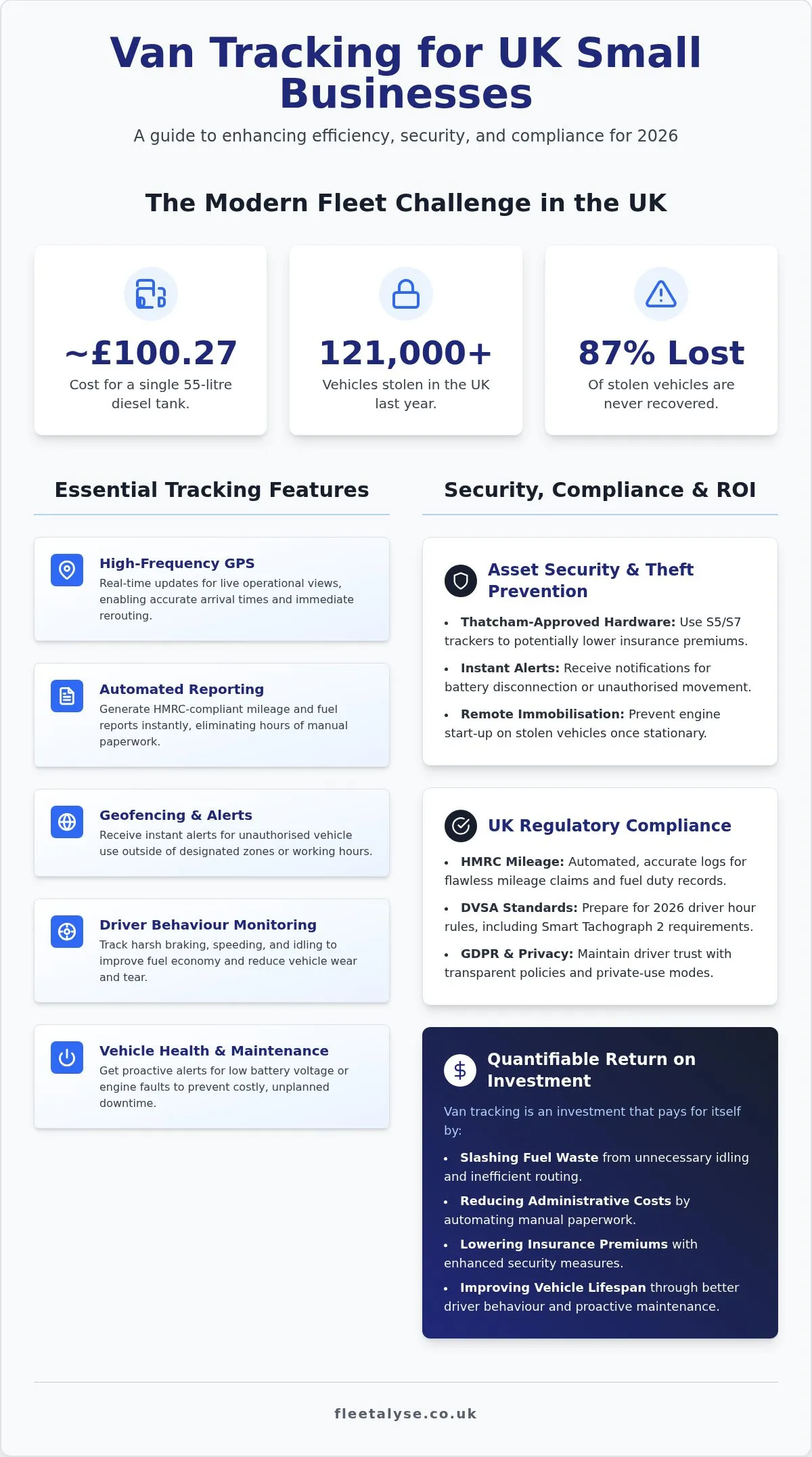
Did you know that a single 55-litre tank of diesel now costs approximately £100.27, whilst vehicle thefts in the UK reached over 121,000 in the last year? For a regional operator, these rising overheads and the constant burden of manual paperwork feel like an exhausting uphill battle. You're likely tired of chasing driver hour logs and worrying about unauthorised vehicle use after the working day ends. It's a drain on your time and your bottom line.
Implementing van tracking for small business fleets UK isn't just about dots on a map. It's a pragmatic engine for operational clarity and total regulatory compliance. By automating data collection, you can slash administrative waste and protect your assets from the 87% of stolen vehicles that are never recovered. This guide provides a straightforward look at the 2026 landscape. We'll cover everything from the July 2026 Smart Tachograph 2 requirements for international work to HMRC mileage allowance updates. You'll discover how to lower insurance premiums, improve driver behaviour, and ensure your business stays ahead of DVSA standards without the usual complexity.
Key Takeaways
- Quantify your return on investment by reducing idling time and securing lower insurance premiums with Thatcham-approved tracking hardware.
- Ensure total regulatory compliance with van tracking for small business fleets UK, covering HMRC mileage claims and 2026 DVSA driver hour standards.
- Prioritise essential features like high-frequency GPS refresh rates and automated reporting to eliminate time-consuming manual paperwork.
- Maintain driver trust by implementing transparent privacy policies and private-use modes that align strictly with UK GDPR requirements.
- Optimise mixed fleet operations by integrating live driver hours and remote tachograph downloads for larger light commercial vehicles.
The Role of Van Tracking in Modern UK Small Business Operations
Van tracking has undergone a fundamental shift. It's no longer a simple security measure tucked away in a dashboard. In 2026, van tracking for small business fleets UK serves as a digital backbone for operational survival. The UK market now demands precise, digital record-keeping to manage everything from fuel duty to duty of care. Relying on paper logs or verbal updates from drivers is a liability your business can't afford.
The transition from reactive theft recovery to proactive fleet management is driven by data. Whilst finding a stolen van remains important, preventing the waste of resources is where the real profit lies. Digitising your assets this year isn't just about following a trend. It's about protecting your margins against 182.0p per litre diesel prices and rising insurance premiums. Modern systems provide the transparency needed to make fast, informed decisions. This level of operational insight is vital for any service-led business, including Taylors Estate Agency, which relies on a mobile team to serve the local community effectively.
Beyond Dots on a Map: Operational Visibility
True visibility means knowing more than just a vehicle's postcode. High-frequency GPS Fleet Tracking allows you to provide customers with accurate arrival times, improving service reliability instantly. It eliminates "dead mileage" by identifying inefficient routes that add unnecessary wear and tear to your vehicles. Monitoring idling time is another quick win. If a van sits with the engine running for thirty minutes a day, that's nearly £100 of fuel wasted every month across a small fleet. Tracking stops this drain on your cash flow immediately.
Addressing the "Big Brother" Culture
Resistance to tracking often stems from a fear of constant surveillance. However, a pragmatic approach focuses on driver safety and professional behaviour. Clear communication is the key to a successful rollout. Explain that the data protects drivers against false insurance claims and provides proof of work. Use the system to reward your smoothest, most efficient drivers rather than just highlighting errors. This shift in perspective turns a monitoring tool into a platform for professional development. When staff understand that van tracking for small business fleets UK secures the company's future, they become partners in your operational success.
Essential Features: What Small Fleets Actually Need
Small businesses don't need expensive, bloated software. They need functional tools that solve daily problems without adding to the workload. Effective van tracking for small business fleets UK starts with high-frequency GPS refresh rates. If your data only updates every ten minutes, you're looking at history, not a live operation. Real-time updates allow you to reroute drivers around congestion or provide clients with precise arrival windows. This level of accuracy is the difference between a productive day and a logistical mess.
Automated reporting is equally vital. Manual mileage logs are prone to error and take up hours of administrative time every week. Modern systems generate HMRC-compliant reports for fuel and mileage at the touch of a button. Couple this with geofencing to prevent unauthorised vehicle use. If a van leaves a designated zone outside of working hours, you get an instant alert. This stops fuel theft and personal use of company assets immediately. It's a simple way to ensure company resources stay focused on company work.
Monitoring driver behaviour directly impacts your overheads. Harsh braking, speeding, and excessive acceleration increase wear on tyres and brakes whilst dragging down fuel economy. By tracking these metrics, you can coach drivers towards a smoother style that preserves your assets. You can also receive battery and health alerts. These notifications warn you of low voltage or engine faults before they lead to a costly breakdown and unplanned downtime. While tracking helps prevent mechanical failures, human errors like mis-fuelling still happen; in these instances, Fuel Mistake® offers 24/7 mobile support to get your vehicles back on the road.
Security remains a primary concern for any regional operator. Thatcham-approved trackers, specifically S5 or S7 categories, are often a prerequisite for competitive commercial insurance premiums. These devices provide a higher level of recovery success for the 121,000 vehicles stolen annually. Some systems offer remote immobilisation, allowing you to prevent the engine from starting once the vehicle is stationary. This is a powerful deterrent. Ensure your system sends instant alerts for battery disconnection or movement during restricted hours to catch thieves before the vehicle is moved too far. For a business like Frankly Flooring, ensuring that every delivery vehicle is secure is essential for maintaining their reliable service.
Integration with Compliance Tools
For businesses running mixed fleets, centralising data is essential. If you operate 3.5t vans alongside larger vehicles, you need a system that integrates Remote Tachograph Download capabilities. Disconnected platforms create administrative silos and increase the risk of compliance gaps. Using a single dashboard for GPS tracking and live driver hours ensures you never miss a legal rest break or a download deadline. This integrated approach simplifies your workflow and keeps your business on the right side of DVSA regulations without the need for multiple subscriptions.
Calculating ROI: How Tracking Reduces Small Business Overheads
ROI for van tracking for small business fleets UK is often misunderstood. Many operators view it as a simple insurance tick-box or a theft recovery tool. Whilst those are valuable, the real return comes from consistent, daily operational savings. You can't manage what you don't measure. By digitising your fleet, you turn vague overheads into manageable data points that directly affect your bottom line; to further drive down costs, you can learn more about Dynogen Remapping Solutions to see how engine tuning can improve your fleet's efficiency.
Fuel is likely your largest variable expense. With diesel averaging 182.0p per litre in August 2026, even small efficiency gains have a massive impact. Monitoring speeding directly correlates to lower fuel bills. High speeds increase wind resistance and fuel consumption significantly. Tracking allows you to identify the most and least efficient drivers. This data enables targeted coaching to reduce these costs across the board.
Predictive maintenance is another area for significant savings. Instead of waiting for a breakdown, use mileage data to schedule service intervals precisely. This prevents minor issues from becoming major repairs. Smoother driving styles also reduce wear on tyres and brake pads. A driver who avoids harsh acceleration and braking can extend the life of these components. This keeps your vans on the road and out of the workshop for longer periods; for on-site maintenance needs, Mobile Tyre Service can help you manage these essential repairs without disrupting your schedule.
Insurance premiums for light commercial vehicles average £429 per year, but this figure climbs steeply for courier or haulage work. Thatcham-approved devices are a pragmatic way to lower these costs. Insurers value the reduced risk of unrecovered theft. If a vehicle is stolen, the low 13% recovery rate for untracked vehicles is a grim reality. Tracking flips those odds in your favour. You can often negotiate better rates by presenting a proven track record of safety data.
Telematics data also provides a robust defence against "crash for cash" scams or false driving complaints. If a member of the public claims your driver was speeding or caused an accident, you have the telemetry to prove exactly where the van was and how it was being driven. This protects your business reputation. It also prevents your claims history from being unfairly tarnished by fraudulent reports.
The "hidden" ROI is the administrative time saved every week. Automating mileage logs for HMRC compliance removes a significant burden from your office staff. For a small fleet, this can save five to ten hours of manual data entry per month. This allows your team to focus on revenue-generating tasks rather than chasing paper logs or correcting manual errors.

Navigating UK Compliance: HMRC, DVSA, and Driver Privacy
Compliance is often viewed as a hurdle. However, for van tracking for small business fleets UK, it's a protective shield. Failing to meet HMRC or DVSA standards leads to severe financial penalties or the loss of your operator's licence. Digital record-keeping replaces the ambiguity of manual logs with verifiable, time-stamped data. This transparency is essential during a DVSA audit. It provides a clear audit trail that proves your business operates within the law.
Tracking is legal but strictly regulated. Under the Data Protection Act 2018 and UK GDPR, you must be transparent with your staff. You usually rely on 'legitimate interests' as a lawful basis for tracking company assets. It's often necessary to conduct a Data Protection Impact Assessment (DPIA) to document your processes. Drivers must know exactly what data you collect and why you collect it. Open communication prevents the "Big Brother" stigma and ensures your business remains legally compliant.
HMRC Mileage and Private Use
HMRC is strict about Benefit-in-Kind (BIK) and fuel claims. For the 2026/27 tax year, the approved mileage allowance is 55p per mile for the first 10,000 business miles and 25p thereafter. Distinguishing between business and personal trips manually is a recipe for error. Modern tracking systems automate this split. Using a physical privacy switch or a mobile app toggle allows drivers to mask their location during personal time. This ensures you only see the data you're legally entitled to whilst satisfying tax inspectors with accurate digital logs.
DVSA Standards and Driver Hours
Fatigue is a major risk factor on UK roads. Monitoring Live Driver Hours helps you prevent incidents before they occur. Whilst many small vans fall under UK domestic driving limits, mixed fleets face more complex rules. As of July 1, 2026, light commercial vehicles over 2.5 tonnes gross weight used for international hire and reward journeys must be fitted with a Smart Tachograph 2. Even for domestic-only fleets, maintaining digital records of hours worked is a pragmatic way to reduce the risk of operator licence fines. Automating this process removes the stress of manual compliance checks.
Secure your fleet compliance today by integrating automated tracking and tachograph analysis into your daily operations.
Optimising Your Fleet with Fleetalyse Solutions
Fleetalyse isn't a distant software provider. We're a UK-based technology company built specifically for the practical needs of regional transport operators. Implementing van tracking for small business fleets UK requires more than just a digital map. It requires a partner who understands local infrastructure and the weight of DVSA regulations. We provide seamless GPS tracking for vans, HGVs, and trailers, ensuring your entire operation is visible through a single, transparent interface.
Operational clarity is our priority. We don't hide behind complex jargon or hidden fees. Instead, we offer industry-leading Remote Tachograph Download services and live driver hours monitoring. This integration is vital for mixed fleets that must juggle different sets of rules. By centralising your tracking and compliance data, you remove the friction of using disconnected platforms. Our support is straightforward and grounded in real-world experience, helping you solve problems quickly.
Why Choose a Specialist Over a Generalist?
Generic tracking providers often offer a one-size-fits-all solution that fails when faced with the specific requirements of UK transport law. Fleetalyse is different. We have direct expertise in UK transport compliance and operator licensing. Our platform is built for reliability in the rigours of daily logistics. We understand that a van off the road is money lost. Because we focus on the domestic market, our team understands the specific challenges you face every day, from regional infrastructure issues to strict enforcement standards.
We make the transition to digital fleet management as frictionless as possible. Professional installation is tailored to your business schedule, ensuring your vehicles stay on the road during peak hours. Once installed, our system integrates your tracking data with existing tachograph analysis software. This creates a unified stream of information for your office team. You won't have to manually move data between spreadsheets or guess your current compliance status. Streamline your fleet with Fleetalyse today and secure your operational future with a pragmatic, expert partner.
Securing Your Fleet's Future in 2026
Modernising your fleet is no longer optional. It's a pragmatic necessity to protect your margins against rising fuel costs and complex DVSA standards. By digitising your assets, you move from reactive management to proactive control. You'll reduce idling, automate HMRC mileage logs, and secure your vehicles against theft with Thatcham-approved technology. This shift ensures your business remains resilient in a fast-paced market.
Implementing van tracking for small business fleets UK provides the operational clarity needed to stay competitive. Fleetalyse acts as your pragmatic expert partner, offering specialists in live driver hours monitoring and expert support for UK transport operator licences. As UK-based compliance specialists, we ensure your data is accurate, transparent, and ready for any audit. We focus on the rigours of real-world application so you don't have to worry about the technical details.
Don't let administrative overhead or regulatory changes slow your growth. Take the first step toward a more efficient, compliant operation today. See our published pricing for your van fleet from Fleetalyse and gain the visibility your business deserves.
Frequently Asked Questions
Is van tracking legal for UK small businesses?
Yes, provided you comply with the Data Protection Act 2018 and UK GDPR. You must have a documented lawful basis, such as 'legitimate interests', to monitor your vehicles. You are required to be transparent with employees about what data is being collected and why. A Data Protection Impact Assessment (DPIA) is often necessary to ensure the rights of the drivers are protected whilst you manage your commercial assets.
Will van tracking reduce my insurance premiums?
Yes, installing Thatcham-approved trackers often leads to lower premiums. Insurers value the reduced risk of theft loss, especially since the recovery rate for untracked vehicles was only 13.18% in late 2025. By providing telemetry data that proves safe driving behaviour, you can negotiate more competitive rates. Many insurers require S5 or S7 category devices for commercial cover to be valid for high-value light commercial vehicles.
Do my van drivers need to use a tachograph?
It depends on the vehicle weight and usage. As of July 1, 2026, vans over 2.5 tonnes gross weight used for international hire and reward journeys must have a Smart Tachograph 2 fitted. For domestic-only use within the UK, most vans under 3.5 tonnes are exempt. However, if your van is part of a mixed fleet or used for towing, you must check if EU or UK domestic drivers' hours rules apply.
How much does van tracking cost per month in the UK?
Monthly costs vary based on the level of functionality and the number of vehicles in your fleet. Basic GPS tracking is generally more affordable than comprehensive systems that include live driver hours and tachograph analysis integration. You should look for transparent providers who offer clear, upfront pricing without hidden contractual complexities. Pricing usually scales with the frequency of data refreshes and the depth of reporting required for compliance.
Can I track my vans outside of working hours?
You can, but you must respect the driver's right to privacy if the vehicle is used for personal trips. Implementing a privacy switch or a 'private mode' in the software allows the driver to disable tracking during their own time. This ensures you maintain GDPR compliance whilst still benefiting from theft alerts or geofencing features that protect the vehicle when it's parked overnight or during weekends.
What is the best type of GPS tracker for a small van fleet?
The best solution for van tracking for small business fleets UK is a Thatcham-approved device that offers high-frequency reporting. Look for systems that integrate with other compliance tools like tachograph analysis. Reliability is key; choose hardware that provides battery health alerts and engine diagnostics. This proactive approach prevents unplanned downtime and ensures your data is accurate enough for HMRC and DVSA record-keeping requirements.
How does van tracking help with HMRC mileage claims?
Tracking software automatically distinguishes between business and private mileage, which is essential for accurate Benefit-in-Kind (BIK) reporting. For the 2026/27 tax year, the approved mileage allowance is 55p per mile for the first 10,000 business miles. Digital logs provide the precise evidence required by tax inspectors, removing the need for manual paperwork. This automation reduces administrative errors and ensures your business stays compliant with the latest HMRC regulations.
Can I install the van trackers myself or do I need a professional?
Whilst some basic plug-and-play devices exist, professional installation is recommended for commercial fleets. Expert fitters ensure the device is hidden from thieves and correctly wired into the vehicle's electrical system to provide engine diagnostics and battery alerts. Professional installation also guarantees that the hardware meets insurance requirements for Thatcham certification. This ensures your van tracking for small business fleets UK remains reliable and tamper-proof for long-term operational use.
Frequently asked questions
Why Choose a Specialist Over a Generalist?
Generic tracking providers often offer a one-size-fits-all solution that fails when faced with the specific requirements of UK transport law. Fleetalyse is different. We have direct expertise in UK transport compliance and operator licensing. Our platform is built for reliability in the rigours of daily logistics. We understand that a van off the road is money lost. Because we focus on the domestic market, our team understands the specific challenges you face every day, from regional infrastructure issues to strict enforcement standards.
Is van tracking legal for UK small businesses?
Yes, provided you comply with the Data Protection Act 2018 and UK GDPR. You must have a documented lawful basis, such as 'legitimate interests', to monitor your vehicles. You are required to be transparent with employees about what data is being collected and why. A Data Protection Impact Assessment (DPIA) is often necessary to ensure the rights of the drivers are protected whilst you manage your commercial assets.
Will van tracking reduce my insurance premiums?
Yes, installing Thatcham-approved trackers often leads to lower premiums. Insurers value the reduced risk of theft loss, especially since the recovery rate for untracked vehicles was only 13.18% in late 2025. By providing telemetry data that proves safe driving behaviour, you can negotiate more competitive rates. Many insurers require S5 or S7 category devices for commercial cover to be valid for high-value light commercial vehicles.
Do my van drivers need to use a tachograph?
It depends on the vehicle weight and usage. As of July 1, 2026, vans over 2.5 tonnes gross weight used for international hire and reward journeys must have a Smart Tachograph 2 fitted. For domestic-only use within the UK, most vans under 3.5 tonnes are exempt. However, if your van is part of a mixed fleet or used for towing, you must check if EU or UK domestic drivers' hours rules apply.
How much does van tracking cost per month in the UK?
Monthly costs vary based on the level of functionality and the number of vehicles in your fleet. Basic GPS tracking is generally more affordable than comprehensive systems that include live driver hours and tachograph analysis integration. You should look for transparent providers who offer clear, upfront pricing without hidden contractual complexities. Pricing usually scales with the frequency of data refreshes and the depth of reporting required for compliance.
Can I track my vans outside of working hours?
You can, but you must respect the driver's right to privacy if the vehicle is used for personal trips. Implementing a privacy switch or a 'private mode' in the software allows the driver to disable tracking during their own time. This ensures you maintain GDPR compliance whilst still benefiting from theft alerts or geofencing features that protect the vehicle when it's parked overnight or during weekends.
What is the best type of GPS tracker for a small van fleet?
The best solution for van tracking for small business fleets UK is a Thatcham-approved device that offers high-frequency reporting. Look for systems that integrate with other compliance tools like tachograph analysis. Reliability is key; choose hardware that provides battery health alerts and engine diagnostics. This proactive approach prevents unplanned downtime and ensures your data is accurate enough for HMRC and DVSA record-keeping requirements.
How does van tracking help with HMRC mileage claims?
Tracking software automatically distinguishes between business and private mileage, which is essential for accurate Benefit-in-Kind (BIK) reporting. For the 2026/27 tax year, the approved mileage allowance is 55p per mile for the first 10,000 business miles. Digital logs provide the precise evidence required by tax inspectors, removing the need for manual paperwork. This automation reduces administrative errors and ensures your business stays compliant with the latest HMRC regulations.
Can I install the van trackers myself or do I need a professional?
Whilst some basic plug-and-play devices exist, professional installation is recommended for commercial fleets. Expert fitters ensure the device is hidden from thieves and correctly wired into the vehicle's electrical system to provide engine diagnostics and battery alerts. Professional installation also guarantees that the hardware meets insurance requirements for Thatcham certification. This ensures your van tracking for small business fleets UK remains reliable and tamper-proof for long-term operational use.