

Vehicle tracking cost for UK commercial fleets: 2026 guide

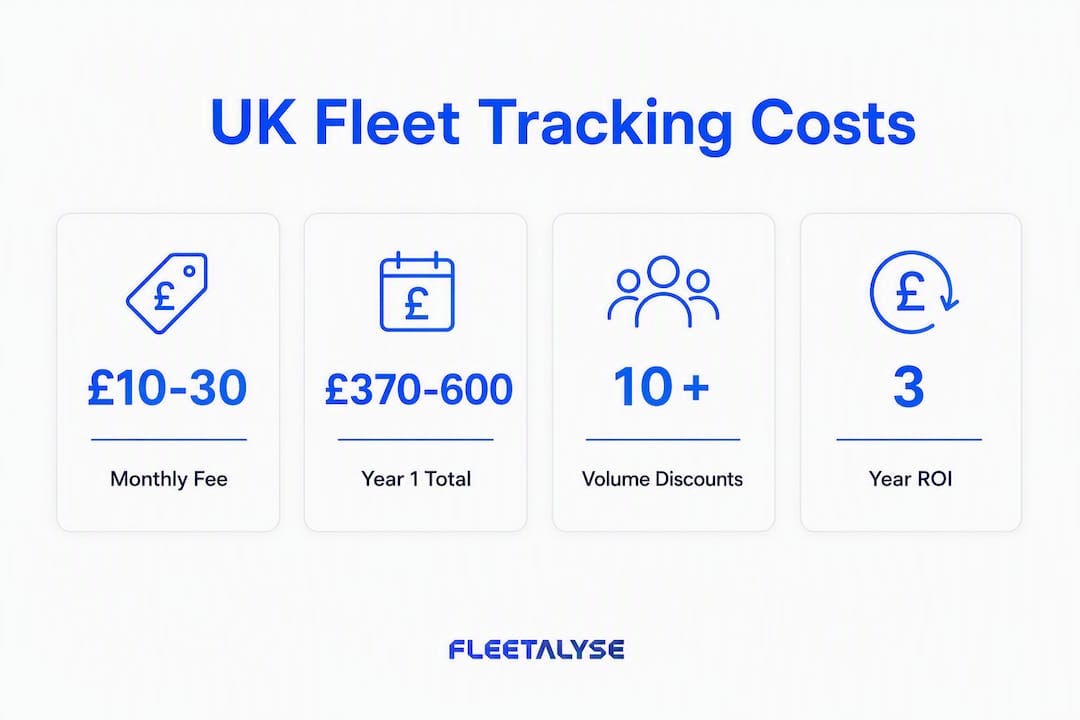
For most UK commercial fleets, vehicle tracking costs £10–£30 per vehicle per month in subscription fees, plus a one-off hardware outlay of roughly £50–£600 per unit depending on device type and whether HGV compliance features are required. Year-one per-vehicle totals commonly sit between £370–£630 for a basic system and £1,000–£1,600 for an advanced HGV setup with tachograph download capability and dashcams included. Those figures are the starting point for any budget conversation, but the final number depends on five distinct cost components.
The five cost components every fleet manager should expect on a quote:
- Monthly subscription — software platform, dashboards, reporting and basic data allowance
- Hardware — OBD plug-in units, hardwired trackers, tachograph head units, dashcams or asset tags (one-off purchase or leased)
- IoT SIM / data — often bundled, but sometimes charged separately at £3–£8 per vehicle per month
- Installation — plug-and-play self-fit or professional hardwire fitting
- Compliance modules — remote tachograph download, evidence retention and DVSA audit-ready reporting for operator-licence holders
Only a minority of fleets have automated alerts for missing or overdue compliance data, which means two-thirds are carrying avoidable cost and enforcement risk through manual oversight. Fleetalyse is built specifically to close that gap for UK HGV, van and mixed fleets.
Table of Contents
- What does vehicle tracking cost you, line by line?
- What are realistic budgets for van, HGV and mixed fleets?
- Which factors move your GPS tracking price up or down?
- How do you build a three-year ROI case?
- What are the DVSA and operator-licence compliance costs?
- How do you compare supplier quotes fairly?
- How does Fleetalyse structure its pricing and reduce your ongoing costs?
- Key takeaways
- The gap between a telematics budget and actual savings
- Fleetalyse: built for UK fleet compliance and cost control
- Useful sources
What does vehicle tracking cost you, line by line?
Understanding each billing line lets you compare quotes properly rather than being drawn to the lowest headline monthly figure.
Subscription tiers typically cover the core software platform, live map, reporting, driver dashboards and a base data allowance. Entry-level plans start around £6 per vehicle per month for basic GPS tracking; standard fleet telematics with driver-behaviour scoring and fuel analytics sits in the £15–£20 band; advanced plans with HGV compliance, remote tachograph download and AI dashcams push toward £25–£30 or above.
Hardware is the largest one-off variable. A basic OBD plug-in tracker costs roughly £50–£100. A hardwired unit with CANbus integration runs £100–£250. A combined tachograph head unit with integrated telematics can reach £500–£1,200 installed, and Smart Tachograph 2 upgrades from existing digital units cost £800–£1,500 including calibration. Dashcams add £80–£200 per unit. For a buyer’s guide to compatible GPS hardware, Fleetalyse covers the main device categories in detail.
Additional fees to watch for:
- Activation or setup fees: £10–£50 per vehicle
- Professional installation: £20–£100 per vehicle
- SIM / data overage charges if your plan caps monthly data
- Early-termination penalties, which vary widely by contract length
- Device replacement or warranty-extension charges after the standard period
What are realistic budgets for van, HGV and mixed fleets?
The table below shows three worked examples using mid-range assumptions. Year-1 totals include hardware, installation and 12 months of subscription. Years 2–3 show subscription-only costs once hardware is sunk.

| Fleet type | Vehicles | Hardware + install (est.) | Year-1 subscription | Year-1 total | Years 2–3 subscription |
|---|---|---|---|---|---|
| Small van fleet | 5 vans | — | — | — | — |
| Mid-size mixed fleet | 20 (incl. 4 HGVs) | — | — | — | — |
| Large HGV fleet | 50 HGVs | — | — | — | — |
Volume discounts often start with fleets of around 10 vehicles, and longer contract terms tend to reduce monthly subscription rates by a notable percentage compared to rolling monthly plans, leading to significant savings, especially for large HGV fleets. The key procurement discipline is to negotiate the break clause alongside the discount, not after.
Which factors move your GPS tracking price up or down?
The full UK market range runs from roughly £5 to £35+ per vehicle per month, and the spread is almost entirely explained by feature selection and contract structure.
Feature-driven cost movers:
- Remote tachograph download and drivers’ hours analysis represent a significant additional cost for HGV operators compared to basic tracking plans.
- AI dashcams and driver-behaviour scoring add meaningful value but also add to the monthly line
- CANbus / CAN data read (fuel consumption, engine diagnostics, idle time) typically requires a hardwired unit and may carry a small additional software fee
- API integrations with third-party maintenance, HR or transport management systems are sometimes charged as bespoke development
Contract and fleet characteristics also matter. International operations trigger roaming SIM costs. Assets with high mileage or harsh-environment use increase device replacement frequency. Mixed fleets with trailers and plant require asset tags at a different price point from vehicle-mounted units.
Pro Tip: When HGVs are in your fleet, specify tachograph remote download and drivers’ hours reporting explicitly in every RFP. Suppliers who bundle these into a standard plan and those who charge them as add-ons will look identical on a headline monthly price but differ by £8–£15 per HGV per month on a full cost comparison.
For a detailed look at the fees that rarely appear in a brochure, Fleetalyse’s analysis of hidden telematics costs covers the contract traps most commonly missed at procurement stage.
How do you build a three-year ROI case?
The total cost of ownership (TCO) formula is straightforward: upfront hardware and installation, plus year-1 subscription, plus years 2–3 subscription, plus an allowance for device replacement and maintenance. For a 20-vehicle mixed fleet at mid-range pricing, that three-year TCO sits around £24,800 before any savings are modelled.
The savings side has four reliable buckets:
- Fuel reduction — telematics-driven routing and idle-time reduction typically cuts fuel spend by 10–15% per vehicle; for a 20-vehicle fleet averaging 15,000 miles per year, that is a material annual saving
- Insurance premium reduction — fitting approved telematics commonly attracts a 5–15% premium discount from day one, with renewal discounts compounding after 12 months of good driver-score data
- Reduced admin time — automated tachograph downloads and compliance reporting eliminate hours of manual data handling per week across a fleet
- Fewer at-fault claims — incident footage and telematics evidence resolves liability disputes that would otherwise be fault-rated
Practitioner evidence suggests that 71% of fleets recoup their tracking investment within 12 months through combined fuel, insurance and efficiency savings.
Post-install, track four KPIs quarterly: fuel spend per vehicle, unplanned downtime hours, incident rate and DVSA audit pass rate. Those four numbers tell you whether the projected savings are landing in reality. Understanding how telematics reduces fuel waste in practice gives you a solid baseline for modelling the fuel bucket.
What are the DVSA and operator-licence compliance costs?
For any fleet operating under an operator licence, compliance is not optional, and the hardware and services that support it carry their own cost line. Tachograph analysis software costs £3–£8 per vehicle per month and automates compliance reporting while flagging infringements before a DVSA inspection.
Commonly chargeable compliance features include:
- Remote tachograph download units and associated software
- Secure evidence retention for incidents (dashcam footage with tamper-evident storage)
- FORS and CLOCS evidence packs for construction and urban logistics operators
- Automated licence-check integrations with DVLA
Fleets with Earned Recognition status exhibit a notably lower prohibitive defect rate—3% compared to 9% across the wider fleet sample., a difference that translates directly into lower enforcement costs and fewer vehicle prohibitions. Automated telematics data integration feeding directly into compliance and maintenance workflows is the primary lever here.
Demand these from any supplier before signing: full audit-trail export in DVSA-compatible format, configurable driver-hours alerts, a minimum 12-month evidence retention period, and a documented SLA for remote download reliability.
Telematics data also supports fleet insurance analytics, giving insurers the behavioural evidence they need to apply meaningful premium reductions at renewal.
How do you compare supplier quotes fairly?
Headline monthly price is the least reliable comparison point. Use a feature-by-feature checklist instead.
- Included features: confirm tachograph download, driver-behaviour scoring, dashcam storage limits and fuel analytics are explicitly listed, not implied
- SIM / data policy: is data bundled or metered? What triggers an overage charge?
- Device ownership: do you own the hardware outright or does it revert to the supplier on exit?
- Installation: is plug-and-play self-fit supported, or is professional fitting mandatory?
- Exit terms: notice period, early-termination fee structure and device return obligations
- Support: UK-based or offshore? Hours of cover and response-time SLA?
- Insurer acceptance: confirm the device and platform appear on your insurer’s approved telematics whitelist before committing
Ask every supplier for a sample audit-export file. A supplier who cannot produce one quickly is telling you something about their compliance capability.
How does Fleetalyse structure its pricing and reduce your ongoing costs?
Fleetalyse subscriptions cover remote tachograph download, driver-behaviour monitoring, fleet analytics, maintenance scheduling and UK-based support within a single platform. There is no need to bolt separate compliance modules onto a basic tracking plan.
- Plug-and-play hardware: Fleetalyse supports unlocked GPS trackers and plug-and-play telematics units, reducing upfront fitting costs and keeping installation within the operator’s own team where preferred
- Automated reporting: tachograph data, driver hours and vehicle health reports generate automatically, cutting the manual admin that accounts for a significant share of fleet compliance overhead
- Consolidated dashboards: live tracking, compliance status, driver scoring and maintenance triggers sit in one view, removing the cost of managing multiple disconnected systems
- UK support: all technical and compliance support is UK-based, with direct access to specialists who understand operator-licence obligations
Fleetalyse gives operators a single subscription that covers GPS tracking, remote tachograph compliance and driver-behaviour analytics, with plug-and-play hardware options that keep installation straightforward and upfront costs predictable.
Request a tailored quote or a pilot using your own fleet data to see a 12-month ROI projection built around your actual vehicle mix, mileage and compliance requirements.
Key takeaways
UK commercial fleet telematics costs £10–£30 per vehicle per month in subscription fees, with year-one totals of £370–£630 for basic systems and £1,000–£1,600 for advanced HGV setups including tachograph download.
| Point | Details |
|---|---|
| Budget bands for RFPs | Use £10–£20/vehicle/month for vans, £20–£30 for HGVs with tachograph compliance, plus £50–£600 one-off hardware per unit. |
| HGV compliance is the biggest cost driver | Specify remote tachograph download and drivers’ hours reporting explicitly; these add £8–£15/HGV/month versus a basic plan. |
| Three-year TCO beats monthly price | Model hardware, installation, subscription and savings (fuel, insurance, admin) over 36 months before comparing quotes. |
| Insurer whitelist check | Confirm device and platform approval with your insurer before signing; approved telematics typically attracts a 5–15% premium discount. |
| Fleetalyse for integrated compliance | Fleetalyse combines GPS tracking, remote tachograph download and driver-behaviour analytics in one subscription with UK support. |
The gap between a telematics budget and actual savings
Most fleet managers I speak with have done the maths on the subscription cost. Fewer have done the harder work of building the governance structure that turns projected savings into real ones. Telematics data is only as valuable as the decisions it drives. A fuel-saving projection means nothing if the operations team does not have a weekly review cadence that acts on idle-time alerts. A compliance dashboard is only useful if someone owns the action when a driver-hours breach is flagged.
The practical advice is to sequence the rollout deliberately. Start with a pilot of 5–10 vehicles, establish the reporting rhythm and accountability before scaling, and run a quarterly KPI review against the four metrics outlined earlier: fuel per vehicle, downtime hours, incident rate and audit pass rate. Fleets that do this consistently find the savings compound over time rather than plateauing after the initial efficiency gains. The technology is the easy part. The cultural change that captures the value is where the real work sits.
Fleetalyse: built for UK fleet compliance and cost control
Lower fleet tracking expenses without sacrificing DVSA compliance is exactly what Fleetalyse is designed to deliver. Where many operators end up paying for a basic tracking platform and then adding compliance modules, tachograph software and a separate dashcam system on top, Fleetalyse consolidates all of that into one subscription with UK-based support and plug-and-play hardware that your team can fit without a specialist.
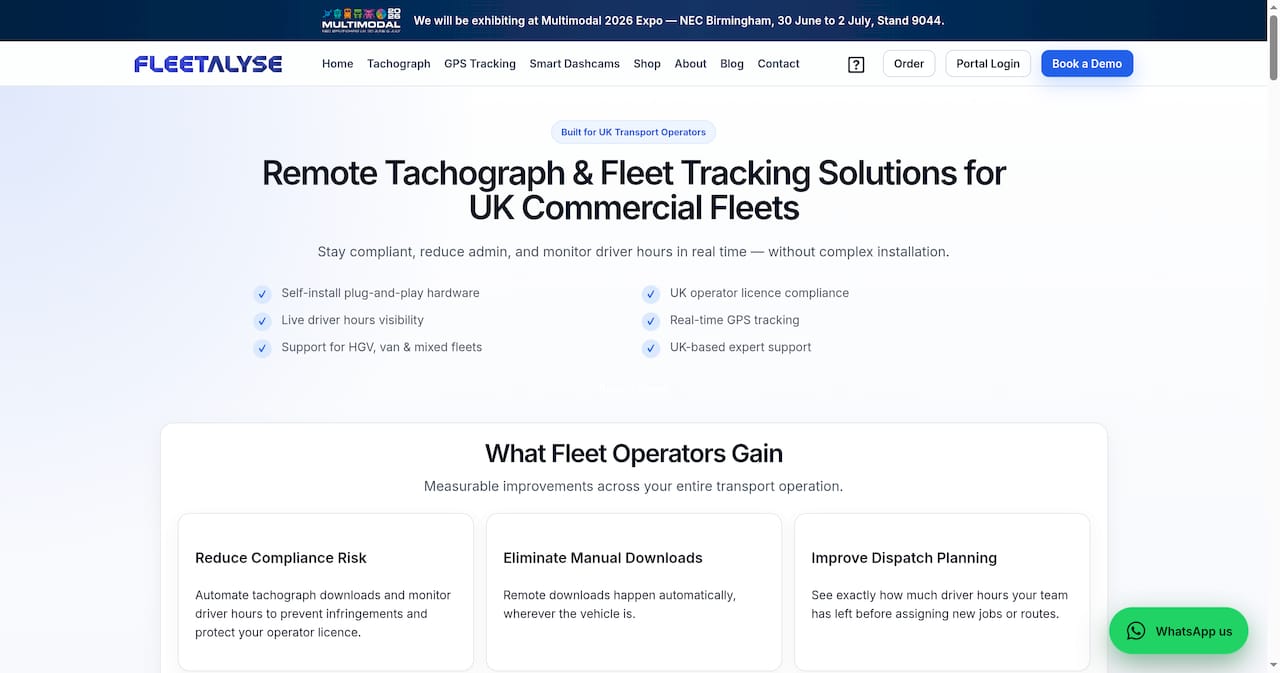
The unlocked GPS trackers in the Fleetalyse shop are compatible with the platform and carry no SIM lock, giving you flexibility on data contracts. The fleet analysis tools generate the audit-ready reports and ROI evidence your finance team needs. Request a tailored quote or a pilot programme today and get a 12-month cost projection built around your own fleet.
Useful sources
- Jaama Fleet Compliance and Cost Benchmark Report — industry benchmark on automation adoption, defect rates and compliance costs
- ExpertSure: Vehicle Tracking Costs UK — per-vehicle subscription and hardware price ranges
- ExpertSure: Tachograph Systems UK — tachograph unit costs, Smart Tachograph 2 upgrade pricing and analysis software rates
- ExpertSure: Commercial Vehicle Trackers UK — HGV-specific feature tiers and pricing
- Quotezone: Fleet Telematics and Insurance — insurer whitelist guidance and premium discount evidence
- CompareYourBusinessCosts: Vehicle Tracking Cost UK — full market range and pricing variables
This article provides general guidance on commercial fleet telematics costs and compliance considerations. Confirm current DVSA requirements, operator-licence obligations and insurer terms with the relevant primary sources or a qualified transport consultant.