
In 2026, the best GPS tracker is no longer just a location tool; it's a compliance engine. You already know that manual tachograph downloads are a massive drain on your time and resources. Chasing drivers and worrying about DVSA fines shouldn't be the standard way to run a regional operation. This guide reveals how the best GPS tracker for commercial fleets goes beyond simple coordinates to automate your UK transport compliance and protect your hard-earned operator licence.
We understand the frustration of hidden subscription costs that often lurk in telematics contracts. You need transparency and tools that actually work in the real world rather than just theoretical data. We'll show you how to implement automated remote tachograph downloads and gain live visibility of driver hours. You'll also learn how to improve asset security for your trailers and vans whilst keeping your operations lean and fully compliant.
This isn't about flashy, unnecessary features. It's about practical utility. By the end of this guide, you'll have a clear framework to choose a system that acts as a reliable ally for your fleet's specific needs. We're moving from identifying the problem to offering a transparently detailed solution for your daily operational struggles.
Key Takeaways
- Modern fleet tracking has evolved from simple location plotting to proactive compliance management for HGVs and vans.
- Identify the best GPS tracker for commercial fleets by prioritising hardware that supports remote tachograph download functionality.
- Eliminate the risk of DVSA fines and operator licence infringements by automating your remote tachograph downloads.
- Gain live visibility of driver hours to simplify complex scheduling whilst ensuring your fleet remains within legal limits.
- Shift away from reactive data collection and adopt a pragmatic, compliance-first approach to protect your transport operation.
Beyond Simple Location: Why Compliance Drives Modern Fleet Tracking
For years, many regional operators viewed tracking as a simple way to see a vehicle on a map. That era of basic visibility is over. In 2026, the best GPS tracker for commercial fleets acts as a digital safeguard for your entire business. It has shifted from a reactive tool used to check history into a proactive compliance engine. This transition is driven by a regulatory environment that no longer accepts "good enough" record-keeping. If you can't prove exactly where a vehicle was and what the driver was doing, your business is exposed to unnecessary risk.
Modern HGV operations require a move toward proactive data management. This means identifying potential infringements before they become DVSA fines. An "audit-ready" tracking system ensures that every mile is accounted for and every rest period is verified. This level of precision is the new industry benchmark. It differentiates professional operators from those who are still struggling with manual processes. At Fleetalyse, we believe that transparency in data is the only way to maintain a healthy, profitable fleet in the long term.
The Evolution of Telematics in the UK Transport Sector
A standard vehicle tracking system used to be a standalone luxury for large corporations. Today, it's the backbone of digital record-keeping for fleets of all sizes. The industry has moved away from simple dots on a map toward integrated telematics that prioritise digital authenticity. Manual data collection is now a significant business risk. It's slow, prone to human error, and often fails to meet the strict digital standards required for 2026 compliance audits.
Protecting Your Operator Licence with Real-Time Data
Your operator licence is the lifeblood of your organisation. Maintaining it requires absolute adherence to the Working Time Directive and tachograph regulations. High-accuracy GPS data provides the necessary evidence to prove driver rest-period compliance during a roadside check. It prevents accidental infringements by matching vehicle movement to driver logs in real time. This live data serves as your primary defence, ensuring you stay on the right side of the law whilst keeping your drivers safe and your assets secure.
Choosing the best GPS tracker for commercial fleets involves looking for hardware that bridges the gap between location and legality. You need a system that doesn't just record where a van or truck went, but why it was there and who was behind the wheel. This holistic approach to tracking turns a simple piece of hardware into a pragmatic expert partner for your daily operations. It values your time and resources by automating the most tedious parts of fleet management.
Key Criteria for Selecting the Best Commercial GPS Tracker
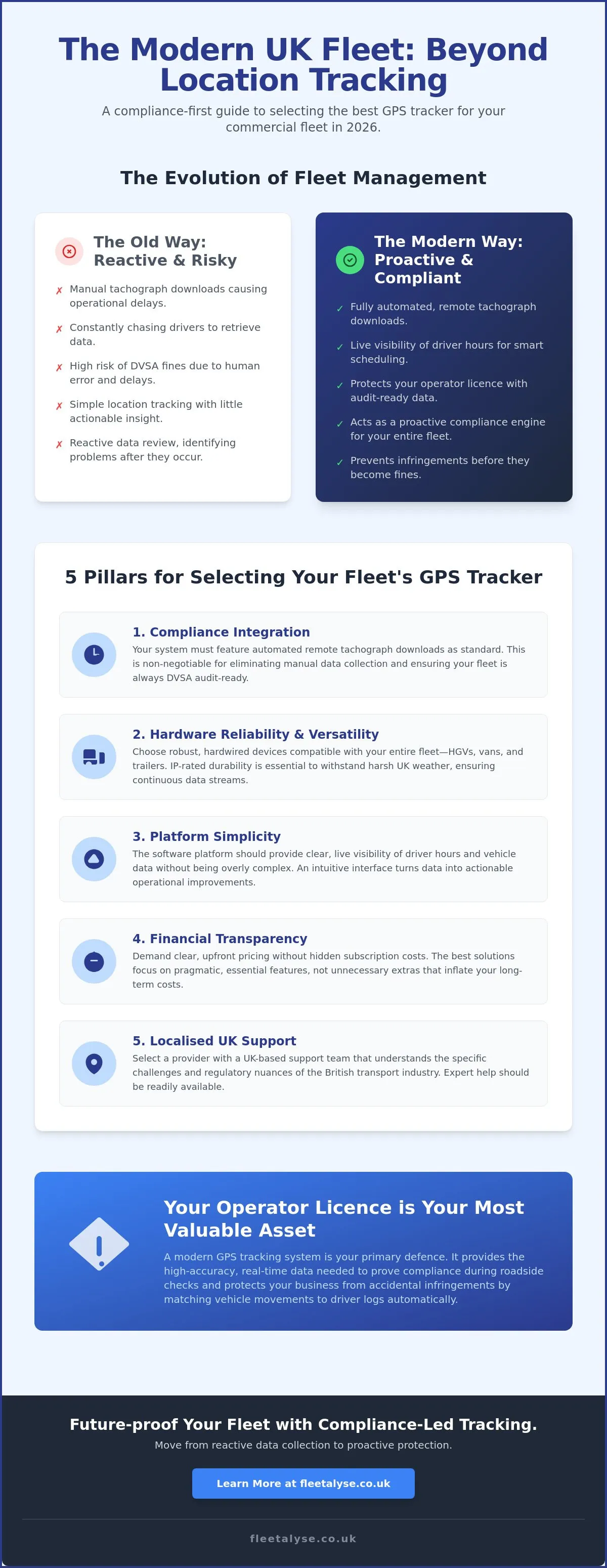
Selecting the best GPS tracker for commercial fleets requires looking beyond basic hardware specs. You need a solution built on five essential pillars: compliance integration, hardware versatility, platform simplicity, financial transparency, and localised support. Without these, you're just buying a gadget rather than a business tool. A top-tier system must act as a catalyst for operational improvement, not a source of technical frustration.
Compliance is the most critical pillar. Your hardware must support remote tachograph download functionality as standard. Chasing drivers for manual downloads is an inefficient use of your time. Whilst UK fleets primarily adhere to DVSA standards, reputable telematics providers often align their data integrity with global safety frameworks, such as FMCSA regulations, to ensure the highest levels of digital authenticity. This global perspective helps future-proof your fleet against evolving domestic rules.
Hardware Reliability and Asset Compatibility
Your fleet likely consists of a mix of HGVs, vans, and trailers. The best GPS tracker for commercial fleets should work seamlessly across all three. Hardwired devices are generally superior to plug-and-play options for security. They are harder to tamper with and provide more reliable data streams. For trailer tracking, IP-rated durability is essential. UK weather is notoriously brutal; your trackers must withstand heavy rain and road salt without failing. Reliable hardware ensures you aren't constantly replacing units or losing visibility of your assets.
Software Integration: Moving Data, Not Just Vehicles
Data should never exist in a silo. The value of a tracker lies in how well it integrates with your existing tachograph analysis software. You need a "single-pane-of-glass" view where you can see vehicle location and live driver hours in one place. Automated data flows reduce administrative overhead by eliminating the need for manual data entry. This efficiency allows you to focus on growth rather than paperwork. If you are ready to simplify your operations, you can explore our integrated tracking and compliance packages to see the difference automation makes.
Ease of use is equally vital. If the platform is overly complex, your managers won't use it effectively and your drivers won't buy into the system. Look for a straightforward interface that provides clear, actionable insights. Finally, insist on transparent pricing. Hidden contractual complexities and "teaser" rates that spike after six months have no place in a professional partnership. You deserve a provider that values honesty and provides UK-based support to help you navigate the specific challenges of national transport operations.

The Best GPS Tracker for Commercial Fleets: 2026 Comparison
The 2026 market for telematics is saturated with options. However, the best GPS tracker for commercial fleets in the UK must be judged on its ability to handle local regulatory pressure. While global giants offer impressive technology, regional hauliers often require a more focused approach to compliance and data authenticity. Choosing the right provider means matching their specific strengths to your operational daily struggles.
We have categorised the leading providers by their primary strength to help you cut through the marketing noise. Whether you prioritise deep analytics, AI safety, or straightforward compliance, there is a solution tailored to your fleet's size and asset type. Each of these providers offers a distinct advantage depending on whether you manage a handful of vans or a national HGV network.
Top 5 Fleet Tracking Providers for UK Operators
- Geotab: Best for deep customisable analytics. They are the preferred choice for large enterprise fleets that require highly specific data sets to drive long-term efficiency.
- Samsara: Best for contextual safety. Their platform excels in integrated dash-cam visibility and AI-led driver coaching. While they align with the Electronic Logging Device (ELD) rule standards in the US, their UK offering is exceptionally robust for large-scale safety monitoring.
- Fleetalyse: Best for UK compliance monitoring. We are the specialist choice for operators who need to automate remote tachograph downloads and live driver hours. Our focus is on protecting your operator licence through pragmatic, reliable data.
- Verizon Connect: Best for all-in-one visibility. Their platform is highly intuitive, making it a strong choice for businesses that need a broad range of features with a user-friendly interface.
- Quartix: Best for low-cost tracking. They provide a straightforward, no-frills service for operators who need basic location data and simple compliance reporting without a heavy price tag.
Matching the Tracker to Your Fleet Size and Type
Your choice of the best GPS tracker for commercial fleets depends heavily on your asset mix. Owner-operators often prioritise cost and basic location visibility. In contrast, large logistics firms with hundreds of vehicles need a scalable platform that can handle complex data flows. HGV operators must ensure their chosen hardware integrates directly with their tachograph units to avoid manual data gaps.
Light commercial vehicle (LCV) operators usually focus on route efficiency and driver behaviour. For these fleets, ease of use and quick installation are the primary drivers. Trailer tracking adds another layer of complexity. You need IP-rated, durable hardware that can survive independently of a power source for extended periods. At Fleetalyse, we help you bridge these gaps by providing hardware that works across your entire asset list, from HGVs to trailers and vans.
Asset security shouldn't be an afterthought. The right system provides a complete operational picture, ensuring that no trailer or van is ever "lost" in your system. This holistic view is what differentiates a simple tracker from a true business management tool.
Integrating GPS Tracking with Live Driver Hours and Tachograph Data
Managing tachograph data often feels like a separate, exhausting job. Many operators hesitate to combine tracking with tacho monitoring, fearing the software will become too complex to handle. However, the best GPS tracker for commercial fleets actually reduces complexity by centralising your most critical data. It moves you away from reactive card reading and toward a streamlined, automated workflow. It's not about adding more data to your screen; it's about making that data work for you.
Remote Tachograph Download (RTD) technology is the engine behind this shift. It establishes a secure link between the vehicle's tacho unit and your office computer. Selecting the best GPS tracker for commercial fleets means looking for hardware that transmits data automatically at scheduled intervals. This data moves through encrypted protocols that keep your compliance records safe and tamper-proof. Automating the download cycle saves significant administrative time, allowing your team to focus on moving freight rather than chasing paper.
How Remote Tachograph Downloads Work
The technical process is designed to be invisible. A small telematics device connects to the back of the tachograph, using the vehicle's cellular connection to send .ddd files directly to your analysis platform. You don't need the driver to be present, and you don't need the vehicle to be at the depot. This ensures your records are always up to date for any potential audit whilst maintaining the highest security standards.
The Power of Live Driver Hours Visibility
Live driver hours visibility is a game-changer for daily dispatch operations. When a dispatcher can see exactly how much driving time is left on a card, they can plan routes with precision. This eliminates the risk of accidental infringements of the Working Time Directive. It also plays a crucial role in fatigue management. By monitoring hours in real time, you ensure drivers stay within safe limits, which directly improves road safety for your entire fleet.
Better communication follows naturally. Drivers don't have to report their hours manually over the phone, and managers don't have to nag for updates. Everyone works from the same live facts. Automated alerts provide an extra layer of security, notifying you immediately if a download fails or if a driver is approaching their legal limit. This integrated approach turns your tracking system into a proactive compliance tool that protects your business every day.
If you're tired of manual card reading and want to protect your operator licence, explore our remote tachograph download and tracking bundles to find the right fit for your business.
Future-Proofing Your Fleet with Fleetalyse Compliance-Led Tracking
Choosing a tracking system is a major commitment for any transport business. A compliance-first approach isn't just a trend; it's the logical conclusion for any UK haulier aiming for long-term stability. The best GPS tracker for commercial fleets must serve as more than a map. It should be a robust shield against regulatory failure. By prioritising compliance today, you ensure your business remains resilient against the stricter enforcement standards expected in the coming years.
Fleetalyse stands apart as a pragmatic expert partner for national transport operators. We don't provide flashy, unnecessary features that clutter your workflow. Instead, we deliver tools built for the rigours of real-world application. Our focus is on functional utility. We understand the specific challenges of regional infrastructure and the constant pressure of DVSA oversight. This localised expertise makes us a reliable ally for your daily operations, ensuring you stay focused on your core business.
A Specialised Solution for UK Transport Compliance
Our systems are designed specifically for the unique requirements of the UK market. We provide absolute transparency regarding financial terms and operational clarity. You won't find hidden subscription costs or complex contractual traps here. Whether you need GPS tracking for HGVs, vans, or trailers, our hardware is engineered for durability. It provides the authentic, tamper-proof data required to defend your operator licence during an audit. Our localised signature reinforces our commitment to the domestic industry and its hardworking operators.
Taking the Next Step Towards Automated Fleet Management
It's time to move away from theoretical data collection and embrace functional utility. Real-world fleet management requires a system that reduces your administrative burden rather than adding to it. Transitioning to an integrated tracking and tacho platform is a frictionless process with the right partner. By automating your remote tachograph downloads and integrating live driver hours, you reclaim valuable time and resources. Our expertise ensures that finding the best GPS tracker for commercial fleets leads you to a solution that actually understands your daily struggles.
Don't let manual processes leave your business vulnerable to fines or infringements. Secure your operator licence future by adopting a system that values your time. Explore how a compliance-led approach can transform your fleet from a source of stress into a streamlined, professional operation. We invite you to view our range of tracking and compliance solutions and start your journey toward automated fleet management today.
Secure Your Fleet’s Future with Compliance-Led Tracking
Modern transport management demands more than just dots on a map. You have seen how the best GPS tracker for commercial fleets acts as a proactive compliance engine; protecting your operator licence through automated remote tachograph downloads and live driver hours visibility. By moving away from manual card reading, you eliminate human error and ensure your records are always audit-ready. This shift isn't just about saving time; it's about building a transparent operation that can withstand any DVSA inspection.
Efficiency comes from total integration. Seeing your HGVs, vans, and trailers on one screen whilst managing tacho data simplifies your daily operations. As UK-based compliance specialists, we provide the tools you need for seamless tachograph analysis integration and real-time asset security. You don't have to navigate these regulatory challenges alone. Our focus remains on practical utility and straightforward support for regional operators who value their time and resources.
Take control of your data today. Optimise your fleet compliance with Fleetalyse tracking solutions and build a more resilient, transparent business. We are ready to help you turn compliance into a competitive advantage for your national transport operations.
Frequently Asked Questions
Is it a legal requirement to have a GPS tracker on a commercial fleet in the UK?
No, there is no specific UK law mandating GPS tracking for all commercial vehicles. However, HGV operators must comply with strict tachograph regulations and safety standards. Using a tracking system is the most efficient way to prove you are meeting these legal obligations. It acts as a digital safety net for your operator licence by providing accurate records of vehicle movements and driver activity.
Can the best GPS trackers really automate remote tachograph downloads?
Yes, high-quality systems integrate directly with the vehicle's tachograph to automate the download process. This technology allows you to retrieve driver card and vehicle unit data remotely without the driver returning to the depot. By selecting the best GPS tracker for commercial fleets, you eliminate the administrative burden of manual downloads whilst ensuring your compliance records are always up to date.
How much does a commercial GPS tracking system cost per vehicle in 2026?
Costs typically depend on the complexity of the features you require and the size of your fleet. Most providers offer tiered subscription models based on whether you need simple location data or full compliance integration. You should look for transparent pricing that avoids hidden contractual fees. We recommend requesting a detailed quote that covers both hardware and monthly service rates to ensure the solution fits your specific budget.
What is the difference between simple vehicle tracking and full fleet telematics?
Simple vehicle tracking focuses primarily on live location and route history. Full fleet telematics goes much deeper by collecting engine diagnostics, fuel consumption, and driver behaviour data. For commercial operators, the most important distinction is compliance integration. A telematics system allows for live driver hours monitoring and tachograph analysis integration, which simple tracking units cannot provide.
How do I ensure my drivers accept the installation of GPS tracking devices?
Open communication is the most effective way to ensure driver buy-in. Explain that the system is there to protect their safety and simplify their daily tasks, such as automating tachograph downloads. Emphasise that accurate data protects them against unfair blame in the event of a road traffic incident. When drivers see the system as a tool for their own security, resistance usually disappears.
Can I track trailers and non-powered assets alongside my HGV fleet?
Yes, you can track trailers, vans, and non-powered assets within the same platform. Specific hardware, such as IP-rated trailer tracking units, is designed to operate in harsh conditions without a constant power source. This provides a "single-pane-of-glass" view of your entire operation. It ensures that every asset, whether it is a prime mover or a standalone trailer, is visible and secure at all times.
What happens to my data if the GPS tracker loses cellular connection?
Data is not lost when a vehicle enters an area with poor cellular coverage. Most professional trackers include internal memory that stores all location and compliance data locally. Once the device reconnects to a network, it automatically uploads the buffered information to the server. This ensures your records remain continuous and accurate, even when drivers are operating in remote regional areas with unreliable signals.
How does GPS tracking help with DVSA Earned Recognition status?
GPS tracking provides the digital evidence needed to qualify for and maintain DVSA Earned Recognition status. The scheme requires operators to share performance data, such as tachograph and maintenance records, with the DVSA. An integrated system automates this data sharing process. It proves you are a high-performing operator, which significantly reduces the likelihood of your vehicles being stopped for roadside inspections.
Frequently asked questions
The Evolution of Telematics in the UK Transport Sector
A standard vehicle tracking system used to be a standalone luxury for large corporations. Today, it's the backbone of digital record-keeping for fleets of all sizes. The industry has moved away from simple dots on a map toward integrated telematics that prioritise digital authenticity. Manual data collection is now a significant business risk. It's slow, prone to human error, and often fails to meet the strict digital standards required for 2026 compliance audits.
Protecting Your Operator Licence with Real-Time Data
Your operator licence is the lifeblood of your organisation. Maintaining it requires absolute adherence to the Working Time Directive and tachograph regulations. High-accuracy GPS data provides the necessary evidence to prove driver rest-period compliance during a roadside check. It prevents accidental infringements by matching vehicle movement to driver logs in real time. This live data serves as your primary defence, ensuring you stay on the right side of the law whilst keeping your drivers safe and your assets secure. Choosing the best GPS tracker for commercial fleets involves looking for hardware that bridges the gap between location and legality. You need a system that doesn't just record where a van or truck went, but why it was there and who was behind the wheel. This holistic approach to tracking turns a simple piece of hardware into a pragmatic expert partner for your daily operations. It values your time and resources by automating the most tedious parts of fleet management. Selecting the best GPS tracker for commercial fleets requires looking beyond basic hardware specs. You need a solution built on five essential pillars: compliance integration, hardware versatility, platform simplicity, financial transparency, and localised support. Without these, you're just buying a gadget rather than a business tool. A top-tier system must act as a catalyst for operational improvement, not a source of technical frustration. Compliance is the most critical pillar. Your hardware must support remote tachograph download functionality as standard. Chasing drivers for manual downloads is an inefficient use of your time. Whilst UK fleets primarily adhere to DVSA standards, reputable telematics providers often align their data integrity with global safety frameworks, such as FMCSA regulations, to ensure the highest levels of digital authenticity. This global perspective helps future-proof your fleet against evolving domestic rules.
Hardware Reliability and Asset Compatibility
Your fleet likely consists of a mix of HGVs, vans, and trailers. The best GPS tracker for commercial fleets should work seamlessly across all three. Hardwired devices are generally superior to plug-and-play options for security. They are harder to tamper with and provide more reliable data streams. For trailer tracking, IP-rated durability is essential. UK weather is notoriously brutal; your trackers must withstand heavy rain and road salt without failing. Reliable hardware ensures you aren't constantly replacing units or losing visibility of your assets.
Software Integration: Moving Data, Not Just Vehicles
Data should never exist in a silo. The value of a tracker lies in how well it integrates with your existing tachograph analysis software. You need a "single-pane-of-glass" view where you can see vehicle location and live driver hours in one place. Automated data flows reduce administrative overhead by eliminating the need for manual data entry. This efficiency allows you to focus on growth rather than paperwork. If you are ready to simplify your operations, you can explore our integrated tracking and compliance packages to see the difference automation makes. Ease of use is equally vital. If the platform is overly complex, your managers won't use it effectively and your drivers won't buy into the system. Look for a straightforward interface that provides clear, actionable insights. Finally, insist on transparent pricing. Hidden contractual complexities and "teaser" rates that spike after six months have no place in a professional partnership. You deserve a provider that values honesty and provides UK-based support to help you navigate the specific challenges of national transport operations. The 2026 market for telematics is saturated with options. However, the best GPS tracker for commercial fleets in the UK must be judged on its ability to handle local regulatory pressure. While global giants offer impressive technology, regional hauliers often require a more focused approach to compliance and data authenticity. Choosing the right provider means matching their specific strengths to your operational daily struggles. We have categorised the leading providers by their primary strength to help you cut through the marketing noise. Whether you prioritise deep analytics, AI safety, or straightforward compliance, there is a solution tailored to your fleet's size and asset type. Each of these providers offers a distinct advantage depending on whether you manage a handful of vans or a national HGV network.
Top 5 Fleet Tracking Providers for UK Operators
Geotab: Best for deep customisable analytics. They are the preferred choice for large enterprise fleets that require highly specific data sets to drive long-term efficiency.
Samsara: Best for contextual safety. Their platform excels in integrated dash-cam visibility and AI-led driver coaching. While they align with the Electronic Logging Device (ELD) rule standards in the US, their UK offering is exceptionally robust for large-scale safety monitoring.
Fleetalyse: Best for UK compliance monitoring. We are the specialist choice for operators who need to automate remote tachograph downloads and live driver hours. Our focus is on protecting your operator licence through pragmatic, reliable data.
Verizon Connect: Best for all-in-one visibility. Their platform is highly intuitive, making it a strong choice for businesses that need a broad range of features with a user-friendly interface.
Quartix: Best for low-cost tracking. They provide a straightforward, no-frills service for operators who need basic location data and simple compliance reporting without a heavy price tag.
Matching the Tracker to Your Fleet Size and Type
Your choice of the best GPS tracker for commercial fleets depends heavily on your asset mix. Owner-operators often prioritise cost and basic location visibility. In contrast, large logistics firms with hundreds of vehicles need a scalable platform that can handle complex data flows. HGV operators must ensure their chosen hardware integrates directly with their tachograph units to avoid manual data gaps. Light commercial vehicle (LCV) operators usually focus on route efficiency and driver behaviour. For these fleets, ease of use and quick installation are the primary drivers. Trailer tracking adds another layer of complexity. You need IP-rated, durable hardware that can survive independently of a power source for extended periods. At Fleetalyse, we help you bridge these gaps by providing hardware that works across your entire asset list, from HGVs to trailers and vans. Asset security shouldn't be an afterthought. The right system provides a complete operational picture, ensuring that no trailer or van is ever "lost" in your system. This holistic view is what differentiates a simple tracker from a true business management tool. Managing tachograph data often feels like a separate, exhausting job. Many operators hesitate to combine tracking with tacho monitoring, fearing the software will become too complex to handle. However, the best GPS tracker for commercial fleets actually reduces complexity by centralising your most critical data. It moves you away from reactive card reading and toward a streamlined, automated workflow. It's not about adding more data to your screen; it's about making that data work for you. Remote Tachograph Download (RTD) technology is the engine behind this shift. It establishes a secure link between the vehicle's tacho unit and your office computer. Selecting the best GPS tracker for commercial fleets means looking for hardware that transmits data automatically at scheduled intervals. This data moves through encrypted protocols that keep your compliance records safe and tamper-proof. Automating the download cycle saves significant administrative time, allowing your team to focus on moving freight rather than chasing paper.
How Remote Tachograph Downloads Work
The technical process is designed to be invisible. A small telematics device connects to the back of the tachograph, using the vehicle's cellular connection to send .ddd files directly to your analysis platform. You don't need the driver to be present, and you don't need the vehicle to be at the depot. This ensures your records are always up to date for any potential audit whilst maintaining the highest security standards.
The Power of Live Driver Hours Visibility
Live driver hours visibility is a game-changer for daily dispatch operations. When a dispatcher can see exactly how much driving time is left on a card, they can plan routes with precision. This eliminates the risk of accidental infringements of the Working Time Directive. It also plays a crucial role in fatigue management. By monitoring hours in real time, you ensure drivers stay within safe limits, which directly improves road safety for your entire fleet. Better communication follows naturally. Drivers don't have to report their hours manually over the phone, and managers don't have to nag for updates. Everyone works from the same live facts. Automated alerts provide an extra layer of security, notifying you immediately if a download fails or if a driver is approaching their legal limit. This integrated approach turns your tracking system into a proactive compliance tool that protects your business every day. If you're tired of manual card reading and want to protect your operator licence, explore our remote tachograph download and tracking bundles to find the right fit for your business. Choosing a tracking system is a major commitment for any transport business. A compliance-first approach isn't just a trend; it's the logical conclusion for any UK haulier aiming for long-term stability. The best GPS tracker for commercial fleets must serve as more than a map. It should be a robust shield against regulatory failure. By prioritising compliance today, you ensure your business remains resilient against the stricter enforcement standards expected in the coming years. Fleetalyse stands apart as a pragmatic expert partner for national transport operators. We don't provide flashy, unnecessary features that clutter your workflow. Instead, we deliver tools built for the rigours of real-world application. Our focus is on functional utility. We understand the specific challenges of regional infrastructure and the constant pressure of DVSA oversight. This localised expertise makes us a reliable ally for your daily operations, ensuring you stay focused on your core business.
A Specialised Solution for UK Transport Compliance
Our systems are designed specifically for the unique requirements of the UK market. We provide absolute transparency regarding financial terms and operational clarity. You won't find hidden subscription costs or complex contractual traps here. Whether you need GPS tracking for HGVs, vans, or trailers, our hardware is engineered for durability. It provides the authentic, tamper-proof data required to defend your operator licence during an audit. Our localised signature reinforces our commitment to the domestic industry and its hardworking operators.
Taking the Next Step Towards Automated Fleet Management
It's time to move away from theoretical data collection and embrace functional utility. Real-world fleet management requires a system that reduces your administrative burden rather than adding to it. Transitioning to an integrated tracking and tacho platform is a frictionless process with the right partner. By automating your remote tachograph downloads and integrating live driver hours, you reclaim valuable time and resources. Our expertise ensures that finding the best GPS tracker for commercial fleets leads you to a solution that actually understands your daily struggles. Don't let manual processes leave your business vulnerable to fines or infringements. Secure your operator licence future by adopting a system that values your time. Explore how a compliance-led approach can transform your fleet from a source of stress into a streamlined, professional operation. We invite you to view our range of tracking and compliance solutions and start your journey toward automated fleet management today. Modern transport management demands more than just dots on a map. You have seen how the best GPS tracker for commercial fleets acts as a proactive compliance engine; protecting your operator licence through automated remote tachograph downloads and live driver hours visibility. By moving away from manual card reading, you eliminate human error and ensure your records are always audit-ready. This shift isn't just about saving time; it's about building a transparent operation that can withstand any DVSA inspection. Efficiency comes from total integration. Seeing your HGVs, vans, and trailers on one screen whilst managing tacho data simplifies your daily operations. As UK-based compliance specialists, we provide the tools you need for seamless tachograph analysis integration and real-time asset security. You don't have to navigate these regulatory challenges alone. Our focus remains on practical utility and straightforward support for regional operators who value their time and resources. Take control of your data today. Optimise your fleet compliance with Fleetalyse tracking solutions and build a more resilient, transparent business. We are ready to help you turn compliance into a competitive advantage for your national transport operations.
Is it a legal requirement to have a GPS tracker on a commercial fleet in the UK?
No, there is no specific UK law mandating GPS tracking for all commercial vehicles. However, HGV operators must comply with strict tachograph regulations and safety standards. Using a tracking system is the most efficient way to prove you are meeting these legal obligations. It acts as a digital safety net for your operator licence by providing accurate records of vehicle movements and driver activity.
Can the best GPS trackers really automate remote tachograph downloads?
Yes, high-quality systems integrate directly with the vehicle's tachograph to automate the download process. This technology allows you to retrieve driver card and vehicle unit data remotely without the driver returning to the depot. By selecting the best GPS tracker for commercial fleets, you eliminate the administrative burden of manual downloads whilst ensuring your compliance records are always up to date.
How much does a commercial GPS tracking system cost per vehicle in 2026?
Costs typically depend on the complexity of the features you require and the size of your fleet. Most providers offer tiered subscription models based on whether you need simple location data or full compliance integration. You should look for transparent pricing that avoids hidden contractual fees. We recommend requesting a detailed quote that covers both hardware and monthly service rates to ensure the solution fits your specific budget.
What is the difference between simple vehicle tracking and full fleet telematics?
Simple vehicle tracking focuses primarily on live location and route history. Full fleet telematics goes much deeper by collecting engine diagnostics, fuel consumption, and driver behaviour data. For commercial operators, the most important distinction is compliance integration. A telematics system allows for live driver hours monitoring and tachograph analysis integration, which simple tracking units cannot provide.
How do I ensure my drivers accept the installation of GPS tracking devices?
Open communication is the most effective way to ensure driver buy-in. Explain that the system is there to protect their safety and simplify their daily tasks, such as automating tachograph downloads. Emphasise that accurate data protects them against unfair blame in the event of a road traffic incident. When drivers see the system as a tool for their own security, resistance usually disappears.
Can I track trailers and non-powered assets alongside my HGV fleet?
Yes, you can track trailers, vans, and non-powered assets within the same platform. Specific hardware, such as IP-rated trailer tracking units, is designed to operate in harsh conditions without a constant power source. This provides a "single-pane-of-glass" view of your entire operation. It ensures that every asset, whether it is a prime mover or a standalone trailer, is visible and secure at all times.
What happens to my data if the GPS tracker loses cellular connection?
Data is not lost when a vehicle enters an area with poor cellular coverage. Most professional trackers include internal memory that stores all location and compliance data locally. Once the device reconnects to a network, it automatically uploads the buffered information to the server. This ensures your records remain continuous and accurate, even when drivers are operating in remote regional areas with unreliable signals.
How does GPS tracking help with DVSA Earned Recognition status?
GPS tracking provides the digital evidence needed to qualify for and maintain DVSA Earned Recognition status. The scheme requires operators to share performance data, such as tachograph and maintenance records, with the DVSA. An integrated system automates this data sharing process. It proves you are a high-performing operator, which significantly reduces the likelihood of your vehicles being stopped for roadside inspections.