
What if you could be in the passenger seat of every vehicle in your fleet, without ever leaving your desk? For many UK operators, the lack of visibility into daily road operations is a constant source of anxiety and financial risk. Adopting van fleet GPS tracking with camera technology has become the standard for businesses that refuse to leave their professional reputation to chance. You likely understand the frustration of rising premiums and the difficulty of defending your drivers against false accusations whilst they're out on the road.
In this complete guide, you'll discover how integrated video telematics protect your drivers, reduce insurance costs, and streamline fleet compliance across the UK. We'll examine everything from the technical integration of GPS and video to the latest AI safety features. By the end, you'll have a clear roadmap for choosing a system that safeguards your assets and your bottom line.
Key Takeaways
- Learn how van fleet GPS tracking with camera technology provides a unified defence against "crash for cash" scams by linking precise location data with time-stamped video evidence.
- Understand the operational differences between continuous recording and event-based triggers to capture critical incidents efficiently without unnecessary data storage.
- Discover how AI-powered smart cameras and Advanced Driver Assistance Systems (ADAS) move beyond simple evidence collection to actively prevent accidents through real-time alerts.
- Identify the specific camera configurations your business requires, including 360-degree visibility for urban multi-drop routes or forward-facing protection for long-haul journeys.
- Explore the benefits of centralising your van, HGV, and trailer data into a single compliance-ready platform to simplify asset management and reduce administrative overhead.
Why Integrated Video Telematics is Essential for UK Van Fleets
A modern van fleet GPS tracking with camera solution is far more than a standalone dash cam. It is a unified vehicle tracking system that synchronises precise GPS coordinates with high-definition video footage. This integration allows fleet managers to transition from reactive recording to proactive management. Instead of waiting for a driver to return with an SD card, you access live data and instant event alerts. This shift is critical as "crash for cash" scams continue to target commercial vehicles across the UK. Criminals often view vans as easy targets for staged accidents, assuming businesses will settle quickly to avoid legal fees. Integrated video telematics provide the undeniable proof needed to shut these claims down immediately.
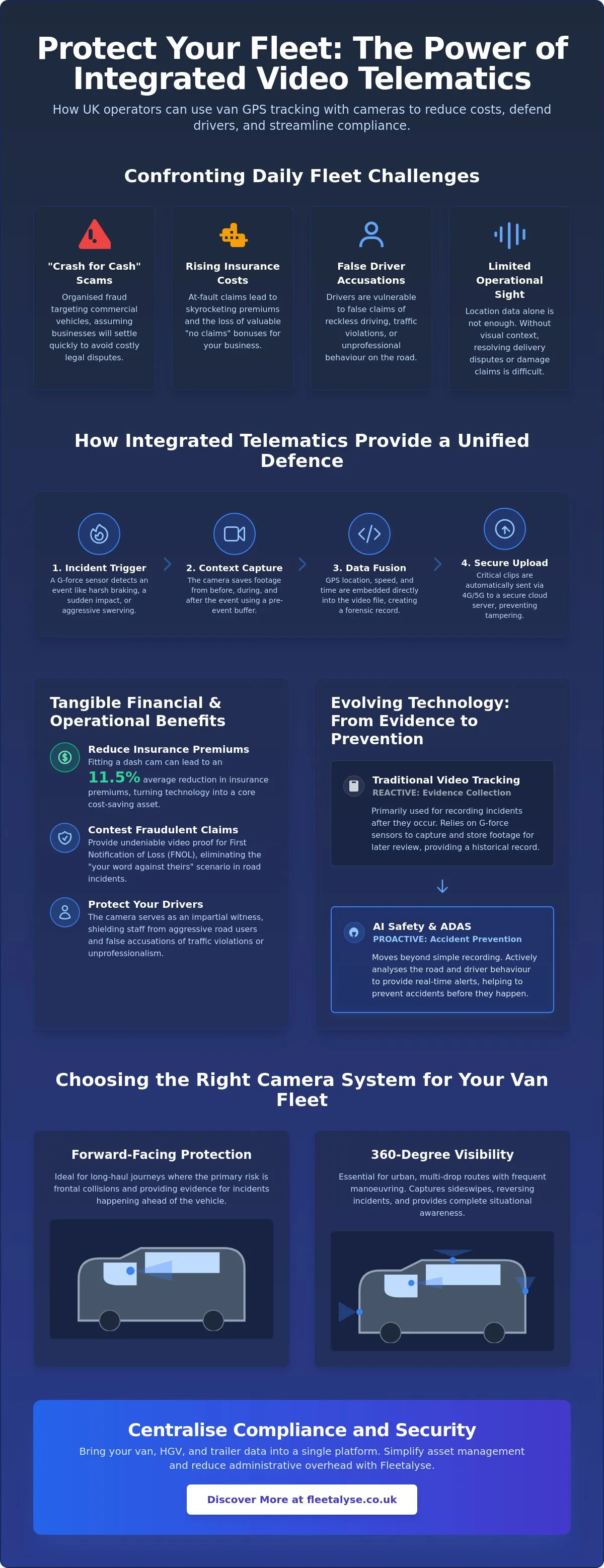
The financial benefits are tangible. Research indicates that fitting a dash cam can lead to an average insurance premium reduction of 11.5 per cent. For regional operators managing tight margins, this saving is significant. It moves the technology from an expensive luxury to a core cost-saving asset. By providing a clear record of every mile, you're not just recording data; you're actively protecting your balance sheet.
For companies in the retail and hospitality sectors, such as TFSE Products Ltd, this financial protection is vital when managing the delivery of high-value catering and food display equipment.
The Real Cost of False Claims
For UK SMEs, an at-fault claim often results in skyrocketing premiums and the potential loss of "no claims" bonuses. Investing in van fleet GPS tracking with camera systems ensures that your business is never left vulnerable to hearsay. Video evidence provides immediate First Notification of Loss (FNOL). This allows your insurer to settle legitimate claims faster or contest fraudulent ones with absolute certainty. Visual proof eliminates the "your word against theirs" scenario that often plagues road incidents. It protects your bottom line and your company's professional reputation simultaneously.
Operational Visibility Beyond Location
Knowing where your van is located provides only half the story. You need to understand how that vehicle is being operated whilst on the road. For multi-drop delivery fleets, integrated cameras help resolve customer disputes regarding missed deliveries or alleged property damage. If a customer claims a driver was reckless or unprofessional, you have the footage to verify the facts. This visibility also serves as a shield for your staff. It protects drivers from aggressive road users and false accusations of traffic violations. By using a platform like Fleetalyse, you consolidate this video evidence with broader fleet data, ensuring your operations remain transparent, efficient, and secure.
How GPS Tracking and Dash Cams Work Together
The technical backbone of van fleet GPS tracking with camera systems lies in the seamless fusion of telemetry and video. It is no longer enough to view a map and a video player as separate entities. High-performance hardware burns GPS location, vehicle speed, and directional data directly into the video stream in real-time. This creates a forensic-quality record for every journey. If a vehicle is involved in an incident, you don't just see the visual context; you have verifiable data on exactly how fast the van was moving and where it was positioned on the road.
Reliable 4G or 5G connectivity ensures this data isn't trapped on a local storage device. In the past, managers had to manually retrieve SD cards, which were prone to corruption or tampering. Modern systems automated the upload of critical clips to a secure cloud server, which evidence shows improves safety and fuel-efficiency across the fleet. Using a centralised interface like Fleetalyse, you can access these insights from any device, ensuring your data is always available when you need it most.
Event-Triggered Alerts and Cloud Storage
Most van fleet GPS tracking with camera units use internal G-force sensors to detect anomalies. When the system identifies harsh braking, a sudden impact, or aggressive swerving, it marks the footage as an "event." Crucially, the camera uses a pre-event buffer. This saves the 10 to 15 seconds of footage before the trigger occurred, providing the full context of the incident. This data is then encrypted and stored according to UK data retention standards, keeping your business compliant with ICO regulations.
Live Streaming vs. Historical Retrieval
You have the choice between real-time oversight and retrospective analysis. Live streaming is best reserved for high-stakes scenarios, such as transporting sensitive cargo or managing an active emergency. For daily operations, historical retrieval is often more efficient. You can select a specific time from the GPS log and remotely request the high-definition footage for that exact window. This approach respects driver privacy whilst ensuring you have the evidence required for any investigation. To explore how these features work with your specific fleet, you can view our available tracking configurations.
Evaluating AI Safety vs. Traditional Video Tracking
Traditional dash cams are passive observers. They record footage to an SD card, which then requires manual retrieval and review after an incident has already occurred. In contrast, an AI-powered van fleet GPS tracking with camera system acts as a proactive digital co-pilot. These "smart" cameras use computer vision to interpret the road environment and driver behaviour in real-time. Whilst a standard camera only provides evidence for a claim, AI systems aim to prevent the claim from happening in the first place. This distinction is fundamental for regional operators looking to move beyond simple asset protection toward a comprehensive safety culture.
Advanced Driver Assistance Systems (ADAS) and Driver State Monitoring (DSM) are the two pillars of this technology. ADAS focuses on the external environment, alerting drivers to forward collision risks or unintended lane departures. DSM looks inward, identifying signs of fatigue, distraction, or mobile phone use. These features align with global shifts in transport safety, similar to the rigorous standards seen in Federal Motor Carrier Safety Administration (FMCSA) regulations regarding electronic logging and driver oversight. By implementing these tools, UK fleet managers can address risky habits before they result in a costly accident.
Driver Coaching and Behavioural Analysis
The true value of video telematics lies in its ability to facilitate constructive driver coaching. Instead of blanket reprimands, managers can use specific footage to illustrate dangerous patterns like tailgating or harsh cornering. Many platforms now include a "safety score" system. This gamifies safe driving by ranking employees based on their performance metrics. It's essential to use this data for positive reinforcement rather than just punishment. Recognising high-scoring drivers incentivises the whole team to maintain better standards on the road. Using a centralised platform like Fleetalyse allows you to track these scores alongside live vehicle data, providing a clear picture of fleet-wide safety trends.
UK Insurance Standards: Thatcham and Beyond
UK insurance providers often require hardware to meet specific security standards before granting premium discounts. You'll frequently see references to Thatcham S7 and S5 categories. S7 is the entry-level standard for vehicle tracking and recovery. S5 is more robust, often requiring driver identification tags to prevent unauthorised use. When selecting a van fleet GPS tracking with camera solution, check if the hardware is "Integrated Camera" approved by your insurer. Some policies specifically mandate AI-enabled features to qualify for the highest level of discount. Always verify these requirements with your broker to ensure your chosen hardware meets the necessary criteria for your specific fleet policy.
Choosing the Right Camera System for Your Van Fleet
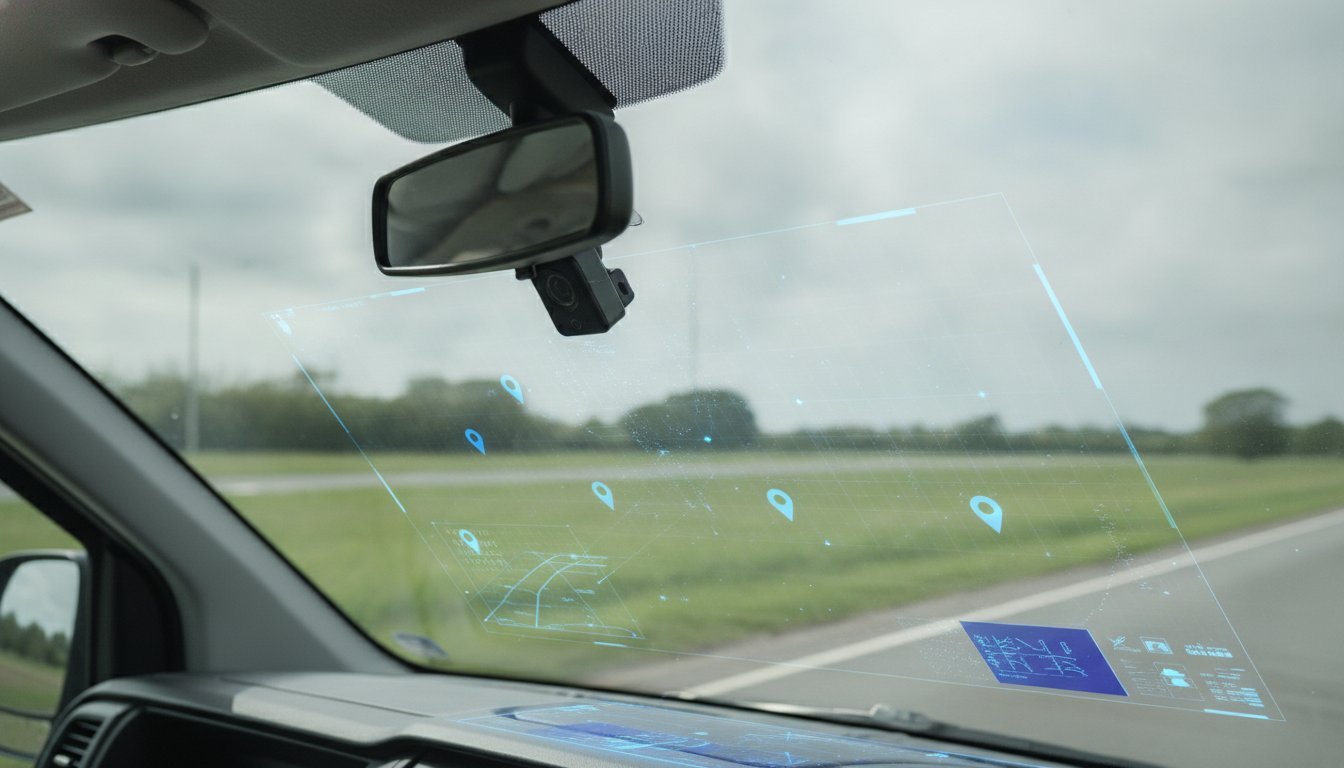
Selecting a van fleet GPS tracking with camera solution requires a clear understanding of your daily operations. A multi-drop delivery fleet navigating tight urban streets needs different coverage than a long-haul courier. For urban routes, a 360-degree view is often necessary to protect against side-swipe claims and pedestrian incidents. Conversely, long-haul operators might prioritise high-definition forward-facing cameras and Driver State Monitoring to manage fatigue. You must decide which angles are critical for your specific risks. Front-facing cameras are the industry standard for insurance, but rear and internal cameras provide the context needed to resolve cargo disputes or verify driver safety.
The software interface must be intuitive. Busy managers don't have time to navigate complex menus or wait for slow video downloads. You need a dashboard that highlights critical events automatically. Scalability is equally important. Ensure the platform can accommodate new vehicles as your business expands without requiring a total system overhaul. Consider the Total Cost of Ownership (TCO). This includes the initial hardware, installation, and monthly data subscriptions. Transparency here prevents hidden costs from eroding your return on investment. A reliable partner like Fleetalyse offers the clarity needed to manage these costs effectively across a growing fleet.
Installation and Maintenance Requirements
Hardwired installation is the professional standard for van fleets. It ensures the system is tamper-proof and remains powered whenever the ignition is on. Covert installation is often preferred to prevent theft or unauthorised removal of the device. In the UK, you must ensure the dash cam does not obstruct the driver's view. Regulations state it cannot protrude more than 40mm into the area swept by the wiper blades. Maintenance is a practical necessity. You must regularly check SD card health and ensure firmware is updated. Many modern systems now use cloud-based health checks to alert you if a camera stops recording or encounters a fault.
Data Privacy and Driver Buy-in
UK businesses using in-vehicle cameras must register with the Information Commissioner's Office (ICO) and pay a data protection fee. This is typically £52 per year for small businesses. GDPR compliance is non-negotiable. You need a clear, written vehicle camera policy that covers data processing, storage, and employee rights. Gaining driver buy-in is easier when you frame the technology as a "digital witness." Emphasise that the camera is there to exonerate them in the event of a false "crash for cash" claim or aggressive road behaviour from other users. When drivers see the technology as a tool for their own protection, adoption rates and safety scores improve. To find a setup that balances security with compliance, you can configure your van fleet tracking system here.
Fleetalyse: Bringing Compliance and Security to Van Tracking
Fleetalyse delivers a specialised van fleet GPS tracking with camera solution designed for the practical needs of UK regional operators. We understand that tracking is not just about dots on a map. It's about protecting your professional reputation and ensuring every vehicle remains compliant with domestic regulations. By integrating video telematics with granular vehicle data, we move beyond simple security. Our platform ensures that every incident is backed by precise location coordinates and time-stamped footage. This is essential for maintaining a clean record, especially for businesses operating under a standard national or international licence where oversight is a priority.
Managing a mixed fleet often leads to fragmented data. Many providers offer separate, incompatible tools for vans, HGVs, and trailers. Fleetalyse solves this by centralising your entire operation. You can view high-level operational gains and technical details in one place. This structured approach prevents you from feeling overwhelmed by data. It allows for a frictionless decision-making process when managing your assets. Our commitment to transparency means you get all financial and contractual details upfront. We value your time and resources, prioritising functional utility over unnecessary features.
A Unified View of Fleet Compliance
Utilising GPS fleet tracking data allows for superior asset management across your entire organisation. When you combine this with Remote Tachograph Downloads and Live Driver Hours, you create a complete picture of your fleet's health. This unified dashboard reduces administrative overhead significantly. Instead of chasing paper logs or manual reports, your team can rely on automated data collection. This efficiency is vital for regional transport businesses where every minute counts. It ensures that your compliance-first strategy is supported by reliable, real-world data rather than theoretical collections.
Expert Support for UK Operators
Fleetalyse is a pragmatic expert partner for regional operators. We understand the specific challenges of UK infrastructure and the rigours of real-world application. Our support team is UK-based and deeply familiar with the domestic market. We don't hide behind complex jargon or distant call centres. Instead, we provide straightforward advice grounded in industry expertise. Whether you need to resolve a driver dispute or streamline your regulatory adherence, we act as a reliable ally that understands the local landscape.
Ready to protect your drivers and reduce your insurance overhead? The next step is simple. You can book a demo to see the platform in action, or skip straight to our published pricing — van tracking from £5.99 per device per month inc VAT, with API access included on every tier. Our team is ready to help you implement a compliance-ready tracking strategy today.
Secure Your Fleet with Integrated Video Telematics
Integrating video with telematics is no longer optional for businesses navigating the risks of modern UK roads. You've seen how this technology serves as an undeniable digital witness, exonerating drivers and lowering insurance overheads by an average of 11.5 per cent. By moving to a proactive AI-driven model, you address risky behaviours like fatigue and distraction before they escalate into costly claims or legal disputes. This proactive stance protects your balance sheet and your professional reputation simultaneously.
Implementing a robust van fleet GPS tracking with camera system ensures your business remains resilient against fraudulent claims and operational inefficiencies. Fleetalyse provides a compliance-first approach to fleet management, backed by transparent pricing with no hidden fees. We remove the complexities often found with generic, global providers, offering a practical solution built specifically for regional operators. Our UK-based expert support team understands the local regulatory landscape and the daily pressures you face on the road.
Optimise your van fleet with Fleetalyse GPS and camera tracking today to secure your assets and streamline your management processes. Take control of your fleet's safety and operational clarity with a partner you can trust.
Frequently Asked Questions
Is it legal to have cameras in company vans in the UK?
Yes, it's entirely legal to install cameras in company vans within the UK, provided you adhere to data protection laws. You must register with the Information Commissioner's Office (ICO) and pay the annual data protection fee, which is typically £52 for small businesses. Companies must also maintain a clear written policy outlining the purpose of the data collection. This ensures your use of van fleet GPS tracking with camera systems remains compliant with GDPR and employee privacy rights.
Will installing cameras in my vans actually lower my insurance premiums?
Most UK insurers offer premium reductions for fleets equipped with dash cams. Research indicates an average reduction of 11.5 per cent, though some providers offer up to 20 per cent for advanced AI systems. These discounts are offered because video evidence speeds up the claims process and reduces the likelihood of fraudulent "crash for cash" payouts. Always check with your broker to ensure your hardware meets their specific approval standards.
How much data does a van tracking camera use per month?
Monthly data usage varies based on how often you access live video or request historical footage. A typical event-based system that only uploads clips when a G-force trigger occurs uses between 500MB and 2GB per month. Continuous live streaming will consume significantly more. Most modern platforms manage this efficiently by only transmitting low-resolution thumbnails initially, allowing you to choose which high-definition clips to download for full review.
Do I need to inform my drivers if I install GPS tracking with cameras?
You are legally required to inform your drivers if you install GPS tracking or cameras in their vehicles. Transparency is a core requirement of UK data protection law. You should update your employee handbook and obtain written consent from all staff members. Clearly explaining that the technology is there to protect them from false accusations often helps gain driver buy-in and maintains a positive workplace culture.
What happens if a van is involved in an accident in an area with poor signal?
If an accident occurs in a poor signal area, the footage is securely stored on the device's internal memory. Most hardware uses industrial-grade SD cards or solid-state drives to record data locally. Once the vehicle enters an area with 4G or 5G coverage, the system automatically resumes the upload to the cloud. This ensures that no critical evidence is lost due to temporary cellular blackspots in rural locations.
Can I see live video from my vans at any time?
Yes, you can access a live feed from your vehicles using a 4G or 5G connection. This is particularly useful for monitoring high-value cargo or responding to emergencies in real-time. However, constant live monitoring isn't usually necessary for daily operations. Most managers prefer to rely on event-triggered alerts, which notify them only when a specific incident, such as harsh braking or an impact, is detected by the system.
What is the difference between a standard dash cam and a fleet tracking camera?
A standard dash cam is a passive device that records footage to a local SD card. In contrast, a van fleet GPS tracking with camera solution is an integrated telematics tool. It links video footage directly to GPS location, speed, and vehicle health data. It also uploads critical clips to a cloud platform automatically. This allows for remote management and instant evidence retrieval that consumer-grade cameras cannot provide.
How long is the video footage stored on the cloud?
Cloud storage duration typically ranges from 30 to 90 days, depending on your subscription and data policy. If a specific clip is flagged as part of an insurance claim or legal investigation, it can be locked and stored indefinitely. It's important to set a retention period that balances your need for evidence with GDPR principles of data minimisation, ensuring you don't store personal data longer than necessary.
Frequently asked questions
The Real Cost of False Claims
For UK SMEs, an at-fault claim often results in skyrocketing premiums and the potential loss of "no claims" bonuses. Investing in van fleet GPS tracking with camera systems ensures that your business is never left vulnerable to hearsay. Video evidence provides immediate First Notification of Loss (FNOL). This allows your insurer to settle legitimate claims faster or contest fraudulent ones with absolute certainty. Visual proof eliminates the "your word against theirs" scenario that often plagues road incidents. It protects your bottom line and your company's professional reputation simultaneously.
Operational Visibility Beyond Location
Knowing where your van is located provides only half the story. You need to understand how that vehicle is being operated whilst on the road. For multi-drop delivery fleets, integrated cameras help resolve customer disputes regarding missed deliveries or alleged property damage. If a customer claims a driver was reckless or unprofessional, you have the footage to verify the facts. This visibility also serves as a shield for your staff. It protects drivers from aggressive road users and false accusations of traffic violations. By using a platform like Fleetalyse, you consolidate this video evidence with broader fleet data, ensuring your operations remain transparent, efficient, and secure. The technical backbone of van fleet GPS tracking with camera systems lies in the seamless fusion of telemetry and video. It is no longer enough to view a map and a video player as separate entities. High-performance hardware burns GPS location, vehicle speed, and directional data directly into the video stream in real-time. This creates a forensic-quality record for every journey. If a vehicle is involved in an incident, you don't just see the visual context; you have verifiable data on exactly how fast the van was moving and where it was positioned on the road. Reliable 4G or 5G connectivity ensures this data isn't trapped on a local storage device. In the past, managers had to manually retrieve SD cards, which were prone to corruption or tampering. Modern systems automated the upload of critical clips to a secure cloud server, which evidence shows improves safety and fuel-efficiency across the fleet. Using a centralised interface like Fleetalyse, you can access these insights from any device, ensuring your data is always available when you need it most.
Event-Triggered Alerts and Cloud Storage
Most van fleet GPS tracking with camera units use internal G-force sensors to detect anomalies. When the system identifies harsh braking, a sudden impact, or aggressive swerving, it marks the footage as an "event." Crucially, the camera uses a pre-event buffer. This saves the 10 to 15 seconds of footage before the trigger occurred, providing the full context of the incident. This data is then encrypted and stored according to UK data retention standards, keeping your business compliant with ICO regulations.
Live Streaming vs. Historical Retrieval
You have the choice between real-time oversight and retrospective analysis. Live streaming is best reserved for high-stakes scenarios, such as transporting sensitive cargo or managing an active emergency. For daily operations, historical retrieval is often more efficient. You can select a specific time from the GPS log and remotely request the high-definition footage for that exact window. This approach respects driver privacy whilst ensuring you have the evidence required for any investigation. To explore how these features work with your specific fleet, you can view our available tracking configurations. Traditional dash cams are passive observers. They record footage to an SD card, which then requires manual retrieval and review after an incident has already occurred. In contrast, an AI-powered van fleet GPS tracking with camera system acts as a proactive digital co-pilot. These "smart" cameras use computer vision to interpret the road environment and driver behaviour in real-time. Whilst a standard camera only provides evidence for a claim, AI systems aim to prevent the claim from happening in the first place. This distinction is fundamental for regional operators looking to move beyond simple asset protection toward a comprehensive safety culture. Advanced Driver Assistance Systems (ADAS) and Driver State Monitoring (DSM) are the two pillars of this technology. ADAS focuses on the external environment, alerting drivers to forward collision risks or unintended lane departures. DSM looks inward, identifying signs of fatigue, distraction, or mobile phone use. These features align with global shifts in transport safety, similar to the rigorous standards seen in Federal Motor Carrier Safety Administration (FMCSA) regulations regarding electronic logging and driver oversight. By implementing these tools, UK fleet managers can address risky habits before they result in a costly accident.
Driver Coaching and Behavioural Analysis
The true value of video telematics lies in its ability to facilitate constructive driver coaching. Instead of blanket reprimands, managers can use specific footage to illustrate dangerous patterns like tailgating or harsh cornering. Many platforms now include a "safety score" system. This gamifies safe driving by ranking employees based on their performance metrics. It's essential to use this data for positive reinforcement rather than just punishment. Recognising high-scoring drivers incentivises the whole team to maintain better standards on the road. Using a centralised platform like Fleetalyse allows you to track these scores alongside live vehicle data, providing a clear picture of fleet-wide safety trends.
UK Insurance Standards: Thatcham and Beyond
UK insurance providers often require hardware to meet specific security standards before granting premium discounts. You'll frequently see references to Thatcham S7 and S5 categories. S7 is the entry-level standard for vehicle tracking and recovery. S5 is more robust, often requiring driver identification tags to prevent unauthorised use. When selecting a van fleet GPS tracking with camera solution, check if the hardware is "Integrated Camera" approved by your insurer. Some policies specifically mandate AI-enabled features to qualify for the highest level of discount. Always verify these requirements with your broker to ensure your chosen hardware meets the necessary criteria for your specific fleet policy. Selecting a van fleet GPS tracking with camera solution requires a clear understanding of your daily operations. A multi-drop delivery fleet navigating tight urban streets needs different coverage than a long-haul courier. For urban routes, a 360-degree view is often necessary to protect against side-swipe claims and pedestrian incidents. Conversely, long-haul operators might prioritise high-definition forward-facing cameras and Driver State Monitoring to manage fatigue. You must decide which angles are critical for your specific risks. Front-facing cameras are the industry standard for insurance, but rear and internal cameras provide the context needed to resolve cargo disputes or verify driver safety. The software interface must be intuitive. Busy managers don't have time to navigate complex menus or wait for slow video downloads. You need a dashboard that highlights critical events automatically. Scalability is equally important. Ensure the platform can accommodate new vehicles as your business expands without requiring a total system overhaul. Consider the Total Cost of Ownership (TCO). This includes the initial hardware, installation, and monthly data subscriptions. Transparency here prevents hidden costs from eroding your return on investment. A reliable partner like Fleetalyse offers the clarity needed to manage these costs effectively across a growing fleet.
Installation and Maintenance Requirements
Hardwired installation is the professional standard for van fleets. It ensures the system is tamper-proof and remains powered whenever the ignition is on. Covert installation is often preferred to prevent theft or unauthorised removal of the device. In the UK, you must ensure the dash cam does not obstruct the driver's view. Regulations state it cannot protrude more than 40mm into the area swept by the wiper blades. Maintenance is a practical necessity. You must regularly check SD card health and ensure firmware is updated. Many modern systems now use cloud-based health checks to alert you if a camera stops recording or encounters a fault.
Data Privacy and Driver Buy-in
UK businesses using in-vehicle cameras must register with the Information Commissioner's Office (ICO) and pay a data protection fee. This is typically £52 per year for small businesses. GDPR compliance is non-negotiable. You need a clear, written vehicle camera policy that covers data processing, storage, and employee rights. Gaining driver buy-in is easier when you frame the technology as a "digital witness." Emphasise that the camera is there to exonerate them in the event of a false "crash for cash" claim or aggressive road behaviour from other users. When drivers see the technology as a tool for their own protection, adoption rates and safety scores improve. To find a setup that balances security with compliance, you can configure your van fleet tracking system here. Fleetalyse delivers a specialised van fleet GPS tracking with camera solution designed for the practical needs of UK regional operators. We understand that tracking is not just about dots on a map. It's about protecting your professional reputation and ensuring every vehicle remains compliant with domestic regulations. By integrating video telematics with granular vehicle data, we move beyond simple security. Our platform ensures that every incident is backed by precise location coordinates and time-stamped footage. This is essential for maintaining a clean record, especially for businesses operating under a standard national or international licence where oversight is a priority. Managing a mixed fleet often leads to fragmented data. Many providers offer separate, incompatible tools for vans, HGVs, and trailers. Fleetalyse solves this by centralising your entire operation. You can view high-level operational gains and technical details in one place. This structured approach prevents you from feeling overwhelmed by data. It allows for a frictionless decision-making process when managing your assets. Our commitment to transparency means you get all financial and contractual details upfront. We value your time and resources, prioritising functional utility over unnecessary features.
A Unified View of Fleet Compliance
Utilising GPS fleet tracking data allows for superior asset management across your entire organisation. When you combine this with Remote Tachograph Downloads and Live Driver Hours, you create a complete picture of your fleet's health. This unified dashboard reduces administrative overhead significantly. Instead of chasing paper logs or manual reports, your team can rely on automated data collection. This efficiency is vital for regional transport businesses where every minute counts. It ensures that your compliance-first strategy is supported by reliable, real-world data rather than theoretical collections.
Expert Support for UK Operators
Fleetalyse is a pragmatic expert partner for regional operators. We understand the specific challenges of UK infrastructure and the rigours of real-world application. Our support team is UK-based and deeply familiar with the domestic market. We don't hide behind complex jargon or distant call centres. Instead, we provide straightforward advice grounded in industry expertise. Whether you need to resolve a driver dispute or streamline your regulatory adherence, we act as a reliable ally that understands the local landscape. Ready to protect your drivers and reduce your insurance overhead? The next step is simple. You can book a demo to see the platform in action, or skip straight to our published pricing — van tracking from £5.99 per device per month inc VAT, with API access included on every tier. Our team is ready to help you implement a compliance-ready tracking strategy today. Integrating video with telematics is no longer optional for businesses navigating the risks of modern UK roads. You've seen how this technology serves as an undeniable digital witness, exonerating drivers and lowering insurance overheads by an average of 11.5 per cent. By moving to a proactive AI-driven model, you address risky behaviours like fatigue and distraction before they escalate into costly claims or legal disputes. This proactive stance protects your balance sheet and your professional reputation simultaneously. Implementing a robust van fleet GPS tracking with camera system ensures your business remains resilient against fraudulent claims and operational inefficiencies. Fleetalyse provides a compliance-first approach to fleet management, backed by transparent pricing with no hidden fees. We remove the complexities often found with generic, global providers, offering a practical solution built specifically for regional operators. Our UK-based expert support team understands the local regulatory landscape and the daily pressures you face on the road. Optimise your van fleet with Fleetalyse GPS and camera tracking today to secure your assets and streamline your management processes. Take control of your fleet's safety and operational clarity with a partner you can trust.
Is it legal to have cameras in company vans in the UK?
Yes, it's entirely legal to install cameras in company vans within the UK, provided you adhere to data protection laws. You must register with the Information Commissioner's Office (ICO) and pay the annual data protection fee, which is typically £52 for small businesses. Companies must also maintain a clear written policy outlining the purpose of the data collection. This ensures your use of van fleet GPS tracking with camera systems remains compliant with GDPR and employee privacy rights.
Will installing cameras in my vans actually lower my insurance premiums?
Most UK insurers offer premium reductions for fleets equipped with dash cams. Research indicates an average reduction of 11.5 per cent, though some providers offer up to 20 per cent for advanced AI systems. These discounts are offered because video evidence speeds up the claims process and reduces the likelihood of fraudulent "crash for cash" payouts. Always check with your broker to ensure your hardware meets their specific approval standards.
How much data does a van tracking camera use per month?
Monthly data usage varies based on how often you access live video or request historical footage. A typical event-based system that only uploads clips when a G-force trigger occurs uses between 500MB and 2GB per month. Continuous live streaming will consume significantly more. Most modern platforms manage this efficiently by only transmitting low-resolution thumbnails initially, allowing you to choose which high-definition clips to download for full review.
Do I need to inform my drivers if I install GPS tracking with cameras?
You are legally required to inform your drivers if you install GPS tracking or cameras in their vehicles. Transparency is a core requirement of UK data protection law. You should update your employee handbook and obtain written consent from all staff members. Clearly explaining that the technology is there to protect them from false accusations often helps gain driver buy-in and maintains a positive workplace culture.
What happens if a van is involved in an accident in an area with poor signal?
If an accident occurs in a poor signal area, the footage is securely stored on the device's internal memory. Most hardware uses industrial-grade SD cards or solid-state drives to record data locally. Once the vehicle enters an area with 4G or 5G coverage, the system automatically resumes the upload to the cloud. This ensures that no critical evidence is lost due to temporary cellular blackspots in rural locations.
Can I see live video from my vans at any time?
Yes, you can access a live feed from your vehicles using a 4G or 5G connection. This is particularly useful for monitoring high-value cargo or responding to emergencies in real-time. However, constant live monitoring isn't usually necessary for daily operations. Most managers prefer to rely on event-triggered alerts, which notify them only when a specific incident, such as harsh braking or an impact, is detected by the system.
What is the difference between a standard dash cam and a fleet tracking camera?
A standard dash cam is a passive device that records footage to a local SD card. In contrast, a van fleet GPS tracking with camera solution is an integrated telematics tool. It links video footage directly to GPS location, speed, and vehicle health data. It also uploads critical clips to a cloud platform automatically. This allows for remote management and instant evidence retrieval that consumer-grade cameras cannot provide.
How long is the video footage stored on the cloud?
Cloud storage duration typically ranges from 30 to 90 days, depending on your subscription and data policy. If a specific clip is flagged as part of an insurance claim or legal investigation, it can be locked and stored indefinitely. It's important to set a retention period that balances your need for evidence with GDPR principles of data minimisation, ensuring you don't store personal data longer than necessary.