

Prove Compliance in 24–48 Hours: UK Operator Licence Undertakings

Operator licence undertakings are legally binding promises you make to the Traffic Commissioner. They cover roadworthy vehicles, compliant drivers’ hours and tachographs, respecting your operating centre limits, and keeping 15 months of retrievable records. Break one, and you risk everything from a warning letter to a Public Inquiry. This guide sets out exactly what each undertaking demands and how to prove you’re meeting it.
TL;DR:
- Operators must keep detailed records for at least 15 months, including maintenance, defect reports, tachograph data, and driver hours, accessible within 24-48 hours of request.
- Meeting daily undertakings requires strict vehicle maintenance schedules, defect escalation procedures, automated tachograph downloads, and continuous oversight by transport managers.
- Breaching an undertaking usually leads to escalation from warnings to Public Inquiry, especially if it involves unreported changes or repeated infringements, rather than isolated mistakes.
- Applying for license variations promptly before changes or expansions prevent compliance violations and avoid operating outside agreed undertakings.
- Using telematics automates proof of compliance, such as remote tachograph downloads, GPS tracking, and driver behaviour monitoring, reducing enforcement risks and manual admin.
Table of Contents
- What are the standard operator licence undertakings?
- Turning each undertaking into a daily process
- Records and audit readiness: the 15-month rule
- What happens when you breach an undertaking
- Applying for and maintaining your licence
- How telematics closes the gap between promise and proof
- Varying or updating your undertakings after licence grant
- When breaching an undertaking differs from a general licence breach
- Publisher perspective: why prevention beats correction every time
- A practical way to keep your undertakings without the admin load
- Sources
What are the standard operator licence undertakings?
Every operator’s licence carries the same core set of promises, regardless of fleet size or licence type. The Traffic Commissioner treats these as non-negotiable, and DVSA checks against them at the roadside, at inspections, and during any formal review.
The standard undertakings require you to:
- Keep vehicles and trailers in a fit and roadworthy condition at all times
- Comply fully with drivers’ hours and tachograph rules
- Report and act on driver defects promptly, with records kept
- Observe the operating centre(s) and vehicle numbers specified on the licence
- Not exceed the environmental conditions attached to the operating centre
- Notify the Traffic Commissioner of relevant convictions or changes to the business
- Keep all required records for at least 15 months
Some licences carry additional bespoke conditions, particularly where an operating centre has restricted hours or noise limits. The goods vehicle operator licensing guide on GOV.UK remains the authoritative reference for the full wording, and it’s worth checking your own licence document rather than assuming the generic list applies word for word.
Turning each undertaking into a daily process
Signing an undertaking is the easy part. Meeting it every single day, across every vehicle and driver, is where operators either build a resilient business or accumulate the small failures that eventually surface at a Public Inquiry.
Vehicle fitness and maintenance scheduling should run on a fixed interval, typically every 6 to 10 weeks depending on vehicle age and mileage, with inspections recorded on standard DVSA-style sheets. Build the schedule around the vehicle, not the calendar month, so a high-mileage HGV gets checked more often than a lightly used van.
Daily walk-round checks need a clear escalation path. A driver who spots a cracked mirror or a slow tyre leak must know exactly who to call, and that vehicle must be taken off the road until the defect is closed out on paper. A defect log with no closure dates is one of the first things an examiner flags.
Tachograph and drivers’ hours monitoring works best when downloads happen automatically rather than depending on someone remembering. Remote tachograph downloads catch infringements within days instead of months, giving you time to retrain a driver before a pattern becomes a habit. Fleetalyse’s remote tachograph downloads service, alongside guidance on common infringements, shows how this fits into a wider monitoring routine.
Transport managers on standard licences must demonstrate continuous and effective control, not just hold the CPC qualification on paper. Keep dated notes of their maintenance reviews, disciplinary actions, and licence checks as evidence of genuine oversight.
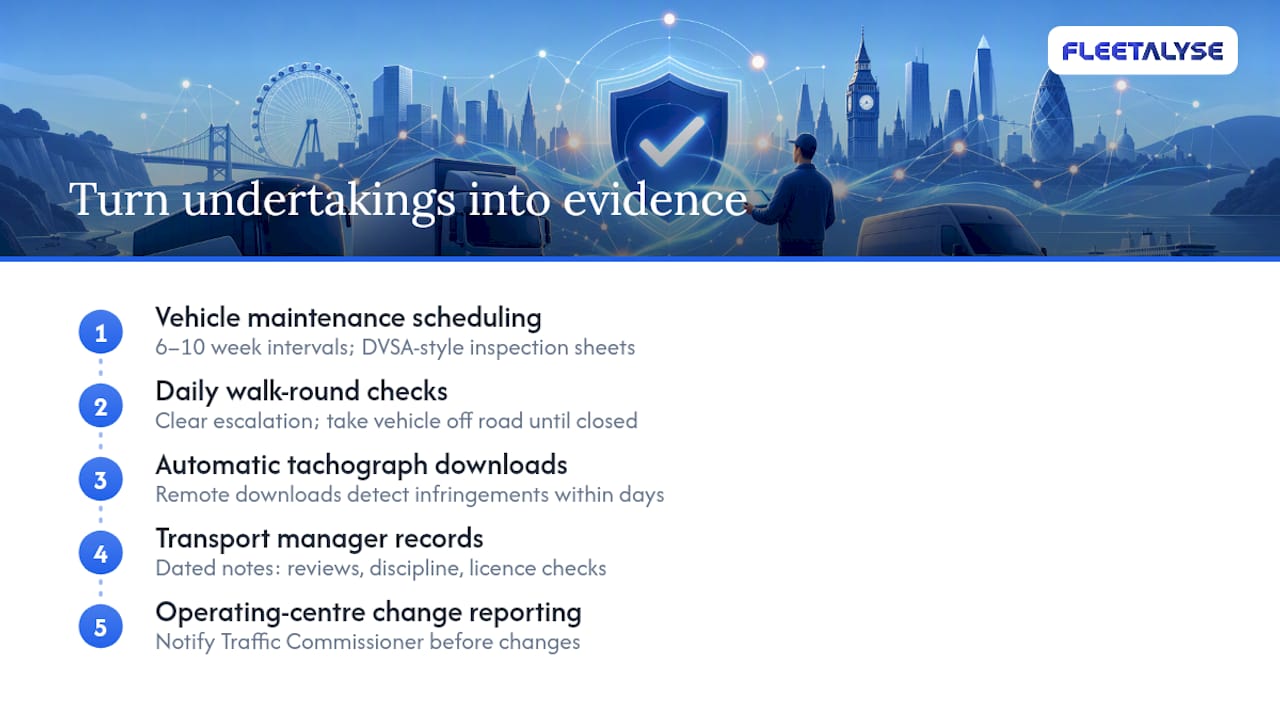
Operating centre limits and any material change, whether that’s a new site, a different maintenance contractor, or a change of transport manager, must be reported to the Traffic Commissioner before it happens, not after.
Pro Tip: Set a recurring calendar reminder to review your transport manager’s oversight notes monthly. Examiners consistently ask for evidence of ongoing control, not a certificate on the wall.
Records and audit readiness: the 15-month rule
Operators must keep records for at least 15 months covering safety inspections, maintenance, repairs, and driver defect reports. That figure isn’t arbitrary. It gives DVSA a full annual cycle plus a margin to catch seasonal patterns in defects or driver behaviour.
Your retrievable records should include:
- Safety inspection and maintenance sheets for every vehicle and trailer
- Driver defect reports, with dates showing when each fault was closed
- Tachograph download data and driver hours summaries
- Driver CPC certificates and licence check records
- Evidence supporting your financial standing declaration
Storage matters as much as collection. Practitioners expect operators to produce 15 months of records within 24 to 48 hours of a DVSA request, which rules out a filing cabinet with no index. Digital archives with consistent naming conventions, backed up off-site, tend to outperform paper systems on retrieval speed alone.
Automating tachograph downloads and driver hours checks materially cuts enforcement risk, because infringements surface within days rather than being discovered months later during a random audit.
What happens when you breach an undertaking
Enforcement follows a graduated ladder rather than jumping straight to revocation. The Traffic Commissioner and DVSA typically move through these stages:
- A warning letter or advisory visit for minor, first-time issues
- A formal warning with a requirement to demonstrate corrective action
- Referral to Public Inquiry for repeated or serious failures
- Licence curtailment, suspension, or revocation
- Director disqualification in the most severe cases
DVSA’s Operator Compliance Risk Score feeds directly into how closely the Traffic Commissioner scrutinises a licence. A poor score triggers more roadside checks and a higher chance of an unannounced maintenance inspection. Failed MOTs, repeated tachograph infringements, and unreported material changes are the most common triggers for a Public Inquiry referral. If you receive a call-up letter, respond promptly with your own records rather than waiting for the hearing to explain gaps.
Applying for and maintaining your licence
Choosing the right licence type comes first. There are three main categories: Restricted licences for own-account transport of your own goods, and Standard National or Standard International licences for hire or reward work. You typically need a licence at all once a vehicle exceeds 3.5 tonnes gross plated weight or 1,525kg unladen weight.
The application steps run roughly as follows:
- Decide on licence type and confirm your vehicles meet the weight threshold
- Nominate a transport manager for standard licences and evidence their professional competence
- Demonstrate financial standing to cover maintenance and compliance costs
- Advertise your proposed operating centre(s) in a local newspaper
- Submit the application with the application fee and licence issue fee as stated on the official government website
- Apply for an interim licence with a fee as stated on the official government site if you need to operate while the full application is processed
Decisions typically take several weeks once all documentation is complete. Once granted, you must notify the Traffic Commissioner of relevant convictions and material changes within the timescales set out in your licence conditions. Restricted licence holders often assume lighter obligations because no transport manager is required, but they must still meet the same roadworthiness and record-keeping undertakings as standard licence holders.
How telematics closes the gap between promise and proof
Meeting an undertaking on paper is one thing. Proving it during an unannounced DVSA check is another, and that’s where automated systems earn their place in a compliance routine.
- Remote tachograph downloads satisfy the 15-month record requirement without a driver ever visiting a depot
- Drivers’ hours alerts flag an approaching infringement before it happens, not after
- GPS tracking evidences that vehicles are actually operating from the registered operating centre, which matters if a commissioner questions unauthorised parking
- Automated maintenance scheduling links defect reports to the next inspection date, closing the loop examiners look for
Integrating telematics into your existing maintenance workflow works best when the alerts feed into whoever already owns defect closure, rather than creating a separate system nobody checks. Fleetalyse’s UK-based support team works directly with operators on this kind of integration, and background on tachograph obligations is covered in the DVSA tachograph rules explainer.
Pro Tip: Review your GPS data against your operating centre address quarterly. A vehicle consistently parked elsewhere overnight is a material change you haven’t declared yet.
Varying or updating your undertakings after licence grant
Undertakings aren’t fixed for the life of a licence. Growth, relocation, or a change in operating pattern can all require a formal variation, and getting this wrong is one of the more common self-inflicted compliance problems.
You need to apply for a variation whenever you want to add vehicles beyond your current authorisation, change or add an operating centre, alter the environmental conditions attached to a site, or change your nominated transport manager. The Act underpinning operator licensing gives traffic commissioners the power to require fresh particulars of vehicles and operating centres whenever circumstances change, which is why a variation application looks similar in structure to a fresh application.
The process starts with submitting a variation form to the Traffic Commissioner, along with any updated financial standing evidence if the change increases your operating costs. Adding a new operating centre still requires advertising, exactly as it did at the original application stage, and objectors have the same right to raise concerns during that advertising period. Expect a similar review timescale to a new application, particularly if the variation involves a significant increase in vehicle numbers or a new site in an area with existing noise or traffic concerns.
Failing to apply for a variation before the change happens, rather than after, is a frequent trigger for scrutiny. A new operating centre used before it’s approved, or extra vehicles running before the licence is updated, both count as operating outside your undertakings even if every vehicle passes its inspection. Notify first, then act.
When breaching an undertaking differs from a general licence breach
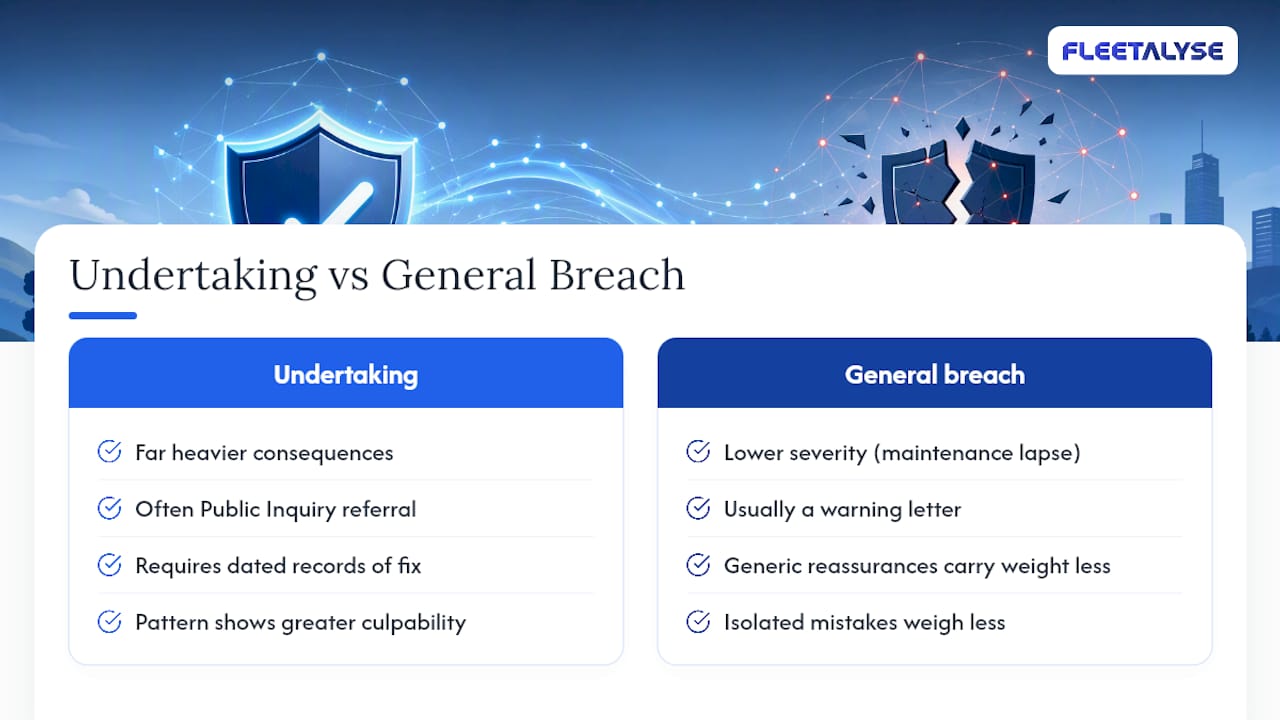
Not every compliance failure is treated the same way. A single missed MOT retest date is a maintenance lapse; a pattern of unreported material changes or repeated tachograph manipulation is a breach of the specific promises made to the Traffic Commissioner; and the second carries far heavier consequences.
The distinction matters because undertakings are the terms the commissioner relied on to grant the licence in the first place. Breaching one suggests the operator either couldn’t or wouldn’t keep the promise that justified being trusted with a licence, which is a different category of failure to an isolated operational mistake. That’s why undertaking breaches are far more likely to trigger a Public Inquiry referral rather than a warning letter, and why the Driver CPC undertaking specifically comes up often at these hearings: it’s straightforward for an examiner to verify at the roadside, so gaps get spotted quickly.
If you’re notified of an investigation into a specific undertaking, the procedure differs from responding to a routine maintenance query. You’ll typically receive a call-up letter naming the undertaking in question, and your response needs to address that specific promise directly, with dated records showing either compliance or the corrective action already taken. Generic reassurances about “improving processes” carry far less weight than a paper trail showing exactly when the gap was identified and closed. Commissioners also weigh whether the failure was a one-off or a pattern, so a single missed download looks very different to six months of gaps in tachograph records.
Outsourcing maintenance or transport management to a third party doesn’t transfer this liability. Operators remain legally responsible for compliance even when the day-to-day work sits with a contractor, and examiners expect to see your own oversight records, not just an assurance that someone else is handling it.
Publisher perspective: why prevention beats correction every time
Undertakings aren’t a box you tick once at application stage. They’re an ongoing commitment, and the operators who struggle at Public Inquiry are almost always the ones treating compliance as reactive rather than routine. Run a mock audit this month, check your Driver CPC records are current, and schedule remote tachograph checks monthly. Fixing a gap before DVSA finds it costs a fraction of what fixing it afterwards does.
— Vytautas
A practical way to keep your undertakings without the admin load
Meeting operator licence undertakings comes down to proof, and proof takes time to collect by hand. Fleetalyse gives you that proof automatically rather than asking your team to chase it every month.
Remote tachograph downloads satisfy your 15-month record requirement without a single depot visit. Drivers’ hours monitoring flags an infringement while there’s still time to act on it. GPS tracking gives you a defensible answer if a commissioner ever questions where your vehicles were operating from, and driver behaviour monitoring adds another layer of evidence around vehicle fitness and driver competence. For operators wanting the fuller picture, fleet analysis software pulls it all into reports you can hand to an examiner without a scramble. If you’re ready to see how this fits your fleet, get in touch with Fleetalyse’s UK-based team for a demo, or browse the unlocked GPS trackers if hardware is where you need to start.