
A single manual error in your tachograph records is no longer just an administrative oversight; it's a direct threat to your right to operate. With the DVSA increasingly using data-sharing and risk-scoring to target inspections, the margin for error has disappeared. You likely feel the weight of managing driver hours and the constant worry that a missed record could lead to a public inquiry. Learning how to maintain operator licence compliance UK is no longer about ticking boxes once a month. It's about building a live, data-driven system that protects your business every hour of the day.
You deserve total peace of mind when a roadside check or a full audit occurs. This guide provides a clear, repeatable strategy to master the complexities of modern standards, from the July 2026 Smart Tachograph 2 mandates to the latest financial standing requirements. We'll show you how to reduce administrative overhead and replace manual burdens with automated oversight. You'll gain the practical tools needed to protect your O-licence and ensure your fleet remains both compliant and profitable.
Key Takeaways
- Recognise that an O-licence is a continuous legal commitment, not a one-off application. Understand the Traffic Commissioner's specific expectations for maintaining professional repute.
- Build a foundation for roadworthiness by distinguishing between minor wear and safety-critical defects. Use daily walkaround checks to identify issues before they lead to costly prohibitions.
- Learn how to maintain operator licence compliance UK by mastering drivers' hours rules and the legal requirement to download driver cards every 28 days.
- Move from reactive fixes to a proactive audit strategy. Discover how the Earned Recognition scheme can shield your business from frequent DVSA interventions and roadside stops.
- Eliminate the risk of manual errors with automated data systems. See how remote tachograph downloads ensure you never miss a deadline or lose critical compliance records.
Understanding the Operator Licence Compliance Framework in the UK
An operator licence isn't a trophy for your office wall. It's a living contract with the state. Many operators treat the application process like a finish line, but in reality, it's the starting block. To understand how to maintain operator licence compliance UK, you must view every vehicle movement as a continuous test of your professional standing. Compliance isn't a monthly check; it's a daily duty that dictates whether your business stays on the road.
The Traffic Commissioners for Great Britain act as the industry's regulators. They demand "repute" from every licence holder. This isn't a vague character trait. It means you must be trustworthy, law-abiding, and entirely transparent in your dealings. If you lose your repute through negligence or dishonesty, you lose your business. There's no middle ground when the DVSA identifies systemic failures.
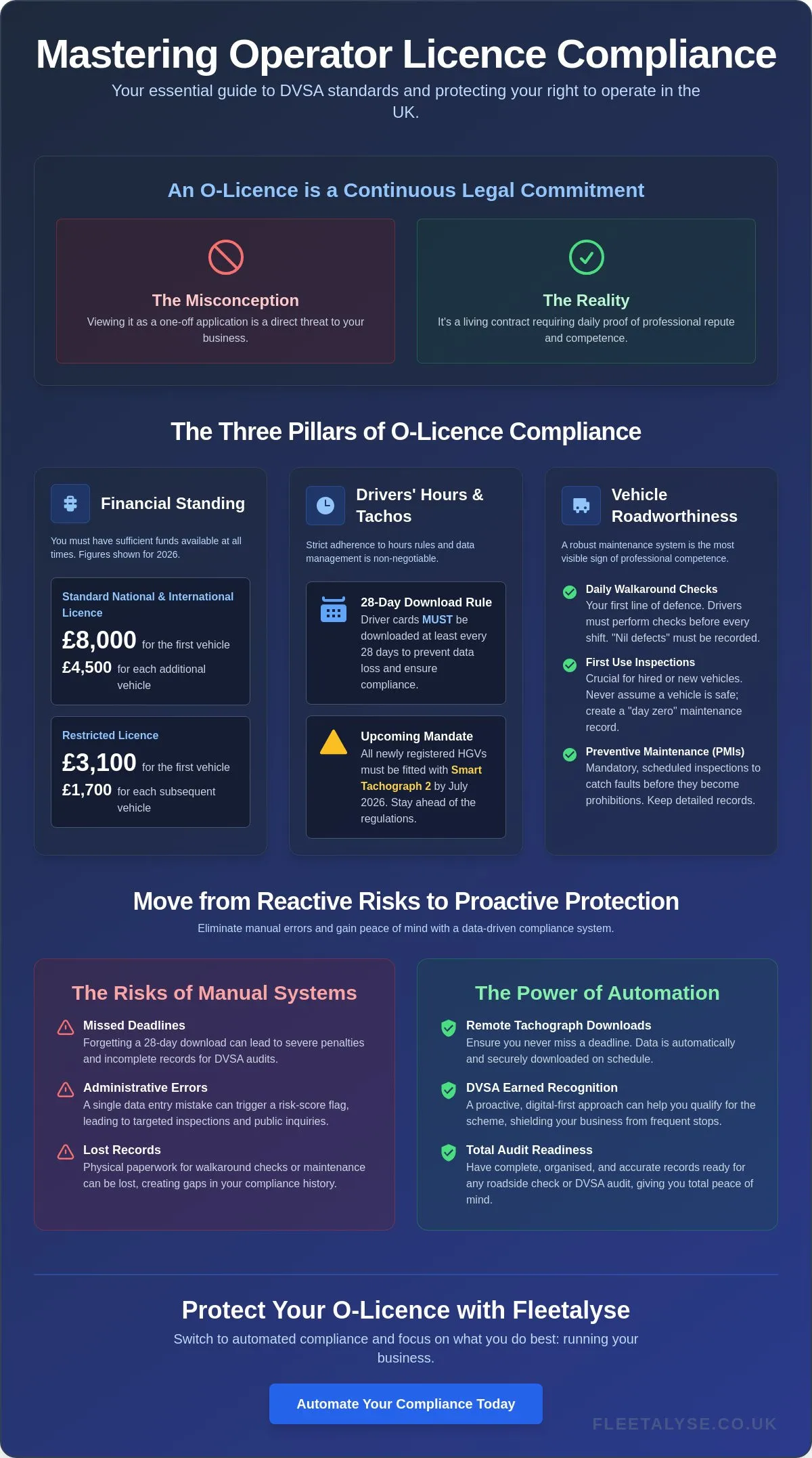
You must also prove you have the funds to keep your fleet safe. This is known as "Financial Standing." For 2026, standard national and international licences require £8,000 for the first vehicle and £4,500 for each additional vehicle. Restricted licences require £3,100 for the first and £1,700 for each subsequent vehicle. These figures are mandatory. You must maintain this level of liquidity every single day of your operation. The DVSA can demand proof of these funds at any moment, and failing to show them is a fast track to licence revocation.
The Continuous Duty of the Transport Manager
The nominated Transport Manager is the linchpin of your operation. They hold personal legal responsibility for your fleet's behaviour. This isn't a "name on a piece of paper" role. The law requires "effective and continuous" control over all transport activities. This means the manager must be on-site, checking records, and challenging unsafe practices. By 2026, staying compliant requires active Continuing Professional Development (CPD). Regulations move fast, especially with new tachograph mandates. Your manager's knowledge must keep pace.
Key Administrative Obligations and Notifications
Administrative silence is often seen as a red flag by the Traffic Commissioner. You're legally required to report specific changes within 28 days. These include changes in maintenance providers, any convictions or fixed penalties, and shifts in your financial stability. One of the biggest risks is changing your "Legal Identity"—such as moving from a sole trader to a limited company—without applying for a new licence first. Doing so makes your current licence void immediately. Always manage your vehicle margins carefully; don't let your fleet count exceed your authorised capacity without prior approval.
Managing Roadworthiness and Vehicle Maintenance Standards
Roadworthiness is not a status you achieve once; it is a condition you must verify every single day. The DVSA expects you to have a robust system that catches faults before they become prohibitions. If a vehicle leaves your yard with a safety-critical defect, the responsibility sits squarely with the operator. Effective vehicle management is the most visible sign of professional competence and is central to how to maintain operator licence compliance UK.
A common trap for many fleets is the treatment of hired or newly acquired assets. You must perform a "First Use Inspection" on every vehicle before it begins its first journey under your licence. Never assume a rental truck is safe just because it looks new or has a recent MOT. This inspection creates a clear "day zero" for your maintenance records and ensures you aren't inheriting someone else's neglect.
Implementing Robust Daily Walkaround Checks
The daily walkaround check is your first line of defence. Drivers must inspect the vehicle and trailer before every shift to ensure they are safe to use. This check must cover safety-critical items including tyres, lights, mirrors, brakes, and load security. Establish a formal, digital system for reporting these checks immediately. Silence is not a record. You must document and file "nil defects" just as rigorously as actual faults. If there is no record of a check, the DVSA assumes the check never happened. Keeping these records organised is simple with integrated fleet tracking and asset management tools.
PMI Scheduling and Record Retention
Preventive Maintenance Inspections (PMIs) are mandatory. You must set a fixed interval for these deep-dive checks, typically every 6, 8, or 12 weeks. This interval depends on the age of the vehicle, the mileage covered, and the type of work it performs. The official government guide provides the standards you must meet for these inspections. Every PMI sheet must include the vehicle details, the date, a list of all items checked, and the signature of the technician who performed the work. You are legally required to keep these maintenance records for at least 15 months. This includes all defect reports, PMI sheets, and receipts for parts or external labour. During an audit, an inspector will look for a "closed loop" where a reported defect is clearly linked to a recorded repair.
Drivers’ Hours and Tachograph Data Management
Tachograph records are the primary evidence of your fleet's safety culture. To understand how to maintain operator licence compliance UK, you must treat driver hours as a live metric rather than a monthly paperwork exercise. For 2026, the stakes are higher; from July 1, 2026, goods vehicles over 2.5 tonnes undertaking international journeys must use Smart Tachograph 2 technology. The legal minimums remain: driver cards must be downloaded every 28 days and vehicle units (VUs) every 90 days. The Road Haulage Association highlights that regular analysis is the only way to demonstrate "continuous and effective" management to a Traffic Commissioner.
Infringement debriefing is a mandatory part of this process. When a driver exceeds their hours or misses a break, you must document the conversation where you addressed the issue. This isn't about punishment; it's about education and prevention. If the DVSA finds a pattern of repeat offences without any evidence of management intervention, your repute is at immediate risk. You need a system that identifies these patterns instantly, allowing for corrective training before the next audit occurs.
The Risks of Manual Tachograph Data Collection
Manual data collection is a legacy process that introduces unnecessary risk. It creates a "Compliance Gap" where vehicles away from base for several weeks remain unmonitored. This delay makes it impossible to address driver errors in a timely fashion. Manual downloads are also vulnerable to administrative failures, such as lost cables or corrupted files. Missing mileage can trigger a DVSA investigation because it suggests that vehicles are being moved without a driver card inserted to hide illegal driving time. Automation removes this suspicion by ensuring every kilometre is accounted for.
Monitoring Driver Behaviour and Rest Periods
Compliance extends far beyond the time spent behind the wheel. You must track "Other Work", such as loading, unloading, and vehicle cleaning, to ensure drivers don't exceed their total duty limits. Recording rest and breaks is equally critical; failure to do so is one of the most common reasons for operator fines. Fleetalyse provides real-time visibility into these live driver hours, giving you the power to see exactly who is running out of time. This proactive approach ensures your team stays within the law whilst keeping your deliveries on schedule.
Preparing for a DVSA Audit: A Proactive Strategy
The DVSA doesn't just knock on doors at random. They use data. To understand how to maintain operator licence compliance UK, you must understand how the DVSA prioritises its interventions. Their primary tool is the Operator Compliance Risk Score (OCRS). This "traffic light" system uses data from roadside inspections and MOT results to calculate your risk level. If your score moves into the red, an audit is almost certain. Being proactive means running your business as if an auditor is already standing in your yard.
Interventions range from remote desk-based assessments to full site visits. During a site visit, an examiner will scrutinise your maintenance records, driver files, and tachograph analysis. You can mitigate this pressure by aiming for the "Earned Recognition" scheme. This is a voluntary scheme for operators who can prove their systems are robust and digitally managed. Once accepted, your fleet is far less likely to be stopped at the roadside, allowing your drivers to stay on schedule without interruption.
Internal "Mock Audits" are your best defence. Don't wait for a regulator to find a gap in your files. Conduct a quarterly review of your own records to catch failings early. Supplement this with a strict "Gate Check" process. A Gate Check is a physical inspection performed as a vehicle leaves the yard. It verifies that the driver has their CPC card, the vehicle is in the condition reported in the walkaround check, and the load is secure. It is your last line of defence against a roadside prohibition.
Common Red Flags That Trigger Public Inquiries
If the DVSA identifies systemic failures, you may be called to a Public Inquiry before the Traffic Commissioner. This is a high-stakes legal hearing that can result in the loss of your licence. Avoid these top five red flags:
- Tachograph Gaps: Missing mileage or unexplained "unknown" driving periods.
- S-marked Prohibitions: These are issued for defects that should have been caught during a daily walkaround check. They signal a total failure in your maintenance culture.
- High MOT Failure Rates: Failing an MOT on "first-use" items like bulbs or tyres suggests you aren't inspecting vehicles between PMIs.
- Financial Standing Failures: Falling below the required capital thresholds for your fleet size.
- TM Control Issues: Evidence that the Transport Manager is not exercising "effective and continuous" control.
Implementing Independent Compliance Audits
Sometimes, a fresh set of eyes is necessary. The Traffic Commissioner often mandates an independent audit if an operator has slipped up. However, smart operators commission these voluntarily. An independent auditor provides a neutral assessment of your systems, often using the ISO 9001:2015 standard as a benchmark for quality management. When choosing an auditor, ensure they have a pragmatic understanding of the haulage industry rather than just a theoretical grasp of the law. Secure your fleet’s future and get started with a compliant data system today to ensure your records are always audit-ready.
Automating Compliance with Remote Tachograph Solutions
Manual record-keeping is a liability. In 2026, the complexity of DVSA standards makes human error almost inevitable if you rely on cables and manual downloads. Remote Tachograph Download has moved from a luxury to a necessity. It is the modern standard for any operator serious about their repute. This technology removes the risk of missing the 28-day or 90-day deadlines. It ensures your data is always safe, stored, and ready for inspection. Your drivers stay on the road, and your office staff stay focused on growth rather than chasing paperwork. Automation is the most reliable way to demonstrate how to maintain operator licence compliance UK.
Streamlining Data with Tachograph Analysis Integration
Effective management requires speed. Fleetalyse sends your tachograph data directly to analysis software in real-time. This eliminates the administrative hours spent chasing driver cards or hunting for misplaced vehicle units. You no longer have to wait for a driver to return from a long-haul trip to see if they’ve committed an infringement. Automated reporting makes infringement management effortless by flagging issues the moment they occur. This allows for immediate debriefing, which is a core requirement for a healthy compliance culture. By removing the manual element, you ensure that no record is ever lost or overlooked during a busy shift.
Real-Time Visibility and Operational Efficiency
Visibility is your best tool for prevention. Knowing exactly how much "drive time" remains for every driver prevents accidental infringements before they happen. You can plan your loads and routes with total certainty. GPS fleet tracking works alongside your tacho data to verify driver logbooks and account for every movement. This cross-referencing ensures there are no "unknown" driving periods that could trigger a DVSA investigation. It optimises your routes whilst keeping your fleet strictly within the law. Using asset and trailer tracking alongside your vehicle data provides a 360-degree view of your entire operation. This level of oversight is exactly what Traffic Commissioners look for when assessing a company's commitment to safety. It transforms compliance from a burden into a competitive advantage.
Secure your fleet’s future with Fleetalyse compliance solutions.
Future-Proof Your Fleet Compliance
Compliance is a continuous legal duty that demands your daily attention. You've seen that maintaining roadworthiness and managing driver hours are the pillars of a safe operation. However, manual systems are no longer enough to satisfy modern DVSA standards. Mastering how to maintain operator licence compliance UK requires a shift from reactive paperwork to proactive, real-time oversight. By identifying risks before they lead to prohibitions, you protect your repute and your bottom line.
Automated systems provide the reliability that manual record-keeping lacks. You gain real-time visibility of live driver hours and benefit from automated remote tachograph downloads that ensure you never miss a deadline. This data flows directly into your systems through seamless integration with leading analysis software. Don't leave your business to chance or wait for a red OCRS score to take action. Automate your compliance and protect your O-licence with Fleetalyse. It's time to trade administrative burdens for total peace of mind. Your fleet stays on the road, and your business remains secure.
Frequently Asked Questions
How often must I download my driver tachograph card in the UK?
You must download your driver tachograph card at least every 28 days. This is the legal minimum requirement for all operators. Many businesses choose to download data more frequently to identify and address infringements before they become a systemic issue. Vehicle units must be downloaded at least every 90 days to ensure all driving activity is accounted for.
What happens if I fail a DVSA operator compliance audit?
Failing a DVSA audit typically results in a formal warning or a referral to a Public Inquiry. The Traffic Commissioner has the authority to suspend, curtail, or revoke your licence based on the severity of the failings. You may also be required to commission an independent audit to prove you have implemented necessary improvements and regained control of your fleet.
Can I manage my operator licence compliance manually in 2026?
You can technically use manual systems, but it is high risk and inefficient. Manual record-keeping is prone to human error and makes it difficult to track live driver hours or missing mileage. Understanding how to maintain operator licence compliance UK effectively in 2026 involves using digital tools to ensure your data is accurate, retrievable, and always ready for a snap inspection.
What is the difference between a Restricted and a Standard National licence?
A Restricted licence is for businesses that only carry their own goods as part of their trade. A Standard National licence is required if you carry goods for other people for "hire and reward." Standard licences have stricter requirements, including the mandatory appointment of a qualified Transport Manager and higher levels of proven financial standing to ensure operational safety.
How long do I need to keep my fleet maintenance records?
You must keep all vehicle maintenance records for a minimum of 15 months. This legal requirement covers preventive maintenance inspection sheets, driver defect reports, and all receipts for repairs or parts. These records provide the audit trail the DVSA needs to see that you are maintaining your vehicles in a roadworthy condition throughout their period of use.
Does remote tachograph download software satisfy DVSA requirements?
Remote tachograph download software fully satisfies DVSA requirements and is often preferred by regulators. It ensures that data is captured within the legal 28-day and 90-day windows without the vehicle needing to return to base. This technology provides a transparent and reliable record of all driving activity, making it much easier to demonstrate how to maintain operator licence compliance UK during an audit.
What is an OCRS score and how can I improve mine?
The Operator Compliance Risk Score is a data-driven rating used by the DVSA to target non-compliant fleets. You can improve your score by ensuring your vehicles pass MOTs on the first attempt and by avoiding roadside prohibitions. Maintaining a "Green" score reduces the likelihood of your vehicles being stopped for random checks, which keeps your operations running smoothly.
Do I need a tachograph if I only drive a van for business?
Most vans under 3.5 tonnes do not require a tachograph for domestic UK work. However, from July 1, 2026, any vehicle over 2.5 tonnes used for international journeys for hire and reward must be fitted with a Smart Tachograph 2. If your business involves crossing borders with light commercial vehicles, you must comply with these updated 2026 regulations to avoid heavy fines.
Frequently asked questions
The Continuous Duty of the Transport Manager
The nominated Transport Manager is the linchpin of your operation. They hold personal legal responsibility for your fleet's behaviour. This isn't a "name on a piece of paper" role. The law requires "effective and continuous" control over all transport activities. This means the manager must be on-site, checking records, and challenging unsafe practices. By 2026, staying compliant requires active Continuing Professional Development (CPD). Regulations move fast, especially with new tachograph mandates. Your manager's knowledge must keep pace.
Key Administrative Obligations and Notifications
Administrative silence is often seen as a red flag by the Traffic Commissioner. You're legally required to report specific changes within 28 days. These include changes in maintenance providers, any convictions or fixed penalties, and shifts in your financial stability. One of the biggest risks is changing your "Legal Identity"—such as moving from a sole trader to a limited company—without applying for a new licence first. Doing so makes your current licence void immediately. Always manage your vehicle margins carefully; don't let your fleet count exceed your authorised capacity without prior approval. Roadworthiness is not a status you achieve once; it is a condition you must verify every single day. The DVSA expects you to have a robust system that catches faults before they become prohibitions. If a vehicle leaves your yard with a safety-critical defect, the responsibility sits squarely with the operator. Effective vehicle management is the most visible sign of professional competence and is central to how to maintain operator licence compliance UK. A common trap for many fleets is the treatment of hired or newly acquired assets. You must perform a "First Use Inspection" on every vehicle before it begins its first journey under your licence. Never assume a rental truck is safe just because it looks new or has a recent MOT. This inspection creates a clear "day zero" for your maintenance records and ensures you aren't inheriting someone else's neglect.
Implementing Robust Daily Walkaround Checks
The daily walkaround check is your first line of defence. Drivers must inspect the vehicle and trailer before every shift to ensure they are safe to use. This check must cover safety-critical items including tyres, lights, mirrors, brakes, and load security. Establish a formal, digital system for reporting these checks immediately. Silence is not a record. You must document and file "nil defects" just as rigorously as actual faults. If there is no record of a check, the DVSA assumes the check never happened. Keeping these records organised is simple with integrated fleet tracking and asset management tools.
PMI Scheduling and Record Retention
Preventive Maintenance Inspections (PMIs) are mandatory. You must set a fixed interval for these deep-dive checks, typically every 6, 8, or 12 weeks. This interval depends on the age of the vehicle, the mileage covered, and the type of work it performs. The official government guide provides the standards you must meet for these inspections. Every PMI sheet must include the vehicle details, the date, a list of all items checked, and the signature of the technician who performed the work. You are legally required to keep these maintenance records for at least 15 months. This includes all defect reports, PMI sheets, and receipts for parts or external labour. During an audit, an inspector will look for a "closed loop" where a reported defect is clearly linked to a recorded repair. Tachograph records are the primary evidence of your fleet's safety culture. To understand how to maintain operator licence compliance UK, you must treat driver hours as a live metric rather than a monthly paperwork exercise. For 2026, the stakes are higher; from July 1, 2026, goods vehicles over 2.5 tonnes undertaking international journeys must use Smart Tachograph 2 technology. The legal minimums remain: driver cards must be downloaded every 28 days and vehicle units (VUs) every 90 days. The Road Haulage Association highlights that regular analysis is the only way to demonstrate "continuous and effective" management to a Traffic Commissioner. Infringement debriefing is a mandatory part of this process. When a driver exceeds their hours or misses a break, you must document the conversation where you addressed the issue. This isn't about punishment; it's about education and prevention. If the DVSA finds a pattern of repeat offences without any evidence of management intervention, your repute is at immediate risk. You need a system that identifies these patterns instantly, allowing for corrective training before the next audit occurs.
The Risks of Manual Tachograph Data Collection
Manual data collection is a legacy process that introduces unnecessary risk. It creates a "Compliance Gap" where vehicles away from base for several weeks remain unmonitored. This delay makes it impossible to address driver errors in a timely fashion. Manual downloads are also vulnerable to administrative failures, such as lost cables or corrupted files. Missing mileage can trigger a DVSA investigation because it suggests that vehicles are being moved without a driver card inserted to hide illegal driving time. Automation removes this suspicion by ensuring every kilometre is accounted for.
Monitoring Driver Behaviour and Rest Periods
Compliance extends far beyond the time spent behind the wheel. You must track "Other Work", such as loading, unloading, and vehicle cleaning, to ensure drivers don't exceed their total duty limits. Recording rest and breaks is equally critical; failure to do so is one of the most common reasons for operator fines. Fleetalyse provides real-time visibility into these live driver hours, giving you the power to see exactly who is running out of time. This proactive approach ensures your team stays within the law whilst keeping your deliveries on schedule. The DVSA doesn't just knock on doors at random. They use data. To understand how to maintain operator licence compliance UK, you must understand how the DVSA prioritises its interventions. Their primary tool is the Operator Compliance Risk Score (OCRS). This "traffic light" system uses data from roadside inspections and MOT results to calculate your risk level. If your score moves into the red, an audit is almost certain. Being proactive means running your business as if an auditor is already standing in your yard. Interventions range from remote desk-based assessments to full site visits. During a site visit, an examiner will scrutinise your maintenance records, driver files, and tachograph analysis. You can mitigate this pressure by aiming for the "Earned Recognition" scheme. This is a voluntary scheme for operators who can prove their systems are robust and digitally managed. Once accepted, your fleet is far less likely to be stopped at the roadside, allowing your drivers to stay on schedule without interruption. Internal "Mock Audits" are your best defence. Don't wait for a regulator to find a gap in your files. Conduct a quarterly review of your own records to catch failings early. Supplement this with a strict "Gate Check" process. A Gate Check is a physical inspection performed as a vehicle leaves the yard. It verifies that the driver has their CPC card, the vehicle is in the condition reported in the walkaround check, and the load is secure. It is your last line of defence against a roadside prohibition.
Common Red Flags That Trigger Public Inquiries
If the DVSA identifies systemic failures, you may be called to a Public Inquiry before the Traffic Commissioner. This is a high-stakes legal hearing that can result in the loss of your licence. Avoid these top five red flags:
Implementing Independent Compliance Audits
Sometimes, a fresh set of eyes is necessary. The Traffic Commissioner often mandates an independent audit if an operator has slipped up. However, smart operators commission these voluntarily. An independent auditor provides a neutral assessment of your systems, often using the ISO 9001:2015 standard as a benchmark for quality management. When choosing an auditor, ensure they have a pragmatic understanding of the haulage industry rather than just a theoretical grasp of the law. Secure your fleet’s future and get started with a compliant data system today to ensure your records are always audit-ready. Manual record-keeping is a liability. In 2026, the complexity of DVSA standards makes human error almost inevitable if you rely on cables and manual downloads. Remote Tachograph Download has moved from a luxury to a necessity. It is the modern standard for any operator serious about their repute. This technology removes the risk of missing the 28-day or 90-day deadlines. It ensures your data is always safe, stored, and ready for inspection. Your drivers stay on the road, and your office staff stay focused on growth rather than chasing paperwork. Automation is the most reliable way to demonstrate how to maintain operator licence compliance UK.
Streamlining Data with Tachograph Analysis Integration
Effective management requires speed. Fleetalyse sends your tachograph data directly to analysis software in real-time. This eliminates the administrative hours spent chasing driver cards or hunting for misplaced vehicle units. You no longer have to wait for a driver to return from a long-haul trip to see if they’ve committed an infringement. Automated reporting makes infringement management effortless by flagging issues the moment they occur. This allows for immediate debriefing, which is a core requirement for a healthy compliance culture. By removing the manual element, you ensure that no record is ever lost or overlooked during a busy shift.
Real-Time Visibility and Operational Efficiency
Visibility is your best tool for prevention. Knowing exactly how much "drive time" remains for every driver prevents accidental infringements before they happen. You can plan your loads and routes with total certainty. GPS fleet tracking works alongside your tacho data to verify driver logbooks and account for every movement. This cross-referencing ensures there are no "unknown" driving periods that could trigger a DVSA investigation. It optimises your routes whilst keeping your fleet strictly within the law. Using asset and trailer tracking alongside your vehicle data provides a 360-degree view of your entire operation. This level of oversight is exactly what Traffic Commissioners look for when assessing a company's commitment to safety. It transforms compliance from a burden into a competitive advantage. Secure your fleet’s future with Fleetalyse compliance solutions. Compliance is a continuous legal duty that demands your daily attention. You've seen that maintaining roadworthiness and managing driver hours are the pillars of a safe operation. However, manual systems are no longer enough to satisfy modern DVSA standards. Mastering how to maintain operator licence compliance UK requires a shift from reactive paperwork to proactive, real-time oversight. By identifying risks before they lead to prohibitions, you protect your repute and your bottom line. Automated systems provide the reliability that manual record-keeping lacks. You gain real-time visibility of live driver hours and benefit from automated remote tachograph downloads that ensure you never miss a deadline. This data flows directly into your systems through seamless integration with leading analysis software. Don't leave your business to chance or wait for a red OCRS score to take action. Automate your compliance and protect your O-licence with Fleetalyse. It's time to trade administrative burdens for total peace of mind. Your fleet stays on the road, and your business remains secure.
How often must I download my driver tachograph card in the UK?
You must download your driver tachograph card at least every 28 days. This is the legal minimum requirement for all operators. Many businesses choose to download data more frequently to identify and address infringements before they become a systemic issue. Vehicle units must be downloaded at least every 90 days to ensure all driving activity is accounted for.
What happens if I fail a DVSA operator compliance audit?
Failing a DVSA audit typically results in a formal warning or a referral to a Public Inquiry. The Traffic Commissioner has the authority to suspend, curtail, or revoke your licence based on the severity of the failings. You may also be required to commission an independent audit to prove you have implemented necessary improvements and regained control of your fleet.
Can I manage my operator licence compliance manually in 2026?
You can technically use manual systems, but it is high risk and inefficient. Manual record-keeping is prone to human error and makes it difficult to track live driver hours or missing mileage. Understanding how to maintain operator licence compliance UK effectively in 2026 involves using digital tools to ensure your data is accurate, retrievable, and always ready for a snap inspection.
What is the difference between a Restricted and a Standard National licence?
A Restricted licence is for businesses that only carry their own goods as part of their trade. A Standard National licence is required if you carry goods for other people for "hire and reward." Standard licences have stricter requirements, including the mandatory appointment of a qualified Transport Manager and higher levels of proven financial standing to ensure operational safety.
How long do I need to keep my fleet maintenance records?
You must keep all vehicle maintenance records for a minimum of 15 months. This legal requirement covers preventive maintenance inspection sheets, driver defect reports, and all receipts for repairs or parts. These records provide the audit trail the DVSA needs to see that you are maintaining your vehicles in a roadworthy condition throughout their period of use.
Does remote tachograph download software satisfy DVSA requirements?
Remote tachograph download software fully satisfies DVSA requirements and is often preferred by regulators. It ensures that data is captured within the legal 28-day and 90-day windows without the vehicle needing to return to base. This technology provides a transparent and reliable record of all driving activity, making it much easier to demonstrate how to maintain operator licence compliance UK during an audit.
What is an OCRS score and how can I improve mine?
The Operator Compliance Risk Score is a data-driven rating used by the DVSA to target non-compliant fleets. You can improve your score by ensuring your vehicles pass MOTs on the first attempt and by avoiding roadside prohibitions. Maintaining a "Green" score reduces the likelihood of your vehicles being stopped for random checks, which keeps your operations running smoothly.
Do I need a tachograph if I only drive a van for business?
Most vans under 3.5 tonnes do not require a tachograph for domestic UK work. However, from July 1, 2026, any vehicle over 2.5 tonnes used for international journeys for hire and reward must be fitted with a Smart Tachograph 2. If your business involves crossing borders with light commercial vehicles, you must comply with these updated 2026 regulations to avoid heavy fines.