

What is fleet legal liability for UK operators?

Fleet legal liability is the full range of civil, regulatory, and criminal exposure a UK operator faces because of how commercial vehicles are used, maintained, and managed. It sits across three distinct domains: the vehicle owner, the Operator Licence holder, and the employer under vicarious liability principles. Understanding where those lines fall is not optional — it is a statutory requirement.
The primary legal hooks every operator must know:
- Road Traffic Act 1988, s.143: using or permitting use of an uninsured vehicle on a public road is a criminal offence. Police can seize the vehicle under s.165A.
- Goods Vehicles (Licensing of Operators) Act 1995: operating goods vehicles without a valid Operator’s Licence, or breaching licence conditions, carries fines up to level 5 on the standard scale.
- Negligent entrustment: allowing an unfit or disqualified driver to take a vehicle can make the operator civilly liable for any resulting harm, regardless of whether the driver was a direct employee.
Pro Tip: After any incident, preserve dashcam footage, tachograph files, and maintenance records immediately. These three categories of evidence are what DVSA inspectors and claimants’ solicitors will request first.
Table of Contents
- Which UK laws create fleet liability?
- Common situations that trigger fleet liability
- What happens when an operator is found liable?
- Insurance covers damages — it does not prevent prosecution
- A practical checklist for reducing your fleet’s legal exposure
- What to do immediately after an incident
- Key takeaways
- Why operators underestimate their legal exposure
- Fleetalyse: compliance-ready telematics for UK fleet operators
- Authoritative UK sources for fleet operators
Which UK laws create fleet liability?
The statutory foundation is straightforward, though the interaction between statutes is where operators often get caught out.

The Road Traffic Act 1988 requires every vehicle used on a road to carry at least third-party insurance covering death, bodily injury, and property damage. The policy must cover any person the operator permits to drive. Gaps in that permission — an unlisted driver, a lapsed policy, a vehicle used outside agreed purposes — can void cover and trigger criminal liability simultaneously.
The Goods Vehicles (Licensing of Operators) Act 1995 places ongoing statutory duties on licence holders: vehicles must be fit for service, maintenance schedules must be followed, and drivers must be compliant. Breach of those duties can result in summary conviction and, critically, loss of good repute — which the gov.uk operator licensing guide confirms can end operations entirely.
Employer liability adds a further layer. Courts assess vicarious liability by examining the substance of the working relationship, not just the contract label. In Barclays Bank plc v Various Claimants [2020] UKSC 13, the Supreme Court confirmed that where a tortfeasor carries on activities as an integral part of a defendant’s business, vicarious liability can arise even without a formal employment contract. For fleet operators using agency drivers or owner-operators, that ruling matters directly.
The Automated Vehicles Act 2024 introduces fresh distinctions for fleets using automated technology: a “user-in-charge” is not liable for the manner of driving during automated mode, but a “no-user-in-charge” operation carries separate statutory oversight obligations. Operators who deploy vehicles with automated capability without understanding these distinctions face new regulatory penalties.
Common situations that trigger fleet liability
Liability rarely arrives without warning. Most incidents trace back to one of a small number of operational failures.
- Negligent entrustment: putting a vehicle in the hands of a driver with a medical condition, a disqualified licence, or a history of serious violations. Courts and insurers both treat this as a primary source of civil liability, and insurers may refuse cover where the operator knowingly allowed an unfit driver to operate.
- Poor or falsified maintenance records: a mechanical failure caused by a missed service interval is difficult to defend when the maintenance log is incomplete or altered. Prosecutors use gaps in records to prove breach of duty of care.
- Operating outside licence conditions: using a restricted licence for hire-or-reward work, or running vehicles on routes not covered by the licence, creates both criminal and regulatory exposure.
- Tachograph falsification and hours breaches: deliberate manipulation of driver hours records is a criminal offence under DVSA regulations, and the consequences extend to the transport manager and the operator.
- Contractor arrangements that retain risk: courts may find vicarious liability where a driver labelled a contractor is, in substance, integrated into the operator’s business — particularly where the operator controls scheduling, routes, and conduct.
What happens when an operator is found liable?
The consequences spread across three domains, and they compound each other.
Criminal penalties under the Goods Vehicles (Licensing of Operators) Act 1995 reach level 5 on the standard scale for operating without a licence. Tachograph offences and hours falsification carry their own criminal sanctions, and in the most serious cases — where dangerous driving causes death — individual managers can face prosecution under the Corporate Manslaughter and Homicide Act 2007.
On the regulatory side, the Traffic Commissioner can suspend or revoke an Operator Licence and disqualify the transport manager. Loss of good repute, as confirmed by the operator licensing guide, can shut down operations — a consequence no insurance policy can reverse. Beyond the immediate penalties, operators typically face sharply higher premiums at renewal, potential breach of customer contracts that require maintained licences, and lasting reputational damage in a sector where word travels fast.
Insurance covers damages — it does not prevent prosecution
This distinction is where many operators develop a false sense of security. Fleet liability insurance can indemnify civil damages paid to a third party. It cannot prevent a criminal prosecution, stop a Traffic Commissioner hearing, or restore a revoked Operator Licence.
Insurers also carry their own defences. Standard policy exclusions include use by an unauthorised driver, deliberate policy breaches, and fraud. Where negligent entrustment is proven — the operator knowingly allowed an unfit driver to take the wheel — the insurer may decline to indemnify, leaving the operator exposed to the full civil award.
The Road Traffic Act 1988 sets out what a policy must cover and, equally, what it is not required to cover: goods carried for hire or reward, property in the operator’s custody, and contractual liabilities all fall outside the statutory minimum. Operators who assume their policy covers everything their business does should read those exclusions carefully.
Pro Tip: Keep maintenance logs, tachograph archives, and telematics records in a single, timestamped store. When an insurer investigates a claim, documentary evidence of your duty-of-care processes is the fastest way to confirm cooperation and protect indemnity.
A practical checklist for reducing your fleet’s legal exposure
This week
- Verify that every vehicle on the road carries valid insurance and that all permitted drivers are named or covered under the policy terms.
- Check driver licences and DVLA entitlements — including any medical restrictions or endorsements.
- Confirm tachograph downloads are current and that no driver has exceeded hours limits.
This month
- Commission a documented maintenance audit across the fleet and record findings in writing.
- Run driver CPC refresher training and log attendance with dates and trainer details.
- Implement a written fatigue policy and obtain signed acknowledgement from every driver.
- Record driver medical checks and set calendar reminders for renewals.
Quarterly and annually
- Conduct a formal Operator Licence compliance audit, checking vehicle fitness, maintenance intervals, and driver compliance against licence conditions.
- Review your Operator Compliance Risk Score (OCRS) — the DVSA uses this score to prioritise roadside checks and targeted inspections. A deteriorating OCRS signals systemic risk.
- Archive tachograph and telematics data in a format that is retrievable within hours, not days.
Pro Tip: Assign named ownership of each control: the fleet manager owns maintenance scheduling, the compliance officer owns licence audits, and the transport manager owns driver hours monitoring. Diffuse responsibility is the fastest route to a gap in your records.
Telematics and smart dashcams produce timestamped, auditable records of location, speed, harsh events, and driver behaviour. Those records are persuasive in court and with DVSA inspectors — far more so than a spreadsheet reconstructed after the fact.
What to do immediately after an incident
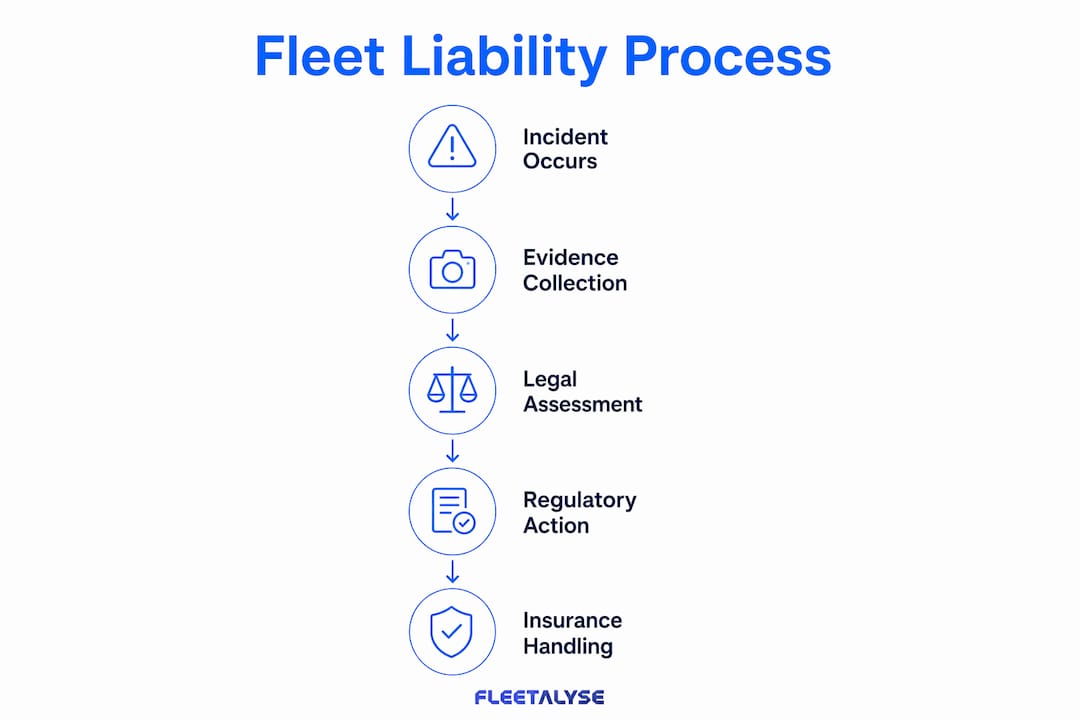
Speed and sequence matter. The actions you take in the first hours after an accident, enforcement visit, or compliance breach shape your legal position for months.
Notify your insurer as required under the policy — late notification is itself a ground for declining cover. For serious incidents involving injury or death, statutory reporting obligations under RIDDOR may apply. Centralise all relevant records: maintenance history, driver logbooks, rostering data, and training certificates. Do not allow vehicles to be repaired or moved until evidence has been captured and documented.
Seek legal advice early if criminal or serious regulatory exposure is possible. Co-ordinate your insurer, legal counsel, and compliance team from the outset rather than in sequence. When DVSA inspectors attend, they will want to see maintenance records, tachograph downloads, driver licence checks, and evidence of a functioning safety management system. Presenting those records calmly and completely is itself a signal of the safety culture that Traffic Commissioners look for.
Key takeaways
Fleet legal liability in the UK spans criminal prosecution, civil damages, and regulatory sanctions — and insurance addresses only one of those three.
| Point | Details |
|---|---|
| Three domains of exposure | Civil, regulatory, and criminal liability each require separate management — insurance alone covers none of them fully. |
| Operator Licence duties | Licence obligations persist regardless of insurance status; loss of good repute can end operations entirely. |
| Vicarious liability risk | Courts examine the substance of working relationships; contractor labels do not automatically remove operator exposure. |
| Documentary evidence | Timestamped maintenance logs, tachograph archives, and telematics records are the strongest defence in court and with DVSA. |
| Fleetalyse | GPS tracking, remote tachograph downloads, and smart dashcams produce the auditable records operators need to demonstrate compliance. |
Why operators underestimate their legal exposure
The most common mistake is treating insurance as a compliance proxy. An operator who carries adequate fleet liability insurance, keeps premiums paid, and assumes that settles the matter is exposed in precisely the ways that matter most: criminal prosecution, Traffic Commissioner hearings, and licence revocation. None of those outcomes are touched by an insurance policy.
Informal practices compound the problem. Oral instructions to drivers, spotty maintenance logs, and tachograph records that exist but are never reviewed create vulnerabilities that only become visible during a DVSA audit or a claimant’s disclosure request. By then, the gap in the record is the evidence.
The shift that protects operators is treating documentation not as administrative overhead but as proactive evidence of a safety culture. A fleet that can produce complete, timestamped records at short notice is demonstrating, in the most concrete terms possible, that it takes its statutory duties seriously. That demonstration matters to Traffic Commissioners, to insurers, and to courts.
Fleetalyse: compliance-ready telematics for UK fleet operators
Staying on the right side of the Road Traffic Act 1988, your Operator Licence conditions, and DVSA expectations requires records that are complete, timestamped, and retrievable fast. Fleetalyse delivers exactly that: GPS fleet tracking, remote tachograph downloads, automated driver hours monitoring, and smart dashcam footage — all held in a single, auditable platform built for UK transport operators.
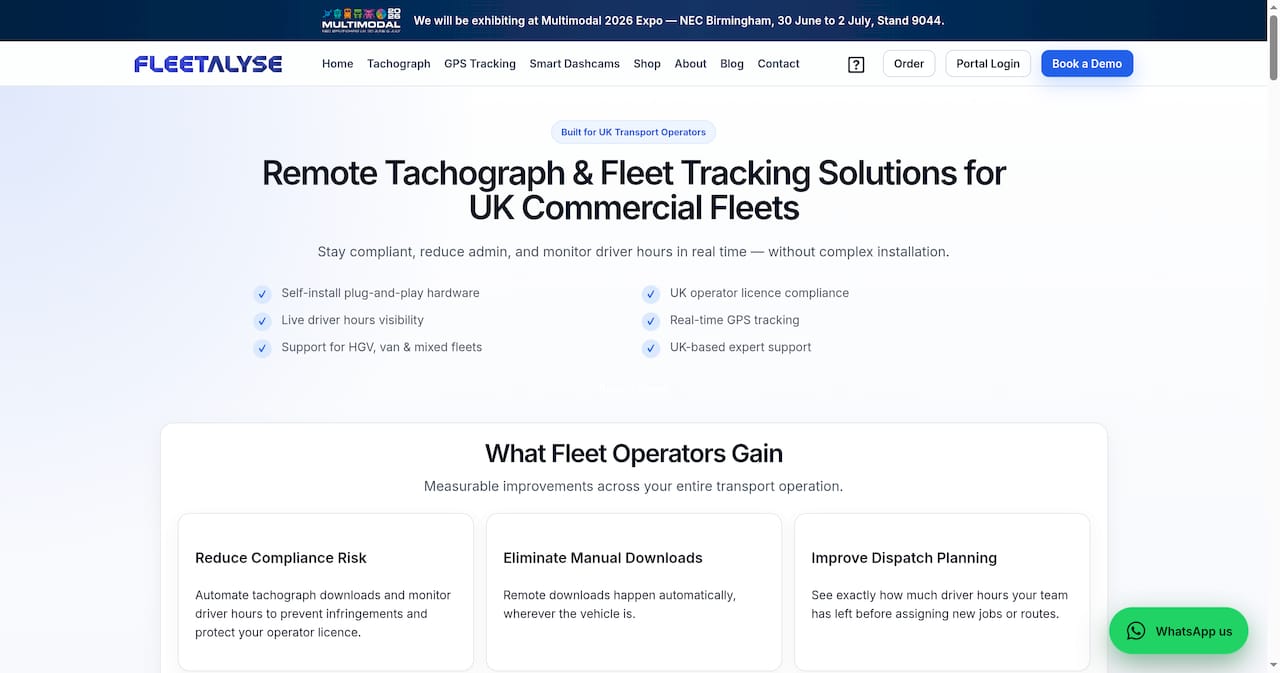
When an enforcement visit arrives, the difference between a smooth interaction and a prolonged investigation often comes down to how quickly you can produce tachograph data and maintenance history. Fleetalyse’s remote download capability means you can retrieve that data within minutes, not hours. For HGV operators, the Teltonika FMC650 tracker integrates directly with the Fleetalyse platform, giving you live location, harsh-event alerts, and a continuous evidence trail without complex installation. Visit fleetalyse.co.uk/solutions to see the full compliance feature set or get in touch to arrange a demonstration.
Authoritative UK sources for fleet operators
- Road Traffic Act 1988 — primary legislation on third-party insurance requirements and the criminal offence of uninsured use.
- Goods Vehicles (Licensing of Operators) Act 1995 — full statutory text covering Operator Licence duties, offences, and sanctions.
- Gov.uk goods vehicle operator licensing guide — practical DVSA guidance on licence applications, conditions, and good repute requirements.
- Automated Vehicles Act 2024 — new statutory framework for automated vehicle liability, including user-in-charge and no-user-in-charge distinctions.
- DVSA enforcement guidance (gov.uk) — details on OCRS scoring, roadside checks, and targeted inspection criteria.
For incidents with potential criminal exposure or large civil claims, seek advice from a solicitor specialising in road transport law. This article is general information, not legal advice — always confirm the current position with a qualified professional or the relevant primary source for your specific situation.