

Fleet insurance group explained for UK operators

Fleet insurance group is defined as a single motor policy covering two or more business vehicles under one agreement, replacing separate individual policies with consolidated cover. A fleet policy typically saves 15% to 40% per vehicle compared to insuring each vehicle separately. That saving compounds quickly across larger fleets. For UK commercial operators running HGVs, vans, or mixed assets, understanding what a fleet insurance group means in practice determines both your compliance position and your annual insurance spend.
What is fleet insurance group and how does it work?
Fleet insurance group is the industry term for a commercial motor policy that pools two or more business vehicles under a single agreement with one insurer. The policy replaces the administrative burden of managing multiple renewal dates, separate claims contacts, and inconsistent cover terms. Fleet insurance simplifies management with a single renewal date, one insurer, and consolidated billing. That consolidation removes the coverage gaps that arise when individual policies fall out of sync.
The policy applies to sole traders, limited companies, and public sector bodies alike. Any business operating vehicles for commercial purposes qualifies. The insurer assesses the fleet as a single risk unit rather than evaluating each vehicle in isolation. This pooled approach is what makes the group model financially and operationally different from individual motor policies.
How does fleet size affect underwriting and policy terms?
Fleet size is the primary variable that determines how an insurer underwrites your policy. The UK market divides commercial fleets into two broad categories.

Mini-fleets cover 2–5 vehicles. Underwriting at this level still resembles individual vehicle assessment, with each vehicle and driver reviewed separately. Premiums reflect the specific risk of each asset.
Traditional fleets start at 5 or more vehicles. At the 5-vehicle threshold, underwriting shifts from individual vehicle assessment to fleet-level risk evaluation. The insurer builds a composite risk profile for the entire operation rather than pricing each vehicle independently.
True fleet policies, typically for 10 or more vehicles, go further. Policies for 10+ vehicles shift underwriting to fleet-level loss ratios, enabling broader ‘any driver’ endorsements that smaller policies cannot offer. That distinction matters if your operation relies on drivers sharing vehicles across shifts.
How fleet size affects your policy in practice:
- Smaller fleets face tighter driver restrictions and higher per-vehicle premiums
- Mid-size fleets gain access to composite risk scoring and negotiated discounts
- Larger fleets unlock ‘any driver’ clauses and loss-ratio-based pricing
- Every additional vehicle strengthens your negotiating position at renewal
Pro Tip: If your fleet sits at 4 vehicles, adding a fifth does not just add cover. It changes your underwriting category entirely and can reduce your per-vehicle premium.
How do insurers calculate fleet insurance group premiums?
Premium calculation for a fleet insurance group goes well beyond counting vehicles. Fleet risk profiles include vehicle mix, composite MVR scores, garaging locations, and telematics safety history. Each factor feeds into the insurer’s assessment of how likely the fleet is to generate claims.
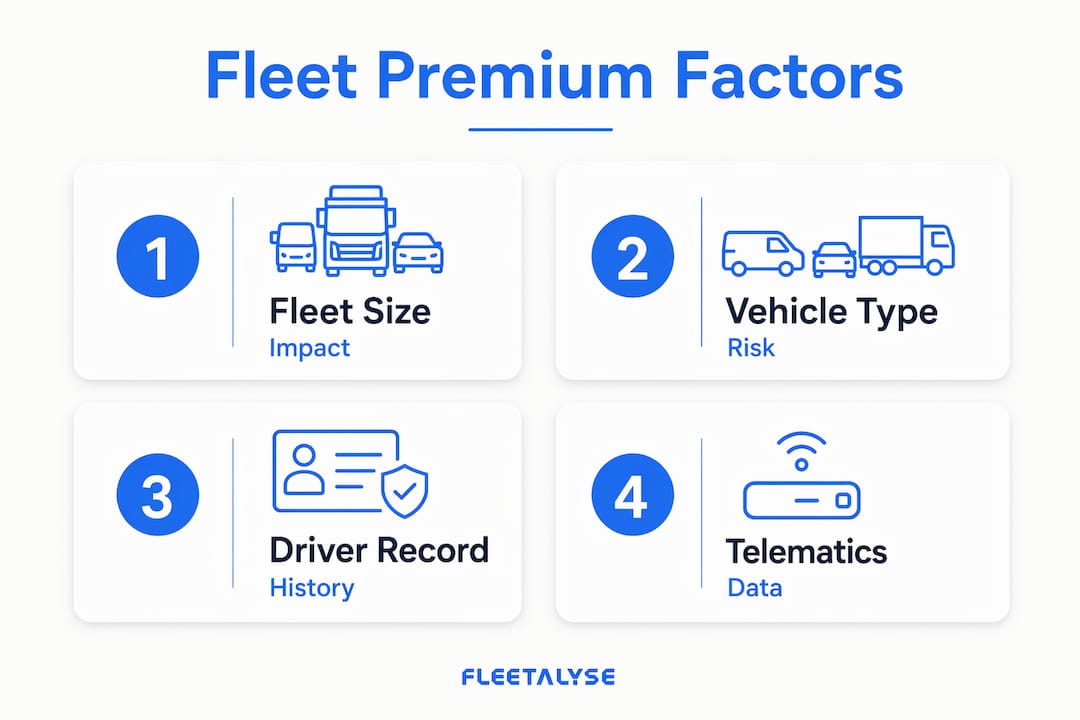
Composite MVR scoring is one of the less-understood elements. Rather than assessing each driver’s motor vehicle record individually, the insurer averages risk across all drivers. A fleet with mostly clean records can absorb one or two higher-risk drivers without a disproportionate premium increase. That pooling effect is a genuine financial advantage of the group model.
Insurers also distinguish between two policy structures:
- Scheduled policies list each vehicle by VIN. Adding or removing a vehicle requires a formal policy amendment.
- Blanket policies cover any vehicle the business operates. Moving to a blanket fleet policy greatly reduces the administrative burden of vehicle additions and removals.
Garaging location affects premium because theft and accident rates vary by postcode. A fleet based in a high-risk urban area will pay more than an equivalent fleet garaged in a rural depot. Operators who document secure overnight parking can use that evidence to negotiate lower rates.
Telematics data is now a standard underwriting input for most UK commercial fleet insurers. Sharing GPS tracking records and driver behaviour scores gives the insurer evidence of proactive risk management. That evidence directly reduces the premium.
What types of coverage does a fleet insurance group policy include?
Fleet insurance group policies offer tiered coverage levels applied uniformly across all vehicles in the policy. The structure mirrors standard motor insurance but is applied at fleet scale.
| Coverage level | What it includes | Best suited for |
|---|---|---|
| Third party only | Liability to other parties | Rarely used for commercial fleets |
| Third party, fire and theft | Liability plus fire damage and theft | Lower-value vehicle fleets |
| Comprehensive | All of the above plus own-vehicle damage | Most UK commercial fleets |
Core fleet coverage includes liability, third party fire and theft, and comprehensive cover, with optional extensions for collision, uninsured motorists, and hired or non-owned vehicles. The optional extensions matter for operators who use hire vehicles during breakdowns or allow drivers to use personal vehicles for business purposes.
Uniform coverage tiers are one of the practical advantages of the group model. Every vehicle in the fleet carries the same level of protection. That consistency prevents the scenario where one vehicle is underinsured because its individual policy was renewed at a lower tier.
Pro Tip: Review your contractual obligations with haulage clients before selecting a coverage tier. Many logistics contracts require comprehensive cover as a minimum condition.
What are the key benefits of fleet insurance groups for UK businesses?
The administrative case for fleet insurance group cover is straightforward. Fleet insurance’s greatest advantage is eliminating administrative complexity with one renewal and a single point of contact for claims and policy management. For operators running 10 or more vehicles, that single point of contact saves significant time across the year.
The financial and operational benefits extend further:
- Single renewal date removes the risk of a policy lapsing unnoticed across a large vehicle pool
- Pro-rata vehicle adjustments mean you pay only for the period a vehicle is active on the policy
- Consolidated claims handling gives you one insurer relationship to manage rather than multiple contacts with different response times
- Scalability means the policy grows with your fleet without requiring a full rewrite
- Negotiating power increases as your fleet size grows, giving you leverage at renewal
Avoiding coverage gaps is the compliance argument for fleet cover. When individual policies are managed separately, a missed renewal or an administrative error can leave a vehicle uninsured. Under a fleet group policy, all vehicles are covered under the same terms until the single renewal date. That consistency supports your Operator Licence obligations and reduces your exposure to DVSA enforcement action.
How can telematics improve your fleet insurance group risk profile?
Telematics is now the most direct lever operators have to reduce fleet insurance premiums. Insurers offer 5–15% discounts for telematics-backed safety programmes, with usage-based insurers offering over 20% for fleets that share detailed driving data. Those discounts apply at renewal and compound year on year as your claims history improves.
The tools that generate the most useful data for insurers include:
- GPS vehicle tracking providing route history, speed data, and geofencing alerts
- Smart dashcams capturing incident footage that supports or defends claims
- Composite driver scoring aggregating harsh braking, acceleration, and cornering events across all drivers
- Driver behaviour monitoring identifying high-risk individuals before they generate a claim
Transparency in risk management via telematics is becoming financially essential, as insurers heavily reward proactive safety data sharing. The practical implication is that fleets without telematics are increasingly priced at a disadvantage compared to those that share data. This is not a future trend. UK commercial fleet insurers are applying it now.
Proactive risk management also improves claims outcomes. When an incident occurs, dashcam footage and GPS records provide objective evidence. That evidence shortens claims resolution times and reduces the risk of fraudulent third-party claims inflating your loss ratio.
Pro Tip: Share your telematics reports with your insurer at mid-term, not just at renewal. Demonstrating an improving risk profile during the policy year builds a stronger case for a discount at the next renewal.
For operators looking at GPS trackers and smart dashcams for commercial fleets, the connection between telematics investment and insurance savings is well established in the UK logistics sector.
Key takeaways
Fleet insurance group cover is the most cost-effective and compliant way for UK commercial operators to insure two or more business vehicles, combining premium savings, administrative simplicity, and consistent cover under a single policy.
| Point | Details |
|---|---|
| Fleet insurance group definition | A single policy covering two or more business vehicles, replacing separate individual policies. |
| Fleet size thresholds | Mini-fleets start at 2–5 vehicles; traditional fleets at 5+; true fleets at 10+ with broader ‘any driver’ terms. |
| Premium savings | Fleet policies typically save 15% to 40% per vehicle compared to individual policies. |
| Telematics discounts | Telematics-backed safety programmes earn 5–15% discounts; usage-based insurers offer over 20%. |
| Administrative benefit | One renewal date, one insurer, and consolidated billing removes coverage gaps across the fleet. |
Why fleet operators underestimate the ‘any driver’ risk
The most common mistake I see UK fleet operators make is treating the ‘any driver’ clause as a blanket permission. It is not. ‘Any driver’ policies often require drivers to be over 25 with clean records to avoid denied claims. Operators who allow younger or higher-risk drivers to use fleet vehicles without notifying their insurer are exposed to claim invalidation at the worst possible moment.
The second mistake is waiting until renewal to engage with the insurer. Your risk profile changes throughout the year. New drivers join, vehicles are added, and incident patterns shift. Operators who share telematics data mid-term and flag improvements proactively get better renewal terms than those who present the same data at the last minute.
The third thing worth saying plainly: fleet size categories are not just administrative labels. Moving from a mini-fleet to a traditional fleet policy changes your underwriting model entirely. If you are sitting at four vehicles and considering a fifth, that decision has direct financial consequences beyond the cost of the additional vehicle. Understanding logistics fleet management best practices helps operators make that transition deliberately rather than by accident.
The direction of travel in UK commercial fleet insurance is clear. Insurers are building data-driven underwriting models that reward operators who share telematics evidence and penalise those who do not. The operators who integrate GPS tracking and driver monitoring now will have a measurable advantage at renewal in 2026 and beyond.
— Vytautas
How Fleetalyse supports your fleet insurance group management
Reducing your fleet insurance premium starts with the quality of data you can put in front of your insurer.
Fleetalyse provides UK commercial fleet operators with GPS vehicle tracking, smart dashcams, and driver behaviour monitoring tools that generate exactly the data insurers reward. The platform covers HGVs, vans, trailers, and mixed fleets, with plug-and-play hardware that requires no professional installation. Real-time visibility into driver activity and vehicle location builds the risk profile evidence that supports lower premiums and faster claims resolution. Visit Fleetalyse to see how the platform supports your fleet insurance group compliance and cost management.
FAQ
What is the minimum fleet size for fleet insurance group cover?
Fleet insurance group cover typically starts at two vehicles. Mini-fleet policies cover 2–5 vehicles, while traditional fleet policies begin at five or more.
Does fleet insurance cover any driver?
‘Any driver’ cover is available on fleet policies, particularly for fleets of 10 or more vehicles. Insurers commonly require drivers to be over 25 with a clean driving record to avoid claim invalidation.
How much does fleet insurance group cover cost?
Fleet insurance premiums depend on vehicle mix, driver records, garaging locations, and telematics history. Fleet policies typically save 15% to 40% per vehicle compared to individual policies, though exact costs vary by insurer and fleet profile.
What types of vehicles can a fleet insurance group policy cover?
Fleet policies cover cars, vans, HGVs, trailers, and mixed asset fleets. The policy applies uniform coverage terms across all vehicles listed or covered under a blanket arrangement.
Can telematics reduce my fleet insurance group premium?
Telematics-backed safety programmes earn standard discounts of 5–15% with most UK insurers. Usage-based insurers offer over 20% for fleets that share detailed driving behaviour data.