

Fleet technology investment explained for UK operators

Fleet technology investment is the strategic allocation of capital towards telematics, AI-driven analytics, compliance software, and integrated fleet management platforms to improve operational efficiency, reduce costs, and maintain regulatory compliance. For UK commercial fleet operators, this means deploying tools such as GPS vehicle tracking, remote tachograph downloads, driver behaviour monitoring, and automated reporting systems. Platforms like Fleetalyse and Viatec Fleet Intelligence represent the modern standard for what these investments look like in practice. The core objective is measurable: lower fuel spend, fewer compliance failures, and better visibility across every vehicle in your operation.
What financial and operational benefits does fleet technology investment deliver?
Fleet technology investment explained in financial terms comes down to one number: the payback period. Returns arrive within 6–12 months post-deployment through fuel savings, maintenance reductions, and compliance efficiency. That timeline is achievable because the gains compound across multiple cost centres simultaneously.
The operational benefits break down into three clear categories:
- Fuel savings: GPS tracking and route optimisation reduce unnecessary mileage. Driver behaviour monitoring flags harsh braking, excessive idling, and speeding, all of which inflate fuel costs directly.
- Maintenance cost reduction: Automated maintenance scheduling catches issues before they become expensive breakdowns. Predictive alerts based on mileage and engine data replace reactive repair cycles.
- Compliance facilitation: Remote tachograph downloads, DVSA-ready reporting, and automated driver hours monitoring remove the manual burden of regulatory record-keeping. GPS tracking and smart dashcams provide the evidence trail required under UK Operator Licence conditions.
The compliance angle is particularly significant for UK HGV operators. A single DVSA prohibition can cost far more in lost operating time than a year’s subscription to a telematics platform. Dashcam footage also reduces fraudulent insurance claims, which is a growing cost pressure for commercial fleets.
Pro Tip: Before committing to any platform, calculate your current cost per vehicle across fuel, maintenance, and compliance administration. Use that baseline to set a minimum ROI threshold and hold your technology provider accountable to it.
How can fleet operators evaluate financial models for fleet tech?
The choice between capital expenditure (CAPEX) and operating expenditure (OPEX) is the first decision every fleet manager faces when investing in fleet solutions. It shapes cash flow, tax treatment, and your ability to upgrade as technology evolves.

| Financial Model | How It Works | Pros | Cons |
|---|---|---|---|
| CAPEX purchase | Outright purchase of hardware and software licences | Full ownership, no ongoing fees | Large upfront cost, technology obsolescence risk |
| OPEX subscription (SaaS) | Monthly per-vehicle fee for software access | Predictable costs, easier to scale | Vendor dependency, ongoing spend |
| Asset finance | Spread hardware costs over 24–60 months | Preserves cash flow, fixed payments | Interest costs, asset tied to contract |
| Fleet-as-a-Service | Bundled hardware, software, and support in one monthly fee | Minimal upfront, fully managed | Less flexibility, potential lock-in |
| R&D tax credits | Government recoupment on qualifying innovation spend | Reduces net cost significantly | Requires qualifying activity, admin overhead |
Flexible ‘as-a-service’ models shift costs from large upfront CAPEX to manageable monthly operating expenses. This matters for operators running 20 to 200 vehicles who need to scale technology without tying up working capital. UK logistics and fleet tech companies can also recoup up to 33% of qualifying R&D expenses through government tax credits, which meaningfully reduces the net cost of integrating new technology.
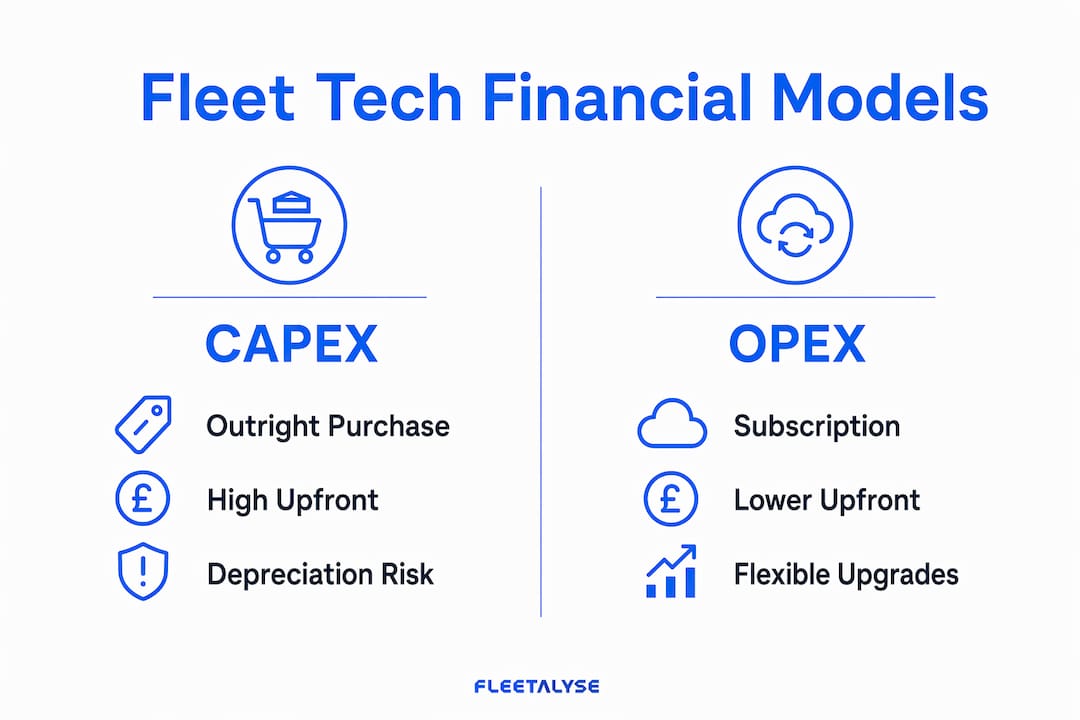
Technology obsolescence is a genuine risk under CAPEX models. Hardware purchased outright in 2022 may not support 4G LTE or AI dashcam integration by 2026. OPEX and as-a-service arrangements transfer that risk to the vendor, who has a commercial incentive to keep the platform current.
Pro Tip: Ask any vendor directly: “What is your hardware upgrade policy within an active contract?” If they cannot answer clearly, that is a red flag for technology lock-in.
Off-the-shelf vs custom fleet management platforms: which is right for you?
The platform decision is where fleet technology ROI is most often won or lost. Off-the-shelf SaaS fleet management software and bespoke enterprise platforms serve fundamentally different operational profiles.
Off-the-shelf SaaS platforms
Off-the-shelf fleet management software costs between £28 and £120 per vehicle per month (equivalent to $35–$150 USD). That pricing model makes deployment fast and financially accessible for fleets of any size. Most platforms include GPS tracking, driver behaviour scoring, maintenance alerts, and basic compliance reporting out of the box. Fleetalyse, for example, combines plug-and-play telematics hardware with a cloud-based platform, meaning operators can be live within days rather than months.
Custom enterprise solutions
Custom fleet management solutions require an initial investment of £400,000 to £2 million (equivalent to $500,000–$2.5 million USD) with significant ongoing development costs. That level of spend is justified only when your operational requirements are genuinely unique: proprietary dispatch algorithms, deep integration with bespoke ERP systems, or competitive differentiation through data ownership.
| Feature | Off-the-Shelf SaaS | Custom Enterprise |
|---|---|---|
| Upfront cost | Low (monthly subscription) | Very high (£400k–£2m+) |
| Deployment time | Days to weeks | Months to years |
| Scalability | High, vendor-managed | High, but costly to modify |
| Integration flexibility | Standard APIs | Fully bespoke |
| Compliance updates | Automatic via vendor | Manual development required |
| Best suited for | Fleets of 5–500 vehicles | Large enterprises with unique needs |
For the majority of UK commercial fleet operators, off-the-shelf platforms deliver the best fleet technology ROI. The faster deployment, lower upfront cost, and automatic compliance updates outweigh the customisation benefits for all but the largest operations. Data migration and system interoperability are the two friction points to plan for: confirm that any new platform can import your existing driver and vehicle records before signing a contract.
How can fleet managers future-proof their technology investments?
Vendor lock-in is the single biggest risk in modern fleet management technology. It occurs when your operational data is held in a proprietary format that cannot be exported or integrated with other systems. The result is a forced dependency on one vendor, regardless of whether their product continues to meet your needs.
Agentic AI platforms like Viatec Fleet Intelligence address this directly by reasoning across telematics, finance, CRM, and other systems without requiring data migration or a centralised data warehouse. That architecture means you can add intelligence to your existing tech stack rather than replacing it. Layered fleet intelligence approaches avoid the rip-and-replace model, preserve data integrity, and improve your ability to adapt as new tools emerge.
Practical steps to protect your investment:
- Demand open APIs. Any platform worth investing in should allow data export in standard formats (CSV, JSON, or direct API access). This is non-negotiable.
- Avoid proprietary hardware ecosystems. If the telematics unit only works with one software platform, you are locked in from day one.
- Assess upgrade paths before signing. Ask vendors how they handle major platform updates and whether existing hardware remains compatible.
- Pilot before scaling. Run a 30-day trial across 5–10 vehicles before committing to a full fleet rollout. Real operational data reveals integration issues that demos never show.
Fleet electrification adds another layer of complexity to future-proofing. Electrification investments face barriers including technology risk and residual value uncertainty, though emerging battery degradation data is improving asset valuation models for lenders and operators alike. Operators who build data collection into their telematics strategy now will be better positioned to access EV-specific financing as the market matures.
Pro Tip: When evaluating technology partners, ask for a reference from a client who has switched away from their platform. How they handle offboarding tells you more about vendor integrity than any sales presentation.
Key takeaways
The most effective fleet technology investment combines a clear ROI baseline, a flexible financial model, and a platform architecture that avoids vendor lock-in from the outset.
| Point | Details |
|---|---|
| ROI arrives quickly | Returns from fleet technology typically materialise within 6–12 months through fuel, maintenance, and compliance savings. |
| Match financial model to cash flow | OPEX and as-a-service models preserve working capital; CAPEX suits operators with strong balance sheets and stable technology needs. |
| Off-the-shelf suits most fleets | SaaS platforms deliver faster deployment and lower upfront cost than custom builds for fleets under 500 vehicles. |
| Demand open data access | Require standard API exports and hardware portability to avoid costly vendor lock-in as your needs evolve. |
| Electrification requires early data | Building telematics data collection now positions your fleet for EV asset financing as valuation models improve. |
The investment decision most operators get wrong
I have spoken with fleet managers across the UK who made the same mistake: they evaluated fleet technology purely on the monthly subscription cost per vehicle. That framing misses the point entirely.
The real question is not what the platform costs. The question is what your fleet costs without it. Unmonitored driver behaviour, manual tachograph analysis, reactive maintenance, and compliance gaps are all expensive. They are just invisible on a spreadsheet until something goes wrong.
My honest observation after working with UK commercial fleets is that the operators who extract the most value from their technology investments are the ones who treat data as an operational asset from day one. They set KPIs before deployment, not after. They track fuel cost per kilometre, not just total fuel spend. They use driver behaviour scores to inform training, not just to monitor.
The emerging shift towards AI-driven fleet intelligence platforms is real, and it will accelerate. Next-generation fleet investment will increasingly depend on AI platforms that unify diverse fleet data, enabling real-time decisions without costly centralised infrastructure. Operators who build that capability incrementally, through layered platforms rather than wholesale replacements, will adapt faster and spend less doing it.
Electrification is the other variable that changes the investment calculus significantly. Early investors who help standardise fleet data and business models stand to gain disproportionately as EV market infrastructure matures. That is not a distant consideration. It is a decision that affects which telematics platform you choose today.
Invest in platforms that give you your data back. Everything else follows from that.
— Vytautas
How Fleetalyse supports your fleet technology investment
Fleetalyse is built specifically for UK commercial fleet operators who need compliance, visibility, and operational control without the complexity of enterprise-scale deployments.
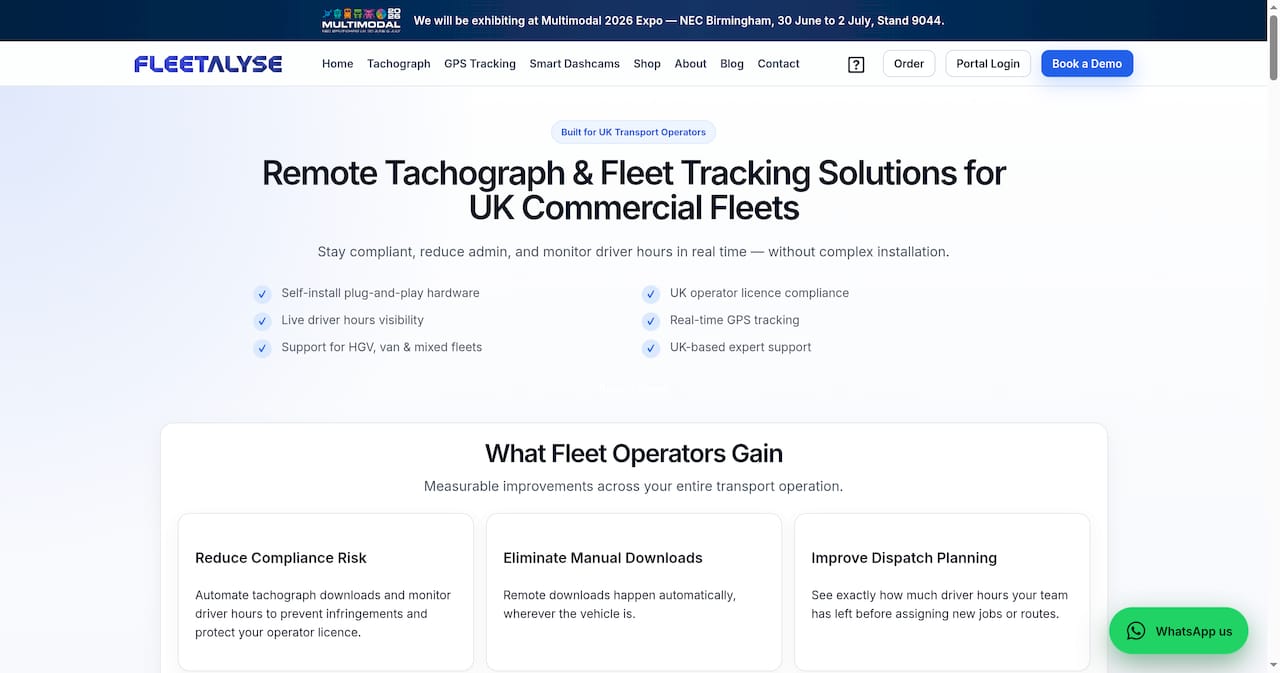
The Fleetalyse platform combines GPS vehicle tracking, smart AI dashcams, remote tachograph downloads, and driver behaviour monitoring in a single integrated system. Plug-and-play hardware means your fleet can be live within days, with no specialist installation required. Support is UK-based, so when you have a question about DVSA compliance or driver hours data, you speak to someone who understands the regulatory context. Explore the full Fleetalyse solutions portfolio to find the right combination of hardware and software for your fleet size and operational profile.
FAQ
What is fleet technology investment?
Fleet technology investment is the allocation of capital towards telematics, GPS tracking, compliance software, and AI analytics platforms to improve fleet efficiency, reduce costs, and maintain regulatory compliance. For UK operators, this typically includes tachograph management, driver behaviour monitoring, and DVSA-compliant reporting tools.
How quickly does fleet technology pay for itself?
Fleet technology typically delivers measurable ROI within 6–12 months through fuel savings, reduced maintenance costs, and lower compliance administration overhead. The exact payback period depends on fleet size, current inefficiencies, and the scope of technology deployed.
What is the difference between CAPEX and OPEX fleet technology models?
CAPEX involves purchasing hardware and software licences outright, while OPEX covers subscription-based or as-a-service models with monthly per-vehicle fees. OPEX models preserve cash flow and transfer technology obsolescence risk to the vendor, making them the preferred choice for most UK fleet operators.
How do i avoid vendor lock-in when investing in fleet software?
Require open API access and standard data export formats before signing any contract. Platforms that use proprietary hardware ecosystems or restrict data portability create long-term dependency that limits your ability to switch providers or integrate new tools.
Is off-the-shelf fleet software sufficient for HGV compliance in the UK?
Off-the-shelf platforms like Fleetalyse are designed specifically for UK HGV compliance requirements, including tachograph management, driver hours monitoring, and DVSA reporting. Custom enterprise solutions are only necessary when your operational requirements fall outside what established SaaS platforms support.