

What is mixed fleet management? A practical guide

Mixed fleet management is the coordinated operation of multiple vehicle types, including electric vehicles (EVs), hybrids, and internal combustion engine (ICE) vehicles, under a single operating strategy to improve efficiency by matching assets to tasks. For UK fleet managers running HGVs alongside vans, trailers, and electrified assets, this is not a theoretical concept. It is the daily operational reality of balancing different powertrains, load capacities, compliance requirements, and maintenance schedules within one business. Platforms like Fleetalyse and OxMaint exist precisely because managing this complexity through separate spreadsheets and disconnected systems produces costly errors, missed compliance checks, and poor vehicle utilisation.
What is mixed fleet management and why does it matter?
Mixed fleet management, known in academic and logistics literature as heterogeneous fleet management, is the practice of coordinating diverse vehicle types within one operational framework. Where a homogeneous fleet runs identical vehicles on identical schedules, a mixed fleet requires distinct planning for each asset class. A 26-tonne HGV, a 3.5-tonne panel van, and a battery-electric light commercial vehicle each carry different load limits, range constraints, maintenance intervals, and regulatory obligations.

The industry term “heterogeneous fleet” appears in supply chain and logistics research to describe this exact challenge. Using both terms matters because the underlying principles are the same: you cannot apply one routing profile, one maintenance template, or one dispatch logic to vehicles that operate fundamentally differently. Integrated dispatch and reporting across all powertrains is the operational standard that separates well-run mixed fleets from those constantly firefighting breakdowns and compliance failures.
The relevance to UK operators is direct. DVSA enforcement, Operator Licence conditions, and the government’s phased transition towards zero-emission vehicles mean that most commercial fleets will be mixed for at least the next decade. Understanding how to manage that mix is not optional. It is a competitive and legal necessity.
Key components of managing a mixed fleet
Effective mixed fleet management rests on several integrated practices. Each one addresses a specific failure point that arises when diverse vehicles are managed as though they were identical.
- Vehicle assignment by task and constraint. Each vehicle should be assigned based on route distance, load weight, access restrictions, and powertrain range. An EV with a 150-mile range is the right choice for a 60-mile urban delivery circuit. It is the wrong choice for a 200-mile motorway run with no en-route charging.
- Powertrain-specific maintenance scheduling. EVs require battery thermal management checks and software updates. ICE vehicles need oil changes, exhaust system inspections, and coolant servicing. Hybrids require both. A single maintenance template applied across all three causes missed safety checks and accelerated component wear.
- Unified telematics data integration. Fleet telematics systems process vehicle location, mechanical health, and driver performance data in a single workflow. When EV battery status, ICE fuel diagnostics, and driver behaviour data feed into one dashboard, planners make decisions based on the full picture rather than a partial view.
- Cross-vehicle performance reporting. Cost-per-mile, fuel and energy consumption, and utilisation rates must be reported per vehicle type and per individual asset. Averaging across the fleet masks which vehicles are underperforming and why.
- Compliance and licence management. In the UK, HGVs and PSVs carry tachograph obligations, driver hours rules, and DVSA inspection requirements that do not apply to light vans. Your management system must distinguish between asset classes when generating compliance alerts.
Pro Tip: When selecting mixed fleet management software, confirm that it supports separate maintenance templates per vehicle category, not just per individual vehicle. Category-level templates save significant configuration time as your fleet grows.
How does mixed fleet route planning work?
Routing a mixed fleet is more complex than routing a homogeneous one because you cannot apply a single optimisation profile to vehicles with different constraints. A route that is perfectly legal and efficient for a 7.5-tonne rigid may be inaccessible to an articulated HGV and unnecessarily long for a light electric van.
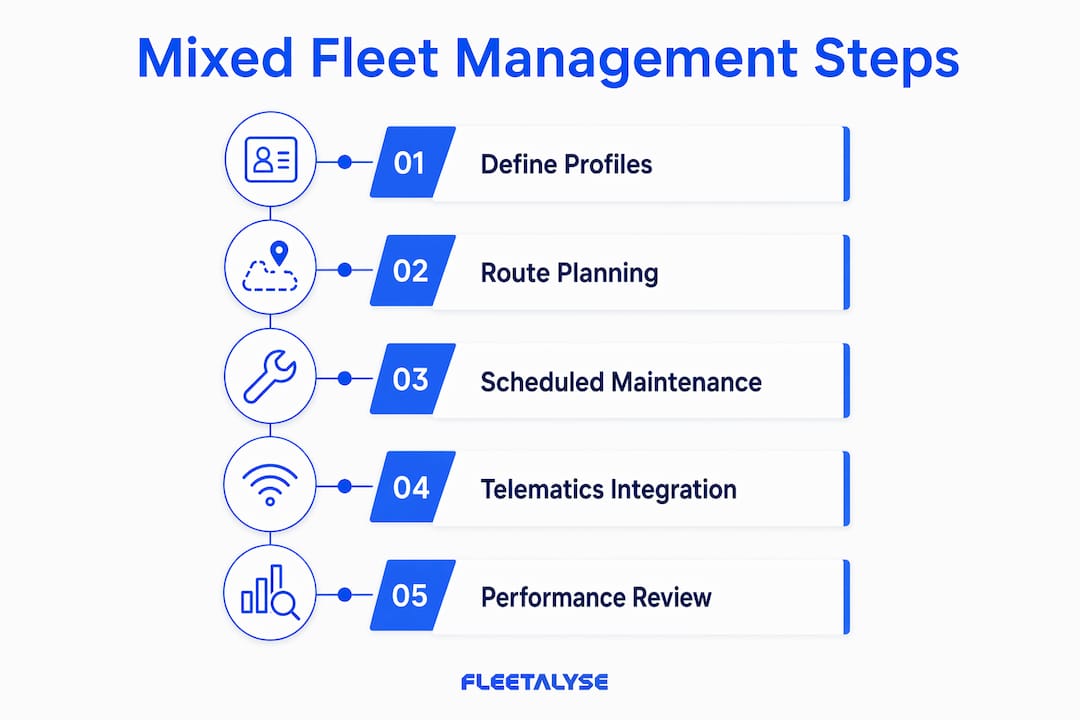
Route4Me’s mixed fleet routing addresses this by applying multiple optimisation profiles simultaneously, each encoding the specific constraints of a given vehicle type. The practical implication is that effective mixed fleet route planning requires you to encode vehicle attributes into your routing system before optimisation runs, not after. Routes that appear feasible on a map but ignore weight limits, bridge heights, or EV range will produce operational violations and poor utilisation.
The four steps to constraint-based mixed fleet routing are:
- Define vehicle profiles. Record gross vehicle weight, height, length, axle configuration, and powertrain range for every asset class in your fleet.
- Map charging and fuel infrastructure. For EVs, identify en-route charging locations and their charge speeds. For ICE vehicles, note preferred fuel card locations. This data feeds directly into route feasibility calculations.
- Set load and access constraints. Enter weight limits, low-emission zone restrictions, and time-window requirements for each vehicle type. In London, for example, ULEZ and LEZ compliance varies by vehicle age and engine standard.
- Run vehicle-specific optimisation. Use a routing tool that applies heterogeneous fleet parameters rather than averaging vehicle characteristics. Research confirms that explicit consideration of vehicle types in assignment and routing yields measurably better utilisation and lower costs.
| Routing approach | Vehicle constraints applied | Typical outcome |
|---|---|---|
| Single-profile routing | No | Route violations, poor utilisation |
| Vehicle-averaged routing | Partial | Reduced violations, suboptimal assignment |
| Constraint-based mixed routing | Yes, per vehicle type | Compliant routes, optimised asset use |
Pro Tip: Encode EV state-of-charge (SoC) thresholds as a hard constraint in your routing system. Range-aware dispatch that cross-references route distance, charging availability, and current SoC before confirming an assignment prevents the most common EV dispatch failures.
How do maintenance needs differ across EV, hybrid, and ICE vehicles?
The biggest maintenance mistake in mixed fleet operations is applying one preventive maintenance template to all powertrains. It is operationally equivalent to servicing a diesel HGV on the same schedule as a bicycle. The components, failure modes, and service intervals are simply different.
Here is how the three main powertrain types diverge in practice:
- ICE vehicles require oil and filter changes, exhaust system checks, coolant servicing, timing belt replacements, and fuel system inspections at mileage-based intervals. These are well-understood tasks, but they do not apply to EVs at all.
- Battery-electric vehicles require battery thermal management monitoring, high-voltage system inspections, software and firmware updates, brake fluid checks (regenerative braking reduces pad wear but fluid still degrades), and tyre rotation schedules adjusted for the additional weight of battery packs.
- Hybrid vehicles carry maintenance obligations from both categories. The combustion engine still needs oil changes and exhaust checks. The battery system still needs thermal and electrical inspections. Hybrid maintenance is additive, not a midpoint between the two.
The risk of a one-size-fits-all approach is not just inefficiency. Missed battery thermal checks on an EV can lead to premature cell degradation and costly pack replacement. Missed exhaust inspections on an ICE vehicle can produce an MOT failure or, worse, a DVSA prohibition notice during a roadside check.
Pro Tip: Train your maintenance team across all three powertrain types, not just the vehicles they currently service most often. As EV adoption increases, technicians who only understand ICE servicing become a bottleneck. Cross-training now reduces that risk before it becomes a staffing crisis.
What are the benefits of a mixed fleet strategy?
A mixed fleet strategy, when managed correctly, delivers three measurable advantages: lower operating costs, reduced emissions, and greater operational resilience.
Mixed fleets reduce fuel expenses and help meet sustainability goals by deploying EVs on short urban routes where they are most efficient and ICE vehicles on longer routes where charging infrastructure is limited. This is not a compromise. It is a deliberate optimisation that uses each powertrain where it performs best. A delivery operation running EVs on city circuits and diesel HGVs on trunk routes can reduce its total energy cost compared to running either type exclusively.
Operational resilience is an underappreciated benefit. A fleet that depends entirely on one powertrain type is exposed to a single point of failure, whether that is a diesel supply disruption, a charging network outage, or a regulatory change. A mixed fleet distributes that risk. If ultra-low emission zone restrictions tighten in a city where you operate, your EVs continue to work unaffected while you plan the transition of remaining ICE assets.
The UK government’s plug-in van grant and the broader zero-emission vehicle mandate create a financial case for phased EV adoption within a mixed fleet. You do not need to convert everything at once. A phased transition, starting with the vehicles best suited to electrification based on route data, reduces capital outlay and allows your team to build operational competence with EVs before scaling.
| Factor | EV advantage | ICE advantage |
|---|---|---|
| Urban short routes | Lower energy cost, zero tailpipe emissions | Higher fuel cost, emission zone charges |
| Long-distance routes | Range constraints, charging time | Established infrastructure, faster refuelling |
| Regulatory risk | Low (zero-emission zones) | High (tightening emission standards) |
| Capital cost | Higher upfront | Lower upfront |
| Operational resilience | Charging network dependency | Fuel supply dependency |
Key takeaways
Mixed fleet management requires vehicle-specific routing, maintenance, and telematics integration to deliver cost savings, compliance, and operational resilience across diverse powertrains.
| Point | Details |
|---|---|
| Define vehicle profiles precisely | Encode powertrain, load, and range constraints before running any route optimisation. |
| Separate maintenance templates | Apply distinct preventive schedules to EVs, hybrids, and ICE vehicles to avoid missed safety checks. |
| Unify telematics data | Consolidate EV battery status, fuel diagnostics, and driver data into one dashboard for accurate planning. |
| Deploy EVs strategically | Assign electric vehicles to short urban routes where they reduce costs and emissions most effectively. |
| Plan for phased EV transition | Use route data to identify which assets to electrify first, reducing capital risk and building team competence gradually. |
Why integrated visibility is the real differentiator
From working closely with UK fleet operators, the pattern I see most often is not a lack of data. It is data that lives in three different systems that never talk to each other. The tachograph data is in one portal, the vehicle tracking is in another, and the maintenance records are in a spreadsheet someone updates on Fridays. When a mixed fleet is managed that way, the dispatcher making an assignment decision at 6am does not know that the EV they are about to send on a 140-mile run has 38% charge remaining and no fast charger on the route.
The operators who manage mixed fleets well share one characteristic: they have invested in a platform that consolidates all of that data before the decision is made, not after the vehicle breaks down. Fleetalyse does exactly this for UK commercial operators, bringing GPS tracking, tachograph compliance, driver behaviour, and asset monitoring into one place. OxMaint takes a similar approach on the maintenance side. Neither platform removes the complexity of running diverse powertrains. What they do is make that complexity visible and manageable in real time.
My honest view is that the technology is not the hard part. The hard part is convincing operations teams to change the process they have used for ten years. The mixed fleet operators who struggle are almost always the ones who bought new software but kept the old workflow. The ones who succeed treated the platform implementation as a process redesign, not just a software purchase.
The future of UK commercial fleets is mixed, and it will stay that way through the transition period to full electrification. The operators building the right data infrastructure now will find that transition significantly less disruptive than those who wait.
— Vytautas
How Fleetalyse supports mixed fleet operations
Managing a mixed fleet without unified visibility is the operational equivalent of running a business without accounts. You can do it for a while, but the errors accumulate.
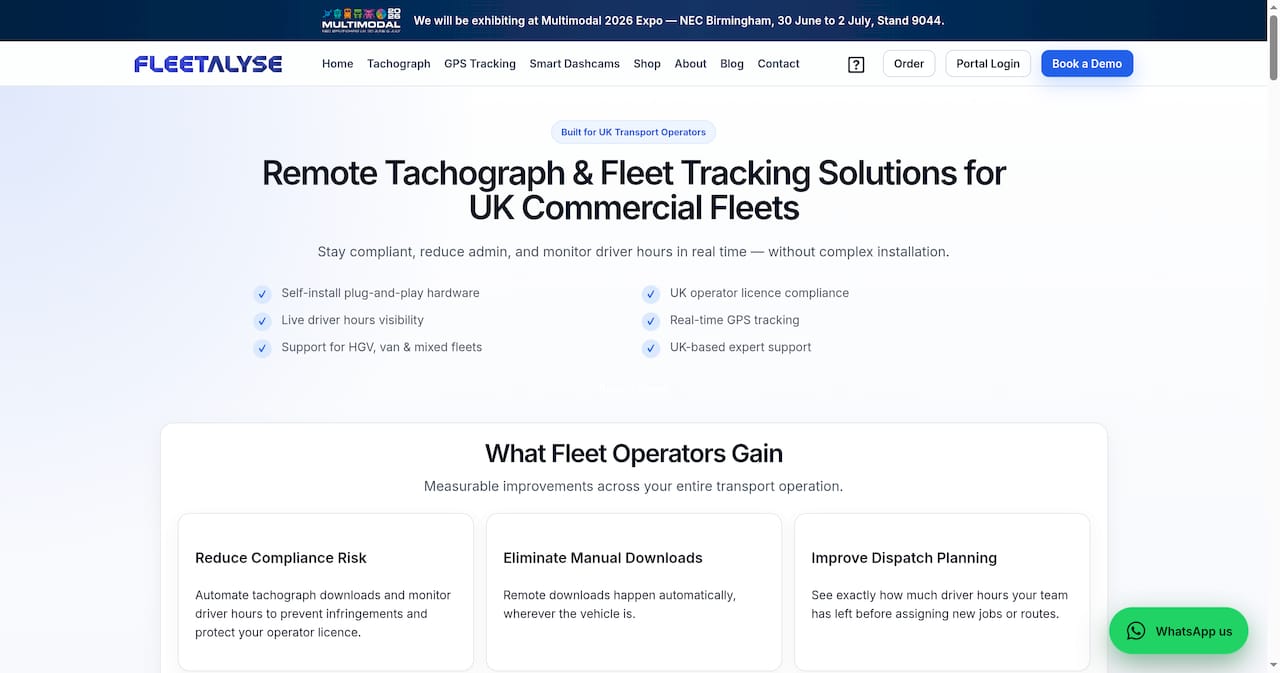
Fleetalyse is built for UK commercial operators running diverse asset classes, from HGVs and trailers to vans and electrified vehicles. The platform brings GPS vehicle tracking, remote tachograph downloads, driver behaviour monitoring, and compliance alerts into a single dashboard. You can track trailers and secondary assets alongside powered vehicles, giving you a complete operational picture rather than isolated dots on a map. For operators managing DVSA obligations and Operator Licence requirements across multiple vehicle types, Fleetalyse reduces the administrative load while improving the accuracy of compliance records. Explore the full range of Fleetalyse fleet solutions to see how the platform fits your specific mixed fleet requirements.
FAQ
What is the mixed fleet management definition?
Mixed fleet management is the coordinated operation of multiple vehicle types, such as EVs, hybrids, and ICE vehicles, under a single strategy that applies vehicle-specific routing, maintenance, and reporting to improve efficiency and reduce costs.
What are the main challenges in mixed fleet management?
The primary challenges are applying separate routing constraints per vehicle type, maintaining distinct preventive schedules for different powertrains, and consolidating diverse telematics data into one planning workflow. Treating all powertrains identically in maintenance and dispatch is the most common and costly operational error.
What software is used for mixed fleet management?
Mixed fleet management software needs to support vehicle-specific routing profiles, separate maintenance templates per powertrain, and unified telematics reporting. Platforms such as Fleetalyse cover GPS tracking, tachograph compliance, and driver monitoring for UK operators managing diverse asset classes.
How do you optimise routes for a mixed fleet?
Effective mixed fleet route planning requires encoding each vehicle’s load capacity, height, weight, and range as hard constraints before optimisation runs. Constraint-based routing tools apply multiple vehicle profiles simultaneously to produce compliant, efficient routes rather than averaging across the fleet.
What are the benefits of running a mixed fleet?
A mixed fleet reduces total energy costs by deploying EVs on short urban routes and ICE vehicles on longer runs, distributes regulatory and supply risk across powertrain types, and supports a phased transition to zero-emission vehicles without requiring full fleet conversion at once.