

Working time directive fleet monitoring: UK compliance guide

What the Working Time Directive means for UK fleet managers
The Working Time Directive, implemented in the UK through the Road Transport (Working Time) Regulations 2005, sets hard limits on total working hours for mobile road transport workers. The average working week must not exceed 48 hours, calculated over a 17-week reference period, with an absolute ceiling of 60 hours in any single week. Night workers face a stricter cap: no more than 10 hours total in any 24-hour period, and that limit cannot be averaged out.
What counts as “working time” is broader than most fleet managers initially assume. Under the directive, working time includes:
- Driving
- Loading and unloading
- Daily vehicle walkaround checks
- Cleaning and maintenance tasks
- Waiting time where the driver is at the employer’s disposal
- Administrative duties directly linked to the transport operation
Breaks, rest periods, and genuine periods of availability (POA) sit outside working time. A POA, where a driver is on standby but genuinely free to rest, must be recorded using the tachograph’s availability mode and still counts toward total duty time records.
The single most common compliance mistake fleet managers make is monitoring EU drivers’ hours rules alone and assuming the Working Time Directive is covered. They are two separate legal obligations. The DVSA checks records for both during roadside stops and site visits. Employers must retain working time records for at least two years and make them available to enforcement agencies on request.
Fleetalyse captures the full picture automatically, pulling tachograph data and GPS activity into one platform so total duty time is recorded from the moment a driver reports for work to the moment they sign off.
Table of Contents
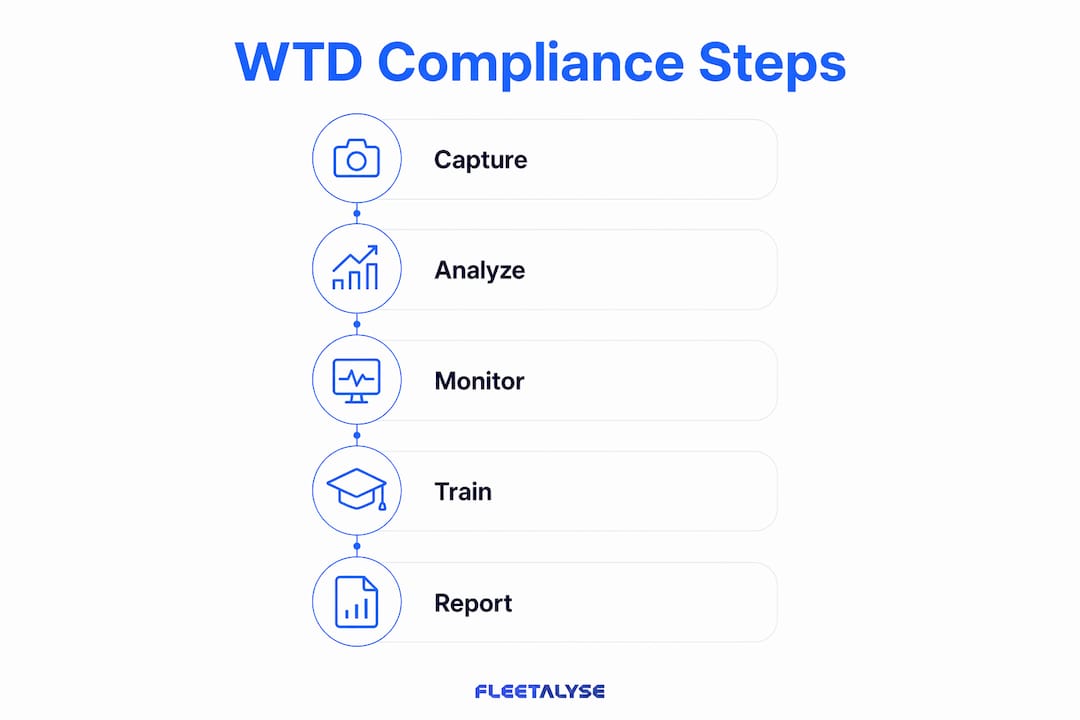
- How to implement Working Time Directive fleet monitoring with Fleetalyse
- How the UK Working Time Directive applies to fleet operations
- Key compliance requirements and definitions you need to know
- Common compliance mistakes and how to avoid them
- How effective monitoring improves operational efficiency
- Driver rest period regulations and how to monitor them
- Integrating Working Time Directive compliance with drivers’ hours rules
- What good fleet monitoring compliance looks like in practice
- Legal consequences of non-compliance for fleet operators
- Training drivers and fleet managers on Working Time Directive requirements
- Fleetalyse: built for UK Working Time Directive compliance
- Key takeaways
How to implement Working Time Directive fleet monitoring with Fleetalyse
Effective monitoring requires more than tracking driving time. Here is how to build a compliant system using Fleetalyse and compatible Teltonika hardware.
- Connect compatible hardware. Fleetalyse works with plug-and-play Teltonika GPS trackers including the FMB003, FMC003, FMC920, and FMT100 for trailers and assets. These devices require no professional installation and begin streaming vehicle and driver data immediately.
- Record full duty time, not just drive time. Configure Fleetalyse to log activity from duty start to sign-off, capturing loading, vehicle checks, and waiting periods alongside driving data.
- Set automated alerts. Configure threshold alerts for approaching the 48-hour weekly average, the 60-hour absolute cap, and the 10-hour night work limit. Real-time alerts let you intervene before a breach occurs, not after.
- Monitor WTD breaks separately from driving breaks. Drivers working 6–9 hours need a break of at least 30 minutes; those working over 9 hours need at least 45 minutes. These breaks can be split into segments of no less than 15 minutes each. Fleetalyse flags when break requirements are unmet independently of tachograph driving break rules.
- Automate tachograph downloads. Automated tachograph analysis removes manual spreadsheet reconciliation and reduces the risk of transcription errors that lead to audit failures.
- Train drivers and managers together. Use Fleetalyse reports in briefings to show drivers exactly where their working time sits against directive limits. Visibility builds accountability.
Pro Tip: Use Fleetalyse working time data alongside route planning to identify shifts where non-driving tasks are consuming hours that push drivers toward the weekly limit. Redistributing loading duties or adjusting departure times can keep drivers well within limits while improving schedule efficiency.
How the UK Working Time Directive applies to fleet operations
Directive 2002/15/EC, transposed into UK law by the Road Transport (Working Time) Regulations 2005, applies to mobile workers employed by transport undertakings whose drivers fall within the scope of EU drivers’ hours rules. Self-employed drivers were brought into scope from March 2009. The directive’s purpose is to protect worker health, reduce fatigue-related road incidents, and align competitive conditions across the transport sector.
For fleet managers, the practical effect is that every hour a driver spends on duty, whether at the wheel or not, must be tracked and measured against the directive’s limits.
Key compliance requirements and definitions you need to know
The directive draws clear lines between four categories of time:
- Working time: all active on-duty tasks as listed above.
- Break: a period during which the driver does no work and is not required to remain available.
- Rest period: a continuous period during which the driver freely disposes of their time.
- Period of availability (POA): standby time where the driver is not required to work but must remain available. POA does not count as working time but must be recorded on the tachograph.
The 48-hour average can be extended to a 26-week reference period where a collective or workforce agreement is in place. No individual opt-out exists for the 48-hour average, unlike the general Working Time Regulations 1998.
Common compliance mistakes and how to avoid them
Treating drivers’ hours and the Working Time Directive as the same thing is the most frequent error. Drivers’ hours rules under Regulation (EC) No 561/2006 govern driving time and rest periods. The Working Time Directive governs total duty time. A driver can be fully compliant with tachograph rules and still breach the directive if non-driving tasks push their weekly hours over the limit.
Other common pitfalls:
- Failing to record waiting time and loading as working time
- Assuming the 45-minute driving break satisfies the WTD break requirement
- Not accounting for hours worked for a second employer when calculating the weekly average
- Keeping records for less than the required two years
Unified data capture, where tachograph data and GPS activity feed into a single platform, is the most reliable way to close these gaps. Siloed records between drivers’ hours tracking and working time monitoring are where audits go wrong.

How effective monitoring improves operational efficiency
Compliance monitoring and operational efficiency are not in tension. Working time data reveals patterns that improve scheduling: which drivers are consistently approaching their weekly limits, where non-driving tasks are eating into available hours, and where route adjustments could reduce total duty time without cutting productivity.
Fleet managers who treat the directive as an efficiency tool rather than a burden tend to see fewer last-minute scheduling changes, lower fatigue risk, and better resource allocation. Automated alerts prevent reactive firefighting by flagging issues before they become infringements. For operations using transport management companies, integrating working time data into wider scheduling decisions produces measurable gains in driver utilisation.
Driver rest period regulations and how to monitor them
Under Regulation (EC) No 561/2006, drivers must not exceed nine hours of daily driving, with a maximum of 56 hours per week and 90 hours across any two consecutive weeks. Daily rest must be at least nine uninterrupted hours; weekly rest must be at least 45 hours regularly, with a reduced rest of 24 hours permitted every other week.
The Working Time Directive adds a separate layer: breaks based on total working time, not driving time alone. Monitoring both simultaneously requires a platform that distinguishes between tachograph driving data and total duty activity. Fleetalyse presents both datasets in a single dashboard, so you can see at a glance whether a driver is approaching a driving limit, a working time limit, or both.
Integrating Working Time Directive compliance with drivers’ hours rules
The two regulatory frameworks overlap but are not interchangeable. Regulation (EC) No 561/2006 sets the driving time and rest period rules; the Working Time Directive sets the total working time limits. A driver on a long-haul run might be within their driving hours but still breach the directive if loading, paperwork, and waiting time push their total duty hours over the weekly cap.
Effective compliance requires both datasets in one place. Tachograph data covers driving time and rest periods; GPS and activity data covers the non-driving elements. Fleetalyse integrates both, giving compliance officers a complete picture rather than two separate reports that need manual cross-referencing. For haulage operations where scheduling compliance is built into the planning stage, tools like AI-assisted scheduling can further reduce the risk of inadvertently building non-compliant rotas.
What good fleet monitoring compliance looks like in practice
A mixed-fleet operator running HGVs and vans across the UK configured Fleetalyse to capture full duty time across all vehicle types. Before implementation, compliance checks relied on manual tachograph downloads and driver-completed timesheets, with reconciliation taking several hours per week. After connecting Teltonika FMC003 units to the van fleet and integrating tachograph data from HGVs, the platform automated both downloads and working time calculations.
The result was immediate visibility into which drivers were approaching the 48-hour weekly average and which shifts were generating excessive non-driving working time through loading delays. Scheduling adjustments reduced average weekly working time and cut the administrative burden on the compliance team. When the DVSA requested records during a site visit, the fleet manager produced two years of complete working time data within minutes.
Legal consequences of non-compliance for fleet operators
The DVSA enforces the Working Time Directive alongside drivers’ hours rules. Penalties for non-compliance include fixed penalty notices, prohibition notices preventing vehicles from operating, and prosecution. Operators found to have systemic record-keeping failures risk their Operator Licence, which is the most serious outcome for any commercial fleet.
Directors and transport managers can be held personally liable where non-compliance is found to be deliberate or negligent. The Traffic Commissioner can impose conditions on an Operator Licence or call an operator to a public inquiry. Maintaining accurate, accessible records for at least two years is the minimum standard required to demonstrate compliance during any enforcement action.
Training drivers and fleet managers on Working Time Directive requirements
Compliance depends on both groups understanding the rules. Drivers need to know what counts as working time, how to record POA correctly on the tachograph, and why WTD breaks are separate from driving breaks. Fleet managers need to understand the reference period calculation, the implications of a second employer’s hours, and how to read compliance reports accurately.
Practical training works best when it uses real data from the fleet’s own operations. Fleetalyse reports showing a driver’s actual working time against directive limits are far more effective in a briefing than generic regulatory guidance. Regular refreshers, particularly when scheduling patterns change or new drivers join, keep awareness current and reduce the risk of inadvertent breaches.
Fleetalyse: built for UK Working Time Directive compliance
Staying compliant with the Working Time Directive is straightforward when your monitoring system captures everything automatically. Fleetalyse gives UK fleet managers a single platform for tachograph downloads, GPS tracking, driver behaviour monitoring, and working time analysis, removing the manual reconciliation that creates audit risk.
The Teltonika FMC003 plugs directly into the OBD port and begins streaming data immediately, with no professional installation required. For trailers and assets, the Fleetalyse tracker range extends visibility across your entire fleet. UK-based support means you get expert help from people who understand DVSA requirements and Operator Licence obligations. Visit fleetalyse.co.uk to see the platform and find the right hardware for your fleet.
Key takeaways
Effective Working Time Directive fleet monitoring requires capturing all on-duty activities, not just driving time, and maintaining two years of accessible records to satisfy DVSA enforcement.
| Point | Details |
|---|---|
| 48-hour weekly average | The directive caps average working time at 48 hours per week, with an absolute maximum of 60 hours in any single week. |
| Night work limit | Night workers cannot exceed 10 hours of total working time in any 24-hour period; this limit cannot be averaged. |
| WTD breaks are separate | Drivers working 6–9 hours need at least 30 minutes of break; over 9 hours requires 45 minutes, independent of driving break rules. |
| Two-year record retention | Employers must keep working time records for at least two years and produce them for DVSA on request. |
| Fleetalyse automates compliance | Fleetalyse integrates tachograph and GPS data to monitor total duty time, set threshold alerts, and generate audit-ready reports. |