

Commercial vehicle tracking benefits for UK fleets

Most fleet operators think of vehicle tracking as a digital map showing dots moving across a screen. That framing undersells it considerably. The real commercial vehicle tracking benefits extend far beyond location: they touch compliance, security, driver safety, insurance costs, and the kind of operational data that actually changes how you run your business. If you manage HGVs, vans, or trailers in the UK, understanding what modern tracking genuinely delivers, and what it requires of you legally, is no longer optional. It is the foundation of a well-run fleet.
Table of Contents
- How vehicle tracking supports compliance with UK transport regulations
- Enhancing fleet security and reducing cargo theft with tracking technologies
- Operational efficiency gains through advanced vehicle tracking data
- Balancing privacy and legal requirements in vehicle tracking use
- Leveraging trailer tracking for compliance and maintenance optimisation
- Why effective commercial vehicle tracking requires integrating technology with policies and workflows
- Explore Fleetalyse solutions for your commercial vehicle tracking needs
- Frequently asked questions
Key Takeaways
| Point | Details |
|---|---|
| Comprehensive compliance | Commercial vehicle tracking helps UK fleets meet strict tachograph and driver hours regulations efficiently. |
| Cargo theft reduction | Active tracking technologies significantly lower cargo theft losses and insurance premiums for fleets. |
| Operational insights | Beyond location, tracking data on driving and engine use enhances safety and cuts fuel and maintenance costs. |
| Legal and privacy balance | UK GDPR and employment law require lawful, transparent, and proportionate vehicle tracking implementation. |
| Integrated policies essential | Tracking benefits depend on strong internal policies, clear communication, and integration into workflows. |
How vehicle tracking supports compliance with UK transport regulations
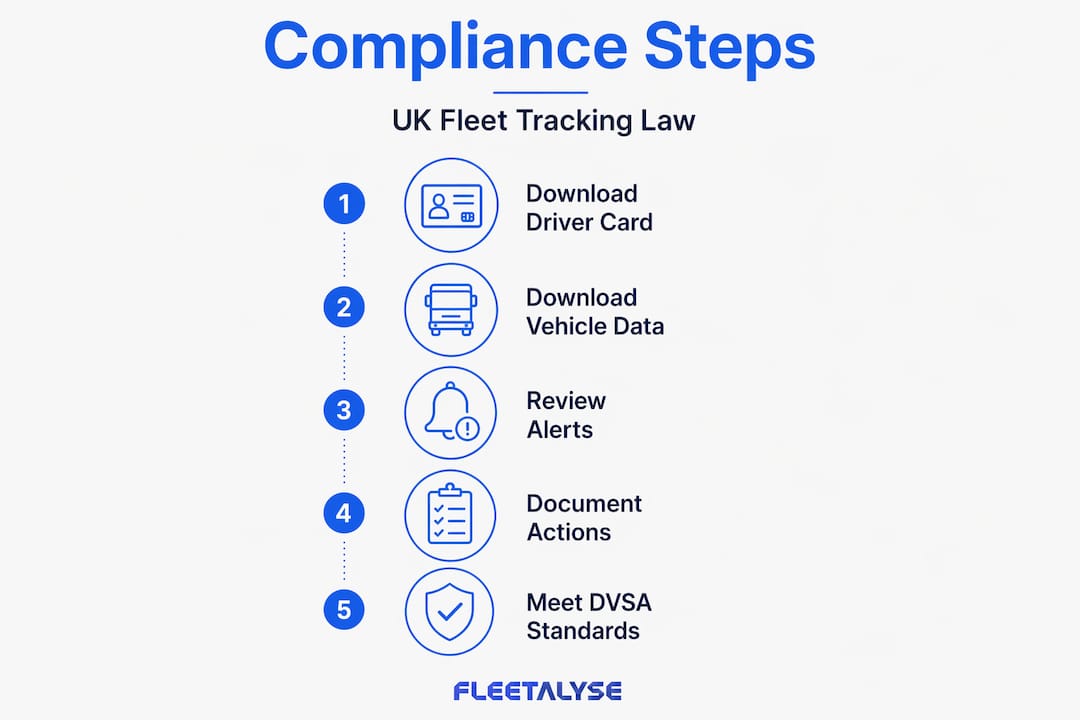
For any operator running HGVs under an Operator Licence, tachograph compliance is not a box-ticking exercise. It is a legal obligation with real consequences when it goes wrong. Tachograph compliance solutions built into your tracking platform are one of the most practical ways to stay ahead of those obligations.
Here is what the rules actually require:
- Download driver card data at least every 28 days.
- Download vehicle unit data at least every 56 days.
- Retain all downloaded data for a minimum of 12 months.
- Make records available for DVSA inspection on request, often at short notice.
- Ensure no data gaps exist between download cycles that could suggest tampering or avoidance.
Driver card data must be downloaded at least every 28 days, with vehicle unit data required every 56 days, and missing these windows constitutes a recordable breach. A single missed download might seem minor, but during a DVSA roadside check or operator compliance investigation, a pattern of gaps can escalate quickly into a serious infringement finding.
The administrative burden of manually chasing drivers to hand in their cards is one of the most common frustrations we hear from transport managers. Remote tachograph downloading removes that friction entirely. Remote tacho downloading improves productivity and reduces the office time spent chasing data, particularly for fleets with vehicles returning to different depots or drivers working varied shift patterns.
When tracking hardware integrates directly with the vehicle’s tachograph head unit, data is retrieved automatically whenever the vehicle is within range of a depot Wi-Fi point or via cellular connection. Your compliance records are current, timestamped, and audit-ready without anyone needing to remember a deadline.
Pro Tip: Set automated alerts in your tracking platform for any vehicle approaching its 56-day vehicle unit download window. A seven-day warning gives you time to act before a breach occurs, rather than discovering the gap during an audit.
Enhancing fleet security and reducing cargo theft with tracking technologies
Cargo theft in the UK is a persistent and costly problem, particularly for operators carrying high-value goods or pharmaceuticals. The advantages of vehicle tracking in a security context go well beyond knowing where a vehicle stopped overnight.
Active asset tracking creates what amounts to a real-time security perimeter around your vehicles and trailers. The key capabilities include:
- Geofence alerts that notify you the moment a vehicle leaves an approved zone outside operational hours.
- Door sensor integration that flags unauthorised access to trailer or vehicle cargo areas.
- Live location sharing with law enforcement in the event of a theft, dramatically improving recovery rates.
- Dashcam footage linked to location events, providing evidence of incidents at loading bays or fuel stops.
The numbers behind fleet security tracking are striking. Organisations using asset tracking saw a 76% reduction in annual losses from cargo theft and a 31% decrease in insurance premiums. That insurance figure alone is worth examining. Insurers price risk, and a fleet with documented, active tracking is demonstrably lower risk than one without. For larger fleets, that 31% reduction can represent a six-figure saving annually.
“The shift from passive GPS to active asset monitoring means operators are no longer just recording what happened. They are preventing it.”
Customer confidence is another benefit that rarely appears in the headline numbers. When you can tell a client exactly where their consignment is, and prove it arrived without incident, you are building the kind of operational credibility that wins repeat contracts.
Operational efficiency gains through advanced vehicle tracking data
Location data is the starting point, not the destination. Modern fleet tracking now captures speed, idling behaviour, engine fault codes, harsh braking events, and fuel consumption patterns, all of which reduce waste and help operators demonstrate safe, efficient operations.
The benefits of fleet management built on this richer data set include:
- Reduced idle time: Engines left running at depots or during long waits burn fuel and add unnecessary engine hours. Tracking idle time by vehicle and driver lets you target the problem precisely.
- Proactive maintenance scheduling: Engine fault codes transmitted in real time mean you can book a vehicle in for repair before a minor issue becomes a roadside breakdown.
- Driver behaviour monitoring: Harsh acceleration, sharp cornering, and speeding all increase tyre wear, fuel consumption, and accident risk. Scored driver behaviour reports give you the data to coach, not just criticise.
- Route adherence: Tracking confirms whether drivers are following planned routes, which matters for fuel costs, customer ETAs, and insurance validity.
| Metric tracked | Operational benefit | Typical cost impact |
|---|---|---|
| Idle time | Reduced fuel waste | Up to 5% fuel saving per vehicle |
| Engine fault alerts | Fewer unplanned breakdowns | Lower roadside recovery costs |
| Harsh braking events | Extended brake and tyre life | Reduced parts and labour spend |
| Route adherence | Accurate ETAs, fewer complaints | Improved customer retention |
Pro Tip: When reviewing driver behaviour data, look at fleet-wide trends before focusing on individuals. If 60% of your drivers are flagging harsh braking on the same stretch of road, the issue is likely the route, not the drivers.
Cost savings with vehicle tracking compound over time. A 5% fuel saving per vehicle sounds modest until you multiply it across a fleet of 50 vehicles running 80,000 miles each per year.
Balancing privacy and legal requirements in vehicle tracking use
Vehicle tracking counts as personal data processing under UK GDPR. That is not a technicality. It means you have legal obligations before you install a single tracker, and ignoring them exposes you to regulatory action and employment disputes.
Here is what a lawful tracking programme requires:
- Establish a lawful basis. For most fleet operators, this will be legitimate interests, meaning the business need for tracking outweighs the privacy impact on drivers. Document this assessment.
- Inform employees clearly. Drivers must know tracking is in place, what data is collected, how long it is retained, and how it may be used, including in disciplinary proceedings.
- Apply proportionality. Tracking working hours is generally proportionate. Tracking a driver’s location during their personal time, if they take a company vehicle home, requires careful justification.
- Conduct a Data Protection Impact Assessment (DPIA) if your tracking involves high-risk processing, such as continuous real-time monitoring of all driver movements.
- Write a clear vehicle tracking policy that covers purpose, retention periods, access controls, and the circumstances under which data may be used in disciplinary or legal proceedings.
Employees must be informed and monitoring must be proportionate, with a documented lawful basis, and high-risk tracking may require a DPIA. The UK vehicle tracking privacy guidance is worth reviewing before you deploy any new hardware.
Pro Tip: Your vehicle tracking policy should be a standalone document, not buried in a general IT policy. Have drivers sign to confirm they have read it, and keep those records. If tracking data is ever used in a disciplinary case, that signed acknowledgement is your first line of defence.
Leveraging trailer tracking for compliance and maintenance optimisation
Tracking the tractor unit is standard practice for most UK operators. Tracking the trailer is where many fleets leave significant value on the table. Trailers spend a large proportion of their working lives detached from any tractor, sitting at customer yards, loading bays, or roadside locations, and without their own tracking, they are effectively invisible.
Modern trailer tracking systems include connected sensors that go well beyond location:
- Brake performance monitoring that flags deteriorating brake efficiency before it becomes a safety or MOT failure.
- Door open and close events recorded with timestamps and GPS coordinates.
- Temperature monitoring for refrigerated trailers, with alerts for excursions outside set ranges.
- Tyre pressure sensors that reduce blowout risk and extend tyre life.
- Coupling detection to confirm which tractor is connected to which trailer at any given time.
Tracking trailers for brake performance and anomaly detection supports both compliance and operational uptime, which is particularly relevant given the DVSA’s focus on trailer roadworthiness during enforcement activity.
| Tracking approach | Visibility | Compliance support | Maintenance data |
|---|---|---|---|
| Tractor-only GPS | Vehicle location only | Driver hours via tachograph | Engine data only |
| Integrated tractor and trailer | Full asset visibility | Tachograph plus trailer events | Brake, tyre, door, temperature |
Visiting the trailer tracking technology available for your fleet type is worth doing before your next trailer inspection cycle. The data trends from even three months of sensor monitoring can transform how you schedule servicing.
Why effective commercial vehicle tracking requires integrating technology with policies and workflows
Here is the uncomfortable truth that most telematics conversations avoid: the technology is the easy part. Buying GPS units, fitting tachograph head units, and getting a dashboard full of data takes weeks. Building the internal processes that make that data actionable takes considerably longer, and most operators underestimate it.
We have seen fleets with excellent hardware generating compliance alerts that nobody acts on, because there is no defined workflow for who receives the alert, what they are expected to do, and by when. The alert fires, the email arrives, and it sits unread while the download window closes. Tracking systems must be embedded into compliance workflows with clear policies to satisfy DVSA and make data genuinely actionable.
The vehicle tracking system advantages that actually show up in your DVSA compliance score and your P&L are the ones tied to documented processes. Who reviews the driver behaviour reports each week? Who escalates a brake anomaly alert to the workshop? Who checks that every driver card has been downloaded before the 28-day window closes? These are workflow questions, not technology questions.
Driver trust matters too. Transparent monitoring, where drivers understand what is tracked, why it is tracked, and how the data benefits them as well as the business, produces better outcomes than surveillance-style monitoring that drivers resent and work around. Operators who involve drivers in reviewing their own behaviour scores consistently see faster improvement than those who use the data only punitively.
The fleet tracking best practices that separate high-performing fleets from average ones are almost always about governance and culture, not the specification of the hardware. Invest in both, and the return on your tracking platform multiplies significantly.
Explore Fleetalyse solutions for your commercial vehicle tracking needs
The insights in this article reflect the real operational and compliance challenges UK fleet operators face every day. Fleetalyse is built specifically to address them, combining GPS vehicle tracking, remote tachograph downloads, driver behaviour monitoring, and smart dashcam integration into a single platform designed for UK compliance requirements.
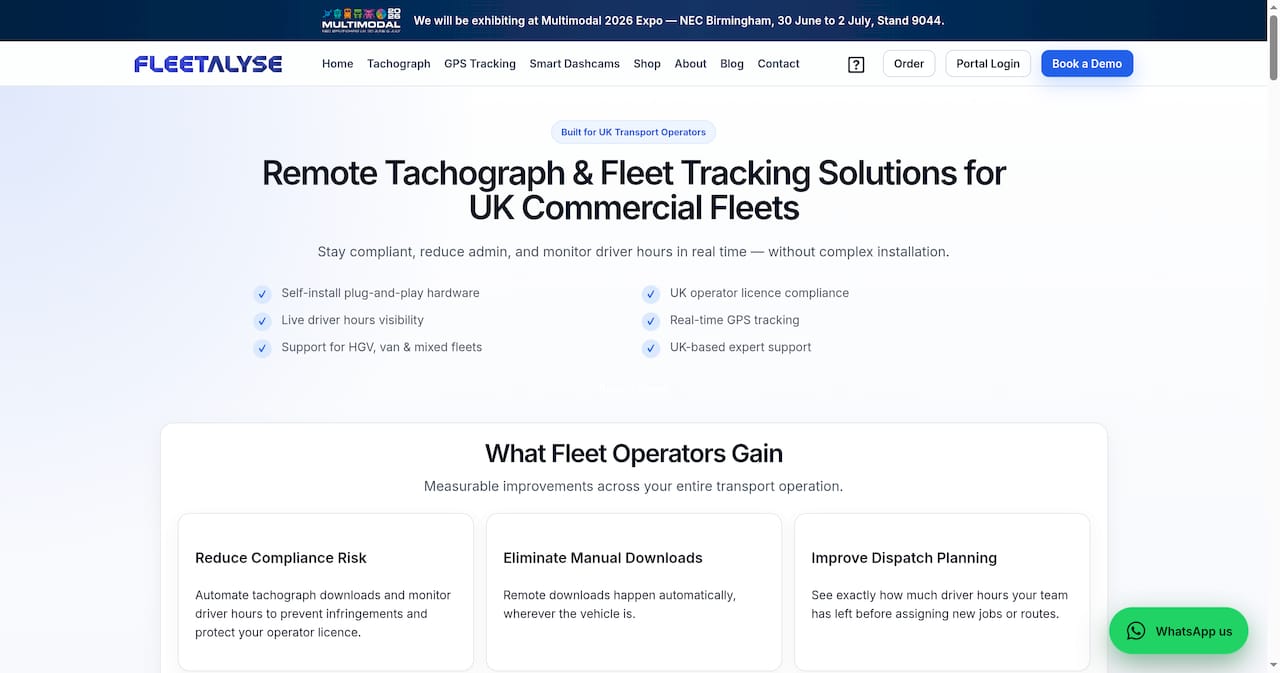
Whether you run a small van fleet or a mixed HGV and trailer operation, the Fleetalyse GPS fleet tracking platform scales to your needs without requiring specialist installation or a large IT team. Our plug-and-play telematics units connect directly to your vehicles’ CAN-bus systems, and our UK-based support team is on hand for setup and troubleshooting. If you are ready to move beyond dots on a map, shop Fleetalyse GPS trackers and dashcams and see what a fully integrated tracking solution looks like in practice.
Frequently asked questions
How often must UK HGV driver card and vehicle unit data be downloaded?
Driver card data must be downloaded at least every 28 days, and vehicle unit data must be downloaded at least every 56 days under UK regulations. Missing these windows constitutes a recordable breach that can affect your Operator Licence standing.
Can vehicle tracking data be used for disciplinary action against drivers in the UK?
Yes, but only where tracking has been implemented lawfully, with transparent policies, a documented lawful basis, and disciplinary processes that follow fair statutory procedures. Lawful basis, transparency, and fair investigation practices must all be in place before data is used in this way.
What are the main security benefits of commercial vehicle tracking?
Active tracking reduces cargo theft through real-time monitoring, geofence alerts, and door sensor integration. Organisations using asset tracking report a 76% reduction in theft losses and a 31% decrease in insurance premiums.
How does vehicle tracking improve operational efficiency beyond location monitoring?
Modern systems monitor driving behaviour, idle time, engine health, and route adherence, enabling fleets to reduce fuel waste, cut maintenance costs, and schedule servicing proactively. Speed, idling, and engine behaviour data are now standard outputs from quality telematics platforms.
What privacy considerations must UK fleet operators keep in mind when using vehicle tracking?
Operators must establish a lawful basis under UK GDPR, inform employees clearly, apply proportionate monitoring, conduct a DPIA where required, and maintain a written tracking policy. Vehicle tracking must comply with UK GDPR including transparency and proportionality requirements before deployment.