

Your operators licence isn't just a piece of paper to be filed away; it's a hard-earned privilege that requires active protection through digital precision. We understand that the administrative weight of manual record-keeping often feels overwhelming. The constant threat of DVSA audits and heavy fines creates a pressure that can distract from your core operations. It's difficult to manage the nuances between Standard and Restricted requirements whilst trying to maintain a "Green" OCRS.
This guide provides the expert clarity you need to master the application process and maintain your status in 2026. You'll learn the latest financial standing rates, such as the £9,100 required for the first vehicle on a Standard licence. We also cover the DVSA's shift toward digital PG10 prohibition notices and the current 9-week average processing time for new applications. We'll show you how integrating tools like remote tachograph downloads and live driver hours transforms your compliance into a streamlined, audit-ready asset. By the end of this guide, you'll have a clear roadmap to navigate the Vehicle Operator Licensing system with confidence.
Key Takeaways
- Distinguish between Standard National, International, and Restricted tiers to ensure your business operates within its legal scope.
- Streamline your operators licence application by preparing for the 9-week lead time and meeting strict financial standing requirements.
- Move beyond a "set and forget" mindset to meet your statutory promises through rigorous 6-week vehicle inspection cycles.
- Automate compliance with Remote Tachograph Download and Live Driver Hours to maintain an audit-ready, digital record of every journey.
- Integrate tachograph analysis directly into your management workflow to secure a "Green" OCRS and reduce the risk of public inquiries.
Understanding the UK Operator’s Licence System
The operators licence, or "O licence," acts as the legal backbone for the UK's commercial transport sector. It's not a mere administrative formality. It is a specific permission granted to businesses, ensuring they possess the financial standing and professional competence required to run a safe fleet. If your business uses vehicles with a gross plated weight of more than 3.5 tonnes to carry goods, this licence is a legal necessity. Operating without one is a criminal offence that leads to vehicle impounding and heavy fines.
Regulatory oversight is managed by the Traffic Commissioners for Great Britain. These independent officials are responsible for licensing and regulating the industry. They hold the power to grant your application or, in cases of serious non-compliance, revoke it entirely. The system relies on the principle of "good repute." This means you must prove you are fit to manage a transport operation through consistent adherence to safety and environmental standards.
Which Licence Type Does Your Business Require?
Choosing the correct tier is vital for your commercial strategy. Selecting the wrong type can lead to immediate licence revocation if you're caught operating outside your permitted scope. There are three primary categories:
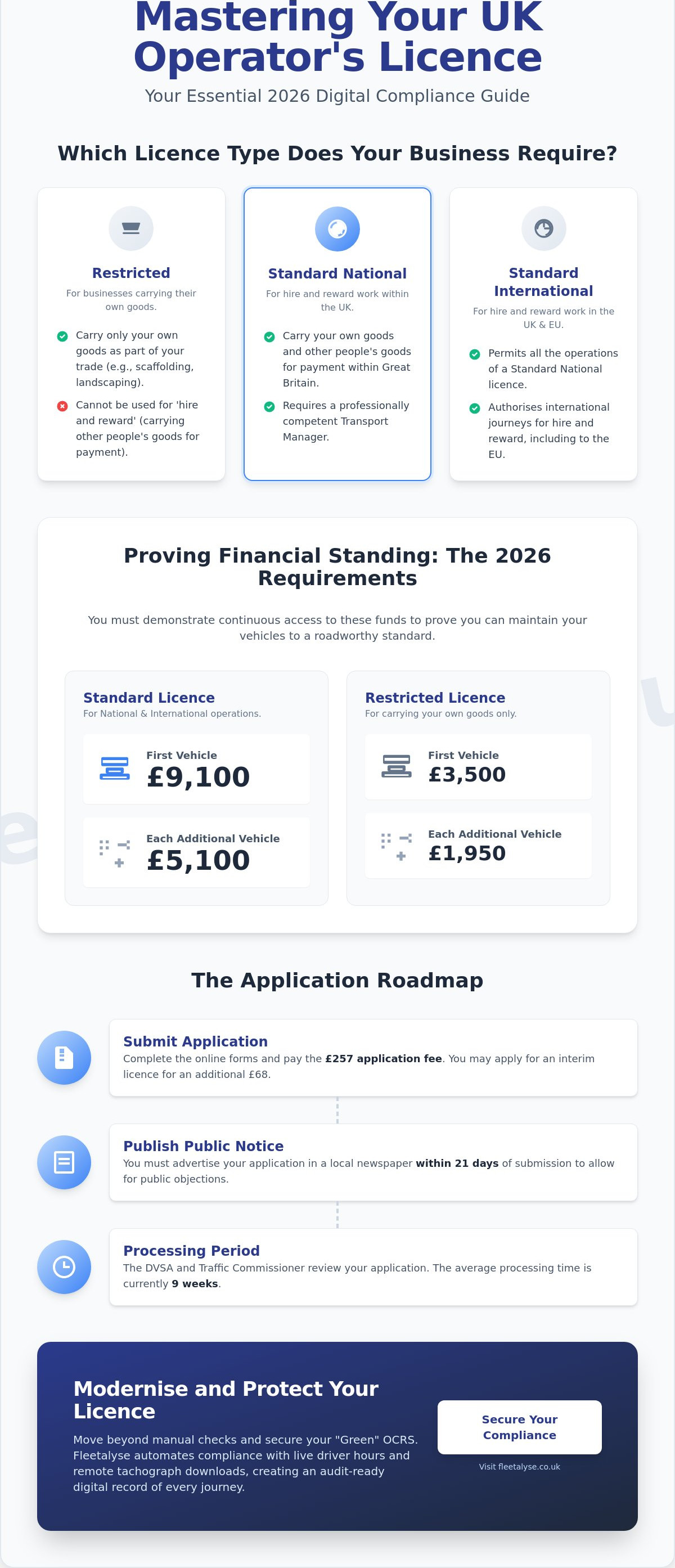
- Standard National: This allows you to carry your own goods and other people's goods for "hire and reward" within the UK. It requires a qualified Transport Manager.
- Standard International: This is essential for hauliers who cross borders. It permits hire and reward work both in the UK and throughout the European Union.
- Restricted: This is designed for businesses that only carry their own goods as part of their trade, such as scaffolding or landscaping. You cannot work for hire and reward on this licence.
The Heavy Goods Vehicle (HGV) vs. Van Distinction
The 3.5-tonne threshold is the critical marker for most operators. However, regulations are becoming increasingly granular. Since May 2022, "Light Goods Vehicle" rules mean that vans or cars pulling trailers with a gross weight between 2.5 and 3.5 tonnes also require an operators licence if they are used for hire or reward internationally. This change caught many regional operators off guard. It's a clear signal that the DVSA is tightening its grip on smaller commercial vehicles. Whether you run a single van or a fleet of HGVs, the "hire and reward" trigger remains the most significant factor in determining your level of regulatory burden.
Navigating the Application Process and Statutory Requirements
Securing an operators licence requires patience and meticulous organisation. The standard processing time is currently 9 weeks. If your business needs to move sooner, you can apply for an interim licence for a £68 fee, though this is only granted once your main application is well underway. You'll also need to pay the £257 application fee upfront. A critical, non-negotiable step is the public notice. You must advertise your application in a local newspaper within 21 days of submitting it. This allows the community to raise concerns regarding your chosen Operating Centre.
Your Operating Centre must be fit for purpose. It requires sufficient space for your fleet and safe access to public roads. Always verify local planning permissions before committing to a site. Traffic Commissioners will scrutinise whether the location can handle the environmental impact of your HGVs. For a deeper dive into the legal framework, consult the Goods vehicle operator licensing guide. This document outlines the full scope of your statutory duties and the consequences of failing to meet them.
Proving Financial Standing in 2026
Financial standing is a mandatory safety net. It proves you have the funds to maintain your vehicles properly and keep them in a roadworthy condition. For Standard licences, you must show £9,100 for the first vehicle and £5,100 for each additional one. Restricted licence holders must demonstrate £3,500 for the first vehicle and £1,950 thereafter. You'll need to provide 28 days of original bank statements. The Traffic Commissioner looks at the average balance. If your funds drop below these levels, your operators licence is at risk. It's a continuous requirement, not a one-time hurdle.
The Professional Competence Requirement
Standard licences demand a designated Transport Manager. This individual must hold a Certificate of Professional Competence (CPC). They carry the legal weight of your fleet's compliance on their shoulders. You can employ an internal manager or contract an external one, provided they have sufficient time to manage your fleet properly. They oversee maintenance records and driver hours. To support their role and ensure your data is always audit-ready, you can order digital tachograph solutions that simplify daily monitoring. Their repute is tied to your business; if the business fails an audit, their professional standing is also jeopardised.
Beyond the Application: The Reality of Continuous Compliance
Obtaining your operators licence is just the beginning of a long-term legal commitment. When you sign the application, you agree to a specific set of "Operator’s Promises." These aren't optional suggestions. They are mandatory standards for vehicle maintenance, driver management, and record-keeping. Many businesses fall into the dangerous "set and forget" trap. They treat compliance as a one-time hurdle rather than a continuous operational requirement. This neglect leads to a rapid decline in safety standards and, eventually, a call from the Traffic Commissioner.
Your O-Licence security is directly tied to driver behaviour and vehicle safety. Even after you apply for your operator licence online and receive your approval, the DVSA monitors your performance. A single driver's speeding offence or a missed daily walk-around check reflects on the operator. If your drivers regularly commit hours infringements, the DVSA views this as a management failure. You are responsible for every vehicle and driver under your licence, regardless of whether you are in the office or on the road.
The Consequences of Non-Compliance
The DVSA uses the Operator Compliance Risk Score (OCRS) to target enforcement. This system calculates the risk you pose based on historical data from roadside stops and MOT results. A "Red" score makes your vehicles a magnet for enforcement officers. If serious failings are identified, you will face a Public Inquiry. This is a formal hearing where the Traffic Commissioner decides if you remain fit to hold a licence. Revocation is a real possibility. It means the immediate end of your transport operations and can lead to a lifetime ban from the industry.
The Shift from Paper to Digital Audits
Manual record-keeping is no longer the industry standard. The DVSA increasingly prefers searchable, digital records over dusty lever-arch files that are prone to human error. Whilst regulations require you to keep maintenance records for at least 15 months, the method of storage matters. Paper systems often suffer from missing signatures or lost inspection sheets. Digital systems ensure your data is audit-ready every day of the year. They provide a transparent, tamper-proof trail of tachograph analysis and maintenance logs. Moving to digital management reduces administrative burden and provides the operational clarity needed to protect your operators licence.
Essential Systems for Licence Maintenance and DVSA Audits
Maintaining your operators licence relies on the absolute accuracy of your data. The DVSA mandates that you download driver card data every 28 days and vehicle unit data every 90 days. Missing these deadlines is one of the quickest ways to trigger an investigation. Manual downloads are often inconsistent and prone to human error. Using remote tachograph download technology removes this risk by automating the process. It ensures your records are complete without requiring vehicles to return to a specific depot. This level of oversight is essential for any transport manager aiming for a "Green" OCRS.
Data collection is only half the battle. You must also prove you are analysing this information to identify and rectify infringements. The DVSA expects to see a clear trail of how you manage driver behaviour and vehicle defects. Paper systems are increasingly seen as a liability because they lack the real-time visibility required for modern fleet management. Digital systems provide the transparency and speed the industry now demands.
Automating Driver Hours and Rest Periods
Tracking live driver hours is the only effective way to prevent infringements before they occur. You must manage the complex interplay between EU driving limits and the Working Time Directive. Relying on retrospective analysis means you only discover errors after the law has been broken. Using telematics and GPS fleet tracking allows you to monitor remaining driving time in real-time. This data identifies patterns of fatigue or consistent non-compliance, enabling you to intervene and provide necessary training before a roadside stop occurs.
Vehicle Safety and Maintenance Logs
Your maintenance schedule must strictly follow the intervals promised on your operators licence application. For most heavy goods vehicles, this involves a 6-week inspection cycle. Daily walk-around checks are your first line of defence against prohibitions. Digital apps have replaced paper checklists, ensuring that every defect is timestamped and reported immediately to the maintenance provider. A clear forward-planning chart for inspections, brake tests, and MOTs is a non-negotiable requirement for any DVSA audit. It proves you are in total control of your fleet's roadworthiness.
Eliminate the stress of manual data collection and secure your compliance history. Order your remote tachograph download hardware today to ensure your fleet stays audit-ready 365 days a year.
Modernising Compliance with Fleetalyse Remote Solutions
Protecting your operators licence requires more than just good intentions; it demands robust, fail-safe systems. Fleetalyse bridges the gap between regulatory theory and daily operational reality. Our hardware integrates directly with your existing tachograph analysis software, creating a seamless flow of data from the vehicle to your desk. This eliminates the need for manual data handling, which is often the primary source of compliance gaps and administrative errors.
Transport managers often struggle with the burden of manual record-keeping. Fleetalyse removes this friction. By automating the collection of live driver hours and tachograph data, you save hours of manual labour every week. This allows your team to focus on proactive safety management rather than chasing paper trails. Whether you run a single regional van or a national HGV fleet, our pragmatic approach provides a scalable foundation that grows alongside your business requirements. It offers the operational clarity needed to reassure the Traffic Commissioner that your fleet is managed with professional precision.
Remote Tachograph Downloads: The End of Manual Retrieval
The days of visiting every vehicle with a download tool are over. Our remote hardware automatically retrieves data from driver cards and vehicle units, transmitting it securely to your office regardless of where the vehicle is located. This ensures you never miss the 28-day or 90-day legal deadlines mentioned earlier in this guide. It also improves driver satisfaction. Drivers no longer need to break their routes or stay late at the depot just to have their cards downloaded. The system works in the background, ensuring your operators licence remains secure without disrupting your schedule.
Live Visibility and GPS Fleet Integration
True compliance requires a holistic view of your operations. By combining GPS fleet tracking with live compliance data, Fleetalyse gives you total visibility over your assets. You can identify "unauthorised driving" immediately, protecting your business from the severe penalties associated with unlicensed vehicle use. Live visibility also enables better dispatch decisions. You can see exactly how many driving hours a driver has remaining before assigning a new job. This ensures every route is planned within legal limits, preventing infringements before they happen and maintaining your "Green" OCRS status with quiet confidence.
Securing Your Fleet’s Future with Digital Precision
Managing an operators licence in 2026 requires a shift from reactive fixes to proactive, digital oversight. You've seen how the DVSA's focus on digital records and the Traffic Commissioner's scrutiny of "good repute" leave no room for manual errors. Success depends on maintaining that "Green" OCRS through consistent vehicle inspections and flawless driver records. Moving to automated systems isn't just about saving time; it's about building a defensive wall around your business's most valuable asset.
Fleetalyse provides the pragmatic, expert support regional operators need to stay ahead of regulatory changes. We are trusted by UK hauliers for reliable remote tachograph downloads and real-time live driver hours monitoring. By integrating these tools directly into your workflow, you eliminate the administrative burden of manual data collection whilst ensuring you never miss a legal deadline. Take the first step toward a more efficient, audit-ready operation today. Book a demo of Fleetalyse to automate your compliance today. You have the tools to turn regulatory pressure into a competitive advantage.
Frequently Asked Questions
How much does a UK operator’s licence cost in 2026?
A new application for an operators licence in Great Britain costs £257 as a one-off fee. Once granted, you must pay a £401 issue fee, which also applies to your five-year licence continuation. If you require an interim licence whilst your main application is processed, this costs an additional £68. In Northern Ireland, the application fee is £254, with the issue or continuation fee set at £449.
How long does it take to get an operator’s licence from the DVSA?
You should allow at least 9 weeks for the DVSA to process a standard application. This timeline assumes your paperwork is complete and your Operating Centre advertisement meets all legal requirements. Delays often occur if the Traffic Commissioner requires more evidence regarding your financial standing. Applying for an interim licence can sometimes allow you to start operations sooner if the initial checks are satisfied.
Do I need an operator’s licence for a 3.5-tonne van?
You only need a licence for a 3.5-tonne van if the gross plated weight exceeds 3,500kg. However, if you use a van between 2.5 and 3.5 tonnes for hire and reward work in the European Union, you must hold a Standard International operators licence. Carrying your own goods domestically in a standard 3.5-tonne van does not currently trigger the requirement for a full licence.
What is the difference between a Standard National and a Restricted licence?
A Standard National licence allows you to carry both your own goods and those of others for hire and reward within the UK. A Restricted licence strictly limits you to carrying your own goods for your own business, such as a contractor moving their own equipment. Restricted holders cannot legally charge a fee to transport goods for a third party. They also have lower financial standing requirements.
Can I lose my operator’s licence for a single driver hour infringement?
It's unlikely you'll lose your licence for a single, isolated driver hour infringement. However, the Traffic Commissioner looks for patterns of systematic failure. If one infringement reveals a lack of proper tachograph analysis or management oversight, it can trigger a DVSA audit. Repeated failures lead to a "Red" OCRS and a potential Public Inquiry where your licence is at risk of revocation.
What is an interim operator’s licence and how do I apply for one?
An interim licence provides temporary permission to operate whilst your full application is under review. You apply for this online through the Vehicle Operator Licensing (VOL) system for a £68 fee. It's typically granted only after the mandatory 21-day period for newspaper advertisements has passed and the DVSA is satisfied with your initial evidence of financial standing and maintenance arrangements.
How often do I need to download my tachograph data for compliance?
Legal requirements state you must download driver card data at least every 28 days and vehicle unit data every 90 days. Most efficient operators choose to do this more frequently to ensure they identify infringements early. Using remote tachograph download hardware automates this process. It ensures you never miss these statutory deadlines regardless of where your vehicles are located, keeping your records audit-ready at all times.
Does every operator need a qualified Transport Manager?
No, only Standard National and Standard International licences require a qualified Transport Manager. Restricted licence holders don't need a designated TM, though they must still prove they have systems in place to remain compliant. Even without a formal Transport Manager, Restricted operators are held to the same safety and maintenance standards as any other fleet and must meet the same "good repute" criteria.
Frequently asked questions
Which Licence Type Does Your Business Require?
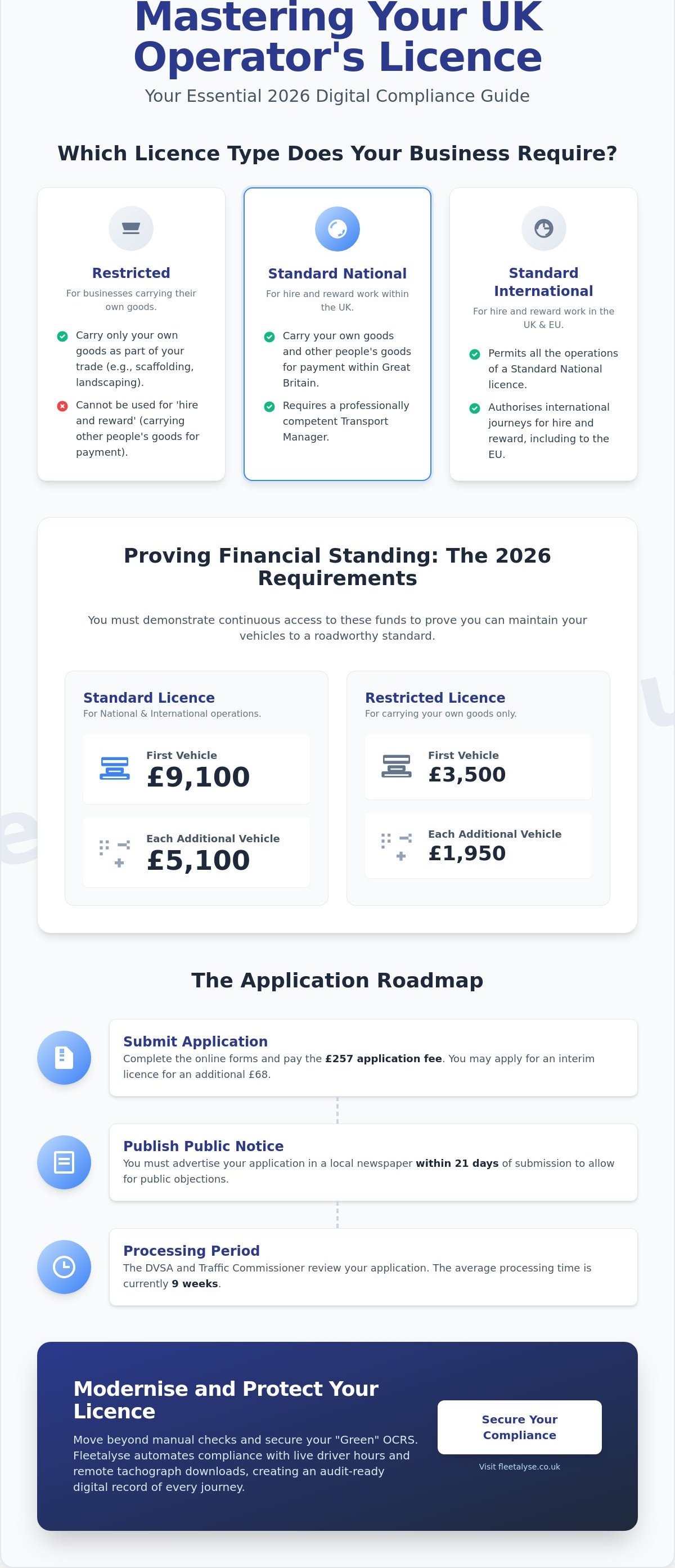
Choosing the correct tier is vital for your commercial strategy. Selecting the wrong type can lead to immediate licence revocation if you're caught operating outside your permitted scope. There are three primary categories:
The Heavy Goods Vehicle (HGV) vs. Van Distinction
The 3.5-tonne threshold is the critical marker for most operators. However, regulations are becoming increasingly granular. Since May 2022, "Light Goods Vehicle" rules mean that vans or cars pulling trailers with a gross weight between 2.5 and 3.5 tonnes also require an operators licence if they are used for hire or reward internationally. This change caught many regional operators off guard. It's a clear signal that the DVSA is tightening its grip on smaller commercial vehicles. Whether you run a single van or a fleet of HGVs, the "hire and reward" trigger remains the most significant factor in determining your level of regulatory burden. Securing an operators licence requires patience and meticulous organisation. The standard processing time is currently 9 weeks. If your business needs to move sooner, you can apply for an interim licence for a £68 fee, though this is only granted once your main application is well underway. You'll also need to pay the £257 application fee upfront. A critical, non-negotiable step is the public notice. You must advertise your application in a local newspaper within 21 days of submitting it. This allows the community to raise concerns regarding your chosen Operating Centre. Your Operating Centre must be fit for purpose. It requires sufficient space for your fleet and safe access to public roads. Always verify local planning permissions before committing to a site. Traffic Commissioners will scrutinise whether the location can handle the environmental impact of your HGVs. For a deeper dive into the legal framework, consult the Goods vehicle operator licensing guide. This document outlines the full scope of your statutory duties and the consequences of failing to meet them.
Proving Financial Standing in 2026
Financial standing is a mandatory safety net. It proves you have the funds to maintain your vehicles properly and keep them in a roadworthy condition. For Standard licences, you must show £9,100 for the first vehicle and £5,100 for each additional one. Restricted licence holders must demonstrate £3,500 for the first vehicle and £1,950 thereafter. You'll need to provide 28 days of original bank statements. The Traffic Commissioner looks at the average balance. If your funds drop below these levels, your operators licence is at risk. It's a continuous requirement, not a one-time hurdle.
The Professional Competence Requirement
Standard licences demand a designated Transport Manager. This individual must hold a Certificate of Professional Competence (CPC). They carry the legal weight of your fleet's compliance on their shoulders. You can employ an internal manager or contract an external one, provided they have sufficient time to manage your fleet properly. They oversee maintenance records and driver hours. To support their role and ensure your data is always audit-ready, you can order digital tachograph solutions that simplify daily monitoring. Their repute is tied to your business; if the business fails an audit, their professional standing is also jeopardised. Obtaining your operators licence is just the beginning of a long-term legal commitment. When you sign the application, you agree to a specific set of "Operator’s Promises." These aren't optional suggestions. They are mandatory standards for vehicle maintenance, driver management, and record-keeping. Many businesses fall into the dangerous "set and forget" trap. They treat compliance as a one-time hurdle rather than a continuous operational requirement. This neglect leads to a rapid decline in safety standards and, eventually, a call from the Traffic Commissioner. Your O-Licence security is directly tied to driver behaviour and vehicle safety. Even after you apply for your operator licence online and receive your approval, the DVSA monitors your performance. A single driver's speeding offence or a missed daily walk-around check reflects on the operator. If your drivers regularly commit hours infringements, the DVSA views this as a management failure. You are responsible for every vehicle and driver under your licence, regardless of whether you are in the office or on the road.
The Consequences of Non-Compliance
The DVSA uses the Operator Compliance Risk Score (OCRS) to target enforcement. This system calculates the risk you pose based on historical data from roadside stops and MOT results. A "Red" score makes your vehicles a magnet for enforcement officers. If serious failings are identified, you will face a Public Inquiry. This is a formal hearing where the Traffic Commissioner decides if you remain fit to hold a licence. Revocation is a real possibility. It means the immediate end of your transport operations and can lead to a lifetime ban from the industry.
The Shift from Paper to Digital Audits
Manual record-keeping is no longer the industry standard. The DVSA increasingly prefers searchable, digital records over dusty lever-arch files that are prone to human error. Whilst regulations require you to keep maintenance records for at least 15 months, the method of storage matters. Paper systems often suffer from missing signatures or lost inspection sheets. Digital systems ensure your data is audit-ready every day of the year. They provide a transparent, tamper-proof trail of tachograph analysis and maintenance logs. Moving to digital management reduces administrative burden and provides the operational clarity needed to protect your operators licence. Maintaining your operators licence relies on the absolute accuracy of your data. The DVSA mandates that you download driver card data every 28 days and vehicle unit data every 90 days. Missing these deadlines is one of the quickest ways to trigger an investigation. Manual downloads are often inconsistent and prone to human error. Using remote tachograph download technology removes this risk by automating the process. It ensures your records are complete without requiring vehicles to return to a specific depot. This level of oversight is essential for any transport manager aiming for a "Green" OCRS. Data collection is only half the battle. You must also prove you are analysing this information to identify and rectify infringements. The DVSA expects to see a clear trail of how you manage driver behaviour and vehicle defects. Paper systems are increasingly seen as a liability because they lack the real-time visibility required for modern fleet management. Digital systems provide the transparency and speed the industry now demands.
Automating Driver Hours and Rest Periods
Tracking live driver hours is the only effective way to prevent infringements before they occur. You must manage the complex interplay between EU driving limits and the Working Time Directive. Relying on retrospective analysis means you only discover errors after the law has been broken. Using telematics and GPS fleet tracking allows you to monitor remaining driving time in real-time. This data identifies patterns of fatigue or consistent non-compliance, enabling you to intervene and provide necessary training before a roadside stop occurs.
Vehicle Safety and Maintenance Logs
Your maintenance schedule must strictly follow the intervals promised on your operators licence application. For most heavy goods vehicles, this involves a 6-week inspection cycle. Daily walk-around checks are your first line of defence against prohibitions. Digital apps have replaced paper checklists, ensuring that every defect is timestamped and reported immediately to the maintenance provider. A clear forward-planning chart for inspections, brake tests, and MOTs is a non-negotiable requirement for any DVSA audit. It proves you are in total control of your fleet's roadworthiness. Eliminate the stress of manual data collection and secure your compliance history. Order your remote tachograph download hardware today to ensure your fleet stays audit-ready 365 days a year. Protecting your operators licence requires more than just good intentions; it demands robust, fail-safe systems. Fleetalyse bridges the gap between regulatory theory and daily operational reality. Our hardware integrates directly with your existing tachograph analysis software, creating a seamless flow of data from the vehicle to your desk. This eliminates the need for manual data handling, which is often the primary source of compliance gaps and administrative errors. Transport managers often struggle with the burden of manual record-keeping. Fleetalyse removes this friction. By automating the collection of live driver hours and tachograph data, you save hours of manual labour every week. This allows your team to focus on proactive safety management rather than chasing paper trails. Whether you run a single regional van or a national HGV fleet, our pragmatic approach provides a scalable foundation that grows alongside your business requirements. It offers the operational clarity needed to reassure the Traffic Commissioner that your fleet is managed with professional precision.
Remote Tachograph Downloads: The End of Manual Retrieval
The days of visiting every vehicle with a download tool are over. Our remote hardware automatically retrieves data from driver cards and vehicle units, transmitting it securely to your office regardless of where the vehicle is located. This ensures you never miss the 28-day or 90-day legal deadlines mentioned earlier in this guide. It also improves driver satisfaction. Drivers no longer need to break their routes or stay late at the depot just to have their cards downloaded. The system works in the background, ensuring your operators licence remains secure without disrupting your schedule.
Live Visibility and GPS Fleet Integration
True compliance requires a holistic view of your operations. By combining GPS fleet tracking with live compliance data, Fleetalyse gives you total visibility over your assets. You can identify "unauthorised driving" immediately, protecting your business from the severe penalties associated with unlicensed vehicle use. Live visibility also enables better dispatch decisions. You can see exactly how many driving hours a driver has remaining before assigning a new job. This ensures every route is planned within legal limits, preventing infringements before they happen and maintaining your "Green" OCRS status with quiet confidence. Managing an operators licence in 2026 requires a shift from reactive fixes to proactive, digital oversight. You've seen how the DVSA's focus on digital records and the Traffic Commissioner's scrutiny of "good repute" leave no room for manual errors. Success depends on maintaining that "Green" OCRS through consistent vehicle inspections and flawless driver records. Moving to automated systems isn't just about saving time; it's about building a defensive wall around your business's most valuable asset. Fleetalyse provides the pragmatic, expert support regional operators need to stay ahead of regulatory changes. We are trusted by UK hauliers for reliable remote tachograph downloads and real-time live driver hours monitoring. By integrating these tools directly into your workflow, you eliminate the administrative burden of manual data collection whilst ensuring you never miss a legal deadline. Take the first step toward a more efficient, audit-ready operation today. Book a demo of Fleetalyse to automate your compliance today. You have the tools to turn regulatory pressure into a competitive advantage.
How much does a UK operator’s licence cost in 2026?
A new application for an operators licence in Great Britain costs £257 as a one-off fee. Once granted, you must pay a £401 issue fee, which also applies to your five-year licence continuation. If you require an interim licence whilst your main application is processed, this costs an additional £68. In Northern Ireland, the application fee is £254, with the issue or continuation fee set at £449.
How long does it take to get an operator’s licence from the DVSA?
You should allow at least 9 weeks for the DVSA to process a standard application. This timeline assumes your paperwork is complete and your Operating Centre advertisement meets all legal requirements. Delays often occur if the Traffic Commissioner requires more evidence regarding your financial standing. Applying for an interim licence can sometimes allow you to start operations sooner if the initial checks are satisfied.
Do I need an operator’s licence for a 3.5-tonne van?
You only need a licence for a 3.5-tonne van if the gross plated weight exceeds 3,500kg. However, if you use a van between 2.5 and 3.5 tonnes for hire and reward work in the European Union, you must hold a Standard International operators licence. Carrying your own goods domestically in a standard 3.5-tonne van does not currently trigger the requirement for a full licence.
What is the difference between a Standard National and a Restricted licence?
A Standard National licence allows you to carry both your own goods and those of others for hire and reward within the UK. A Restricted licence strictly limits you to carrying your own goods for your own business, such as a contractor moving their own equipment. Restricted holders cannot legally charge a fee to transport goods for a third party. They also have lower financial standing requirements.
Can I lose my operator’s licence for a single driver hour infringement?
It's unlikely you'll lose your licence for a single, isolated driver hour infringement. However, the Traffic Commissioner looks for patterns of systematic failure. If one infringement reveals a lack of proper tachograph analysis or management oversight, it can trigger a DVSA audit. Repeated failures lead to a "Red" OCRS and a potential Public Inquiry where your licence is at risk of revocation.
What is an interim operator’s licence and how do I apply for one?
An interim licence provides temporary permission to operate whilst your full application is under review. You apply for this online through the Vehicle Operator Licensing (VOL) system for a £68 fee. It's typically granted only after the mandatory 21-day period for newspaper advertisements has passed and the DVSA is satisfied with your initial evidence of financial standing and maintenance arrangements.
How often do I need to download my tachograph data for compliance?
Legal requirements state you must download driver card data at least every 28 days and vehicle unit data every 90 days. Most efficient operators choose to do this more frequently to ensure they identify infringements early. Using remote tachograph download hardware automates this process. It ensures you never miss these statutory deadlines regardless of where your vehicles are located, keeping your records audit-ready at all times.
Does every operator need a qualified Transport Manager?
No, only Standard National and Standard International licences require a qualified Transport Manager. Restricted licence holders don't need a designated TM, though they must still prove they have systems in place to remain compliant. Even without a formal Transport Manager, Restricted operators are held to the same safety and maintenance standards as any other fleet and must meet the same "good repute" criteria.