


Vehicle health monitoring: a complete guide for UK fleets

Most fleet operators assume vehicle health monitoring is simply about reading fault codes when a warning light appears. It is not. What is vehicle health monitoring, really? It is a continuous, real-time process of collecting data from dozens of vehicle systems simultaneously, analysing that data against known failure patterns, and generating actionable alerts long before a breakdown occurs. For UK fleet operators managing HGVs, vans, and mixed assets under DVSA scrutiny, understanding this distinction is not academic. It is the difference between a vehicle that fails roadside and one that reaches its service bay on schedule.
Table of Contents
- What is vehicle health monitoring and why does it matter?
- How vehicle health monitoring supports predictive maintenance
- Key technologies and data involved in vehicle health monitoring
- The role of vehicle health monitoring in UK fleet compliance and safety
- Integrating vehicle health data with maintenance workflows for best results
- Why vehicle health monitoring is a game changer for UK fleet operators
- Enhance your fleet management with Fleetalyse vehicle health monitoring solutions
- Frequently asked questions
Key Takeaways
| Point | Details |
|---|---|
| Continuous data monitoring | Vehicle health monitoring collects live sensor data to detect issues early and prevent breakdowns. |
| Predictive maintenance | Using analytics on monitoring data shifts maintenance from fixed schedules to condition-based actions. |
| Compliance integration | Monitoring systems support UK fleet compliance with digital records and instant notifications. |
| Workflow automation | Connecting monitoring alerts directly to maintenance workflows improves response times and fleet uptime. |
| Fleet resilience | Advanced monitoring enhances safety, reduces costs, and future-proofs fleet operations. |
What is vehicle health monitoring and why does it matter?
Vehicle health monitoring is the continuous collection and analysis of data from across a vehicle’s systems, covering engine performance, brake condition, battery voltage, tyre pressures, exhaust outputs, and much more. Unlike a single diagnostic scan carried out during a service, a vehicle monitoring system runs persistently, capturing thousands of data points per journey. Vehicle health monitoring for fleets continuously collects vehicle health data and generates alerts as part of predictive maintenance.
The core value lies in the shift from reactive to proactive. When you know a component is degrading before it fails, you control the outcome. You schedule the repair at a time that suits your operation, rather than scrambling to recover a stranded vehicle.
Key data points captured by a vehicle monitoring system include:
- Fault codes from the engine control unit (ECU), transmitted in real time rather than stored until the next service
- Sensor readings covering coolant temperature, oil pressure, battery state of charge, and exhaust particulate levels
- Vibration and acoustic data that can indicate bearing wear, brake fade, or drivetrain stress
- Mileage and engine hours, which feed into usage-based maintenance scheduling
- Driver behaviour inputs such as harsh braking and rapid acceleration, which accelerate component wear
For operators running fleet telematics and monitoring across multiple vehicles, this data creates a live picture of fleet health that no paper-based inspection process can replicate.
How vehicle health monitoring supports predictive maintenance
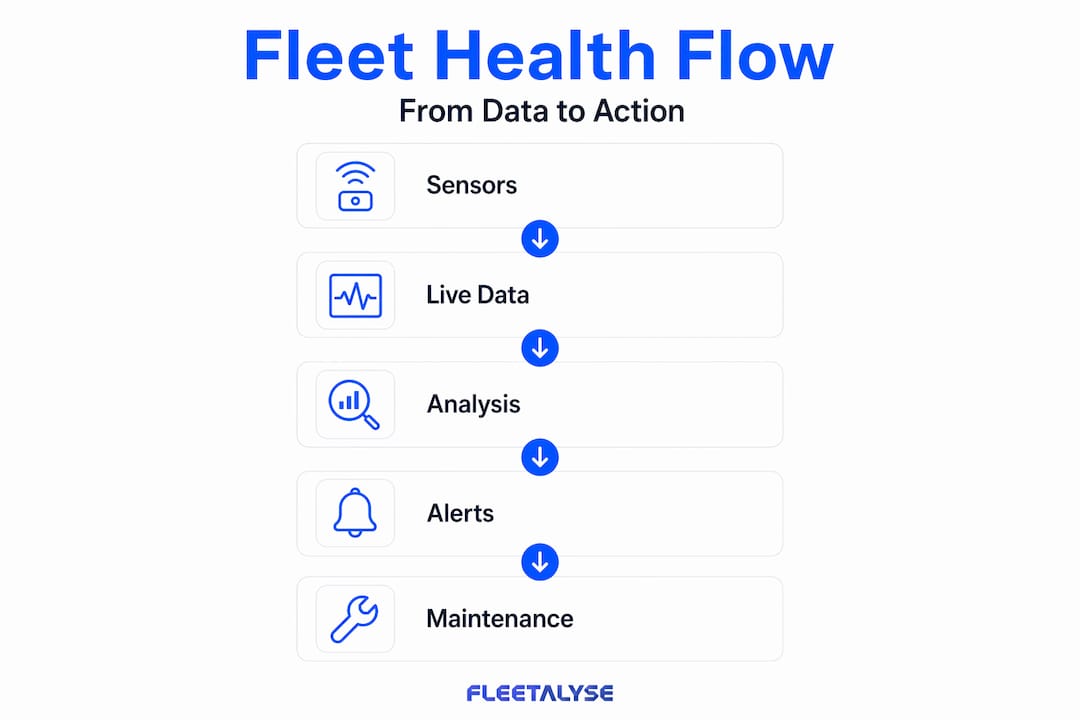
With a foundational understanding in place, we can explore how vehicle health monitoring forms the basis for smarter maintenance practices. Traditional calendar-based servicing is, by its nature, approximate. You service a vehicle every 12 weeks or 15,000 miles regardless of how hard it has actually worked. That means some vehicles are serviced too early, wasting resource, while others reach the interval with a fault already developing.
Prognostic maintenance uses predictive models on health-monitoring data to forecast degradation and optimise maintenance timing. Here is how the workflow typically operates:
- Data acquisition — sensors and ECUs capture real-time vehicle health data continuously during operation.
- Anomaly detection — the monitoring platform compares incoming data against baseline parameters and flags deviations.
- Failure prediction — analytics models estimate when a component is likely to fail based on the rate of degradation observed.
- Maintenance scheduling — the system generates a maintenance alert, recommending action within a defined window before failure risk becomes critical.
- Repair and verification — the technician completes the work, and the system resets the component baseline for ongoing monitoring.
This five-step loop, when running consistently, can reduce unplanned breakdowns significantly. Research indicates that predictive approaches typically reduce maintenance costs compared to purely calendar-based programmes, because you replace components at the point of actual need rather than at a fixed interval that may be too early or too late.
Pro Tip: If your predictive maintenance solutions do not include a mechanism for logging the outcome of each repair against the original alert, you lose the feedback loop that makes predictive models more accurate over time. Always close the loop.
Key technologies and data involved in vehicle health monitoring
Understanding how vehicle health monitoring works requires insight into the hardware and data flows behind it. A modern vehicle health monitoring system is not a single device. It is an ecosystem of interconnected components.
Vehicle health monitoring uses sensors, ECUs, telematics units, wireless networks, and cloud analytics to continuously monitor and analyse vehicle health in real time. Breaking that down practically:
- Onboard sensors monitor specific systems including engine temperature, brake pad thickness via pressure sensors, tyre inflation via TPMS (tyre pressure monitoring systems), battery health, and exhaust gas composition.
- ECUs (electronic control units) process sensor inputs locally and generate diagnostic trouble codes (DTCs) when readings fall outside acceptable ranges.
- Telematics gateways act as the digital bridge between the vehicle’s onboard systems and the outside world. They read data from the vehicle’s CAN-bus (the internal communication network that connects all ECUs), package it, and transmit it over cellular or satellite networks.
- Cloud-based analytics platforms receive this data, apply machine learning models to detect patterns, and generate alerts, reports, and trend analyses that fleet managers can act on.
The table below summarises the key components and their roles:
| Component | Function | Data produced |
|---|---|---|
| Onboard sensors | Monitor individual vehicle systems | Temperature, pressure, voltage, vibration readings |
| ECU | Interprets sensor data locally | Diagnostic trouble codes (DTCs) |
| Telematics gateway | Transmits data via CAN-bus to cloud | Packaged real-time vehicle health data |
| Cellular/satellite network | Carries data from vehicle to platform | Uninterrupted data transmission |
| Cloud analytics platform | Analyses data using AI/ML models | Alerts, trend reports, failure predictions |
You can explore vehicle monitoring technology that integrates these components into a single, manageable solution. The most practical systems for UK fleets use plug-and-play telematics units that connect without requiring specialist installation, reducing the barrier to adoption considerably.
Pro Tip: When evaluating a vehicle monitoring system, check whether the telematics gateway reads directly from the CAN-bus rather than relying solely on the OBD-II port. CAN-bus access provides far richer data, particularly for HGVs where proprietary diagnostic protocols are common.
The role of vehicle health monitoring in UK fleet compliance and safety
Beyond maintenance, vehicle health monitoring plays a critical part in ensuring compliance and safety in UK fleets. The DVSA expects operators to demonstrate that vehicles are maintained in a roadworthy condition at all times, not merely that they have been serviced on a schedule. Real-time vehicle health data provides the evidence trail that makes this demonstrable.
UK fleet compliance apps combine condition monitoring with documented processes, providing timestamped evidence and notifications for fast issue resolution. In practice, this means:
- Digital walkaround checks linked directly to the monitoring system, so defects reported by drivers are cross-referenced with sensor data automatically.
- Timestamped fault records that show when an issue was detected, when it was actioned, and who authorised the repair, all of which are essential for DVSA audits.
- Instant notifications sent to transport managers when a vehicle generates a critical fault code, enabling rapid decisions about whether a vehicle should continue operating or be recalled.
- Inspection readiness reports generated automatically, compiling monitoring data, defect histories, and maintenance records into a format suitable for audit.
For UK DVSA-compliant vehicle checks, having this evidence readily available transforms what is often a stressful audit process into a straightforward demonstration of diligent management.
Accreditation schemes and fleet insurance providers increasingly favour operators who can demonstrate systematic, data-backed maintenance processes. A digital record showing continuous UK fleet compliance management activity is far more persuasive than a folder of paper service records.
“The regulator wants to see not just that you have maintained your vehicles, but that you have a system to catch problems early and act on them promptly. Monitoring data makes that case for you.”
Integrating vehicle health data with maintenance workflows for best results
To realise full benefits, vehicle health information must connect directly with maintenance workflows. This is where many fleets lose value. A telematics dashboard that shows fault codes is useful. A platform that automatically converts those fault codes into work orders, assigns them to technicians, and tracks resolution is transformative.

Without linking monitoring alerts to CMMS work orders, fleets often react only after breakdowns. Automated integration shifts maintenance from reactive to proactive. Consider the difference in practice:
| Approach | Fault detection to repair time | Risk of breakdown | Administrative burden |
|---|---|---|---|
| Manual monitoring review | 1 to 5 days (if noticed) | High | High |
| Automated alert with CMMS integration | 2 to 4 hours | Low | Minimal |
The benefits of fleet maintenance automation that closes this loop include:
- Threshold-based triggers that generate a work order automatically when a fault code reaches a defined severity level, without requiring a manager to review a dashboard.
- Technician routing that assigns work orders to the right person based on vehicle location, fault type, and technician availability.
- Parts pre-ordering linked to failure predictions, so components are available before the vehicle arrives at the workshop.
- Audit trail continuity, ensuring every fault detected is logged against a corresponding repair record, which is critical for demonstrating due diligence under Operator Licence conditions.
Pro Tip: When setting up threshold-based triggers, avoid alerting on every minor deviation or your team will quickly begin ignoring notifications. Work with your platform provider to calibrate alert thresholds based on actual failure data from your vehicle types, so alerts carry genuine urgency.
Why vehicle health monitoring is a game changer for UK fleet operators
Here is an opinion grounded in what we see across UK commercial fleets: most operators significantly underestimate the cost of reactive maintenance, not because they fail to count repair bills, but because they rarely quantify the full cost of a vehicle being off the road unexpectedly. A single HGV breakdown on a motorway can mean recovery costs, delayed deliveries, driver overtime, and potential DVSA scrutiny if the fault was pre-existing and unrecorded.
The real shift that advanced vehicle health monitoring delivers is not just fewer breakdowns. It is the ability to treat your fleet as a set of managed assets rather than a collection of unpredictable liabilities. When you have real-time vehicle health data feeding into a maintenance workflow and a compliance record simultaneously, you are operating with a level of control that paper-based processes cannot approach.
There is also a less-discussed benefit: fleet resilience under fleet resilience strategies that account for driver behaviour. Harsh braking and aggressive acceleration do not just affect fuel consumption. They accelerate component wear in precisely the ways that monitoring can detect early. When driver behaviour data and vehicle health data are analysed together, you get a far more accurate picture of which vehicles are ageing faster than their mileage suggests.
The operators who get the most from vehicle health monitoring are those who treat the data as operational intelligence rather than a compliance checkbox. They use it to make scheduling decisions, to have informed conversations with maintenance suppliers, and to build the kind of audit-ready evidence trail that protects their Operator Licence when the DVSA comes calling. In an environment where regulatory expectations are rising and vehicle complexity is increasing, investing in monitoring is not optional for serious fleet operators. It is foundational.
Enhance your fleet management with Fleetalyse vehicle health monitoring solutions
If the case for vehicle health monitoring is clear, the next question is which platform delivers it in a way that suits UK commercial operations. Fleetalyse is built specifically for this environment, integrating real-time vehicle health data, DVSA-aligned compliance workflows, and automated maintenance triggers into a single platform designed for HGVs, vans, trailers, and mixed fleets.
The Fleetalyse compliance and telematics platform connects plug-and-play telematics hardware directly to your vehicle’s CAN-bus, providing the rich data access that basic OBD-II readers cannot match. From fault code detection to timestamped audit records, every element of the monitoring process is captured, documented, and available when you need it. Explore the range of vehicle monitoring devices from Fleetalyse and speak with our UK-based support team to find the right configuration for your fleet’s specific compliance and maintenance needs.
Frequently asked questions
What exactly does vehicle health monitoring track in a fleet vehicle?
Vehicle health monitoring continuously tracks sensor data including fault codes, coolant temperatures, battery voltage, brake wear indicators, tyre pressures, and vibration patterns to identify developing issues before they cause a failure.
How does vehicle health monitoring improve fleet maintenance?
It enables predictive maintenance by forecasting component degradation, so fleets can schedule repairs proactively. Prognostic maintenance builds on health-monitoring data using predictive analytics to forecast failures, shifting maintenance to condition-based servicing rather than fixed calendar intervals.
Can vehicle health monitoring help with legal compliance for UK fleets?
Yes. By integrating monitoring data into digital compliance workflows, fleets gain timestamped fault records and real-time alerts that make audit trail generation straightforward, supporting DVSA inspections and Operator Licence obligations.
Is it enough to just have the monitoring data, or does it need to be integrated with maintenance systems?
Integration is essential. Without CMMS integration, faults may not result in timely repairs, leaving fleets reactive rather than proactive and the monitoring data largely underused.