


Vehicle kilometre tracking explained for fleet managers

Most fleet managers treat kilometre tracking as a tax obligation and little else. That framing costs money. Vehicle kilometre tracking explained properly reveals a management tool that touches fuel spend, driver behaviour, regulatory compliance, and maintenance scheduling simultaneously. For UK commercial transport operators navigating DVSA requirements and Operator Licence obligations, accurate mileage data is not a back-office formality — it is operational intelligence. This article covers what modern tracking systems actually do, where manual methods fall short, and how to implement tracking in a way that genuinely moves the needle for your fleet.
Table of Contents
- Why vehicle kilometre tracking matters beyond mileage
- Manual logs vs automated vehicle kilometre tracking
- Modern vehicle kilometre tracking technology explained
- Common pitfalls and best practices in vehicle kilometre tracking
- How to implement vehicle kilometre tracking for regulatory and operational success
- The insight most operators miss about kilometre tracking
- How Fleetalyse supports your kilometre tracking goals
- Frequently asked questions
Key Takeaways
| Point | Details |
|---|---|
| Cost savings potential | Automated vehicle kilometre tracking can reduce mileage reimbursement and fuel costs significantly through accurate data and optimisation. |
| Accuracy is crucial | Maintaining consistent, contemporaneous records—whether manual or automated—is key to compliance and successful audits. |
| Technology integration | Modern tracking systems collect detailed operational data beyond mileage, enabling better maintenance and safety management. |
| Clear policies prevent errors | Defining business versus personal trips and training staff ensure reliable data and reduce compliance risks. |
| Regular audits required | Ongoing review of tracking data prevents false security and maintains accuracy and regulatory compliance. |
Why vehicle kilometre tracking matters beyond mileage
The phrase “mileage tracking” undersells what good kilometre monitoring actually delivers. Yes, you need accurate distance records for HMRC compliance, fuel tax rebates, and driver reimbursements. But the data generated by tracking every kilometre driven is far richer than a spreadsheet column of numbers.
Accurate tracking supports regulatory compliance by giving you irrefutable, timestamped evidence of vehicle usage. During a DVSA roadside inspection or an Operator Licence review, a well-maintained digital record is worth considerably more than a handwritten logbook. It removes ambiguity and protects your operating licence.
The financial case is equally strong. Automated systems can reduce mileage reimbursement costs by up to 30% and fuel costs by up to 55% through better route planning and driver monitoring. Those figures reflect the combined effect of eliminating inflated manual claims, reducing unnecessary idling, and making routing decisions based on real distance data rather than estimates.
Beyond costs, kilometre tracking feeds into a broader operational data layer. When integrated with a GPS fleet tracking platform, distance data sits alongside engine diagnostics, idling time, speeding events, and service intervals. You are not just counting kilometres — you are building a picture of how your fleet actually operates.
Key areas where accurate kilometre tracking adds value:
- Regulatory compliance: Verified mileage records for DVSA, HMRC, and Operator Licence audits
- Cost control: Identifies over-claiming, excessive idling, and inefficient routing
- Maintenance scheduling: Distance-triggered service alerts reduce unexpected breakdowns
- Driver accountability: Route adherence and trip duration data support performance conversations
- Insurance accuracy: Precise annual mileage figures help negotiate fairer premiums
“Kilometre tracking is not a reporting function. It is the connective tissue between every operational decision you make about your fleet.”
Manual tracking wastes time and introduces the kind of errors that jeopardise tax deductions and reimbursement accuracy. A driver who fills in a weekly log from memory on a Friday afternoon is not giving you reliable data. The telematics platform features available today eliminate that risk entirely.
Manual logs vs automated vehicle kilometre tracking
Understanding the gap between these two approaches is central to vehicle tracking systems explained clearly. Both methods are legally acceptable, but they are not equally reliable.
Manual logs, to remain valid for HMRC purposes, must record the date, start and end location, distance travelled, and the business purpose of each trip — ideally at the time of travel. The requirement for contemporaneous recording is where most operators struggle. Manual logs are legally acceptable if maintained at the time of travel but are prone to human error, lost records, and audit risk. Even well-intentioned drivers forget to log short trips, and those gaps accumulate.
Automated GPS tracking changes the equation. Automated GPS tracking captures precise, timestamped trip data that reduces audit triggers and eases compliance. The system records when a journey started, where it went, how long it took, and how far the vehicle travelled, without relying on a driver’s recollection. Trip classification can then be assigned by the driver or administrator after the fact, with the GPS record as the foundation.
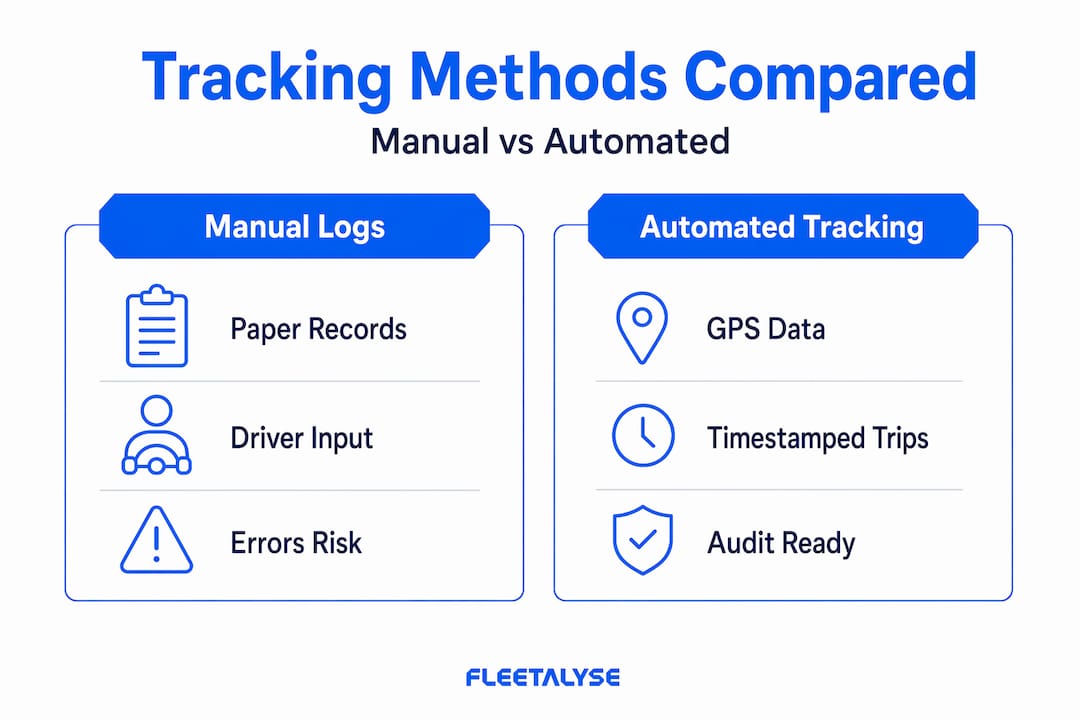
| Factor | Manual logs | Automated GPS tracking |
|---|---|---|
| Accuracy | Dependent on driver memory | GPS-verified to the metre |
| Time required | 5-10 mins per driver per day | Near zero, once configured |
| Audit readiness | High risk of gaps and disputes | Timestamped records, exportable |
| Compliance risk | Moderate to high | Low |
| Cost | Low upfront, high in errors | Upfront hardware investment, lower ongoing risk |
| Driver compliance | Inconsistent | Consistent once installed |
| Trip misclassification | Common | Reduced but requires policy |
Transitioning from manual to automated tracking does not need to be disruptive. A clear sequence makes adoption straightforward:
- Audit your existing mileage logs to identify gaps, inconsistencies, and high-risk records
- Select a vehicle tracking device that fits your fleet type, whether HGV, van, or mixed assets
- Install hardware and configure the software platform with your fleet’s vehicle and driver profiles
- Define trip classification rules in the system before going live
- Run parallel records (manual and automated) for the first 30 days to validate data accuracy
- Retire manual logs once confidence in the automated system is established
- Schedule your first data audit for 60 days post-launch to catch any configuration issues
Pro Tip: Consistency matters far more than system sophistication. A straightforward GPS tracker used every day beats a feature-heavy platform that drivers regularly disable or bypass. Start simple, build habits, then add complexity.
Modern vehicle kilometre tracking technology explained
What is kilometre tracking in its modern form? It is the integration of several hardware and software components working together to capture, transmit, and interpret vehicle data in real time.
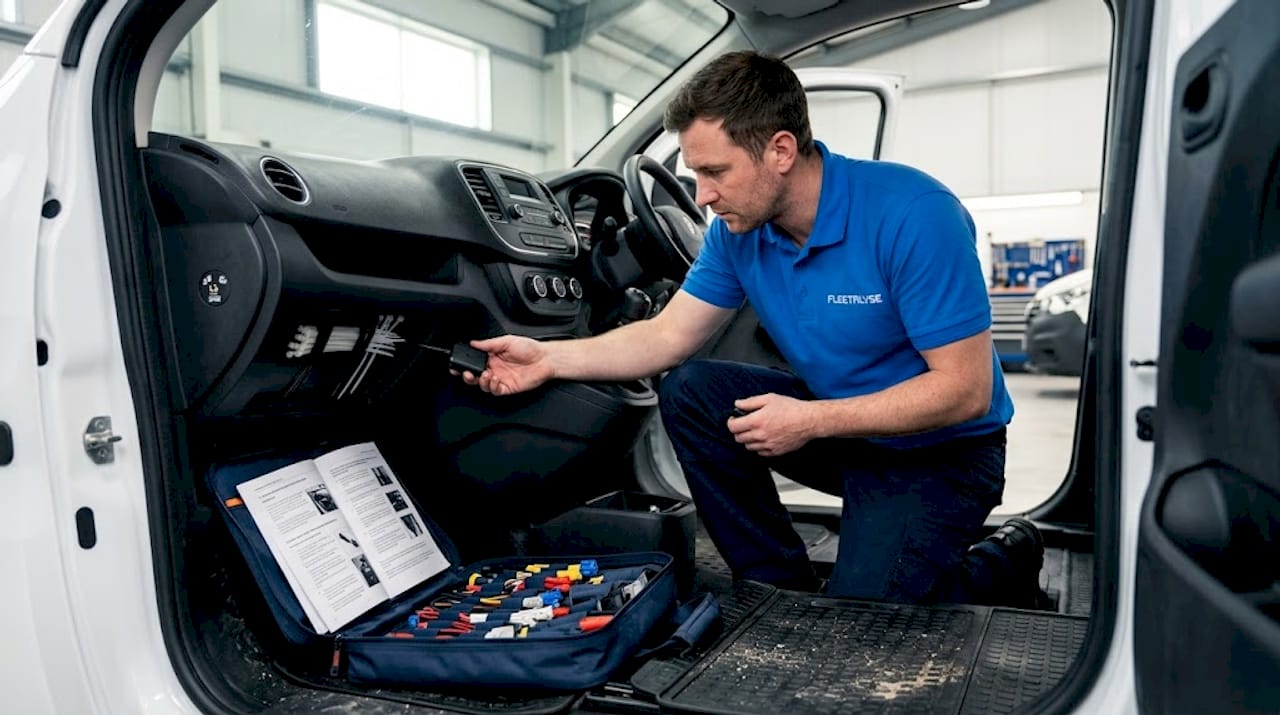
At the hardware level, tracking hardware includes GNSS receivers (which draw on GPS, GLONASS, and Galileo satellite networks for greater accuracy), communication modules that transmit data via cellular or satellite networks, and onboard sensors that connect to the vehicle’s CAN-bus to read engine data directly. Plug-and-play telematics units, like those used in Fleetalyse-equipped fleets, connect via the OBD-II port or a dedicated harness, requiring no professional installation in most cases.
The software side is where raw location and distance data becomes actionable. Fleet tracking today encompasses GPS location, engine diagnostics, idling behaviour, driver events, and integration with business systems for compliance and operational planning. You are not looking at dots on a map — you are reading a continuous stream of operational intelligence.
Modern platforms add significant value through:
- Real-time location and route history: Precise kilometre logs with replay functionality for dispute resolution
- Idle time monitoring: Fuel wasted while stationary is a quantifiable, reducible cost
- Driver behaviour scoring: Harsh braking, speeding, and rapid acceleration mapped against distance travelled
- Maintenance triggers: Service reminders based on kilometres driven rather than calendar dates
- Integration with ERP, payroll, and accounting systems: Mileage data flows directly into reimbursement calculations and compliance reports, removing duplicate data entry
For fleets operating HGVs under tachograph regulations, the connection between kilometre tracking and fleet tracking hardware goes deeper still. Distance data from the tachograph and the telematics unit should align. Discrepancies between the two are a red flag worth investigating before a DVSA examiner does it for you.
Pro Tip: Define business versus personal trip classifications in writing before you configure your system. Without a documented policy, even perfect GPS data creates compliance exposure because the system cannot determine trip purpose on your behalf.
Common pitfalls and best practices in vehicle kilometre tracking
Efficient vehicle tracking methods are only as effective as the policies and habits surrounding them. Technology solves the data capture problem. It does not solve the human and organisational problems that sit on top of it.
The most common failure is the absence of a clear trip classification policy. Failing to define business versus personal trips causes misclassification and compliance risks even when the GPS data itself is accurate. If a driver is unsure whether a trip to a supplier on the way home qualifies as business mileage, they will guess. Some will over-claim, others will under-claim, and neither outcome serves your audit position.
A second pitfall is passive reliance on automation. Operators assume that because the system is recording data, the data must be correct. Periodic audits are essential; neglecting review leads to large volumes of unverified, non-compliant records. Hardware faults, GPS signal loss in urban canyons, and configuration errors all create gaps in the record that only a review process will catch.
Integrating mileage data with maintenance and operational systems is where tracking moves from compliance tool to fleet tracking compliance asset. Vehicles serviced on kilometre milestones rather than calendar intervals experience fewer unplanned breakdowns, and the data trail demonstrates due diligence to insurers and regulators alike.
Best practices to follow:
- Document your trip classification policy and make it part of driver induction
- Train all drivers on how the system works and why accurate classification matters
- Review data monthly rather than waiting for an audit trigger
- Set up automated alerts for GPS signal loss or unexpected gaps in journey records
- Reconcile telematics data with fuel card records to catch anomalies early
Pro Tip: Pair automated tracking with a monthly spot-check of 10 to 15 randomly selected trips per driver. It reinforces the message that records are reviewed, which alone improves classification accuracy.
How to implement vehicle kilometre tracking for regulatory and operational success
Moving from intention to action requires a structured approach. Here are the core implementation steps:
- Audit your current process. Quantify what manual logging costs in staff time, reimbursement errors, and compliance risk. This baseline makes the ROI of automation concrete.
- Select a platform. Prioritise automated tracking implementation that supports GPS verification, tachograph integration if relevant, and exports compatible with your accounting and payroll systems.
- Write your trip classification policy. Define what counts as business mileage, how commuting is treated, and what the process is for personal use of company vehicles.
- Install and configure hardware. Use plug-and-play units where possible to avoid downtime.
- Train your team. Drivers need to understand the system and their responsibilities. Compliance officers need to know how to extract and export records for audit purposes.
- Audit at 30, 60, and 90 days. The first quarter reveals configuration issues, policy gaps, and driver behaviour patterns that need addressing.
| Metric | Before automation | After automation (typical) |
|---|---|---|
| Time spent on mileage admin | 3-5 hours per week | Under 30 minutes per week |
| Reimbursement error rate | 15-25% of claims | Under 2% of claims |
| Fuel cost per kilometre | Baseline | Up to 55% reduction possible |
| Audit preparation time | Days | Hours |
| Compliance risk | Moderate to high | Low |
Switching to automated tracking can cut reimbursement costs by up to 30%, with compounding benefits in fuel efficiency and audit readiness. The implementation itself is rarely the barrier. The barrier is treating it as an IT project rather than an operational change that requires policy, training, and ongoing review.
The insight most operators miss about kilometre tracking
Here is something most guides on this subject will not tell you: the operators who get the most from kilometre tracking are not the ones with the most sophisticated technology. They are the ones who treat tracking data as a management conversation, not a compliance record.
When a compliance officer reviews mileage data, the instinct is to look for problems: discrepancies, missing records, over-claiming. That is necessary. But the more valuable habit is to look for patterns. A driver consistently covering 20% more kilometres than their route plan suggests is either taking inefficient routes, making undeclared stops, or dealing with a navigation issue that better route guidance would solve. That is a coaching opportunity, not just a compliance flag.
Similarly, fleets that benchmark kilometre-per-litre performance across comparable routes and vehicle types identify underperforming vehicles before they become costly. A lorry that was achieving 10 km/litre and now averages 8.2 km/litre over the same routes is telling you something worth hearing before it tells the breakdown service.
The data exists. The gap is usually in how it is used — reactively rather than proactively. Kilometre tracking, used well, is not a rear-view mirror. It is a forward-looking tool that surfaces problems while you still have choices about how to address them.
How Fleetalyse supports your kilometre tracking goals
If you are re-evaluating how your fleet handles mileage data, Fleetalyse offers a direct path from manual or fragmented tracking to fully integrated kilometre and telematics monitoring.
Our platform combines plug-and-play telematics hardware with automated GPS mileage logging, tachograph integration, and driver behaviour monitoring — all designed for UK commercial transport operators. Whether you run HGVs, vans, or a mixed fleet, Fleetalyse feeds accurate kilometre data into compliance reports, maintenance scheduling, and fuel analysis without adding to your team’s administrative workload. UK-based support means setup is straightforward and troubleshooting is handled by people who understand DVSA regulations and Operator Licence requirements firsthand. Visit Fleetalyse to see how the platform fits your operation.
Frequently asked questions
What is vehicle kilometre tracking and why is it important for fleet managers?
Vehicle kilometre tracking records every distance driven by your fleet vehicles to support accurate driver reimbursements, HMRC tax compliance, and operational analysis. Tracking provides an irrefutable audit trail that eliminates manual errors and strengthens your position during regulatory inspections.
Are manual mileage logs still acceptable for compliance purposes?
Yes, manual logs remain legally valid provided they record date, distance, and business purpose at the time of travel. However, manual logs carry significantly higher human error and audit risk compared to GPS-verified automated records.
What are the main benefits of switching to automated kilometre tracking systems?
Automated systems reduce administrative time, lower reimbursement costs, provide GPS-verified trip records, and make audit preparation far quicker. Automated GPS tracking can reduce reimbursement costs by up to 30% and fuel costs by up to 55% compared to unmonitored manual processes.
How can fleet managers avoid common pitfalls in vehicle kilometre tracking?
The most effective approach is to establish a written policy on business versus personal trip classification before deploying any system, train drivers thoroughly, and conduct regular data audits. Clear business versus personal policies prevent compliance risk even when GPS data capture is accurate.