

Set Defensible HGV PMI Intervals for UK Fleets With ISO Weeks

The DVSA’s roadworthiness guidance sets a normal inspection frequency within a range of weeks, and there is no single fixed legal figure that applies to every vehicle. What you must do is pick a justified interval based on your vehicle’s age, mileage and duty cycle, record the equivalent maximum time-frequency on the Vehicle Operator Licensing service, and monitor defect trends every month. If you need a starting point while you gather your own data, six weeks is a common practical default starting point for a mixed general haulage fleet.
TL;DR:
- Operators should set PMI intervals based on usage, vehicle age, and defect history, typically ranging from four to thirteen weeks, with six weeks as a default starting point.
- Maintaining accurate documentation—including defect reports, corrective actions, next-due schedules, and defect trend summaries—is crucial for compliance and audit readiness.
- Using ISO week numbering and automated scheduling tools helps ensure timely PMIs and reduces the risk of drift caused by calendar irregularities or workshop capacity issues.
- Vehicles over 12 years old or involved in arduous work require shorter inspections, often around four to six weeks, regardless of mileage, due to higher wear rates.
- Manual tracking of PMI due dates is prone to error, and integrating telematics and automation significantly improves scheduling accuracy and oversight.
Table of Contents
- What does DVSA guidance say about HGV PMI intervals?
- How do you set a defensible PMI interval for your fleet?
- How do you schedule PMIs using ISO weeks without losing track?
- What records do you need to keep for a DVSA audit?
- Which vehicles need shorter PMI intervals?
- What are the risks of getting PMI intervals wrong?
- How does telematics reduce the risk of missed PMIs?
- An operator’s take: interval decisions should be a live process, not a one-off
- Automate your PMI scheduling with Fleetalyse
- Sources
What does DVSA guidance say about HGV PMI intervals?
The Guide to maintaining roadworthiness is the document every transport manager should have open on a second monitor. It states plainly that preventive maintenance inspection frequency would normally range between four and thirteen weeks. That range is deliberately wide because a gritter working nights in a quarry wears out differently to a curtain-sider doing motorway trunking five days a week.
Rather than a single number, the guide gives you bands tied to how a vehicle is actually used. This is where most operators go wrong: they pick a number that sounds safe (usually the maximum) without checking whether their operating conditions justify it.
| Operating condition | Example PMI frequency |
|---|---|
| Light or infrequent use | 10 to 13 weeks |
| Trunking and general haulage | 6 to 10 weeks |
| Arduous work (construction, waste, off-highway loading) | 4 to 6 weeks |
| Genuine off-road operation | 4 weeks |
| Vehicles and trailers aged 12 years or older | 6 weeks (commonly used minimum) |
These bands aren’t a menu you pick from once and forget. They’re a starting classification you’re expected to revisit as usage changes, a vehicle ages, or your defect data tells a different story.
There’s an administrative layer that catches a lot of operators out. If you run mileage-based scheduling instead of a straight calendar interval, you still have to enter an equivalent maximum time-frequency on VOL. DVSA needs a time ceiling on record even when your actual trigger is mileage, because auditors need a way to check compliance without cross-referencing every vehicle’s odometer history.
That’s also why the guide recommends ISO week planning rather than calendar dates. ISO weeks give every vehicle a numbered slot (week 14, week 20, week 26 and so on) that doesn’t shift with bank holidays or month-end quirks, which makes workshop booking and audit tracking far more reliable than trying to remember that “vehicle 12 is due sometime in mid-March.”
Practical takeaways from this section:
- There is no universal legal number. The 4 to 13 week band is the DVSA’s operating framework, not a single mandated figure.
- Your operating condition, not habit or convenience, should set which end of the band you sit in.
- Mileage-based scheduling still needs a recorded time equivalent entered on VOL.
- ISO week numbering removes the ambiguity that calendar dates introduce.
How do you set a defensible PMI interval for your fleet?
Setting an interval that will actually stand up to scrutiny (from a traffic commissioner, a DVSA examiner, or your own insurer) means working through a specific set of factors rather than copying whatever the last operator you spoke to does.
- Vehicle age. Anything 12 years or older typically needs a six-week ceiling or tighter, regardless of how lightly it’s used, because component wear accelerates with age in ways that mileage alone doesn’t capture.
- Annual and monthly mileage. High-mileage trunking vehicles wear brakes, tyres and steering components faster than mileage-light urban delivery vehicles, even on the same chassis.
- Duty cycle and route type. Motorway-heavy work is gentler on suspension and drivetrain components than stop-start urban delivery or unmade-surface access roads.
- Payload and load type. Vehicles regularly running at or near plated weight put more stress on brakes, suspension and tyres than those running light.
- Defect history. A vehicle that keeps failing PMIs on the same component is telling you your interval is too long for that specific asset, not that the component is simply unlucky.
- Environmental conditions. Coastal salt exposure, quarry dust, or waste-site debris accelerate corrosion and wear well beyond what a standard interval assumes.
If you’re running a mileage-based system rather than a fixed calendar, the mechanics matter. You set a trigger mileage (say, every 12,000 miles), but VOL still requires an equivalent time ceiling, commonly the maximum number of weeks that mileage would typically be covered in. Most fleet management systems let you flag this as a mixed-frequency vehicle so the earlier of the two triggers, whichever comes first, initiates the booking.
Documenting your rationale isn’t optional box-ticking. A traffic commissioner reviewing your operator licence wants to see reasoning, not guesswork. A short internal template covers you:
- Chosen interval: the number of weeks (or miles plus equivalent weeks) and which operating band it sits in.
- Data sources used: mileage records, defect history, route profile, vehicle age.
- Review date: when you’ll next reassess, typically three to six months after setting a new interval.
- Monitoring metric: monthly defect rate per vehicle or per fleet segment.
- Sign-off: the transport manager or compliance officer who approved the interval and the date.
That documentation, kept alongside your inspection records, is exactly what an operator guidance summary recommends when it stresses that there’s no single legal interval and that operators should be prepared to show their working.
How do you schedule PMIs using ISO weeks without losing track?
ISO week numbering solves a problem that calendar-based scheduling creates constantly: months have different lengths, and “every six weeks from the 15th” drifts unpredictably once you hit February or a leap year. Under ISO 8601, every week of the year gets a fixed number from 1 to 52 (occasionally 53), so a six-week interval is simply week 10, week 16, week 22, week 28, and so on, with no ambiguity about which Monday that actually lands on.

Planning tools built around this logic, such as the SIPCAT scheduling calculator, let you input a frequency in days and generate the full ISO week sequence automatically, flagging vehicles that are overdue or approaching their due week. That kind of tool removes the manual spreadsheet drift that catches out smaller operators without dedicated compliance staff.
Real workshops don’t always hit the exact due week, and DVSA guidance accounts for that. If an inspection has to move earlier because of a defect found during a walkaround, or later because of workshop capacity, the sensible approach is to reset the cadence from the actual inspection date rather than trying to force the vehicle back onto the original sequence. Drifting the whole schedule to chase one missed week just compounds the problem.
Intermediate checks on high-wear items (brake linings, tyre tread, coupling gear) sit alongside, not instead of, your main PMI. They let you extend a main interval cautiously in specific cases, but only when documented and only when you’re actively watching whether defect rates stay low as a result.
Pro Tip: Book your ISO week slots for the whole fleet at the start of each quarter rather than one vehicle at a time. Workshops fill up fast around common intervals like week 26 and week 52, and booking in bulk avoids the scramble that causes inspections to slip past their due week.
What records do you need to keep for a DVSA audit?
DVSA examiners expect to see a complete, unbroken chain of evidence, not a folder of the last three months’ paperwork. The guide to maintaining roadworthiness sets out what a robust maintenance system should retain and be able to produce on request.
Keep the following as standard practice:
- Signed PMI inspection reports for every vehicle, with the inspector’s name and date clearly recorded.
- Defect reports linked to each inspection, showing what was found and when.
- Evidence of corrective action taken, including parts fitted and the date the defect was closed out.
- Next-due schedules showing the planned date or ISO week for the following inspection.
- Monthly defect trend summaries showing whether your chosen interval is working.
One figure worth holding onto: your monthly defect rate per vehicle is the single metric DVSA and traffic commissioners return to most often when questioning whether an interval is too long.
When you’re presenting monitoring evidence during an audit, a simple month-by-month log of defects found per inspection, broken down by vehicle or fleet segment, does more to demonstrate genuine oversight than a stack of individual reports ever will. Digital, searchable archives beat paper filing cabinets here, purely because an examiner asking for “every PMI on vehicle 14 from the last two years” needs an answer in minutes, not a rummage through a filing cabinet.
Which vehicles need shorter PMI intervals?
Age and operating severity are the two factors that most reliably push an interval down from the DVSA’s upper range. Vehicles and trailers aged 12 years or older commonly need six-weekly inspections as a practical minimum, even if their mileage looks moderate on paper, because age-related wear on brakes, chassis and electrical systems doesn’t always show up in mileage figures alone. Off-road and arduous operations, construction, waste collection, quarry haulage, typically sit at four to six weeks for the same reason: the physical stress on the vehicle is simply higher than a mileage count suggests.
Mitigations that reduce risk without necessarily forcing every vehicle onto the shortest interval include:
- Component-specific intermediate checks on brakes, tyres and coupling gear between main PMIs.
- Heavier defect-monitoring cadence, moving from monthly to fortnightly review for high-risk vehicles.
- Scheduled replacement planning that retires vehicles before age-related defect rates climb sharply.
Whatever you decide, document it and link that decision explicitly to your fleet replacement strategy. A vehicle approaching 12 years old with a rising defect count is a signal to plan its exit, not just tighten its inspection schedule indefinitely.
What are the risks of getting PMI intervals wrong?
The most persistent myth in this space is that thirteen weeks is a safe, universal target because it’s the top of the DVSA’s range. It isn’t. Industry commentary on the DVSA roadworthiness guide is explicit that thirteen weeks functions as an administrative ceiling, not a recommendation, and treating it as a default for every vehicle regardless of use is exactly the kind of decision a DVSA examiner will challenge.
It’s also worth separating PMIs from daily walkaround checks, because operators sometimes conflate the two. A walkaround catches obvious defects before a vehicle leaves the yard each day. A PMI is a scheduled, thorough inspection covering items a driver simply can’t assess visually, and you need both running in parallel, not one substituting for the other.
Getting intervals wrong carries real consequences:
- DVSA prohibition notices that take vehicles off the road immediately.
- Fines and penalty points against your operator licence.
- Traffic commissioner scrutiny that can put your entire licence at risk.
- Higher repair costs from defects that escalate between inspections that were spaced too far apart.
How does telematics reduce the risk of missed PMIs?
Most missed or late inspections come down to one thing: nobody was tracking the due date closely enough. Automated scheduling tools remove that risk by generating next-due alerts based on ISO week numbers, so a vehicle approaching week 26 flags itself well before the workshop diary fills up.
Telematics platforms can link scheduling directly to mileage and time data pulled from GPS tracking, so mixed-frequency vehicles (the ones running on whichever trigger comes first) get flagged accurately rather than relying on someone manually checking odometer readings against a spreadsheet. Signed digital inspection records attach directly to each vehicle’s history, and defect dashboards surface trend data by vehicle or by fleet segment, exactly the kind of monthly monitoring evidence DVSA examiners want to see.
Practically, this covers:
- Automated next-due alerts tied to ISO week scheduling.
- Mileage and time linkage for mixed-frequency vehicles.
- Signed digital inspection attachments stored against vehicle records.
- Defect trend dashboards for monthly review.
Pro Tip: If you’re still tracking PMI due dates on a spreadsheet, run a manual audit against your actual inspection dates for the last six months first. Most operators find at least one vehicle that drifted past its intended interval without anyone noticing, and that gap is usually the clearest business case for automating the schedule.
An operator’s take: interval decisions should be a live process, not a one-off
The mistake I see most often isn’t choosing the wrong number. It’s choosing a number once and never revisiting it. An interval set correctly for a three-year-old trunking vehicle stops being correct the moment that vehicle turns nine and starts picking up brake defects at every third inspection.

Start cautiously if you’re unsure, six weeks for a mixed general haulage fleet is a reasonable opening position, then watch your monthly defect rate closely for the first two review cycles. One anonymised pattern that shows up repeatedly in operator forums: fleets that tightened an ageing vehicle’s interval from ten weeks to six weeks after a run of repeat brake defects typically saw those repeat failures drop off within two or three inspection cycles, simply because problems were caught earlier and closed out before they compounded.
Document why you set the interval you did, review it on a fixed schedule, and don’t be afraid to lengthen it again if the data genuinely supports it. Manual tracking makes this discipline hard to sustain. Telematics-based monitoring makes it close to automatic.
— Vytautas
Automate your PMI scheduling with Fleetalyse
Chasing due dates across a spreadsheet, a workshop diary and a driver’s memory is how PMIs slip through the cracks in the first place. Vehicle mileage and time data can be linked straight into maintenance schedules, so mixed-frequency vehicles get flagged the moment either trigger, weeks or miles, arrives, without anyone needing to check manually.
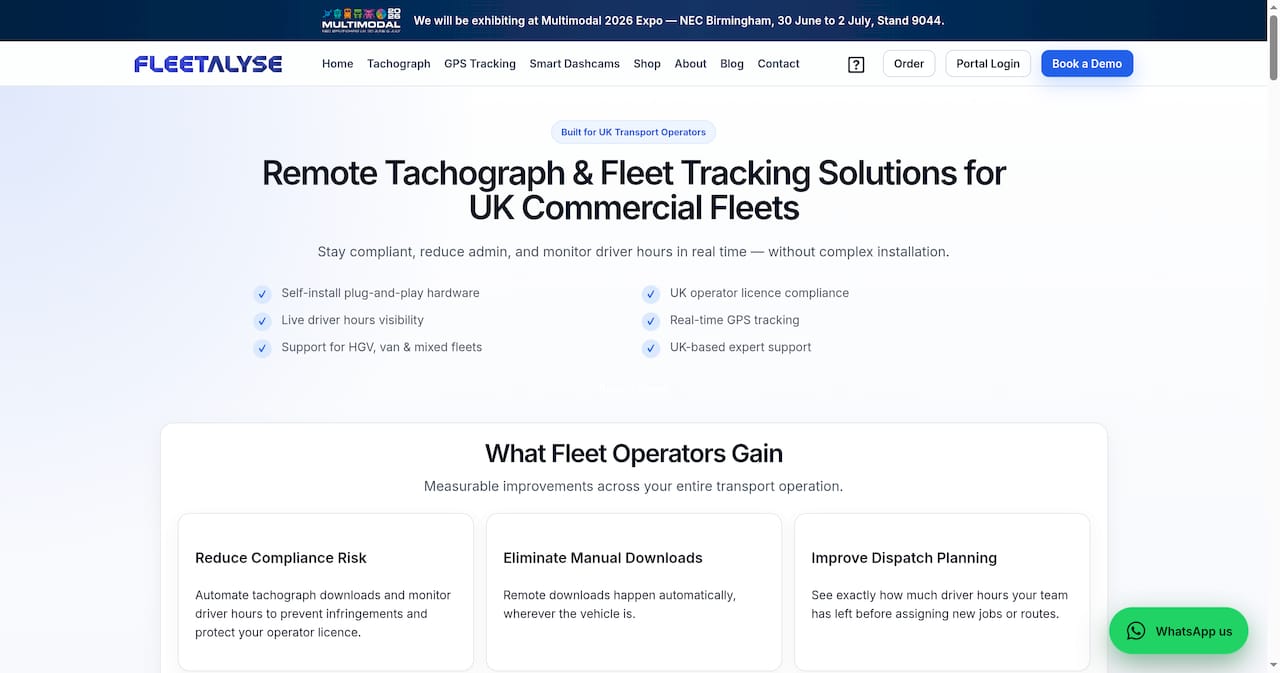
Such platforms can pull together automated next-due alerts, tachograph integration for driver hours alongside vehicle scheduling, and signed digital inspection records attached directly to each vehicle’s history, providing defect trend evidence that DVSA examiners may ask for without building it from scratch every audit. If you’re managing driver behaviour and vehicle condition as separate systems, the driver behaviour monitoring platform brings both into one view, and GPS hardware from the unlocked tracker range supplies the mileage data that mixed-frequency scheduling depends on. Get in touch for a demo and see how your current PMI schedule maps onto automated ISO week tracking.
Sources
Start with the GOV.UK roadworthiness guide for the official 4 to 13 week framework. The SIPCAT planner builds ISO week schedules from your chosen frequency. For internal scheduling structure, see Fleetalyse’s maintenance scheduling guide.
- Guide to maintaining roadworthiness: commercial goods and passenger carrying vehicles
- Preventative Maintenance Inspection PMI Records Guide