
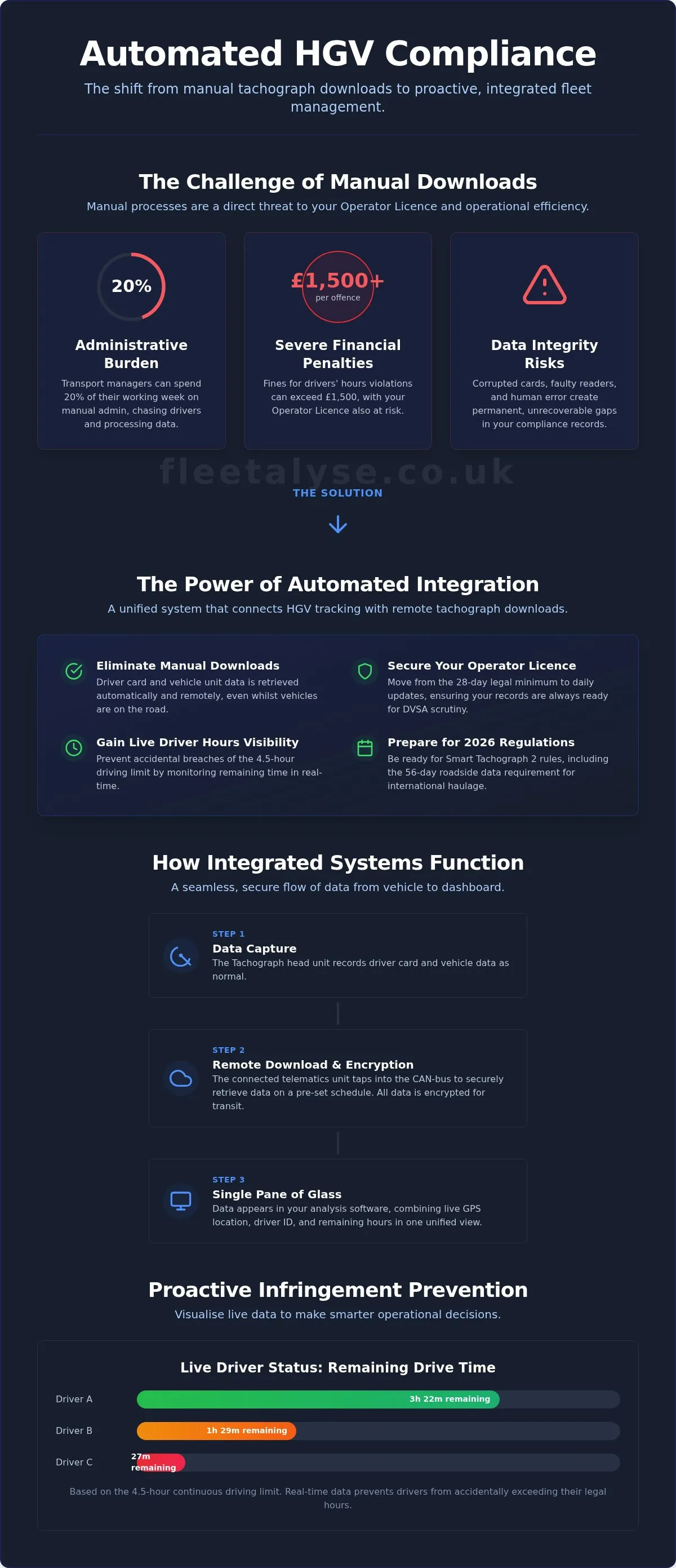
Manual tachograph downloads aren't just a drain on your time; they're a direct threat to your Operator Licence. You likely spend hours every month chasing driver cards or worrying about the £700+ fines that follow simple record-keeping errors. It's a constant battle between operational speed and DVSA standards. Adopting HGV tracking with tachograph integration changes this dynamic. It moves your business from reactive paperwork to proactive, automated management.
We know that compliance shouldn't feel like a secondary full-time job. This guide explains how integrating your fleet tracking with remote tachograph downloads removes the administrative burden whilst giving you live visibility of remaining drive time. You'll learn how to secure your licence, prevent infringements before they occur, and meet the 2026 Smart Tachograph 2 requirements. We'll examine the shift to automated data retrieval and how it creates a self-managing compliance system for your fleet.
Key Takeaways
- Discover how HGV tracking with tachograph integration eliminates manual driver card downloads and reduces administrative overhead by automating data retrieval.
- Understand the transition from 28-day legal minimums to daily automated updates that better protect your Operator Licence from DVSA scrutiny.
- Gain real-time visibility over live driver hours to prevent accidental breaches of the 4.5-hour driving limit whilst vehicles are still on the road.
- Prepare for the 2026 Smart Tachograph 2 regulations by adopting a unified system that connects telematics hardware directly to the tachograph head.
- Identify the operational gains of a pragmatic partnership that prioritises functional utility and transparent pricing over complex industry jargon.
The Growing Challenge of HGV Compliance in the UK
UK road haulage operates under a microscope. The DVSA is moving rapidly towards digital-first enforcement, leaving little room for error. Standards like Earned Recognition have raised the bar for every fleet. If your record-keeping isn't flawless, you're inviting an audit. Modern operators are shifting to HGV tracking with tachograph integration from Fleetalyse to remove the guesswork. Compliance is no longer a back-office task; it's a live operational requirement.
Understanding the technical basics of What is a Tachograph? is vital for any fleet owner. It's the primary tool for proving your operation follows the law. However, simply having the hardware isn't enough. You must manage the data it generates with absolute precision. The 2026 regulatory landscape demands a level of data accuracy that manual systems struggle to provide.
The Administrative Burden of Manual Downloads
Manual downloads are a massive drain on resources. The "chasing drivers" cycle forces vehicles back to the yard just to read a card. This kills route efficiency and wastes fuel. Transport managers often spend 20% of their working week on admin alone. This hidden labour cost is a silent profit killer. Every hour spent chasing a driver is an hour not spent on business growth.
Data integrity is another major concern. Manual card reading is prone to human error and equipment failure. A single corrupted card or a faulty reader can leave a permanent gap in your records. You can't recover that lost data, and the DVSA doesn't accept "technical glitch" as a valid excuse. Manual systems are simply too fragile for the rigours of modern haulage.
Regulatory Risks and Your Operator Licence
Your Operator Licence is the lifeblood of your business. The DVSA links record accuracy directly to your licence security. During roadside checks, missing data is treated with extreme suspicion. As of 2026, international HGVs must be able to produce 56 days of data on the spot. This is a significant increase from the previous 28-day requirement. If your downloads are late or incomplete, you're exposed.
The financial impact is severe. Fines for hours violations can reach £1,500 per offence. A single missed download can trigger a chain reaction of fines and a potential downgrade of your O-licence rating. Relying on HGV tracking with tachograph integration ensures you're never caught short. It provides a real-time stream of data that satisfies digital enforcement standards. It protects your assets whilst you focus on moving freight.
How Integrated HGV Tracking and Tachograph Systems Function
Modern fleet management requires more than just knowing a vehicle's location. A unified system creates a direct bridge between your telematics hardware and the tachograph head. It isn't a separate add-on; it's a deep technical connection. By tapping into the vehicle's CAN-bus, the system captures precise data directly from the source. This ensures that the information you see in your office matches exactly what the driver sees on their dashboard.
Data flows securely from the driver card through the telematics unit and into your analysis software in real-time. This constant stream allows you to monitor adherence to UK drivers' hours rules without waiting for the vehicle to return to the yard. Investing in HGV tracking with tachograph integration means your compliance records are always current. It replaces the fragmented approach of old-fashioned tracking with a single, reliable data pipeline.
Remote Tachograph Download Mechanics
The core of this technology is the automated download schedule. You can set specific intervals for vehicle and driver card downloads to occur whilst the vehicle is in use. This process happens in the background, requiring no input from the driver. Security is paramount; all data is encrypted and remains tamper-proof during transit to ensure it meets DVSA standards. These systems are fully compatible with both older digital units and the latest Smart Tachograph 2 hardware required for 2026 international transport.
The Single Pane of Glass Advantage
Many operators struggle with "dashboard fatigue." Using separate software for GPS tracking and tachograph analysis is inefficient and increases the risk of missing critical alerts. An integrated system offers a single pane of glass view. It combines live GPS location with driver identity, giving you total journey context. You don't just see a lorry on a map; you see exactly who is driving it and how much drive time they have left.
This integration eliminates the hidden costs of non-integrated systems, such as the time wasted switching between windows or manually matching driver names to vehicle IDs. You receive real-time alerts for expiring company cards or driver cards before they become a legal issue. If you're ready to simplify your operations, you can view our integration options to see how a unified dashboard protects your business.
By centralising your data, you reduce administrative friction. This pragmatic approach to HGV tracking with tachograph integration ensures that your transport manager spends less time on software management and more time on fleet efficiency. It's about building a reliable system that works for the rigours of the UK haulage industry.
Comparing Manual Downloads vs Automated Remote Integration
Manual downloads are a relic of a slower era. They're inefficient, prone to error, and fundamentally risky. A typical manual download takes roughly 20 minutes per vehicle. This includes the time spent locating the driver, securing the card, and physically reading the data. For a fleet of 20 vehicles, that's nearly seven hours of productivity lost every month. Contrast this with HGV tracking with tachograph integration, which reduces that administrative time to zero. Data is pulled from the vehicle whilst it's working, meaning your trucks stay on the road earning revenue instead of idling in the yard.
The difference in data frequency is equally stark. Manual systems often rely on the 28-day legal minimum. This leaves you blind to infringements for weeks at a time. Automated remote integration provides daily updates. This ensures you're always looking at current data, not historical mistakes. A side-by-side comparison reveals the operational gap:
- Data Retrieval: 20 minutes per vehicle (Manual) vs 0 minutes (Remote).
- Update Frequency: 28-day legal minimum (Manual) vs Daily automated updates (Remote).
- Vehicle Availability: Requires vehicle recall (Manual) vs Total operational flexibility (Remote).
- Data Handling: High risk of misfiling or loss (Manual) vs Direct, encrypted integration (Remote).
The Labour ROI of Automation
You shouldn't view automation as an expense; it's a direct saving. If a transport manager earns £40,000 and spends 20% of their week on compliance admin, that costs the business £8,000 every year in lost time. Automating these tasks allows your staff to refocus on route optimisation and fuel efficiency. These are the areas that actually drive profit. In most cases, the hardware pays for itself within the first 12 months just by reclaiming those lost labour hours. It's a pragmatic shift that replaces manual drudgery with technical precision.
Data Accuracy and Audit Readiness
DVSA audits are stressful because manual records often have "missing data" gaps. These gaps are immediate red flags for inspectors. Remote downloads ensure you're always "audit-ready" by eliminating the human error factor. You don't have to worry about a driver forgetting to download their card or a file being misnamed on a local PC. HGV tracking with tachograph integration standardises your data formats, allowing for seamless tachograph analysis integration. This means your records are always complete, accurate, and ready for inspection at a moment's notice.
Using Live Driver Hours to Minimise DVSA Infringements
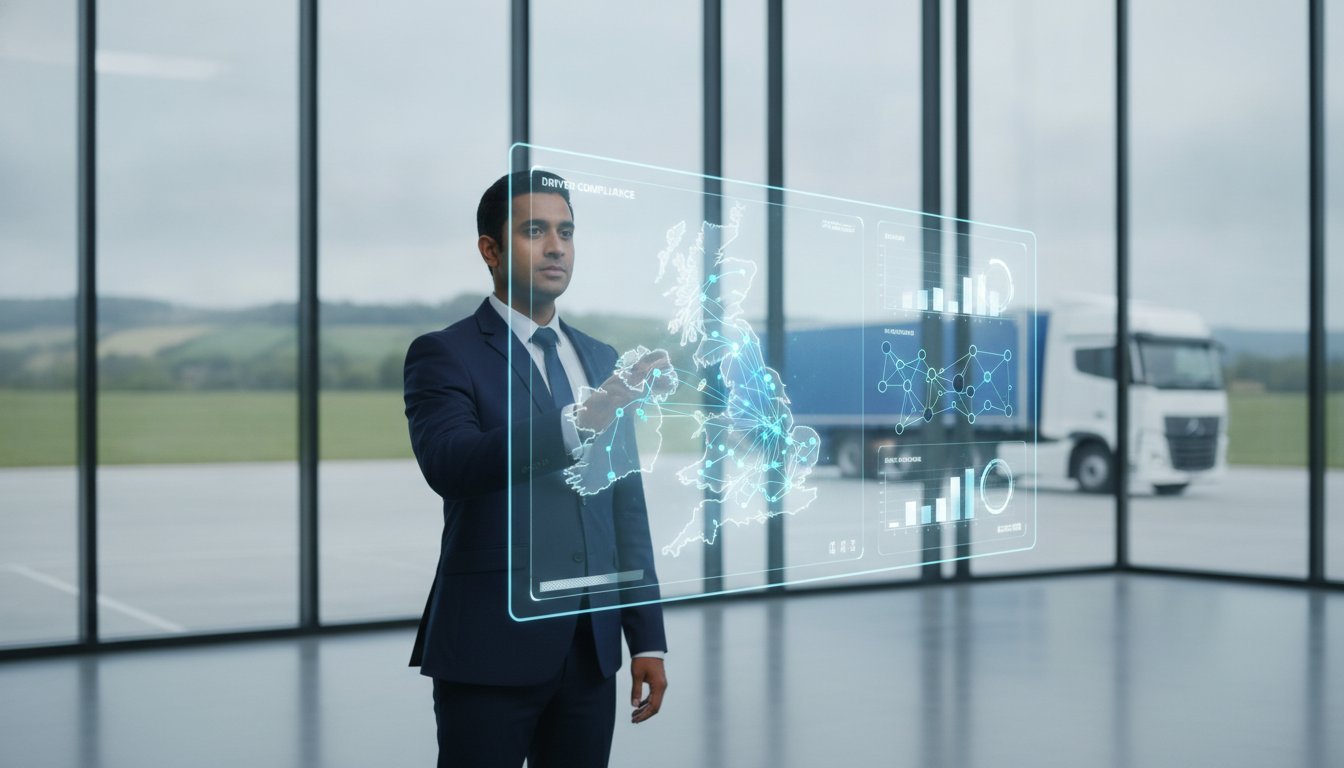
Compliance is often treated as a post-trip autopsy, but integrated systems turn it into a live safety net. By using HGV tracking with tachograph integration, you see exactly where your drivers stand against legal limits in real-time. This prevents the common 4.5-hour driving limit breach before the driver even realises they're close. It moves your operation from identifying past mistakes to preventing future fines through immediate intervention.
Real-Time Visibility for Dispatchers
Dispatchers shouldn't have to play phone tag with drivers to check their remaining hours. A unified dashboard shows exactly how many minutes a driver has left before a mandatory break is required. This allows for informed dispatch decisions based on actual legal capacity. You can plan routes that are realistic, reducing driver stress and eliminating the temptation to "push through" a rest period. It removes the burden of manual hour tracking from the driver, allowing them to focus entirely on the road whilst you manage the legalities from the office.
Managing the 56-Day Record Requirement
The regulatory landscape for international haulage shifted significantly in 2026. HGVs on international journeys must now be able to produce 56 days of tachograph data at any roadside check. Managing this requirement manually is nearly impossible for a modern fleet. If a driver is stopped during an international journey and cannot provide the full 56-day history, the vehicle faces immediate impoundment and heavy fines.
Integrated systems solve this through automated archiving. The software secures and organises records for the required duration without any manual input. This ensures international compliance and protects your business from the risks associated with missing data. Whether your vehicles are operating domestically or crossing international borders, you have the peace of mind that their records are complete and accessible. You can secure your fleet's compliance today by choosing our integrated tracking and tachograph solution.
Proactive infringement management is about identifying bad habits before they become expensive penalties. If a driver consistently cuts their daily rest short by five minutes, the system flags it immediately. You can address the behaviour through training rather than waiting for a DVSA inspector to find it during an audit. This pragmatic approach to data ensures your O-licence remains secure and your fleet stays operational. It's a reliable way to manage the rigours of modern road transport.
Future-Proofing Your Fleet with Fleetalyse Integration
Fleetalyse represents the pragmatic choice for UK transport operators who value honesty and operational clarity. We aren't a distant, global software provider; we're a localised specialist that understands the specific challenges of regional infrastructure and DVSA regulations. Adopting HGV tracking with tachograph integration is a commitment to the long-term health of your business. We focus on delivering a service built for real-world application, ensuring your data is reliable and your O-licence remains secure whilst you focus on moving freight.
A Partnership Approach to Compliance
We move beyond the role of a standard software vendor to become your expert compliance partner. Our team provides UK-based support, offering industry-specific knowledge that generic competitors simply can't match. We understand that your time is valuable, so we provide straightforward solutions that resolve daily operational struggles. Our transparent pricing models are designed to respect the margins of the transport sector. You won't encounter hidden costs or unexpected contractual complexities.
Our GPS fleet tracking and tacho solutions are built to scale alongside your fleet. This scalability ensures that as your business grows, your compliance ecosystem remains robust and manageable. By joining our network, you align your business with other compliant, efficient UK hauliers who prioritise regulatory adherence. We act as an active catalyst for your operational improvement, providing the tools you need to manage assets effectively and transparently.
Getting Started with Remote Tachograph Downloads
The shift to remote tachograph downloads is designed to be frictionless. Our HGV tracking hardware features a simple installation process that avoids lengthy vehicle downtime. We prioritise technical compatibility, allowing you to integrate with your existing tacho analysis software without a hitch. This ensures a seamless transition for your transport office, maintaining continuity in your record-keeping and preventing data gaps.
Taking the first step toward automation is a clear decision-making point. You can Contact Fleetalyse — our pricing is published in full, from £5.99 per device per month inc VAT to see our financial terms upfront. We provide all the granular details you need to make an informed choice for your fleet. Don't let manual admin hold your business back. Future-proof your operations with a reliable ally that values your time and resources.
Secure Your Fleet's Future with Automated Compliance
The road to full compliance doesn't have to be paved with manual paperwork. Adopting HGV tracking with tachograph integration transforms your transport office from a reactive administrative hub into a proactive, efficient operation. Remote downloads eliminate the "chasing drivers" cycle; real-time visibility of driver hours stops infringements before they result in DVSA fines. You reclaim lost labour hours whilst securing your business against regulatory scrutiny.
Choosing a pragmatic partner like Fleetalyse puts UK-based compliance experts in your corner. We offer transparent pricing with no hidden costs, providing the functional utility you need without unnecessary hyperbole. Our systems deliver the live visibility required to protect your Operator Licence and keep your vehicles productive. Don't let outdated manual processes put your business at risk in a digital-first enforcement landscape. Take control of your data and join a network of efficient UK hauliers.
Secure your Operator Licence with Fleetalyse Remote Tacho Downloads today and build a more resilient fleet for the years ahead.
Frequently Asked Questions
Is remote tachograph download legal in the UK?
Remote tachograph downloading is completely legal in the UK and is officially recognised by the DVSA. It provides a secure method for operators to meet their data retrieval obligations without needing physical access to the vehicle. This technology ensures that the digital signature of the data remains intact, maintaining its validity for legal and audit purposes. It's an essential practice for modern fleets aiming for high compliance ratings and administrative efficiency.
How often should I download my HGV tachograph data?
By law, you must download driver card data every 28 days and vehicle unit data every 90 days. However, HGV tracking with tachograph integration allows for much more frequent, automated downloads. Most operators set the system to retrieve data daily or weekly. This proactive approach ensures you identify infringements early and never miss a legal deadline, keeping your records current for any potential roadside inspection or internal audit.
What is the fine for a tachograph infringement in 2026?
In 2026, the DVSA issues graduated fixed penalties for tachograph infringements ranging from £50 to over £300 per offence. For more serious breaches of drivers' hours rules, fines can reach up to £1,500. Additionally, record-keeping errors carry significant financial risks. Because the DVSA can review up to 28 days of historical data during a single check, multiple penalties can accumulate quickly, potentially costing thousands of pounds and risking your licence security.
Can I integrate my existing tachograph analysis software?
Yes, our system features seamless tachograph analysis integration. We understand that most transport operators already have a preferred analysis platform. Our technology is designed to be flexible, automatically sending your remote download files directly to your existing software. This ensures a frictionless transition and allows you to maintain your current reporting workflows whilst benefiting from the speed and reliability of automated, remote data retrieval without any manual file handling.
Does HGV tracking with tacho integration work for international journeys?
The system is specifically designed to handle international journeys. As of 2026, HGVs on international routes must be able to produce 56 days of data at the roadside. Remote integration ensures this data is always archived and accessible, regardless of where the vehicle is located in Europe. It also supports the latest Smart Tachograph 2 requirements, which automatically record border crossings and facilitate easier compliance for cross-border haulage operations and regulatory checks.
What hardware is required for remote tachograph downloads?
You will need a compatible telematics unit installed in the vehicle and connected directly to the tachograph head. This hardware acts as the bridge between your vehicle and the cloud, securely transmitting data in real-time. The installation is straightforward and works with both standard digital tachographs and the newer smart models. Once the hardware is in place, the system handles all scheduled downloads automatically without requiring any driver interaction or vehicle downtime.
How does live driver hours tracking help with DVSA compliance?
Live driver hours tracking provides real-time visibility into each driver's remaining drive time and mandatory rest periods. This allows dispatchers to make informed decisions and prevent accidental breaches of the 4.5-hour driving limit. By seeing exactly when a break is due, you can plan routes more accurately and reduce the risk of infringements. This proactive management is a key factor in maintaining a high DVSA compliance rating whilst using HGV tracking with tachograph integration.
Will this system work with older HGV models?
The system is compatible with the vast majority of HGVs currently on UK roads. As long as your vehicle is equipped with a digital tachograph, which has been mandatory for new vehicles since 2006, the integration will function correctly. We support a wide range of tachograph heads from major manufacturers. Our team can verify your specific hardware configuration to ensure a seamless connection and reliable data flow for your entire fleet, regardless of vehicle age.
Frequently asked questions
Is remote tachograph download legal in the UK?
Remote tachograph downloading is completely legal in the UK and is officially recognised by the DVSA. It provides a secure method for operators to meet their data retrieval obligations without needing physical access to the vehicle. This technology ensures that the digital signature of the data remains intact, maintaining its validity for legal and audit purposes. It's an essential practice for modern fleets aiming for high compliance ratings and administrative efficiency.
How often should I download my HGV tachograph data?
By law, you must download driver card data every 28 days and vehicle unit data every 90 days. However, HGV tracking with tachograph integration allows for much more frequent, automated downloads. Most operators set the system to retrieve data daily or weekly. This proactive approach ensures you identify infringements early and never miss a legal deadline, keeping your records current for any potential roadside inspection or internal audit.
What is the fine for a tachograph infringement in 2026?
In 2026, the DVSA issues graduated fixed penalties for tachograph infringements ranging from £50 to over £300 per offence. For more serious breaches of drivers' hours rules, fines can reach up to £1,500. Additionally, record-keeping errors carry significant financial risks. Because the DVSA can review up to 28 days of historical data during a single check, multiple penalties can accumulate quickly, potentially costing thousands of pounds and risking your licence security.
Can I integrate my existing tachograph analysis software?
Yes, our system features seamless tachograph analysis integration. We understand that most transport operators already have a preferred analysis platform. Our technology is designed to be flexible, automatically sending your remote download files directly to your existing software. This ensures a frictionless transition and allows you to maintain your current reporting workflows whilst benefiting from the speed and reliability of automated, remote data retrieval without any manual file handling.
Does HGV tracking with tacho integration work for international journeys?
The system is specifically designed to handle international journeys. As of 2026, HGVs on international routes must be able to produce 56 days of data at the roadside. Remote integration ensures this data is always archived and accessible, regardless of where the vehicle is located in Europe. It also supports the latest Smart Tachograph 2 requirements, which automatically record border crossings and facilitate easier compliance for cross-border haulage operations and regulatory checks.
What hardware is required for remote tachograph downloads?
You will need a compatible telematics unit installed in the vehicle and connected directly to the tachograph head. This hardware acts as the bridge between your vehicle and the cloud, securely transmitting data in real-time. The installation is straightforward and works with both standard digital tachographs and the newer smart models. Once the hardware is in place, the system handles all scheduled downloads automatically without requiring any driver interaction or vehicle downtime.
How does live driver hours tracking help with DVSA compliance?
Live driver hours tracking provides real-time visibility into each driver's remaining drive time and mandatory rest periods. This allows dispatchers to make informed decisions and prevent accidental breaches of the 4.5-hour driving limit. By seeing exactly when a break is due, you can plan routes more accurately and reduce the risk of infringements. This proactive management is a key factor in maintaining a high DVSA compliance rating whilst using HGV tracking with tachograph integration.
Will this system work with older HGV models?
The system is compatible with the vast majority of HGVs currently on UK roads. As long as your vehicle is equipped with a digital tachograph, which has been mandatory for new vehicles since 2006, the integration will function correctly. We support a wide range of tachograph heads from major manufacturers. Our team can verify your specific hardware configuration to ensure a seamless connection and reliable data flow for your entire fleet, regardless of vehicle age.