
In 2026, waiting for a weekly tachograph download to spot an infringement isn't just a risk; it's a direct threat to your Operator Licence. You're likely already feeling the pressure of managing driver fatigue regulations uk whilst trying to keep your fleet moving. The administrative burden of manual data collection is heavy. The fear of a DVSA fine for a mistake you didn't see in time is a constant worry. We understand the daily struggle to balance operational speed with strict legal adherence.
This article provides a clear path to mastering UK fatigue regulations by using live data to ensure total compliance. You'll learn how to meet HSE and DVSA expectations. We'll show you how to implement a system that prevents hours infringements before they happen. We'll explore how tools like AI dashcams, remote tachograph downloads, and live driver hours can reduce your administrative workload and protect your drivers. It's time to move beyond retrospective analysis. Start using live telematics to intervene before a safety breach occurs.
Key Takeaways
- Align your fleet with the Health and Safety at Work Act 1974 by identifying and monitoring mental and physical performance declines.
- Navigate the complexities of managing driver fatigue regulations uk by identifying the specific thresholds for GB Domestic and EU/AETR rules.
- Bridge the compliance gap by moving from retrospective 28-day manual downloads to live, automated data monitoring.
- Establish a proactive Fatigue Risk Management System through route risk assessments and clear, accessible driver fatigue policies.
- Streamline operations with live driver hours and GPS fleet tracking to prevent infringements before they occur.
Understanding the Legal Framework for Managing Driver Fatigue in the UK
The Health and Safety Executive (HSE) defines fatigue as a decline in mental and physical performance. It's more than just feeling a bit tired. It's a physiological state resulting from prolonged exertion, sleep loss, or disrupted circadian rhythms. In a transport environment, this translates to slower reaction times, poor decision-making, and reduced situational awareness. When a driver is fatigued, their ability to operate a heavy vehicle safely is fundamentally compromised.
Managing driver fatigue regulations uk is a fundamental legal obligation for every operator. The Health and Safety at Work Act 1974 requires employers to protect the safety of their staff and the general public. This duty is non-negotiable. Additionally, the Management of Health and Safety at Work Regulations 1999 mandates that operators conduct formal risk assessments for all activities. If your operational planning doesn't explicitly account for driver exhaustion, your business is exposed to significant legal risk. You must prove you've taken every reasonable step to mitigate the danger.
The DVSA views fatigue as a "top-tier" risk during fleet inspections. They recognise that exhaustion is a major factor in HGV collisions across the country. During an audit, inspectors look for evidence of robust management systems rather than just clean paperwork. They use Tachograph Rules Explained to verify that mandatory rest periods are being followed. A failure to produce these records or evidence of systematic breaches suggests a total failure of management control. It signals to the DVSA that your fleet is a danger to the public.
Employer vs. Driver Responsibilities
Operators hold a primary "duty of care" to their employees and the public. You must organise work in a way that allows for sufficient rest and prevents burnout. Drivers have a duty to arrive fit for work and manage their own sleep hygiene effectively. However, a driver's "willingness to work" doesn't exempt an employer from liability. If a driver agrees to an extra shift but causes an accident due to fatigue, the operator remains responsible. You cannot rely on a driver's discretion; you need data-driven systems from Fleetalyse to enforce safety limits and protect your business.
The Consequences of Regulatory Non-Compliance
The penalties for ignoring fatigue are severe. Under corporate manslaughter legislation, companies face unlimited fines, and individual directors can face custodial sentences. Your Operator Compliance Risk Score (OCRS) is also at stake. Frequent fatigue-related infringements will move your fleet into a high-risk category. This leads to more frequent roadside stops and potentially a summons to a Public Inquiry before a Traffic Commissioner. Losing your Operator Licence is a business-ending event. Additionally, fatigue-related crashes lead to massive insurance premium hikes and lasting damage to your brand reputation amongst your customers.
The Core Regulations: Driver Hours and Tachograph Rules
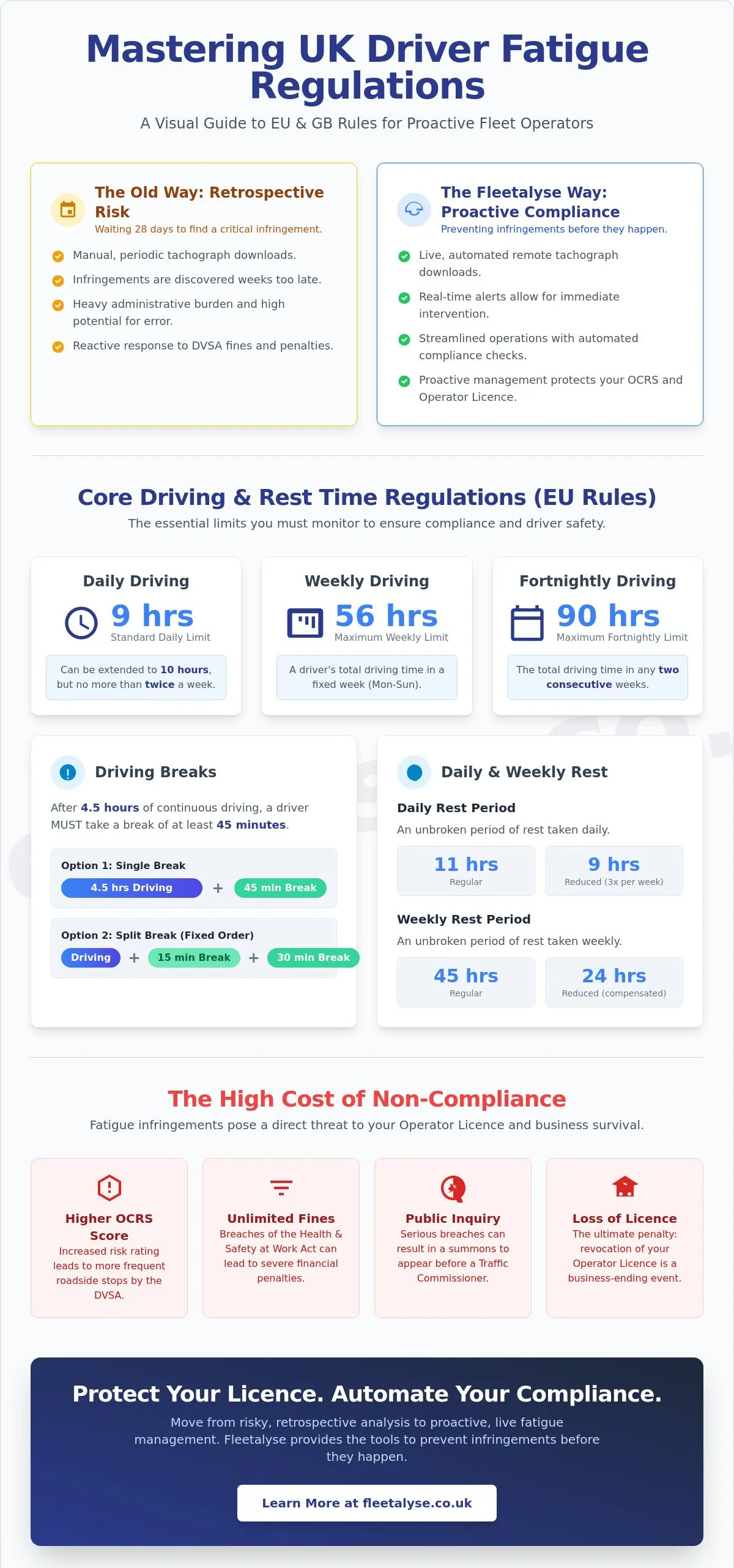
Compliance starts with knowing which rule set applies to your operation. For most HGV operators, the assimilated EU rules dictate the working day. These include a strict 9-hour daily driving limit, which you can extend to 10 hours twice a week. Total weekly driving must not exceed 56 hours, whilst the fortnightly limit is capped at 90 hours. Managing driver fatigue regulations uk requires constant vigilance over these varying standards. From 1 July 2026, even light commercial vehicles (LCVs) between 2.5 and 3.5 tonnes used for international hire must fit Smart Tachograph 2 units. Domestic UK LCV operations remain exempt from this specific update for now.
The 4.5-hour driving limit is a critical safety threshold. After this period, a driver must take an uninterrupted break of at least 45 minutes. You can split this into a 15-minute break followed by a 30-minute break, but the order is fixed. These pauses are essential for physical and mental recovery. For full details on rest requirements, consult the official UK Driver Hours Regulations. Tachographs record every second of movement, acting as a permanent "black box" for enforcement. If the data shows a 44-minute break instead of 45, the DVSA will flag it as an infringement during an audit.
Daily and weekly rest periods provide the necessary time for full physiological recovery. Drivers need at least 11 hours of daily rest, though this can be reduced to 9 hours three times between any two weekly rest periods. A regular weekly rest is an unbroken 45-hour period. You can reduce this to 24 hours every other week, provided the reduction is compensated by an equivalent period of rest taken en bloc before the end of the third week following the week in question. Tracking these complex patterns manually is difficult. It's often more efficient to streamline your compliance management using live data feeds.
Night Work and the Working Time Directive
Night work introduces higher fatigue risks. If any work occurs between 00:00 and 04:00, a 10-hour daily working limit applies. This includes non-driving work. You can only exceed this limit with a formal collective or workforce agreement. Operators must calculate average weekly hours over a "reference period", usually 17 or 26 weeks. Keeping track of these averages manually is a recipe for error. Accuracy is vital to avoid breaching the 48-hour average weekly limit.
Exemptions and Emergencies
Drivers can occasionally deviate from these rules to reach a suitable stopping place for the safety of the vehicle or its load. This isn't a loophole for poor planning. Every deviation requires a manual tachograph entry and a printout explaining the reason. The DVSA rarely accepts "unforeseen traffic" as a valid excuse without verifiable proof. They expect operators to build contingency time into every route. Relying on emergency exemptions during an audit is a high-risk strategy that rarely pays off.
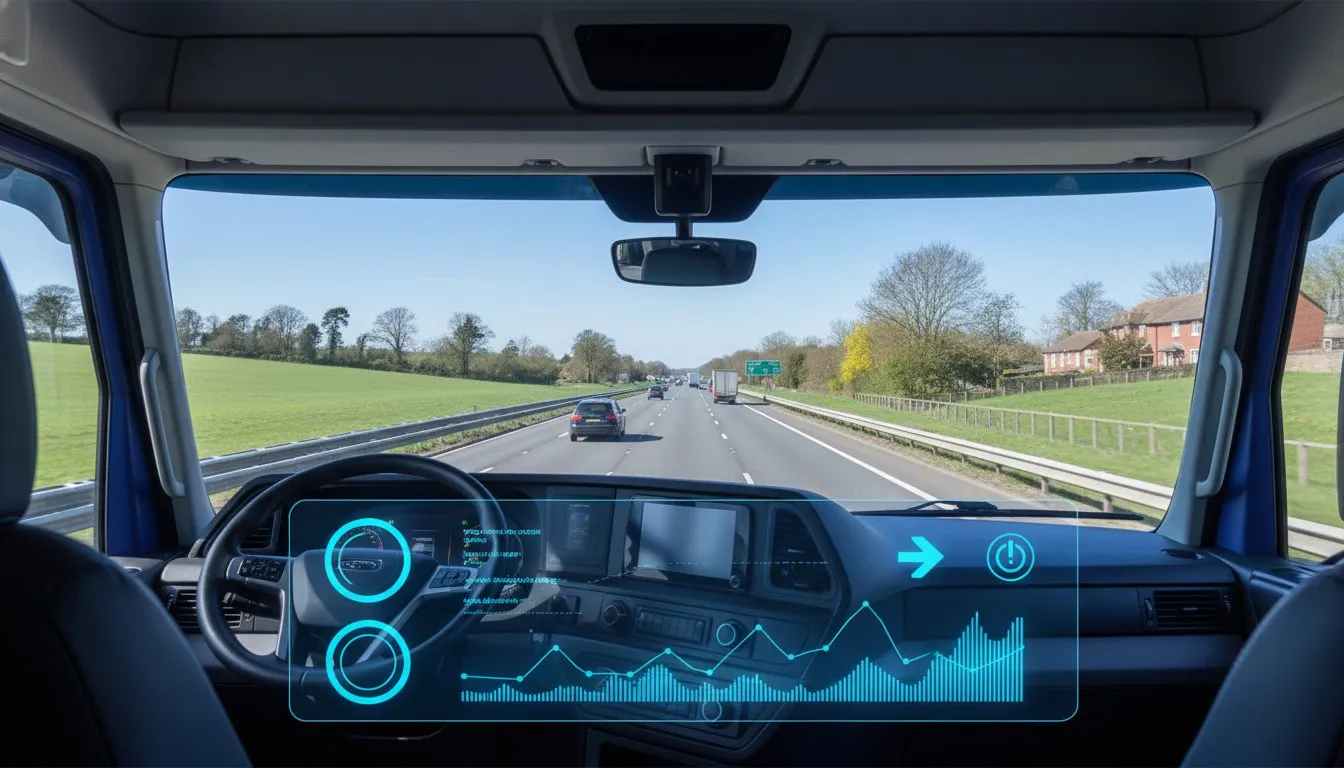
Manual vs. Automated Fatigue Management: Addressing the Compliance Gap
Manual compliance systems are inherently reactive. The industry standard often relies on a 28-day download cycle for driver cards and a 90-day cycle for vehicle units. This creates a dangerous compliance gap. If a driver commits an hours infringement on day one of the cycle, you won't discover it for nearly a month. By then, the damage is done. Retrospective analysis only identifies mistakes after they've happened. It doesn't prevent them. This delay makes managing driver fatigue regulations uk nearly impossible in a fast-moving operational setting. You're essentially managing by looking in the rear-view mirror.
The administrative cost of manual management is high. Transport managers spend hours chasing drivers for cards or waiting for specific vehicles to return to the depot. This manual process is prone to human error. Files get corrupted, cards are forgotten, and deadlines are missed. These "unintentional" non-compliance issues carry the same DVSA penalties as deliberate ones. You're paying for administrative friction that actually increases your risk profile. It distracts your team from more productive tasks, like route optimisation or asset management. Efficiency suffers whilst the risk of a Public Inquiry grows.
The Value of Live Driver Hours Visibility
Live Driver Hours visibility transforms the transport office. Instead of guessing, managers see real-time data on drive time, break status, and remaining duty hours. This allows for immediate intervention. If a driver is minutes away from a 4.5-hour breach, you can redirect them to a safe stopping point immediately. It removes the "stress factor" for staff during peak periods. You stop being a record-keeper and start being a proactive safety manager. Your team can make decisions based on facts rather than estimates or best-case scenarios. This transparency builds trust between the office and the cab.
Remote Tachograph Downloads: A Compliance Game-Changer
Remote Tachograph Download technology removes the manual burden entirely. Data is collected automatically on a schedule you define. Your fleet remains "audit-ready" at all times without a single manual intervention. The system integrates directly with tachograph analysis software. This means instant reporting and clear visibility of your compliance standing. You'll never miss a download deadline again. It's a pragmatic solution for regional operators who need to prioritise road time over paperwork. By automating Remote Tachograph Download, you ensure that your records are always complete, accurate, and ready for inspection.
Implementing a Fatigue Risk Management System (FRMS)
An FRMS is a data-driven, systematic approach to safety. It doesn't replace the law; it provides the framework to exceed it. Managing driver fatigue regulations uk effectively requires a structured plan that moves beyond simple compliance. You need a process that identifies, monitors, and mitigates fatigue risks before they result in a collision or a DVSA fine. This isn't about ticking boxes on a form. It's about building a culture where safety is measurable and non-negotiable.
- Step 1: Conduct a thorough risk assessment. Analyse your routes and shift patterns. Identify where high-intensity driving or long motorway stretches create the most strain.
- Step 2: Create a robust Fatigue Policy. Draft a document that drivers actually understand. It should clearly define maximum duty lengths and mandatory rest procedures.
- Step 3: Train staff on recognition. Teach both drivers and office staff to spot the early physical and mental signs of exhaustion.
- Step 4: Use technology to monitor performance. Deploy tools like Fleetalyse to track live driver hours and GPS data. This provides the objective evidence needed to manage risk.
- Step 5: Review and iterate. Use your weekly infringement reports to refine your strategy. If a specific route consistently causes hours breaches, change the route.
Identifying High-Risk Routes and Schedules
Not all miles are equal. Long motorway stretches are notoriously dangerous because of "monotonous driving." This lack of stimulation can trigger micro-sleeps, even in drivers who have had sufficient rest. Shift transitions are another major risk factor. Moving a driver from day shifts to night shifts disrupts their circadian rhythm. This disruption peaks between 00:00 and 04:00, when the body's natural urge to sleep is strongest. You must ensure your schedules include adequate facilities for rest and refuelling. A driver forced to search for a parking space whilst their clock is ticking is a driver under dangerous levels of stress.
Culture and Reporting
A successful FRMS relies on honest communication. You should encourage a "no-blame" culture. If a driver feels too tired to continue safely, they must feel empowered to stop without fear of disciplinary action. This transparency is vital for long-term safety. However, you must also address "rogue" behaviour. Some drivers may intentionally push their limits to finish early. By using objective data, you can have fair, evidence-based conversations. It's not your word against theirs; it's a discussion based on recorded facts. To start building a safer, more transparent operation, you can integrate automated compliance tools today.
Modern Solutions for Driver Fatigue and Compliance
Technology is the only way to scale safety effectively. Managing driver fatigue regulations uk requires more than spreadsheets and good intentions. Fleetalyse integrates Live Driver Hours with GPS Fleet Tracking to provide a complete operational picture. You don't just see a vehicle on a map; you see the legal status of the person behind the wheel. This combination allows you to match the right driver to the right job based on their remaining legal hours. It eliminates the guesswork that often leads to accidental infringements.
A "single pane of glass" approach simplifies your entire operation. You can manage HGV compliance, trailer tracking, and van tracking in one centralised dashboard. This reduces the need for multiple software subscriptions and prevents data silos. Centralised data also improves your risk profile. When you can prove a history of proactive fatigue management with hard data, you position your business as a lower risk to insurance underwriters. It demonstrates a commitment to safety that goes beyond the bare minimum required by law.
Preparing for the future is essential. UK transport regulations are evolving quickly. The government's 2026 Road Safety Strategy and the rollout of Smart Tachograph 2 for international LCVs show a clear trend toward digital, precision enforcement. Using a data-led system ensures you stay ahead of these changes. You move from being a reactive operator to being an industry leader in safety. This proactive stance protects your Operator Licence and ensures your business remains competitive in a tightening regulatory environment.
Live Visibility for Proactive Management
Managers need to see exactly how much drive time is left before a mandatory break. Fleetalyse provides this visibility in real-time. The system sends automated alerts to managers when a driver nears their limit. This allows for immediate route adjustments or driver swaps. You can use this live data to improve dispatch planning and route efficiency. It ensures that your schedules are realistic and legally achievable. Drivers feel supported when the office understands their legal constraints, reducing the pressure to "push through" exhaustion.
Seamless Compliance Integration
Remote tachograph downloads remove the burden of manual data collection. Files are pulled from the vehicle automatically, ensuring data integrity for DVSA Earned Recognition or other industry accreditations. Your records stay complete and accurate without your team lifting a finger. This automation is the foundation of a modern, audit-ready fleet. It allows you to focus on growth whilst the system handles the technicalities of compliance. To see how these tools can protect your business, organise a demonstration of Fleetalyse compliance tools today.
Secure Your Fleet's Future with Proactive Compliance
Moving from manual, retrospective record-keeping to live, data-driven oversight is the only way to secure your fleet's operational future. You now have the practical steps to move beyond the 28-day compliance gap and intervene before a safety breach occurs. By prioritising real-time data, you protect your drivers, your Operator Licence, and your business reputation. It's about shifting from reactive record-keeping to active safety management.
Managing driver fatigue regulations uk doesn't have to be a heavy administrative burden. Automation ensures your fleet remains audit-ready whilst allowing your transport team to focus on core operational tasks. As specialists in UK transport compliance, Fleetalyse provides the real-time visibility of live driver hours needed to manage risk effectively. Our systems offer seamless integration with major tacho analysis software, providing a transparent and reliable solution built for the rigours of the road.
Don't leave your compliance status to chance or outdated manual processes. Streamline your fleet compliance with Fleetalyse remote tachograph solutions. Taking these proactive steps today ensures a safer, more efficient, and fully compliant operation for years to come.
Frequently Asked Questions
What are the main causes of driver fatigue in the UK transport industry?
Circadian rhythm disruption and monotonous driving on long motorway stretches are the primary causes of exhaustion. Irregular shift patterns and inadequate rest facilities also contribute significantly to the problem. Managing driver fatigue regulations uk requires operators to identify these environmental and physiological triggers during their mandatory risk assessments. Failing to account for the "body clock" during night work often leads to dangerous concentration lapses between 00:00 and 04:00.
How many hours can an HGV driver legally drive in the UK?
Under assimilated EU rules, an HGV driver is limited to 9 hours of daily driving, which can be increased to 10 hours twice a week. The weekly limit is fixed at 56 hours, whilst the total fortnightly driving time must not exceed 90 hours. Drivers must also take a 45-minute break after every 4.5 hours of driving. These limits are strictly enforced through tachograph data to ensure road safety and driver health.
What are the penalties for breaching driver fatigue regulations?
Breaching these rules results in graduated fixed penalties, impact on your Operator Compliance Risk Score (OCRS), and potential referral to a Public Inquiry. In serious cases involving collisions, employers face unlimited fines and custodial sentences under corporate manslaughter laws. The DVSA views fatigue as a high-tier risk. Systematic failures to manage hours can lead to the immediate suspension or total loss of your Operator Licence, effectively ending your business operations.
How often must I download driver card and vehicle unit data?
Legal requirements mandate downloading driver card data at least every 28 days and vehicle unit data every 90 days. However, relying on these maximum intervals creates a dangerous "compliance gap" where infringements aren't spotted for weeks. Most professional operators now use remote tachograph downloads to collect data daily. This automation ensures the fleet is always audit-ready and allows for immediate corrective action when a driver nears their legal limit.
Can an employer be held liable for a fatigue-related accident?
Employers hold a primary duty of care under the Health and Safety at Work Act 1974 and are liable for fatigue-related incidents. You cannot shift this responsibility to the driver; even if a driver "volunteers" for extra hours, the operator remains legally accountable. If an accident occurs and your records show a pattern of ignored infringements or poor scheduling, the authorities will pursue the business and its directors for regulatory failures.
What is the difference between EU and GB domestic driver hours rules?
EU rules are stricter and apply to most HGV operations, requiring a 45-minute break after 4.5 hours of driving. GB domestic rules apply to specific exempt vehicles and allow for 10 hours of daily driving with an 11-hour daily duty limit. It's vital to know which set applies to your specific fleet. Most regional operators find that managing driver fatigue regulations uk is more complex under EU rules due to the intricate rest and compensation requirements.
How does remote tachograph download improve compliance?
Remote tachograph downloads remove the 28-day lag and administrative friction associated with manual data collection. The system pulls data automatically, ensuring you never miss a legal deadline or lose a file. When integrated with live driver hours, it gives managers a real-time view of remaining drive time. This allows you to prevent infringements before they happen. It transforms compliance from a retrospective reporting task into a proactive safety strategy.
What are the early warning signs of driver fatigue that managers should look for?
Managers should look for physical indicators like frequent yawning, heavy eyelids, or slower reaction times during briefings. Mental signs include increased irritability, poor concentration, or a driver forgetting recent instructions. On the road, telematics data often shows poor lane discipline or erratic braking as early indicators of a performance decline. Spotting these signs early allows for intervention before a micro-sleep or a serious collision occurs on a high-speed route.
Frequently asked questions
Employer vs. Driver Responsibilities
Operators hold a primary "duty of care" to their employees and the public. You must organise work in a way that allows for sufficient rest and prevents burnout. Drivers have a duty to arrive fit for work and manage their own sleep hygiene effectively. However, a driver's "willingness to work" doesn't exempt an employer from liability. If a driver agrees to an extra shift but causes an accident due to fatigue, the operator remains responsible. You cannot rely on a driver's discretion; you need data-driven systems from Fleetalyse to enforce safety limits and protect your business.
The Consequences of Regulatory Non-Compliance
The penalties for ignoring fatigue are severe. Under corporate manslaughter legislation, companies face unlimited fines, and individual directors can face custodial sentences. Your Operator Compliance Risk Score (OCRS) is also at stake. Frequent fatigue-related infringements will move your fleet into a high-risk category. This leads to more frequent roadside stops and potentially a summons to a Public Inquiry before a Traffic Commissioner. Losing your Operator Licence is a business-ending event. Additionally, fatigue-related crashes lead to massive insurance premium hikes and lasting damage to your brand reputation amongst your customers. Compliance starts with knowing which rule set applies to your operation. For most HGV operators, the assimilated EU rules dictate the working day. These include a strict 9-hour daily driving limit, which you can extend to 10 hours twice a week. Total weekly driving must not exceed 56 hours, whilst the fortnightly limit is capped at 90 hours. Managing driver fatigue regulations uk requires constant vigilance over these varying standards. From 1 July 2026, even light commercial vehicles (LCVs) between 2.5 and 3.5 tonnes used for international hire must fit Smart Tachograph 2 units. Domestic UK LCV operations remain exempt from this specific update for now. The 4.5-hour driving limit is a critical safety threshold. After this period, a driver must take an uninterrupted break of at least 45 minutes. You can split this into a 15-minute break followed by a 30-minute break, but the order is fixed. These pauses are essential for physical and mental recovery. For full details on rest requirements, consult the official UK Driver Hours Regulations. Tachographs record every second of movement, acting as a permanent "black box" for enforcement. If the data shows a 44-minute break instead of 45, the DVSA will flag it as an infringement during an audit. Daily and weekly rest periods provide the necessary time for full physiological recovery. Drivers need at least 11 hours of daily rest, though this can be reduced to 9 hours three times between any two weekly rest periods. A regular weekly rest is an unbroken 45-hour period. You can reduce this to 24 hours every other week, provided the reduction is compensated by an equivalent period of rest taken en bloc before the end of the third week following the week in question. Tracking these complex patterns manually is difficult. It's often more efficient to streamline your compliance management using live data feeds.
Night Work and the Working Time Directive
Night work introduces higher fatigue risks. If any work occurs between 00:00 and 04:00, a 10-hour daily working limit applies. This includes non-driving work. You can only exceed this limit with a formal collective or workforce agreement. Operators must calculate average weekly hours over a "reference period", usually 17 or 26 weeks. Keeping track of these averages manually is a recipe for error. Accuracy is vital to avoid breaching the 48-hour average weekly limit.
Exemptions and Emergencies
Drivers can occasionally deviate from these rules to reach a suitable stopping place for the safety of the vehicle or its load. This isn't a loophole for poor planning. Every deviation requires a manual tachograph entry and a printout explaining the reason. The DVSA rarely accepts "unforeseen traffic" as a valid excuse without verifiable proof. They expect operators to build contingency time into every route. Relying on emergency exemptions during an audit is a high-risk strategy that rarely pays off. Manual compliance systems are inherently reactive. The industry standard often relies on a 28-day download cycle for driver cards and a 90-day cycle for vehicle units. This creates a dangerous compliance gap. If a driver commits an hours infringement on day one of the cycle, you won't discover it for nearly a month. By then, the damage is done. Retrospective analysis only identifies mistakes after they've happened. It doesn't prevent them. This delay makes managing driver fatigue regulations uk nearly impossible in a fast-moving operational setting. You're essentially managing by looking in the rear-view mirror. The administrative cost of manual management is high. Transport managers spend hours chasing drivers for cards or waiting for specific vehicles to return to the depot. This manual process is prone to human error. Files get corrupted, cards are forgotten, and deadlines are missed. These "unintentional" non-compliance issues carry the same DVSA penalties as deliberate ones. You're paying for administrative friction that actually increases your risk profile. It distracts your team from more productive tasks, like route optimisation or asset management. Efficiency suffers whilst the risk of a Public Inquiry grows.
The Value of Live Driver Hours Visibility
Live Driver Hours visibility transforms the transport office. Instead of guessing, managers see real-time data on drive time, break status, and remaining duty hours. This allows for immediate intervention. If a driver is minutes away from a 4.5-hour breach, you can redirect them to a safe stopping point immediately. It removes the "stress factor" for staff during peak periods. You stop being a record-keeper and start being a proactive safety manager. Your team can make decisions based on facts rather than estimates or best-case scenarios. This transparency builds trust between the office and the cab.
Remote Tachograph Downloads: A Compliance Game-Changer
Remote Tachograph Download technology removes the manual burden entirely. Data is collected automatically on a schedule you define. Your fleet remains "audit-ready" at all times without a single manual intervention. The system integrates directly with tachograph analysis software. This means instant reporting and clear visibility of your compliance standing. You'll never miss a download deadline again. It's a pragmatic solution for regional operators who need to prioritise road time over paperwork. By automating Remote Tachograph Download, you ensure that your records are always complete, accurate, and ready for inspection. An FRMS is a data-driven, systematic approach to safety. It doesn't replace the law; it provides the framework to exceed it. Managing driver fatigue regulations uk effectively requires a structured plan that moves beyond simple compliance. You need a process that identifies, monitors, and mitigates fatigue risks before they result in a collision or a DVSA fine. This isn't about ticking boxes on a form. It's about building a culture where safety is measurable and non-negotiable.
Identifying High-Risk Routes and Schedules
Not all miles are equal. Long motorway stretches are notoriously dangerous because of "monotonous driving." This lack of stimulation can trigger micro-sleeps, even in drivers who have had sufficient rest. Shift transitions are another major risk factor. Moving a driver from day shifts to night shifts disrupts their circadian rhythm. This disruption peaks between 00:00 and 04:00, when the body's natural urge to sleep is strongest. You must ensure your schedules include adequate facilities for rest and refuelling. A driver forced to search for a parking space whilst their clock is ticking is a driver under dangerous levels of stress.
Culture and Reporting
A successful FRMS relies on honest communication. You should encourage a "no-blame" culture. If a driver feels too tired to continue safely, they must feel empowered to stop without fear of disciplinary action. This transparency is vital for long-term safety. However, you must also address "rogue" behaviour. Some drivers may intentionally push their limits to finish early. By using objective data, you can have fair, evidence-based conversations. It's not your word against theirs; it's a discussion based on recorded facts. To start building a safer, more transparent operation, you can integrate automated compliance tools today. Technology is the only way to scale safety effectively. Managing driver fatigue regulations uk requires more than spreadsheets and good intentions. Fleetalyse integrates Live Driver Hours with GPS Fleet Tracking to provide a complete operational picture. You don't just see a vehicle on a map; you see the legal status of the person behind the wheel. This combination allows you to match the right driver to the right job based on their remaining legal hours. It eliminates the guesswork that often leads to accidental infringements. A "single pane of glass" approach simplifies your entire operation. You can manage HGV compliance, trailer tracking, and van tracking in one centralised dashboard. This reduces the need for multiple software subscriptions and prevents data silos. Centralised data also improves your risk profile. When you can prove a history of proactive fatigue management with hard data, you position your business as a lower risk to insurance underwriters. It demonstrates a commitment to safety that goes beyond the bare minimum required by law. Preparing for the future is essential. UK transport regulations are evolving quickly. The government's 2026 Road Safety Strategy and the rollout of Smart Tachograph 2 for international LCVs show a clear trend toward digital, precision enforcement. Using a data-led system ensures you stay ahead of these changes. You move from being a reactive operator to being an industry leader in safety. This proactive stance protects your Operator Licence and ensures your business remains competitive in a tightening regulatory environment.
Live Visibility for Proactive Management
Managers need to see exactly how much drive time is left before a mandatory break. Fleetalyse provides this visibility in real-time. The system sends automated alerts to managers when a driver nears their limit. This allows for immediate route adjustments or driver swaps. You can use this live data to improve dispatch planning and route efficiency. It ensures that your schedules are realistic and legally achievable. Drivers feel supported when the office understands their legal constraints, reducing the pressure to "push through" exhaustion.
Seamless Compliance Integration
Remote tachograph downloads remove the burden of manual data collection. Files are pulled from the vehicle automatically, ensuring data integrity for DVSA Earned Recognition or other industry accreditations. Your records stay complete and accurate without your team lifting a finger. This automation is the foundation of a modern, audit-ready fleet. It allows you to focus on growth whilst the system handles the technicalities of compliance. To see how these tools can protect your business, organise a demonstration of Fleetalyse compliance tools today. Moving from manual, retrospective record-keeping to live, data-driven oversight is the only way to secure your fleet's operational future. You now have the practical steps to move beyond the 28-day compliance gap and intervene before a safety breach occurs. By prioritising real-time data, you protect your drivers, your Operator Licence, and your business reputation. It's about shifting from reactive record-keeping to active safety management. Managing driver fatigue regulations uk doesn't have to be a heavy administrative burden. Automation ensures your fleet remains audit-ready whilst allowing your transport team to focus on core operational tasks. As specialists in UK transport compliance, Fleetalyse provides the real-time visibility of live driver hours needed to manage risk effectively. Our systems offer seamless integration with major tacho analysis software, providing a transparent and reliable solution built for the rigours of the road. Don't leave your compliance status to chance or outdated manual processes. Streamline your fleet compliance with Fleetalyse remote tachograph solutions. Taking these proactive steps today ensures a safer, more efficient, and fully compliant operation for years to come.
What are the main causes of driver fatigue in the UK transport industry?
Circadian rhythm disruption and monotonous driving on long motorway stretches are the primary causes of exhaustion. Irregular shift patterns and inadequate rest facilities also contribute significantly to the problem. Managing driver fatigue regulations uk requires operators to identify these environmental and physiological triggers during their mandatory risk assessments. Failing to account for the "body clock" during night work often leads to dangerous concentration lapses between 00:00 and 04:00.
How many hours can an HGV driver legally drive in the UK?
Under assimilated EU rules, an HGV driver is limited to 9 hours of daily driving, which can be increased to 10 hours twice a week. The weekly limit is fixed at 56 hours, whilst the total fortnightly driving time must not exceed 90 hours. Drivers must also take a 45-minute break after every 4.5 hours of driving. These limits are strictly enforced through tachograph data to ensure road safety and driver health.
What are the penalties for breaching driver fatigue regulations?
Breaching these rules results in graduated fixed penalties, impact on your Operator Compliance Risk Score (OCRS), and potential referral to a Public Inquiry. In serious cases involving collisions, employers face unlimited fines and custodial sentences under corporate manslaughter laws. The DVSA views fatigue as a high-tier risk. Systematic failures to manage hours can lead to the immediate suspension or total loss of your Operator Licence, effectively ending your business operations.
How often must I download driver card and vehicle unit data?
Legal requirements mandate downloading driver card data at least every 28 days and vehicle unit data every 90 days. However, relying on these maximum intervals creates a dangerous "compliance gap" where infringements aren't spotted for weeks. Most professional operators now use remote tachograph downloads to collect data daily. This automation ensures the fleet is always audit-ready and allows for immediate corrective action when a driver nears their legal limit.
Can an employer be held liable for a fatigue-related accident?
Employers hold a primary duty of care under the Health and Safety at Work Act 1974 and are liable for fatigue-related incidents. You cannot shift this responsibility to the driver; even if a driver "volunteers" for extra hours, the operator remains legally accountable. If an accident occurs and your records show a pattern of ignored infringements or poor scheduling, the authorities will pursue the business and its directors for regulatory failures.
What is the difference between EU and GB domestic driver hours rules?
EU rules are stricter and apply to most HGV operations, requiring a 45-minute break after 4.5 hours of driving. GB domestic rules apply to specific exempt vehicles and allow for 10 hours of daily driving with an 11-hour daily duty limit. It's vital to know which set applies to your specific fleet. Most regional operators find that managing driver fatigue regulations uk is more complex under EU rules due to the intricate rest and compensation requirements.
How does remote tachograph download improve compliance?
Remote tachograph downloads remove the 28-day lag and administrative friction associated with manual data collection. The system pulls data automatically, ensuring you never miss a legal deadline or lose a file. When integrated with live driver hours, it gives managers a real-time view of remaining drive time. This allows you to prevent infringements before they happen. It transforms compliance from a retrospective reporting task into a proactive safety strategy.
What are the early warning signs of driver fatigue that managers should look for?
Managers should look for physical indicators like frequent yawning, heavy eyelids, or slower reaction times during briefings. Mental signs include increased irritability, poor concentration, or a driver forgetting recent instructions. On the road, telematics data often shows poor lane discipline or erratic braking as early indicators of a performance decline. Spotting these signs early allows for intervention before a micro-sleep or a serious collision occurs on a high-speed route.