

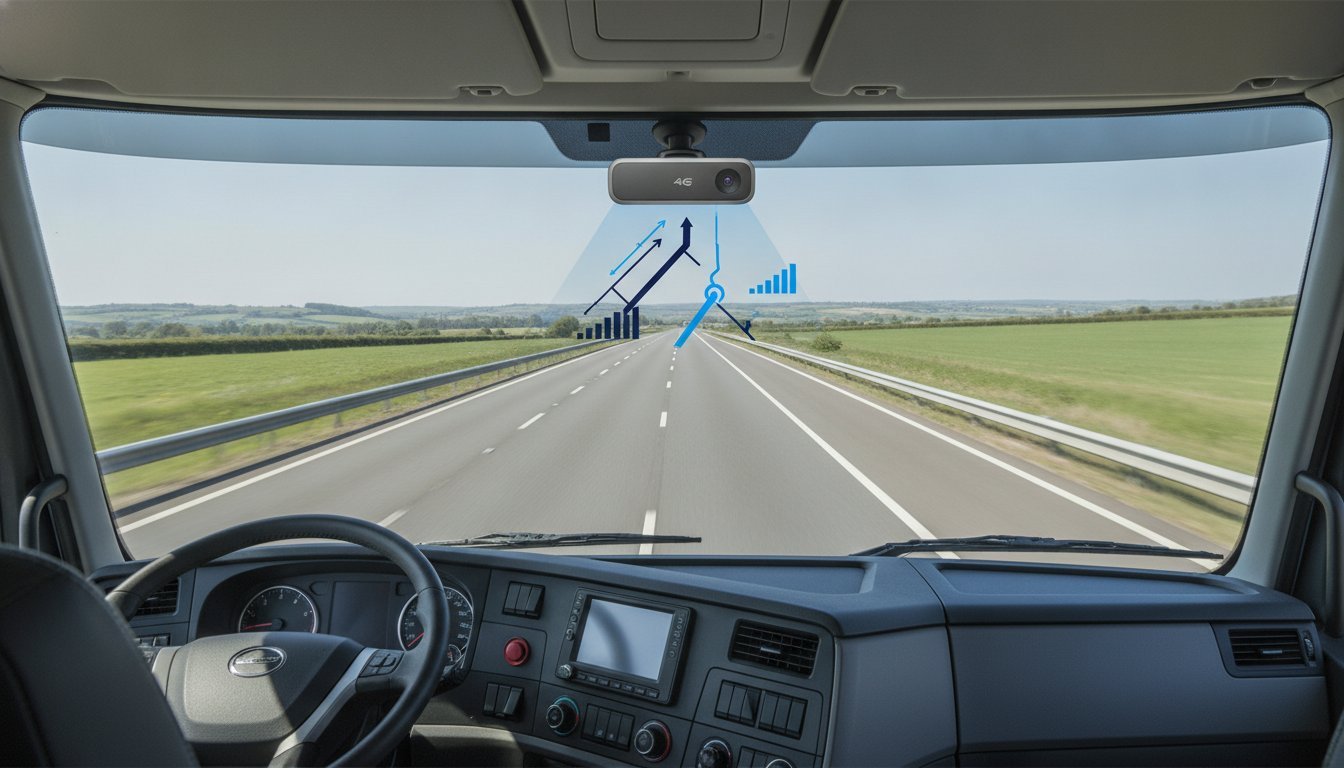
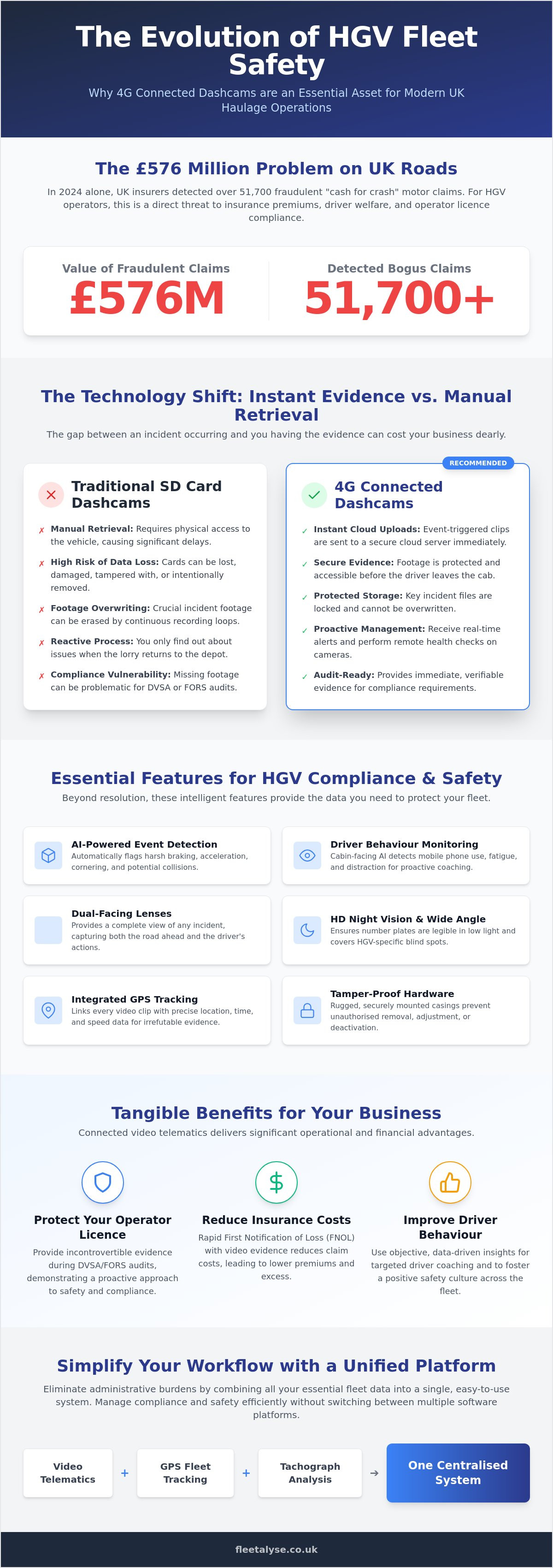
In 2024, UK insurers detected over 51,700 fraudulent motor claims valued at £576 million. For HGV operators, these "cash for crash" scams represent more than just an administrative headache; they're a direct hit to insurance premiums and fleet reputation. You've likely spent hours manually retrieving SD cards only to find the crucial footage is missing or corrupted. It's a frustrating, time-consuming process that often leaves your business vulnerable during DVSA or FORS audits.
Investing in 4G Dashcams for Lorries transforms video from a reactive tool into a proactive compliance asset. This guide explains how live-connected systems provide instant access to incident footage, shielding your drivers from false accusations whilst streamlining your data management. You'll discover how to choose hardware that improves driver behaviour and leverages telematics data to secure fairer insurance rates. We will break down the essential features, from 4K resolution to AI-powered monitoring, to ensure your fleet remains protected and compliant on every journey.
Key Takeaways
- Eliminate the hassle of manual SD card retrieval. Learn how LTE connectivity provides instant video access for immediate incident response.
- Identify the essential hardware features required for FORS and DVSA compliance. Dual-facing lenses and integrated GPS provide the precise evidence needed for audits.
- Understand how 4G Dashcams for Lorries reduce insurance costs. Verified evidence and improved driver behaviour lead to lower premiums and reduced excess.
- Manage data consumption effectively across your fleet. Discover how multi-network roaming SIMs maintain connectivity in remote UK areas for uninterrupted monitoring.
- Simplify your administrative workload. See the benefit of combining video telematics with GPS fleet tracking and tachograph analysis on a single platform.
What are 4G Dashcams for Lorries and Why are They Essential in 2026?
4G Dashcams for Lorries have evolved from simple recording devices into sophisticated video telematics hubs. These systems use integrated LTE modules to maintain a constant link between the vehicle and the transport office. In 2026, relying on a camera that just records to a local card is a significant liability. Modern UK haulage requires high-speed data transmission to manage the complexities of busy road networks and strict operator licence requirements. These devices are built specifically for the HGV environment. They feature ruggedised casings and multi-channel support that standard passenger car cameras simply don't offer. This hardware must withstand extreme vibrations and long operational hours whilst providing a reliable data stream for logistics management.
4G Connectivity vs Standard SD Card Dashcams
The primary weakness of traditional Dashcam technology is the "retrieval gap". When a driver is involved in a serious incident, the physical SD card can easily be lost, damaged, or even intentionally removed. If the vehicle is away from the depot for several days, crucial footage might be overwritten by newer data. 4G Dashcams for Lorries solve this by uploading event-triggered clips to the cloud instantly. This ensures the evidence is secure before the driver even leaves the cab. You won't have to chase drivers for cards or wait for lorries to return to base. Beyond storage, 4G allows managers to perform remote configuration and health checks. You can verify that every camera in your fleet is operational and adjust settings over-the-air without ever touching the hardware.
The Shift Towards Connected Fleet Safety
A connected camera acts as the witness that never sleeps, providing transport managers with an objective, real-time view of their operations. Real-time alerts for harsh driving events have become the benchmark for safety in the UK transport sector. Instead of reviewing historical data days later, you receive an immediate notification when a risk is detected. This allows for instant driver coaching and intervention to improve on-road behaviour. Connectivity is also vital for improving First Notification of Loss (FNOL) speeds. Reporting an incident to your insurer with video evidence in minutes, rather than days, is the most effective way to mitigate costs and stop fraudulent claims in their tracks. Integrating these cameras with systems like Fleetalyse ensures that video is always paired with precise GPS fleet tracking data. This creates a powerful, unified platform for managing both compliance and safety across your entire fleet.
Essential Features for HGV Dashcams: Beyond High Definition
High resolution is just the baseline. For a fleet manager, the real value of 4G Dashcams for Lorries lies in the metadata and intelligent event detection. You need hardware that identifies harsh braking, aggressive cornering, and tailgating automatically. These AI-powered triggers ensure you aren't wading through hours of footage; you only see what matters. Night vision and wide-angle lenses are also non-negotiable for HGVs. Large cabs and long trailers create unique blind spots that standard cameras can't cover. High-quality sensors ensure that number plates remain legible even during night trunking on unlit motorways.
Durability is another critical factor. Commercial vehicles operate in harsh conditions with significant vibration. Tamper-proof designs and secure mountings prevent unauthorised removal or lens adjustment. When installing these systems, operators should consider international safety standards, such as the FMCSA vehicle safety technology regulations, which provide clear guidance on mounting hardware without obstructing the driver's view. In the UK, incorrect placement that intrudes more than 40mm into the swept area of the wipers can lead to a £100 fine and three penalty points. Professional installation is the best way to avoid these compliance risks.
Driver Behaviour and Cabin Monitoring
Dual-facing lenses provide a complete picture of an incident. While the road-facing lens captures the external event, the interior camera can instantly exonerate a driver from allegations of mobile phone use or distraction. Modern AI goes further, detecting signs of fatigue or micro-sleeps in real-time. This allows for immediate intervention before an accident occurs. Privacy remains a priority; most professional systems only upload interior footage when a safety event is triggered, ensuring your drivers feel supported rather than watched.
GPS and Telematics Integration
Video is far more persuasive when backed by precise speed and location data. Integrated GPS provides a digital breadcrumb trail that is vital for legal admissibility in UK courts. It verifies route compliance and delivery windows whilst proving exactly where a vehicle was at the time of a claim. This level of detail is a core component of effective GPS fleet tracking, turning simple video into a comprehensive compliance record. Precise time-stamping ensures that your evidence stands up to the scrutiny of insurers and legal professionals alike, which is crucial since UK police now accept dashcam footage as evidence in 85% of cases.
Protecting Your Operator Licence and Reducing Insurance Premiums
Maintaining a clean operator licence is the foundation of a successful haulage business. 4G Dashcams for Lorries provide the indisputable evidence needed to protect that licence when incidents occur. In a sector where "cash for crash" scams cost UK insurers £576 million in 2024, having a digital witness is essential. These systems don't just record events; they provide the transparency required to meet high-level industry standards like FORS, CLOCS, and DVSA Earned Recognition. By proving a commitment to safety through video telematics, operators can often negotiate lower insurance excess and more favourable premium rates based on verified risk reduction.
Insurance providers are shifting away from simple hardware discounts. They now prioritise fleets that demonstrate active risk management. Using connected cameras allows you to present a factual account of every road event, effectively shielding your drivers from false accusations. This proactive approach to safety is a core requirement for maintaining a high rating during DVSA audits, ensuring your business remains a low-risk prospect for both regulators and underwriters.
Instant FNOL and Claims Management
First Notification of Loss (FNOL) is the most critical window in claims management. Industry analysis indicates that reducing the time between an incident and reporting it can lower total claim costs by up to 20%. With a 4G connection, footage is sent to the insurer whilst the lorry is still on-site. This immediate evidence gathering prevents the "long tail" of claims where costs spiral due to lack of clarity. It allows your insurer to settle legitimate third-party claims quickly or refute fraudulent ones before they gain traction. Speed is the enemy of the fraudster; 4G connectivity ensures they have no time to embellish their version of events.
Supporting the Transport Manager’s Compliance Audit
A transport manager's role involves constant oversight and risk assessment. 4G dashcams create a robust digital paper trail that simplifies incident reporting and internal audits. When integrated with systems like Fleetalyse, video data can be cross-referenced with tacho records and live driver hours. This provides a complete view of driver activity, making it easier to identify fatigue or pattern-based risks. For legal compliance, the physical installation must be precise. Following FMCSA installation regulations regarding the placement of safety technology ensures that the hardware itself doesn't become a compliance failure during a roadside check. Using this footage for targeted driver coaching turns a defensive tool into a proactive training asset, reinforcing a culture of safety that satisfies both DVSA inspectors and insurance underwriters.
Managing Data and Connectivity Across a Large Lorry Fleet
Scaling a video solution from a few vehicles to a fleet of fifty or more requires a strategic approach to connectivity. It's no longer practical to manage individual data accounts or manual storage. You need a centralised system that handles the data pipe as efficiently as the lorries handle their cargo. 4G Dashcams for Lorries consume data in two primary ways: live streaming and event-based uploads. Continuous live streaming is data-intensive and usually unnecessary for standard operations. Most professional transport managers prefer event-based uploads, where the camera only sends clips to the cloud when it detects a safety trigger like harsh braking or an impact. This surgical approach preserves bandwidth and ensures your storage remains uncluttered by hours of uneventful motorway driving.
Connectivity reliability is another hurdle for UK operators. Network coverage is notoriously patchy in rural areas and along certain motorway corridors. A standard single-network SIM card will leave your vehicles "blind" the moment they enter a low-signal zone. Multi-network roaming SIMs are the industry standard for national haulage. These SIMs automatically hop between providers to find the strongest available signal, ensuring your "witness that never sleeps" stays connected from the Scottish Highlands to the South Coast. Cloud storage logistics also require attention; most platforms offer 30-day retention periods as standard, which is usually sufficient to identify and secure footage for any insurance or disciplinary requirements.
SIM Cards and Data Plan Considerations
Standard consumer SIMs are fundamentally unsuitable for commercial use. They aren't designed for the high-temperature environment of a lorry cab and often lack the robust data throughput required for consistent video transmission. Pooled data plans are the most efficient way to manage a large fleet. These plans allow vehicles on high-usage routes to draw from a shared data "pot", balanced out by lorries on shorter or less frequent journeys. This prevents overage charges and ensures consistent service across the entire organisation. It's a transparent, predictable way to manage your digital overheads whilst maintaining 24/7 fleet visibility.
GDPR and Driver Privacy in the UK
Compliance with UK GDPR is a legal necessity for any business recording video in a public space. You must register with the Information Commissioner's Office (ICO) and pay the annual data protection fee, which for most small businesses is £52. Transparency is key; you must display visible signage on your vehicles and include clear dashcam policies in your driver handbooks. Secure your operation by choosing a system with end-to-end encryption and restricted access protocols. This ensures that sensitive footage is only accessible to authorised personnel, protecting your business from data breaches and privacy complaints. To ensure your fleet meets these rigorous standards, you can order your compliant tracking and video hardware through our secure portal today.
Integrating 4G Dashcams with Fleetalyse Tracking and Compliance
Treating video telematics as a standalone gadget is a common mistake. It forces transport managers to juggle multiple logins and fragmented data sets. True operational efficiency comes from a unified approach where video, location, and compliance data live in one place. By integrating 4G Dashcams for Lorries into a broader telematics ecosystem, you turn raw footage into actionable insight. You can see exactly what a driver was doing at the moment a tacho infringement occurred or why a vehicle deviated from its planned route. This integration is the difference between having a camera and having a compliance tool.
Administrative tasks shouldn't dictate your day. Manual cross-referencing of video timestamps with paper logs is a relic of the past. A centralised platform simplifies this burden by automating the link between visual evidence and telematics events. You gain a high-level view of fleet safety whilst retaining the ability to drill down into granular details for specific audits. This structured approach prevents information overload. It provides a steady stream of data that supports clear, frictionless decision-making for busy operators managing regional infrastructure.
Unified Telematics: The Big Picture
Managing separate systems for tracking and video is inefficient. It leads to missed connections and delayed responses. Fleetalyse integrates video with live driver hours monitoring, allowing you to see the context behind the numbers. If a driver triggers a harsh braking alert, you can instantly view the corresponding video whilst checking their current tacho status. This level of detail is crucial for effective driver coaching. Integrating 4G Dashcams for Lorries with your GPS fleet tracking and tachograph analysis integration ensures that your entire compliance stack works in harmony. You benefit from a single point of contact for all hardware and software needs.
Getting Started with Professional Fleet Video
The complexity of HGV electrics and the need for optimal lens placement make professional installation essential. A poorly mounted camera is a compliance risk and a potential point of failure. We provide professional installation services for HGVs across the entire UK, ensuring your hardware is fitted correctly and securely. Beyond the initial setup, we offer ongoing support and hardware health monitoring to ensure maximum uptime. You'll know immediately if a camera goes offline, allowing for rapid resolution. Don't leave your fleet safety to chance with unverified hardware or amateur fitting. Speak to our experts about 4G dashcam solutions for your fleet today to build a more resilient, compliant operation.
Future-Proof Your Fleet with Connected Video Telematics
Adopting 4G Dashcams for Lorries is no longer just about recording road events; it's about building a resilient, data-led transport operation. Instant cloud uploads eliminate the retrieval gap, ensuring footage is secure before a vehicle returns to the depot. By integrating video with your existing GPS tracking and tachograph analysis, you create a single, authoritative source of truth for every mile travelled. This transition from reactive recording to proactive monitoring is essential for maintaining a competitive edge in modern haulage.
This pragmatic, compliance-first approach ensures your business stays ahead of DVSA and FORS standards whilst reducing the financial impact of insurance claims. We provide UK-based expert support and seamless tachograph analysis integration to ensure your systems remain operational and secure. Take the next step in streamlining your fleet management and protecting your operator licence. Contact Fleetalyse for a transparent quote on 4G dashcams and fleet tracking. We look forward to helping you build a safer, more efficient fleet.
Frequently Asked Questions
Do 4G dashcams for lorries require a monthly subscription?
Yes, an active subscription is necessary to maintain the 4G connection and cloud storage features. These monthly fees cover the cost of the SIM card data and the secure hosting of your video evidence. Without a subscription, you lose the ability to retrieve footage remotely or receive real-time alerts, which are the primary benefits of a connected system.
How much data does a 4G dashcam use per month?
Data consumption depends entirely on your fleet's configuration. Most operators prefer event-based uploads, where only clips triggered by harsh driving or impacts are sent to the cloud. This is a highly efficient way to manage data. Continuous live streaming will use significantly more bandwidth, so pooled data plans are the most pragmatic solution for managing costs across multiple vehicles.
Can I view the dashcam footage live from my office?
You can access live video feeds at any time through a secure web portal or mobile app. The 4G link allows for real-time monitoring of both the road ahead and the driver's cab. This feature is invaluable for instant incident assessment and verifying the safety of your drivers whilst they are out on the road.
Are 4G dashcams for lorries legal under UK GDPR rules?
These systems are legal provided you comply with UK GDPR and ICO guidelines. You must register your business as a data controller and display clear signage on the vehicle to inform the public and drivers that recording is in progress. 4G Dashcams for Lorries must also use encrypted storage and restricted access protocols to protect the privacy of recorded individuals.
What happens if the lorry is in an area with poor 4G signal?
The camera continues to record to its internal memory even when the signal is lost. Once the vehicle re-enters a coverage area, the system automatically synchronises with the cloud and uploads any pending event footage. Using multi-network roaming SIMs helps to minimise these gaps by switching to the strongest available provider in any given location.
Can 4G dashcams help reduce my HGV insurance premiums?
Verified video evidence is one of the most effective ways to lower your total cost of insurance. By providing indisputable proof in the event of a "cash for crash" scam, you can avoid unfair claims and protect your no-claims history. Insurers value the proactive risk management that 4G Dashcams for Lorries provide through improved driver behaviour and faster incident reporting.
Is professional installation required for lorry dashcams?
Professional installation is essential to ensure the hardware is reliable and legally compliant. An expert installer will place the camera so it doesn't obstruct the driver's view, which is a critical requirement for UK roadside inspections. They also ensure the wiring is integrated safely with the vehicle's electrical system to prevent hardware failure or interference with other cab electronics.
Do 4G dashcams record whilst the engine is turned off?
Most professional systems feature a parking mode that monitors the vehicle even when the ignition is off. If the camera's internal sensors detect an impact or movement while the lorry is parked, it will wake up to record the event and send an immediate alert to the transport manager. This provides 24/7 protection for your assets at the depot or in roadside laybys.
Frequently asked questions
4G Connectivity vs Standard SD Card Dashcams
The primary weakness of traditional Dashcam technology is the "retrieval gap". When a driver is involved in a serious incident, the physical SD card can easily be lost, damaged, or even intentionally removed. If the vehicle is away from the depot for several days, crucial footage might be overwritten by newer data. 4G Dashcams for Lorries solve this by uploading event-triggered clips to the cloud instantly. This ensures the evidence is secure before the driver even leaves the cab. You won't have to chase drivers for cards or wait for lorries to return to base. Beyond storage, 4G allows managers to perform remote configuration and health checks. You can verify that every camera in your fleet is operational and adjust settings over-the-air without ever touching the hardware.
The Shift Towards Connected Fleet Safety
A connected camera acts as the witness that never sleeps, providing transport managers with an objective, real-time view of their operations. Real-time alerts for harsh driving events have become the benchmark for safety in the UK transport sector. Instead of reviewing historical data days later, you receive an immediate notification when a risk is detected. This allows for instant driver coaching and intervention to improve on-road behaviour. Connectivity is also vital for improving First Notification of Loss (FNOL) speeds. Reporting an incident to your insurer with video evidence in minutes, rather than days, is the most effective way to mitigate costs and stop fraudulent claims in their tracks. Integrating these cameras with systems like Fleetalyse ensures that video is always paired with precise GPS fleet tracking data. This creates a powerful, unified platform for managing both compliance and safety across your entire fleet. High resolution is just the baseline. For a fleet manager, the real value of 4G Dashcams for Lorries lies in the metadata and intelligent event detection. You need hardware that identifies harsh braking, aggressive cornering, and tailgating automatically. These AI-powered triggers ensure you aren't wading through hours of footage; you only see what matters. Night vision and wide-angle lenses are also non-negotiable for HGVs. Large cabs and long trailers create unique blind spots that standard cameras can't cover. High-quality sensors ensure that number plates remain legible even during night trunking on unlit motorways. Durability is another critical factor. Commercial vehicles operate in harsh conditions with significant vibration. Tamper-proof designs and secure mountings prevent unauthorised removal or lens adjustment. When installing these systems, operators should consider international safety standards, such as the FMCSA vehicle safety technology regulations, which provide clear guidance on mounting hardware without obstructing the driver's view. In the UK, incorrect placement that intrudes more than 40mm into the swept area of the wipers can lead to a £100 fine and three penalty points. Professional installation is the best way to avoid these compliance risks.
Driver Behaviour and Cabin Monitoring
Dual-facing lenses provide a complete picture of an incident. While the road-facing lens captures the external event, the interior camera can instantly exonerate a driver from allegations of mobile phone use or distraction. Modern AI goes further, detecting signs of fatigue or micro-sleeps in real-time. This allows for immediate intervention before an accident occurs. Privacy remains a priority; most professional systems only upload interior footage when a safety event is triggered, ensuring your drivers feel supported rather than watched.
GPS and Telematics Integration
Video is far more persuasive when backed by precise speed and location data. Integrated GPS provides a digital breadcrumb trail that is vital for legal admissibility in UK courts. It verifies route compliance and delivery windows whilst proving exactly where a vehicle was at the time of a claim. This level of detail is a core component of effective GPS fleet tracking, turning simple video into a comprehensive compliance record. Precise time-stamping ensures that your evidence stands up to the scrutiny of insurers and legal professionals alike, which is crucial since UK police now accept dashcam footage as evidence in 85% of cases. Maintaining a clean operator licence is the foundation of a successful haulage business. 4G Dashcams for Lorries provide the indisputable evidence needed to protect that licence when incidents occur. In a sector where "cash for crash" scams cost UK insurers £576 million in 2024, having a digital witness is essential. These systems don't just record events; they provide the transparency required to meet high-level industry standards like FORS, CLOCS, and DVSA Earned Recognition. By proving a commitment to safety through video telematics, operators can often negotiate lower insurance excess and more favourable premium rates based on verified risk reduction. Insurance providers are shifting away from simple hardware discounts. They now prioritise fleets that demonstrate active risk management. Using connected cameras allows you to present a factual account of every road event, effectively shielding your drivers from false accusations. This proactive approach to safety is a core requirement for maintaining a high rating during DVSA audits, ensuring your business remains a low-risk prospect for both regulators and underwriters.
Instant FNOL and Claims Management
First Notification of Loss (FNOL) is the most critical window in claims management. Industry analysis indicates that reducing the time between an incident and reporting it can lower total claim costs by up to 20%. With a 4G connection, footage is sent to the insurer whilst the lorry is still on-site. This immediate evidence gathering prevents the "long tail" of claims where costs spiral due to lack of clarity. It allows your insurer to settle legitimate third-party claims quickly or refute fraudulent ones before they gain traction. Speed is the enemy of the fraudster; 4G connectivity ensures they have no time to embellish their version of events.
Supporting the Transport Manager’s Compliance Audit
A transport manager's role involves constant oversight and risk assessment. 4G dashcams create a robust digital paper trail that simplifies incident reporting and internal audits. When integrated with systems like Fleetalyse, video data can be cross-referenced with tacho records and live driver hours. This provides a complete view of driver activity, making it easier to identify fatigue or pattern-based risks. For legal compliance, the physical installation must be precise. Following FMCSA installation regulations regarding the placement of safety technology ensures that the hardware itself doesn't become a compliance failure during a roadside check. Using this footage for targeted driver coaching turns a defensive tool into a proactive training asset, reinforcing a culture of safety that satisfies both DVSA inspectors and insurance underwriters. Scaling a video solution from a few vehicles to a fleet of fifty or more requires a strategic approach to connectivity. It's no longer practical to manage individual data accounts or manual storage. You need a centralised system that handles the data pipe as efficiently as the lorries handle their cargo. 4G Dashcams for Lorries consume data in two primary ways: live streaming and event-based uploads. Continuous live streaming is data-intensive and usually unnecessary for standard operations. Most professional transport managers prefer event-based uploads, where the camera only sends clips to the cloud when it detects a safety trigger like harsh braking or an impact. This surgical approach preserves bandwidth and ensures your storage remains uncluttered by hours of uneventful motorway driving. Connectivity reliability is another hurdle for UK operators. Network coverage is notoriously patchy in rural areas and along certain motorway corridors. A standard single-network SIM card will leave your vehicles "blind" the moment they enter a low-signal zone. Multi-network roaming SIMs are the industry standard for national haulage. These SIMs automatically hop between providers to find the strongest available signal, ensuring your "witness that never sleeps" stays connected from the Scottish Highlands to the South Coast. Cloud storage logistics also require attention; most platforms offer 30-day retention periods as standard, which is usually sufficient to identify and secure footage for any insurance or disciplinary requirements.
SIM Cards and Data Plan Considerations
Standard consumer SIMs are fundamentally unsuitable for commercial use. They aren't designed for the high-temperature environment of a lorry cab and often lack the robust data throughput required for consistent video transmission. Pooled data plans are the most efficient way to manage a large fleet. These plans allow vehicles on high-usage routes to draw from a shared data "pot", balanced out by lorries on shorter or less frequent journeys. This prevents overage charges and ensures consistent service across the entire organisation. It's a transparent, predictable way to manage your digital overheads whilst maintaining 24/7 fleet visibility.
GDPR and Driver Privacy in the UK
Compliance with UK GDPR is a legal necessity for any business recording video in a public space. You must register with the Information Commissioner's Office (ICO) and pay the annual data protection fee, which for most small businesses is £52. Transparency is key; you must display visible signage on your vehicles and include clear dashcam policies in your driver handbooks. Secure your operation by choosing a system with end-to-end encryption and restricted access protocols. This ensures that sensitive footage is only accessible to authorised personnel, protecting your business from data breaches and privacy complaints. To ensure your fleet meets these rigorous standards, you can order your compliant tracking and video hardware through our secure portal today. Treating video telematics as a standalone gadget is a common mistake. It forces transport managers to juggle multiple logins and fragmented data sets. True operational efficiency comes from a unified approach where video, location, and compliance data live in one place. By integrating 4G Dashcams for Lorries into a broader telematics ecosystem, you turn raw footage into actionable insight. You can see exactly what a driver was doing at the moment a tacho infringement occurred or why a vehicle deviated from its planned route. This integration is the difference between having a camera and having a compliance tool. Administrative tasks shouldn't dictate your day. Manual cross-referencing of video timestamps with paper logs is a relic of the past. A centralised platform simplifies this burden by automating the link between visual evidence and telematics events. You gain a high-level view of fleet safety whilst retaining the ability to drill down into granular details for specific audits. This structured approach prevents information overload. It provides a steady stream of data that supports clear, frictionless decision-making for busy operators managing regional infrastructure.
Unified Telematics: The Big Picture
Managing separate systems for tracking and video is inefficient. It leads to missed connections and delayed responses. Fleetalyse integrates video with live driver hours monitoring, allowing you to see the context behind the numbers. If a driver triggers a harsh braking alert, you can instantly view the corresponding video whilst checking their current tacho status. This level of detail is crucial for effective driver coaching. Integrating 4G Dashcams for Lorries with your GPS fleet tracking and tachograph analysis integration ensures that your entire compliance stack works in harmony. You benefit from a single point of contact for all hardware and software needs.
Getting Started with Professional Fleet Video
The complexity of HGV electrics and the need for optimal lens placement make professional installation essential. A poorly mounted camera is a compliance risk and a potential point of failure. We provide professional installation services for HGVs across the entire UK, ensuring your hardware is fitted correctly and securely. Beyond the initial setup, we offer ongoing support and hardware health monitoring to ensure maximum uptime. You'll know immediately if a camera goes offline, allowing for rapid resolution. Don't leave your fleet safety to chance with unverified hardware or amateur fitting. Speak to our experts about 4G dashcam solutions for your fleet today to build a more resilient, compliant operation. Adopting 4G Dashcams for Lorries is no longer just about recording road events; it's about building a resilient, data-led transport operation. Instant cloud uploads eliminate the retrieval gap, ensuring footage is secure before a vehicle returns to the depot. By integrating video with your existing GPS tracking and tachograph analysis, you create a single, authoritative source of truth for every mile travelled. This transition from reactive recording to proactive monitoring is essential for maintaining a competitive edge in modern haulage. This pragmatic, compliance-first approach ensures your business stays ahead of DVSA and FORS standards whilst reducing the financial impact of insurance claims. We provide UK-based expert support and seamless tachograph analysis integration to ensure your systems remain operational and secure. Take the next step in streamlining your fleet management and protecting your operator licence. Contact Fleetalyse for a transparent quote on 4G dashcams and fleet tracking. We look forward to helping you build a safer, more efficient fleet.
Do 4G dashcams for lorries require a monthly subscription?
Yes, an active subscription is necessary to maintain the 4G connection and cloud storage features. These monthly fees cover the cost of the SIM card data and the secure hosting of your video evidence. Without a subscription, you lose the ability to retrieve footage remotely or receive real-time alerts, which are the primary benefits of a connected system.
How much data does a 4G dashcam use per month?
Data consumption depends entirely on your fleet's configuration. Most operators prefer event-based uploads, where only clips triggered by harsh driving or impacts are sent to the cloud. This is a highly efficient way to manage data. Continuous live streaming will use significantly more bandwidth, so pooled data plans are the most pragmatic solution for managing costs across multiple vehicles.
Can I view the dashcam footage live from my office?
You can access live video feeds at any time through a secure web portal or mobile app. The 4G link allows for real-time monitoring of both the road ahead and the driver's cab. This feature is invaluable for instant incident assessment and verifying the safety of your drivers whilst they are out on the road.
Are 4G dashcams for lorries legal under UK GDPR rules?
These systems are legal provided you comply with UK GDPR and ICO guidelines. You must register your business as a data controller and display clear signage on the vehicle to inform the public and drivers that recording is in progress. 4G Dashcams for Lorries must also use encrypted storage and restricted access protocols to protect the privacy of recorded individuals.
What happens if the lorry is in an area with poor 4G signal?
The camera continues to record to its internal memory even when the signal is lost. Once the vehicle re-enters a coverage area, the system automatically synchronises with the cloud and uploads any pending event footage. Using multi-network roaming SIMs helps to minimise these gaps by switching to the strongest available provider in any given location.
Can 4G dashcams help reduce my HGV insurance premiums?
Verified video evidence is one of the most effective ways to lower your total cost of insurance. By providing indisputable proof in the event of a "cash for crash" scam, you can avoid unfair claims and protect your no-claims history. Insurers value the proactive risk management that 4G Dashcams for Lorries provide through improved driver behaviour and faster incident reporting.
Is professional installation required for lorry dashcams?
Professional installation is essential to ensure the hardware is reliable and legally compliant. An expert installer will place the camera so it doesn't obstruct the driver's view, which is a critical requirement for UK roadside inspections. They also ensure the wiring is integrated safely with the vehicle's electrical system to prevent hardware failure or interference with other cab electronics.
Do 4G dashcams record whilst the engine is turned off?
Most professional systems feature a parking mode that monitors the vehicle even when the ignition is off. If the camera's internal sensors detect an impact or movement while the lorry is parked, it will wake up to record the event and send an immediate alert to the transport manager. This provides 24/7 protection for your assets at the depot or in roadside laybys.