

Your Operator Licence is your most valuable asset. Don't leave it to chance with manual processes. Choosing the right commercial vehicle GPS trackers is no longer just about seeing dots on a map; it is the foundation of your regulatory compliance. You already know that chasing drivers for tachograph cards and worrying about DVSA roadside checks consumes far too much of your week. It is a constant source of stress that pulls you away from moving your business forward.
This guide shows you how to transition from basic tracking to a fully integrated compliance and asset management system that secures your licence. We will explore how to automate remote tachograph downloads and gain real-time visibility into remaining driver hours. You will learn how to protect your vans and trailers while consolidating all your fleet data onto a single, efficient platform. With new mandates for light commercial vehicles arriving in July 2026, now is the time to modernise your approach to fleet intelligence and operational security.
Key Takeaways
- Shift your focus from passive anti-theft devices to active operational intelligence that supports your daily transport tasks.
- Automate your regulatory compliance by using remote tachograph downloads to eliminate manual data collection and reduce administrative errors.
- Identify why hard-wired commercial vehicle GPS trackers are the standard for maintaining HGV compliance and securing valuable trailer assets.
- Improve your bottom line by using live telematics data to identify wasted fuel and streamline your existing office workflows.
- Future-proof your operation with a modular platform that integrates directly with your tachograph analysis software for a complete fleet overview.
Beyond Simple Location: The Evolution of Commercial Vehicle GPS Trackers
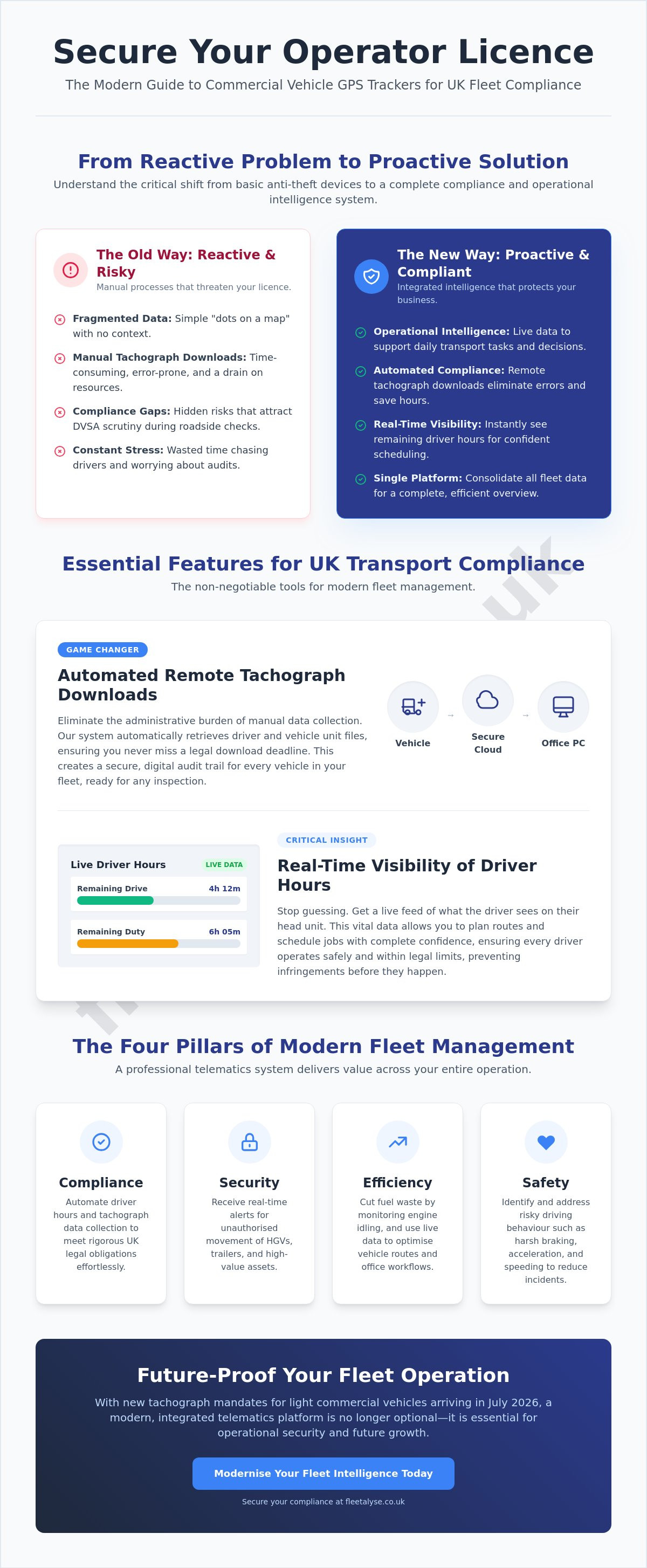
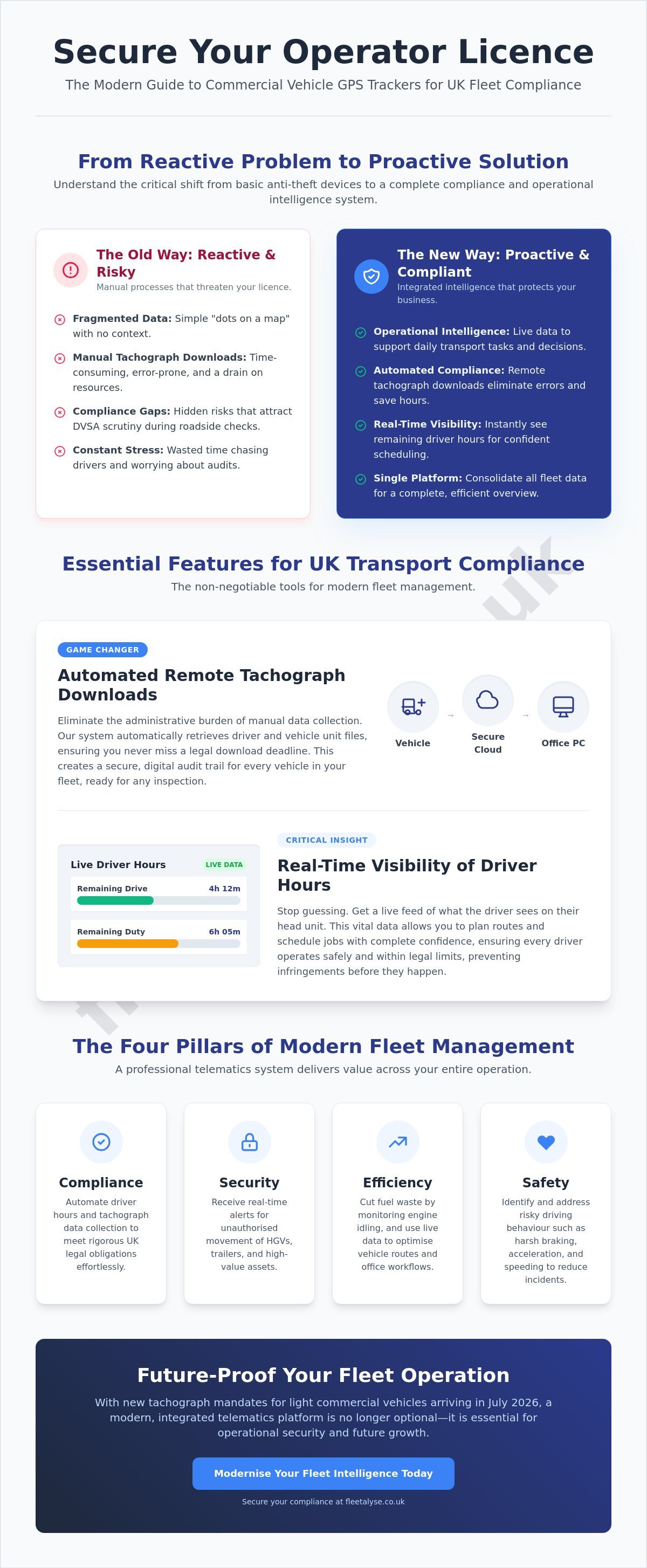
Tracking technology has moved far beyond the simple anti-theft devices of the past. For a modern UK haulier, seeing a dot on a map is no longer enough to stay competitive or compliant. Today, commercial vehicle GPS trackers act as the central nervous system of a transport office. They provide the active operational intelligence required to manage a fleet in real time, moving away from passive data collection toward proactive decision-making. If you are still using basic units that only report location, you are missing the vital data needed to protect your margins.
Understanding the gap between consumer-grade and commercial-grade telematics is essential. A consumer device might help you find a stolen car, but it won't help you pass a DVSA audit. A professional vehicle tracking system for HGVs and vans integrates directly with the vehicle's internal systems. This connectivity supports the four pillars of modern fleet management:
- Compliance: Automating the collection of driver hours and tachograph data to meet legal obligations.
- Safety: Identifying risky driving behaviour, such as harsh braking or speeding, to reduce collision rates.
- Efficiency: Cutting fuel waste by monitoring engine idling and optimising routes.
- Security: Providing real-time alerts for unauthorised movement of trailers, vans, and high-value assets.
The Limitations of Traditional Tracking
Basic GPS units fail because they lack granularity. They don't connect to the tachograph head unit or the vehicle's CAN-bus system. This means transport managers still have to rely on manual data collection, which is a hidden drain on office resources. Manual downloads take time and are prone to human error. When your systems are fragmented, compliance gaps appear. These gaps are exactly what the DVSA looks for during inspections. Relying on outdated hardware creates an unnecessary risk to your Operator Licence.
The Move Towards Integrated Compliance
Modern commercial vehicle GPS trackers eliminate "compliance anxiety" by providing a constant, real-time flow of data. Instead of waiting for a driver to return to the yard, you can see their remaining hours instantly. This allows you to plan routes with confidence, knowing every driver is operating within legal limits. Choosing a British-based partner like Fleetalyse ensures your system is built for UK-specific regulations. You need a partner that understands the local infrastructure and the rigours of domestic enforcement. This localized expertise transforms a simple piece of hardware into a strategic asset for your business.
Essential Features for UK Transport Compliance and Data Management
Compliance in the UK transport sector is a rigorous, data-heavy requirement. To manage it effectively, commercial vehicle GPS trackers must do more than ping a location every few minutes. They need to act as a bridge between the driver's cab and the transport manager's desk. This integration allows for the collection of CAN-bus data, providing insights into fuel consumption and engine health that basic trackers simply cannot reach. Beyond the engine, monitoring driver behaviour, such as harsh braking or excessive idling, helps you build a culture of safety and efficiency whilst protecting your margins.
Automating the Remote Tachograph Download
Remote tachograph download is a hands-off method for retrieving driver and vehicle files directly from the vehicle, regardless of its location. This feature eliminates the need for drivers to manually upload cards at a terminal, saving hours of downtime every month. By setting up an automated scheduling system, you ensure that you never miss a legal download deadline. This process creates a seamless synergy between your hardware and your remote tachograph download analysis software. It removes the administrative burden from your team and provides a secure, digital audit trail for every vehicle in your fleet.
Real-Time Visibility of Driver Hours
Managing a schedule requires knowing exactly how much driving time is left on a shift. High-quality commercial vehicle GPS trackers provide a live feed of what the driver sees on their head unit. This data is vital for ensuring adherence to UK government guidance for HGV drivers regarding rest periods and working time. When dispatchers can see remaining hours in real time, they plan routes with precision. This prevents the risk of drivers "speeding to finish" a job before they run out of legal hours. It also allows you to predict and prevent potential infringements before they occur, protecting both the driver and the company licence.
Geofencing and instant alerts add another layer of security. You can set virtual boundaries around your yard or specific delivery sites. If a vehicle moves outside these areas without authorisation, you receive an immediate notification. This level of visibility is essential for protecting high-value assets and ensuring that your fleet stays on its designated routes. If you're ready to stop chasing paperwork and start automating your compliance, you can view our integrated tracking packages to find the right fit for your fleet.
Selecting Tracking Hardware for HGVs, Vans, and Trailers
Hardware selection is where many operators stumble by attempting a one-size-fits-all approach. A professional deployment of commercial vehicle GPS trackers requires hardware tailored to the specific electrical and environmental demands of your assets. An HGV requires a permanent, hard-wired connection to the vehicle's 24V power supply and the tachograph head unit to function as a compliance tool. In contrast, a trailer tracker must survive months of unpowered operation whilst exposed to the British weather. Choosing the wrong unit for the job leads to premature hardware failure and costly gaps in your data visibility.
HGV and Van Tracking Requirements
For heavy vehicles, 24V compatibility and robust wiring are non-negotiable. The hardware must be built to withstand the constant vibrations and electrical surges common in large diesel engines. Professional installation is vital to ensure these devices don't interfere with sensitive cab electronics, such as speed limiters or emergency braking systems. In multi-driver van fleets, the role of driver ID fobs becomes essential. These fobs allow you to assign every journey to a specific person, which is crucial for managing speeding fines and monitoring individual driving behaviour. This level of detail helps you balance business efficiency with driver privacy, especially if vans are used for personal commutes after hours.
Specialised Trailer and Asset Security
Integrated trailer tracking solves the persistent problem of "lost" assets in large distribution hubs or third-party yards. These units are housed in rugged, weatherproof casings with high IP ratings to protect against rain and road salt. Because trailers spend significant time unpowered, the hardware must utilise intelligent "sleep modes" to preserve battery life. The tracker only wakes up when it detects movement or a scheduled heartbeat check. If a trailer is moved without authorisation, the system triggers an immediate alert. This provides the real-time location data needed for recovery whilst the asset is still in transit, significantly increasing the chances of a successful retrieval. This same technology applies to asset tracking for plant and containers, ensuring every piece of mobile equipment is accounted for on a single platform.
By matching the hardware to the specific rigours of the asset, you reduce maintenance overheads and ensure a reliable stream of data. Whether it is a hard-wired HGV unit or a battery-powered asset tracker, the goal remains the same: total visibility and protection for your fleet. Investing in the right commercial vehicle GPS trackers today prevents the administrative headaches and financial losses associated with equipment failure tomorrow.
Maximising Operational ROI Through Live Telematics Data
ROI in the transport industry is often measured by fuel savings, but the true value of commercial vehicle GPS trackers lies in the recovery of lost time and the reduction of risk. Identifying excessive idling and correcting aggressive driving habits directly impacts your bottom line. You reduce wear and tear whilst lowering your weekly fuel bill. Beyond the fuel pump, telematics data streamlines your entire back-office process. You move from hours of manual paperwork to a few minutes of digital review. This efficiency allows your team to focus on growth rather than administration.
Historical data also acts as an undeniable "Proof of Delivery." When a customer disputes a delivery time, you have the exact GPS coordinates and timestamp to resolve the issue instantly. This protects your reputation and prevents unnecessary credit notes. Over time, maintaining a clean compliance record through this data leads to lower insurance premiums. It also positions your business as a top-tier candidate for lucrative contracts and tenders that require proof of high operational standards. High-quality data makes your business more bankable and more resilient.
Staying Audit-Ready for the DVSA
GPS tracking provides the missing link in your driver record logbook. It validates the data on the tachograph, ensuring there are no unaccounted-for movements. Using telematics reports allows you to demonstrate to the DVSA that you are proactively managing driver behaviour. This transparency is a key step toward achieving Earned Recognition status. It proves that your fleet is consistently compliant without the need for frequent roadside checks. You move from a reactive stance to a position of total control over your regulatory obligations.
Improving Dispatch and Customer Service
Provide real-time ETA updates to your customers based on live traffic conditions and remaining driver hours. This level of precision builds trust and improves your service reliability. Optimising your routes reduces "empty running" and cuts out unnecessary mileage between jobs. By empowering your back-office staff with live data, they can answer customer queries instantly without needing to call the driver. This creates a more professional image and keeps your drivers focused on the road. Better data leads to better scheduling and a more profitable operation.
If you are ready to transform your operational efficiency and protect your margins, select your fleet management package today and start seeing the results in your next quarterly review.
Future-Proofing Your Fleet with Integrated Compliance Solutions
Fleet management is not a static task. As regulations evolve and the UK transport industry faces new pressures, your technology must adapt. Choosing generic, "one size fits all" hardware is a strategic mistake. These systems often lack the flexibility to integrate with new compliance requirements or asset types. Instead, a modular approach allows you to scale your capabilities as your business grows. By selecting commercial vehicle GPS trackers that offer deep integration with your existing workflows, you move from reactive problem-solving to proactive fleet management. You stop fixing issues after they occur and start preventing them through better data visibility.
The strength of your tracking system depends heavily on the partner you choose. A distant, global software provider often lacks the specific context of UK road laws and DVSA enforcement priorities. You need a partner that offers ongoing support and grounded, UK-based expertise. Fleetalyse simplifies the transport office by bridging the gap between hardware and software. We ensure that every data point collected by your commercial vehicle GPS trackers serves a practical purpose, whether it's protecting your Operator Licence or improving your daily route efficiency.
The Fleetalyse Difference: Pragmatic Expertise
We believe in total transparency regarding costs and contractual terms. There are no hidden complexities or marketing hyperbole here. Our commitment is to the regional operators who keep the UK moving. We understand the daily struggles of managing driver behaviour and regulatory adherence. That's why our system is designed to bridge the gap between GPS fleet tracking and tachograph analysis. By consolidating these functions into a single platform, we remove the friction of using multiple, disconnected systems. This integration provides a clear, honest view of your entire operation at any given moment.
Next Steps for Your Fleet
Modernising your fleet doesn't have to be an overwhelming process. Start by conducting a thorough fleet audit to identify your biggest compliance risks. Is it manual tacho downloads? Is it a lack of visibility into trailer locations? Once you have identified the gaps, consider trialling hardware on a small subset of your vehicles. This allows you to prove the ROI and see the benefits of live data before committing to a full-fleet rollout. When you are ready for a straightforward, jargon-free consultation, contact Fleetalyse. We will help you build a system that protects your assets and your licence for the long term.
Secure Your Fleet's Future with Integrated Intelligence
Modern fleet management requires more than just knowing where your vehicles are. It demands a system that actively protects your Operator Licence whilst driving operational efficiency. By implementing professional commercial vehicle GPS trackers, you eliminate the time-consuming burden of manual data collection and gain a clear, real-time view of your entire operation. Whether you're managing HGVs, vans, or trailers, the right technology ensures you remain audit-ready and profitable in an increasingly regulated landscape.
Fleetalyse provides the pragmatic expertise needed to bridge the gap between tracking and compliance. Our UK-based technical support team understands the specific challenges of domestic haulage. We offer automated DVSA compliance tools and specialise in HGV and trailer tracking to ensure every asset is visible and every mile is accounted for. You don't have to manage these complexities alone.
Book a transparent, expert consultation for your fleet today and take the first step toward a more secure, automated transport office. We look forward to helping you streamline your operation.
Frequently Asked Questions
Do commercial vehicle GPS trackers require a subscription?
Yes, professional tracking systems require an ongoing subscription to cover the costs of secure data transmission and software access. This fee ensures the SIM card within the hardware stays active on the cellular network to provide real-time updates. It also covers the hosting of your historical compliance data and access to the technical support team. Most operators find that the administrative time saved through automation far outweighs the monthly cost of the service.
Can GPS tracking help with my DVSA Earned Recognition application?
GPS tracking is a fundamental component of a successful DVSA Earned Recognition application. The system provides the transparent, digital evidence required to prove you are proactively monitoring your fleet's safety and driver conduct. By using commercial vehicle GPS trackers to share compliance data, you demonstrate that your operation meets the highest standards of regulatory control. This digital audit trail reduces the need for frequent roadside stops and manual inspections.
Is it legal to track my employees whilst they are driving company vans?
It is entirely legal to track employees in company vehicles, provided you comply with the Data Protection Act 2018 and GDPR. You must have a lawful basis for tracking, such as ensuring driver safety, improving efficiency, or protecting assets. You are also required to inform your drivers that tracking is in place. If your vans are used for personal mileage, it's best practice to provide a privacy switch that allows drivers to disable tracking outside of working hours.
How does remote tachograph download actually work with the tracker?
The tracker connects directly to the vehicle's tachograph head unit via the internal data ports. At pre-set intervals, the hardware initiates a secure, wireless connection to retrieve both driver card and vehicle files. This data is transmitted through the cellular network directly to your analysis software without the vehicle needing to return to the yard. It's a completely hands-off process that ensures you never miss a legal download deadline.
What happens if a driver exceeds their hours whilst being tracked?
If a driver exceeds their legal limits, the system triggers an immediate alert for the transport manager and records the infringement for your reports. Because the platform provides live visibility of remaining driver hours, you can often intervene before a breach occurs. This allows you to redirect the vehicle to a safe stopping point or adjust the schedule. Having this data allows you to manage infringements proactively rather than discovering them weeks later during a manual review.
Can I track trailers that are not connected to a tractor unit?
You can track uncoupled trailers by using specialised, battery-powered trailer tracking units. These devices are built with high-capacity internal batteries and rugged, weatherproof housing to survive months without an external power source. They utilise intelligent "sleep modes" to conserve energy, only waking up to report their location when movement is detected or at scheduled heartbeat intervals. This ensures your assets remain visible even when they are left in third-party yards or remote sites.
Will installing a GPS tracker void my vehicle's warranty?
Installing a tracker won't void your vehicle's warranty as long as the installation is carried out professionally. Modern commercial vehicle GPS trackers are designed to integrate with the vehicle's electrical system without causing interference. Using non-intrusive CAN-bus clips also allows for data collection without cutting or splicing any original wires. This protects the integrity of the vehicle's electronics whilst providing the deep diagnostics needed for fleet management.
How much data does a commercial vehicle tracker use per month?
Most commercial trackers use a minimal amount of data, typically between 5MB and 50MB per month. The exact amount depends on how frequently the device pings its location and whether you're using data-heavy features like remote tachograph downloads. This data usage is almost always included in your monthly subscription fee, so you don't have to worry about unexpected roaming charges or managing separate SIM card contracts for your fleet.
Frequently asked questions
The Limitations of Traditional Tracking
Basic GPS units fail because they lack granularity. They don't connect to the tachograph head unit or the vehicle's CAN-bus system. This means transport managers still have to rely on manual data collection, which is a hidden drain on office resources. Manual downloads take time and are prone to human error. When your systems are fragmented, compliance gaps appear. These gaps are exactly what the DVSA looks for during inspections. Relying on outdated hardware creates an unnecessary risk to your Operator Licence.
The Move Towards Integrated Compliance
Modern commercial vehicle GPS trackers eliminate "compliance anxiety" by providing a constant, real-time flow of data. Instead of waiting for a driver to return to the yard, you can see their remaining hours instantly. This allows you to plan routes with confidence, knowing every driver is operating within legal limits. Choosing a British-based partner like Fleetalyse ensures your system is built for UK-specific regulations. You need a partner that understands the local infrastructure and the rigours of domestic enforcement. This localized expertise transforms a simple piece of hardware into a strategic asset for your business. Compliance in the UK transport sector is a rigorous, data-heavy requirement. To manage it effectively, commercial vehicle GPS trackers must do more than ping a location every few minutes. They need to act as a bridge between the driver's cab and the transport manager's desk. This integration allows for the collection of CAN-bus data, providing insights into fuel consumption and engine health that basic trackers simply cannot reach. Beyond the engine, monitoring driver behaviour, such as harsh braking or excessive idling, helps you build a culture of safety and efficiency whilst protecting your margins.
Automating the Remote Tachograph Download
Remote tachograph download is a hands-off method for retrieving driver and vehicle files directly from the vehicle, regardless of its location. This feature eliminates the need for drivers to manually upload cards at a terminal, saving hours of downtime every month. By setting up an automated scheduling system, you ensure that you never miss a legal download deadline. This process creates a seamless synergy between your hardware and your remote tachograph download analysis software. It removes the administrative burden from your team and provides a secure, digital audit trail for every vehicle in your fleet.
Real-Time Visibility of Driver Hours
Managing a schedule requires knowing exactly how much driving time is left on a shift. High-quality commercial vehicle GPS trackers provide a live feed of what the driver sees on their head unit. This data is vital for ensuring adherence to UK government guidance for HGV drivers regarding rest periods and working time. When dispatchers can see remaining hours in real time, they plan routes with precision. This prevents the risk of drivers "speeding to finish" a job before they run out of legal hours. It also allows you to predict and prevent potential infringements before they occur, protecting both the driver and the company licence. Geofencing and instant alerts add another layer of security. You can set virtual boundaries around your yard or specific delivery sites. If a vehicle moves outside these areas without authorisation, you receive an immediate notification. This level of visibility is essential for protecting high-value assets and ensuring that your fleet stays on its designated routes. If you're ready to stop chasing paperwork and start automating your compliance, you can view our integrated tracking packages to find the right fit for your fleet. Hardware selection is where many operators stumble by attempting a one-size-fits-all approach. A professional deployment of commercial vehicle GPS trackers requires hardware tailored to the specific electrical and environmental demands of your assets. An HGV requires a permanent, hard-wired connection to the vehicle's 24V power supply and the tachograph head unit to function as a compliance tool. In contrast, a trailer tracker must survive months of unpowered operation whilst exposed to the British weather. Choosing the wrong unit for the job leads to premature hardware failure and costly gaps in your data visibility.
HGV and Van Tracking Requirements
For heavy vehicles, 24V compatibility and robust wiring are non-negotiable. The hardware must be built to withstand the constant vibrations and electrical surges common in large diesel engines. Professional installation is vital to ensure these devices don't interfere with sensitive cab electronics, such as speed limiters or emergency braking systems. In multi-driver van fleets, the role of driver ID fobs becomes essential. These fobs allow you to assign every journey to a specific person, which is crucial for managing speeding fines and monitoring individual driving behaviour. This level of detail helps you balance business efficiency with driver privacy, especially if vans are used for personal commutes after hours.
Specialised Trailer and Asset Security
Integrated trailer tracking solves the persistent problem of "lost" assets in large distribution hubs or third-party yards. These units are housed in rugged, weatherproof casings with high IP ratings to protect against rain and road salt. Because trailers spend significant time unpowered, the hardware must utilise intelligent "sleep modes" to preserve battery life. The tracker only wakes up when it detects movement or a scheduled heartbeat check. If a trailer is moved without authorisation, the system triggers an immediate alert. This provides the real-time location data needed for recovery whilst the asset is still in transit, significantly increasing the chances of a successful retrieval. This same technology applies to asset tracking for plant and containers, ensuring every piece of mobile equipment is accounted for on a single platform. By matching the hardware to the specific rigours of the asset, you reduce maintenance overheads and ensure a reliable stream of data. Whether it is a hard-wired HGV unit or a battery-powered asset tracker, the goal remains the same: total visibility and protection for your fleet. Investing in the right commercial vehicle GPS trackers today prevents the administrative headaches and financial losses associated with equipment failure tomorrow. ROI in the transport industry is often measured by fuel savings, but the true value of commercial vehicle GPS trackers lies in the recovery of lost time and the reduction of risk. Identifying excessive idling and correcting aggressive driving habits directly impacts your bottom line. You reduce wear and tear whilst lowering your weekly fuel bill. Beyond the fuel pump, telematics data streamlines your entire back-office process. You move from hours of manual paperwork to a few minutes of digital review. This efficiency allows your team to focus on growth rather than administration. Historical data also acts as an undeniable "Proof of Delivery." When a customer disputes a delivery time, you have the exact GPS coordinates and timestamp to resolve the issue instantly. This protects your reputation and prevents unnecessary credit notes. Over time, maintaining a clean compliance record through this data leads to lower insurance premiums. It also positions your business as a top-tier candidate for lucrative contracts and tenders that require proof of high operational standards. High-quality data makes your business more bankable and more resilient.
Staying Audit-Ready for the DVSA
GPS tracking provides the missing link in your driver record logbook. It validates the data on the tachograph, ensuring there are no unaccounted-for movements. Using telematics reports allows you to demonstrate to the DVSA that you are proactively managing driver behaviour. This transparency is a key step toward achieving Earned Recognition status. It proves that your fleet is consistently compliant without the need for frequent roadside checks. You move from a reactive stance to a position of total control over your regulatory obligations.
Improving Dispatch and Customer Service
Provide real-time ETA updates to your customers based on live traffic conditions and remaining driver hours. This level of precision builds trust and improves your service reliability. Optimising your routes reduces "empty running" and cuts out unnecessary mileage between jobs. By empowering your back-office staff with live data, they can answer customer queries instantly without needing to call the driver. This creates a more professional image and keeps your drivers focused on the road. Better data leads to better scheduling and a more profitable operation. If you are ready to transform your operational efficiency and protect your margins, select your fleet management package today and start seeing the results in your next quarterly review. Fleet management is not a static task. As regulations evolve and the UK transport industry faces new pressures, your technology must adapt. Choosing generic, "one size fits all" hardware is a strategic mistake. These systems often lack the flexibility to integrate with new compliance requirements or asset types. Instead, a modular approach allows you to scale your capabilities as your business grows. By selecting commercial vehicle GPS trackers that offer deep integration with your existing workflows, you move from reactive problem-solving to proactive fleet management. You stop fixing issues after they occur and start preventing them through better data visibility. The strength of your tracking system depends heavily on the partner you choose. A distant, global software provider often lacks the specific context of UK road laws and DVSA enforcement priorities. You need a partner that offers ongoing support and grounded, UK-based expertise. Fleetalyse simplifies the transport office by bridging the gap between hardware and software. We ensure that every data point collected by your commercial vehicle GPS trackers serves a practical purpose, whether it's protecting your Operator Licence or improving your daily route efficiency.
The Fleetalyse Difference: Pragmatic Expertise
We believe in total transparency regarding costs and contractual terms. There are no hidden complexities or marketing hyperbole here. Our commitment is to the regional operators who keep the UK moving. We understand the daily struggles of managing driver behaviour and regulatory adherence. That's why our system is designed to bridge the gap between GPS fleet tracking and tachograph analysis. By consolidating these functions into a single platform, we remove the friction of using multiple, disconnected systems. This integration provides a clear, honest view of your entire operation at any given moment.
Next Steps for Your Fleet
Modernising your fleet doesn't have to be an overwhelming process. Start by conducting a thorough fleet audit to identify your biggest compliance risks. Is it manual tacho downloads? Is it a lack of visibility into trailer locations? Once you have identified the gaps, consider trialling hardware on a small subset of your vehicles. This allows you to prove the ROI and see the benefits of live data before committing to a full-fleet rollout. When you are ready for a straightforward, jargon-free consultation, contact Fleetalyse. We will help you build a system that protects your assets and your licence for the long term. Modern fleet management requires more than just knowing where your vehicles are. It demands a system that actively protects your Operator Licence whilst driving operational efficiency. By implementing professional commercial vehicle GPS trackers, you eliminate the time-consuming burden of manual data collection and gain a clear, real-time view of your entire operation. Whether you're managing HGVs, vans, or trailers, the right technology ensures you remain audit-ready and profitable in an increasingly regulated landscape. Fleetalyse provides the pragmatic expertise needed to bridge the gap between tracking and compliance. Our UK-based technical support team understands the specific challenges of domestic haulage. We offer automated DVSA compliance tools and specialise in HGV and trailer tracking to ensure every asset is visible and every mile is accounted for. You don't have to manage these complexities alone. Book a transparent, expert consultation for your fleet today and take the first step toward a more secure, automated transport office. We look forward to helping you streamline your operation.
Do commercial vehicle GPS trackers require a subscription?
Yes, professional tracking systems require an ongoing subscription to cover the costs of secure data transmission and software access. This fee ensures the SIM card within the hardware stays active on the cellular network to provide real-time updates. It also covers the hosting of your historical compliance data and access to the technical support team. Most operators find that the administrative time saved through automation far outweighs the monthly cost of the service.
Can GPS tracking help with my DVSA Earned Recognition application?
GPS tracking is a fundamental component of a successful DVSA Earned Recognition application. The system provides the transparent, digital evidence required to prove you are proactively monitoring your fleet's safety and driver conduct. By using commercial vehicle GPS trackers to share compliance data, you demonstrate that your operation meets the highest standards of regulatory control. This digital audit trail reduces the need for frequent roadside stops and manual inspections.
Is it legal to track my employees whilst they are driving company vans?
It is entirely legal to track employees in company vehicles, provided you comply with the Data Protection Act 2018 and GDPR. You must have a lawful basis for tracking, such as ensuring driver safety, improving efficiency, or protecting assets. You are also required to inform your drivers that tracking is in place. If your vans are used for personal mileage, it's best practice to provide a privacy switch that allows drivers to disable tracking outside of working hours.
How does remote tachograph download actually work with the tracker?
The tracker connects directly to the vehicle's tachograph head unit via the internal data ports. At pre-set intervals, the hardware initiates a secure, wireless connection to retrieve both driver card and vehicle files. This data is transmitted through the cellular network directly to your analysis software without the vehicle needing to return to the yard. It's a completely hands-off process that ensures you never miss a legal download deadline.
What happens if a driver exceeds their hours whilst being tracked?
If a driver exceeds their legal limits, the system triggers an immediate alert for the transport manager and records the infringement for your reports. Because the platform provides live visibility of remaining driver hours, you can often intervene before a breach occurs. This allows you to redirect the vehicle to a safe stopping point or adjust the schedule. Having this data allows you to manage infringements proactively rather than discovering them weeks later during a manual review.
Can I track trailers that are not connected to a tractor unit?
You can track uncoupled trailers by using specialised, battery-powered trailer tracking units. These devices are built with high-capacity internal batteries and rugged, weatherproof housing to survive months without an external power source. They utilise intelligent "sleep modes" to conserve energy, only waking up to report their location when movement is detected or at scheduled heartbeat intervals. This ensures your assets remain visible even when they are left in third-party yards or remote sites.
Will installing a GPS tracker void my vehicle's warranty?
Installing a tracker won't void your vehicle's warranty as long as the installation is carried out professionally. Modern commercial vehicle GPS trackers are designed to integrate with the vehicle's electrical system without causing interference. Using non-intrusive CAN-bus clips also allows for data collection without cutting or splicing any original wires. This protects the integrity of the vehicle's electronics whilst providing the deep diagnostics needed for fleet management.
How much data does a commercial vehicle tracker use per month?
Most commercial trackers use a minimal amount of data, typically between 5MB and 50MB per month. The exact amount depends on how frequently the device pings its location and whether you're using data-heavy features like remote tachograph downloads. This data usage is almost always included in your monthly subscription fee, so you don't have to worry about unexpected roaming charges or managing separate SIM card contracts for your fleet.