
In 2026, fleet tracking is no longer just about seeing dots on a map; it's a vital legal safeguard that automates UK transport compliance. With 25% of all UK road traffic incidents involving someone driving for work, the pressure to maintain a perfect safety record has never been higher. You need fleet management tracking software that acts as a proactive partner rather than a passive data collector. This technology ensures you stay ahead of stringent regulations whilst protecting your bottom line from rising operational costs.
We understand the frustration of chasing drivers for manual tachograph downloads whilst insurance premiums climb and fuel costs squeeze your margins. You want to focus on growth, not paperwork or the constant fear of DVSA fines for driver hour infringements. This guide will show you how modern software automates your compliance, integrates live driver hours, and slashes the administrative overhead that slows your business down.
We'll examine the best systems for remote tachograph downloads, van tracking, and asset management to keep your operation lean and visible. You'll also learn how to navigate 2026 requirements, including the G2V2 smart tachograph rules for international van operations, to ensure your fleet remains fully compliant and efficient.
Key Takeaways
- Learn how remote tachograph downloads eliminate the manual card swipe headache whilst ensuring you meet DVSA data collection standards automatically.
- Discover why modern fleet management tracking software has evolved from simple GPS location into a proactive legal safeguard for your entire operation.
- Understand the tactical advantage of integrating trailer and asset tracking with geofencing to prevent theft and unauthorised vehicle usage.
- Follow a straightforward two-step process to audit your compliance gaps and select hardware that supports live driver hours from the start.
- Identify why choosing a localised UK specialist ensures transparent pricing and avoids the hidden "tech fees" common with generic global providers.
What is Modern Fleet Management Tracking Software in 2026?
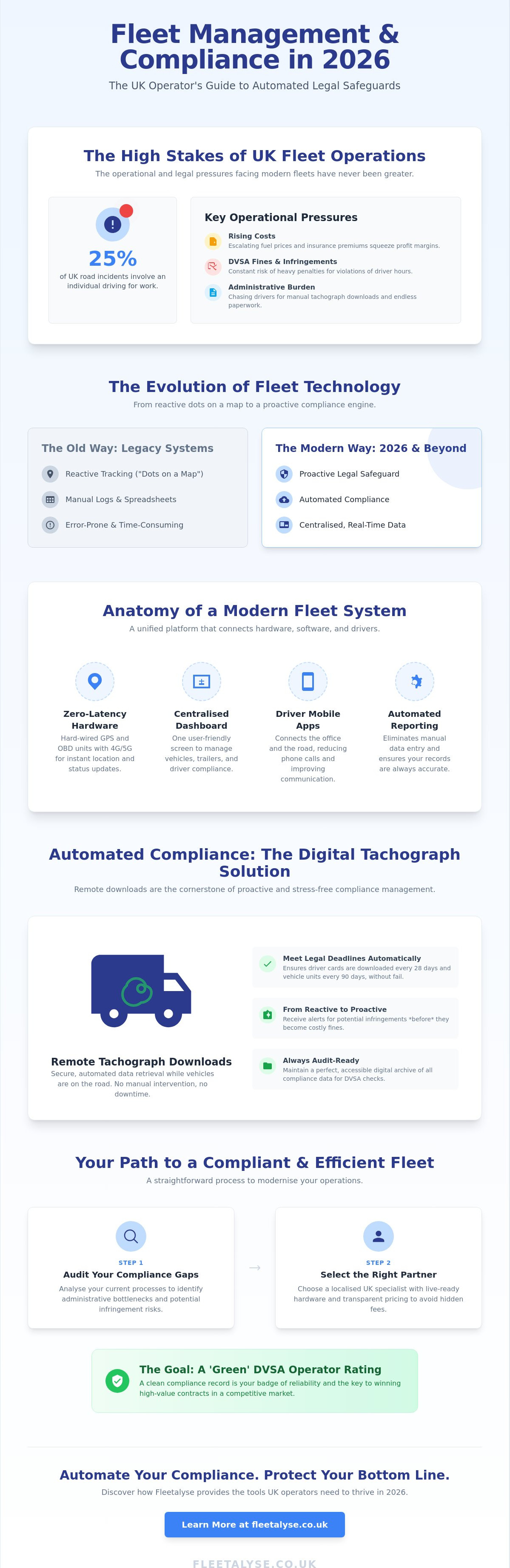
Modern fleet management tracking software in 2026 is a centralised digital platform. It merges GPS telematics with vehicle health and driver compliance data into one interface. The industry has moved beyond reactive tracking. You no longer just check where a vehicle is after a customer calls. Instead, you orchestrate your entire fleet proactively. This shift allows for automated reporting that previously took hours of manual data entry.
British operators are rapidly abandoning spreadsheets. Manual logs are prone to error and impossible to scale as your fleet grows. Integrated cloud-based systems like Fleetalyse provide the real-time data needed to maintain a "Green" DVSA operator rating. This rating is your badge of reliability. It proves you manage driver hours and vehicle maintenance without fail. In a competitive market, a clean compliance record is often the difference between winning a contract and being overlooked.
The Evolution of Telematics: From GPS to Compliance
Telematics has changed. Basic GPS is now the baseline, not the solution. Modern fleet management tracking software focuses on the "how" and "why" of vehicle movement. The rollout of 4G and 5G hardware ensures zero-latency updates. This speed is vital for accurate live driver hours. Most UK logistics contracts now demand this level of real-time visibility as a standard requirement. If you can't provide instant data, you can't compete for high-value work.
Core Components of an Effective Tracking System
A robust system relies on professional hardware. This includes hard-wired GPS units for permanent installation or On-board Diagnostics (OBD) devices for quick deployment. These units capture granular data that a simple mobile phone tracker cannot reach. A clean back-office dashboard is the heart of the operation. It must be user-friendly, allowing transport managers to spot potential infringements before they become costly fines. Mobile apps for drivers complete the loop. They turn the cab into a connected workspace, ensuring the office and the road stay in sync whilst reducing the need for constant phone calls.
- Automated Reporting: Eliminates the need for manual data collation.
- Real-Time Compliance: Links directly to tachograph data for instant legal checks.
- Zero-Latency Hardware: 5G-ready devices for immediate location and status updates.
- Centralised Dashboard: One screen to manage vehicles, trailers, and drivers.
The Compliance Core: Remote Tachograph and Live Driver Hours
Compliance is the foundation of any successful UK transport business. Managing tachograph data manually is a significant administrative burden that often leads to missing files or late downloads. Modern fleet management tracking software solves this by automating the entire retrieval process. You no longer need to chase drivers for their cards or wait for vehicles to return to the depot. The system handles the heavy lifting, ensuring your records are always up to date and audit-ready.
This technology shifts the focus from reactive damage control to proactive management. Instead of discovering an infringement weeks after it happened, you receive alerts before a breach occurs. This level of control is essential for maintaining a healthy Operator Licence and avoiding the heavy fines associated with driver hour violations.
Automating the 28-Day Driver Card Download
Remote download technology retrieves data whilst the vehicle is on the road. It uses a secure wireless connection to send encrypted files directly to your analysis platform. This is a game-changer for long-haul operators. Drivers stay on their routes without diverting back to base for a manual card swipe. It ensures you meet the legal requirement for driver card downloads every 28 days and vehicle unit downloads every 90 days. You maintain data integrity without any human intervention or downtime.
Safety on the road is inseparable from legal compliance. When Evaluating Key Features of your transport safety policy, you must ensure drivers aren't pushed beyond their legal limits. Automated systems provide the transparency needed to protect your staff and the public. By removing the manual element, you eliminate the risk of lost data or forgotten deadlines.
Live Visibility: Protecting Your Operator Licence
Your Operator Licence is your most valuable asset. Protecting it requires more than just retrospective analysis of old data. Live driver hours give you a real-time view of remaining driving time across your entire fleet. You see exactly when a mandatory break is due. This prevents accidental over-driving. It also allows for better route planning. If a driver is delayed in traffic, you can see if they have enough hours left to complete a delivery or if they must stop immediately.
This live data stream builds a robust digital trail that supports DVSA Earned Recognition. It proves to the authorities that you are in total control of your operation. Proactive alerts replace the old method of finding errors after the fact. If you want to stop chasing physical cards and start automating your compliance, you can explore our remote download and live hours solutions to streamline your back-office tasks.
Evaluating Key Features: GPS, Security, and Asset Tracking
Choosing the right fleet management tracking software requires a clear understanding of your hardware needs. Standard vehicle tracking often fails to address the unique requirements of unpowered assets or specialised HGVs. You need a system that distinguishes between a tractor unit on the motorway and a trailer sitting in a remote yard. High-quality hardware ensures that the data you see on your screen matches the reality on the ground. We focus on providing hardware that is built for the rigours of real-world application, not just theoretical data collection.
Geofencing is a critical security feature. It allows you to draw digital boundaries around depots or customer sites. If a vehicle moves outside these zones without authorisation, you receive an instant alert. This is vital for theft prevention and identifying unauthorised usage. With UK commercial fleet insurance premiums increasing by 35% between 2023 and 2026, robust security features are a financial necessity. Beyond security, the software uses live mileage data to automate maintenance scheduling. By linking your fleet to the Driver and Vehicle Standards Agency (DVSA) inspection standards, you can set reminders for MOTs, services, and safety inspections based on actual usage rather than guesswork.
Automating your back-office tasks ensures nothing slips through the cracks. Key features to look for include:
- Live Mileage Tracking: Triggers maintenance alerts exactly when they are due.
- Idling Reports: Highlights vehicles wasting fuel whilst stationary.
- Geofence Alerts: Provides immediate notification of theft or unauthorised movement.
Fuel management is another area where precise data pays off. Tracking habits like excessive idling or harsh acceleration helps identify where money is being wasted. By addressing these behaviours, operators often see a direct reduction in their weekly fuel spend. You can view our full range of GPS fleet tracking solutions to see how these features integrate into a single dashboard.
Van and HGV Tracking: Different Needs, One Platform
Van fleets prioritise multi-drop efficiency and driver behaviour. Monitoring speeding and harsh braking is essential for reducing wear and tear. Conversely, HGV operators require route optimisation that accounts for bridge heights and weight restrictions to avoid costly strikes. Telematics is the integrated technology used to monitor vehicle movements and driver behaviour, which directly facilitates fuel savings through improved operational efficiency.
Securing Trailers and Non-Powered Assets
Unpowered assets require a different approach. Trailer tracking relies on long-life battery units that can survive for months without an external power source. This technology reduces the time spent searching for "lost" equipment and improves your overall utilisation rates. When you integrate trailer data with your main tractor unit tracking, you gain a complete, uninterrupted view of your entire fleet's movement and status.
Implementing Software Without the Administrative Headache
Adopting new fleet management tracking software often feels like a daunting task for busy operators. The fear of a complex setup or driver resistance can delay a transition that's actually designed to make life easier. Successful implementation isn't about the technology alone; it's about a structured approach that prioritises operational clarity. By following a logical sequence, you can move from manual spreadsheets to automated compliance without disrupting your daily deliveries.
The process starts with a clear audit of your current compliance gaps. Identify where your team spends the most time, whether it's chasing driver cards or manually checking vehicle locations. Once you know where the bottlenecks are, follow these steps to get up and running:
- Step 1: Audit your gaps. Compare your manual processes against automated alternatives to find the biggest time-savers.
- Step 2: Choose the right hardware. Select units that support remote tachograph downloads from day one to avoid future upgrades.
- Step 3: Organise training. Introduce the system to your team early to ensure buy-in and reduce anxiety.
- Step 4: Integrate systems. Link your tracking data with your existing tachograph analysis software for a single source of truth.
- Step 5: Review weekly. Use the data to identify patterns, such as repeated idling or route inefficiencies, and refine your operation.
Reducing the Admin Burden for Small to Medium Fleets
For SMEs, every hour spent on paperwork is an hour taken away from business growth. Automation removes the need for physical logbooks and manual spreadsheets, which are often riddled with errors. Industry professionals report that automating these tasks can save several hours of admin time per vehicle every month. You can see how Fleetalyse reduces admin overhead by centralising your compliance and tracking data in one place.
Driver Engagement: Making Tracking a Tool, Not a Burden
Driver buy-in is the most critical part of the setup. It's vital to frame the technology as a safety tool rather than a "big brother" device. High-quality fleet management tracking software provides drivers with proof of non-fault in the event of an accident, protecting their professional reputation. You can also use driver scorecards to reward safe and fuel-efficient driving behaviour, turning a compliance requirement into a positive incentive. Transparency is key; clearly explain what data is being tracked and how it helps protect their jobs by ensuring the company stays on the right side of DVSA regulations.
A well-implemented system doesn't just track vehicles; it empowers your entire team to work more efficiently. If you're ready to automate your compliance and remove the manual headache, you can get started with our straightforward setup today.
Why Fleetalyse is the Pragmatic Choice for UK Operators
Fleetalyse stands apart from generic global providers by focusing exclusively on the UK transport sector. Whilst many competitors offer broad, one-size-fits-all tools, our fleet management tracking software is built specifically to address the rigorous demands of DVSA compliance. We don't believe in flashy, unnecessary features that clutter your dashboard. Instead, we prioritise functional utility that solves real-world operational problems for regional hauliers and van fleet operators.
Our approach is grounded in transparency. We provide straightforward contracts with no hidden "tech fees" or surprise costs. This openness is crucial in an industry where operational clarity is often obscured by complex pricing structures and long-term commitments. By integrating GPS tracking with remote tachograph analysis, we offer a seamless solution that handles both location and legality in one place, removing the need for multiple, disconnected systems.
A Local Specialist for a National Industry
Choosing a UK-based partner gives you a distinct advantage. We understand the specific regional infrastructure and the evolving domestic regulations that impact your fleet daily. Our support team consists of experts who speak the language of transport managers, not just software developers. We focus on the daily grind of haulage, ensuring our tools reflect the practical needs of operators rather than theoretical data collection. This local expertise ensures your compliance is never left to chance.
Next Steps: Moving to Automated Compliance
Transitioning from a legacy provider doesn't have to be a headache. We specialise in making the switch frictionless, ensuring minimal disruption to your fleet's schedule. Moving to an automated system provides a significant long-term ROI by reducing administrative overhead and securing your assets against theft. When you automate your compliance and security, you free up resources to focus on scaling your business and improving your bottom line.
If you're ready to move away from manual spreadsheets and embrace a pragmatic, compliance-first approach, the next step is simple. You can book a demo with Fleetalyse today to see our platform in action. Let us show you how a specialised partner can protect your Operator Licence whilst improving your fleet's efficiency. We are here to act as a reliable ally for your business, prioritising the tools you actually need to succeed.
Secure Your Transport Operation with Automated Compliance
Managing a UK fleet in 2026 demands more than just basic location data. You need a system that acts as a legal shield. By adopting fleet management tracking software, you move from reactive troubleshooting to proactive orchestration. You've seen how automating remote tachograph downloads and monitoring live driver hours protects your Operator Licence whilst slashing the administrative burden that holds back your growth.
Fleetalyse provides the pragmatic tools required for the rigours of the British haulage industry. We are specialists in remote tachograph downloads and live driver hours monitoring, backed by UK-based support and deep industry expertise. Our platform ensures your data is secure, your drivers are safe, and your compliance is never in doubt. Don't let manual paperwork or rising insurance premiums compromise your efficiency.
Streamline your fleet compliance with Fleetalyse today. It's time to trade the spreadsheet headache for a reliable, expert-led solution that keeps your business moving forward.
Frequently Asked Questions
Is fleet management tracking software a legal requirement in the UK?
No, installing a tracking system is not a standalone legal requirement. However, the data it manages often is mandatory. For instance, as of July 1, 2026, vans between 2.5 and 3.5 tonnes used for international freight must use smart tachographs. Software simplifies the legal obligation to download driver cards every 28 days and vehicle units every 90 days. It ensures you remain compliant with DVSA regulations without manual errors.
How much does fleet management software typically cost per vehicle?
Costs vary significantly based on your specific operational needs. Factors influencing the price include your fleet size, the type of tracking hardware required, and whether you need integrated tachograph features. Most providers offer tailored packages rather than flat rates. It is best to request a quote based on your requirements for vehicle, trailer, or asset tracking to ensure you only pay for the functional utility you actually use.
Can tracking software help with my DVSA Earned Recognition application?
Yes, it is a vital tool for the application process. The DVSA Earned Recognition scheme requires operators to share performance KPIs regarding vehicle maintenance and driver hours. Modern fleet management tracking software automates this data collection. It creates a transparent, digital audit trail that proves you are meeting national safety standards. This reduces the likelihood of roadside inspections and demonstrates your commitment to road safety.
What is the difference between active and passive GPS tracking?
Active tracking transmits data in real time via cellular networks, whilst passive tracking stores data to be downloaded later. For a modern transport business, active tracking is the industry standard. It enables live driver hours monitoring and immediate geofence alerts. This real-time visibility is essential for protecting your assets and making quick decisions when a driver is nearing their legal work limits.
Will the software work with my existing tachograph analysis provider?
Yes, most professional systems offer tachograph analysis integration. This allows the software to push encrypted remote download files directly to your chosen analysis platform. It eliminates the need to switch providers for your deeper compliance reporting. The goal is to create a seamless flow of information from the vehicle's tachograph unit straight to your back-office compliance team without any manual intervention.
How does remote tachograph download hardware actually connect to the vehicle?
The hardware typically connects to the rear of the digital tachograph head or the vehicle's CAN-bus system. This hard-wired connection allows the device to communicate directly with the tachograph unit. Once installed, it can trigger automatic downloads on a set schedule. This setup ensures that data is retrieved securely whilst the vehicle is on the road, removing the need for the driver to return to the depot for a manual card swipe.
Can I track trailers that do not have their own power source?
Yes, you can track unpowered assets using specialised trailer tracking units. These devices feature long-life internal batteries designed to last for several months or even years between charges. They are built to withstand harsh weather conditions and can report their location periodically or when they detect movement. This technology is crucial for improving fleet utilisation and locating specific trailers in large yards or remote sites.
How long does it take to install the tracking hardware across a fleet?
A standard professional installation usually takes between 45 and 90 minutes per vehicle. The exact time depends on whether you are fitting a basic GPS tracker or a complex system that requires tachograph integration. Experienced engineers often work around your fleet's downtime, such as evenings or weekends, to ensure your operations aren't disrupted. This structured approach allows for a swift rollout across your entire fleet with minimal impact on your daily delivery schedules.
Frequently asked questions
The Evolution of Telematics: From GPS to Compliance
Telematics has changed. Basic GPS is now the baseline, not the solution. Modern fleet management tracking software focuses on the "how" and "why" of vehicle movement. The rollout of 4G and 5G hardware ensures zero-latency updates. This speed is vital for accurate live driver hours. Most UK logistics contracts now demand this level of real-time visibility as a standard requirement. If you can't provide instant data, you can't compete for high-value work.
Core Components of an Effective Tracking System
A robust system relies on professional hardware. This includes hard-wired GPS units for permanent installation or On-board Diagnostics (OBD) devices for quick deployment. These units capture granular data that a simple mobile phone tracker cannot reach. A clean back-office dashboard is the heart of the operation. It must be user-friendly, allowing transport managers to spot potential infringements before they become costly fines. Mobile apps for drivers complete the loop. They turn the cab into a connected workspace, ensuring the office and the road stay in sync whilst reducing the need for constant phone calls. Compliance is the foundation of any successful UK transport business. Managing tachograph data manually is a significant administrative burden that often leads to missing files or late downloads. Modern fleet management tracking software solves this by automating the entire retrieval process. You no longer need to chase drivers for their cards or wait for vehicles to return to the depot. The system handles the heavy lifting, ensuring your records are always up to date and audit-ready. This technology shifts the focus from reactive damage control to proactive management. Instead of discovering an infringement weeks after it happened, you receive alerts before a breach occurs. This level of control is essential for maintaining a healthy Operator Licence and avoiding the heavy fines associated with driver hour violations.
Automating the 28-Day Driver Card Download
Remote download technology retrieves data whilst the vehicle is on the road. It uses a secure wireless connection to send encrypted files directly to your analysis platform. This is a game-changer for long-haul operators. Drivers stay on their routes without diverting back to base for a manual card swipe. It ensures you meet the legal requirement for driver card downloads every 28 days and vehicle unit downloads every 90 days. You maintain data integrity without any human intervention or downtime. Safety on the road is inseparable from legal compliance. When Evaluating Key Features of your transport safety policy, you must ensure drivers aren't pushed beyond their legal limits. Automated systems provide the transparency needed to protect your staff and the public. By removing the manual element, you eliminate the risk of lost data or forgotten deadlines.
Live Visibility: Protecting Your Operator Licence
Your Operator Licence is your most valuable asset. Protecting it requires more than just retrospective analysis of old data. Live driver hours give you a real-time view of remaining driving time across your entire fleet. You see exactly when a mandatory break is due. This prevents accidental over-driving. It also allows for better route planning. If a driver is delayed in traffic, you can see if they have enough hours left to complete a delivery or if they must stop immediately. This live data stream builds a robust digital trail that supports DVSA Earned Recognition. It proves to the authorities that you are in total control of your operation. Proactive alerts replace the old method of finding errors after the fact. If you want to stop chasing physical cards and start automating your compliance, you can explore our remote download and live hours solutions to streamline your back-office tasks. Choosing the right fleet management tracking software requires a clear understanding of your hardware needs. Standard vehicle tracking often fails to address the unique requirements of unpowered assets or specialised HGVs. You need a system that distinguishes between a tractor unit on the motorway and a trailer sitting in a remote yard. High-quality hardware ensures that the data you see on your screen matches the reality on the ground. We focus on providing hardware that is built for the rigours of real-world application, not just theoretical data collection. Geofencing is a critical security feature. It allows you to draw digital boundaries around depots or customer sites. If a vehicle moves outside these zones without authorisation, you receive an instant alert. This is vital for theft prevention and identifying unauthorised usage. With UK commercial fleet insurance premiums increasing by 35% between 2023 and 2026, robust security features are a financial necessity. Beyond security, the software uses live mileage data to automate maintenance scheduling. By linking your fleet to the Driver and Vehicle Standards Agency (DVSA) inspection standards, you can set reminders for MOTs, services, and safety inspections based on actual usage rather than guesswork. Automating your back-office tasks ensures nothing slips through the cracks. Key features to look for include: Fuel management is another area where precise data pays off. Tracking habits like excessive idling or harsh acceleration helps identify where money is being wasted. By addressing these behaviours, operators often see a direct reduction in their weekly fuel spend. You can view our full range of GPS fleet tracking solutions to see how these features integrate into a single dashboard.
Van and HGV Tracking: Different Needs, One Platform
Van fleets prioritise multi-drop efficiency and driver behaviour. Monitoring speeding and harsh braking is essential for reducing wear and tear. Conversely, HGV operators require route optimisation that accounts for bridge heights and weight restrictions to avoid costly strikes. Telematics is the integrated technology used to monitor vehicle movements and driver behaviour, which directly facilitates fuel savings through improved operational efficiency.
Securing Trailers and Non-Powered Assets
Unpowered assets require a different approach. Trailer tracking relies on long-life battery units that can survive for months without an external power source. This technology reduces the time spent searching for "lost" equipment and improves your overall utilisation rates. When you integrate trailer data with your main tractor unit tracking, you gain a complete, uninterrupted view of your entire fleet's movement and status. Adopting new fleet management tracking software often feels like a daunting task for busy operators. The fear of a complex setup or driver resistance can delay a transition that's actually designed to make life easier. Successful implementation isn't about the technology alone; it's about a structured approach that prioritises operational clarity. By following a logical sequence, you can move from manual spreadsheets to automated compliance without disrupting your daily deliveries. The process starts with a clear audit of your current compliance gaps. Identify where your team spends the most time, whether it's chasing driver cards or manually checking vehicle locations. Once you know where the bottlenecks are, follow these steps to get up and running:
Reducing the Admin Burden for Small to Medium Fleets
For SMEs, every hour spent on paperwork is an hour taken away from business growth. Automation removes the need for physical logbooks and manual spreadsheets, which are often riddled with errors. Industry professionals report that automating these tasks can save several hours of admin time per vehicle every month. You can see how Fleetalyse reduces admin overhead by centralising your compliance and tracking data in one place.
Driver Engagement: Making Tracking a Tool, Not a Burden
Driver buy-in is the most critical part of the setup. It's vital to frame the technology as a safety tool rather than a "big brother" device. High-quality fleet management tracking software provides drivers with proof of non-fault in the event of an accident, protecting their professional reputation. You can also use driver scorecards to reward safe and fuel-efficient driving behaviour, turning a compliance requirement into a positive incentive. Transparency is key; clearly explain what data is being tracked and how it helps protect their jobs by ensuring the company stays on the right side of DVSA regulations. A well-implemented system doesn't just track vehicles; it empowers your entire team to work more efficiently. If you're ready to automate your compliance and remove the manual headache, you can get started with our straightforward setup today. Fleetalyse stands apart from generic global providers by focusing exclusively on the UK transport sector. Whilst many competitors offer broad, one-size-fits-all tools, our fleet management tracking software is built specifically to address the rigorous demands of DVSA compliance. We don't believe in flashy, unnecessary features that clutter your dashboard. Instead, we prioritise functional utility that solves real-world operational problems for regional hauliers and van fleet operators. Our approach is grounded in transparency. We provide straightforward contracts with no hidden "tech fees" or surprise costs. This openness is crucial in an industry where operational clarity is often obscured by complex pricing structures and long-term commitments. By integrating GPS tracking with remote tachograph analysis, we offer a seamless solution that handles both location and legality in one place, removing the need for multiple, disconnected systems.
A Local Specialist for a National Industry
Choosing a UK-based partner gives you a distinct advantage. We understand the specific regional infrastructure and the evolving domestic regulations that impact your fleet daily. Our support team consists of experts who speak the language of transport managers, not just software developers. We focus on the daily grind of haulage, ensuring our tools reflect the practical needs of operators rather than theoretical data collection. This local expertise ensures your compliance is never left to chance.
Next Steps: Moving to Automated Compliance
Transitioning from a legacy provider doesn't have to be a headache. We specialise in making the switch frictionless, ensuring minimal disruption to your fleet's schedule. Moving to an automated system provides a significant long-term ROI by reducing administrative overhead and securing your assets against theft. When you automate your compliance and security, you free up resources to focus on scaling your business and improving your bottom line. If you're ready to move away from manual spreadsheets and embrace a pragmatic, compliance-first approach, the next step is simple. You can book a demo with Fleetalyse today to see our platform in action. Let us show you how a specialised partner can protect your Operator Licence whilst improving your fleet's efficiency. We are here to act as a reliable ally for your business, prioritising the tools you actually need to succeed. Managing a UK fleet in 2026 demands more than just basic location data. You need a system that acts as a legal shield. By adopting fleet management tracking software, you move from reactive troubleshooting to proactive orchestration. You've seen how automating remote tachograph downloads and monitoring live driver hours protects your Operator Licence whilst slashing the administrative burden that holds back your growth. Fleetalyse provides the pragmatic tools required for the rigours of the British haulage industry. We are specialists in remote tachograph downloads and live driver hours monitoring, backed by UK-based support and deep industry expertise. Our platform ensures your data is secure, your drivers are safe, and your compliance is never in doubt. Don't let manual paperwork or rising insurance premiums compromise your efficiency. Streamline your fleet compliance with Fleetalyse today. It's time to trade the spreadsheet headache for a reliable, expert-led solution that keeps your business moving forward.
Is fleet management tracking software a legal requirement in the UK?
No, installing a tracking system is not a standalone legal requirement. However, the data it manages often is mandatory. For instance, as of July 1, 2026, vans between 2.5 and 3.5 tonnes used for international freight must use smart tachographs. Software simplifies the legal obligation to download driver cards every 28 days and vehicle units every 90 days. It ensures you remain compliant with DVSA regulations without manual errors.
How much does fleet management software typically cost per vehicle?
Costs vary significantly based on your specific operational needs. Factors influencing the price include your fleet size, the type of tracking hardware required, and whether you need integrated tachograph features. Most providers offer tailored packages rather than flat rates. It is best to request a quote based on your requirements for vehicle, trailer, or asset tracking to ensure you only pay for the functional utility you actually use.
Can tracking software help with my DVSA Earned Recognition application?
Yes, it is a vital tool for the application process. The DVSA Earned Recognition scheme requires operators to share performance KPIs regarding vehicle maintenance and driver hours. Modern fleet management tracking software automates this data collection. It creates a transparent, digital audit trail that proves you are meeting national safety standards. This reduces the likelihood of roadside inspections and demonstrates your commitment to road safety.
What is the difference between active and passive GPS tracking?
Active tracking transmits data in real time via cellular networks, whilst passive tracking stores data to be downloaded later. For a modern transport business, active tracking is the industry standard. It enables live driver hours monitoring and immediate geofence alerts. This real-time visibility is essential for protecting your assets and making quick decisions when a driver is nearing their legal work limits.
Will the software work with my existing tachograph analysis provider?
Yes, most professional systems offer tachograph analysis integration. This allows the software to push encrypted remote download files directly to your chosen analysis platform. It eliminates the need to switch providers for your deeper compliance reporting. The goal is to create a seamless flow of information from the vehicle's tachograph unit straight to your back-office compliance team without any manual intervention.
How does remote tachograph download hardware actually connect to the vehicle?
The hardware typically connects to the rear of the digital tachograph head or the vehicle's CAN-bus system. This hard-wired connection allows the device to communicate directly with the tachograph unit. Once installed, it can trigger automatic downloads on a set schedule. This setup ensures that data is retrieved securely whilst the vehicle is on the road, removing the need for the driver to return to the depot for a manual card swipe.
Can I track trailers that do not have their own power source?
Yes, you can track unpowered assets using specialised trailer tracking units. These devices feature long-life internal batteries designed to last for several months or even years between charges. They are built to withstand harsh weather conditions and can report their location periodically or when they detect movement. This technology is crucial for improving fleet utilisation and locating specific trailers in large yards or remote sites.
How long does it take to install the tracking hardware across a fleet?
A standard professional installation usually takes between 45 and 90 minutes per vehicle. The exact time depends on whether you are fitting a basic GPS tracker or a complex system that requires tachograph integration. Experienced engineers often work around your fleet's downtime, such as evenings or weekends, to ensure your operations aren't disrupted. This structured approach allows for a swift rollout across your entire fleet with minimal impact on your daily delivery schedules.