

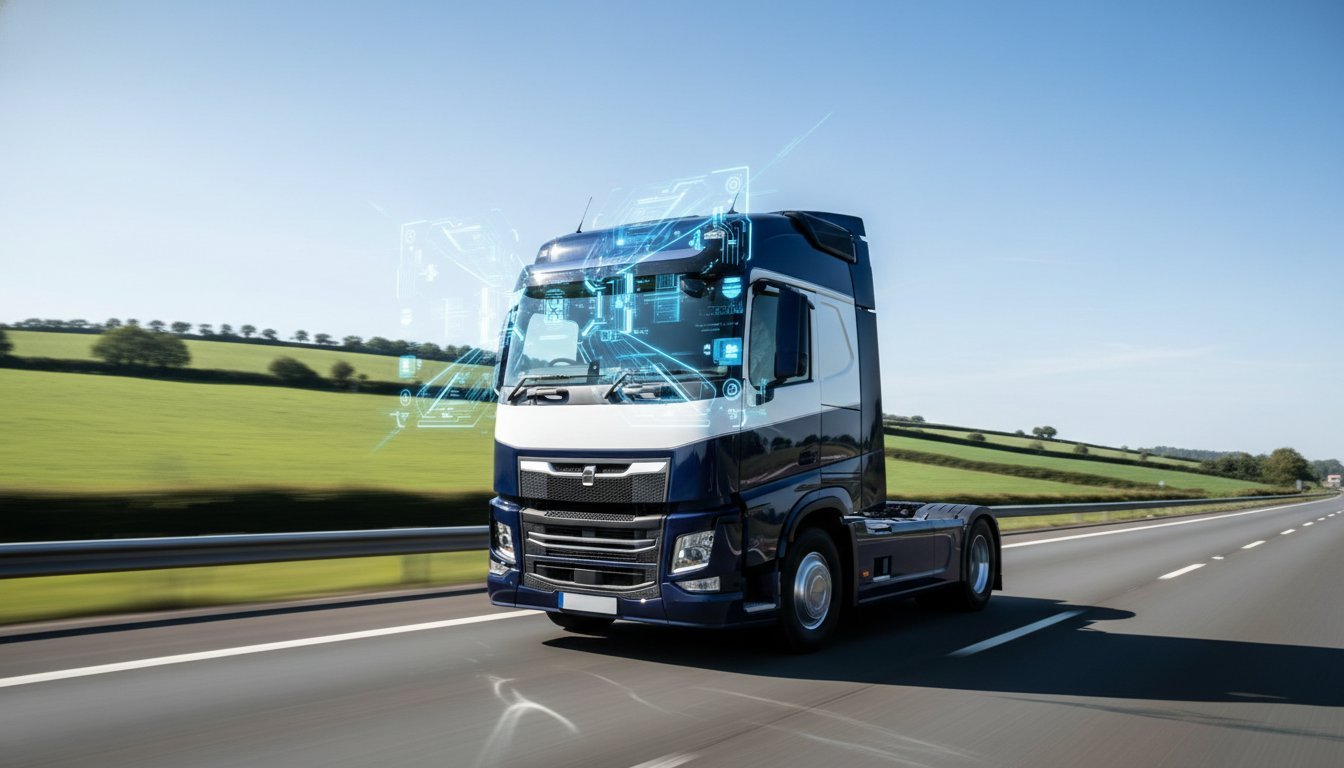
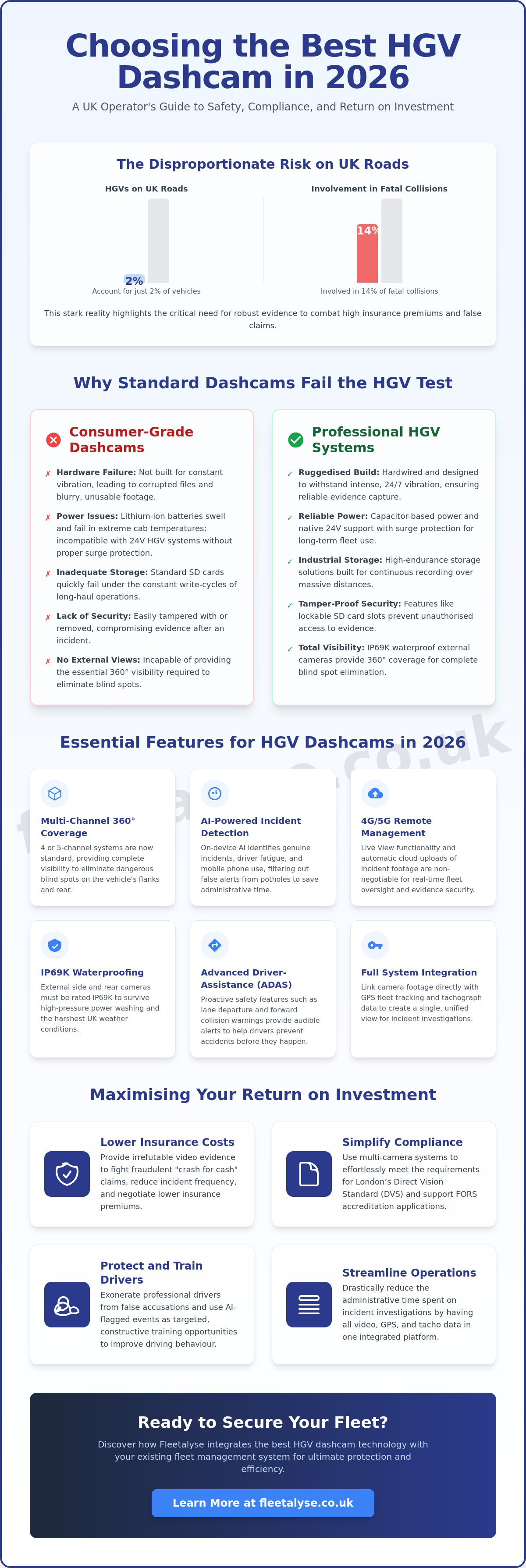
HGVs account for just 2% of vehicles on UK roads, yet they're involved in 14% of fatal collisions. This data explains why your insurance premiums stay high and why false claims are so damaging to your bottom line. Finding the Best HGV Dashcam 2026 is about more than just video; it's about securing a ruggedised tool that survives constant vehicle vibration. You need hardware that provides total visibility without the risk of technical failure when it matters most.
We understand that regional operators value transparency and practical utility over flashy features. It's frustrating when you can't retrieve footage remotely or when systems don't talk to each other. This guide identifies the most reliable, compliance-ready hardware to protect your drivers and lower insurance costs. We'll preview the top-rated systems and explain how they integrate with your GPS fleet tracking and tachograph analysis to create a seamless safety ecosystem.
Key Takeaways
- Identify why professional, hardwired systems are the only way to prevent hardware failure caused by heavy vehicle vibration.
- Compare the Best HGV Dashcam 2026 options to find the right balance between AI incident detection and 360-degree multi-channel coverage.
- Use video evidence to simplify compliance for London’s Direct Vision Standard (DVS) and support your FORS accreditation applications.
- Link your camera footage directly with live driver hours and GPS fleet tracking to streamline incident investigations and administrative tasks.
Why Standard Dashcams Fail the HGV Test
A professional HGV dashcam isn't a suction-mounted accessory; it's a hardwired safety asset. Standard units designed for passenger cars fail in the heavy goods environment because they aren't built for 24/7 operation or the intense vibrations of a 44-tonne chassis. When searching for the Best HGV Dashcam 2026, operators must prioritise ruggedised systems that handle the specific electrical and physical demands of a commercial fleet. Relying on consumer-grade hardware often leads to corrupted files or hardware failure at the exact moment you need evidence.
Vibration is the silent killer of cheap dashcams. Constant engine hum and road impact shake internal components loose, resulting in blurry footage that's useless for insurance claims. There's also the issue of voltage. Commercial vehicles operate on 24V systems. While some car cameras claim compatibility, they often lack the surge protection required for heavy-duty ignition cycles. This dashcam technology overview explains how professional systems have evolved to meet these specific commercial needs, moving far beyond the simple "plug and play" gadgets found in retail stores.
Storage demands are another major hurdle. HGVs cover massive distances. Standard SD cards burn out under the constant write-cycles of long-haul shifts. Professional systems require high-endurance, industrial-grade storage. This ensures critical footage isn't overwritten before the vehicle returns to the depot. For maximum utility, these systems should eventually link with your GPS fleet tracking to provide a complete picture of every journey.
Hardware Durability and Build Quality
Plastic casings warp in the heat of a cab parked in direct sun. Metal casings provide the heat dissipation required for continuous recording during 10-hour shifts. We recommend capacitor-based power over lithium-ion batteries. Batteries swell and fail in extreme temperatures; capacitors are far more reliable for long-term fleet use. Security is equally vital. Lockable SD card slots prevent unauthorised personnel from removing evidence after an incident. You need a system that remains tamper-proof and functional, regardless of the environment.
The Need for External Waterproofing
Standard dashcams sit behind a windscreen, but HGV safety requires external cameras to eliminate blind spots. These must be IP69K rated to survive high-pressure power washes at the depot. Side and rear cameras with infrared (IR) LEDs are essential for night-time loading. They provide clear visibility in pitch-black yards. This allows drivers to see obstacles that a standard camera would miss. High-quality external hardware is a cornerstone of the Best HGV Dashcam 2026, providing the 360-degree protection necessary for modern compliance.
Essential Features for HGV Dashcams in 2026
The Best HGV Dashcam 2026 must do more than just record video; it needs to interpret the road. Modern systems use AI-powered incident detection to filter out irrelevant data like potholes or harsh speed bumps. This prevents your office team from being buried under thousands of false alerts. While high resolution is helpful, it's secondary to the system's ability to provide actionable context. Operators should consult the UK guidance on HGV camera systems to ensure their multi-camera setups remain compliant with vehicle equipment standards, especially for specialised or abnormal loads.
Industry standards are moving away from simple 2-channel systems. A 4 or 5-channel setup provides 360-degree coverage, which is essential for protecting the vehicle's flanks and rear. Advanced Driver Assistance Systems (ADAS) further enhance safety by providing audible lane departure and forward collision warnings. These features act as a second pair of eyes for the driver, potentially preventing an accident before it occurs. This proactive approach is what distinguishes a professional safety tool from a basic recording device.
AI and Edge Processing
AI now monitors what happens inside the cab as well as outside. Real-time edge processing identifies signs of driver fatigue or distracted behaviour, such as mobile phone use, without needing to upload every minute of video to the cloud. This significantly reduces data transmission costs over 5G networks. Accuracy depends on G-sensor calibration; this is the specific process of fine-tuning the camera's sensitivity to distinguish between normal vehicle movement and a genuine collision. Without precise calibration, your team will waste hours investigating false-positive alerts.
Connectivity and Remote Management
Built-in 4G or 5G LTE connectivity is a non-negotiable standard for the Best HGV Dashcam 2026. It allows for "Live View" functionality, letting managers check a vehicle's surroundings instantly if a driver reports an issue. Automatic event upload is equally critical. This feature secures footage of an incident to a secure server before a driver or third party can intervene. It ensures that evidence is safe even if the hardware is damaged during a crash. For operators looking to integrate these insights, reviewing your current fleet tracking options can help identify where these data streams should meet for maximum efficiency.
The Top HGV Dashcams for UK Operators in 2026
Selecting the Best HGV Dashcam 2026 involves matching hardware to your specific route types and fleet size. For long-haul reliability, the BlackVue DR970X-2CH Truck remains a top contender. Its external infrared camera handles the grime of UK motorways without failing, whilst its ruggedised build suits the constant duty cycles of a 24-hour operation. Operators who prioritise a user-friendly interface often look toward the Garmin Dash Cam Live. This unit provides always-on LTE connectivity, giving managers instant access to footage without waiting for the vehicle to return to the yard.
For large-scale enterprise fleets, standalone units often fall short. Professional operators require integrated telematics cameras that feed directly into a wider compliance ecosystem. This is where Fleetalyse provides a distinct advantage. By linking video events with tachograph analysis integration and live driver hours, you create a single source of truth for every incident. This level of integration is essential for managing risk across hundreds of assets. It moves the conversation from simply recording video to active asset management.
Best for 360-Degree Coverage
Urban driving presents the highest risk of side-swipe accidents and cyclist incidents. Systems that support side-mounted cameras are now essential for meeting modern safety standards. Signal integrity is a common failure point for long vehicles. High-quality systems use coaxial cabling to maintain clear video feeds over 15-metre trailers. Whilst wireless trailer links offer convenience, hardwired connections remain the gold standard for articulated vehicles. They prevent signal dropouts caused by electronic interference from the tractor unit, ensuring the Best HGV Dashcam 2026 setup remains reliable.
Best Value for Small Hauliers
Smaller hauliers need a balance of price and durability. The Vantrue N5 serves as a capable multi-channel option for van fleets and light rigids. Even at a lower price point, GPS logging is a non-negotiable requirement. It provides the location and speed data necessary to dismiss false accident claims. For fleets without a dedicated workshop, look for models that offer straightforward hardwiring kits. These allow for efficient installation without keeping vehicles off the road for extended periods. Professional safety shouldn't be reserved for the largest operators; it's a necessity for any business protecting its no-claims bonus.
Legal Compliance and Insurance: Maximising Your ROI
ROI on safety technology is measured by the costs you avoid. This includes fines, lost permits, and insurance premium spikes. The Best HGV Dashcam 2026 acts as a shield for your business, ensuring you meet the strict requirements of London's Direct Vision Standard (DVS). Since October 2024, HGVs over 12 tonnes must have a three-star rating or fit a Progressive Safe System (PSS) to operate in Greater London. A compliant multi-camera setup is a core component of this system, preventing costly access bans for your fleet.
Compliance also extends to voluntary standards like the Fleet Operator Recognition Scheme (FORS). Achieving Silver or Gold status requires specific safety equipment, including cameras that eliminate blind spots. Beyond vehicle hardware, you must manage data correctly to stay within GDPR boundaries. This involves using warning stickers for passengers and establishing clear data retention policies. Transparent data management protects your business from privacy claims whilst securing the evidence you need to defend your drivers.
Protecting Your Operator Licence
Your Operator Compliance Risk Score (OCRS) is your most valuable asset. A single false allegation of dangerous driving can trigger a DVSA investigation. Video evidence provides immediate exoneration during roadside inspections, proving your driver's conduct was within legal limits. Use this footage as a proactive tool for internal training. By reviewing near-miss events, you can correct risky behaviour before it leads to a serious infringement. This proactive approach shows the DVSA that you are a responsible, low-risk operator.
Insurance Premium Reduction
Insurers value certainty. The First Notification of Loss (FNOL) process is significantly faster when you provide video evidence immediately after an incident. This speed prevents third-party costs from spiralling. High-quality side-view footage effectively neutralises "crash-for-cash" scams, which often target larger commercial vehicles. Statistics show that fleets using integrated video telematics can see an average insurance saving of 10-15%. To secure these discounts, you must prove your fleet is a lower risk. Organise your fleet compliance tools today to start building a more defensible insurance profile.
Integrating Dashcams with Your Fleet Compliance Strategy
Choosing the Best HGV Dashcam 2026 is only the first step. For a regional operator, the real value lies in how that hardware talks to your office systems. Standalone cameras create data silos that require manual management. In 2026, professional hauliers should demand a "single pane of glass" approach. This means viewing high-definition incident video alongside live driver hours to understand exactly why a situation occurred. If a driver was nearing the end of their shift or stuck in traffic, that context is vital for a fair and accurate incident analysis.
Manual SD card retrieval is a hidden drain on your resources. Sending a vehicle back to the depot or paying a manager to visit a remote site just to pull a card is inefficient. It's a labour cost that quickly outweighs the initial saving of a cheaper, non-connected camera. Future-proof your fleet by selecting hardware that grows with your compliance needs. You need a system that uploads critical events automatically. This ensures you never lose data due to a corrupted card or a simple human error during a busy shift.
Synchronising Video with GPS Tracking
Linking video events to GPS location data allows you to find specific footage in seconds rather than hours. You can search by a specific delivery address or a known congestion point to verify driver reports. Overlaying vehicle speed and braking force onto the video file provides the forensic detail needed for insurance claims. This level of transparency also improves dispatch efficiency. By seeing what the driver sees during delivery delays, you can provide customers with accurate updates based on real-time visual evidence rather than guesswork.
The Fleetalyse Approach to Total Visibility
We act as the pragmatic partner that organises all your compliance data in one place. Managing separate logins for tracking, cameras, and tachographs is a recipe for administrative failure. We encourage managers to combine remote tachograph downloads with video telematics to create a robust safety ecosystem. This unified approach ensures that every asset is accounted for and every driver is protected. Professional haulage requires professional tools. Moving away from consumer gadgets toward an integrated compliance strategy is the only way to secure long-term operational clarity and protect your Best HGV Dashcam 2026 investment.
Future-Proof Your Fleet Safety and Compliance
Investing in the Best HGV Dashcam 2026 is a strategic decision that goes beyond simple recording. You need hardware that withstands the rigours of the UK road network whilst providing the data required to defend your drivers and your operator licence. Professional systems provide the durability that consumer gadgets lack; ensuring you have clear evidence when insurance claims or roadside inspections occur. Relying on standalone tools often leads to administrative bottlenecks that your business doesn't need.
True operational efficiency comes from total visibility. It's not enough to have video in isolation. By linking your video telematics with remote tachograph downloads and GPS tracking, you'll eliminate data gaps and reduce overheads. Fleetalyse acts as a pragmatic partner for regional hauliers; providing specialist expertise in UK transport compliance and seamless system integration. We understand the daily pressures of asset management and regulatory adherence. Optimise your fleet compliance with Fleetalyse today and secure the tools your business needs to stay safe and profitable. We're ready to help you build a more resilient and transparent operation.
Frequently Asked Questions
Do dashcams lower HGV insurance premiums in the UK?
Yes, many UK insurance providers offer discounts between 10% and 15% for fleets fitted with approved camera systems. Dashcams provide the objective evidence needed to settle claims quickly; this reduces the administrative costs for the insurer. By proving a low-risk profile through consistent video data, you can often negotiate better terms during your annual policy renewal.
Is it legal to have a camera facing the driver in an HGV?
It is legal to install driver-facing cameras in the UK, provided you comply with GDPR and privacy regulations. You must inform drivers they are being recorded, typically through signage, and have a clear policy on how the data is stored. These cameras are essential for monitoring fatigue and distracted behaviour; which are key factors in maintaining a safe fleet environment.
What is the best dashcam for meeting DVS requirements?
The Best HGV Dashcam 2026 for DVS compliance is a multi-channel system that integrates with a Progressive Safe System (PSS). For London's Direct Vision Standard, you need side-mounted cameras that eliminate blind spots and provide an audible warning to vulnerable road users. The system must be hardwired and durable enough to withstand constant vehicle vibration to pass a technical inspection.
How long does a dashcam keep footage before overwriting it?
Retention time depends on the SD card capacity and the recording resolution you choose. A standard 128GB card might hold 6 to 10 hours of 1080p footage across multiple channels before loop recording overwrites the oldest files. To keep evidence longer, choose a system with automatic event uploads to the cloud; this secures critical footage immediately after a detected collision.
Can I use a standard SD card in my HGV dashcam?
You should never use standard retail SD cards in a commercial vehicle dashcam. HGV systems subject cards to extreme heat and constant write-cycles that would cause a standard card to fail within weeks. Always use industrial-grade, high-endurance SD cards. These are specifically designed for the continuous recording demands and harsh physical environment of a 24-hour haulage operation.
Do HGV dashcams work when the engine is turned off?
Yes, HGV dashcams can record when the engine is off if they are hardwired with a "parking mode" feature. This uses the vehicle's battery or a dedicated power pack to monitor for impacts whilst the vehicle is stationary. It's a vital feature for protecting assets in overnight laybys or unsecured loading bays where theft or accidental damage is a risk.
What is the difference between a dashcam and a full vehicle CCTV system?
A standard dashcam is typically a one or two-camera system focused on the road ahead and the driver. A full vehicle CCTV system uses 4 to 8 cameras and a separate digital video recorder (DVR) to provide 360-degree visibility around the tractor and trailer. CCTV is often necessary for meeting higher-level FORS requirements and comprehensive DVS compliance for larger vehicles.
How much does it cost to install a dashcam across a whole fleet?
Fleet installation costs vary based on the number of cameras per vehicle and the complexity of the integration. The Best HGV Dashcam 2026 setup for your business will include hardware costs, professional hardwiring fees, and potential monthly software subscriptions for cloud connectivity. We recommend requesting a transparent quote that accounts for both the initial outlay and the long-term data costs for your specific fleet size.
Frequently asked questions
Hardware Durability and Build Quality
Plastic casings warp in the heat of a cab parked in direct sun. Metal casings provide the heat dissipation required for continuous recording during 10-hour shifts. We recommend capacitor-based power over lithium-ion batteries. Batteries swell and fail in extreme temperatures; capacitors are far more reliable for long-term fleet use. Security is equally vital. Lockable SD card slots prevent unauthorised personnel from removing evidence after an incident. You need a system that remains tamper-proof and functional, regardless of the environment.
The Need for External Waterproofing
Standard dashcams sit behind a windscreen, but HGV safety requires external cameras to eliminate blind spots. These must be IP69K rated to survive high-pressure power washes at the depot. Side and rear cameras with infrared (IR) LEDs are essential for night-time loading. They provide clear visibility in pitch-black yards. This allows drivers to see obstacles that a standard camera would miss. High-quality external hardware is a cornerstone of the Best HGV Dashcam 2026, providing the 360-degree protection necessary for modern compliance. The Best HGV Dashcam 2026 must do more than just record video; it needs to interpret the road. Modern systems use AI-powered incident detection to filter out irrelevant data like potholes or harsh speed bumps. This prevents your office team from being buried under thousands of false alerts. While high resolution is helpful, it's secondary to the system's ability to provide actionable context. Operators should consult the UK guidance on HGV camera systems to ensure their multi-camera setups remain compliant with vehicle equipment standards, especially for specialised or abnormal loads. Industry standards are moving away from simple 2-channel systems. A 4 or 5-channel setup provides 360-degree coverage, which is essential for protecting the vehicle's flanks and rear. Advanced Driver Assistance Systems (ADAS) further enhance safety by providing audible lane departure and forward collision warnings. These features act as a second pair of eyes for the driver, potentially preventing an accident before it occurs. This proactive approach is what distinguishes a professional safety tool from a basic recording device.
AI and Edge Processing
AI now monitors what happens inside the cab as well as outside. Real-time edge processing identifies signs of driver fatigue or distracted behaviour, such as mobile phone use, without needing to upload every minute of video to the cloud. This significantly reduces data transmission costs over 5G networks. Accuracy depends on G-sensor calibration; this is the specific process of fine-tuning the camera's sensitivity to distinguish between normal vehicle movement and a genuine collision. Without precise calibration, your team will waste hours investigating false-positive alerts.
Connectivity and Remote Management
Built-in 4G or 5G LTE connectivity is a non-negotiable standard for the Best HGV Dashcam 2026. It allows for "Live View" functionality, letting managers check a vehicle's surroundings instantly if a driver reports an issue. Automatic event upload is equally critical. This feature secures footage of an incident to a secure server before a driver or third party can intervene. It ensures that evidence is safe even if the hardware is damaged during a crash. For operators looking to integrate these insights, reviewing your current fleet tracking options can help identify where these data streams should meet for maximum efficiency. Selecting the Best HGV Dashcam 2026 involves matching hardware to your specific route types and fleet size. For long-haul reliability, the BlackVue DR970X-2CH Truck remains a top contender. Its external infrared camera handles the grime of UK motorways without failing, whilst its ruggedised build suits the constant duty cycles of a 24-hour operation. Operators who prioritise a user-friendly interface often look toward the Garmin Dash Cam Live. This unit provides always-on LTE connectivity, giving managers instant access to footage without waiting for the vehicle to return to the yard. For large-scale enterprise fleets, standalone units often fall short. Professional operators require integrated telematics cameras that feed directly into a wider compliance ecosystem. This is where Fleetalyse provides a distinct advantage. By linking video events with tachograph analysis integration and live driver hours, you create a single source of truth for every incident. This level of integration is essential for managing risk across hundreds of assets. It moves the conversation from simply recording video to active asset management.
Best for 360-Degree Coverage
Urban driving presents the highest risk of side-swipe accidents and cyclist incidents. Systems that support side-mounted cameras are now essential for meeting modern safety standards. Signal integrity is a common failure point for long vehicles. High-quality systems use coaxial cabling to maintain clear video feeds over 15-metre trailers. Whilst wireless trailer links offer convenience, hardwired connections remain the gold standard for articulated vehicles. They prevent signal dropouts caused by electronic interference from the tractor unit, ensuring the Best HGV Dashcam 2026 setup remains reliable.
Best Value for Small Hauliers
Smaller hauliers need a balance of price and durability. The Vantrue N5 serves as a capable multi-channel option for van fleets and light rigids. Even at a lower price point, GPS logging is a non-negotiable requirement. It provides the location and speed data necessary to dismiss false accident claims. For fleets without a dedicated workshop, look for models that offer straightforward hardwiring kits. These allow for efficient installation without keeping vehicles off the road for extended periods. Professional safety shouldn't be reserved for the largest operators; it's a necessity for any business protecting its no-claims bonus. ROI on safety technology is measured by the costs you avoid. This includes fines, lost permits, and insurance premium spikes. The Best HGV Dashcam 2026 acts as a shield for your business, ensuring you meet the strict requirements of London's Direct Vision Standard (DVS). Since October 2024, HGVs over 12 tonnes must have a three-star rating or fit a Progressive Safe System (PSS) to operate in Greater London. A compliant multi-camera setup is a core component of this system, preventing costly access bans for your fleet. Compliance also extends to voluntary standards like the Fleet Operator Recognition Scheme (FORS). Achieving Silver or Gold status requires specific safety equipment, including cameras that eliminate blind spots. Beyond vehicle hardware, you must manage data correctly to stay within GDPR boundaries. This involves using warning stickers for passengers and establishing clear data retention policies. Transparent data management protects your business from privacy claims whilst securing the evidence you need to defend your drivers.
Protecting Your Operator Licence
Your Operator Compliance Risk Score (OCRS) is your most valuable asset. A single false allegation of dangerous driving can trigger a DVSA investigation. Video evidence provides immediate exoneration during roadside inspections, proving your driver's conduct was within legal limits. Use this footage as a proactive tool for internal training. By reviewing near-miss events, you can correct risky behaviour before it leads to a serious infringement. This proactive approach shows the DVSA that you are a responsible, low-risk operator.
Insurance Premium Reduction
Insurers value certainty. The First Notification of Loss (FNOL) process is significantly faster when you provide video evidence immediately after an incident. This speed prevents third-party costs from spiralling. High-quality side-view footage effectively neutralises "crash-for-cash" scams, which often target larger commercial vehicles. Statistics show that fleets using integrated video telematics can see an average insurance saving of 10-15%. To secure these discounts, you must prove your fleet is a lower risk. Organise your fleet compliance tools today to start building a more defensible insurance profile. Choosing the Best HGV Dashcam 2026 is only the first step. For a regional operator, the real value lies in how that hardware talks to your office systems. Standalone cameras create data silos that require manual management. In 2026, professional hauliers should demand a "single pane of glass" approach. This means viewing high-definition incident video alongside live driver hours to understand exactly why a situation occurred. If a driver was nearing the end of their shift or stuck in traffic, that context is vital for a fair and accurate incident analysis. Manual SD card retrieval is a hidden drain on your resources. Sending a vehicle back to the depot or paying a manager to visit a remote site just to pull a card is inefficient. It's a labour cost that quickly outweighs the initial saving of a cheaper, non-connected camera. Future-proof your fleet by selecting hardware that grows with your compliance needs. You need a system that uploads critical events automatically. This ensures you never lose data due to a corrupted card or a simple human error during a busy shift.
Synchronising Video with GPS Tracking
Linking video events to GPS location data allows you to find specific footage in seconds rather than hours. You can search by a specific delivery address or a known congestion point to verify driver reports. Overlaying vehicle speed and braking force onto the video file provides the forensic detail needed for insurance claims. This level of transparency also improves dispatch efficiency. By seeing what the driver sees during delivery delays, you can provide customers with accurate updates based on real-time visual evidence rather than guesswork.
The Fleetalyse Approach to Total Visibility
We act as the pragmatic partner that organises all your compliance data in one place. Managing separate logins for tracking, cameras, and tachographs is a recipe for administrative failure. We encourage managers to combine remote tachograph downloads with video telematics to create a robust safety ecosystem. This unified approach ensures that every asset is accounted for and every driver is protected. Professional haulage requires professional tools. Moving away from consumer gadgets toward an integrated compliance strategy is the only way to secure long-term operational clarity and protect your Best HGV Dashcam 2026 investment. Investing in the Best HGV Dashcam 2026 is a strategic decision that goes beyond simple recording. You need hardware that withstands the rigours of the UK road network whilst providing the data required to defend your drivers and your operator licence. Professional systems provide the durability that consumer gadgets lack; ensuring you have clear evidence when insurance claims or roadside inspections occur. Relying on standalone tools often leads to administrative bottlenecks that your business doesn't need. True operational efficiency comes from total visibility. It's not enough to have video in isolation. By linking your video telematics with remote tachograph downloads and GPS tracking, you'll eliminate data gaps and reduce overheads. Fleetalyse acts as a pragmatic partner for regional hauliers; providing specialist expertise in UK transport compliance and seamless system integration. We understand the daily pressures of asset management and regulatory adherence. Optimise your fleet compliance with Fleetalyse today and secure the tools your business needs to stay safe and profitable. We're ready to help you build a more resilient and transparent operation.
Do dashcams lower HGV insurance premiums in the UK?
Yes, many UK insurance providers offer discounts between 10% and 15% for fleets fitted with approved camera systems. Dashcams provide the objective evidence needed to settle claims quickly; this reduces the administrative costs for the insurer. By proving a low-risk profile through consistent video data, you can often negotiate better terms during your annual policy renewal.
Is it legal to have a camera facing the driver in an HGV?
It is legal to install driver-facing cameras in the UK, provided you comply with GDPR and privacy regulations. You must inform drivers they are being recorded, typically through signage, and have a clear policy on how the data is stored. These cameras are essential for monitoring fatigue and distracted behaviour; which are key factors in maintaining a safe fleet environment.
What is the best dashcam for meeting DVS requirements?
The Best HGV Dashcam 2026 for DVS compliance is a multi-channel system that integrates with a Progressive Safe System (PSS). For London's Direct Vision Standard, you need side-mounted cameras that eliminate blind spots and provide an audible warning to vulnerable road users. The system must be hardwired and durable enough to withstand constant vehicle vibration to pass a technical inspection.
How long does a dashcam keep footage before overwriting it?
Retention time depends on the SD card capacity and the recording resolution you choose. A standard 128GB card might hold 6 to 10 hours of 1080p footage across multiple channels before loop recording overwrites the oldest files. To keep evidence longer, choose a system with automatic event uploads to the cloud; this secures critical footage immediately after a detected collision.
Can I use a standard SD card in my HGV dashcam?
You should never use standard retail SD cards in a commercial vehicle dashcam. HGV systems subject cards to extreme heat and constant write-cycles that would cause a standard card to fail within weeks. Always use industrial-grade, high-endurance SD cards. These are specifically designed for the continuous recording demands and harsh physical environment of a 24-hour haulage operation.
Do HGV dashcams work when the engine is turned off?
Yes, HGV dashcams can record when the engine is off if they are hardwired with a "parking mode" feature. This uses the vehicle's battery or a dedicated power pack to monitor for impacts whilst the vehicle is stationary. It's a vital feature for protecting assets in overnight laybys or unsecured loading bays where theft or accidental damage is a risk.
What is the difference between a dashcam and a full vehicle CCTV system?
A standard dashcam is typically a one or two-camera system focused on the road ahead and the driver. A full vehicle CCTV system uses 4 to 8 cameras and a separate digital video recorder (DVR) to provide 360-degree visibility around the tractor and trailer. CCTV is often necessary for meeting higher-level FORS requirements and comprehensive DVS compliance for larger vehicles.
How much does it cost to install a dashcam across a whole fleet?
Fleet installation costs vary based on the number of cameras per vehicle and the complexity of the integration. The Best HGV Dashcam 2026 setup for your business will include hardware costs, professional hardwiring fees, and potential monthly software subscriptions for cloud connectivity. We recommend requesting a transparent quote that accounts for both the initial outlay and the long-term data costs for your specific fleet size.