

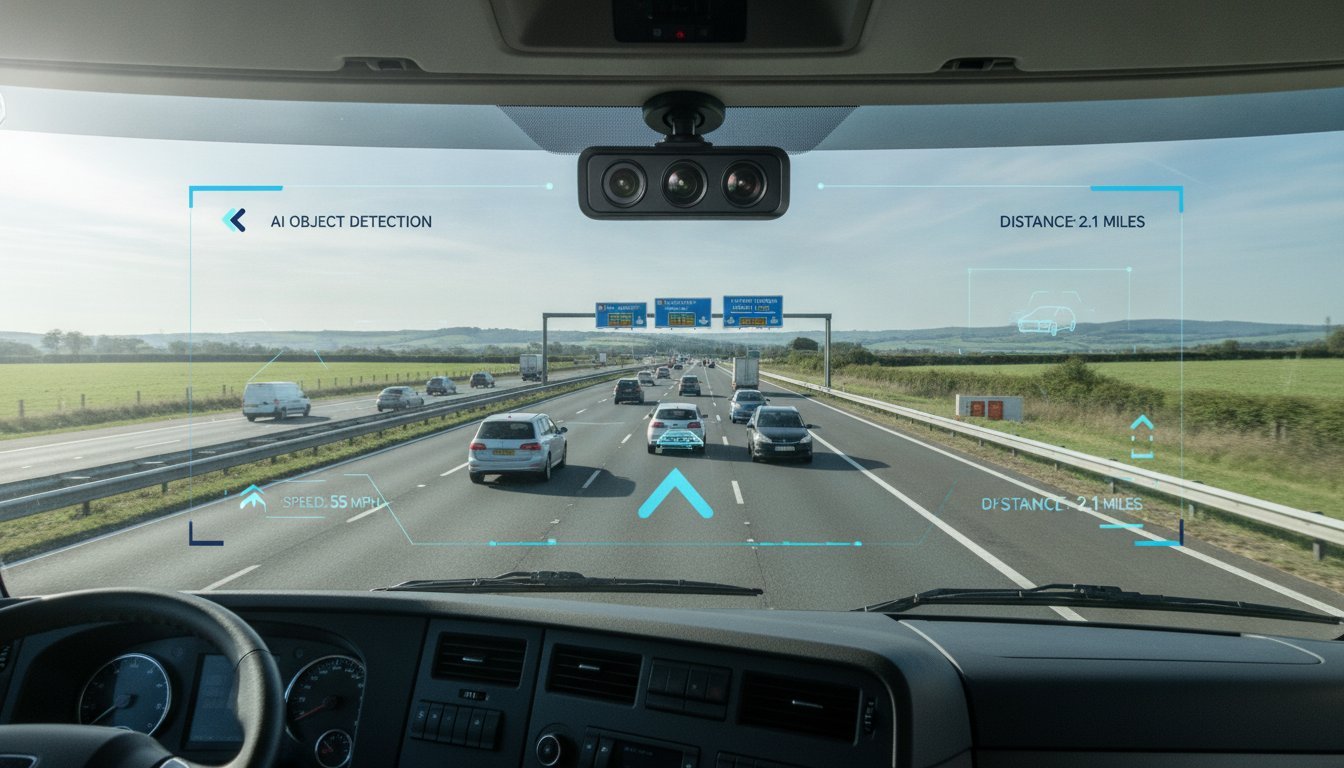
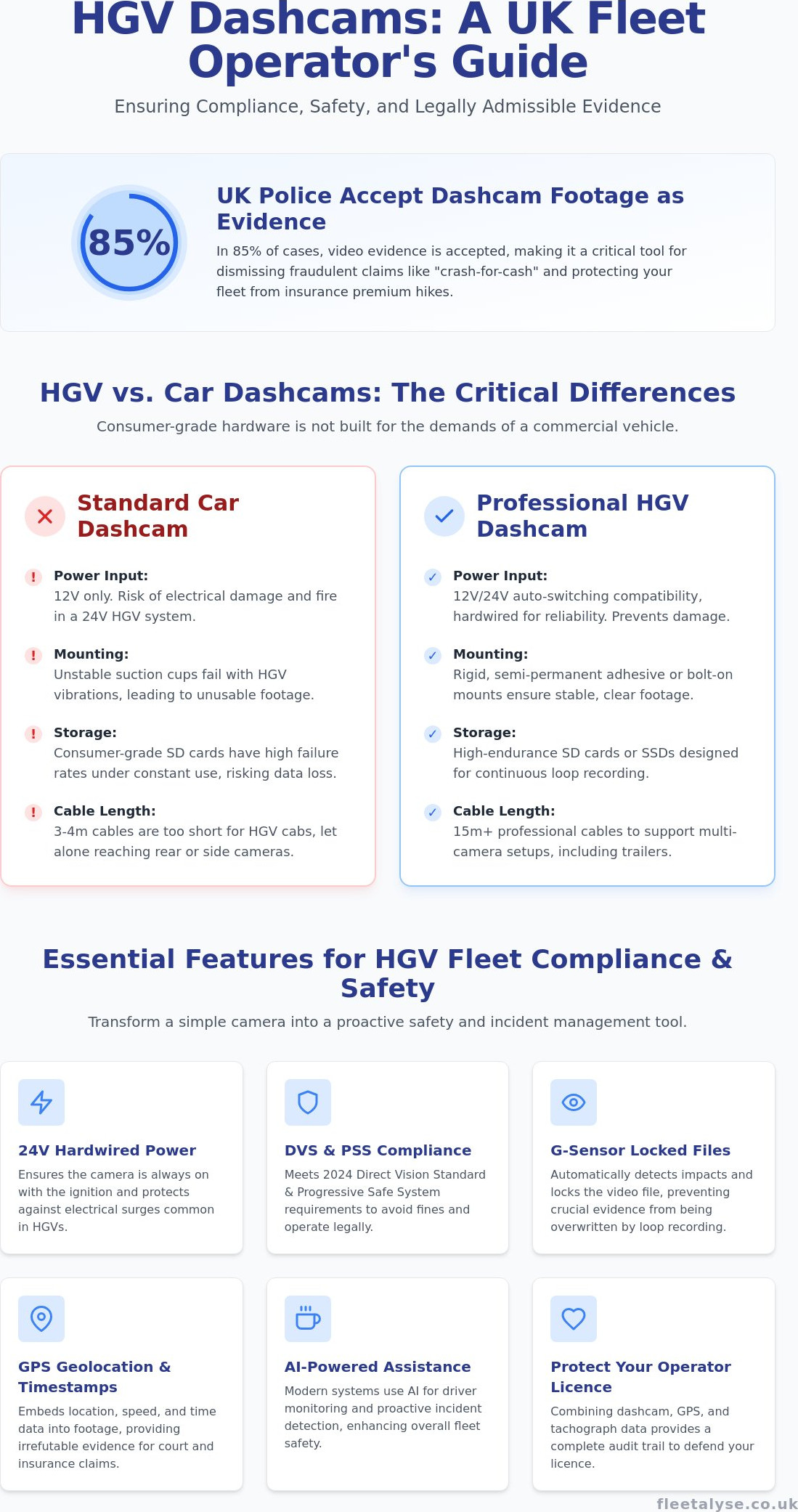
Did you know that UK police now accept dashcam footage in 85% of cases? For a fleet operator, that isn't just a statistic. It's the difference between a dismissed "crash-for-cash" claim and a devastating insurance hike. An HGV dashcam isn't a consumer gadget. It's a critical piece of professional infrastructure. Finding the best dashcams for HGV drivers UK means looking past basic retail specs and focusing on 24V compatibility and Progressive Safe System (PSS) requirements.
You already know that a single £550 fine for non-compliance or a corrupted memory card can ruin your operational margins. It's frustrating when hardware fails because it wasn't built for the rigours of a commercial cab. This guide promises to clarify the technical standards your equipment must meet to protect your Operator Licence and ensure evidence stands up in court. We'll preview the top-rated hardware for 2026; covering everything from AI-powered incident detection to the latest UK GDPR and Data (Use and Access) Act regulations.
Key Takeaways
- Learn why standard 12V consumer hardware fails in commercial cabs and how to select 24V compatible units that prevent electrical damage.
- Identify the essential technical features required in the best dashcams for HGV drivers UK to meet 2024 Direct Vision Standard (DVS) and Progressive Safe System (PSS) compliance.
- Eliminate the risk of data loss during critical incidents by understanding the necessity of high-endurance storage and professional-grade loop recording.
- Explore how AI-powered driver assistance and cloud connectivity can transform a simple camera into a proactive safety and incident management tool.
- Discover how linking video footage with GPS tracking and tachograph analysis provides the evidence needed to protect your Operator Licence during compliance audits.
Why UK HGV Drivers Need More Than a Standard Car Dashcam
Equipping a 44-tonne artic with a budget camera from a high-street retailer is a recipe for failure. These consumer units aren't built for the 24V electrical systems found in most HGV cabs. Forcing 24V through a 12V-rated device will fry the internal circuitry; often voiding your insurance in the process. The best dashcams for HGV drivers UK are engineered for high-voltage environments and the relentless vibration of long-haul trunking. Standard suction mounts designed for a Ford Fiesta won't last a week on the M6. Professional hardware uses semi-permanent adhesive or bolted mounts to ensure the horizon stays level and the footage remains stable.
Field of view is another critical differentiator. Standard cameras often lack the vertical range to capture what's happening directly in front of a high-set cab while also monitoring the wider road. Professional units are designed to eliminate the specific blind spots associated with heavy goods vehicles. Understanding the evolution of dashcam technology helps operators appreciate why professional-grade hardware is now a requirement, not an option, for modern fleet safety.
The Legal Weight of Video Evidence in UK Courts
In the UK, insurance providers and courts have strict standards for video admissibility. Footage must be clearly timestamped and geolocated. Without integrated GPS data to prove the exact location and speed, your defence against a "crash-for-cash" claim is significantly weakened. You must also remain compliant with UK GDPR. This involves displaying clear signage on the vehicle and having a robust data management policy. Integrating your video data with GPS Fleet Tracking provides a complete picture of every incident, ensuring your evidence is indisputable.
HGV Dashcam vs Car Dashcam: A Direct Comparison
The technical gap between consumer and commercial hardware is vast. Professional units prioritising "locked" files ensure that high-impact incidents aren't overwritten during a long shift. Night vision is also vital; long-haul night trunking requires sensors that can handle low-light conditions without graininess.
| Feature | Standard Car Dashcam | Professional HGV Dashcam |
|---|---|---|
| Power Input | 12V only | 12V / 24V Auto-switching |
| Cable Length | Typically 3-4m | 15m+ (to reach trailers/rear) |
| Storage Type | Standard SD (High failure rate) | High-Endurance SD or SSD |
| Mounting | Suction cup (Unstable) | Adhesive or Bolt-on (Rigid) |
Investing in the best dashcams for HGV drivers UK ensures that when an incident occurs, the hardware actually works. Don't rely on a £50 gadget to protect your Operator Licence and your business's reputation.
Technical Standards: Power, Storage, and DVS Compliance
Professional HGV operations demand more than just a lens on a windscreen. Technical reliability starts with the power source. Plugging a camera into a cigarette lighter is a liability. These sockets are prone to vibration-induced disconnects and accidental driver tampering. Hardwiring is the professional standard. It ensures the camera starts recording the moment the ignition turns and provides a much cleaner cab environment. No trailing cables. No blown fuses. It's a permanent solution for a permanent business need.
Loop recording and G-sensors are the backbone of incident management. When the G-sensor detects an impact or harsh braking, it "locks" the current video file. This prevents the loop recording from overwriting critical evidence. In a high-pressure fleet environment, this automation is non-negotiable. It ensures data remains secure for review even if the driver is shaken or distracted after an incident. Maintaining high standards in fleet compliance and safety requires hardware that aligns with these rigorous technical requirements.
The best dashcams for HGV drivers UK function as part of a wider safety ecosystem. They must align with UK regulations including the Direct Vision Standard (DVS) and FORS. For operators looking to optimise fleet data collection, choosing hardware that supports integrated analysis is a logical next step for long-term protection.
Meeting the Direct Vision Standard (DVS) Requirements
As of 28 October 2024, HGVs over 12 tonnes must comply with the Progressive Safe System (PSS) to operate in Greater London. A forward-facing dashcam is only one piece of the puzzle. The PSS requires a camera monitoring system that eliminates nearside blind spots. These systems often include audible alerts for the driver and external warnings for pedestrians. Recording this data provides a vital audit trail for Transport for London (TfL) compliance and proves you are operating a safe, legal fleet.
Selecting the Right Memory Card for 24/7 Operation
High Endurance memory cards are mandatory because they are specifically engineered to survive the constant, heavy write cycles of 24/7 commercial recording. A standard SD card will fail prematurely under the heat and data volume of a commercial cab. If you use 4K recording, the write load increases significantly, shortening the lifespan of inferior cards. For multi-day international routes, 256GB is the minimum recommended capacity to prevent vital footage from being overwritten before the vehicle returns for data retrieval.
Top Features to Evaluate for Professional Use in 2026
Selecting the best dashcams for HGV drivers UK requires looking beyond simple video recording. In 2026, the focus has shifted toward proactive safety and data accessibility. Cloud connectivity is now a prerequisite for efficient fleet management. It allows controllers to access footage instantly during an emergency. You no longer need to wait for a vehicle to return to the depot to retrieve a memory card. This immediate access can be vital for clearing a driver's name on the spot. It also simplifies the process of sharing evidence with insurance providers or the police whilst the vehicle is still on the road.
Multi-channel systems provide the 360-degree coverage necessary for large vehicles. Integrating front, rear, and side-view cameras into a single interface simplifies the driver's task. It also provides a comprehensive record of every manoeuvre, from tight urban turns to motorway lane changes. Driver behaviour monitoring uses this footage to identify patterns like harsh braking or rapid acceleration. This isn't about surveillance. It's about professional development and asset protection. Use these insights to coach staff and reduce fuel costs through smoother driving habits. It turns raw footage into a tool for operational improvement.
Night Vision and WDR: Seeing Through the Darkness
UK winters present unique challenges with long hours of darkness and heavy rain. Wide Dynamic Range (WDR) is essential for balancing light levels. It prevents the "white-out" effect from motorway floodlights or oncoming LED headlamps. Sony Starvis sensors have become the industry standard for low-light clarity. They capture legible number plates in conditions where standard sensors only show shadows. Clear footage at 3 AM on a rain-slicked A-road is a non-negotiable requirement for professional reliability. It ensures that your evidence is usable regardless of the time of day or weather conditions.
The Rise of AI and Machine Vision in Cabs
Modern AI features found in the best dashcams for HGV drivers UK go beyond simple recording. They act as a second pair of eyes for the operator. Machine vision identifies pedestrians and cyclists in urban environments, providing real-time alerts to the driver. The key is avoiding "alarm fatigue". The best systems filter out irrelevant data and only trigger alerts for genuine hazards. For fleet managers, AI-tagged footage is a massive time-saver. Instead of scrolling through hours of video, the system highlights specific incidents for quick review. This efficiency allows you to focus on high-risk events that actually impact your fleet's safety profile and insurance premiums.
Choosing the Right Setup: Agency Drivers vs. Fleet Operators
The approach to hardware depends entirely on who owns the vehicle. Agency drivers require portability and rapid deployment. Fleet operators prioritising long-term asset protection need integrated, tamper-proof systems. Both groups seek the best dashcams for HGV drivers UK, but their technical priorities differ. Whilst a fleet manager looks for centralised data, an agency driver needs a unit that can be moved between a DAF, a Scania, and a Volvo without needing a toolbox. The goal remains the same: ensuring that when an incident occurs, the footage is there, it's clear, and it's legally admissible.
Justifying the investment to stakeholders often comes down to the "cost of doing nothing". A single successfully defended insurance claim usually pays for the entire fleet's hardware three times over. Beyond the initial purchase, maintenance is the most overlooked factor in fleet safety. Lenses must be wiped weekly to remove road grime and salt. Memory cards require regular formatting to maintain write speeds. Without a structured maintenance routine, even the most expensive hardware becomes a liability. To secure your fleet's future, invest in professional compliance tools today.
The Agency Driver’s Toolkit
For drivers moving between cabs daily, suction mounts are a necessary compromise. Look for industrial-grade locking suctions that can withstand the heavy vibration of a diesel engine. Managing your own data is vital. If you rely on the vehicle owner's SD card, you lose control of the evidence the moment you hand back the keys. Carry your own high-endurance card and a card reader. This ensures you have a personal copy of any incident to protect your own vocational licence. A quick-start guide kept in your kit bag helps you calibrate the horizon level in seconds every morning, ensuring the best dashcams for HGV drivers UK actually capture the road, not the dashboard.
Fleet-Wide Implementation Strategy
Standardising hardware across a permanent fleet simplifies everything from driver training to data retrieval during a compliance audit. Integrated systems should always be hardwired with tamper-proof covers over the SD card slots. This prevents accidental data loss or intentional "card missing" excuses following a driver-fault incident. Organise a rolling maintenance schedule where cameras are checked during every six-week safety inspection. This proactive approach ensures that dead pixels or failing capacitors are caught before they result in a gap in your evidence trail. It's about building a culture of transparency and reliability across the entire operation.
Beyond Video: Linking Dashcams to Fleet Compliance
Video evidence is a reactive tool when used in isolation. To truly safeguard a business, operators must adopt a holistic view that pairs visual records with operational data. The best dashcams for HGV drivers UK provide the "what," but integrating this with GPS tracking and live driver hours explains the "why." This level of detail is exactly what the DVSA looks for during a compliance audit. It proves that you aren't just recording incidents; you're actively managing them. Proactive management is the strongest defence for your Operator Licence.
Streamlining these audits becomes significantly easier when your evidence is centralised. Instead of chasing SD cards, you have a digital trail ready for inspection. This professional approach also has a direct impact on your bottom line. Insurance providers increasingly favour fleets that use integrated systems to reduce risk. It isn't just about proving you weren't at fault. It's about proving you have the systems in place to prevent future occurrences. This transparency builds trust with insurers and regulators alike.
Integrating Video with Remote Tachograph Data
A tachograph infringement only tells half the story. Without video, a driver's explanation for a sudden stop or a late finish is just hearsay. Using Fleetalyse to manage compliance alongside asset tracking changes the dynamic. You can cross-reference a tacho event with the exact video footage in seconds. This single-platform approach removes the friction from fleet management. It allows you to track, time, and record every movement from one dashboard. This isn't a luxury; it's an efficiency requirement for modern logistics.
Future-Proofing Your Fleet for 2026 and Beyond
Upcoming UK transport legislation will continue to push for tighter telematics integration. The shift toward fully integrated suites means your hardware must be capable of more than just simple loop recording. Before you invest in your next set of cameras, run through this final checklist to ensure they are fit for purpose.
- Is it 24V compatible? Avoid consumer 12V units that risk electrical failure in a heavy vehicle.
- Does it support high-endurance storage? Ensure your data survives the heat and vibration of a commercial cab.
- Can it integrate with your tracking software? Look for platforms that combine video with GPS and tachograph data.
- Does it meet DVS 2024/2026 standards? Ensure nearside and forward coverage complies with Greater London requirements.
- Is data retrieval instant? Cloud connectivity is vital for immediate incident response and remote auditing.
Choosing the right hardware is the first step toward a safer, more compliant fleet. By focusing on integration and technical reliability, you protect your drivers, your assets, and your business reputation for the long term.
Secure Your Fleet's Future with Professional Compliance
Investing in the best dashcams for HGV drivers UK isn't just about capturing video; it's about building a robust evidence trail that protects your Operator Licence. You've seen why 24V compatibility and high-endurance storage are mandatory for commercial cabs. You also know that meeting DVS and PSS standards is essential for legal operation in Greater London. These technical requirements ensure your hardware remains reliable under the rigours of the road.
However, video is most powerful when it's part of a connected ecosystem. Isolated footage requires manual retrieval and lacks the context of driver hours or exact asset locations. Since 2020, we've helped regional operators bridge this gap with specialised transport compliance tools. It's time to move beyond simple recording and embrace full operational visibility. This approach turns raw data into a shield for your business reputation.
Optimise your fleet compliance with Fleetalyse tracking and tacho solutions to gain real-time visibility into driver activity. Our platform offers seamless tachograph analysis integration, ensuring you have the data needed to defend against false claims and streamline audits. Take control of your fleet's safety and stay ahead of regulatory changes with confidence.
Frequently Asked Questions
Is it legal for HGV drivers to have a dashcam in the UK?
Yes, it's perfectly legal provided the device doesn't obstruct your view of the road. Specifically, the camera cannot protrude more than 40mm into the area of the windscreen swept by the wipers. You must also comply with UK GDPR by displaying a sticker to inform others of recording. Remember that manually operating the device whilst driving carries a fine of up to £2,500 and six penalty points.
Do dashcams work on 24V HGV electrical systems?
Only units specifically designed with 12V/24V auto-switching circuitry will work safely in a heavy goods vehicle. Most consumer-grade hardware is built for 12V car sockets and will fail or blow fuses if connected to a 24V system. The best dashcams for HGV drivers UK are engineered to handle the higher voltage and the electrical spikes common in commercial diesel engines.
What is the best dashcam for a truck driver who does agency work?
Agency drivers should prioritise portability and ease of setup. A high-quality unit with an industrial-strength suction mount allows for quick installation in different cabs every morning. It's vital to use your own high-endurance SD card so you retain ownership of the evidence. This ensures you can defend your vocational licence independently if a dispute arises whilst working for different operators. Finding the best dashcams for HGV drivers UK often means looking for this specific balance of portability and professional durability.
Can dashcam footage be used to challenge a DVSA fine?
Clear video evidence can be a powerful tool for challenging fines or fixed penalties. If a recording shows that a tacho infringement or road traffic violation was caused by an emergency or a forced manoeuvre, it provides the necessary context for an appeal. It turns a "your word against theirs" scenario into a factual review of the incident during a compliance audit.
How long does a dashcam keep footage before overwriting?
The duration depends on your SD card capacity and the recording resolution. A 256GB card typically stores several days of footage before the loop recording begins overwriting the oldest files. For international trunking or multi-day shifts, larger storage is essential to ensure critical data isn't lost before you return to the depot for data retrieval.
Do I need a dashcam that records the driver inside the cab?
Internal cameras aren't a legal requirement, but they offer significant protection against false claims of mobile phone use or fatigue. If you choose an internal-facing lens, you must ensure your privacy policy is updated and drivers are fully informed. It's a proactive way to prove professional behaviour and compliance with safety regulations during a high-stakes investigation.
Will a dashcam reduce my HGV insurance premium?
Many UK insurers offer discounts for fleets that install approved camera systems. Even without a direct discount, dashcams protect your claims history by proving non-fault in accidents. Since police now accept clear, timestamped footage in 85% of cases, the hardware pays for itself by preventing unjust premium hikes following "crash-for-cash" attempts.
How do I install a dashcam in an HGV without voiding the warranty?
Use a professional hardwire kit and connect to the fuse box using "add-a-circuit" taps rather than splicing directly into the vehicle's wiring loom. This method is non-destructive and easily reversible. For permanent fleets, having the installation performed by a certified technician ensures the setup meets manufacturer standards and won't interfere with the vehicle's existing electronics.
Frequently asked questions
The Legal Weight of Video Evidence in UK Courts
In the UK, insurance providers and courts have strict standards for video admissibility. Footage must be clearly timestamped and geolocated. Without integrated GPS data to prove the exact location and speed, your defence against a "crash-for-cash" claim is significantly weakened. You must also remain compliant with UK GDPR. This involves displaying clear signage on the vehicle and having a robust data management policy. Integrating your video data with GPS Fleet Tracking provides a complete picture of every incident, ensuring your evidence is indisputable.
HGV Dashcam vs Car Dashcam: A Direct Comparison
The technical gap between consumer and commercial hardware is vast. Professional units prioritising "locked" files ensure that high-impact incidents aren't overwritten during a long shift. Night vision is also vital; long-haul night trunking requires sensors that can handle low-light conditions without graininess. Investing in the best dashcams for HGV drivers UK ensures that when an incident occurs, the hardware actually works. Don't rely on a £50 gadget to protect your Operator Licence and your business's reputation. Professional HGV operations demand more than just a lens on a windscreen. Technical reliability starts with the power source. Plugging a camera into a cigarette lighter is a liability. These sockets are prone to vibration-induced disconnects and accidental driver tampering. Hardwiring is the professional standard. It ensures the camera starts recording the moment the ignition turns and provides a much cleaner cab environment. No trailing cables. No blown fuses. It's a permanent solution for a permanent business need. Loop recording and G-sensors are the backbone of incident management. When the G-sensor detects an impact or harsh braking, it "locks" the current video file. This prevents the loop recording from overwriting critical evidence. In a high-pressure fleet environment, this automation is non-negotiable. It ensures data remains secure for review even if the driver is shaken or distracted after an incident. Maintaining high standards in fleet compliance and safety requires hardware that aligns with these rigorous technical requirements. The best dashcams for HGV drivers UK function as part of a wider safety ecosystem. They must align with UK regulations including the Direct Vision Standard (DVS) and FORS. For operators looking to optimise fleet data collection, choosing hardware that supports integrated analysis is a logical next step for long-term protection.
Meeting the Direct Vision Standard (DVS) Requirements
As of 28 October 2024, HGVs over 12 tonnes must comply with the Progressive Safe System (PSS) to operate in Greater London. A forward-facing dashcam is only one piece of the puzzle. The PSS requires a camera monitoring system that eliminates nearside blind spots. These systems often include audible alerts for the driver and external warnings for pedestrians. Recording this data provides a vital audit trail for Transport for London (TfL) compliance and proves you are operating a safe, legal fleet.
Selecting the Right Memory Card for 24/7 Operation
High Endurance memory cards are mandatory because they are specifically engineered to survive the constant, heavy write cycles of 24/7 commercial recording. A standard SD card will fail prematurely under the heat and data volume of a commercial cab. If you use 4K recording, the write load increases significantly, shortening the lifespan of inferior cards. For multi-day international routes, 256GB is the minimum recommended capacity to prevent vital footage from being overwritten before the vehicle returns for data retrieval. Selecting the best dashcams for HGV drivers UK requires looking beyond simple video recording. In 2026, the focus has shifted toward proactive safety and data accessibility. Cloud connectivity is now a prerequisite for efficient fleet management. It allows controllers to access footage instantly during an emergency. You no longer need to wait for a vehicle to return to the depot to retrieve a memory card. This immediate access can be vital for clearing a driver's name on the spot. It also simplifies the process of sharing evidence with insurance providers or the police whilst the vehicle is still on the road. Multi-channel systems provide the 360-degree coverage necessary for large vehicles. Integrating front, rear, and side-view cameras into a single interface simplifies the driver's task. It also provides a comprehensive record of every manoeuvre, from tight urban turns to motorway lane changes. Driver behaviour monitoring uses this footage to identify patterns like harsh braking or rapid acceleration. This isn't about surveillance. It's about professional development and asset protection. Use these insights to coach staff and reduce fuel costs through smoother driving habits. It turns raw footage into a tool for operational improvement.
Night Vision and WDR: Seeing Through the Darkness
UK winters present unique challenges with long hours of darkness and heavy rain. Wide Dynamic Range (WDR) is essential for balancing light levels. It prevents the "white-out" effect from motorway floodlights or oncoming LED headlamps. Sony Starvis sensors have become the industry standard for low-light clarity. They capture legible number plates in conditions where standard sensors only show shadows. Clear footage at 3 AM on a rain-slicked A-road is a non-negotiable requirement for professional reliability. It ensures that your evidence is usable regardless of the time of day or weather conditions.
The Rise of AI and Machine Vision in Cabs
Modern AI features found in the best dashcams for HGV drivers UK go beyond simple recording. They act as a second pair of eyes for the operator. Machine vision identifies pedestrians and cyclists in urban environments, providing real-time alerts to the driver. The key is avoiding "alarm fatigue". The best systems filter out irrelevant data and only trigger alerts for genuine hazards. For fleet managers, AI-tagged footage is a massive time-saver. Instead of scrolling through hours of video, the system highlights specific incidents for quick review. This efficiency allows you to focus on high-risk events that actually impact your fleet's safety profile and insurance premiums. The approach to hardware depends entirely on who owns the vehicle. Agency drivers require portability and rapid deployment. Fleet operators prioritising long-term asset protection need integrated, tamper-proof systems. Both groups seek the best dashcams for HGV drivers UK, but their technical priorities differ. Whilst a fleet manager looks for centralised data, an agency driver needs a unit that can be moved between a DAF, a Scania, and a Volvo without needing a toolbox. The goal remains the same: ensuring that when an incident occurs, the footage is there, it's clear, and it's legally admissible. Justifying the investment to stakeholders often comes down to the "cost of doing nothing". A single successfully defended insurance claim usually pays for the entire fleet's hardware three times over. Beyond the initial purchase, maintenance is the most overlooked factor in fleet safety. Lenses must be wiped weekly to remove road grime and salt. Memory cards require regular formatting to maintain write speeds. Without a structured maintenance routine, even the most expensive hardware becomes a liability. To secure your fleet's future, invest in professional compliance tools today.
The Agency Driver’s Toolkit
For drivers moving between cabs daily, suction mounts are a necessary compromise. Look for industrial-grade locking suctions that can withstand the heavy vibration of a diesel engine. Managing your own data is vital. If you rely on the vehicle owner's SD card, you lose control of the evidence the moment you hand back the keys. Carry your own high-endurance card and a card reader. This ensures you have a personal copy of any incident to protect your own vocational licence. A quick-start guide kept in your kit bag helps you calibrate the horizon level in seconds every morning, ensuring the best dashcams for HGV drivers UK actually capture the road, not the dashboard.
Fleet-Wide Implementation Strategy
Standardising hardware across a permanent fleet simplifies everything from driver training to data retrieval during a compliance audit. Integrated systems should always be hardwired with tamper-proof covers over the SD card slots. This prevents accidental data loss or intentional "card missing" excuses following a driver-fault incident. Organise a rolling maintenance schedule where cameras are checked during every six-week safety inspection. This proactive approach ensures that dead pixels or failing capacitors are caught before they result in a gap in your evidence trail. It's about building a culture of transparency and reliability across the entire operation. Video evidence is a reactive tool when used in isolation. To truly safeguard a business, operators must adopt a holistic view that pairs visual records with operational data. The best dashcams for HGV drivers UK provide the "what," but integrating this with GPS tracking and live driver hours explains the "why." This level of detail is exactly what the DVSA looks for during a compliance audit. It proves that you aren't just recording incidents; you're actively managing them. Proactive management is the strongest defence for your Operator Licence. Streamlining these audits becomes significantly easier when your evidence is centralised. Instead of chasing SD cards, you have a digital trail ready for inspection. This professional approach also has a direct impact on your bottom line. Insurance providers increasingly favour fleets that use integrated systems to reduce risk. It isn't just about proving you weren't at fault. It's about proving you have the systems in place to prevent future occurrences. This transparency builds trust with insurers and regulators alike.
Integrating Video with Remote Tachograph Data
A tachograph infringement only tells half the story. Without video, a driver's explanation for a sudden stop or a late finish is just hearsay. Using Fleetalyse to manage compliance alongside asset tracking changes the dynamic. You can cross-reference a tacho event with the exact video footage in seconds. This single-platform approach removes the friction from fleet management. It allows you to track, time, and record every movement from one dashboard. This isn't a luxury; it's an efficiency requirement for modern logistics.
Future-Proofing Your Fleet for 2026 and Beyond
Upcoming UK transport legislation will continue to push for tighter telematics integration. The shift toward fully integrated suites means your hardware must be capable of more than just simple loop recording. Before you invest in your next set of cameras, run through this final checklist to ensure they are fit for purpose. Choosing the right hardware is the first step toward a safer, more compliant fleet. By focusing on integration and technical reliability, you protect your drivers, your assets, and your business reputation for the long term. Investing in the best dashcams for HGV drivers UK isn't just about capturing video; it's about building a robust evidence trail that protects your Operator Licence. You've seen why 24V compatibility and high-endurance storage are mandatory for commercial cabs. You also know that meeting DVS and PSS standards is essential for legal operation in Greater London. These technical requirements ensure your hardware remains reliable under the rigours of the road. However, video is most powerful when it's part of a connected ecosystem. Isolated footage requires manual retrieval and lacks the context of driver hours or exact asset locations. Since 2020, we've helped regional operators bridge this gap with specialised transport compliance tools. It's time to move beyond simple recording and embrace full operational visibility. This approach turns raw data into a shield for your business reputation. Optimise your fleet compliance with Fleetalyse tracking and tacho solutions to gain real-time visibility into driver activity. Our platform offers seamless tachograph analysis integration, ensuring you have the data needed to defend against false claims and streamline audits. Take control of your fleet's safety and stay ahead of regulatory changes with confidence.
Is it legal for HGV drivers to have a dashcam in the UK?
Yes, it's perfectly legal provided the device doesn't obstruct your view of the road. Specifically, the camera cannot protrude more than 40mm into the area of the windscreen swept by the wipers. You must also comply with UK GDPR by displaying a sticker to inform others of recording. Remember that manually operating the device whilst driving carries a fine of up to £2,500 and six penalty points.
Do dashcams work on 24V HGV electrical systems?
Only units specifically designed with 12V/24V auto-switching circuitry will work safely in a heavy goods vehicle. Most consumer-grade hardware is built for 12V car sockets and will fail or blow fuses if connected to a 24V system. The best dashcams for HGV drivers UK are engineered to handle the higher voltage and the electrical spikes common in commercial diesel engines.
What is the best dashcam for a truck driver who does agency work?
Agency drivers should prioritise portability and ease of setup. A high-quality unit with an industrial-strength suction mount allows for quick installation in different cabs every morning. It's vital to use your own high-endurance SD card so you retain ownership of the evidence. This ensures you can defend your vocational licence independently if a dispute arises whilst working for different operators. Finding the best dashcams for HGV drivers UK often means looking for this specific balance of portability and professional durability.
Can dashcam footage be used to challenge a DVSA fine?
Clear video evidence can be a powerful tool for challenging fines or fixed penalties. If a recording shows that a tacho infringement or road traffic violation was caused by an emergency or a forced manoeuvre, it provides the necessary context for an appeal. It turns a "your word against theirs" scenario into a factual review of the incident during a compliance audit.
How long does a dashcam keep footage before overwriting?
The duration depends on your SD card capacity and the recording resolution. A 256GB card typically stores several days of footage before the loop recording begins overwriting the oldest files. For international trunking or multi-day shifts, larger storage is essential to ensure critical data isn't lost before you return to the depot for data retrieval.
Do I need a dashcam that records the driver inside the cab?
Internal cameras aren't a legal requirement, but they offer significant protection against false claims of mobile phone use or fatigue. If you choose an internal-facing lens, you must ensure your privacy policy is updated and drivers are fully informed. It's a proactive way to prove professional behaviour and compliance with safety regulations during a high-stakes investigation.
Will a dashcam reduce my HGV insurance premium?
Many UK insurers offer discounts for fleets that install approved camera systems. Even without a direct discount, dashcams protect your claims history by proving non-fault in accidents. Since police now accept clear, timestamped footage in 85% of cases, the hardware pays for itself by preventing unjust premium hikes following "crash-for-cash" attempts.
How do I install a dashcam in an HGV without voiding the warranty?
Use a professional hardwire kit and connect to the fuse box using "add-a-circuit" taps rather than splicing directly into the vehicle's wiring loom. This method is non-destructive and easily reversible. For permanent fleets, having the installation performed by a certified technician ensures the setup meets manufacturer standards and won't interfere with the vehicle's existing electronics.