

Commercial fleet reporting explained for UK operators

Commercial fleet reporting is the systematic process of collecting, organising, and analysing vehicle and driver data to demonstrate continuous compliance with UK regulations and to support informed operational decisions. For any operator holding an Operator Licence, this is not optional administration. Fleet management reporting is a legal compliance demonstration, and documentation weaknesses routinely cause regulatory penalties. The DVSA, Traffic Commissioner, and Vehicle Certification Agency (VCA) each expect operators to produce structured, linked records at short notice. Understanding what those records must contain, and how they connect, is the foundation of a well-run fleet.
What are the critical components of commercial fleet reporting in the UK?
Commercial fleet reporting covers four interconnected record categories. Each one carries its own regulatory obligations, and weakness in any single area can undermine the credibility of your entire compliance file.
Maintenance records and safety inspections
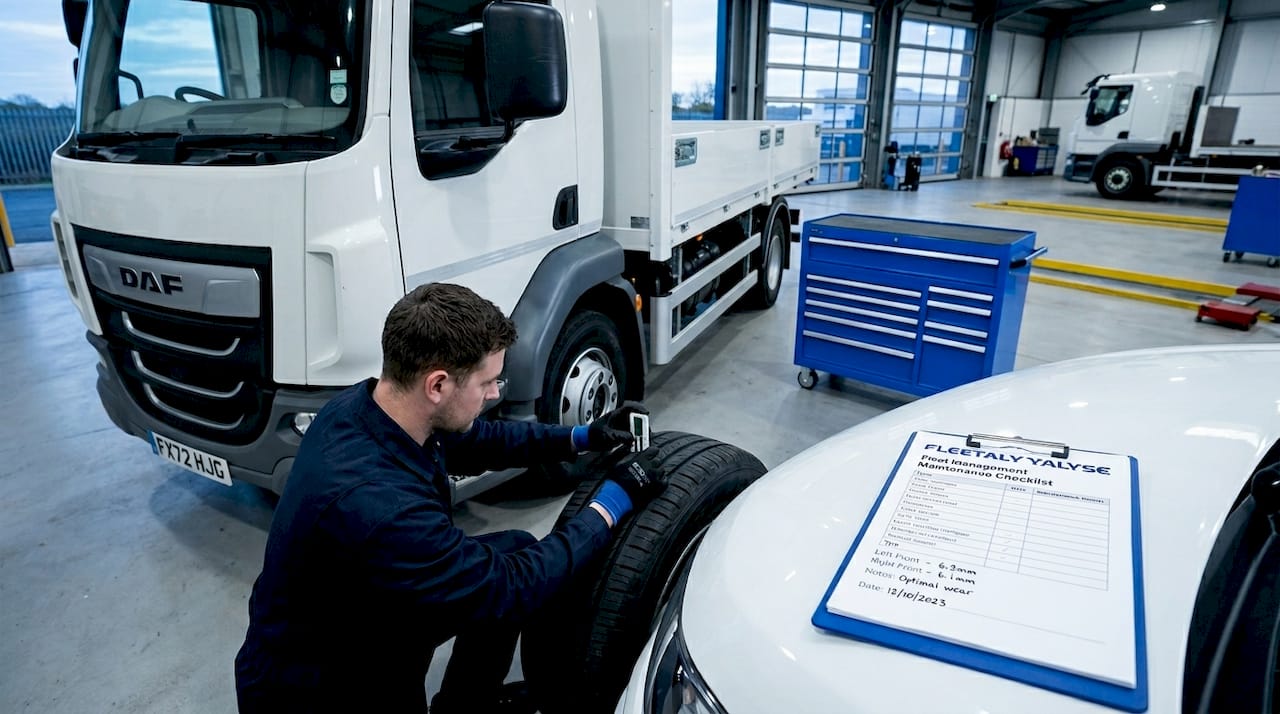
Planned maintenance intervals must be documented in a formal maintenance programme. Every periodic inspection must generate a record that links directly to any defects found, the repairs carried out, and the authorisation to return the vehicle to service. Maintenance file quality is judged by the connectivity of records rather than their volume. A thick file of disconnected documents offers little protection during a DVSA audit.
Driver compliance and tachograph data
Tachograph records are among the most scrutinised elements of any compliance file. Driver card downloads must occur every 28 days, vehicle unit downloads every 56 days, and all records must be retained for a minimum of 12 months. Missing a download deadline is not merely an administrative failure. Data can be permanently overwritten, creating a compliance breach with serious consequences including licence action.
Transport manager governance
The transport manager’s role carries its own reporting obligations. Under Traffic Commissioner guidance, operators must notify the Traffic Commissioner within 28 days of any material change affecting the transport manager’s role. This broadens fleet reporting well beyond vehicle metrics into formal governance events.
Emissions and in-service conformity
The VCA requires in-service conformity testing every 24 months up to five years or 100,000 kilometres, with results formally reported. For operators with sustainability obligations, Scope 3 emissions disclosure under the GHG Protocol Corporate Value Chain methodology adds a further layer of structured data collection and reporting.
- Planned maintenance programme with documented inspection intervals
- Defect report records linked to repair invoices and return-to-service sign-offs
- Tachograph downloads at correct intervals with infringement analysis
- Driver licence checks and records of outcomes
- Transport manager change notifications to the Traffic Commissioner
- Emissions test results and, where applicable, Scope 3 fleet data
Pro Tip: Set calendar reminders for every tachograph download deadline across your fleet. A missed download on a single vehicle unit can result in overwritten data that no system can recover.
How does good fleet reporting demonstrate continuous regulatory compliance?
The distinction between operators who pass DVSA audits confidently and those who struggle often comes down to one thing: record linkage. DVSA auditors typically review 12 to 15 months of maintenance records, and they expect to trace a clear path from a periodic inspection, through any defect identified, to the workshop repair, invoice, and final return-to-service authorisation. If that trail breaks at any point, the record fails regardless of how many documents are present.
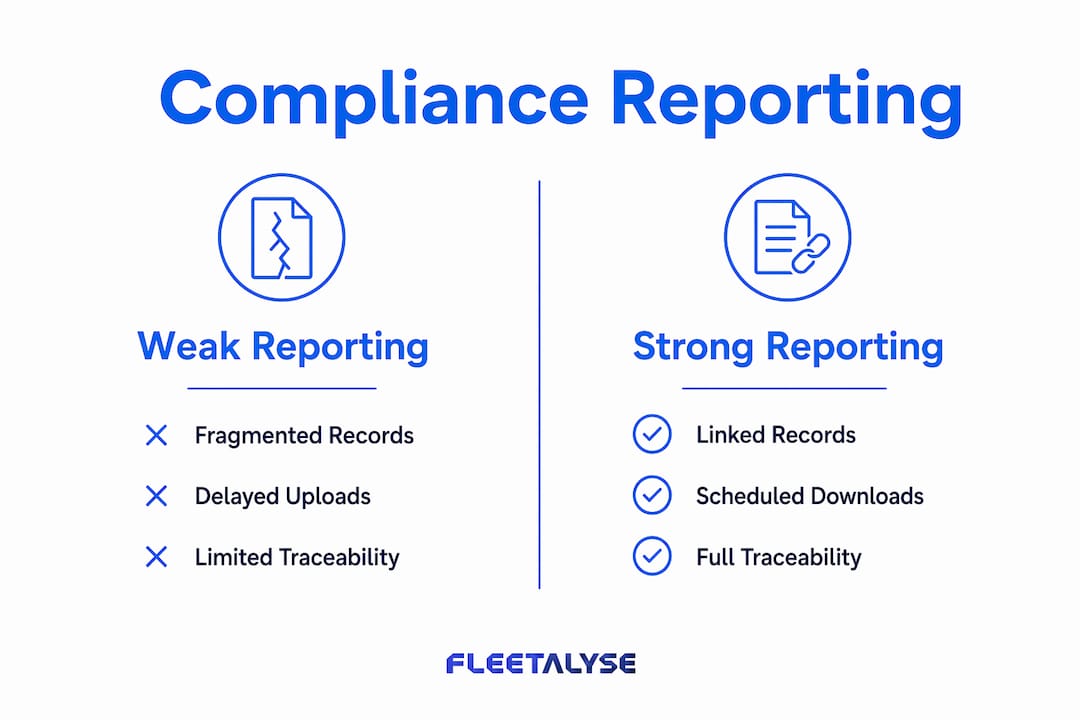
The table below contrasts the characteristics of weak and strong compliance reporting systems.
| Characteristic | Weak reporting system | Strong reporting system |
|---|---|---|
| Record linkage | Inspections and repairs filed separately | Defect, repair, and return-to-service records connected |
| Tachograph downloads | Ad hoc, often delayed | Scheduled controls with named accountability |
| Audit response time | Hours or days to compile records | Audit-ready records produced within an hour |
| Governance events | Informally managed | Transport manager changes formally notified within 28 days |
| Emissions data | Collected only when required | Maintained continuously for multiple reporting frameworks |
Operators with well-structured systems can produce a complete compliance file within an hour of a DVSA request. That speed is not luck. It reflects a deliberate design where every record is created, linked, and stored in a predictable location from the moment a vehicle leaves for inspection.
The weakest point in most maintenance files is defect closure traceability. A defect report that records the fault but cannot be matched to a repair invoice and a signed return-to-service decision is an open question in an auditor’s eyes. Systems that record the full trail from detection to resolution pass audits more robustly and protect the operator’s licence.
Pro Tip: Treat tachograph downloads as a scheduled compliance control, not a background task. Assign a named individual responsible for each vehicle unit and driver card, and record the date and outcome of every download.
What are the operational and business benefits of effective fleet reporting beyond compliance?
Compliance is the floor, not the ceiling. Operators who treat commercial vehicle data analysis as a management tool rather than a regulatory obligation extract measurable operational value from the same records they are already required to keep.
- Reduced vehicle downtime. Proactive defect management and scheduled maintenance recording allow you to identify patterns before they become breakdowns. A vehicle that generates recurring defect reports for the same component is signalling a problem that planned maintenance can address before a roadside failure occurs.
- Improved driver management. Tachograph infringement analysis does more than satisfy the DVSA. It identifies drivers who consistently exceed hours limits, take insufficient rest, or operate in ways that increase fuel consumption and tyre wear. Structured performance feedback based on this data produces measurable improvements in driver behaviour.
- Fuel and cost efficiency. Fleet data analysis covering mileage, idle time, and route patterns reveals inefficiencies that are invisible without structured reporting. Operators who monitor these metrics regularly reduce fuel costs without changing their vehicle fleet.
- Sustainability reporting. Scope 3 emissions data collected for a compliant fleet inventory can serve multiple reporting frameworks simultaneously, reducing duplicative data collection. Operators subject to CSRD-style obligations benefit directly from a well-maintained fleet emissions record.
- Strategic asset decisions. Accurate utilisation data shows which vehicles are overworked, which are underused, and which are approaching the end of their cost-effective service life. These are decisions that affect capital expenditure, and they are only possible with consistent reporting.
The connection between tachograph compliance and operational efficiency is direct. Operators who download and analyse tachograph data on schedule do not just avoid penalties. They gain a detailed picture of how their drivers and vehicles are actually performing against planned routes and hours.
Which tools and best practices should UK fleet operators adopt?
Effective fleet reporting does not happen through goodwill and spreadsheets. It requires systems, processes, and clear accountability. The following steps reflect what well-run UK fleets consistently do differently.
- Adopt integrated fleet management software. Digital platforms that combine defect reporting, maintenance scheduling, and tachograph data handling eliminate the disconnected paper trails that cause audit failures. Look for systems that link records automatically rather than requiring manual cross-referencing.
- Assign named accountability for every reporting task. Tachograph downloads, defect sign-offs, and licence checks must each have a named owner with a documented schedule. Shared responsibility without named individuals produces gaps.
- Schedule regular internal maintenance recording checks. Do not wait for a DVSA visit to discover that your records are incomplete. A quarterly internal review of a sample of vehicle files reveals systemic weaknesses before they become regulatory problems.
- Use automated alerts for compliance deadlines. Manual diary systems fail under operational pressure. Automated reminders for tachograph download windows, licence expiry dates, and inspection intervals remove the human error that causes missed deadlines.
- Build traceability into your defect management process. Every defect report must generate a repair record, and every repair record must connect to a return-to-service authorisation. Defect closure traceability is the element auditors examine most closely, and it is the element most operators get wrong.
For operators managing HGVs, vans, or mixed fleets, GPS vehicle tracking adds a further layer of verifiable data that supports both compliance records and operational analysis. Real-time location data corroborates tachograph records and provides an independent audit trail for vehicle activity.
For fleets with trailer assets, trailer GPS tracking extends visibility beyond the cab and supports accurate utilisation and emissions reporting across the full asset base.
Key takeaways
Effective commercial fleet reporting requires linked, audit-ready records across maintenance, tachograph data, driver compliance, and governance events, maintained continuously rather than compiled reactively.
| Point | Details |
|---|---|
| Record linkage is the priority | Connect every inspection, defect, repair, and return-to-service record to pass DVSA audits. |
| Tachograph downloads are time-critical | Download driver cards every 28 days and vehicle units every 56 days to avoid data overwrite. |
| Governance events require formal reporting | Notify the Traffic Commissioner within 28 days of any transport manager change. |
| Operational data has commercial value | Fleet reporting data reduces downtime, improves driver behaviour, and informs asset decisions. |
| Automation reduces compliance risk | Scheduled alerts and integrated software prevent the missed deadlines that cause regulatory penalties. |
Why fleet reporting deserves more than a compliance mindset
I have worked with enough UK fleet operators to recognise a pattern. The ones who treat reporting as a box-ticking exercise are the same ones who spend three days scrambling to compile records when the DVSA calls. The ones who treat it as a management system are the ones who answer that call calmly and produce a complete file within the hour.
The uncomfortable truth is that most compliance failures are not caused by operators who are reckless or indifferent. They are caused by operators who are busy, who rely on informal systems that work fine until they do not, and who have never had to explain a broken record trail to a Traffic Commissioner. The consequences of that moment are severe: licence curtailment, public inquiry, and in some cases revocation.
What I find genuinely encouraging is how much the technology has changed the equation. Remote tachograph downloads, digital defect reporting, and automated maintenance scheduling have removed most of the administrative friction that made continuous compliance feel impossible for smaller operators. The data is already being generated by your vehicles and drivers. The question is whether your systems are capturing it in a form that protects your licence and informs your decisions.
My honest recommendation is to stop thinking about fleet reporting as something you do for the DVSA and start thinking about it as something you do for your business. The records that satisfy an auditor are the same records that tell you which driver is costing you money, which vehicle is approaching a costly repair, and whether your fleet is actually running the routes you think it is. That is not a compliance burden. That is a management advantage.
— Vytautas
How Fleetalyse supports your fleet compliance reporting
Fleetalyse is built specifically for UK commercial fleet operators who need more than dots on a map. The platform combines GPS vehicle tracking, remote tachograph downloads, driver behaviour monitoring, and automated maintenance alerts into a single system designed to keep your compliance file audit-ready at all times.
Whether you operate HGVs, vans, trailers, or a mixed asset fleet, Fleetalyse gives you the real-time visibility and structured data records that DVSA auditors expect to see. Automated download scheduling removes the risk of missed tachograph windows, and linked defect and repair records mean your maintenance file connects cleanly from inspection to return-to-service. Explore the full range of Fleetalyse compliance solutions and see how the platform supports both your legal obligations and your operational performance.
FAQ
What is commercial fleet reporting?
Commercial fleet reporting is the systematic collection, organisation, and analysis of vehicle and driver data to demonstrate regulatory compliance and support operational management. In the UK, it covers maintenance records, tachograph data, driver licence checks, and emissions reporting.
How often must tachograph data be downloaded?
Driver card data must be downloaded at least every 28 days, and vehicle unit data every 56 days. Records must be retained for a minimum of 12 months to satisfy DVSA requirements.
What do DVSA auditors look for in a maintenance file?
DVSA auditors examine whether maintenance records link cleanly from periodic inspection through defect identification, workshop repair, and return-to-service authorisation. Disconnected records are treated as evidence of poor maintenance control, regardless of how many documents are present.
What happens if tachograph download deadlines are missed?
Missing a download deadline risks permanent data overwrite, which constitutes a compliance breach. This can result in financial penalties, licence curtailment, or referral to a public inquiry before the Traffic Commissioner.
How does fleet reporting support sustainability obligations?
Scope 3 emissions data collected through a compliant fleet reporting system can satisfy multiple frameworks simultaneously, including CSRD-style obligations. A well-maintained fleet emissions record reduces the need for duplicative data collection across different reporting requirements.