


Common van fleet management challenges: 2026 UK guide

Commercial vehicles are involved in nearly one in five road incidents and close to one in three road fatalities in the UK. That single statistic defines why common van fleet management challenges carry consequences far beyond operational inconvenience. UK fleet operators face a stacking of pressures: rising costs, tightening compliance expectations, fragmented technology, and a driver workforce that requires constant oversight. Getting any one of these wrong creates legal exposure. Getting several wrong simultaneously is how businesses end up in front of regulators.
1. How compliance and legal accountability challenge van fleets
Van fleets now face the same regulatory scrutiny as HGV operations. Regulators do not distinguish between vehicle types when investigating serious incidents. They examine management systems, vehicle condition records, training documentation, and the decisions made by supervisors, not just the actions of individual drivers.
The compliance gap is real and well documented. Van fleets commonly lack a dedicated transport manager, which creates a structural weakness that becomes critical the moment an incident occurs. When investigators arrive, they look for evidence of a functioning compliance system, not a policy document filed in a drawer.
“Investigations extend beyond individual drivers to include vehicle condition, training records, fatigue management, supervision, policies, and documented management decision-making processes. Businesses that cannot produce this evidence face serious legal exposure.” Charlotte Le Maire, LMP Legal
The consequences of non-compliance include criminal investigation, civil litigation, regulatory fines, and lasting reputational damage. The Health and Safety Executive (HSE) holds organisations accountable for systemic failures, not just individual errors.
- Maintain documented evidence of vehicle checks, not just verbal confirmation
- Record driver training dates, content, and outcomes in a centralised system
- Establish a named compliance lead, even for smaller van fleets
- Link incident investigation directly to operational controls and policy review
Pro Tip: Build a continuous risk management process that connects compliance monitoring, incident investigation, and operational controls. This is the standard regulators expect to see, and it is the standard that protects you legally.
2. What operational efficiency issues hinder van fleet management
Rising operational costs are the top concern for 54.4% of fleet leaders, with regulatory compliance second at 46.1%. Those two pressures are not separate problems. Compliance failures generate costs, and cost pressures tempt operators to cut corners on compliance.
Maintenance is where efficiency breaks down most visibly. Technician shortages and parts availability issues mean vehicles sit idle longer than they should. Fleet operators running mixed assets face the added complexity of managing different service intervals, warranty conditions, and inspection requirements across a single operation.

The EV transition adds another layer of difficulty. Van fleets face particular challenges with charging infrastructure, range limitations for multi-drop routes, and the upfront cost of replacing internal combustion vehicles. Many operators are retaining older diesel vans longer than planned, which increases maintenance frequency and cost.
Administrative burden compounds every operational challenge. When systems do not talk to each other, data must be entered manually. That is time your team spends on admin instead of managing vehicles.
| Efficiency challenge | Practical impact |
|---|---|
| Technician shortages | Longer vehicle downtime, missed service windows |
| Parts availability | Delayed repairs, increased hire vehicle costs |
| Manual data entry | Higher admin hours, greater risk of error |
| EV infrastructure gaps | Route limitations, charging delays, range anxiety |
| Ageing vehicle retention | Rising maintenance spend, lower residual values |
Pro Tip: Integrate your telematics platform with your maintenance scheduling system. When mileage data flows automatically into service reminders, you eliminate manual triggers and catch issues before they become costly breakdowns.
3. How driver safety and behavioural management affect van fleets
Driver behaviour is both a safety issue and a compliance issue. Speeding, harsh braking, and fatigue are not just operational risks. They are the behaviours that regulators examine after a serious incident. Fleet operators who cannot demonstrate active monitoring of driver conduct face the same legal exposure as those with no compliance records at all.
Investigations scrutinise fatigue management policies, supervision records, and whether management acted on known risks. A driver with a documented history of near-misses who is then involved in a fatal collision creates a direct line of liability back to the operator.
Effective driver behaviour management requires more than a telematics unit in the cab. It requires a process: data collection, review, coaching, documentation, and follow-up. Real-time monitoring identifies risky patterns. Documented coaching demonstrates that the operator responded to those patterns.
- Record all driver training with dates, content covered, and trainer sign-off
- Use telematics data to identify repeat offenders for specific risk behaviours
- Conduct regular licence checks and DVLA verification for all drivers
- Document fatigue management policies and show how they are enforced operationally
- Link driver behaviour scores to formal review processes, not just informal conversations
The most common failure is collecting data without acting on it. Telematics generates evidence. What you do with that evidence determines your legal position.
4. What data and technology challenges affect van fleet optimisation
80% of fleet managers manually input data across multiple disconnected systems. That figure is striking because it persists despite high levels of software adoption across the industry. The problem is not a lack of technology. The problem is that systems do not integrate, so data sits in silos and someone has to move it by hand.
Switching from spreadsheets to specialist fleet software solves some problems and creates others. When telematics data, maintenance records, and driver compliance information live in separate platforms with no connection between them, the administrative workload increases rather than decreases. Fleet operators end up managing both the software and the manual processes that fill the gaps between systems.
AI adoption is the next frontier, but caution is warranted. 50.8% of fleet leaders cite concerns about AI accuracy, and 43.3% report a lack of confidence in AI-generated outputs. A further 37.7% still require human oversight of AI decisions before acting on them. Those are not the numbers of an industry ready to hand control to automated systems.
The practical implication is that hybrid operations, where technology supports human decision-making rather than replacing it, remain the dominant model. That is not a failure of ambition. It is a sensible response to the current reliability of available tools.
- Prioritise platforms that integrate telematics, compliance, and maintenance data in one place
- Audit your current systems for data silos before adding new software
- Treat AI outputs as a prompt for human review, not a final decision
- Establish clear data ownership so records are maintained consistently across teams
Pro Tip: Adopt technology in phases. Start with GPS tracking and automated alerts, then layer in driver behaviour monitoring once your team is confident in the data. Phased adoption builds trust in the system and reduces the risk of costly implementation errors.
5. How supply chain and procurement issues compound fleet management problems
Long vehicle delivery times and OEM volatility force fleets to retain older vehicles beyond their planned replacement cycles. Every additional month an ageing van stays on the road increases the probability of a mechanical failure, a failed inspection, and an unplanned maintenance cost.
Tariff volatility and pricing unpredictability make budgeting for new vehicles genuinely difficult. Fleet managers who locked in procurement plans twelve months ago are now managing vehicles that cost more to replace than anticipated, with delivery timescales that have shifted multiple times. Residual values are also affected, which changes the financial case for early disposal.
Fleet challenges rarely appear in isolation. Budget constraints, OEM unpredictability, and volatile tariffs stack together, demanding a level of strategic agility that most fleet operations were not originally structured to provide. Cross-functional coordination between finance, operations, and procurement becomes non-negotiable.
- Build contingency timelines into vehicle replacement planning, assuming delays of three to six months
- Maintain flexible maintenance contracts that can absorb increased workload on older vehicles
- Review residual value assumptions quarterly rather than annually
- Develop supplier relationships with multiple dealers to reduce single-source dependency
Key takeaways
The most effective approach to common van fleet management challenges combines proactive compliance documentation, integrated telematics data, active driver behaviour management, and phased technology adoption to reduce both legal exposure and operational cost.
| Point | Details |
|---|---|
| Compliance is a system, not a policy | Regulators expect documented evidence of active management, not just written procedures. |
| Manual data entry is a hidden cost | 80% of fleet managers input data manually, increasing admin workload and error risk. |
| Driver behaviour requires a process | Collecting telematics data without acting on it creates liability rather than reducing it. |
| AI adoption needs human oversight | Over half of fleet leaders cite accuracy concerns; hybrid human-technology models remain best practice. |
| Procurement delays raise maintenance costs | Older vehicle retention from supply chain disruption increases spend and reduces residual values. |
The compliance gap is wider than most operators realise
Van operations carry hidden compliance risks that businesses accustomed to HGV frameworks consistently underestimate. I have seen this pattern repeatedly: a fleet operator with solid HGV compliance processes assumes the same standards apply to their van operation by default. They do not. Van fleets often lack the dedicated transport manager oversight that HGV operations require by law, and that gap becomes critical the moment something goes wrong.
What strikes me most about the current state of van fleet management is how the challenges compound each other. Rising costs push operators to delay vehicle replacement. Older vehicles generate more maintenance work. More maintenance work increases administrative burden. More administrative burden means compliance records slip. And slipping compliance records are exactly what investigators find when an incident occurs. The chain is predictable, and it is preventable.
Technology helps, but only when it is implemented with realistic expectations. The operators I find most effective are not the ones chasing the latest AI feature. They are the ones who have GPS tracking feeding directly into their compliance records, who use driver behaviour monitoring to generate coaching conversations, and who treat telematics data as a management tool rather than a surveillance system.
The mindset shift that matters most is moving from reactive to proactive. Compliance is not something you demonstrate after an incident. It is something you build continuously, document consistently, and review regularly. That is what protects your business, your drivers, and your licence to operate.
— Vytautas
How Fleetalyse supports van fleet operators
Van fleet operators dealing with compliance pressure, data fragmentation, and driver behaviour challenges need a platform that connects these problems rather than treating them separately.
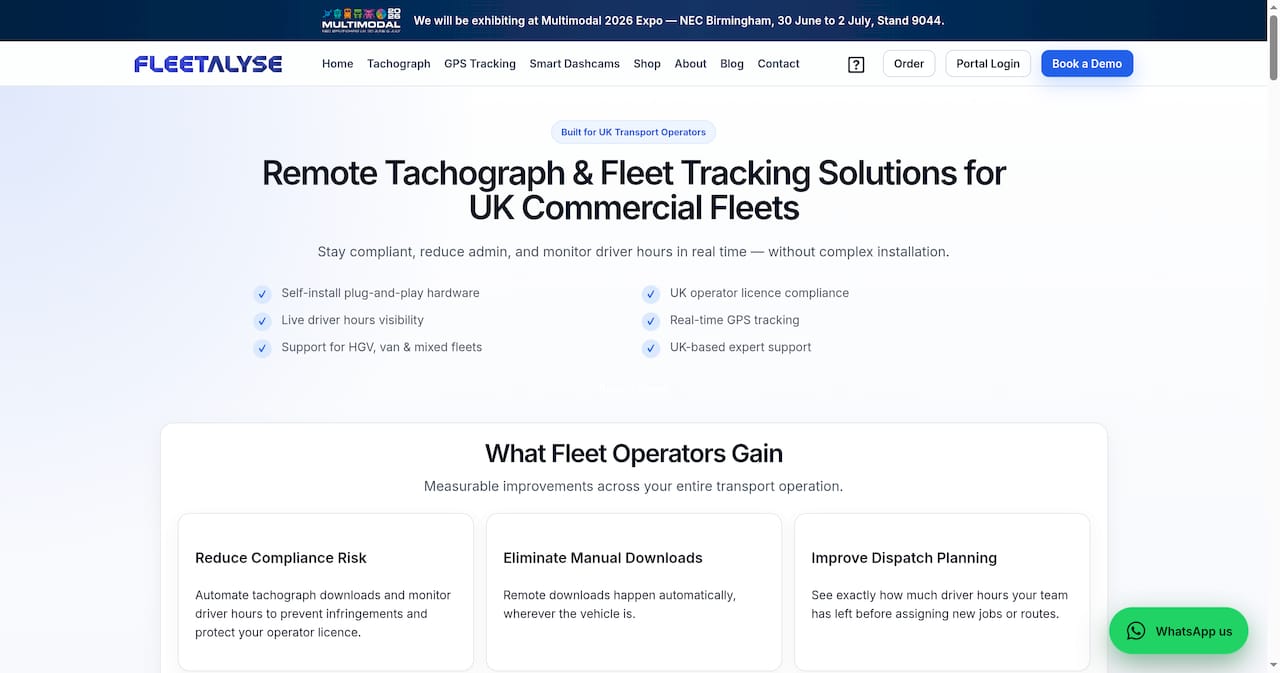
Fleetalyse provides GPS vehicle tracking, driver behaviour monitoring, and automated compliance alerts through a single integrated platform built for UK commercial operators. The Teltonika FMC650 GPS tracker delivers real-time vehicle location data alongside driver activity records, giving fleet managers the evidence base that regulators expect to see. For operators managing mixed assets including vans, trailers, and HGVs, the Fleetalyse platform brings all tracking and compliance data into one place, reducing the manual data entry that costs your team hours every week. UK-based support means you get practical help from people who understand DVSA requirements and Operator Licence obligations.
FAQ
What are the most common van fleet management challenges in the UK?
The most common fleet management issues are rising operational costs, regulatory compliance, driver behaviour monitoring, and data fragmentation across disconnected systems. Commercial vehicles are involved in nearly one in five UK road incidents, making safety and compliance the highest-stakes areas for operators.
Are van fleets subject to the same compliance rules as HGV fleets?
Regulators treat van fleets with the same accountability as HGV operations after serious incidents. Investigations examine vehicle condition records, training documentation, fatigue management policies, and management decision-making, regardless of vehicle type.
How can telematics improve van fleet efficiency?
Telematics reduces manual data entry by automating mileage tracking, maintenance triggers, and driver behaviour reporting. Operators who integrate telematics with compliance and scheduling systems report significant reductions in administrative workload and improved vehicle utilisation.
Why are fleet managers cautious about AI in fleet management?
50.8% of fleet leaders cite concerns about AI accuracy, and 43.3% report a lack of confidence in AI outputs. Most operators currently use AI as a prompt for human review rather than as an autonomous decision-making tool.
What should a van fleet compliance system include?
A van fleet compliance system should include documented vehicle inspection records, driver training logs, fatigue management policies, incident investigation procedures, and a named compliance lead. Regulators expect to see evidence of active management, not just written policies.