


Did you know the DVSA issues over 20,000 fixed penalty notices for tachograph offences every year? For many UK operators, the fear of a roadside prohibition or a surprise audit is a constant source of operational stress. You likely feel that manual data downloads are a massive drain on your time, especially with the confusion surrounding new hardware requirements. This guide provides the DVSA Tachograph Rules UK Explained, giving you the clarity needed to navigate complex regulations without the guesswork.
You'll master the latest driving hours and rest period requirements, including the critical Smart 2 tachograph deadlines for July 2026. We'll show you how to move beyond manual admin and automate your fleet compliance for a completely stress-free audit. This article covers everything from current download schedules to the specific rules for light goods vehicles. By the end, you'll have a streamlined way to manage your data and total confidence during any DVSA inspection.
Key Takeaways
- Clarify the core limits for daily and fortnightly driving to prevent graduated fixed penalties during roadside checks.
- Navigate the transition to Smart 2 technology and understand the 2026 retrofitting deadlines for international operations.
- Master the DVSA Tachograph Rules UK Explained to ensure you meet the 28-day and 90-day data download deadlines without fail.
- Learn how remote tachograph downloads eliminate manual admin and provide real-time visibility into driver hours.
- Gain the insights needed to maintain an impeccable operator licence record through proactive data analysis and record keeping.
Understanding DVSA Tachograph Rules and Operator Requirements
A tachograph is a legal recording device installed in commercial vehicles to track speed, distance, and driver activities. It serves as the primary tool for enforcement agencies to ensure drivers stay within legal limits. To understand What is a Tachograph, one must view it as a digital witness to every minute of a driver's shift. For most UK operators, these rules apply to any vehicle or vehicle combination exceeding 3.5 tonnes used for commercial purposes. Mastering the DVSA Tachograph Rules UK Explained is essential for protecting your operator licence and avoiding costly penalties.
The DVSA uses tachograph data during roadside inspections and full-scale office audits. With over 20,000 fixed penalty notices issued annually for tachograph offences, the stakes are high. These checks don't just look for missing data; they scrutinise driver behaviour to prevent fatigue-related accidents. Maintaining accurate records is a non-negotiable requirement for any regional transport business. Many operators now choose to automate this process through Fleetalyse to ensure they remain audit-ready without the manual admin burden.
UK Domestic vs EU/Assimilated Rules
The terminology changed following Brexit. Rules previously known as EU regulations are now referred to as "assimilated" rules. These apply to most heavy goods vehicles (HGVs) on commercial journeys. GB domestic rules generally apply to drivers who are exempt from the main tachograph regulations but still need to track their time. By July 2026, the scope expands. Light goods vehicles (LGVs) over 2.5 tonnes on international hire and reward trips must also fit Smart 2 tachographs. Understanding the DVSA Tachograph Rules UK Explained helps you decide if your fleet needs to upgrade hardware before the 2026 deadlines.
Common Exemptions from Tachograph Regulations
Not every vehicle requires a tachograph. Common exemptions include:
- Emergency services and armed forces vehicles.
- Agricultural or forestry vehicles used within a 100km radius of their base.
- Vehicles with a maximum authorised mass not exceeding 7.5 tonnes used for non-commercial carriage of goods.
- Classic vehicles manufactured over 25 years ago not used for commercial hire.
Being "exempt" from tachograph rules doesn't mean you're exempt from recording hours. Many operators still use logbooks or internal software to track working time. This ensures you can still prove compliance with the Working Time Directive during a DVSA inspection. Transparency in your data management is the best way to remain compliant and avoid prohibitions.
UK Drivers’ Hours: Driving, Breaks, and Rest Periods
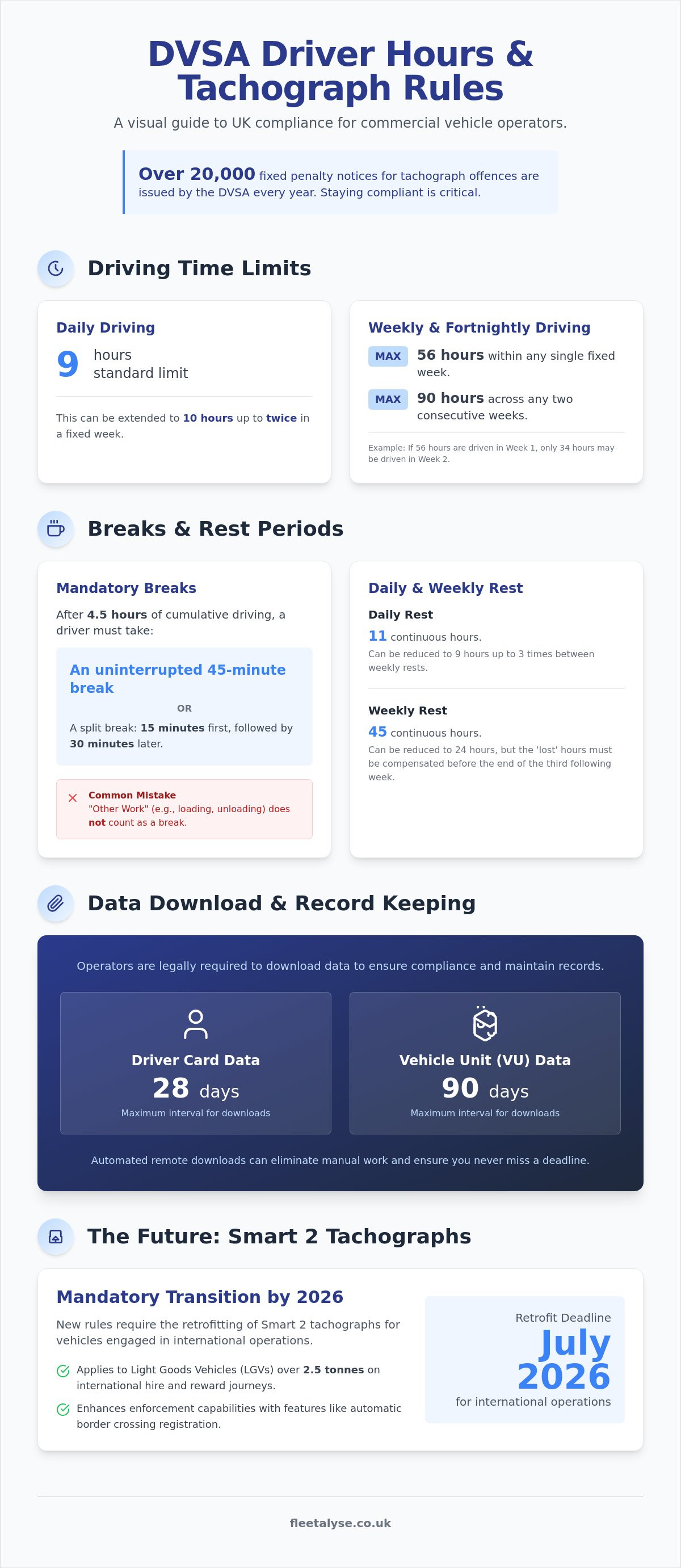
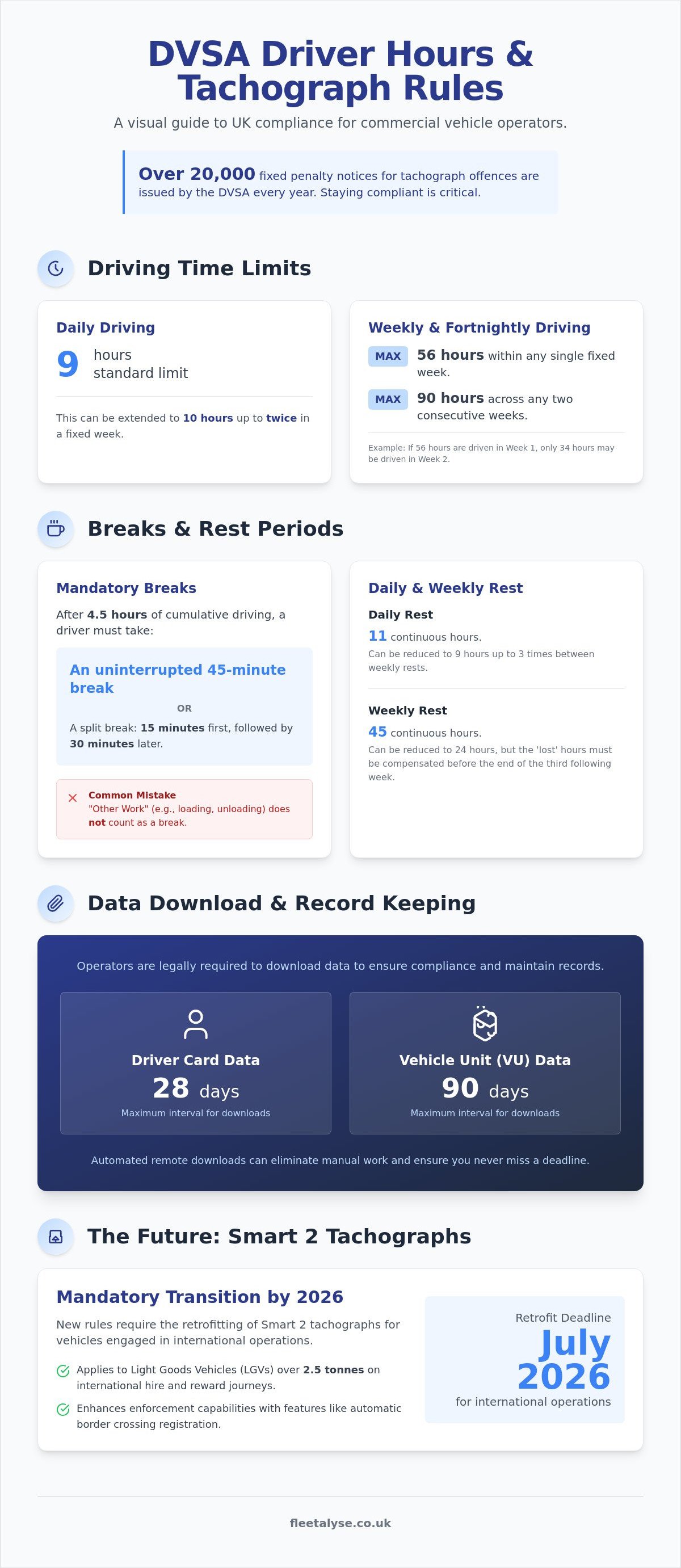
Efficiency in the cab depends on mastering the clock. UK drivers' hours are the backbone of road safety. They ensure drivers remain alert and vehicles operate within legal limits. Under the DVSA Tachograph Rules UK Explained, the standard daily driving limit is 9 hours. You can extend this to 10 hours twice in any fixed week. However, driving is only part of the story. You must also account for cumulative totals across the month.
Weekly driving must not exceed 56 hours. Over any two consecutive weeks, the total cannot exceed 90 hours. This means if a driver hits the 56-hour limit in week one, they are capped at 34 hours for week two. Precision is required here. Many operators find that tracking these rolling totals manually leads to errors. Using live driver hours monitoring allows you to catch these potential infringements before they occur.
Breaks are non-negotiable. After 4.5 hours of cumulative driving, a driver must take a 45-minute break. This can be split into a 15-minute break followed by a 30-minute break. A common error is recording "Other Work" (symbolised by the crossed hammers) as a break. Other work includes loading, unloading, or vehicle cleaning. It does not count towards your mandatory 45-minute rest period. Mixing these up on the vehicle unit is a quick way to fail a roadside inspection.
Daily and Weekly Rest Requirements
Standard daily rest is 11 continuous hours. You can reduce this to 9 hours up to three times between any two weekly rest periods. Weekly rest is equally strict. A regular weekly rest is 45 hours. You can take a reduced weekly rest of 24 hours, but the reduction must be compensated. You must pay back the "lost" hours in one block before the end of the third week following the reduction. Failure to record this compensation correctly is a frequent target for DVSA audits.
Multi-Manning and Ferry/Train Exceptions
When two drivers are in the cab, the rules for daily rest change. A multi-manned crew must take a new daily rest period of at least 9 hours within 30 hours of the end of the previous rest. This allows for longer journeys whilst maintaining safety standards.
Ferry and train crossings offer specific flexibility. Drivers can interrupt a regular daily rest period (11 hours) up to twice to board or disembark. These interruptions must not exceed one hour in total. If you are using a reduced daily rest or a weekly rest, these interruptions are generally not permitted. Mistakes often happen during the manual entry of these events. Ensure your drivers are trained to select the correct mode to avoid unnecessary fines.
The Evolution of Smart Tachographs: Moving to Smart 2 in 2026
The tachograph has evolved from simple wax discs to the sophisticated Smart 2 units we see today. This transition isn't just about hardware. It's about data connectivity. The Smart 2 generation is now the mandatory standard for newly registered vehicles. It brings enhanced GPS tracking and Dedicated Short-Range Communication (DSRC) technology to the cab. For operators, this means the DVSA Tachograph Rules UK Explained now involve a high level of automated oversight. You can no longer rely on manual oversight to catch errors.
DSRC is a game-changer for enforcement. It allows DVSA officers to scan vehicle data whilst it is in motion. They can check for card fraud or calibration issues without even stopping the truck. If your data is clean, you keep moving. If there's a red flag, you're pulled over. This technology also automates border crossings. The unit records the exact moment you cross into a new country. This removes the need for manual driver entries and reduces the risk of simple human error during international journeys.
Retrofitting Deadlines for 2026
International transport faces the strictest timeline. By 1 July 2026, all light goods vehicles (LGVs) over 2.5 tonnes used for international hire and reward must have Smart 2 units fitted. For larger HGVs, the retrofit deadlines for international work are even closer. Missing these dates isn't just an admin slip. It can lead to serious fines, sometimes reaching £1,500, and risks your operator licence. You must plan your workshop slots now. Lead times for fitting and calibration are already stretching to 6 weeks in many regions.
Smart Cards: Driver, Company, and Workshop
Every operator needs a suite of smart cards. Driver cards record individual activity. Company cards allow you to lock and download data. Workshop cards are for authorised technicians only. Smart 2 units are backwards compatible with older driver cards, but you won't get the full benefit of new features until the driver upgrades to a G2 card. Manage your renewals carefully. Driving without a card, or with an expired one, is a "most serious infringement" that triggers immediate DVSA action. Consistency in card management is the only way to stay audit-ready.
Data Management: Download Deadlines and Record Keeping
Data is the only evidence that stands between your business and a heavy fine. Under the DVSA Tachograph Rules UK Explained, the clock starts the moment a driver card is inserted. You are legally required to download data from driver cards at least every 28 days. For the vehicle unit (VU), the deadline is every 90 days. These aren't just suggestions. They are hard limits. Missing these windows by even a single day can trigger a graduated fixed penalty during a roadside check. It puts your operator licence at immediate risk.
Simply holding the data isn't enough. Your duty as an operator includes a full analysis of these records. You must identify infringements, such as exceeded driving hours or insufficient rest, and take documented action. Records must be retained for a minimum of 12 months. If you use this data for Working Time Directive compliance, HMRC and the DVSA expect you to keep them for 2 years. Manually chasing these deadlines across a fleet is a significant administrative burden that often leads to gaps in your history. You can automate your remote tachograph downloads to ensure you never miss a legal deadline again.
The Audit Trail: Being Ready for a DVSA Visit
A clean audit trail is your best defence. When a driver is away from the vehicle, they must make manual entries on the tachograph to account for their time. This includes "other work" or "rest". If a driver is on sick leave or holiday, you should provide a letter of attestation to explain the gap in their card data. Whilst the DVSA has moved away from requiring these for every tiny break, they remain a vital tool for explaining long absences during a formal audit. Clear, organised records show the DVSA that you are a responsible, compliant operator.
Common Infringements and How to Avoid Them
Missing mileage is a primary target for investigators. If the vehicle unit records movement without a driver card inserted, it creates a gap. The DVSA views this as a potential attempt to hide excessive driving hours. Driving without a card is only legal in very specific circumstances, such as moving a vehicle in a secure yard or if a card is lost or stolen mid-journey. In the latter case, the driver must produce daily printouts and report the loss immediately. Address frequent errors through regular driver training. Documenting your disciplinary procedures for repeat infringements proves to the DVSA that you take your compliance obligations seriously.
Streamlining Compliance with Remote Tachograph Downloads
Compliance is a data management challenge. As we have seen with the DVSA Tachograph Rules UK Explained, the administrative burden of meeting 28-day and 90-day deadlines is significant. Manual downloads are more than just a chore; they are a point of failure. Remote tachograph download technology removes this risk by automating the collection of data directly from the vehicle unit and driver card. Your data moves from the cab to your office without any human intervention. This ensures you remain 100% audit-ready at all times.
Automating this process reduces administrative overhead. It also improves data accuracy by removing the gaps often found in manual records. By integrating tachograph data with GPS fleet tracking, you gain a total compliance view. You don't have to cross-reference different systems to see where your vehicles are and how many hours your drivers have worked. This unified approach is the most efficient way for regional operators to maintain their licence standards. It's about working smarter, not harder.
Live Driver Hours Monitoring
Prevention is always better than a fixed penalty. Live driver hours monitoring provides real-time visibility into the cab. Fleet managers can view live countdowns of remaining driving time and rest periods from any device. This allows you to plan routes with precision. You'll know exactly who can take on an extra drop and who needs to find a safe place to park. This transparency encourages safer driving behaviour and reduces the likelihood of accidental infringements. It turns compliance from a reactive worry into a proactive management tool.
Tachograph Analysis Integration
Collecting data is only half the battle. You must also analyse it to identify and correct driver errors. Seamless tachograph analysis integration allows your data to flow directly into reporting software. This highlights trends in fleet compliance, such as frequent break violations or missing mileage. You can then target your driver training where it will have the most impact. Fleetalyse offers specialised solutions for automated UK compliance, helping you manage assets and driver hours through a single, transparent platform. This pragmatic approach values your time and resources, ensuring your fleet stays on the road and out of the DVSA's spotlight.
Secure Your Fleet's Future with Automated Compliance
Managing a commercial fleet requires constant vigilance. The upcoming transition to Smart 2 technology and the rigid 28/90-day download deadlines leave no room for administrative error. This guide provided the DVSA Tachograph Rules UK Explained to help you address these complexities with expert precision. You now understand that while the regulations are strict, your management of them doesn't have to be a manual burden.
By shifting to a remote system, you eliminate the risk of missing mileage and the stress of manual data retrieval. Fleetalyse provides UK-based expert support to ensure your transition is seamless. You'll benefit from automated 28/90 day downloads and real-time driver hours tracking that keeps you ahead of any inspection. It's time to replace theoretical compliance with practical, automated data collection.
Remove the stress of DVSA audits with Fleetalyse remote tachograph solutions. Protecting your operator licence is a long-term commitment. With the right data at your fingertips, you can focus on growing your business with total peace of mind.
Frequently Asked Questions
How often must I download my tachograph data?
You must download data from driver cards at least every 28 days and from vehicle units every 90 days. These are the maximum legal intervals allowed under the DVSA Tachograph Rules UK Explained. Many operators choose to download more frequently to ensure they catch infringements early. Automated systems remove the risk of missing these critical windows.
What is the penalty for exceeding driving hours in the UK?
Penalties are issued on a graduated scale based on the severity of the breach. Minor infringements typically result in a £100 fixed penalty, whilst more serious offences can reach £300 at the roadside. Persistent or severe violations may lead to a court summons with unlimited fines and potential action against your operator licence. The DVSA issues over 20,000 fixed penalty notices annually for these offences.
Do I need a tachograph for a van and trailer combination?
Yes, you need a tachograph if the combined maximum authorised mass (MAM) of the van and trailer exceeds 3.5 tonnes for commercial journeys. If your combination exceeds this weight, it falls under the same regulations as heavy goods vehicles. Exemptions may apply for "own account" journeys within a 100km radius if driving isn't the driver's main activity.
Can I drive an HGV without a driver card?
You cannot legally drive a vehicle equipped with a digital tachograph without a valid driver card unless the card is lost, stolen, or malfunctioning. In these specific cases, you must report the issue to the DVLA immediately and apply for a replacement within seven days. You are permitted to drive for a maximum of 15 calendar days whilst using daily printouts to record your activities.
What is a Smart 2 tachograph and do I need one in 2026?
A Smart 2 tachograph is the latest generation of recording hardware featuring enhanced GPS and remote enforcement capabilities. From 1 July 2026, these units are mandatory for light goods vehicles over 2.5 tonnes used for international hire and reward. HGVs involved in international transport also face strict retrofitting deadlines throughout 2025 and 2026 to remain compliant with the EU Mobility Package.
How long do I need to keep my tachograph records?
You must retain tachograph records for at least 12 months from the date of the recording. However, if you use this data to prove compliance with the Working Time Directive, you should keep the records for two years to satisfy HMRC and DVSA audit requirements. Storing these files digitally in a secure analysis platform is the most reliable way to maintain this long-term archive.
Is remote tachograph download legal in the UK?
Remote tachograph downloading is completely legal and is an increasingly popular method for ensuring compliance. The DVSA accepts data collected via remote systems as long as the file remains in its original, untampered format. This technology helps regional operators stay audit-ready by removing the human error associated with manual data collection and physical card swiping.
What happens if my tachograph becomes faulty during a journey?
If a tachograph fails during a trip, you must have it repaired by an approved workshop as soon as the vehicle returns to base. If the vehicle is unable to return within one week of the failure, the repair must be carried out en route. During the period the unit is faulty, the driver must maintain manual records of their activities on the back of a tachograph printout roll.
Frequently asked questions
UK Domestic vs EU/Assimilated Rules
The terminology changed following Brexit. Rules previously known as EU regulations are now referred to as "assimilated" rules. These apply to most heavy goods vehicles (HGVs) on commercial journeys. GB domestic rules generally apply to drivers who are exempt from the main tachograph regulations but still need to track their time. By July 2026, the scope expands. Light goods vehicles (LGVs) over 2.5 tonnes on international hire and reward trips must also fit Smart 2 tachographs. Understanding the DVSA Tachograph Rules UK Explained helps you decide if your fleet needs to upgrade hardware before the 2026 deadlines.
Common Exemptions from Tachograph Regulations
Not every vehicle requires a tachograph. Common exemptions include: Being "exempt" from tachograph rules doesn't mean you're exempt from recording hours. Many operators still use logbooks or internal software to track working time. This ensures you can still prove compliance with the Working Time Directive during a DVSA inspection. Transparency in your data management is the best way to remain compliant and avoid prohibitions. Efficiency in the cab depends on mastering the clock. UK drivers' hours are the backbone of road safety. They ensure drivers remain alert and vehicles operate within legal limits. Under the DVSA Tachograph Rules UK Explained, the standard daily driving limit is 9 hours. You can extend this to 10 hours twice in any fixed week. However, driving is only part of the story. You must also account for cumulative totals across the month. Weekly driving must not exceed 56 hours. Over any two consecutive weeks, the total cannot exceed 90 hours. This means if a driver hits the 56-hour limit in week one, they are capped at 34 hours for week two. Precision is required here. Many operators find that tracking these rolling totals manually leads to errors. Using live driver hours monitoring allows you to catch these potential infringements before they occur. Breaks are non-negotiable. After 4.5 hours of cumulative driving, a driver must take a 45-minute break. This can be split into a 15-minute break followed by a 30-minute break. A common error is recording "Other Work" (symbolised by the crossed hammers) as a break. Other work includes loading, unloading, or vehicle cleaning. It does not count towards your mandatory 45-minute rest period. Mixing these up on the vehicle unit is a quick way to fail a roadside inspection.
Daily and Weekly Rest Requirements
Standard daily rest is 11 continuous hours. You can reduce this to 9 hours up to three times between any two weekly rest periods. Weekly rest is equally strict. A regular weekly rest is 45 hours. You can take a reduced weekly rest of 24 hours, but the reduction must be compensated. You must pay back the "lost" hours in one block before the end of the third week following the reduction. Failure to record this compensation correctly is a frequent target for DVSA audits.
Multi-Manning and Ferry/Train Exceptions
When two drivers are in the cab, the rules for daily rest change. A multi-manned crew must take a new daily rest period of at least 9 hours within 30 hours of the end of the previous rest. This allows for longer journeys whilst maintaining safety standards. Ferry and train crossings offer specific flexibility. Drivers can interrupt a regular daily rest period (11 hours) up to twice to board or disembark. These interruptions must not exceed one hour in total. If you are using a reduced daily rest or a weekly rest, these interruptions are generally not permitted. Mistakes often happen during the manual entry of these events. Ensure your drivers are trained to select the correct mode to avoid unnecessary fines. The tachograph has evolved from simple wax discs to the sophisticated Smart 2 units we see today. This transition isn't just about hardware. It's about data connectivity. The Smart 2 generation is now the mandatory standard for newly registered vehicles. It brings enhanced GPS tracking and Dedicated Short-Range Communication (DSRC) technology to the cab. For operators, this means the DVSA Tachograph Rules UK Explained now involve a high level of automated oversight. You can no longer rely on manual oversight to catch errors. DSRC is a game-changer for enforcement. It allows DVSA officers to scan vehicle data whilst it is in motion. They can check for card fraud or calibration issues without even stopping the truck. If your data is clean, you keep moving. If there's a red flag, you're pulled over. This technology also automates border crossings. The unit records the exact moment you cross into a new country. This removes the need for manual driver entries and reduces the risk of simple human error during international journeys.
Retrofitting Deadlines for 2026
International transport faces the strictest timeline. By 1 July 2026, all light goods vehicles (LGVs) over 2.5 tonnes used for international hire and reward must have Smart 2 units fitted. For larger HGVs, the retrofit deadlines for international work are even closer. Missing these dates isn't just an admin slip. It can lead to serious fines, sometimes reaching £1,500, and risks your operator licence. You must plan your workshop slots now. Lead times for fitting and calibration are already stretching to 6 weeks in many regions.
Smart Cards: Driver, Company, and Workshop
Every operator needs a suite of smart cards. Driver cards record individual activity. Company cards allow you to lock and download data. Workshop cards are for authorised technicians only. Smart 2 units are backwards compatible with older driver cards, but you won't get the full benefit of new features until the driver upgrades to a G2 card. Manage your renewals carefully. Driving without a card, or with an expired one, is a "most serious infringement" that triggers immediate DVSA action. Consistency in card management is the only way to stay audit-ready. Data is the only evidence that stands between your business and a heavy fine. Under the DVSA Tachograph Rules UK Explained, the clock starts the moment a driver card is inserted. You are legally required to download data from driver cards at least every 28 days. For the vehicle unit (VU), the deadline is every 90 days. These aren't just suggestions. They are hard limits. Missing these windows by even a single day can trigger a graduated fixed penalty during a roadside check. It puts your operator licence at immediate risk. Simply holding the data isn't enough. Your duty as an operator includes a full analysis of these records. You must identify infringements, such as exceeded driving hours or insufficient rest, and take documented action. Records must be retained for a minimum of 12 months. If you use this data for Working Time Directive compliance, HMRC and the DVSA expect you to keep them for 2 years. Manually chasing these deadlines across a fleet is a significant administrative burden that often leads to gaps in your history. You can automate your remote tachograph downloads to ensure you never miss a legal deadline again.
The Audit Trail: Being Ready for a DVSA Visit
A clean audit trail is your best defence. When a driver is away from the vehicle, they must make manual entries on the tachograph to account for their time. This includes "other work" or "rest". If a driver is on sick leave or holiday, you should provide a letter of attestation to explain the gap in their card data. Whilst the DVSA has moved away from requiring these for every tiny break, they remain a vital tool for explaining long absences during a formal audit. Clear, organised records show the DVSA that you are a responsible, compliant operator.
Common Infringements and How to Avoid Them
Missing mileage is a primary target for investigators. If the vehicle unit records movement without a driver card inserted, it creates a gap. The DVSA views this as a potential attempt to hide excessive driving hours. Driving without a card is only legal in very specific circumstances, such as moving a vehicle in a secure yard or if a card is lost or stolen mid-journey. In the latter case, the driver must produce daily printouts and report the loss immediately. Address frequent errors through regular driver training. Documenting your disciplinary procedures for repeat infringements proves to the DVSA that you take your compliance obligations seriously. Compliance is a data management challenge. As we have seen with the DVSA Tachograph Rules UK Explained, the administrative burden of meeting 28-day and 90-day deadlines is significant. Manual downloads are more than just a chore; they are a point of failure. Remote tachograph download technology removes this risk by automating the collection of data directly from the vehicle unit and driver card. Your data moves from the cab to your office without any human intervention. This ensures you remain 100% audit-ready at all times. Automating this process reduces administrative overhead. It also improves data accuracy by removing the gaps often found in manual records. By integrating tachograph data with GPS fleet tracking, you gain a total compliance view. You don't have to cross-reference different systems to see where your vehicles are and how many hours your drivers have worked. This unified approach is the most efficient way for regional operators to maintain their licence standards. It's about working smarter, not harder.
Live Driver Hours Monitoring
Prevention is always better than a fixed penalty. Live driver hours monitoring provides real-time visibility into the cab. Fleet managers can view live countdowns of remaining driving time and rest periods from any device. This allows you to plan routes with precision. You'll know exactly who can take on an extra drop and who needs to find a safe place to park. This transparency encourages safer driving behaviour and reduces the likelihood of accidental infringements. It turns compliance from a reactive worry into a proactive management tool.
Tachograph Analysis Integration
Collecting data is only half the battle. You must also analyse it to identify and correct driver errors. Seamless tachograph analysis integration allows your data to flow directly into reporting software. This highlights trends in fleet compliance, such as frequent break violations or missing mileage. You can then target your driver training where it will have the most impact. Fleetalyse offers specialised solutions for automated UK compliance, helping you manage assets and driver hours through a single, transparent platform. This pragmatic approach values your time and resources, ensuring your fleet stays on the road and out of the DVSA's spotlight. Managing a commercial fleet requires constant vigilance. The upcoming transition to Smart 2 technology and the rigid 28/90-day download deadlines leave no room for administrative error. This guide provided the DVSA Tachograph Rules UK Explained to help you address these complexities with expert precision. You now understand that while the regulations are strict, your management of them doesn't have to be a manual burden. By shifting to a remote system, you eliminate the risk of missing mileage and the stress of manual data retrieval. Fleetalyse provides UK-based expert support to ensure your transition is seamless. You'll benefit from automated 28/90 day downloads and real-time driver hours tracking that keeps you ahead of any inspection. It's time to replace theoretical compliance with practical, automated data collection. Remove the stress of DVSA audits with Fleetalyse remote tachograph solutions. Protecting your operator licence is a long-term commitment. With the right data at your fingertips, you can focus on growing your business with total peace of mind.
How often must I download my tachograph data?
You must download data from driver cards at least every 28 days and from vehicle units every 90 days. These are the maximum legal intervals allowed under the DVSA Tachograph Rules UK Explained. Many operators choose to download more frequently to ensure they catch infringements early. Automated systems remove the risk of missing these critical windows.
What is the penalty for exceeding driving hours in the UK?
Penalties are issued on a graduated scale based on the severity of the breach. Minor infringements typically result in a £100 fixed penalty, whilst more serious offences can reach £300 at the roadside. Persistent or severe violations may lead to a court summons with unlimited fines and potential action against your operator licence. The DVSA issues over 20,000 fixed penalty notices annually for these offences.
Do I need a tachograph for a van and trailer combination?
Yes, you need a tachograph if the combined maximum authorised mass (MAM) of the van and trailer exceeds 3.5 tonnes for commercial journeys. If your combination exceeds this weight, it falls under the same regulations as heavy goods vehicles. Exemptions may apply for "own account" journeys within a 100km radius if driving isn't the driver's main activity.
Can I drive an HGV without a driver card?
You cannot legally drive a vehicle equipped with a digital tachograph without a valid driver card unless the card is lost, stolen, or malfunctioning. In these specific cases, you must report the issue to the DVLA immediately and apply for a replacement within seven days. You are permitted to drive for a maximum of 15 calendar days whilst using daily printouts to record your activities.
What is a Smart 2 tachograph and do I need one in 2026?
A Smart 2 tachograph is the latest generation of recording hardware featuring enhanced GPS and remote enforcement capabilities. From 1 July 2026, these units are mandatory for light goods vehicles over 2.5 tonnes used for international hire and reward. HGVs involved in international transport also face strict retrofitting deadlines throughout 2025 and 2026 to remain compliant with the EU Mobility Package.
How long do I need to keep my tachograph records?
You must retain tachograph records for at least 12 months from the date of the recording. However, if you use this data to prove compliance with the Working Time Directive, you should keep the records for two years to satisfy HMRC and DVSA audit requirements. Storing these files digitally in a secure analysis platform is the most reliable way to maintain this long-term archive.
Is remote tachograph download legal in the UK?
Remote tachograph downloading is completely legal and is an increasingly popular method for ensuring compliance. The DVSA accepts data collected via remote systems as long as the file remains in its original, untampered format. This technology helps regional operators stay audit-ready by removing the human error associated with manual data collection and physical card swiping.
What happens if my tachograph becomes faulty during a journey?
If a tachograph fails during a trip, you must have it repaired by an approved workshop as soon as the vehicle returns to base. If the vehicle is unable to return within one week of the failure, the repair must be carried out en route. During the period the unit is faulty, the driver must maintain manual records of their activities on the back of a tachograph printout roll.