


What if the administrative burden of manual tachograph downloads wasn't just a tedious chore, but the single biggest risk to your operator licence? Most regional transport managers agree that the constant pressure of tracking driver hours and trailer maintenance creates a significant operational strain. You're likely concerned about the July 2026 Smart Tachograph Version 2 mandate and how it impacts your fleet's daily operations. To effectively improve fleet compliance UK haulage firms must move away from retrospective data and embrace real-time oversight.
This guide helps you master the complexities of UK transport regulations and explains how automated technology keeps your fleet audit-ready. You'll learn how to gain full visibility of driver hours through remote data collection and secure a 'Green' rating on the DVSA Earned Recognition scheme. We'll explore the transition from manual admin to automated efficiency, ensuring your business stays compliant whilst improving your bottom line. It's time to replace the fear of infringements with the confidence of total visibility.
Key Takeaways
- Adapt to the 2026 Smart Tachograph mandates by switching to automated, remote data collection.
- Use real-time oversight of driver hours to proactively prevent infringements and protect your operator licence.
- Strengthen your operational standards to improve fleet compliance UK haulage firms need for a 'Green' DVSA Earned Recognition rating.
- Integrate trailer and asset tracking to ensure maintenance schedules for non-powered units never slip through the cracks.
- Build an audit-ready digital archive that provides instant access to the essential documents required by the DVSA.
The Evolving Landscape of UK Haulage Compliance in 2026
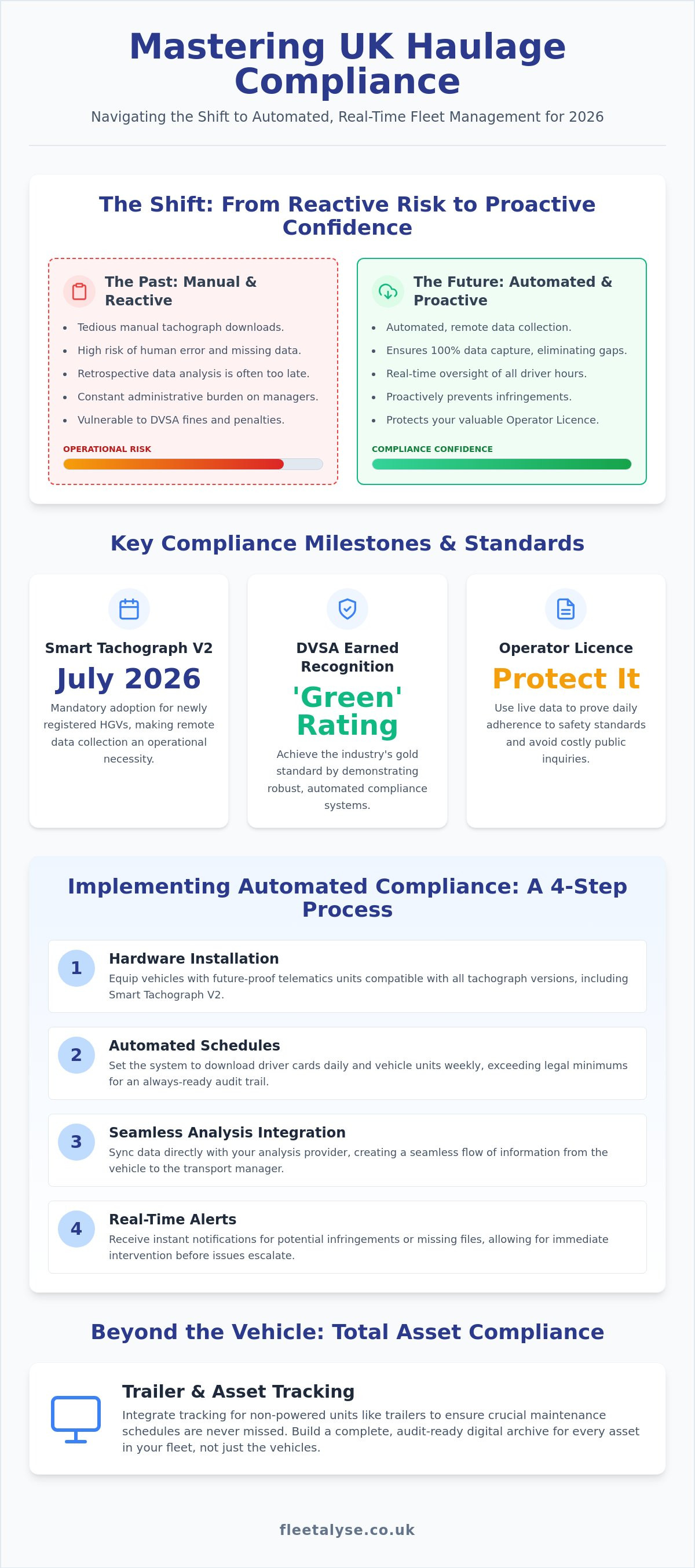
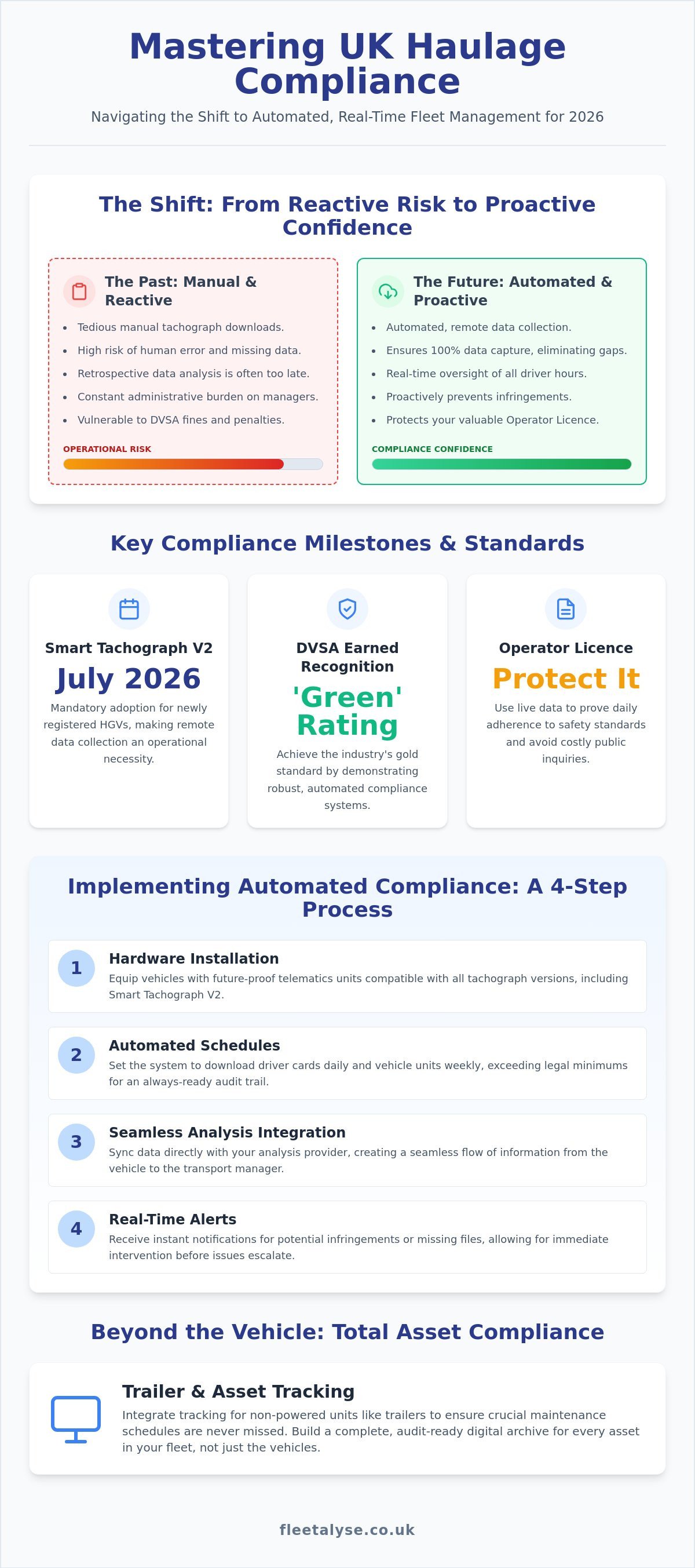
2026 represents a definitive turning point for the UK transport sector. Compliance is no longer a static goal achieved through monthly audits. It's an active, data-driven process that demands constant oversight. To effectively improve fleet compliance UK haulage operators must transition from retrospective record-keeping to real-time monitoring. This shift is driven by new mandates, such as the Smart Tachograph Version 2 requirement and the inclusion of Light Commercial Vehicles (LCVs) over 2.5 tonnes in international transport rules. Staying ahead means understanding that the DVSA now expects instant access to accurate data.
The DVSA Earned Recognition scheme has evolved from a voluntary pilot into the industry's gold standard for excellence. Operators who maintain a 'Green' rating demonstrate they have robust, automated systems in place. Relying on manual record-keeping is now a significant liability. Paper-based systems are slow, prone to human error, and offer no protection during a roadside inspection. The mandatory fitting of Event Data Recorders (EDRs) in new heavy vehicles from January 2026 further emphasises this move toward total transparency. If you aren't using digital tools to track your performance, you're already falling behind.
DVSA Standards and the Operator Licence
The Traffic Commissioner holds the ultimate authority over your business's right to operate. Their focus has moved from reactive punishment to proactive intervention. If your systems can't prove daily adherence to safety standards, your Operator Licence (O-licence) is vulnerable. Compliance failures don't just result in fines. They lead to public inquiries and potential fleet size reductions. Maintaining a clean record requires a system that identifies infringements before they become systemic issues. Proactive management is the only way to protect your commercial future.
The Digital Shift in UK Transport
Modern fleet management relies on a single source of truth. Moving away from paper-heavy workflows to cloud-based storage is essential for survival. Digital systems ensure that data is secure, accessible, and ready for immediate review by authorities. By centralising Tachograph regulations and vehicle maintenance records, you eliminate the risk of missing critical deadlines. This digital transition allows managers to focus on operational growth rather than chasing missing driver logs. For more information on how to digitise your operations, visit Fleetalyse to explore our integrated solutions. Using digital tools helps improve fleet compliance UK haulage firms need to remain competitive in a strictly regulated market.
Modernising Driver Hours and Tachograph Management
Manual tachograph downloads are a gamble your business shouldn't take. Missing a single driver card download or vehicle unit file can trigger a chain reaction of DVSA investigations and penalty points. To effectively improve fleet compliance UK haulage operators need a system that removes the human element from data collection. Remote Tachograph Download is the gold standard for 2026. It ensures 100% data capture regardless of where the vehicle is located. No more waiting for a truck to return to the depot; no more chasing drivers for their cards at the end of a shift.
According to official DVSA guidance, it's the operator's legal duty to collect and store this data accurately. Manual systems often suffer from 'missing data' gaps, especially when vehicles are away on long-haul routes or sub-contracted out for several weeks. Automation closes these gaps permanently by pulling data directly from the vehicle whilst it's on the road. This ensures your records are always complete and ready for inspection.
Implementing Remote Tachograph Downloads
- Step 1: Hardware Selection. Equip your HGVs and vans with telematics units that support remote reading. Compatibility with both older digital tachographs and the new Smart Tachograph Version 2 is essential for future-proofing your fleet.
- Step 2: Automated Schedules. Set your system to download driver cards every 24 hours and vehicle units every week. This far exceeds the legal minimums and ensures you're always audit-ready without manual intervention.
- Step 3: Analysis Integration. Sync your data directly with your preferred analysis provider. This creates a seamless flow from the vehicle to the transport manager’s desk, allowing for instant review of any drive-time issues.
- Step 4: Real-time Alerts. Configure notifications for upcoming deadlines or missing files. Catching a potential issue on day two is much better than discovering it during a month-end review.
Monitoring Live Driver Hours
Historical data only tells you what went wrong in the past. Live Driver Hours provide visibility of what's happening right now. This distinction is critical for effective fatigue management and road safety. When a dispatcher can see a driver's remaining drive time in real-time, they can plan routes that don't push legal limits. It removes the guesswork and the pressure that leads to accidental infringements. This level of transparency is exactly what the DVSA looks for amongst high-performing operators.
Automating this process significantly reduces the administrative colour of your daily operation. Your team stops being data collectors and starts being proactive compliance managers. You no longer need to manually download cards or worry about vehicle availability at the weekend. If you're ready to secure your data and protect your licence, you can get started with our Remote Tachograph Download solution today. This simple shift ensures your fleet remains compliant whilst your staff focus on more productive tasks.
Beyond the Vehicle: Trailer and Asset Compliance
Compliance doesn't stop at the tractor unit's bumper. For many operators, trailers and mobile plant represent a significant blind spot in their regulatory oversight. To truly improve fleet compliance UK haulage businesses must treat non-powered assets with the same level of scrutiny as their HGVs. A trailer with a defective tyre or an overdue service is just as likely to earn you a PG9 prohibition as a faulty truck. Effective management requires a move away from manual spreadsheets to automated tracking systems that provide a clear view of your entire inventory.
The Road Haulage Association (RHA) consistently emphasises that trailer roadworthiness is a core pillar of a safe transport operation. Without dedicated Trailer Tracking, managing maintenance schedules amongst a busy fleet is often based on guesswork. GPS fleet tracking provides the precise data needed to ensure no asset is overlooked. It allows you to monitor usage patterns and ensure that every piece of equipment is where it should be, doing what it was intended to do.
Trailer Maintenance and Roadworthiness
Trailers are frequently swapped between different units and depots, making it nearly impossible to track actual mileage through manual logs. Modern tracking technology solves this by recording every mile the trailer travels. You can use this data to trigger service intervals based on actual wear and tear rather than arbitrary dates. This proactive approach ensures your trailers meet the same rigorous safety standards as your HGVs. Documenting these inspections digitally creates a robust audit trail that is essential for satisfying DVSA requirements during a fleet review.
Asset Tracking and Security
Securing high-value mobile plant and equipment is a constant challenge for regional operators. Asset Tracking provides real-time visibility, allowing you to monitor the movement of generators, compressors, or specialist plant. By using geofencing, you can set virtual boundaries around your depots or customer sites. If an asset moves outside these zones during restricted hours, you receive an instant alert. This level of security reduces the risk of theft and ensures operational continuity. It also provides the transparency needed to improve fleet compliance UK haulage standards by ensuring all equipment is accounted for and maintained correctly.
Mixed-fleet operators must also consider the role of Van Tracking. As regulations tighten for lighter vehicles, having a unified system for both HGVs and vans is vital. It ensures that your safety culture extends across the whole business. You can explore our full range of tracking and compliance tools at Fleetalyse to see how we help you manage every asset in your fleet from a single, intuitive platform. Protecting your assets is just as important as monitoring your drivers.
Preparing for DVSA Audits with Live Data
DVSA audits in 2026 focus on your ability to manage data in real-time. Inspectors are no longer satisfied with dusty folders of paper records. They want to see how you use digital tools to improve fleet compliance UK haulage operations. When an officer visits your depot, they'll evaluate your systems for identifying and rectifying errors. Having a digital archive of remote downloads proves that you aren't just reacting to problems after they occur. It demonstrates a proactive culture where data drives every safety decision.
To remain audit-ready, you need specific documents at your fingertips. A standard compliance checklist for 2026 should include:
- Driver card data (downloaded at least every 28 days, though daily is preferred).
- Vehicle unit data (downloaded at least every 90 days).
- Preventative Maintenance Inspection (PMI) records for all HGVs and trailers.
- Daily driver defect reports and evidence of completed repairs.
- Training records for Driver CPC and workplace transport safety.
Common pitfalls often involve missing data gaps or untracked 'unknown driving' events. If your records show a vehicle moved without a card inserted, you must have a documented reason. Manual systems often fail here because the context is lost weeks before the audit happens. Live data capture ensures these events are flagged immediately, allowing you to assign the movement to a driver or technician whilst the event is still fresh.
Record-Keeping for the Modern Age
Storing your records centrally in a cloud-based system is now an operational necessity. Data integrity is paramount; the DVSA needs to know that records cannot be tampered with or deleted. UK law requires you to keep tachograph data for at least 12 months and maintenance records for 15 months. Digital systems automate this retention, ensuring you never accidentally dispose of a critical document. This single source of truth makes it easy to improve fleet compliance UK haulage standards across multiple depots.
Preventing Infringements Before They Occur
Live data serves as a feedback loop between your tachograph analysis and driver coaching. By monitoring driver behaviour data, you can identify training needs before they lead to a serious road incident or a heavy fine. If a driver consistently pushes their 4.5-hour driving limit, you can intervene with targeted education. Live data acts as an early warning system for compliance breaches by providing instant visibility of potential hours violations before they are finalised on a driver card.
Moving from manual checks to automated oversight is the most effective way to protect your business. It reduces the stress of an unannounced inspection and ensures your 'Green' rating remains secure. To simplify your next audit and secure your data, sign up for our tachograph analysis integration today. This investment provides the transparency you need to satisfy the most rigorous DVSA inspector.
Future-Proofing Your Haulage Business with Fleetalyse
Fleetalyse isn't just another software provider. We are a localised specialist that understands the specific challenges of regional infrastructure and UK regulations. To effectively improve fleet compliance UK haulage firms need a partner that values operational clarity over flashy, unnecessary features. Our service is built for the rigours of real-world application. We provide a straightforward, authoritative voice in a sector often clouded by hidden complexities. Transparency is at our core. We offer clear financial terms and upfront contractual details, ensuring you always know where you stand whilst managing your costs.
Our remote tachograph download solutions are designed to scale alongside your business. Whether you're managing a handful of local vans or a national HGV fleet, our platform adapts to your specific requirements. You gain access to a specialist UK-based support team that understands the nuances of domestic transport law. We don't offer generic advice; we provide practical solutions that keep your wheels turning. This reliability makes us the preferred ally for operators who value their time and resources.
The Fleetalyse Advantage
Efficiency comes from seamless integration between your tracking hardware and compliance software. Our systems work in unison to provide a single, reliable source of truth for all your fleet data. We offer tailored solutions for HGVs, vans, and trailers, ensuring every asset is accounted for amongst your records. This unified approach is the most effective way to improve fleet compliance UK haulage businesses require to achieve DVSA Earned Recognition status. By automating your data collection, you demonstrate the high level of management control that regulators demand from top-tier operators.
Next Steps for Your Fleet
Transitioning to an automated compliance system is simpler than you might think. We handle the technical heavy lifting, allowing your transport managers to focus on core logistics. The long-term ROI is clear: you'll see a massive reduction in administrative overhead and a virtual elimination of preventable fines. You move from a reactive state of hoping for the best to a proactive state of total visibility. It's about protecting your operator licence and your professional reputation.
Ready to secure your future? Contact Fleetalyse today to improve your fleet compliance and streamline your transport office. Our pragmatic approach ensures you get the functional utility you need without any unnecessary fluff. Let's work together to make your fleet the safest and most efficient on the road.
Secure Your Commercial Future with Real-Time Data
Maintaining a 'Green' rating on the DVSA Earned Recognition scheme requires more than just good intentions. It demands a robust, automated infrastructure that eliminates the risks associated with manual data collection. By integrating remote tachograph downloads and real-time asset tracking, you transform compliance from a reactive burden into a strategic advantage. This shift ensures your business remains resilient against the regulatory changes of 2026 and beyond.
To effectively improve fleet compliance UK haulage operators must adopt technology that scales with their business whilst providing total transparency. Fleetalyse offers exactly that. Our platform provides seamless integration with major tacho analysis tools, ensuring your data is always accurate and accessible. You benefit from specialized UK-based technical support and a straightforward service model with no hidden costs or complex contracts. We prioritize functional utility over flashy features, giving you the tools you actually need to run a safe operation.
Don't leave your operator licence to chance. Take control of your data today and protect your business from the evolving pressures of the transport industry. Request a demo of our remote tachograph and compliance solutions to see how we can streamline your transport office. We look forward to helping you build a safer, more efficient fleet.
Frequently Asked Questions
How often should I download my driver cards and vehicle units in 2026?
You must download driver cards at least every 28 days and vehicle units every 90 days to meet the legal minimum requirements. However, to effectively improve fleet compliance UK haulage operators should aim for daily card downloads and weekly unit downloads via remote systems. This proactive approach ensures you identify infringements immediately rather than discovering them weeks later. High-frequency data collection is essential for maintaining an audit-ready status at all times.
What are the specific penalties for HGV overloading in the UK?
Fixed penalty notices for overloading range from £100 to £300 depending on the severity of the offence. If a vehicle is overloaded by more than 30% or exceeds the limit by 5 tonnes, you'll likely face a court summons and potential prosecution. These offences carry significant weight during DVSA audits and can lead to a public inquiry with the Traffic Commissioner. Monitoring axle weights is a critical part of your daily safety checks and operational oversight.
Can remote tachograph downloads completely replace manual checks?
Remote downloads automate the data collection process but they don't replace the need for analysis and management action. You still need to review the data to identify infringements and provide driver coaching where necessary. The technology removes the administrative burden of chasing drivers for physical cards. It allows your transport office to focus on resolving safety issues rather than simply collecting and filing raw data.
What is the DVSA Earned Recognition scheme and is it mandatory?
The DVSA Earned Recognition scheme is a voluntary programme that allows operators to prove they meet high safety and compliance standards. By sharing performance data with the DVSA, you reduce the likelihood of your vehicles being stopped for roadside inspections. It isn't mandatory, but it serves as a powerful mark of quality for your business. Achieving this status helps you win new contracts by proving your commitment to road safety and regulatory excellence.
How does GPS fleet tracking help with insurance premiums for hauliers?
GPS fleet tracking provides insurers with concrete evidence of your fleet's risk profile. Features like theft recovery and geofencing reduce the likelihood of permanent asset loss, which often leads to lower premiums. Additionally, data on driver behaviour allows you to prove that your fleet is operated safely and professionally. Many insurers offer discounts to hauliers who use telematics to actively manage their operational risks and prevent accidents.
What are the requirements for van tracking in a commercial fleet?
From July 2026, vans over 2.5 tonnes used for international transport must be fitted with Smart Tachograph Version 2 hardware. Whilst tracking isn't a standalone legal requirement for all vans, it's the only practical way to manage driver hours and maintenance for a mixed fleet. Using Van Tracking ensures your lighter vehicles adhere to the same safety culture as your HGVs. It prevents your van operations from becoming a compliance blind spot that could threaten your licence.
How long should I keep my tachograph records for a DVSA audit?
You must keep tachograph records for at least 12 months from the date they were recorded. Maintenance and PMI records have a longer retention requirement of 15 months. Digital systems make this process effortless by archiving files securely in the cloud. Storing these records centrally ensures you can produce them instantly during an unannounced DVSA inspection or a formal fleet audit without searching through paper archives.
What is the role of a Transport Manager in ensuring fleet compliance?
The Transport Manager is legally responsible for the continuous and effective management of the transport operation. This includes overseeing driver hours, vehicle maintenance, and load security to improve fleet compliance UK haulage standards. They must ensure the business remains compliant with the specific terms of its Operator Licence at all times. Using automated tools allows a Transport Manager to maintain total oversight without being buried in manual paperwork.
Frequently asked questions
DVSA Standards and the Operator Licence
The Traffic Commissioner holds the ultimate authority over your business's right to operate. Their focus has moved from reactive punishment to proactive intervention. If your systems can't prove daily adherence to safety standards, your Operator Licence (O-licence) is vulnerable. Compliance failures don't just result in fines. They lead to public inquiries and potential fleet size reductions. Maintaining a clean record requires a system that identifies infringements before they become systemic issues. Proactive management is the only way to protect your commercial future.
The Digital Shift in UK Transport
Modern fleet management relies on a single source of truth. Moving away from paper-heavy workflows to cloud-based storage is essential for survival. Digital systems ensure that data is secure, accessible, and ready for immediate review by authorities. By centralising Tachograph regulations and vehicle maintenance records, you eliminate the risk of missing critical deadlines. This digital transition allows managers to focus on operational growth rather than chasing missing driver logs. For more information on how to digitise your operations, visit Fleetalyse to explore our integrated solutions. Using digital tools helps improve fleet compliance UK haulage firms need to remain competitive in a strictly regulated market. Manual tachograph downloads are a gamble your business shouldn't take. Missing a single driver card download or vehicle unit file can trigger a chain reaction of DVSA investigations and penalty points. To effectively improve fleet compliance UK haulage operators need a system that removes the human element from data collection. Remote Tachograph Download is the gold standard for 2026. It ensures 100% data capture regardless of where the vehicle is located. No more waiting for a truck to return to the depot; no more chasing drivers for their cards at the end of a shift. According to official DVSA guidance, it's the operator's legal duty to collect and store this data accurately. Manual systems often suffer from 'missing data' gaps, especially when vehicles are away on long-haul routes or sub-contracted out for several weeks. Automation closes these gaps permanently by pulling data directly from the vehicle whilst it's on the road. This ensures your records are always complete and ready for inspection.
Implementing Remote Tachograph Downloads
Step 1: Hardware Selection. Equip your HGVs and vans with telematics units that support remote reading. Compatibility with both older digital tachographs and the new Smart Tachograph Version 2 is essential for future-proofing your fleet.
Step 2: Automated Schedules. Set your system to download driver cards every 24 hours and vehicle units every week. This far exceeds the legal minimums and ensures you're always audit-ready without manual intervention.
Step 3: Analysis Integration. Sync your data directly with your preferred analysis provider. This creates a seamless flow from the vehicle to the transport manager’s desk, allowing for instant review of any drive-time issues.
Step 4: Real-time Alerts. Configure notifications for upcoming deadlines or missing files. Catching a potential issue on day two is much better than discovering it during a month-end review.
Monitoring Live Driver Hours
Historical data only tells you what went wrong in the past. Live Driver Hours provide visibility of what's happening right now. This distinction is critical for effective fatigue management and road safety. When a dispatcher can see a driver's remaining drive time in real-time, they can plan routes that don't push legal limits. It removes the guesswork and the pressure that leads to accidental infringements. This level of transparency is exactly what the DVSA looks for amongst high-performing operators. Automating this process significantly reduces the administrative colour of your daily operation. Your team stops being data collectors and starts being proactive compliance managers. You no longer need to manually download cards or worry about vehicle availability at the weekend. If you're ready to secure your data and protect your licence, you can get started with our Remote Tachograph Download solution today. This simple shift ensures your fleet remains compliant whilst your staff focus on more productive tasks. Compliance doesn't stop at the tractor unit's bumper. For many operators, trailers and mobile plant represent a significant blind spot in their regulatory oversight. To truly improve fleet compliance UK haulage businesses must treat non-powered assets with the same level of scrutiny as their HGVs. A trailer with a defective tyre or an overdue service is just as likely to earn you a PG9 prohibition as a faulty truck. Effective management requires a move away from manual spreadsheets to automated tracking systems that provide a clear view of your entire inventory. The Road Haulage Association (RHA) consistently emphasises that trailer roadworthiness is a core pillar of a safe transport operation. Without dedicated Trailer Tracking, managing maintenance schedules amongst a busy fleet is often based on guesswork. GPS fleet tracking provides the precise data needed to ensure no asset is overlooked. It allows you to monitor usage patterns and ensure that every piece of equipment is where it should be, doing what it was intended to do.
Trailer Maintenance and Roadworthiness
Trailers are frequently swapped between different units and depots, making it nearly impossible to track actual mileage through manual logs. Modern tracking technology solves this by recording every mile the trailer travels. You can use this data to trigger service intervals based on actual wear and tear rather than arbitrary dates. This proactive approach ensures your trailers meet the same rigorous safety standards as your HGVs. Documenting these inspections digitally creates a robust audit trail that is essential for satisfying DVSA requirements during a fleet review.
Asset Tracking and Security
Securing high-value mobile plant and equipment is a constant challenge for regional operators. Asset Tracking provides real-time visibility, allowing you to monitor the movement of generators, compressors, or specialist plant. By using geofencing, you can set virtual boundaries around your depots or customer sites. If an asset moves outside these zones during restricted hours, you receive an instant alert. This level of security reduces the risk of theft and ensures operational continuity. It also provides the transparency needed to improve fleet compliance UK haulage standards by ensuring all equipment is accounted for and maintained correctly. Mixed-fleet operators must also consider the role of Van Tracking. As regulations tighten for lighter vehicles, having a unified system for both HGVs and vans is vital. It ensures that your safety culture extends across the whole business. You can explore our full range of tracking and compliance tools at Fleetalyse to see how we help you manage every asset in your fleet from a single, intuitive platform. Protecting your assets is just as important as monitoring your drivers. DVSA audits in 2026 focus on your ability to manage data in real-time. Inspectors are no longer satisfied with dusty folders of paper records. They want to see how you use digital tools to improve fleet compliance UK haulage operations. When an officer visits your depot, they'll evaluate your systems for identifying and rectifying errors. Having a digital archive of remote downloads proves that you aren't just reacting to problems after they occur. It demonstrates a proactive culture where data drives every safety decision. To remain audit-ready, you need specific documents at your fingertips. A standard compliance checklist for 2026 should include: Common pitfalls often involve missing data gaps or untracked 'unknown driving' events. If your records show a vehicle moved without a card inserted, you must have a documented reason. Manual systems often fail here because the context is lost weeks before the audit happens. Live data capture ensures these events are flagged immediately, allowing you to assign the movement to a driver or technician whilst the event is still fresh.
Record-Keeping for the Modern Age
Storing your records centrally in a cloud-based system is now an operational necessity. Data integrity is paramount; the DVSA needs to know that records cannot be tampered with or deleted. UK law requires you to keep tachograph data for at least 12 months and maintenance records for 15 months. Digital systems automate this retention, ensuring you never accidentally dispose of a critical document. This single source of truth makes it easy to improve fleet compliance UK haulage standards across multiple depots.
Preventing Infringements Before They Occur
Live data serves as a feedback loop between your tachograph analysis and driver coaching. By monitoring driver behaviour data, you can identify training needs before they lead to a serious road incident or a heavy fine. If a driver consistently pushes their 4.5-hour driving limit, you can intervene with targeted education. Live data acts as an early warning system for compliance breaches by providing instant visibility of potential hours violations before they are finalised on a driver card. Moving from manual checks to automated oversight is the most effective way to protect your business. It reduces the stress of an unannounced inspection and ensures your 'Green' rating remains secure. To simplify your next audit and secure your data, sign up for our tachograph analysis integration today. This investment provides the transparency you need to satisfy the most rigorous DVSA inspector. Fleetalyse isn't just another software provider. We are a localised specialist that understands the specific challenges of regional infrastructure and UK regulations. To effectively improve fleet compliance UK haulage firms need a partner that values operational clarity over flashy, unnecessary features. Our service is built for the rigours of real-world application. We provide a straightforward, authoritative voice in a sector often clouded by hidden complexities. Transparency is at our core. We offer clear financial terms and upfront contractual details, ensuring you always know where you stand whilst managing your costs. Our remote tachograph download solutions are designed to scale alongside your business. Whether you're managing a handful of local vans or a national HGV fleet, our platform adapts to your specific requirements. You gain access to a specialist UK-based support team that understands the nuances of domestic transport law. We don't offer generic advice; we provide practical solutions that keep your wheels turning. This reliability makes us the preferred ally for operators who value their time and resources.
The Fleetalyse Advantage
Efficiency comes from seamless integration between your tracking hardware and compliance software. Our systems work in unison to provide a single, reliable source of truth for all your fleet data. We offer tailored solutions for HGVs, vans, and trailers, ensuring every asset is accounted for amongst your records. This unified approach is the most effective way to improve fleet compliance UK haulage businesses require to achieve DVSA Earned Recognition status. By automating your data collection, you demonstrate the high level of management control that regulators demand from top-tier operators.
Next Steps for Your Fleet
Transitioning to an automated compliance system is simpler than you might think. We handle the technical heavy lifting, allowing your transport managers to focus on core logistics. The long-term ROI is clear: you'll see a massive reduction in administrative overhead and a virtual elimination of preventable fines. You move from a reactive state of hoping for the best to a proactive state of total visibility. It's about protecting your operator licence and your professional reputation. Ready to secure your future? Contact Fleetalyse today to improve your fleet compliance and streamline your transport office. Our pragmatic approach ensures you get the functional utility you need without any unnecessary fluff. Let's work together to make your fleet the safest and most efficient on the road. Maintaining a 'Green' rating on the DVSA Earned Recognition scheme requires more than just good intentions. It demands a robust, automated infrastructure that eliminates the risks associated with manual data collection. By integrating remote tachograph downloads and real-time asset tracking, you transform compliance from a reactive burden into a strategic advantage. This shift ensures your business remains resilient against the regulatory changes of 2026 and beyond. To effectively improve fleet compliance UK haulage operators must adopt technology that scales with their business whilst providing total transparency. Fleetalyse offers exactly that. Our platform provides seamless integration with major tacho analysis tools, ensuring your data is always accurate and accessible. You benefit from specialized UK-based technical support and a straightforward service model with no hidden costs or complex contracts. We prioritize functional utility over flashy features, giving you the tools you actually need to run a safe operation. Don't leave your operator licence to chance. Take control of your data today and protect your business from the evolving pressures of the transport industry. Request a demo of our remote tachograph and compliance solutions to see how we can streamline your transport office. We look forward to helping you build a safer, more efficient fleet.
How often should I download my driver cards and vehicle units in 2026?
You must download driver cards at least every 28 days and vehicle units every 90 days to meet the legal minimum requirements. However, to effectively improve fleet compliance UK haulage operators should aim for daily card downloads and weekly unit downloads via remote systems. This proactive approach ensures you identify infringements immediately rather than discovering them weeks later. High-frequency data collection is essential for maintaining an audit-ready status at all times.
What are the specific penalties for HGV overloading in the UK?
Fixed penalty notices for overloading range from £100 to £300 depending on the severity of the offence. If a vehicle is overloaded by more than 30% or exceeds the limit by 5 tonnes, you'll likely face a court summons and potential prosecution. These offences carry significant weight during DVSA audits and can lead to a public inquiry with the Traffic Commissioner. Monitoring axle weights is a critical part of your daily safety checks and operational oversight.
Can remote tachograph downloads completely replace manual checks?
Remote downloads automate the data collection process but they don't replace the need for analysis and management action. You still need to review the data to identify infringements and provide driver coaching where necessary. The technology removes the administrative burden of chasing drivers for physical cards. It allows your transport office to focus on resolving safety issues rather than simply collecting and filing raw data.
What is the DVSA Earned Recognition scheme and is it mandatory?
The DVSA Earned Recognition scheme is a voluntary programme that allows operators to prove they meet high safety and compliance standards. By sharing performance data with the DVSA, you reduce the likelihood of your vehicles being stopped for roadside inspections. It isn't mandatory, but it serves as a powerful mark of quality for your business. Achieving this status helps you win new contracts by proving your commitment to road safety and regulatory excellence.
How does GPS fleet tracking help with insurance premiums for hauliers?
GPS fleet tracking provides insurers with concrete evidence of your fleet's risk profile. Features like theft recovery and geofencing reduce the likelihood of permanent asset loss, which often leads to lower premiums. Additionally, data on driver behaviour allows you to prove that your fleet is operated safely and professionally. Many insurers offer discounts to hauliers who use telematics to actively manage their operational risks and prevent accidents.
What are the requirements for van tracking in a commercial fleet?
From July 2026, vans over 2.5 tonnes used for international transport must be fitted with Smart Tachograph Version 2 hardware. Whilst tracking isn't a standalone legal requirement for all vans, it's the only practical way to manage driver hours and maintenance for a mixed fleet. Using Van Tracking ensures your lighter vehicles adhere to the same safety culture as your HGVs. It prevents your van operations from becoming a compliance blind spot that could threaten your licence.
How long should I keep my tachograph records for a DVSA audit?
You must keep tachograph records for at least 12 months from the date they were recorded. Maintenance and PMI records have a longer retention requirement of 15 months. Digital systems make this process effortless by archiving files securely in the cloud. Storing these records centrally ensures you can produce them instantly during an unannounced DVSA inspection or a formal fleet audit without searching through paper archives.
What is the role of a Transport Manager in ensuring fleet compliance?
The Transport Manager is legally responsible for the continuous and effective management of the transport operation. This includes overseeing driver hours, vehicle maintenance, and load security to improve fleet compliance UK haulage standards. They must ensure the business remains compliant with the specific terms of its Operator Licence at all times. Using automated tools allows a Transport Manager to maintain total oversight without being buried in manual paperwork.